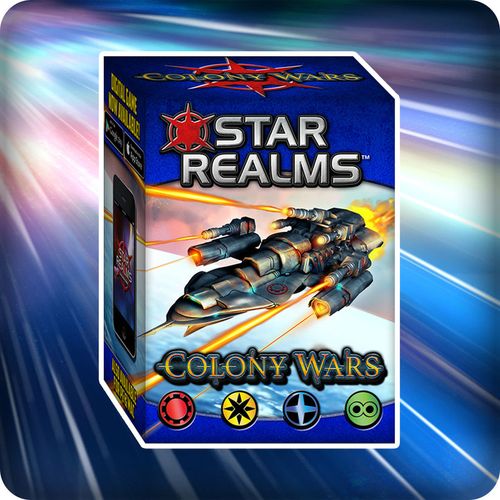
Star Realms: Colony Wars
Star Realms: Colony Wars Rulebook
Table of Contents
Table of Contents
Contents
- (80) Trade Deck cards
- (16) Scout cards
- (10) Explorer cards
- (4) Viper cards
- (12) 1/5 Authority cards
- (6) 10/20 Authority cards
- This Rules Sheet
Overview
In Star Realms, each player starts with a personal deck of cards representing their space armada. Each turn, players play cards from their hand to gain Trade, Combat, Authority, and other effects.
Trade is used to buy powerful Ships and Bases from the Trade Row to add to your deck. Combat is used to attack opponents and their Bases directly.
Authority is your score. Each player begins the game with 50 Authority. The first player to reduce their opponent's Authority to zero wins!
Setup
Each player starts with a personal deck (containing eight Scout cards and two Viper cards) and 50 Authority. Players may track their Authority using the included Authority cards or with a pencil and paper.
To set up the game, place the ten Explorer cards face up on the table. Shuffle the Trade Deck and place it face down on the table. Leave a space next to this for the Scrap Heap (cards that will be removed from the game during play). Lay out the top five cards from the Trade Deck face up on the table. This is the Trade Row.
Both players shuffle their personal decks and place them face-down in front of them. Leave room next to each personal deck for a Discard Pile.
Randomly determine which player will play first. That player draws three cards (players always draw from their own personal deck), the other player draws five cards.
Play
Players alternate taking turns. Each turn has three phases:
- Main Phase
- Discard Phase
- Draw Phase
Main Phase
At any time during your Main Phase, you may perform any of the following actions, in any order you wish:
- Play cards from your hand.
- Use the Primary Abilities of in-play Bases.
- Use the Ally/Scrap abilities of in-play Ships and Bases.
- Use Trade to acquire new cards from the Trade Row.
- Use Combat to attack an opponent and/or their Bases.
Playing Cards
There is no cost to play a card, simply place it "in play" (face-up on the table in front of you) and do what it says. There are two types of cards you can have in your deck: Ships and Bases.
Ships
When a Ship is played, its Primary Ability triggers immediately. If a Ship has an Ally and/or Scrap Ability, you may choose to use one or both of these abilities at any time during your Main Phase (provided you fulfill the obligations for doing so).
Ships you put into play remain face-up in front of you until your Discard Phase, at which point they are placed in your Discard Pile.
Bases
Unlike Ships, Bases are not discarded at the end of the turn. Instead, they remain in play until they are destroyed or scrapped. Also unlike Ships, you may choose when during the Main Phase to activate a Base's Primary Ability.
Each Base has a Defense number that represents the amount of Combat that it must be hit with in a single turn to destroy it. Once destroyed, a Base is placed in its owner's Discard Pile.
Bases with the Outpost designation protect you and your other Bases. If you have an Outpost in play, you may not be attacked and your non-outpost Bases may not be attacked or targeted by an opponent until all of your Outposts are destroyed.
Using Abilities
With the exception of a Ship's Primary Ability (which triggers immediately as the Ship is played), players may use the various abilities of their in-play Ships and Bases at any time during their Main Phase. Each ability may be used only once each turn.
Some abilities are static abilities, which are in effect at all times (for example, Mech World is always an ally for all factions).
If an ability grants Combat or Trade, that resource goes into a resource pool, which can be used at any point during the Main Phase. If an ability grants additional Authority, immediately add it to your Authority score.
Some abilities allow you to choose from multiple effects (3 Combat or 5 Authority). Make it clear which effect you are choosing when you use these abilities.
Ally Abilities
Ally Abilities are indicated by a faction icon in the text box. On your turn, an Ally Ability may be used as soon as you have another Ship or Base of that faction in-play. Ally Abilities may be used at any time during your Main Phase.
Scrap Abilities
Some Ships and Bases have a Scrap Ability, indicated by a trash can icon in the text box. Any time during the Main Phase you may use a card's Scrap Ability by immediately removing it from play and placing it in the Scrap Heap. Cards in the Scrap Heap do not return to your deck, so consider carefully if the card's Scrap Ability is worth junking it!
Scrapping Cards
Some card abilities allow you to scrap other cards from your hand, your Discard Pile, or the Trade Row. Whenever a card is scrapped, place it in the Scrap Heap. If a card is scrapped for any reason other than its own Scrap Ability, that Scrap Ability does not trigger. If an Explorer would be placed in the Scrap Heap for any reason, instead place it face-up in the Explorer Pile.
The Trade Row should always have five cards in it, so if you scrap a card from the Trade Row, immediately replace it with the next card from the Trade Deck.
Acquiring Cards
Some card abilities will give you Trade. When you gain Trade, it goes into a Trade Pool which you may add to and use over the course of your Main Phase.
Trade is used to acquire cards from the Trade Row or the Explorer Pile. A card's cost is found in the Trade symbol in its upper right hand corner. To acquire a card, subtract Trade from your Trade Pool equal to the card's cost and put the card into your Discard Pile. Acquiring a card doesn't count as playing it, so it doesn't go into play and you don't use its abilities. Any remaining Trade is saved and can be used to acquire additional cards during the Main Phase.
Sometimes a card's ability will instruct you to "Acquire a card." In this case you immediately acquire the card without paying its cost.
Remember, the Trade Row should always have five cards in it, so if you acquire a card from the Trade Row, immediately replace it with the next card from the Trade Deck.
Attacking
Some card abilities will give you Combat. When you gain Combat, it goes into a Combat Pool which you may add to and use over the course of your Main Phase. You may use Combat to attack your opponent or their Bases.
To attack a Base, subtract Combat from your Combat Pool equal to the Base's Defense. That Base is destroyed and goes to your opponent's Discard Pile.
Sometimes a card's ability will instruct you to "Destroy target Base." In this case you destroy the Base without using Combat.
To attack your opponent, subtract any amount of Combat from your Combat Pool and lower your opponent's Authority by that amount.
If your opponent controls any Bases with the Outpost designation, these must be destroyed before you can attack/target your opponent's non-outpost Bases or attack your opponent directly.
Discard Phase
Whenever you discard a card or acquire a new card, place it face-up in your Discard Pile. Any player may look through your Discard Pile at any time.
During your Discard Phase you:
- Lose any Trade remaining in your Trade Pool.
- Lose any Combat remaining in your Combat Pool.
- Put all in-play Ships into your Discard Pile.
- Put any cards left in your hand into your Discard Pile.
Draw Phase
During your Draw Phase you:
- Draw five cards, then your turn ends.
Note: if you need to draw a card and your personal deck is empty, shuffle your Discard Pile and place it face-down as your new personal deck.
Example: At the beginning of your Draw Phase you have three cards left in your deck. Draw those three cards, shuffle your Discard Pile into a new personal deck, then draw two more cards.
Icon Reference List
Faction Icons: Blob faction icon, Trade Federation faction icon, Star Empire faction icon, Machine Cult faction icon. When one of these icons is found in the upper-left hand corner of a card, this indicates the card's faction. When this icon is found in a card's text box, this indicates an Ally Ability.
Authority: Players start the game with a score of 50 Authority. If your Authority is reduced to zero or below, you lose the game. When this icon is found in a card's text box, this indicates an amount of Authority you gain.
Combat: When this icon is found in a card's text box, this indicates an amount of Combat you gain.
Trade: When this icon is found in the upper-right hand corner of a card, this indicates the card's cost. When this icon is found in a card's text box, this indicates an amount of Trade you gain.
Scrap: When this icon is found in a card's text box, this indicates a Scrap Ability.
Outpost: This Base is an Outpost. If a player has an Outpost in play, they may not be attacked and their non-outpost Bases may not be attacked or targeted by an opponent until all of their Outposts are destroyed.
Defense: A Base's Defense is the amount of Combat that it must be hit with in a single turn to destroy it.
Multiplayer Rules
Star Realms is designed to support a wide variety of multiplayer formats — combine Colony Wars with the original Star Realms Deckbuilding Game (or other Star Realms sets) for three or four players. Unless otherwise specified, all the standard two-player rules apply to multiplayer.
Note: In most multiplayer formats, Outposts belonging to one opponent do not prevent you from attacking other players or attacking/targeting the Bases other players control.
Free-For-All (3+ players)
Randomly determine which player is going first. That player gets a three-card starting hand. The player going second gets a four-card starting hand. All other players get a five-card starting hand.
On their turn, players may attack/target any combination of Bases and players. The last player alive wins the game!
Hunter (3+ players)
Randomly determine which player is going first. That player gets a three-card starting hand. The player going second gets a four-card starting hand. All other players get a five-card starting hand.
On their turn, players may only attack/target the player to their left and/or the Bases belonging to players on their left and right. If the player to your left is defeated, the next player to their left can then be attacked/targeted. The last player alive wins the game!
Hydra (4 or 6 players)
All players on a team share an Authority score. Each individual player has their own personal deck, hand, Discard Pile and in-play zone (for example, your teammate's in-play cards won't trigger your Ally Abilities).
Randomly determine which team will go first. Players on that team get three-card starting hands; players on the opposing team get five-card starting hands. Each team takes turns (rather than each player), teammates going through their Main, Discard and Draw Phases at the same time.
Each player still has their own Trade and Combat Pool and still makes their own decisions regarding playing cards, acquiring cards, ability activations and attacking. Teammates may work together to destroy Bases, using a combination of Combat from their respective Combat Pools. Teammates may also pool their respective Trade to acquire cards from the Trade Row. As long as any player on a given team has an Outpost in play, that team may not be attacked and any non-outpost Bases belonging to that team may not be attacked or targeted by opponents.
When a team's Authority is reduced to zero, all players on that team are defeated.
Two-Headed Hydra (4 players): Each two-player team has a shared score of 75 Authority.
Three-Headed Hydra (6 players): Each three-player team has a shared score of 100 Authority.
Emperor (6 players)
Players split into two teams of three, with each team choosing one teammate to be their Emperor. The Emperors sit facing each other, flanked by their teammates (Admirals) on either side.
Admirals start the game with 50 Authority. Emperors start with 60 Authority. The team going first (Team A) gets a three-card starting hand. The team going second (Team B) gets a five-card starting hand. Play begins with Player 1 and proceeds clockwise.
Admirals may only attack/target the enemy Admiral across from them and/or Bases controlled by that Admiral. If that Admiral is defeated, they may then begin to attack/target the enemy Emperor and his Bases. Emperors may attack/target any player or Base. During their Main Phase, any player may pay one Trade to move a card from their Discard Pile to the Discard Pile of a neighboring teammate.
When an Admiral is defeated, they may put any one card they own into their Emperor's Discard Pile. When an Emperor is defeated, their team loses the game!
Raid (3-6 players: 1 boss and 2-5 raiders)
Choose one player to act as the Boss, with all other players acting as the Raiders. Play starts with the Boss and proceeds clockwise around the table. The Boss begins the game with two fewer cards than their normal hand size (found below), while Raiders begin the game with a standard five-card hand. Raiders take their turns individually, but any damage dealt to the Boss's Bases doesn't heal until the start of the Boss's turn (so that one Raider can start an attack on a Base while another Raider finishes the job on their own turn).
Raiders: Raiders may look at each other's hands and discuss strategy. Though Raiders are playing as a team, each player still has their own Trade Pool and Combat Pool, and still makes their own decisions regarding playing cards, acquiring cards, ability activations and attacking. When a Raider is eliminated, they may place one card they own in the Discard Pile of each teammate. If all of the Raiders are eliminated, the Boss wins!
The Boss: The Boss's starting Authority score and hand size is dependent on the number of Raiders.
| # of Raiders | Boss Starting Authority | Boss Hand Size |
|---|---|---|
| 2 | 50 | 7 |
| 3 | 70 | 7 |
| 4 | 70 | 8 |
| 5 | 90 | 8 |
If the Boss has their Authority reduced to zero, the Raiders win!