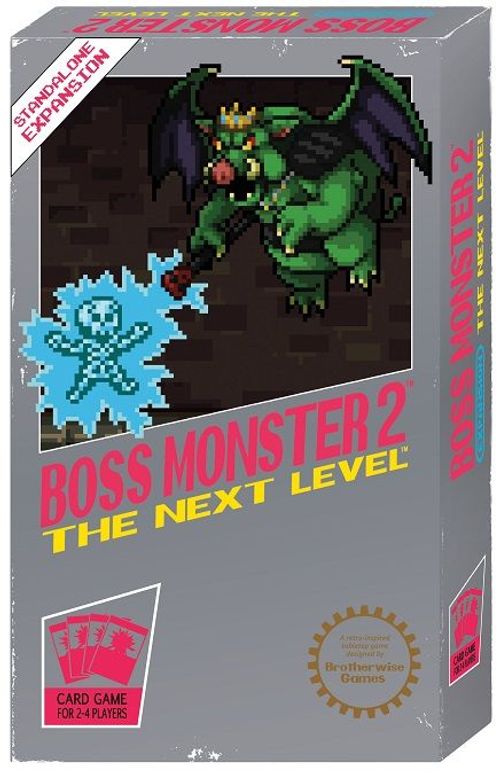
Boss Monster 2: The Next Level
Boss Monster 2: The Next Level Rulebook
Table of Contents
Table of Contents
How to Play
Boss Monster is the fast-paced card game of strategic dungeon building! As a Boss Monster, your goal is to lure hapless adventurers into your dungeon and consume their Souls. But beware! Your dungeon must be as deadly as it is enticing, or the puny Heroes can actually survive long enough to wound you. More importantly, you have competition. Adventurers are a hot commodity, and other Boss Monsters are all trying to outdo you with more precious treasures and more nefarious traps. Are you a bad enough dude to become the ultimate Boss Monster?
Box Contents
- Boss Deck with 12 cards
- Room Deck with 75 cards
- Spell Deck with 31 cards
- Hero and Epic Hero Deck with 42 cards
- Rulebook
- Quick Start Guide
Object of the Game
The goal of Boss Monster is to lure Heroes into your dungeon and kill them. Heroes who die in your dungeon are turned face down and count as "Souls." Heroes who survive give you "Wounds."
- A player wins if she ends a turn with 10 Souls.
- A player loses if he ends a turn with 5 Wounds.
A turn is not complete until all players have had a chance to act. In the case of a tie, refer to the tiebreaker rules (see p. 16).
Getting Ready
To play Boss Monster: The Next Level, you just need 2-4 players, the cards included with this game, and enough space to spread out your cards. If you're also playing with the original Boss Monster set, shuffle the Room and Spell decks of both games together, but decide on just one Hero and Epic Hero deck to use.
The first time you play, allow yourself at least 45 minutes. Once players are familiar with the cards, a two-player game will typically take 20-30 minutes.
Gameplay at a Glance
The heart of Boss Monster is dungeon building! Your Boss card sits at the right end of a side-scrolling dungeon, and each turn you can strengthen and refine it with Rooms. A Room's treasure value determines what type of Heroes it attracts, while its damage determines its ability to destroy Heroes (by depleting their Health).
- Your dungeon builds out from your Boss card.
- Each turn you can expand your dungeon by building a MONSTER ROOM or TRAP ROOM. Each Room has a treasure value that lures Heroes...and a damage value that kills Heroes. An ADVANCED ROOM can upgrade an existing Room.
- HEROES enter your dungeon each turn. Defeated Heroes are turned face-down and are worth Souls, and... Heroes who survive deal Wounds. You must gain 10 Souls before you take 5 Wounds!
Your scorekeeping area sits off to the side of your dungeon, where face-down Heroes add to your Souls (gold crystals), and face-up Heroes add to your Wounds (blood drops). You may only have a maximum of five visible Rooms in your dungeon. The first time you hit five Rooms, apply your Boss card's "Level Up" effect!
Card Types: Bosses
Your Boss card represents the ultimate villain waiting at the end of your dungeon…you! While it has a treasure value, it does not count as a Room. It cannot deal damage, be deactivated, or be destroyed (more on these terms later).
- A. Boss Icon: This icon indicates that this is a Boss card.
- B. Boss Ability: Each Boss card has a powerful "Level Up" ability, which triggers at the end of the Build Phase when your dungeon first reaches five visible Rooms.
- C. XP: During each phase, players act "in XP order." The highest-XP player goes first, followed by the second highest, and so on.
- D. Treasure: A Boss card's treasure icon adds to its dungeon's total.
Your "Level Up" ability triggers only once per game, the first time your dungeon hits its maximum length of five Rooms (not counting your Boss). Use a coin or token to indicate that this ability has been used.
Card Types: Rooms
Your dungeon's Rooms attract and damage Heroes. Each turn, you can build a new Room in your dungeon, up to a maximum of five visible Rooms. Ordinary Rooms can be built at the end of your dungeon, or over any other Room. Advanced Rooms are "upgrades" that can only be built on existing Rooms with at least one matching treasure icon.
- A. Room Icon: A silver icon is an ordinary Room, while Advanced Rooms have gold icons. This icon also shows a Room's subtype: whether it's a Monster Room or a Trap Room (skull icon = Monster, mask icon = Trap).
- B. Ability: The rules text of the card is active as long as it is visible and in play.
- C. Damage: Each time a Hero enters a Room, it takes the listed damage. When the damage meets or exceeds its Health, that Hero dies.
- D. Treasure: The treasure icons indicate what type of Heroes this Room attracts.
Card Types: Heroes
Heroes are the key resource of Boss Monster. Heroes appear "in town" every turn, waiting for adventures. Ordinary Heroes are silver; Epic Heroes are gold. Epic Heroes don't show up in town until all the ordinary Heroes have shown up in town.
- A. Treasure Icon: The type of treasure that lures this Hero (note that Hybrid Heroes have two treasure types).
- B. Health: The amount of damage this Hero can resist before dying. Note that Epic Heroes have more health than ordinary Heroes.
- C. Wound: If an ordinary Hero survives your dungeon, it remains face-up and counts as one Wound. Epic Heroes count as two Wounds.
- D. Player Icon: This indicates whether the card should be used in a two-, three-, or four-player game (note that Boss Monster 2 Heroes with the star icon are always included).
- Soul: When a Hero dies in your dungeon, turn it face-down. Ordinary Heroes count as one Soul, while Epic Heroes count as two!
Card Types: Spells
Spells reflect the power of your Boss Monster to affect what happens in your dungeon…and beyond! After the beginning of the game, you may only draw new Spell cards when a card specifically tells you to do so.
You may play any number of Spells per turn, but may only play Spells during the Build and Adventure phases.
Once you've played a Spell, place it in the discard pile.
- A. Text: The rules text of the card describes its effects.
- B. Phase Icon: This icon indicates the phase when the card can be played. (Hammer = Build, Axe = Adventure, Both = Either)
Priority: You are the active player while you are placing a Room face-down during the Build phase, or while you are "processing" Heroes in your dungeon. If another player plays a Spell while you are the active player, you may play and resolve any number of Spells or effects before opponents' Spells or abilities resolve. Non-active players' Spells and effects then resolve in order of XP value.
Set Up
Prepare the Hero Decks
The number of players determines the number of Hero cards that should be used in a game:
- Two Players: 13 Heroes, 9 Epic Heroes
- Three Players: 17 Heroes, 13 Epic Heroes
- Four Players: 25 Heroes, 17 Epic Heroes
If you are playing a two-player game, remove all cards with the "Three Player" or "Four Player" icons. If you are playing a three-player game, just remove the "Four Player" Heroes. Boss Monster 2 Heroes with the star icon are always included.
Initial Set Up
Shuffle all decks and randomly deal one Boss card to each player. Players reveal their Boss cards face up on the table. All Room cards will be "built" to the left of the Boss card. Set up the Hero, Epic Hero, Dungeon, and Spell decks as shown below.
Set up the discard pile by placing 4 random Room and 2 random Spell cards face-up in the pile.
Starting Hand
Each player draws 5 Room cards and 2 Spell cards.
For a more challenging game, try the "Classic Mode" Play Variant (see Page 17).
Mulligan: If you draw four Advanced Rooms or four of one treasure type, you may shuffle your entire hand back into the decks and draw a new hand.
Build Your First Room
Before the first turn begins, each player can build one Room.
To "build" a Room card, place it face-down on the table to the left of your Boss card. The highest-XP player goes first, then each other player places a face-down Room. Once all players have placed their cards, simultaneously reveal the newly built Rooms. In XP order, resolve any "when you build this" effects.
At this point, Set Up is complete and the first turn begins.
Game Set Up Example
A full game layout, per player, looks like this:
- Souls and Wounds tracks sit beside the Boss card.
- The Boss card sits at the dungeon entrance end nearest the player, with up to five Room cards built out to form the Dungeon Entrance.
- Between the two players' dungeons sit the shared "Town" area (two Revealed Hero slots), the Heroes and Epic Heroes decks, and the Room Deck, Discard Pile, and Spell Deck.
Reading the shared play area from one player's perspective: Souls | Wounds | Boss | Room | Room | Room | Room | Room | Dungeon Entrance, then Epic Heroes | Heroes | Revealed Hero | Revealed Hero ("Town") | Room Deck | Discard Pile | Spell Deck, then the second player's mirrored row: Dungeon Entrance | Room | Room | Room | Room | Room | Boss | Wounds | Souls.
Sequence of Play
After the initial Set Up, each turn in Boss Monster consists of five phases:
- Beginning of Turn: Reveal Heroes in town (one Hero per player in the game), then each player draws a card from the Room Deck.
- Build phase: Each player may build one Room. Players take turns in XP order, highest to lowest, placing their Room cards face down. At the end of the Build phase, newly built Rooms are revealed simultaneously.
- Bait phase: Heroes move to the entrance of the dungeon with the highest corresponding treasure value (or stay in town, if treasure values are tied).
- Adventure phase: Heroes travel through dungeons. In XP order, each player takes a turn as the active player, "processing" all Heroes at his or her dungeon entrance and acquiring Souls or Wounds.
- End of Turn: The turn ends and a new turn begins.
Within each phase of the game, priority passes from player to player. The "active player" always has priority.
XP Value: Each Boss has an XP value that determines who goes first in each phase. During the Build phase, the highest-XP player is the first to place a Room (followed by each other player, in XP order). At the end of the Build phase, any Level Up or "when you build this Room" effects trigger in XP order. During the Adventure phase, the highest-XP player is the first to "process" adventurers through her dungeon.
Active Player: When you are the Active Player (i.e., when you are placing a Room or "processing" adventurers), you have priority. You can use any number of Spells and abilities before any other player can respond (even higher-XP players).
Beginning of Turn
During the Beginning of Turn phase, the following occurs:
- Heroes appear in town: Reveal one Hero card for each player in the game. In general, all ordinary Heroes must be revealed before an Epic Hero is revealed.
- Each player draws a card: Each player draws one Room card.
Spell cards, Room cards, and activated abilities cannot be used during the Beginning of Turn phase.
Once each player has drawn a card, the Build phase begins.
Build Phase
During the Build phase, players take turns placing Rooms face-down in their dungeon. You must specify where the Room is to be placed.
A Room can be placed in one of two locations:
- To the left of your leftmost card: During Set Up, place your first Room to the left of your Boss card. Afterward, build additional new Rooms to the left. You may build a maximum of five visible Rooms in your dungeon (your Boss is not a Room).
- On top of an existing Room card: Ordinary Rooms can be built on top of any Room. Advanced Rooms can only be built on top of a Room with at least one matching treasure icon.
You may choose not to play a Room, but you cannot change your choice once you are no longer the "Active Player."
During the Build phase, you may use Room abilities and play Spells marked with the Build (hammer) icon. The Active Player's effects are always resolved first, with other players' effects resolved in XP order.
Once each player has had the chance to place a Room, during the "end of the Build phase," players simultaneously flip over their Room cards. These Rooms are now considered "built." Any "Level Up" and "when you build this Room" abilities take effect for the highest-XP player, followed by lower-XP players.
Pro Tip — Building Over: Keep an eye on your treasure types as you're building Rooms, because they will limit the Advanced Rooms you're allowed to play. Multi-treasure Rooms (with gold borders) tend to be low-damage, but they give your dungeon versatility. Also keep in mind that ordinary Rooms can always be built over any Room, regardless of treasure type!
Example: Where can we build Wraith's Throne (an Advanced Monster Room)? Here! It matches the Cleric treasure in Dark Portal (a Trap Room). Here! It also matches one of the treasures in Cursed Tomb (a Trap Room). Not here! Fangroot Garden (a Monster Room) contains no Cleric treasure.
Bait Phase
During the Bait phase, players have the chance to lure Heroes to their dungeons. Take the following steps:
- Compare Treasure Values: Count the amount of treasure icons in each dungeon corresponding to each Hero in town. Add any modifiers from Room abilities or Spells.
- Lure: For each Hero, the dungeon with the highest relevant treasure value lures in that Hero. The Hero moves to that dungeon's entrance (place the Hero beside the leftmost Room in that dungeon).
- Tie: If no player has treasure of that Hero's type, or if all players are tied, the Hero stays in town until the next turn.
Spell cards and Room abilities cannot be used during the Bait phase.
If multiple Heroes move to a player's dungeon, they arrive in the order that they were revealed from the Hero deck. Once all Heroes are accounted for, the Adventure phase begins.
Pro Tip — Bottlenecked Heroes: If no player has the highest treasure value for a given Hero, either because all players have zero or all players are tied, that Hero stays in town. On the next turn, new Heroes arrive as normal. If a tie is not broken, Heroes can really start to stack up in town! When the tie is broken, all relevant Heroes go to the "winning" dungeon, which means the stakes just keep getting higher. Manipulating the Bait phase to make sure Heroes come your way is the key to success in Boss Monster!
Bait Phase Example: Here we see a snapshot of the play area for a two-player game, focused on the ordinary Hero deck and the players' dungeons (for a full game layout, see the Set Up section). As this turn's Bait phase begins, there are three Heroes in town.
Player 1's dungeon (above) contains:
- 1 Cleric treasure
- 2 Mage treasures
- 0 Fighter treasures
- 2 Thief treasures
Player 2's dungeon (below) contains:
- 3 Cleric treasure
- 0 Mage treasures
- 1 Fighter treasure
- 2 Thief treasures
The Mage is lured to Player 1, the Cleric is lured to Player 2, and the Thief stays in town. Next turn, two new Heroes will arrive in town, and the situation may change as new Rooms are built.
Adventure Phase
During the Adventure phase, Heroes "attack" dungeons, and players take turns contending with them. Players with Heroes at their dungeon entrances take turns as the Active Player (highest XP going first), following these steps:
- Heroes Enter: Starting with the first Hero to arrive at an entrance to a player's dungeon, that Hero begins to move through that player's dungeon.
- Rooms Deal Damage: As the Hero enters each Room, any Room ability takes effect, then the Room deals its damage.
- Spells and Abilities: In each Room, after damage is dealt, players may play abilities or Spells marked with the Adventure (axe) icon. The active player's effects are always resolved first.
- Death: If a Hero exits a Room with damage equal to or exceeding its Health, it dies. Move that Hero to your scorekeeping area and place it face-down, adding its Soul value to your total.
- Survival: If you are not able to sufficiently damage the Hero (or kill it by other means) before it reaches your Boss, place it face-up in your scorekeeping area, adding its Wound value to your total.
All killed or surviving Heroes are placed in the player's scorekeeping area. Once all Heroes are processed, priority passes to the player with the next highest XP.
Pro Tip — Tracking Heroes: Sometimes, Hero sequence can be important. Heroes obey a "first in, first out" rule. To keep track of this, place each newly revealed Hero to the side of the deck. The closest to the deck should always be the one that has been in play longest. Once that Hero heads to a dungeon, slide the newer cards toward the deck to take its place. Remember, new Heroes continue to arrive in town at the beginning of each turn!
End of Turn Phase
Once all players have had a chance to be the active player during the Adventure phase, the turn ends. At the end of the turn, any "until end of turn" effects are resolved. Any deactivated Rooms are turned upright.
In the event that a Hero takes damage during the Adventure phase but is returned to town or the entrance of a dungeon by a card ability, damage to that Hero does not carry over to subsequent turns.
Spell cards and activated abilities cannot be used during the End of Turn phase.
Pro Tip — Multiplayer Games: In a game with more than two players, when one player loses, that player's cards are set aside and "removed from the game." They do not go to the discard pile, and no effects can interact with those cards until the game concludes. The number of Heroes entering town does not change, so the pressure is on!
End of Game
The game does not end until a full turn is complete and every eligible player has had a chance to resolve an Adventure phase. Once every player has had a chance to act, determine the following:
- If a player ends the turn with 5 or more Wounds, that player loses the game (regardless of Soul count).
- If a player ends the turn with 10 Souls (and fewer than 5 Wounds), that player wins the game.
- If two players meet the victory or loss conditions above, subtract each player's Wounds total from his Souls total. The player with the higher result wins.
- If the result above is still a tie, the player with the lowest XP value wins.
Now shuffle the decks, deal out some new Boss cards, and play again!
Play Variants
Classic Mode: During Setup, each player draws five Room cards and two Spell cards, then discards two cards of their choice.
Hard Mode: Remove all ordinary Heroes with a Health value of four. This makes it difficult to avoid a Wound in early turns, and brings Epic Heroes into play a turn earlier.
I Choose You: During Setup, deal each player two Boss cards. Players choose one and remove the other from the game.
Machinations: At the end of turn, if a player did not gain a Soul this turn, that player may draw one card from the Room or Spell Deck.
Unlimited Lives: Players are not eliminated upon reaching five Wounds. The game ends when a turn ends with no cards left in the Hero decks. The winner of the game is the player with the highest total Souls minus Wounds.
For a full FAQ and advanced rules, visit brotherwisegames.com
Glossary
Activated Ability: An activated ability is any effect that requires the player to declare its use or pay a cost (for example, "destroy this Room" abilities are activated abilities). They can be used whenever you could play a Spell. Ongoing abilities and "when you build this Room" abilities are not considered activated abilities.
Active Player: See the Sequence of Play section for details.
Build: Abilities that say "When you build this Room" trigger when a Room is built, not if it is revealed for other reasons. You may build one Room per turn, you may not rearrange Rooms in your dungeon when building (unless a card states otherwise), you may not build over face-down Rooms, and you may only build a maximum of five visible Rooms in your dungeon.
Cancel: Any Spell or ability that allows you to "cancel" a Spell allows you to interrupt a declared spell, even if you are not the Active Player. A canceled spell is not cast and must be placed in the discard pile. A Spell may also be canceled if its target is destroyed (or otherwise rendered moot) by a higher-priority effect. Once the target for a Spell has been declared, it cannot be changed.
Damage: Rooms deal damage (marked in the lower left-hand corner of each room as a number in an empty heart). Damage equal to a Hero's Health kills that Hero.
Deactivate: A "deactivated" Room is turned sideways until the end of the turn. This does not reveal any Room cards beneath it. Ignore any damage, treasure, and abilities usually associated with the Room while it is turned sideways. Effects that trigger off the number of Rooms in your dungeon do not count it as a Room while it is deactivated. Rooms cannot be built over deactivated cards, and a deactivated Room cannot be destroyed. Treat it as a "blank" space in the dungeon, so cards on either side are not adjacent to one another. At the end of the turn, it is reactivated.
Dead: Heroes can be killed by damage, Spells, or Room effects. Any Hero that does not survive a dungeon is considered "dead" and is placed in that player's scorekeeping area face-down. The Room in which a Hero is reduced to zero Health is the Room in which it "dies."
Destroy: A Room that is "destroyed" is sent to the discard pile from play. If there is a Room under that Room, it is Uncovered. If this creates a "hole" in the dungeon, all the cards slide to the right (toward your Boss) to close any gaps. You may only destroy a Room if a card specifically allows you to do so.
Discard: A card is "discarded" if a player must remove it from his hand and place it in the discard pile. By default, an effect that forces a player to discard a card allows the player to choose which card is discarded. When a card says "discard a card at random," an opponent randomly chooses.
Entrance: The "entrance" to your dungeon is the area to the left of your leftmost Room. At the beginning of the Adventure phase, Heroes enter dungeons in the order that they arrived.
Face-Down: Cards are played face-down in order to conceal information. Rooms are played face-down during the Build phase before being revealed at the end of the Build phase. Additional Rooms cannot be built over face-down cards, and they cannot be destroyed.
Hand: The cards in your hand cannot be viewed by other players unless a card effect specifically allows them to do so. There is no minimum or maximum number of cards that can be in your hand.
Heal: If an effect allows you to "heal" a Wound, you may flip over one face-up Hero (ordinary or Epic) in your scorekeeping area. Instead of counting its Wound value, you now count its Soul value.
Health: A Hero's Health is its ability to sustain damage. As soon as its Health is reduced to zero, it dies (see "Dead" above).
Hero: When a card refers to an "ordinary Hero," it means a non-epic Hero (including "Dark Heroes"). When it specifies "Epic Hero," it only refers to an Epic Hero (including "Hybrid Heroes"). A card that just says "Hero" can refer to either type.
Level Up: The first time your dungeon reaches five Rooms in length (not counting the Boss card itself), your Boss card's "Level Up" ability is triggered. This ability takes effect during the end of the Build phase when you reveal your fifth room, followed by any other "when you build this Room" effects from that Room.
Monster: A Monster Room is a Room with a silver or gold Monster icon in the upper left-hand corner. These trigger certain card effects that specifically refer to "Monster Rooms."
Ordinary: An "ordinary Hero" is a non-Epic Hero, and an "ordinary Room" is a non-Advanced Room. When card ability text references a "Hero," it means "ordinary or Epic Hero" unless it specifies one or the other. Similarly, "Room" means "ordinary or Advanced Room" unless it has a specific descriptor.
Search: Whenever an effect allows a player to search the Spell or Room deck, the player must shuffle the deck afterward.
Trap: A Trap Room is a Room with a silver or gold Trap icon in the upper left-hand corner. These trigger certain card effects that specifically refer to "Trap Rooms."
Uncover: A Room is uncovered when the Room above it is destroyed, or when it is moved to the top of its Room stack by another effect.
XP: A Boss card's XP value determines which player gets to go first during each phase of the game. See the Sequence of Play section for details.
Quick Reference: Sequence of Play
This summary appears on the back cover of the printed rulebook.
- Beginning of Turn: Reveal Heroes (one per player), then each player draws a card from the Room Deck.
- Build Phase (hammer icon): Each player may build one Room. Players take turns placing their Room cards face down. Players may play Room abilities and Spells with the Build icon. At the end of the Build phase, newly built Rooms are revealed.
- Bait Phase: Heroes move to the entrance of the dungeon with the highest number of matching Treasure icons (or stay in town, if Treasure values are tied). No Spells or abilities may be played.
- Adventure Phase (axe icon): Heroes travel through dungeons one by one, taking damage and becoming Souls or Wounds. Players may play Room abilities and Spells with the Adventure icon.
- End of Turn: If a player has 10 Souls, he or she is the winner! If a player has 5 Wounds, he or she loses.