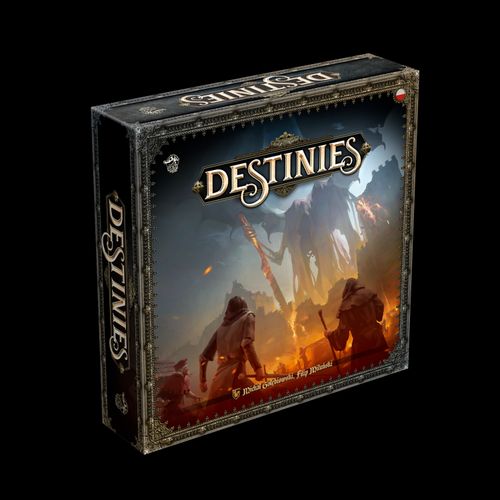
Destinies
Destinies Rulebook
Table of Contents
Table of Contents
Destinies System
Destinies offers a fully story-driven, app-supported, RPG-like board game experience, without the need for a game master. Each scenario depicts part of a vivid world, full of dark stories, epic NPCs, and mysteries to solve. Each player takes the role of a hero on a quest to fulfill their own Destiny. Each Destiny is the final goal of a character and has at least two completely different paths to victory, composed of a branching series of quests. Players compete with each other to push the world towards their own Destiny.
The game uses an app and Scan&Play technology to offer players a unique story-driven experience full of dynamic events, epic adventures, and an ever-changing game world. At every turn, players discover new parts of the world presented on tiles, explore them and pick one point of interest to visit. There, they learn more about the story and make crucial choices about how they want to interact with people, creatures or situations faced. The consequences of each choice are meaningful and often change the state of the world forever.
Components
67 Map tiles — with one side showing an explored part of the map and the second side with an unexplored part of the map. Keep map tiles sorted by number to easily find a given tile during play.
150 Item cards — are various objects and equipment that characters may obtain during the game. Keep Item cards sorted to easily find a given card during the game.
15 Destiny Cards — with two paths each player may choose from to fulfill their character's Destiny and thus win the game. Do not read Destiny cards before playing the game, as they contain secret information intended only for the player who takes the role of a specific character!
26 Point of Interest markers
20 Coin tokens
3 Player boards — shows three skill tracks, supply area and inventory with places for five Item cards.
6 Main dice
9 Effort dice
20 Experience tokens
10 Pairs of Trade tokens
36 Skill marker tokens
31 Miniatures — Player characters, NPCs and enemies.
Destinies requires a free app, which you can download from Apple's App Store, Google Play or Steam. You only need the app installed on one device with a camera to play. It's impossible to play without the app. Once downloaded, the app doesn't require any internet connection during gameplay. The language can be changed within the app. The app saves your progress so you may resume the scenario later on.
The Campaign and Replayability
Destinies comes with 5 different scenarios. The Nature of the Beast is stand-alone, and we suggest it as a first scenario to play. The four other scenarios form a campaign. The four scenarios of the campaign should be played in the suggested order. We recommend playing the whole campaign with the same group of players, but this is not mandatory. Scenarios are linked together, and each unveils the next steps of a bigger plot, but each scenario is a separate story, and knowing previous scenarios should not give a player any unfair advantage.
Destinies is inspired by the sandbox genre. Each scenario presents part of a vivid world and gives players many optional places to visit and characters to interact with. Therefore, Destinies scenarios may be replayed, but only if all players already played the scenario - otherwise, a player who already played a particular scenario would have an unfair advantage over a player playing it for the first time.
Setup
-
In the app, choose the scenario to play.
-
Read the scenario introduction aloud to all players.
-
Each player then chooses one of the playable characters presented by the app. If players cannot agree on character selection, assign their characters randomly.
-
Each player gets:
- a Player Board,
- 2 Main Dice and 3 Effort Dice,
- 1 Coin,
- their character's Destiny Card and miniature.
-
Each player:
- places their 2 Main Dice and a starting coin in the supply area of their player board (A),
- places their 3 Effort Dice off their player board to mark they are exhausted (B),
- places skill tokens on skill tracks, according to the values provided by the app (C),
- privately reads their Destiny Card and then places it on their player board (D) so the character illustration is visible and their Destiny is face down. (Destinies are secret; no player should show or read them to the other players).
-
Follow the instructions in the app to set up the world:
- Place Map Tiles on the table. One side of each tile shows an explored part of the map (A), while the other side shows an unexplored part of the map (B). At the beginning of the game, usually only one tile is explored;
- Place available Points of Interest marked with their Tokens and 3D Points of Interest Minis on the explored tile as shown in the app;
- Place all Characters' Minis on the explored, starting Map Tile.
You are ready to begin your journey!
Objective
Players are each trying to fulfill their personal destiny. Each Destiny gives a player two completely different possible paths to fulfill it. By exploring the world, getting and using items, talking with characters, and overcoming challenges, each player tries to complete one of their two possible destiny paths before their opponents do. The app informs players when they reach the next steps of their path. Players are free to switch between their two paths at any time, and can even try to progress on both paths. When a player is ready, they start a Finale - a series of events which ends with the player fulfilling their Destiny. The first player to fulfill their Destiny is the winner.
A player will never be blocked from their Finale and their personal Destiny, no matter what quests and items their opponents might have taken. One player might start their Finale first, but another better-prepared player might then fulfill their own personal Destiny faster and win!
Game Flow
Players take turns, passing the device from one to another.
A player's turn has three steps, performed in order:
- Start of the turn
- Movement
- Visiting a Point of Interest
All narrative events and information gained during play are public! The active player has to read aloud to the others all descriptions from the app.
Start of the Turn
At the start of the turn, the player refreshes one Effort Die, by moving it from the table onto the supply area of their player board. Refreshed dice may be used during any upcoming test.
Most game events (see Events on page 12) trigger at this step of a player's turn.
Movement
Players may choose any tile that is up to 2 tiles away from their current position, counting orthogonally (no diagonal movement). Players may move onto an unexplored tile, but must immediately stop moving there. Each player moves their character miniature from tile to tile to show their current location. A player may choose to stay on the same tile, instead of moving to a different tile.
Onto An Explored Tile
After moving to an explored tile, the player may visit one Point of Interest on that tile. Points of Interest are represented by tokens and miniatures.
Onto An Unexplored Tile
After moving onto an unexplored tile, the player explores it, by clicking in the app on this tile, and following the instructions. Typically, the instructions will be:
- flip the chosen tile to its explored side;
- place the player's character miniature onto the tile;
- place Point of Interest markers onto the tile;
- place new unexplored tiles adjacent to the tile, with their unexplored side up.
Finally, the player may choose a Point of Interest on that tile to visit. Points of Interest are marked by tokens and miniatures.
Visiting a Point of Interest
To visit a Point of Interest, the player clicks on the chosen Point of Interest in the app. The app will display a description of the Point of Interest, which the player should read aloud.
When visiting a Point of Interest, the player will have multiple options. Any or all options may be chosen in any order, but each option can be chosen only once. In some cases, choosing an option may open or close certain other options, or even force the player to leave the Point of Interest and end their turn.
The possible options are: interactions, tests, item scanning, destiny card scanning, and trading.
Interactions
An interaction lets a player do an action without having to pass a test. The action will automatically happen but its consequences vary and are unknown beforehand.
Sometimes, doing an action will change the situation and give the player a new choice to make. The player must choose to proceed further.
Tests
A test lets a player attempt something harder and less certain, with a random chance of success. When choosing a test in the app, the player will know what they are trying to do and which skill the test will use. The app will not explicitly state the test's difficulty – this must be deduced from the description. For example, breaking a stick is surely easier than lifting a huge rock.
There are three character skills in Destinies:
- INTELLIGENCE - reflects cleverness, charisma and wisdom. Examples are: talking with someone, focusing on a task, reasoning, drawing conclusions.
- DEXTERITY - reflects agility and sense awareness. Examples are: sneaking past guards, searching for tracks, climbing a tree.
- POWER - reflects strength, health and endurance. Examples are: fighting a monster, lifting a heavy object, running a long distance.
When taking a test, the player must roll their dice.
Dice
There are two types of dice:
Main Dice — Each player has 2 Main dice. These are used in every test, and their use is obligatory. They do not become exhausted: they are used for every test, every turn.
Effort Dice — Each player has 3 Effort dice, which may optionally be rolled with their Main dice during a test. A player may choose to roll all, some, or none of their Effort dice that are in their supply. When an Effort die is used, it becomes exhausted (removed from the player's supply). At the start of each turn, a player refreshes one of their Effort Dice back to their supply. The star symbol is an automatic success, which the player adds to the total number of successes made with the roll.
To check how well they did, the player sums up the numbers on all rolled dice. Then, they compare this roll total with their skill markers on the relevant skill track: for each skill marker on a number less than or equal to the roll total, the player scores one success. For each automatic success die result, they also score a success.
They enter their total number of successes into the app, which then tells the result of their action. The result may include:
- storyline changes;
- experience points gained by the player;
- items gained by the player;
- skill gain/loss.
Example
The player is taking an intelligence test, and chooses to use 2 Effort Dice. They rolled: 3, 4, 1, and an automatic success.
Their total sum is 3+4+1=8. 2 skill markers on their skill track are on values less than or equal to 8 (one on 5, one on 6), so that gives 2 successes.
They also rolled one automatic success on an Effort die, so they enter a total of 2+1=3 successes into the app.
Tests give various results, depending on the player's number of successes. Even a low number of successes can have an effect, but trying again later and getting more successes may give a different better result.
A test in Destinies never needs more than 6 successes! When deciding how many Effort Dice to use, this table may help:
| Test difficulty | Number of successes to pass |
|---|---|
| Easy | 1 |
| Moderate | 2 |
| Difficult | 3 |
| Very difficult | 4 |
| Epic | 5-6 |
Scanning Item Cards
When visiting a Point of Interest, players will often have an option to scan their items. The app indicates whether a particular scan represents talking about the item with an NPC or using the item in some way.
If a player asks an NPC about their character's weapon, the weapon won't be lost... but if a player gives a weapon to an NPC, the NPC might not give it back! Using an axe to cut a tree probably won't destroy it... but throwing an axe from a cliff will surely lose the axe.
Scanning a Destiny Card
When talking to NPCs, players have an option to ask them about their Destiny.
Scanning their Destiny Card when they talk to an NPC represents sharing their story with the NPC. It usually results in getting hints about how to fulfill one's destiny, which might be very helpful.
Each Destiny Card has two QR codes to reflect two different paths the character may take. If a player talks to an NPC about their destiny, they should scan the code of the specific path they want to talk about. All text in the app is public and should always be read aloud for all players to hear, but a player's Destiny is secret. NPC's answers about Destiny are usually worded in an indirect way that makes them much harder to understand for opponents, who don't know about the player's Destiny.
Scan or Test
Some situations in the game give players a choice of using an item or performing a test to achieve the same result. If a player uses the right item, the action automatically succeeds, but if they use the wrong item, the action automatically fails. In contrast, a Test gives a chance of success, depending on the player's skill markers and number of Effort Dice rolled. A player can only try one of these two methods per turn.
Trading
When a Point of Interest offers a trading opportunity for the first time, the app will typically instruct players to create a Trade Stack by getting some specific Item Cards, plus any matching pair of Trade Stack Tokens. One Trade Stack Token goes next to the Point of Interest on the map, and its matching Token goes on the Item Cards nearby which are available to buy.
The Trade Stack remains in play at that Point of Interest from then on, with whatever items are there. Thus if one player sells an item there, later another player can buy that item. Similarly, when one player buys something, it becomes unavailable to others.
Item prices are equal to their printed value, both when buying and selling.
During each Trade a player may sell and buy any number of items.
Events during the game may cause new items to appear in Trade Stacks.
Besides trading, players may also use money for other purposes. Sometimes the app allows paying coins to bribe, to repay debts, or even to throw coins somewhere. In cases like these, the player should put used coins back into the general supply.
Finale Interaction
Once a player has fulfilled the requirements to begin their Finale, they can visit a specific Point of Interest (which is hinted on their Destiny card), where the app will present a new option (only to that specific player) to trigger their Finale.
Other Game Concepts
Experience
Experience points are gained as a result of various interactions. At any moment during their turn, except during a test, a player may spend their gained Experience points to upgrade their skills.
Upgrading a skill lets a player move Skill Markers on Skill Tracks. For each experience point spent, a player may move any of their Skill Markers a total of two spaces left, either moving one Skill Marker two spaces left, or moving two different Skill Markers each one space left (on the same track or on two different tracks).
There can never be two Skill Markers in the same space of a skill track!
Example
Joanne is about to fight some enemies, and she wants to roll 3 successes. Her Power Skill Markers are currently on 2, 5, 8, 9. She decides to spend one experience point to improve her Power: she moves her Skill Marker from 8 two spaces left, to 6, giving her a very good chance to roll three successes in her upcoming combat test.
Skill Gain and Loss
Some players' actions may result in a character gaining or losing skill. The app instructs the player to move their Skill Markers of a specified skill to the left (when gaining) or to the right (when losing). The app tells the total number of spaces to move, but the player decides how to distribute these moves among their Skill Markers on that track.
Both skill loss and skill gain are permanent. Players may use experience points to regain lost skills.
Some items let players lose some skill in exchange for some other reward.
Depending on the situation, a specific skill may be lost (Intelligence/Dexterity/Power), or the player may be able to choose which skill to lose.
Some items and interactions may cause players to gain skills by moving Skill Markers to the left, the same way as when upgrading their skills.
Example
Lose Dexterity, Dexterity.
A failed combat encounter forces Joanne to lose two points of Dexterity. She has Dexterity Skill Markers on 3, 5, 7 and 8. She wants to keep her markers on 3 and 5, because those are good easy successes, so she decides to move one Skill Marker from 8 to 9 and to move another from 7 to 8.
Items
Item cards show:
- Name.
- Coin value of the item for both buying and selling.
- Item categories. Sometimes any card in a given category will work (for example to start a bonfire, any Item with the "fire" category will work).
- Illustration.
- QR Code.
- Special Ability. There are two types of special abilities. "Always" means that the ability is active as long as the character has the Item in their Inventory. "Discard" means that to use the ability, the owning player must return the Item Card to the box.
- Card Number. Keeping item cards sorted in numerical order in the box will make it easier to find a specific item.
Each player's inventory is limited to 5 Item Cards. If a player gets more than five, they must get rid of excess items to reduce back to five immediately. They can either abandon an excess item, or they can use its "Discard" ability and then discard it back to the box.
When a player abandons an item, they place it near the map. They take a pair of unused Trade Stack Markers, put one marker onto the abandoned card, and the matching marker onto the map tile where the character is. This shows where the item was dropped. From now on, any player who visits any Point of Interest on this Map Tile may, as a free action, pick up this Item Card and add it to their inventory.
A player may use their Item abilities freely in any order during their turn.
If an Item ability does not specify exact moment when it should be used (e.g. "on turn start", or "after the roll") a player is allowed to use it in any moment of their turn, as they wish.
If it ever happens that the result of a player combining several actions seems ambiguous, choose the resolution most favorable for that player.
Examples
Joanne is about to visit Old Ruins and she expects a Power test. She decides to use the "Discard" ability of Medicine. She has three other items in the inventory so she puts the Medicine card back in the box and gains 3 points of Power skill. She moves a Skill Marker from 6 to 4 and another Skill Marker from 7 to 6.
During Day 2 Charles decides to not move his character miniature and stay on the same tile he explored during Day 1. This triggers the Sheep's "Always" ability, so Charles can improve one skill. He chooses Dexterity and moves his Skill Marker from 7 to 6 before he visits a Point of Interest.
Ted is about to fight a pack of wolves. It is a Power test and he expects a difficult fight. Unfortunately, his roll total is only 4, and he got 0 successes! He decides to discard his Talisman to get 3 successes, and then to discard his Hatchet for 2 more successes. He returns both discarded item cards to the box and enters 5 successes into the app. The wolves are defeated!
Events
The world of Destinies is full of events. When an event is triggered, the active player follows the app's instructions. Events may change the state of Points of Interest, perhaps creating or moving them, changing their token, or completely removing them from the world. Such events might happen, for example, when an NPC arrives at a location, or moves to another location.
Virtue
The world remembers. Players' moral choices can affect how the world interacts with them. Good or evil, it is up to each player to choose their own path. The deeper they follow the path, the more it benefits them.
Finales and the Game End
When the criteria described on a player's Destiny Card are met, a new type of interaction appears at the relevant Point of Interest. Clicking on this interaction will trigger that character's Finale. This is a series of events, full of tests and special interactions, depicting the character's final actions in the game.
Once a player triggers their Finale, they can not go back to taking normal turns. Instead, they start a series of climactic events that will last several turns, depending on how well they have prepared and what choices they made earlier. In the end, they will either fulfill their Destiny and win the game, or be defeated.
The number of turns to play out a Finale greatly depends on players' current and previous actions, so even when one player has already started their Finale, other players still have a good chance to trigger their own Finale and fulfill their own Destiny first, and thus win the game.
Solo Mode
You can experience Destinies scenarios in one of two solo modes.
If you want to enjoy exploring the game's story, pick Explorer mode: there's no time pressure or special events pushing you to optimize your performance.
If you seek a real challenge, pick Challenger mode. Time pressure and special events will make it difficult! Beware that in Challenger mode, you may lose each scenario and replay it several times!
Glossary of Terms
Abandoning items — Each player's inventory is limited to five Item Cards. If a player gets more than five, they must immediately get rid of excess items, to have only five. Excess items can be discarded or abandoned. Abandoned items are placed near the map, and an unused pair of Trade Stack Markers is placed, one on the abandoned item(s) and one on the character's current map tile. This shows where the item was dropped. From now on, any player who visits any Point of Interest on this Map Tile may, as a free action, pick up this Item Card and add it to their inventory.
Destiny — Destiny is a player's ultimate goal: to win, a player must fulfill their Destiny. Each character has their own secret Destiny Card, received at the start of the scenario. Each Destiny always offers two completely different paths. A player's opponents may seek the same items, quests, and NPCs, but have very different final Destinies. A player may always decide to change which path they are following, until they commit to one path by triggering their Finale.
Exhausting Effort Dice — Each player has three Effort Dice. Each time a player chooses to use Effort Dice in a test, those dice become exhausted, and are moved from the player board's supply area to the table nearby. Some item abilities allow exhausting an Effort Die (not during a test) to trigger some effect; if all of a player's effort dice are exhausted, then they cannot do this.
Experience — Players earn experience tokens during play. At any moment during their turn, except during a test, a player may spend their gained Experience points to upgrade their skills, by moving Skill Markers on Skill Tracks. For each experience point discarded, a player may move any of their Skill Markers a total of two spaces left, either moving one Skill Marker two spaces left, or moving two different Skill Markers each one space left, on the same track or on two different tracks.
Exploration — Whenever a player moves onto an unexplored tile, they explore it. Typically this will mean flipping it to its explored side, with illustrations of the discovered terrain, and placing Points of Interest tokens on it. Some item abilities involve exploration and trigger special effects when the item's owner explores.
Finale — A Finale is a series of events, full of tests and special interactions, depicting the character's final actions in the game. The Finale interaction appears in the description of the Point of Interest mentioned on the Destiny card. Once started, the Finale can not be stopped for that player. The number of turns to play out a Finale greatly depends on players' current and previous actions, so even when one player has already started their Finale, other players still have a good chance to trigger their own Finale and fulfill their own Destiny first, and thus win the game.
Inventory — Each player's board has space to hold five Item cards. As long as a player has an item in their inventory, they can scan it and can use its "Always" ability. If a player uses an item's "Discard" ability, the item must return to the game box.
NPC — Non-player characters can be met while visiting a Point of Interest. They may be asked about the player's Destiny giving useful hints as to how to fulfill it. Some interactions may change the state of a particular NPC, allowing new interactions or blocking the old ones. The same NPC may react differently to different player characters, based on their actions and choices. NPCs may move from one Point of Interest to another during the game. This is usually triggered by events, and the app will instruct players to move a specific NPC miniature to another Point of Interest, or to remove it from the map.
Point of Interest — Players will visit Points of Interest. When a tile is explored, new Points of Interest will be placed on the tile. They may be removed by events or as a consequence of player choices. During a visit to a single Point of Interest a player may try any of the available options in any order they wish, but each option can be tried only once per turn.
Skill Gain and Loss — As a result of a player's action, the app may instruct the player to gain or lose some of their proficiency in a particular skill. In some rare cases it might be possible to obtain a new Skill Marker for your skill!
Refreshing Effort Dice — Each player has three Effort Dice. Each time a player chooses to use Effort Dice in a test, those dice become exhausted, and are moved from the player board's supply area to the table nearby. At the start of a player's turn, they refresh one of their exhausted Effort dice by moving it back to their player board's supply area. A player may never have more than 3 Effort Dice in their supply area.
Roll Total — During a test, a player rolls their dice and computes the total sum of values on all dice, both main dice and effort dice. Some item abilities can change a roll total. The player compares their markers on the relevant skill track with their roll total to see how many resulting successes they have in the test.
Virtue — Virtue is a secret fourth skill tracked by the app based on player choices. Its value reflects moral choices taken by a player during the game. Some NPC states and interactions may change based on a player's virtue.
Icons Reference
- Skill marker
- Skill marker on Intelligence Skill Track
- Skill marker on Dexterity Skill Track
- Skill marker on Power Skill Track
- Skill gain
- Skill loss
- Point of Interest marker
- Experience point
- Success
- Coin
- Map tile
- Item
- Main Die
- Effort die
- Intelligence test
- Dexterity test
- Power test
- Interaction
- Item scan
- Destiny scan
- Trading
- Finale