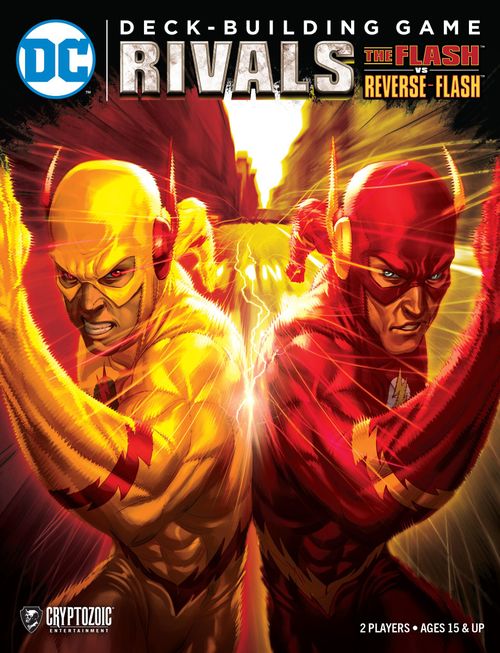
DC Deck-Building Game: Rivals – The Flash vs Reverse-Flash
DC Deck-Building Game: Rivals – The Flash vs Reverse-Flash Rulebook
Table of Contents
Table of Contents
Contents
- 98 Game Cards
- 14 Punch Starter Cards
- 6 Vulnerability Starter Cards
- 60 Main Deck Cards
- 8 Super-Speed Cards
- 10 Weakness Cards
- 6 Oversized DC Character Cards
- 1 Rulebook
- 1 Randomizer Card
- 1 Divider
Types of Cards
The different card types are: Starter, Villain, Location, Hero, Super Power, and Equipment. Weakness and Super-Speed cards have no card type.
Oversized Character Cards
Each of your oversized Character cards has a different special ability and cost. Be sure to read each of your Character cards at the start of the game, so you can plan your strategy accordingly. At the start of the game, you will only have access to your 9-cost ability. Once your 9-cost version is defeated, you will then be able to use your 12-cost version, but no longer your 9-cost version. Once your 12-cost version is defeated, you will only have your 15-cost version.
Setup
1. Your Character Stack and Starting Deck
One player plays as The Flash, while the other one plays as Reverse-Flash. Grab your 3 oversized Character cards and place them in a face-up stack with the 9 on top, 12 in the middle, and 15 on the bottom.
Each player begins with a starting deck of 7 Punch cards and 3 Vulnerability cards with symbols matching their Character.
2. The Main Deck
Most of the cards that you will add to your deck as the game progresses come from the main deck. None of the following cards should be placed into the main deck: Punch, Vulnerability, Super-Speed, Weakness, or oversized Characters. The main deck is made up of every other card in the game (60 cards total). Shuffle the main deck and place it in the middle of the table.
3. The Line-Up and Stacks
Place the top 5 cards from the main deck in a row to form the Line-Up. There is no board necessary to play this game; just reserve space for each card.
Next, place the Super-Speed and Weakness stacks at the end of the Line-Up. Super-Speed cards are always available to buy during your turn (while cards remain in the stack). Weakness cards are never bought; they are gained only through unfriendly card effects. The main deck and the 2 stacks of cards on the end are not part of the Line-Up.
Once you have arranged the main deck, Line-Up, and stacks, it will looks something like a row of five face-up cards next to the Super-Speed and Weakness stacks. Your opening 5 cards in the Line-Up will vary.
At the start of the game, there should be 8 Super-Speed and 10 Weakness cards in their respective stacks.
4. First Player
The player who most recently read a comic book gets to go first. Alternatively, you can determine first player randomly. Each player begins by shuffling their 10-card starting deck and drawing 5 cards. Players will alternate taking turns.
Gameplay
Each turn, you must first decide if you will take a Normal Turn and buy cards to add to your deck or Confront your opponent and try to defeat their current Character. At the beginning of the game, you will not have enough Power in your deck to Confront your opponent, so you should spend your first few turns buying new cards for your deck.
If you take a Normal Turn, you may buy cards from the Line-Up or Super-Speed stack to improve your deck. Cards you buy are immediately placed into your discard pile unless you are instructed otherwise. Discard piles are always face up and may be looked through at any time. Soon they'll be shuffled into your deck, and then you'll be drawing these more powerful cards into your hand so you can play them.
You can buy any number of available cards with combined cost less than or equal to the amount of Power you have for the turn. For example, your Punch cards each give you +1 Power. If you draw 4 of them and a Vulnerability, your total Power for the turn is 4. You can buy a single card with cost 2, 3, or 4, or even 2 cards each with cost 2, assuming these options are available. Super-Speed cards are (usually) available if the cards in the Line-Up are too expensive, and you may buy more than 1 during your turn if you wish. You don't have to spend all your Power if you don't want to, but unspent Power does not carry over to the next turn.
Vulnerability and Weakness cards provide no Power. You may play them if you wish, but they have no effect when played. After you play a card, leave it in your play zone in front of you and do not immediately put it into your discard pile.
If you decide to Confront your opponent, you will not be able to buy any cards to add to your deck. See the following section for more on Confrontations.
Sample Normal Turn Sequence
After shuffling up your starting cards, you draw a hand of 4 Punch cards and 1 Vulnerability for your first turn. You may play the 4 Punch cards for a total of 4 Power, which is enough to buy Iris West from the Line-Up. After buying that card, you put it into your discard pile. Playing the Vulnerability provides you no additional Power. You have no Power left to buy additional cards and no other cards to play, so you can end your turn. Put all of the cards you have played into your discard pile and then draw a new hand of 5 cards. After refilling the Line-Up, it will be your opponent's turn.
Order of Playing Your Cards
On your turn, you get to play the cards in your hand in the order of your choice. When you play a card, its game text resolves immediately from top to bottom. When you have played all the cards you wish to play at that time, total up the Power you have accumulated and buy cards from the Line-Up and/or the Super-Speed stack. You do not have to play all of the cards in your hand before you start making purchases. You may play additional cards even after making purchases.
Confronting Your Opponent
At the start of your turn, you may announce a Confrontation. Only by announcing a Confrontation can you attempt to defeat your opponent. If you can defeat your opponent 3 times, you instantly win the game! However, your opponent is no easy mark. Each Character has 3 versions that are progressively harder to defeat. If you generate Power equal to or exceeding its cost during a Confrontation, that version of your opponent's Character is removed from their Character stack and placed into your score pile. Should the game end due to being unable to refill the Line-Up, these defeated Character cards are worth a lot of Victory Points.
Note that during a Confrontation, you can only beat the top card; even if you have 30 Power, you cannot defeat more than 1 of their Characters in the same turn.
If you choose to Confront your opponent, you cannot buy cards from the Line-Up or Super-Speed stack. You should only choose to Confront your opponent if there is a chance that you can amass enough Power to beat your opponent's cost. You may not have all of the Power you need to defeat your opponent at the very start of your turn. If you need 9 Power to defeat your opponent, and you start your turn with 6 Power and the ability to draw 2 cards, you might be able to get to 9 or more Power with those extra draws.
Several cards you can acquire during the game work especially well during a Confrontation. These cards have the bold keyword "Confrontation:" in their game text. The text after the "Confrontation:" keyword is only active while you are Confronting your opponent.
Block
Block cards contain the bold keyword "Block" followed by a number in parentheses in their game text. After a foe Confronting you has played all of their cards, you may discard any number of Block cards from your hand to increase your Character's cost. The value in the parentheses is how much your Character's cost increases by. Any text after the Block keyword is only resolved if you discard the card to increase your cost while you are being Confronted. In order to prevent your foe from defeating your Character, you must discard enough Block cards to increase your cost to a number higher than your opponent's Power total. Raising your cost to match their Power isn't good enough. The increased cost of your Character only lasts until the end of the current turn.
Block cards may be played during your turn just like any other card, but the Block text is not applicable.
Ending Your Turn
- Announce that you are ending your turn. Your turn is now over.
- Place any cards remaining in your hand into your discard pile.
- Resolve any "at end of turn" effects.
- Place all cards without the Ongoing keyword you control into your discard pile. Any unspent Power is lost.
- Draw 5 cards.
- If there are less than 5 cards in the Line-Up, take cards from the top of the main deck and add them to the Line-Up. Do not replace empty slots as soon as you gain a card from the Line-Up.
- Now your opponent starts their turn.
End of Game
The game ends immediately when either of the following 2 conditions is met:
- You defeat your opponent's last Character card. You win instantly!
- You are unable to refill all 5 slots of the Line-Up.
If you are unable to refill the Line-Up, both players return all Ongoing cards they have in play, all cards in their hands, and all cards in their discard piles to their decks. Then, players total up the Victory Points on cards in their decks and on opposing Characters in their score piles. Weakness cards in a player's deck at the end of the game will subtract Victory Points (VP) from their total. The player with the highest VP total wins! In case of a tie, the player with more opposing Character cards in their score pile is the winner. If there is still a tie, the player with more cards in their deck is the winner.
Additional Rules
Resolving Card Abilities
When an effect tells you to draw a card, that card always comes from your own deck. If you cannot fully resolve the text on a card, resolve as much of it as possible. Text after "Confrontation:" only resolves if you are currently Confronting an opponent. Text after "Defense:" can only be used when your opponent plays an Attack card. When you see the phrase "that foe," it refers to the foe you chose earlier for an Attack card or that you are currently Confronting.
Some cards in this set affect multiple opponents. Even though Rivals — The Flash vs. Reverse-Flash is a 1v1 experience, it can be combined with other sets to play with more players. These cards are worded that way to integrate more easily with other sets.
Shuffling Your Deck
You don't shuffle your discard pile and make it your new deck as soon as you run out of cards. However, if at any point during the game there are no cards in your deck and you need to draw, discard, or reveal a card from your deck, immediately shuffle your discard pile, and it becomes your new deck.
Ongoing
Some cards have the keyword "Ongoing:" in their game text. This keyword is found on all Locations and Weakness cards in this set. Ongoing cards go straight to your discard pile when gained, just like any other card. However, when you later draw and play an Ongoing card, that card will remain face up and in play in front of you for the rest of the game. Ongoing cards are not put into your discard pile at the end of your turn like all of the other cards you play. The text after the "Ongoing:" keyword is not active while the card is in your hand and is only active for you while the card remains in play. The Ongoing effect may be used every turn. You can have any number of Ongoing cards in play at once.
Controlling Cards
You control the cards in your play zone that you played this turn and Ongoing cards you played on a previous turn. You do not control cards in your hand, deck, or discard pile.
Attack and Defense
Attack cards have the bold keyword "Attack:" in their game text and will have some negative effect for your opponent. When you play a card with an Attack ability, it will either affect all of your foes or a foe of your choice, signified by the word "target." Each affected foe has an opportunity to avoid the Attack with a Defense card. If a player doesn't avoid the Attack, they are immediately affected by the text after "Attack:".
Defense cards have the bold keyword "Defense:" in their game text and allow you to avoid the negative effects of an Attack card played by your opponent. In order to use a Defense card, it must be in your hand. A player may only utilize 1 Defense card per Attack. Most Defense cards give you a reward when you use them to avoid an Attack. The reward is listed after "If you do" on your Defense card. Avoiding an Attack does not negate any of the Attack card's text prior to "Attack:" (like +2 Power).
If an Attack looks for a particular card or card type and you do not have one in the place where the Attack looks, you suffer no effects of the Attack, but you may still use a Defense against it to gain the Defense reward.
Discarding Cards
When a card tells you to "discard" a card, it means from your hand as the default. However, a card may tell you to discard a card from another place, such as the top of your deck. Cards that are discarded this way count as being "discarded."
Destroying Cards
Some cards have the ability to destroy a card in your hand, your discard pile, the Line-Up, etc. When you destroy a card, place it into a face-up pile of destroyed cards anywhere away from the area to show that it is no longer a part of the zone it came from. You will often get to choose which of your cards to destroy. Destroying Starter and Weakness cards will improve your deck greatly! If Weakness or Super-Speed cards are destroyed, they go back to their respective stacks.
New Concepts
Speedster
Some Hero and Villain cards in the main deck have the "Speedster:" keyword. (You will also see a lightning bolt watermark in their textbox as a reminder.) When you play a Speedster card, the text after "Speedster:" is only active if you drew a card earlier that turn. Drawing cards does not activate Speedster cards you played earlier in that turn. A Speedster card that draws a card will not trigger its own Speedster effect. Drawing 1 card will activate the Speedster effect of all cards you play later that turn.
Some cards have an additional effect if you control a Speedster card. As long as you control a card with this keyword, you will get the bonus, even if you have not already drawn a card this turn.
Weakness
Some cards force players to gain a Weakness. If this happens, the affected player takes a Weakness card from the Weakness stack and places it into their discard pile, effectively adding it to their deck. If the Weakness stack runs out, effects that would cause a player to gain a Weakness do not do so, but any other effects those cards have still resolve as usual. If the game ends due to being unable to refill the Line-Up, each Weakness card you have subtracts 1 Victory Point from your VP total.
Weakness cards from this set must be played during your turn before you play any non-Weakness cards. You may not end your turn while you have a Weakness card in your hand. Weakness cards also have the Ongoing keyword, so remember not to put them in your discard pile at the end of your turn. Your Character has -1 cost for each Weakness you have in play. That means when a foe Confronts you, they need 1 less Power to defeat you for each Weakness you control. If a foe successfully defeats you in a Confrontation, return all Weakness cards you have in play to the Weakness stack. You still keep any Weakness cards in your hand, deck, or discard pile.
Gaining Cards
Gaining a card is the process of taking ownership of that card. This occurs most often when you purchase a card by paying its cost. When a card tells you to gain a particular card or a card of your choice, that card is taken and immediately placed into your discard pile at no additional cost, unless otherwise directed by the card. If a card tells you to gain a card with a specific name, card type, or cost and there are none available, you don't gain a card.
Specific Card Clarifications
- The Flash (15) / Reverse Flash (15): Both of the abilities of these Characters are only active during a Confrontation.
- Abra Kadabra / Golden Glider: If you have no cards in your deck when you play one of these cards, you will shuffle your discard pile before revealing. Otherwise, if there are fewer cards remaining in your deck than the number you are supposed to reveal, only reveal the cards remaining in your deck.
- The Black Flash: This card only causes each foe to discard 1 card total. Any card of their choice or a Speedster card if the additional effect is triggered.
- Negative Flash: You must have destroyed a card before you play this card in order to draw. You will not draw a card if you destroy a card after playing this card. If you start a Confrontation, you may no longer buy cards from the Line-Up. You will resolve the Confrontation text on all cards you play after this card, but not the ones you have already played.
- Speedster Suit: If you are playing the standard mode of play instead of Confrontations, this card will increase the cost of the top card of the Super-Villain stack for the remainder of the turn.
- S.T.A.R. Labs: If a single card effect allows you to destroy multiple cards at the same time, you only generate +1 Power.
- Super-Speed: You must decide if you are returning this card when you play it. If you choose to return it, you will no longer be considered to control the card but you do still keep the +2 Power.
- Zoom: If you trigger his Speedster effect, you may play any card from the destroyed pile. It does not have to be either of the cards destroyed by his effect.
Combining Sets
This set can be combined with other Cryptozoic Cerberus Engine deck-building games. You are free to mix and match cards from any sets to make your own custom game experience. We recommend that when you swap cards, you exchange them for cards of similar type and cost.
For additional games in the Confrontations line and the ability to play with up to four players, check out these DC Deck-Building Game titles: Confrontations, Rivals — Batman vs. The Joker, and Rivals — Green Lantern vs. Sinestro. Below are some additional recommendations when combining this game with those sets.
Rivals — Batman vs. The Joker / Green Lantern vs. Sinestro
If you are playing this as a 1v1 game:
- When forming the main deck, only combine cards associated with the Characters being played. For example, if you are playing as The Flash against Sinestro, the main deck would contain all cards with an emblem that matches the emblem on The Flash and Sinestro Characters. Cards from other Characters would not be shuffled into the main deck.
- Batman vs. The Joker: Use the Super-Speed stack instead of the Kick stack.
- Green Lantern vs. Sinestro: Use the Hard-Light Construct stack instead of the Super-Speed stack.
If you are playing this as a 2v2 game:
- Shuffle both main decks together.
- Create a Hard-Light Construct stack / Kick stack in addition to the Super-Speed stack during setup. Cards can be purchased from either stack.
- You will form 1 team of Super Heroes and 1 of Super-Villains. Have a seat next to your partner. That way, you can compare hands and talk secretly about your plans. Teammates take separate turns and player order will alternate between teams. For example, if Batman takes the first turn, The Joker would take the second turn, The Flash the third, and Reverse-Flash the fourth. The turn order remains the same for the entire game.
- Block cards can be used to increase the cost of your Character or your teammate's Character.
- If both of your foes are at the same Level, you can choose to Confront either of them. If they are not the same Level, you must Confront the foe with the lower Level.
- A team instantly wins if they defeat the Level 3 Character of either foe. If the game ends due to the main deck running out, determine the winner based on each team's combined VP total.
Confrontations
- Follow the suggested guidelines outlined in the combining sets section of the Confrontations rulebook.
- Create both a Super-Speed stack and an Enhanced Strength stack during setup. Cards can be purchased from either stack.
Turn Sequence (Quick Reference)
Turn Sequence
Choose whether you will take a Normal Turn to buy cards or a Confrontation Turn to Confront your opponent directly.
Normal Turn:
- Play cards from your hand. Total up your Power and purchase cards with combined cost less than or equal to that total. You may play additional cards even after making purchases.
- As soon as you gain a card, place it into your discard pile, unless instructed otherwise.
Confrontation Turn:
- Play cards from your hand. Resolve all "Confrontation:" text on cards you play.
- After you have played all your cards, your opponent may discard Block cards to make their cost greater than your Power.
- If your Power is greater than or equal to the cost of the opposing Character, you have defeated that card. Place it into your score pile.
End of Turn
- Announce that you are ending your turn. Your turn is now over.
- Place any cards remaining in your hand into your discard pile.
- Resolve any "at end of turn" effects.
- Place all cards without the Ongoing keyword you control into your discard pile. Any unspent Power is lost.
- Draw 5 cards.
- If there are less than 5 cards in the Line-Up, take cards from the top of the main deck and add them to the Line-Up until there are 5 cards. Do not replace empty slots as soon as you gain a card from the Line-Up.
- Now your opponent starts their turn.
The game ends immediately when either of the following 2 conditions is met:
- You defeat your opponent's last Character card. You win instantly!
- You are unable to refill all 5 slots of the Line-Up. Most VP on their cards wins.