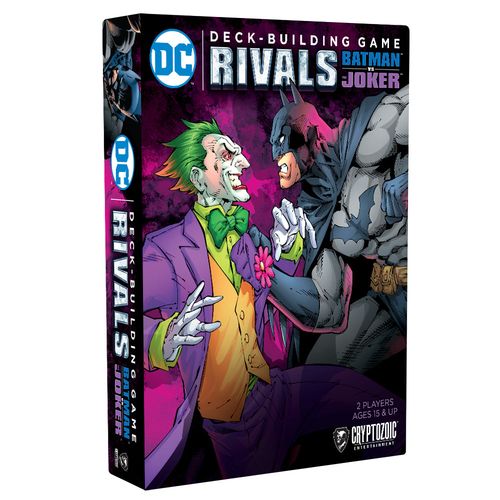
DC Deck-Building Game: Rivals – Batman vs The Joker
DC Deck-Building Game: Rivals – Batman vs The Joker Rulebook
Table of Contents
Table of Contents
Contents
- 98 Game Cards
- 14 Punch Starting Cards
- 6 Vulnerability Starting Cards
- 60 Main Deck Cards
- 8 Kick Cards
- 10 Weakness Cards
- 6 Oversized DC Comics Character Cards
- 1 Rulebook
Types of Cards
Cards show a Card Name, Card Type, Cost, Victory Points, and any Special Rules Text or Abilities. The different card types that you can play are: Starter, Villain, Location, Hero, Super Power, and Equipment. Weakness cards have no card type.
Setup for Your First Game
1. Your Character and Starting Deck
One player plays as Batman, while the other one plays as The Joker. Grab your three oversized Character cards and place them in a face-up stack with the 9 on top, 12 in the middle, and the 15 on the bottom.
Each player begins with a starting deck of seven Punch cards and three Vulnerability cards. You will use your Punch cards to buy more powerful cards to add to your deck, improving it as the game goes on. Vulnerability cards represent the things that occasionally cause a character to falter. They don't do anything for you when drawn or played, so it's best to get rid of them as soon as possible (more on how to do that later).
2. The Main Deck
Most of the cards that you will add to your deck as the game progresses come from the main deck. Shuffle the main deck and place it in the middle of the table. None of the following cards should ever be placed into the main deck: Punch, Vulnerability, Kick, Weakness, or the oversized Character cards. The main deck is made up of every other card in the game (60 cards total).
3. The Line-Up
After shuffling the main deck, place the top five cards from the main deck into the Line-Up. There is no board necessary to play this game; just reserve space for each card.
Next, place the Kick and Weakness stacks at the end of the Line-Up. You may want to turn these stacks perpendicular to the board so that everyone can reach them. Kicks are always available to be bought during your turn (while cards remain in the stack). Weaknesses are never bought; they are gained only through unfriendly card effects. The main deck and the two stacks of cards on the end are not part of the Line-Up.
Once you have arranged the main deck, the Line-Up, and the other stacks, it will look something like a row of five face-up cards next to the Kick and Weakness stacks. Your opening five cards in the Line-Up will vary. At the start of the game, there should be 8 Kicks and 10 Weaknesses in their respective stacks.
Gameplay
Randomly determine a player to go first. Each player begins by shuffling his or her deck and drawing five cards. Players take turns in clockwise order.
Each turn, you may buy cards from the Line-Up or Kick stack to improve your deck. Cards you buy or gain are always immediately placed into your discard pile unless you are instructed otherwise. Discard piles are always face up. Soon they'll be shuffled into your deck, and then you'll be drawing these newer, more powerful cards into your hand so you can play them. Buying powerful cards builds up the effectiveness of your deck. That's why it's called a "deck-building game."
You can buy any number of available cards with combined cost less than or equal to the amount of Power you have for the turn. For example, your Punch cards each give you +1 Power. If you draw four of them and no other cards with any Power bonuses, your total Power for the turn is 4. You can buy a single card with cost 2, 3, or 4, or even two cards each with cost 2, assuming these options are available. Kick cards are (usually) available if the cards in the Line-Up are too expensive, and you may buy more than one during your turn if you wish. You may pass if you cannot buy or do not wish to buy any cards.
Vulnerability and Weakness cards provide no Power. Since they weaken your draws and deck, you should try to destroy them as soon as possible. You may play them if you wish, but they have no effect when played. They are not discarded until the end of your turn when you discard all cards you have played and any cards that you have kept in your hand.
Order of Playing Your Cards
On your turn, you get to play the cards in your hand in the order of your choice. When you play a card, its game text resolves immediately. When you have played all the cards you wish to play at that time, total up the Power you have accumulated and buy what you wish to buy from the Line-Up or the face-up stacks. You do not have to play all of the cards in your hand before you start making purchases if you don't wish to. You may play additional cards even after making purchases.
Most cards you play have simple effects like +Power, card drawing, or an Attack. The order in which you play these cards typically does not matter.
Ending Your Turn
- Announce that you are ending your turn. Your turn is now over.
- Discard any cards remaining in your hand.
- Resolve any "at the end of your turn" effects.
- Place all the cards you played into your discard pile. Any unspent Power from cards played during the turn is lost.
- If any of the slots in the Line-Up are empty, take cards from the top of the main deck and add them to the Line-Up. Do not replace empty slots as soon as you buy or gain a card from the Line-Up.
- Draw five cards.
- Now your opponent starts his turn.
Sample Turn Sequence
After shuffling up your starting cards, you draw a hand of four Punches and one Vulnerability for your first turn. You may play the four Punches for a total of 4 Power, which is enough to buy Huntress from the Line-Up. After buying it, you put it into your discard pile. The Vulnerability provides you with no additional Power. Once you have played and bought all the cards you want, discard the cards you have played and any remaining in your hand and then draw a new hand of five cards.
End of Game
The game ends immediately when either of the following two conditions is met:
- You defeat your opponent's last Character card. You win instantly!
- You are unable to refill all five slots of the Line-Up.
If you are unable to refill the Line-Up, return all Locations you have in play, all cards in your hand, and all cards in your discard pile to your deck. Then, players total up the Victory Points on cards in their deck. Weakness cards in your deck at the end of the game will subtract Victory Points (VP) from your total. The opposing Character cards you defeated are also worth a lot of points to you!
The player with the highest VP total is crowned the winner! In case of a tie, the player with more opposing Character cards is the winner.
After a winner has been determined, all players will need to take apart their decks, placing all of the cards back into their proper stacks.
Additional Rules
Oversized Character Cards
Each of your oversized Character cards has a different special ability and cost. Be sure to read each of your Character cards at the start of the game, so you can plan your strategy accordingly. Once your 9-cost version is defeated, you will then be able to use your 12-cost version, but no longer your 9-cost version.
Attacks and Defenses
Some cards allow you to make an Attack against the other players in the game. When you play a card with an Attack ability, each other player has an opportunity to avoid the Attack with a card that has a Defense ability. A player using a Defense card's ability negates the Attack only for that defending player. A player may only play one Defense card per Attack. Any players who don't avoid the Attack are then affected by the Attack card's ability. Avoiding an Attack does not negate any other abilities (like +2 Power) of a card, unless an ability specifically counts the players successfully hit by the Attack.
Confronting Your Opponent
At the start of your turn, you may announce a Confrontation. Confronting your opponent is the best way to defeat them once and for all. Only by announcing a Confrontation can you attempt to defeat your opponent. If you can defeat your opponent three times, you instantly win the game! However, your opponent is no easy mark. Each Character has three versions. They are progressively harder and harder to beat. The first one has a cost of 9. That means you must amass at least 9 Power to defeat that Character. If you generate Power equal to or exceeding their cost during a Confrontation, that version of your opponent's Character is removed from his Character card stack and placed near your side of the table. Should the game end due to being unable to refill the Line-Up, they are worth a lot of Victory Points.
The new version of their Character will have a better ability and will also have a higher cost for the next time you Confront him. Note that during a Confrontation you can only beat the top card, even if you have 30 Power, you cannot defeat more than one of their Character cards in the same turn.
You will only want to Confront your opponent when you are fairly confident that you can amass enough Power to beat your opponent's cost. However, you are unlikely to have all of the Power you need to defeat your opponent at the very start of your turn. If you need 9 Power to defeat your opponent, and you start your turn with 5 Power and the ability to draw three cards, you might be able to get to 9 or more Power with those extra draws. If you know that you have some good cards left in your deck, you might want to announce a Confrontation at the start of your turn.
Several cards you can acquire during the game work especially well during a Confrontation. You may only play cards that read "During a Confrontation…" during your own turn, unless that text appears as part of a Defense or Block. The only cards that may be played during an opponent's turn are Defenses and Blocks.
- You must announce a Confrontation at the very start of your turn in order to defeat your opponent. You cannot decide to do it after you have played cards.
- When you Confront your opponent, you cannot buy cards that turn, even if you have left over Power.
- A Confrontation is not an Attack. You may play Attacks during your Confrontation. Your opponent may use Defense cards to defend as usual. Blocks are only used to make your Character harder to beat when Confronted.
Confronting Your Opponent (cont'd)
- During a Confrontation, resolve all game text after the phrase "During a Confrontation…" If you do not announce a Confrontation, you do not resolve this text, but you may still play the card.
- When you have played all of the cards you wish to play, let your opponent know. They can now play Block cards to increase their Character's cost. You cannot play additional cards, so get your Power as high as you can before you say you are ready.
Blocks
When your opponent Confronts you, you may utilize Block cards from your hand to increase your Character's cost. You must wait for your opponent to play all of the cards they wish to play during the Confrontation before you may play Blocks. Then play Block cards to increase your cost to a number higher than your opponent's Power total. Raising it to even isn't good enough. If your opponent has amassed more Power than your Blocks can overcome, no need to waste them on a lost cause.
Your opponent cannot play additional cards to overcome your Character's new cost. He must play all the cards he wishes to play, then announce that he is done playing cards. Then it's your chance to stop him. The increased cost of your Character only lasts until the end of the current turn.
Block cards may be played during your turn just like any other card, but the Block text is not applicable.
Weakness
Some cards force the attacked players to gain a Weakness. If this happens, the Weakness cards are usually placed in that player's discard pile, effectively adding them to that player's deck. They have no ability when drawn during the game and can be played or kept in your hand and discarded at the end of your turn. If the game ends due to being unable to refill the Line-Up, each Weakness in your deck subtracts 1 Victory Point from your VP total, so you'll need a plan for destroying them at some point! If the Weakness deck runs out, effects that would cause a player to gain a Weakness do not do so, but any other effects those cards have still resolve as usual. A player may still play a Defense to avoid an Attack, even when there are no Weaknesses available to be gained.
Shuffling Your Deck
You don't reshuffle your discard pile into your deck as soon as you run out of cards. However, if at any point during the game if there are no cards in your deck and you need to draw, discard, or reveal a card from your deck, immediately reshuffle your discard pile, and it becomes your new deck.
Locations
Location cards go straight to your discard pile when bought or gained, just like any other card. However, when you later draw and play a Location, that card will remain face up and in play in front of you for the rest of the game. Each Location has a unique effect that can trigger during each of your turns for the rest of the game. The word Ongoing is a reminder that this card keeps working for you turn after turn. This effect triggers only once during each of your turns. You can have any number of Locations in play at once.
Destroying Cards
Some cards have an ability that allows you to destroy a card from your hand, your deck, or even the Line-Up. When you destroy a card, place it into a face-up pile of destroyed cards anywhere away from the play area, removing it from your deck and the game. You will often get to choose which of your cards to destroy. Destroying Vulnerability and Weakness cards will improve your deck greatly! If Weaknesses and Kicks are destroyed, they do not go back to their respective stacks.
Gaining Cards
When a card tells a player to gain a particular card or a card of your choice, that card is taken and immediately placed in that player's discard pile at no additional cost, unless otherwise directed by the card. If a card tells to you gain a card with a specific name, card type, or cost and there are none available, you simply don't gain the card.
Resolving Card Abilities
If a card's ability affects multiple players, and the order matters (for example, an Attack that has each of three opponents gain a Weakness, with only two Weaknesses remaining on the board), resolve that ability for each affected player in clockwise order, starting from the player who played the ability.
When you play a card that triggers another effect, like on your Character card or a Location you control, fully resolve the card you are playing before resolving any secondary effects triggered by your card play.
When you see the phrase "that foe," it refers to the foe you are currently acting against, like during a Confrontation.
Specific Card Clarifications
- Black Canary: Note that if you buy, gain, or destroy the last Villain in the Line-Up, she immediately gains the additional 3 Power.
- Lucius Fox: If you are not being Confronted, adding 1 to your Character's cost does nothing. Note that this is not a Block. You may only discard it when you are Attacked.
- Poison Ivy: Your opponent cannot play a Block during a Confrontation to avoid having to discard it to this Attack.
- Red Hood: You succeed in a Confrontation if you defeat the opposing Character during a Confrontation. This effect will last for the rest of the turn. You don't have to wait to play this card until after the Confrontation is over. In fact, you can't play any cards once a Confrontation is over. You may even destroy one card in your hand and one card in your discard pile, as that adds up to two cards.
- The Riddler: If your opponent chooses the next card, the top card of the main deck returns to the top of the deck.
- Scarecrow: The second sentence is not part of the Attack, so even if the Attack is avoided, the +2 Power ability remains.
- World's Greatest Detective: You may reveal this multiple times during your turn if you are Attacked by multiple cards. After revealing it, place it back into your hand.
Oversized Character Cards
Batman 15, The Joker 15: Each of the cards listed will grant you +1 Power. It's not for each pairing of cards listed.
Turn Sequence (Quick Reference)
Turn Sequence
- If you wish to engage in a Confrontation with your opponent, announce that at the very start of your turn. If you do, you cannot buy cards this turn.
- Play cards from your hand.
- If you Confronted your opponent, he may utilize Block cards after you are done playing cards to make his cost greater than your Power.
- If your Power is greater than or equal to the cost of the opposing Character during a Confrontation, you have defeated that card. Place it on your side of the table. If it was the last one in their stack, you instantly win the game!
- If you did not Confront your opponent, total up your Power and purchase cards with combined cost less than or equal to that total. You may play additional cards even after making purchases.
- As soon as you buy or gain a card, place it into your discard pile, unless instructed otherwise.
End of Turn
- Announce that you are ending your turn. Your turn is now over.
- Discard any cards remaining in your hand.
- Resolve any "at the end of your turn" effects.
- Place all the cards you played into your discard pile. Any unspent Power from cards played during the turn is lost.
- Draw five cards.
- If any of the slots in the Line-Up are empty, take cards from the top of the main deck and add them to the Line-Up. Do not replace empty slots as soon as you buy or gain a card from the Line-Up.
- Now your opponent starts his turn.
The game ends immediately when either of the following two conditions is met:
- You defeat your opponent's last Character card. You win instantly!
- You are unable to refill all five slots of the Line-Up.