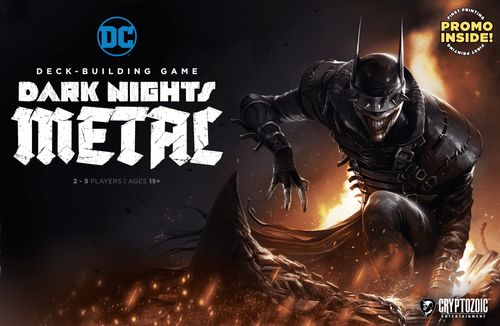
DC Deck-Building Game: Dark Nights – Metal
DC Deck-Building Game: Dark Nights – Metal Rulebook
Table of Contents
Table of Contents
Contents
202 Game Cards
- 36 Punch Starter Cards
- 16 Vulnerability Starter Cards
- 97 Main Deck Cards
- 16 Breakthrough Cards
- 7 DC Super-Villain Cards
- 30 Weakness Cards
11 Oversized DC Super Heroes 1 The Batman Who Laughs Tile 1 Dark Nights: Metal Divider 1 Dark Nights: Metal Randomizer (see Combining with Other Sets) 1 Rulebook
Setup
1. DC Super Heroes and Starting Decks
First, remove Batman from the stack of oversized Super Heroes and shuffle the rest of them. Each player is dealt 2 random oversized Super Hero cards, and chooses 1 of them. Alternately, each player may choose to play as their favorite Character. Place the unused oversized cards face down in a stack nearby.
Each player begins with a starting deck of 7 Punch cards and 3 Vulnerability cards. You will use your Punch cards to buy more powerful cards to add to your deck, improving it as the game goes on. Vulnerability cards represent the things that occasionally cause a DC Super Hero to falter.
2. The Main Deck
Most of the cards that you will add to your deck as the game progresses come from the main deck. Remove all Breakthrough, Starter, Weakness, and Super-Villain cards and The Batman Who Laughs tile from the stacks of cards. Shuffle the remaining cards and place them in the middle of the table. This forms the main deck, which is made up of 97 cards total.
3. The Line-Up and Stacks
After shuffling the main deck, place the top 5 cards from the main deck into the Line-Up. There is no board necessary to play this game; just reserve space for each card.
Next, place the Breakthrough and Weakness stacks at the end of the Line-Up. Leave a space in between them for the Super-Villain stack, which we will get to in a moment. You may want to turn these stacks perpendicular to the Line-Up so that everyone can reach them. You will always use all 16 Breakthroughs and all 30 Weaknesses each game. Breakthroughs and Super-Villains are always available to be bought during your turn (while cards remain in their stacks). Weaknesses are never bought; they are gained only through card effects. The main deck and the 3 stacks of cards on the end are not part of the Line-Up.
4. The Super-Villain Stack and Unused Super Heroes
Set aside Barbatos and The Batman Who Laughs. Shuffle the three 11-cost Super-Villains and place them face down. Next, shuffle the three 9-cost Super Villains, place them face down on top of the 11-cost Super-Villains, then flip the top one face up. This will be the first Super-Villain you face. There is no "starting Super-Villain" in Dark Nights: Metal, but there is a final one. Place Barbatos face down on the bottom of the stack. His cardback is blue to remind you of this. Place the Super-Villain stack in between the Breakthrough and Weakness stacks.
Place The Batman Who Laughs next to the stacks and place the oversized Batman card underneath it (face up). Shuffle the unused Super Hero stack face down and place it next to the stacks, but not too close to The Batman Who Laughs.
Batman begins each game Captured and it's up to you to rescue him! The Batman Who Laughs is going to be menacing the players during each game, but he is not a Super-Villain you may buy. The back of his tile is red to warn you of the impending danger. More on Captured Super Heroes later ...
The Batman Who Laughs tile reads: "Each time you gain a Super-Villain with cost 13 or less, rescue a Captured Character and gain 2 Weakness cards. If at any time there are no Captured Characters, the top card of the Character stack becomes Captured."
Cards
The different card types you can play are: Starter, Villain, Location, Hero, Super Power, and Equipment. Breakthrough and Weakness cards have no card type.
Each card shows its card name at the top, its card type (and, on some cards, a subtype such as METAL) in the middle info bar, its victory points in the star at the bottom left, and its cost in the circle at the bottom right.
Gameplay
Randomly determine a player to go first. Each player begins by shuffling their deck and drawing 5 cards. Players take turns in clockwise order. You take your turn by playing cards from your hand face up for all players to see. This generates Power (the "currency" of the game) and other effects.
Each turn, you may buy cards from the Line-Up, Breakthrough cards, and/or the top card of the Super-Villain stack to improve your deck. Cards you buy or gain are always immediately placed into your face-up discard pile unless you are instructed otherwise (see Super-Villains). Soon they'll be shuffled into your deck, and then you'll draw these newer, more powerful cards into your hand so you can play them. Buying powerful cards builds up the effectiveness of your deck. That's why it's called a "deck-building game."
You can buy any number of available cards with combined cost less than or equal to the amount of Power you have for the turn. For example, your Punch cards each give you +1 Power. If you draw 4 of them and no other cards with any Power bonuses, your total Power for the turn is 4. You can buy a single card with cost 2, 3, or 4, or even 2 cards each with cost 2, assuming these options are available. Breakthrough cards are (usually) available if the cards in the Line-Up are too expensive, and you may buy more than 1 during your turn if you wish. You may end your turn if you cannot buy or do not wish to buy any cards.
Vulnerability and Weakness cards provide no Power. Since they weaken your draws and deck, you should try to destroy them as soon as possible.
Playing Your Cards
When you play a card, its game text resolves immediately. When you have played all the cards you wish to play at that time, total up the Power you have accumulated and buy what you wish to buy from the Line-Up or the face-up stacks (but not the Weakness cards). You do not have to play all of the cards in your hand before you start making purchases if you don't wish to. You may play additional cards even after making purchases.
Sample Turn Sequence
After shuffling up your starting cards, you draw a hand of 4 Punches and 1 Vulnerability for your first turn. You may play the 4 Punches for a total of 4 Power, which is enough to buy War Cry from the Line-Up. After buying it, you put it into your discard pile. The Vulnerability provides you with no additional Power.
End of Turn
- Announce that you are ending your turn.
- If you do not have a Super Hero in front of you, Recruit 1 (see Recruiting Super Heroes).
- Place any cards remaining in your hand into your discard pile.
- Resolve any "at the end of your turn" effects.
- Place all the cards you have played into your discard pile. Any unspent Power is lost.
- Draw 5 cards.
- Fill each empty slot in the Line-Up with a card from the top of the main deck.
- If the top card of the Super-Villain stack is face down, flip it up and read aloud the next Super-Villain's "First Appearance – Attack."
- The next player starts their turn.
End of Game
The game ends immediately when either of the following 2 conditions is met:
- At the end of the turn in which Barbatos is bought.
- You are unable to refill all 5 slots of the Line-Up.
Return all Ongoing cards you have in play, all cards in your hand, all cards in your discard pile, and all cards in your score pile (see Super-Villains) to your deck. Then, players total up the Victory Points (VPs) on cards in their deck. Weakness cards in your deck at the end of the game will subtract Victory Points from your total. Some cards have a * in their VP star. Such cards have additional information in their text box on how to score them at the end of the game. You will need to remind yourself of this text to maximize the value of these cards at end of game.
The player with the highest VP total is crowned the winner! In case of a tie, the tied player with more Super-Villain cards wins. If there is still a tie, the tied player with the greater number of cards in their deck wins.
Additional Rules
DC Characters
Your Character gives you an ability that you would be wise to consider with each purchase you make. If your Character has a bonus based on Heroes, buy lots of Heroes! Note that while most Characters you'll encounter are Super Heroes, oversized Super-Villains are also Characters, and are treated just like Super Heroes for any effects that reference "Characters" or "Super Heroes." For example, if you need to count the number of Characters on your team, count your oversized Super-Villains as well (but not the Super-Villains you have defeated).
Attacks and Defenses
Some cards allow you to make an Attack against the other players in the game. When you play a card with an Attack ability, each affected player has an opportunity to avoid the Attack with a card that has a Defense ability in their hand (or an Ongoing Defense in play). If you have a ready Defense, you are not required to use it to avoid an Attack. Using a Defense card's ability negates the Attack only for that defending player. You may only utilize 1 Defense card per Attack. Using a Defense to avoid an Attack is not "playing" the card. You are discarding it.
If you don't avoid the Attack, you are immediately affected by the Attack card's ability. However, if the Attack requires interaction among the players (like passing cards), the Attack won't resolve against any players until each player has had a chance to avoid it. Avoiding an Attack does not negate any other abilities (like +3 Power) of a card, unless an ability specifically counts the players successfully hit by the Attack. An "Attack" card is any card that has the bold keyword "Attack:" in its text box. A "Defense" card is any card that has the bold keyword "Defense:" in its text box.
Super-Villains
When you have accumulated enough Power in a turn, you can choose to buy a Super-Villain. If you do, take the topmost face-up card from the stack and place it next to your discard pile (this will be referred to as your score pile). Unlike most other releases in the DC Deck-Building Game line, in Dark Nights: Metal, Super-Villains you buy do not go into your deck. At the end of the game, the VPs from your score pile will be added to your score, including those from the Super-Villains you have defeated. The next card in the Super-Villain stack remains face down until your turn is over, so you may buy only 1 Super-Villain per turn.
Super-Villains don't go into your deck, but you do receive a Reward for your heroics. Look for the Reward text on each Super-Villain as they are all different. When you buy a Super-Villain, immediately resolve the Reward listed on its card.
The Super-Villains also have a "First Appearance – Attack." Each time a Super-Villain is removed from the stack, the next 1 on the stack is going to announce its arrival in a big way after the current turn has ended. Note that the Super-Villain who is flipped face up at the beginning of the game does not perform its First Appearance – Attack.
When revealed on the Super-Villain stack, this Attack resolves immediately against each player in the game. Each player with a Defense card may defend against the Attack. The Attack will resolve against any players who do not defend themselves. These Attacks do not happen during any player's turn.
Destroying Cards
Some cards have an ability that allows you to destroy a card from your hand, your deck, or even the Line-Up. When you destroy a card, place it into a face-up pile of destroyed cards anywhere away from the play area, removing it from your deck and the game. You will often get to choose which of your cards to destroy. Destroying Vulnerability and Weakness cards will improve your deck greatly! Destroyed Weakness cards go back to their stack, but destroyed Breakthrough cards are not returned to their stack.
Gaining Cards
When a card tells you to gain a particular card or a card of your choice, that card is taken and immediately placed into your discard pile at no additional cost, unless otherwise directed by the card. If a card tells you to gain a card with a specific name, card type, or cost and there are none available, you simply don't gain the card.
Discarding Cards
When a card tells you to "discard" a card, it means from your hand as the default. Such cards won't say "from your hand." However, a card may tell you to discard a card from another place, such as the top of your deck or from in play. Cards discarded this way count as being "discarded."
Shuffling Your Deck
You don't shuffle your discard pile and make it your new deck as soon as you run out of cards. However, at any point during the game if there are no cards in your deck and you need to draw, discard, or reveal a card from your deck, immediately shuffle your discard pile, and it becomes your new deck.
Ongoing
Some cards in this set have the keyword Ongoing. When you buy or gain a card with Ongoing, it goes to your discard pile just like any other card. However, when you later draw and play an Ongoing card, it will remain in play in front of you for the rest of the game, unless something tells you to discard it.
An Ongoing card in front of you (that you control) counts as "in play," just like any card you played during your turn. It counts as "played" only on the turn in which it entered play. Cards in the Line-Up or that a foe controls are never "in play" for you to take advantage of. Ongoing cards give you special abilities turn after turn while they remain in play.
When an Ongoing card says to "discard" it for an effect, that means removing it from play anytime during your turn and placing it into your discard pile. An "Ongoing" card is any card with the bold keyword Ongoing in its text box. You can have any number of different Ongoing cards in play at once.
Locations
Locations all have Ongoing abilities that will work for you turn after turn. Location cards go straight to your discard pile when bought or gained, just like any other card. However, when you later draw and play a Location, that card will remain face up and in play in front of you for the rest of the game. Most Locations have a unique effect that can trigger during each of your turns for the rest of the game. The word Ongoing is a reminder that this card keeps working for you turn after turn. You can have any number of Locations in play at once.
Note for experienced players: Locations no longer have the purple bar in their text box with the reminder text to leave them in play. However, they work exactly like Locations from previous sets.
Resolving Card Abilities
If a card's ability affects multiple players, and the order matters (for example, an Attack that has each of 3 opponents gain a Weakness, with only 2 Weaknesses remaining on the board), resolve that ability for each affected player in clockwise order, starting from the player who played the ability.
When you play a card that triggers another effect, like on your Super Hero or a Location you control, fully resolve the card you are playing before resolving any secondary effects triggered by your card play.
Own vs. Control
You control cards that you have played and are in play or that are in front of you on an Ongoing basis. You do not control cards in your hand, deck, or discard pile.
You own cards that came from your deck, whether they are in play, being played, in your hand, deck, or discard pile. You can both own and control the same card at the same time.
New Rules for Dark Nights: Metal
Weakness Cards
Weakness cards are extremely dangerous in Dark Nights: Metal. Not only do they clog up your deck and reduce your VP score, but they can also get your Super Hero Captured! Note that Weakness cards cannot be purchased from the stacks. They are only gained through certain card effects, mainly Attacks. They have a cost of 0 as some cards reference the costs of cards.
The Weakness card reads: "Play Weakness cards before playing other cards or ending your turn. If you control 2 Weakness cards, put 1 in your score pile and return the other to the stack. 1 of your Characters becomes Captured, and your turn ends."
As the card text explains, you must play Weakness cards in your hand before playing any other cards or ending your turn. Weaknesses must be played 1 at a time. As soon as you control 2 of them, your Super Hero becomes Captured and your turn ends. So, if you start your turn with 3 Weaknesses in hand, the first 2 will end your turn before the third can be played.
When 1 of your Super Heroes becomes Captured, resolve all effects generated from playing that Weakness, and then immediately end your turn. Place 1 Weakness in your score pile, and return the other to its stack. Discard your hand (including additional Weaknesses!) and all cards you played that turn. You can't buy, gain, or play any other cards.
Place your Super Hero under The Batman Who Laughs. If that was your only Super Hero, you will Recruit a new 1 during Step 2 of the End of Turn Sequence. If you have more than 1 Super Hero in front of you when 1 of your Super Heroes becomes Captured, choose only 1 of them to place under The Batman Who Laughs.
Unless your Super Hero becomes Captured, you cannot end your turn while there are Weakness cards in your hand. They must be played. However, if you have a single effect that causes you to draw a card and then discard a card, you may discard a Weakness that you just drew from that effect. You can't hold a Weakness in hand to discard to such an effect.
If a Weakness card is destroyed, return it to its stack. If the Weakness stack runs out, effects that would cause a player to gain 1 do not do so. Some cards allow you to choose to gain a Weakness for a particular bonus effect (see Phoenix Cannon and oversized Mister Terrific). If there are none, you cannot choose to gain 1. You don't get the bonus effect if there are no Weaknesses on the stack. "At start of turn" effects happen before you may play any cards, including Weakness cards.
Controlling Multiple Super Heroes
In Dark Nights: Metal, you might be lucky enough to gather up a team of Super Heroes to battle against the forces of darkness. There is no limit to the number of Super Heroes you can have. Your Super Heroes exist on your team, which means they are working only for you. You don't control them and they are not counted when counting cards you control, etc.
When you add a Super Hero to your team, its abilities are immediately in effect, but the Super Hero doesn't look backwards for "play" effects (e.g., The Flash would not draw a card for a Defense you already played earlier that turn). A new Super Hero will recognize cards you "control" even if it was not part of your team when you played those cards. If you trigger effects on 2 or more of your Super Heroes at the same time, you choose the order in which to resolve them.
Captured!
Batman starts each game under The Batman Who Laughs. In the Dark Nights: Metal storyline, Batman was captured early on and trapped in the Dark Multiverse by a vast conspiracy of villains, motivating many of his colleagues to take desperate measures to rescue him!
When a Super Hero becomes Captured, it is placed face up underneath The Batman Who Laughs. If there are multiple Captured Super Heroes, fan them out a bit so players can see that there is more than 1.
Each time you buy a Super-Villain (except Barbatos!), you also rescue a Captured Super Hero. Choose 1 from among all Captured Super Heroes, place it in front of you, and return the rest.
Recruiting Super Heroes
When you Recruit a Super Hero, look at the top 2 cards of the face-down Super Hero stack (not the Captured ones). Choose 1 of them and put it in front of you. Place the 1 you did not choose face down on the bottom of the stack.
During Step 2 of the End of Turn Sequence, if you have no Super Heroes, Recruit a new 1 using the procedure described above.
In the unlikely event that the Super Hero stack runs out and you need to Recruit a Super Hero, you do not Recruit 1. Players without a Super Hero in front of them are not out of the game and play continues as normal.
Breakthrough Cards
Replacing the usual Kick cards are Breakthrough cards. They have no card type and aren't worth any VP, but they can come in handy.
First, they give you +2 Power when played. As soon as you play a Breakthrough, you must immediately decide if you want to return your Breakthrough to its stack or not. If you do, you get to destroy a Vulnerability or Weakness you control (destroyed Weakness cards go back to their stack). A Breakthrough won't destroy cards in your hand or discard pile. It can only destroy cards you have played this turn and currently control.
The story behind the card: The Super Heroes connect with everyone on Earth through Element X and bring them (and the Earth itself!) out of darkness. This unleashes so much energy that they break through the Source Wall at the end of the universe, unlocking infinite new space to explore. Getting rid of rotten cards is this game's way of triumphing over darkness.
Metal Cards
These cards are totally metal! "Metal" is a subtype that some cards have, mostly among the Equipment. A Metal card has the stylized keyword METAL in its middle info bar ... and a shiny foil treatment!
Specific Card Clarifications
Barbatos
When you defeat Barbatos, you decide whether to destroy each Weakness in your discard pile or your score pile. You don't do both.
The Batman Who Laughs
Read his text to all players before the game begins and pay special attention to him each time you buy a Super-Villain. When you rescue a Super Hero, you may choose any Captured Super Hero to join your team.
Batmanium, Multiverse Map
If you reveal a card with VP -1, count that as 0. You cannot lose Power.
Cyborg One Million, Dionesium, Kendra Saunders, Lady Blackhawk
These cards all have a bonus that can be earned by playing a card of 1 of the listed types or subtypes. The bonus can only be earned once, even if multiple qualifying types are played. For example, if you play Cyborg One Million, a Super Power, and an Equipment, you would only gain the additional +2 Power once.
Detective Chimp, The Drowned
"Stopping when empty" means stop looking when there are no more cards to look at in your deck, even if you have not seen the full amount listed. Do not shuffle your discard pile to continue looking at more cards, even if there are no cards in your deck when the effects starts. Do not mix up the order of the cards that will go back on top of your deck. Place them back in the same order as they were, minus the cards that were discarded.
Eighth Metal Sunblade
Weakness and Breakthrough cards don't have a type, so Eighth Metal Sunblade will not put them into your hand, causing them to be discarded.
Oblivion Bar
This card must be in play to utilize it as a Defense.
Starro
If the chosen foe has 2 oversized Super Heroes/Super-Villains on their team, they would discard 2 non-Weakness cards.
Steel
If a card you play is both an Equipment and METAL, it will still only be counted once, and thus will only give +1 Power on its own.
The Merciless
If you are the only person affected by the First Appearance – Attack (all other players avoided it, for example), you will reveal the top card of your deck and do nothing else with it.
When performing the Reward effect, you do not get to look at the second card in the main deck when deciding whether to take the first (visible) card or the second.
The Murder Machine
If you don't have a METAL card to discard, you must gain the Weaknesses. If you do have a METAL card, you can still choose to gain the Weaknesses instead of discarding it, even if there are no Weaknesses in the Weakness stack (in which case, you simply wouldn't gain any.)
X-Ray Vision
If you keep an Ongoing card, it remains in play.
Oversized Super Heroes
Aquaman, Doctor Fate, Kendra Saunders, Wonder Woman. These Characters are looking for you to play 2 cards of the 2 types listed in any combination. For example, Aquaman can be enabled by playing 2 Super Powers, 2 Villains, or a Super Power and a Villain.
Batman. When you play your second Weakness, resolve Batman's ability before ending your turn.
Superman. All of your Super Heroes are protected by this ability. If you do control 3 Weaknesses, choose 1 of your Super Heroes to become Captured, put 1 Weakness in your score pile, and return the other 2 to the Weakness stack.
The oversized Superman card reads: "It requires 3 Weakness cards for your Characters to become Captured. (The third Weakness is also returned to the stack.)"
Combining with Other Sets
You can add more variety to your games of Dark Knights: Metal by adding in one of several previously released Crossover Packs. Follow the normal setup rules with the following changes:
- You can play with either the Metal Super-Villain stack or the Crossover Super-Villain stack.
- Shuffle all of the Crossover Super Heroes with the Metal Super Heroes before dealing them out and creating the unused Super Hero pile. This gives you more Super Heroes to Recruit and rescue.
The Randomizer and Divider aren't used in the base game, but allow Dark Nights: Metal to be combined with the Multiverse Crossover Pack, found in the DC Deck-Building Game Multiverse Box.
Quick Tips
Turn Sequence
- Play cards from your hand. Remember: You must play Weakness cards in your hand before proceeding with your turn.
- Total up your Power and purchase cards with combined cost less than or equal to that total. As soon as you buy or gain a card, place it into your discard pile unless instructed otherwise. You may play additional cards even after making purchases.
End of Turn
- Announce that you are ending your turn. Your turn is now over.
- If you do not have a Super Hero in front of you, Recruit 1 (see Recruiting Super Heroes).
- Place any cards remaining in your hand into your discard pile.
- Resolve any "at the end of your turn" effects.
- Place all the cards you played into your discard pile. Any unspent Power is lost.
- Draw 5 cards.
- Fill each empty slot in the Line-Up with a card from the top of the main deck.
- If the top card of the Super-Villain stack is face down, flip it face up and read aloud the next Super-Villain's "First Appearance – Attack."
- The next player starts their turn.
Do not shuffle your discard pile and make it your new deck just because you have no cards in your deck. Wait until you must draw, discard, or reveal a card from your deck. Then shuffle your discard pile, and it becomes your new deck.
The GAME ENDS immediately when either of the following conditions is met:
- At the end of the turn in which Barbatos is bought.
- You are unable to refill all 5 slots of the Line-Up.