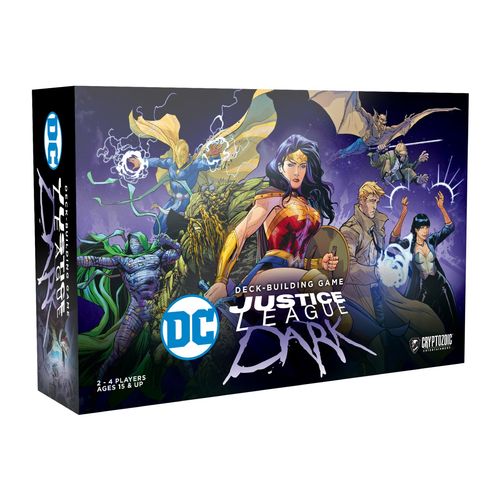
DC Deck-Building Game: Justice League Dark
DC Deck-Building Game: Justice League Dark Rulebook
Table of Contents
Table of Contents
Contents
- 215 Game Cards
- 40 Starter Cards
- 107 Main Deck Cards
- 12 Mystic Ritual Cards
- 16 Weakness Cards
- 29 Transformed Cards
- 10 Nemesis Cards
- 1 Randomizer Card
- 8 Oversized DC Character Cards
- 4 Seal Tokens
- 1 Rulebook
- 1 Multiverse Divider
Card Details
The different card types that you can play are: Starter, Villain, Hero, Super Power, Location, and Equipment. Weakness and Mystic Ritual cards have no card type.
Transformation Zone
Cards in this zone cannot be purchased and are only gained by specific card effects. Transformed cards have a black textbox with magical flair as well as the "Transformed" subtype to the right of their card type.
The Stacks
The Stacks hold the Mystic Ritual cards, the Weakness cards, and the Nemesis cards (standard-sized Super-Villain and Super Hero cards).
Main Deck Cards
Main Deck cards show a Card Type, Victory Points, Abilities, and Cost. A card's Card Type is shown at the bottom-left of the card, and its Cost is shown at the bottom-right.
Setup
1. Your Character and Starting Deck
Each player is dealt 2 random oversized Character cards and chooses 1 of them to play. Alternatively, each player may choose to play as their favorite Character. Return the unused Characters to the game box. Each player also takes a Seal token of their choice.
Each player begins the game with a starting deck of 6 Punch cards, 2 Vulnerability cards, 1 Incantation card, and 1 Sealed Defense card. Return any unused Starters to the game box.
2. Transformed Cards
Transformed cards have a black textbox with magical flair as well as the "Transformed" subtype to the right of their card type. Take all of the Transformed cards and make 4 separate stacks of them based on their card type. You may find it useful to sort the cards in each stack alphabetically so they're easier to find during the game. Cards in this zone cannot be purchased and are only gained by specific card effects.
3. The Main Deck
Most of the cards that you will add to your deck during the game come from the main deck. Set aside all Mystic Ritual, Weakness, and Nemesis cards. Shuffle the remaining Hero, Villain, Equipment, Location, and Super Power cards together and place them in the middle of the table. (Reminder: There should be no cards with a black textbox in the main deck at the start of the game.) This forms the main deck, which is made up of 107 cards total.
4. The Line-Up and Stacks
After shuffling the main deck, place the top 5 cards from the main deck into a row below the Transformation Zone to form the Line-Up. There is no board necessary to play this game; just reserve space for each card. Next, place the Mystic Ritual and Weakness stacks at the end of the Line-Up. Rotate these stacks to help distinguish them from the Line-Up cards. The main deck, the stacks of cards on the end, and Transformation Zone are not part of the Line-Up.
5. The Nemesis Stack
The term Nemesis is used to collectively refer to the standard-sized Super-Villain and Super Hero cards used to create the Nemesis stack. While all of the Nemesis cards in this set are Super-Villains, other sets (including the Justice League Dark Expansion) have Nemesis cards that are Super Heroes. You are free to use only Super-Villains, only Super Heroes, or a mix of both when forming the Nemesis stack.
Sort the standard-sized Nemesis cards by their Level and shuffle each facedown stack separately. (You may notice that some of these cards have a blue back. The different color is to help remind you that this card will always be the last in the stack.) Take the Level 4 Nemesis cards and place one of them face down next to the Mystic Ritual stack. Then, take two Level 3 Nemesis cards and put them face down on top of the Level 4 card. Next, take three Level 2 Nemesis cards and put them face down on the Nemesis stack. Finally, take one Level 1 Nemesis card and put it on top of the stack face up.
Once you have arranged the main deck, Line-Up, and stacks, it will look something like the below image. At the start of the game, there should be 12 Mystic Ritual and 16 Weakness cards in their respective stacks.
Your opening five cards in the Line-Up will vary.
6. First Player
The player who most recently read a comic book gets to go first. Alternatively, you can determine first player randomly. Each player shuffles their 10-card starting deck and draws 5 cards.
Gameplay Overview
Players take turns in clockwise order. You take your turn by playing cards from your hand face up in front of you for all players to see. Any game text on the card resolves immediately from top to bottom. This will generate Power (the "currency" of the game) and other abilities. After you play a card, leave it in your play zone in front of you. Do not put the cards you play directly into your discard pile.
Each turn, you may spend the Power you generate to buy cards from the Line-Up, Mystic Ritual stack, and/or the top of the Nemesis stack to improve your deck. You cannot buy cards from the Transformation Zone. All cards you gain are immediately placed into your face-up discard pile unless you are instructed otherwise. Discard piles are always face up and may be looked through at any time. You do not have to play all of the cards in your hand before you start to buy cards and may play additional cards after you have started to purchase cards.
You can buy any number of available cards with combined cost less than or equal to the total Power you have generated this turn. For example, your Punch cards each give you +1 Power. If you play 4 of them and a Vulnerability, which generates no Power, your total Power for the turn is 4. You can buy a single card with cost 2, 3, or 4, or even 2 cards each with cost 2, assuming these options are available. Mystic Ritual cards are (usually) available if the cards in the Line-Up are too expensive, and you may buy more than 1 during your turn.
You may choose to end your turn when you are done playing and buying cards. You do not have to play all the cards in your hand or spend all of your Power before ending your turn. However, you cannot carry over cards you do not play to your next turn and any Power you do not spend is lost. So, it's normally a good idea to play all your cards and spend as much of your Power as you can.
Once you have finished your turn, you will refresh the game area and draw 5 cards from your deck. The player to your left will then begin their turn.
Ending Your Turn
When you end your turn, resolve the following steps in order:
- Announce that you are ending your turn. Your turn is now over.
- Put any cards remaining in your hand into your discard pile.
- Resolve all "end of turn" abilities in any order you choose.
- Put all non-Ongoing cards you played into your discard pile. Any unspent Power is lost.
- Draw 5 cards from your deck.
- If there are fewer than 5 cards in the Line-Up, add cards from the top of the main deck to the Line-Up until there are 5 cards.
- If the top card of the Nemesis stack is face down, flip it up and read aloud its "First Appearance — Attack."
- The next player in the turn sequence starts their turn.
Resolving Card Abilities
When an ability tells you to draw a card, that card is always drawn from your own deck. If you cannot fully resolve the text on a card, resolve as much of it as possible. When you play a card that triggers another ability, like on your Character, fully resolve the card you are playing before resolving any secondary abilities triggered by your card play. If you have multiple triggered abilities, you resolve them in any order you choose.
If a card's ability affects multiple players, and the order matters (for example, each player gaining a Weakness, with only 1 Weakness remaining in the stack), resolve that ability for each affected player in clockwise order, starting with the active player.
Shuffling Your Deck
You don't shuffle your discard pile and make it into your deck as soon as you run out of cards. However, if at any point during the game there are no cards in your deck and you need to draw, discard, or reveal a card from your deck, immediately shuffle your discard pile, and it becomes your new deck. Then, carry out the action.
Sample Turn Sequence
After shuffling up your starting cards, you draw a hand of 4 Punch cards and 1 Vulnerability for your first turn. You may play the 4 Punch cards for a total of 4 Power, which is enough to buy Word of Power from the Line-Up. After buying that card, you put it into your discard pile. The Vulnerability provides you with no additional Power. You have no Power left to buy additional cards and no other cards to play, so you can end your turn. Put all of the cards you have played into your discard pile and then draw a new hand of 5 cards. After refilling the Line-Up, the next player starts their turn.
End of Game
The game ends when either of the following conditions is met:
- At the end of the turn in which the last Nemesis is defeated.
- Immediately if you are unable to refill the Line-Up to 5 cards.
At the end of the game, all players return all Ongoing cards they have in play, all cards in their hands, and all cards in their discard piles to their decks. Then, each player totals up the Victory Points on cards in their deck and score pile. Remember that Weakness cards will subtract their VP values from your VPs.
The player with the highest VP total wins! In case of a tie, the tied player with more Nemesis cards wins. If there is still a tie, the tied player with the greater number of cards in their deck wins.
Additional Rules
Controlling Cards
You control the cards in your play zone. These include the cards you played this turn and Ongoing cards still in play from a previous turn. You do not control cards in your hand, deck, discard pile, or score pile.
Attack and Defense Cards
Attack cards have the bold keyword "Attack:" in their game text and allow you to directly Attack your foes. When you play a card with an Attack ability, it will either affect all your foes or a foe of your choice, signified by the word "target." Starting with the foe to the attacker's left, each affected foe has an opportunity to avoid the Attack with a Defense card. After each player has decided whether they will defend or not, each player that didn't avoid the Attack is affected by the text after "Attack:". If an Attack is unavoidable, that means players may not use a Defense card and must resolve the negative effects of the Attack.
Defense cards have the bold keyword "Defense:" in their game text and allow you to avoid the negative effects of an Attack card played by a foe. In order to use a Defense card, it must be in your hand. A player may utilize only 1 Defense card per Attack. Most Defense cards give you a reward when you use them to avoid an Attack. The reward is listed after "If you do" on your Defense card. This text is ignored when playing a Defense card during your turn.
Discarding a Defense card to avoid an Attack is not considered playing the card. Avoiding an Attack does not negate any of the Attack card's text prior to "Attack:" (like "Draw a card" or "+3 Power"). If an Attack would have no effect on a player, such as gaining a Weakness when the stack is empty, you may still use a Defense against it to gain the Defense reward.
Nemesis Cards
The term Nemesis collectively refers to the standard-sized cards with the Super-Villain and Super Hero subtypes (middle-right of the card). These 3 terms should be considered interchangeable. If a card specifically affects Super-Villains, it also affects Super Heroes and vice versa.
During your turn, you can spend Power equal to the cost of the top card of the Nemesis stack to defeat that Nemesis. If you do, gain the topmost face-up card from the Nemesis stack and place it into your score pile. Then, resolve the text after the keyword "Reward:" in that card's game text. These cards offer immediate abilities and are worth a lot of VPs at the end of the game. The next card in the Nemesis stack remains face down until your turn is over, so you may only defeat 1 Nemesis per turn. Nemesis cards in this set do not have an ability when played. If an effect causes you to play a Nemesis card, it has no inherent ability but does count as being played and can trigger other abilities.
During the End of Turn procedure, if the top card of the Nemesis stack is face down, the next Nemesis card in the stack is flipped face up and it Attacks every player. Read aloud the text after "First Appearance — Attack:" and each player in turn order, starting with the player who defeated the Nemesis, has the option to avoid the Attack with a Defense card. After each player has decided if they will defend, the players resolve the Attack in the same turn order. These Attacks are considered to happen between turns, so abilities that occur during a player's turn may not be used here.
Destroying Cards
Some cards give you the ability to destroy a card from your hand, your deck, the Line-Up, etc. When you destroy a card, place it into a face-up pile of destroyed cards anywhere away from the play area to show that it is no longer a part of the zone it came from. Destroying Starter and Weakness cards will improve your deck greatly! Return any destroyed Weakness and Mystic Ritual cards to their respective stacks.
Discarding Cards
When a card tells you to "discard" a card, it means from your hand as the default. However, a card may tell you to discard a card from another place, such as the top of your deck. Cards that are discarded this way count as being "discarded."
Gaining Cards
Gaining a card is the process of taking ownership of that card. This occurs most often when you purchase a card by paying its cost. When a card tells a player to gain a card, that card is taken and immediately placed into that player's discard pile at no additional cost, unless otherwise directed. Sealing a card you do not already own or being passed a card also causes you to gain that card.
Ongoing
Some cards have the keyword "Ongoing:" in their game text. Ongoing cards go straight to your discard pile when gained, just like any other card. However, when you later draw and play an Ongoing card, that card will remain face up and in play in front of you for the rest of the game. Ongoing cards are not put into your discard pile at the end of your turn like all of the other cards you play. An Ongoing card counts as "played" only on the turn in which it entered play. The text after the word "Ongoing:" is not active while the card is in your hand, your discard pile, or the Line-Up and is only active for you while the card remains in play. The Ongoing ability may be used every turn. You may have any number of Ongoing cards in play at once.
Owner
A player owns all cards in their hand, deck, discard pile, and score pile. A player also owns the cards they played this turn and Ongoing cards from previous turns. A player becomes the owner of a card when they buy it, gain it, or are passed it. Sealing a card from the main deck, Line-Up, destroyed pile, or another player's zone causes you to become the owner of that card.
Oversized Character Cards
Your Character gives you access to 1 or more unique abilities. Most abilities can only be used on your turn, but some of them function during other players' turns as well. You should keep your ability in mind when deciding what cards to add to your deck. Some Characters are labeled as Super Heroes and others as Super-Villains. Those tags have no in-game function and only serve thematic purposes.
Payment Abilities
Some Characters have a payment ability as indicated by a bolded action followed by a colon at the start of a sentence. These abilities can only be used during a player's turn and may be used any number of times unless otherwise stated.
For example, during Swamp Thing's turn, he can discard a non-Weakness card from his hand. Doing so allows him to add the top card of the main deck to the Line-Up. This ability does not have a limit printed on it, so he can do it multiple times in the same turn.
New Concepts
Surge
When a card tells you to Surge, add the top card of the main deck to the Line-Up. This can cause the Line-Up to increase above 5 cards. Note that Surging while there are no cards in the main deck does not cause the game to end.
Score Pile
Each player has their own score pile where they place their Sealed cards. You own but do not control the cards in your score pile. They are not part of your deck, and you will not be able to play those cards without a special card ability. When you would gain a card with the Reward keyword (such as on a Nemesis card), it goes into your score pile instead of your discard pile. At the end of the game, the cards in your score pile are also counted for your final score. If a card you do not own enters your score pile, you are considered to gain that card.
Sealing Cards
When a card tells you to Seal a card, place that card into your score pile. The card's ability will always tell you what zone(s) the card can be Sealed from. When the word Seal is bold, it gives a player the ability to Seal a card. When you see the word Seal without bold, that means it is part of an ability that triggers when a card is Sealed. If you Seal a card you do not own (such as from the Line-Up or main deck), you are considered to gain that card. If an ability refers to a "Sealed" card, it refers to the cards in your score pile, unless otherwise stated.
Blue Banner Text
Some cards have a blue banner at the top of their text box. The text on the blue banner only matters after the card moves between certain zones, such as entering your score pile or the destroyed pile. That text is not resolved when you play the card.
When you play Word of Power from your hand, you ignore the text on the blue banner and it generates +2 Power. If you discard Word of Power from your hand or deck, you draw a card from your deck. If you play a card that Seals Word of Power from the Line-Up or another zone, you draw a card from your deck.
Transforming Cards
A Transform card has the bold keyword "Transform:" in its game text. If you meet the special condition on a Transform card when you play it, you gain access to a specific card. You must meet the Transformation condition when you play the card; meeting the condition later in your turn does not allow you to Transform the card. Transforming a card always causes you to Seal the Transform card. After placing the card in your score pile, you will gain a new card directly into your hand unless otherwise stated.
- First, check to see if the card named in the Transform text is in your score pile. If it is there, gain that card.
- If the named card is not in your score pile, check the Transformation Zone. If the card is there, gain it.
- If the named card is not in the Transformation Zone, check the destroyed pile. If the card is there, gain it.
- Finally, if the named card is not in any of the above zones, you do not gain a card. (Note: You are free to check these zones before choosing to Transform a card.)
Anything that triggered off of playing the card now resolves. If you do not Transform the card when you play it, you will resolve the "Otherwise" text below the Transform ability. Note that the Transformed version of a card can have a different card type than its original card. The star watermark in the card's textbox is a visual indicator of the other version's card type.
When you play Billy Batson, Chosen, you must decide if you want to discard a Super Power or not. If you do, immediately put Billy Batson into your score pile. You then check and see that Shazam! Champion of Magic is not in your score pile. Since Shazam! is not in your score pile, you gain Shazam! from the Transformation Zone and put him into your hand. You no longer control Billy Batson. If you had chosen not to discard a Super Power, you would have generated +1 Power instead.
Reverting Cards
Transformed cards with the Revert keyword may not permanently stay in their Transformed state. This keyword is similar to the Transform keyword but different in a few important ways. Reverting a card is never optional. If you meet the Revert condition on a Transformed card, you must Revert it. The Revert card immediately goes to your score pile, which means you no longer control the card. Any abilities on the card prior to the Revert keyword remain and anything that triggered off of playing the card now resolves. (Note that if you really don't want to Revert a card, you can choose not to play it.) Another important difference is that when a card Reverts, the card you gain from it Reverting can only come from your score pile. If you do not have a card of the name listed in the Revert text in your score pile, the card still Reverts, and you do not gain any card. Finally, the card that you gain from your score pile goes to your discard pile instead of your hand like it does with a Transform card.
If you do not have a Super Power in your discard pile when you play Shazam! Champion of Magic, he immediately Reverts. Shazam! goes to your score pile. While you no longer control him, you do still retain the +3 Power he generated. If Billy Batson, Chosen is in your score pile, you move Billy into your discard pile. If not, nothing else happens.
Weakness
Some cards force players to gain 1 or more Weakness cards. If this happens, each affected player takes the indicated number of Weakness cards from the Weakness stack and places them into their discard pile, effectively adding them to their deck. If the Weakness stack runs out, abilities that would cause a player to gain a Weakness do not do so, but any other abilities those cards have still resolve as usual. A player may still use a Defense card to avoid an Attack, even when there are no Weakness cards available to be gained.
Weakness cards in Justice League Dark reduce your score at the end of the game by 2 VPs! While these cards have larger penalties than previous games, they also have a built-in way to get rid of them. During your turn, you may choose to play the Weakness card from your hand and discard 2 other cards to return the Weakness card to its stack. Note that if you have multiple Weakness cards in your hand, you will need to discard 2 cards for each Weakness you wish to return to its stack.
Play Mode Variants
Short Game
Playing with new players or short on time? This variant shortens the overall game length. Remove the Level 4 Nemesis from the Nemesis stack.
Extended Game
Want your game to be an epic marathon? This variant lengthens the overall game time. Add an additional Level 3 and Level 2 Nemesis to the Nemesis stack.
(Not recommended for new players.)
Mixing in Cards from Other Sets
Justice League Dark is compatible with other DC Deck-Building Game products. Here are a few recommendations for setting up a game with mixed sets.
- When setting up the main deck, feel free to mix in the cards from any one of the Crossover or Crisis expansions. If you want to customize the cards in the main deck, we recommend not going over 150 cards. If you wish to add additional new cards, you should remove cards with similar types and costs.
- Any standard-sized Super-Villain and Super Hero cards can be mixed into the Nemesis stack. When building the Nemesis stack, treat these cards as having a Level based on their cost:
| Cost | 8 | 9 or 10 | 11 or 12 | 13+ |
|---|---|---|---|---|
| Level | 1 | 2 | 3 | 4 |
Additional Players
You can use additional Starter cards (from another set) to play Justice League Dark with more than 4 players.
If you are playing with 5 players, use 1 less Level 3 Nemesis than you would in a 4-player game.
If you are playing with 6 players, we recommend using the World Hopper rules found in the Multiverse expansion and the same number of Nemesis cards as a 3-player game.
Specific Card Clarifications
Black Adam, Corrupted: Since Mystic Ritual and Weakness cards do not have a card type, they are not considered different for this card's ability and cannot be put into your hand.
Floronic Man, Woodrue: If you Seal a Location you control because of Houdini Key, that Location is returned to its previous zone at the end of your turn.
Houdini Key / New Avatar of the Green: The Location remains in the same zone it was in. You do not "gain" the Location when you take control of it.
Enchantress, Dzamor: This card's Transform ability occurs when it is used to avoid an Attack. This card cannot be Transformed when played. If you use this Defense to avoid a Nemesis Attack, the Nemesis card is not Sealed.
Magical Shield: Since the Defense ability on this card is part of its Ongoing ability, you can only use it to avoid an Attack while you control it. You cannot use it to avoid an Attack while it is in your hand.
Mordru: This card's Reward allows you to Transform a card without meeting its prerequisite. Seal the card you are Transforming and gain its Transformed version. If the Transform card has multiple Transformed options, you can choose any one of them. Note that the gained card goes to your discard pile instead of your hand.
Nergal: Treat negative VP values as zero for this card's Attack.
Raeppasid: When resolving this card's Defense reward, you may not choose to put this card on the bottom of your deck.
Zatanna Zatara (Hero): If the card you played leaves your play area (because it was destroyed, Sealed, etc.), you cannot play it a second time.
Oversized Character Clarifications
Ragman / Wonder Woman: You do not need to play both cards listed in their ability to Seal a card. The ability of each Character allows you to Seal a maximum of 1 card per turn.
You are playing as Ragman. If you play a 5-cost Hero and no Equipment, you can Seal 1 card with cost less than 5. If you play a 4-cost Equipment and no Hero, you can Seal 1 card with cost less than 4. Playing a 5-cost Equipment and a 4-cost Hero still only lets you Seal 1 card with cost less than 5.
Components
In the box you will find two special components. These are for the DC Deck-Building Game: Multiverse Box, a large and sturdy box that you can use to store your DC Deck-Building Game cards.
The plastic Multiverse Divider is used in the box to keep your Justice League Dark cards separate from the rest. The Randomizer card is used in a special Multiverse game format, in which you get to use your entire collection! The Multiverse Box also includes over 50 new cards that enhance this game format.