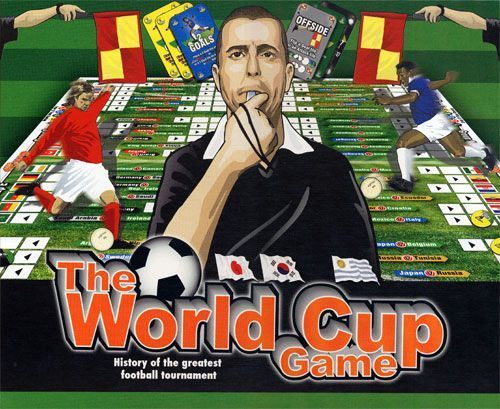
The World Cup Game
The World Cup Game Rulebook
Table of Contents
Table of Contents
- I. Object of the game
- II. Components
- III. The Game Boards
- IV. Preparing for play
- V. Starting the game
- VI. Action cards and Action tiles
- VII. Protected and Vulnerable Attack tiles and Goal tiles
- VIII. Ending the round
- IX. Equal points and replays in the Group stage (1930 World Cup)
- X. Dividing teams on equal points (2002 World Cup)
- XI. Subsequent rounds
- XI. Drawn games in the 2002 Knock out rounds
- Quick start rules!
I. Object of the game
To win the World Cup! The player controlling the team that wins the World Cup Final, wins the game. To do this each player will control a number of teams. Through the play of cards you will score goals for your teams as well as using the power of the match officials to remove goals for infringements. Guide your teams through the rounds to get them as far as possible and hopefully, to the FINAL itself.
II. Components
THE WORLD CUP GAME box contains all the components needed to play the 1930 and 2002 World Cup games.
- 1 x Game board for the 2002 World Cup group stages (Board 1)
- 1 x Game board for the 1930 World Cup and Knock-out stages of the 2002 World Cup (Board 2)
- 74 National team flag tiles – 2 of each team taking part in either or both World Cup games
- 182 Circular Action tiles divided as follows – 50 x Attack, 40 x Defence, 60 x '1 Goal', 18 x '2 Goal', 6 x '3 Goal' and 8 x 'P' (Penalty) tiles.
- 87 Action cards divided as follows – 25 x Attack, 20 x Defence, 12 x '1 Goal', 6 x '2 Goal', 4 x Foul, 4 x Offside, 4 x Penalty, 3 x '3 Goal', 3 x '2+1 Goal', 3 x '1+1+1 Goal' and 3 x '1+1 Goal'.
- 4 dice – 2 White and 2 Natural. The faces are coloured with a single spot as follows:-
- First White die: 2 Black, 2 Red, 1 Blue, 1 Green
- Second White die: 2 Black, 1 Red, 1 Blue, 1 Green, 1 Yellow
- First Natural die: 3 Black, 2 Red, 1 Blue
- Second Natural die: 1 each of Black, Red, Blue, Green, Yellow, White
- 36 Plastic coloured football pieces: 2 Black, 2 Red, 7 Blue, 14 Green, 7 Yellow and 4 White.
- 3 Score sheets – one double-sided sheet for the 1930 World Cup and two double-sided sheets for the 2002 World Cup. Please ensure that you copy these sheets for future use.
- 1 Rulebook
III. The Game Boards
There are 2 game boards. Each board is a graphical representation of the format for the 1930 and 2002 World Cup tournaments.
a) Board 1 has 8 'Groups' represented by the letters A through to H. Within each group are 6 matches to be played by the 4 teams in that group – 3 matches each (1 match against each other team in the group).
b) Board 2 is divided into two distinct coloured areas. The green half of the board shows the format of the group stages for the 2002 World Cup. The brown half of the board shows the complete format for the 1930 World Cup with all group stages, Semi-Finals and Final.
The green half is sub-divided into progressively smaller groups: Round of 16, Quarter-Finals, Semi-Finals, 3rd Place and Final. The brown half has 4 groups, numbered 1 to 4; Group 1 with 6 matches and Groups 2, 3 and 4 with 3 matches. Again each team plays one match against every other team in the group.
c) Each national team taking part is printed on a particular colour. These colours represent the rankings of the teams based on their actual performance during that World Cup. The ranking colours are in order from best to worst: Black, Red, Blue, Green, Yellow, Grey. Each team has a number of squares adjacent to the name of the national team. These are called the 'playing squares' where the circular action tiles are placed during the game. The Black and Red teams have 4 squares, the Blue and Green teams have 3 squares, the Yellow and Grey teams have just 2 squares. The more squares a team has, the more tiles may be placed on that team and therefore the more goals it may potentially score. Furthermore, the National flag of each team is printed on the outermost square for ease of identification.
(A snapshot of part of Board 2 in the original rulebook calls out these features: Playing squares; open circles for placing football pieces; coloured spots where National team flags are placed; team ranking indicator; arrows indicating the first 'inside' square and direction of placement of Action tiles; National team flags (Argentina shown as an example); name of team (background colour determines rank, e.g. France on Yellow); group identity.)
d) The later rounds in each World Cup have 5 squares per team with coloured spots in some of the squares. Not all squares are used. Teams progressing from the group stage to the next round will have their national flag tile placed on the square with the corresponding coloured spot, leaving between 2 and 4 playing squares, according to team ranking. For example, in the 2002 World Cup, Germany win Group E and Rep. Ireland are runners-up. The duplicate German national flag tile is placed on the square with the Black spot to the left of 'Winner E' in the Round of 16 (Match 1). A Black football piece is placed on the open circle underneath the wording 'Winner E' to highlight that Germany is ranked 'Black'. The duplicate Rep. Ireland national flag tile is placed on the square with the green spot to the right of '2nd E' in the Round of 16 (Match 4). A Green football piece is placed on the open circle underneath the wording '2nd E' to highlight that Rep. Ireland is ranked 'Green'.
The number of squares from the arrow to the coloured spot represent the number of playing squares available. In the example above Germany will have four playable squares and the Rep. Ireland will have three playable squares. The square on which the national flag tile is placed and any square(s) to the outside edge are NOT playable squares in the knock-out rounds i.e. you cannot place action tiles on these squares.
IV. Preparing for play
a) Place the relevant board in the middle of the table. For the 1930 World Cup Game use the Brown coloured half of Board 2 which has the flag and name of the host Uruguay 1930 around the edge. For the 2002 World Cup Game place Board 1, showing the groups stages, in the middle of the table. This board shows all groups from A to H and all matches that are to take place during the group stage. Set aside Board 2 for the moment.
b) Sort the National flag tiles so that you have two each of every team participating in this particular World Cup. The teams for each World Cup are as follows:-
1930: Argentina, Belgium, Bolivia, Brazil, Chile, France, Mexico, Paraguay, Peru, Romania, USA, Uruguay and Yugoslavia – 13 teams in all
2002: Argentina, Belgium, Brazil, Cameroon, China, Costa Rica, Croatia, Denmark, Ecuador, England, France, Germany, Rep. Ireland, Italy, Japan, South Korea, Mexico, Nigeria, Paraguay, Poland, Portugal, Russia, Saudi Arabia, Senegal, Slovenia, South Africa, Spain, Sweden, Tunisia, Turkey, USA and Uruguay – 32 teams in all.
c) Place one tile of each team in an opaque cup or bag. Set aside all the duplicate National team tiles for now. The teams need to be divided as evenly as possible between all the players.
Example: If you have 5 players playing the 2002 World Cup, each player will have at least 6 teams (32 teams divided by 5 players = 6.4). Each player then takes (without looking) the relevant number of tiles out of the cup or bag according to the number determined. The remaining two teams will go to those players who have drawn the grey coloured teams on the board (China and Saudi Arabia in the 2002 game; Mexico and Bolivia in the 1930 game). If there are still teams left, give them to players with any teams marked in Yellow lettering on the board, but not to those who have already received an extra team. If there are more eligible players than teams remaining, the players with the lower ranked mix of teams should get the additional team(s). Some players may have more teams than others but no player may have more than one extra team.
Example: 5 players draw the following sets of teams:
- Player 1 gets Brazil, Costa Rica, Russia, Saudi Arabia, South Africa, USA
- Player 2 gets Argentina, Croatia, Japan, Nigeria, Senegal, Spain
- Player 3 gets Cameroon, Denmark, England, Rep. Ireland, Portugal, Slovenia
- Player 4 gets Belgium, France, Italy, Mexico, Poland, Sweden
- Player 5 gets Ecuador, Germany, South Korea, Paraguay, Tunisia, Uruguay
This leaves China and Turkey to be allocated. As player 1 has Saudi Arabia (a Grey ranked team), he chooses an extra team. Players 2, 3 and 5 are eligible for the last team as they each have a Yellow ranked team. As player 5 has a Black ranked team (Germany), he is no longer eligible. Player 2 has three Blue ranked teams to Player 3 who has only one, so Player 3 should receive the final team.
All players place the National team tiles drawn face-up in front of them. It doesn't matter that players may have teams playing in the same groups.
d) Place the circular Attack, Defence, Goal and Penalty Action tiles in piles to the side of the board so that each player has access to all six types of action tile.
e) Each player receives one coloured football piece per team according to their colour rank. In the example above (Rule IV c), player 2 would receive 3 Blue, 2 Green and 1 Yellow football piece. These are placed in front of him which makes it easy to ascertain player strengths at a glance.
f) In the 1930 World Cup game, remove the following 9 cards from the deck of action cards as they are not used for this game: 3 x 1+1 Goal, 3 x 2+1 Goal and 3 x 1+1+1 Goal. The whole deck of action cards is used in the 2002 World Cup game.
g) One player shuffles the action cards and deals 3 cards face-down to each player, placing the remaining deck of cards face down by the side of the board within reach of all players. Players take their 3 cards in their hand but keep them hidden from the other players.
V. Starting the game
Each player's turn consists of (in order): Play a card / Execute an action / Take the top card from the unused deck of action cards
a) The player to the left of the dealer begins the game by playing one of his action cards face-up in front of him. He then takes the appropriate action indicated on the card. Once the action is completed he then places that action card beside the face-down deck (to start a discard pile) and takes the top card from the face-down deck to complete his turn. The next player to his left does the same and so on round the table. Play continues in this manner until the face-down deck is exhausted.
b) Only one card may be played or discarded per turn. Note that a player may discard a card, take no action and take the top card from the face-down deck. Actions are not compulsory (exception – see rules VI d, e, f)
VI. Action cards and Action tiles
The Action cards are divided into 11 different types (see Components). Six types of Action card correspond to the Six types of circular Action tiles. When an Action card is played, the player will take the corresponding Action tile and place it on the board. It must be placed on any available 'inside' playing square i.e. starting with the square with the arrow pointing away from the name of the team on whom it is being played. If that square is occupied, then the next adjacent square. Placement of tiles is from inside out towards the National flag. You may play a tile on ANY team not just your own teams.
(Each Action card in the original rulebook is illustrated with: Card title; Action Tile type; Colour code. Action Tiles correspond to Action Cards.)
Each Action card may be used as follows:
a) 3 Goals (Yellow): Place a 3 Goal tile on any available inside square. 3 Goal tiles may only be placed on teams shown in Black, Red or Blue. You may play a 3 Goal action card and choose to place a goal tile of a lower value than 3 on a lower ranked team. E.g. If you play a 3 goal action card on a Green team, you may only place a 2 Goal tile. On Yellow or Grey team you can only play a 1 Goal tile.
b) 2 Goals (Blue): Place a 2 Goal tile on any available inside square. 2 Goal tiles may only be placed on teams shown in Black, Red, Blue or Green. You may play a 2 Goal action card and choose to place a 1 Goal action tile on a Yellow or Grey team.
c) 1 Goal (Dark Green): Place a 1 Goal tile on any available inside square on any team.
d) 2+1 Goals (Blue and Green): On any available inside squares, place one 2 Goal tile and one 1 Goal tile on two different teams. The 2 Goal tile may only be placed on teams shown in Black, Red, Blue or Green. There is no option to place a 1 Goal action tile instead of the 2 Goal action tile with this card. Furthermore, if you place one of the Goal tiles you must place both i.e. a player must place both the 2 and 1 Goal tiles or none at all with this card.
e) 1+1+1 Goal (Pale Green): On any available inside squares, place three 1 Goal tiles on three different teams. If you place one of the Goal tiles you must place all three or none with this card.
f) 1+1 Goal (Mid Green): On any available inside squares, place two 1 Goal tiles on two different teams. If you place one of the Goal tiles you must place both or none with this card.
g) Attack (Red): Place an Attack tile on any available inside square. An Attack tile counts as 1/2 goal, so if two Attack tiles are placed on a team in the same match, that team is considered to have scored a goal. Single Attack tiles (1/2 goal) remaining on a team may prove useful at the end of the round – see Ending the round.
h) Defence (Purple): The player has two choices of action:- i. Place a Defence tile on any available inside square. A Defence tile can be used to 'protect' the goals you have scored – see Rule VII; or to fill a square to prevent your opponents from placing goals in that square. Defence tiles are never flipped or removed once placed. ii. Instead of placing a Defence tile, the player may 'flip' over any 'vulnerable' Attack tile – see Rule VII. The Attack tile is simply turned over but left in the square, rendering that square unplayable for the rest of the round. This voids the 1/2 goal.
i) Foul (Light Grey): Any 'vulnerable' goal may be flipped over voiding the goal (Disallowed for an infringement). If this is played on a 3 Goal or 2 Goal tile, the tile is still flipped over, but a new tile with a value of one less goal is placed in the adjacent square (remember play moves from the team name towards National flag) e.g. A 3 Goal tile is flipped over and a 2 Goal tile is placed in the adjacent square. It is perfectly possible to have a 3 Goal tile reduced to two, then one, then zero if other Foul/Offside cards are played on that team in the same match.
j) Offside (Dark Grey): As 'Foul' except that the player has the choice to flip an Attack tile instead of a Goal tile. [Note on Foul and Offside: If the tile to be flipped is a 3 Goal or 2 Goal tile and is on the last playable square for that team, the tile is simply removed and replaced with the next lowest goal tile].
k) Penalty (Black): A penalty has been awarded. The player chooses any team in any match and then rolls one white die to see if they have scored. Any colour except Black scores 1 Goal, so a 'P' (Penalty) tile is placed on that team. As penalties are permanent the tile is always 'protected' and may not be removed by Foul or Offside Actions, even if it is in a normally vulnerable position. 'P' (Penalty) tiles are worth 1 Goal.
Important: Only one tile may occupy any playing square at any time during the game.
VII. Protected and Vulnerable Attack tiles and Goal tiles
As all tiles are placed on the inside squares adjacent to any team, a player can protect any goals against 'Foul' or 'Offside' actions.
Any tile that is situated on the outer edge of the team squares is 'unprotected' and thus vulnerable to 'Foul' and 'Offside'. However this vulnerable tile protects any action tiles that have been previously placed 'inside' the tile, so they cannot be affected by 'Foul' or 'Offside' actions. Even if the outside tile is flipped over, the inside tiles are still protected.
In the example in the original rulebook, in the Mexico v. Italy match; Mexico has a 'Defence' tile on the outermost square so his Attack and 1 Goal tiles are protected. However, Italy only has a 1 Goal tile placed with no other tile on the adjacent outside square so is vulnerable to Foul and Offside cards.
VIII. Ending the round
a) Each World Cup will have a specified number of Action cards in the face-down deck e.g. In the 1930 World Cup, 1 deck of Action cards will be used for the group round (minus the 9 specified in rule IV f.) For the 2002 World Cup, 2 decks of Action cards will be used for the group round – once the first deck has been exhausted the discard pile is reshuffled and placed face-down to continue the round.
b) The round ends immediately the very last action card is picked up by a player, unless there are 9 or more players in the game. In this case another turn is played by each player. All players keep all 3 cards that they have in their hands to use in the next round. This will be just 2 cards in games with 9 or more players.
c) The scores for each match will need to be calculated to decide which team(s) go through to the next round. It is recommended that one player fills in the score sheet while the other players roll the modifying dice between them.
d) The modifying dice. Before the scores are finally recorded, extra goals might be scored (in added time!). For each group one player rolls all four dice. Each coloured spot rolled represents 1/2 goal to the team of that particular colour e.g. If 2 Blacks, 1 Blue and 1 Yellow are rolled, any Black team in the group gets another goal. The Blue and Yellow teams get 1/2 goal only if those teams have an odd number of Attack tiles, which together score an extra goal.
1 Attack + 1 Coloured spot on die = 1 goal.
The dice are rolled per group and all coloured spots apply to all relevant teams in all matches within that group.
Example: In Group 1 of the 1930 World Cup the dice are rolled resulting in 1 Black, 2 Red and 1 Yellow being rolled. This gives 1 additional Goal to Argentina (Red team) in all of their matches in this group. There are no Black teams in Group 1, so this roll is ignored. However, France is Yellow so adds 1/2 goal to all its matches. Only if France has one single Attack on any match will it score the extra goal. If France has two Attacks on any one match the dice roll is ignored as France would already have a goal for the two Attack tiles.
d) Add up all the goals scored in each match for each team and apply the relevant points for wins and draws. In the 1930 World Cup there are 2 points for a win and 1 point for a draw. In the 2002 World Cup there are 3 points for a win and 1 point for a draw. (A fixture sheet is included in the game which must be copied for multiple use). In the 1930 World Cup the top team from each group progresses to the Semi-Final. In the 2002 World Cup the top two teams progress to the Round of 16.
Ensure that your scoring is accurate.
IX. Equal points and replays in the Group stage (1930 World Cup)
In the 1930 World Cup group stage, any two or more teams who are level on points after all group matches have been played will need to replay their matches. Goal average and goal difference are not used in the 1930 World Cup.
E.g. In Group 4 the USA and Paraguay both end on 3 points. The match between these two teams will need to be replayed. It is quite possible that all teams within a group have drawn all their matches. In this case all matches will need to be replayed.
Procedure:
a) Remove all the Action tiles from the board.
b) Determine the number of matches that will need to be replayed. One player (preferably neutral) will shuffle the discard deck and deal 6 cards per replayed match face-down in front of him. For example, if there are three replays then an 18 card stack is dealt out.
c) The dealer then sets aside all the remaining cards and shuffles the smaller card deck that he has just dealt out in front of him, keeping the cards face down at all times. He then places this deck on the table to be used by the players who have teams involved in the replays. Only those players who have teams involved in the replays will play in this 'sub-phase'.
d) Beginning with the player to the left of the player who took the very last card at the end of the last round, play begins again. The same format is used: Play a card, execute the relevant action and draw a new card.
e) This continues around the table until the last card in the deck is picked up. At this point the replays end and the scores are determined.
f) This time the modifying dice are rolled only once for all replays, irrespective of whether they are in different groups.
g) If the games are drawn again, they will need a second replay following the procedure above. Further draws are continuously replayed until a winner emerges.
Once again all players should still have 3 cards held in their hands at the end of the round.
X. Dividing teams on equal points (2002 World Cup)
In the 2002 World Cup game, teams with equal points after the group round are divided in the order as follows:
i. Result of the match between those two teams, the winner is placed higher than the loser. If the match was drawn then…….
ii. Goal difference (total goals for minus total goals against in that group). If equal then……..
iii. The team that has scored the most goals. If equal then…….
iv. Randomly determined by the flip of a coin or whatever method the players wish to use.
There are no replays in the 2002 World Cup.
XI. Subsequent rounds
Note that any player with no teams left in the game at the end of a round is eliminated from the game and his hand of cards must be returned to the discard pile.
a) Remove all the Action tiles from the board back into their respective piles. For the 2002 World Cup, replace Board 1 with Board 2 showing the round of 16 through to the Final.
b) In the 1930 World Cup, the top four teams from each group progress to the Semi-Finals. Take the National flag tile for each successful team from the duplicate National team flag tiles and place it on the Semi-Finals section of the board according to the colour code corresponding to that team. E.g. If Chile were the winners of Group 1, the tile will be placed on the square containing the Green dot in the 'Winner 1' section. This leaves 3 playable squares to the right of the tile.
The controlling player places a corresponding coloured football piece on the open circle over the word 'Winner' to show the ranking colour. In the example above Chile are Green, so a green football piece is placed on the circle. This makes it easier to check the results after the modifying die rolls.
c) One player shuffles all the Action cards (not in the hands of the players) and deals a 12 card stack face down. If there were 9 or more original players, an extra card is dealt to each player from the rest of the deck (not the 12 card stack) so that all remaining players will start with 3 cards. Setting aside the rest of the cards, he shuffles the 12 cards and places them on the table for continuing play.
Play then continues starting with the player to the left of the last player to pick up the final card in the last round. Once the last card of the 12 Action cards has been picked up, the Semi-Final round immediately ends and the games are scored. Players keep their 3 cards in hand unless eliminated from the game. Again, the 4 modifying dice are rolled by one player and the half goals apply to both Semi-Final games. Scoring is exactly as in the group round.
d) If there are any drawn games a replay will have to take place to determine the winners as per the rule IX.
e) The National flag tiles of the two winning teams are placed in the 'FINAL' section (coloured gold) on their respective coloured spots on one of the squares either side of the 'FINAL' section. The corresponding coloured football piece is placed in the open circle below the word 'FINAL'.
f) In the Final there will only be two players left in the game. [It is possible for just one player to have both teams in the Final, in which case he has won the game, though he may wish to play through his cards to bring about a result for the Final]
g) One of the players (or an eliminated player) takes the remaining deck of Action cards, shuffles them and deals out 8 cards face-down. Setting aside the remaining deck he shuffles these 8 cards and places them on the table to continue play.
Play then continues starting with the player to the left of the last player to pick up the final card in the last round. As there are only 8 cards in the Action card deck, each player will have 4 turns.
h) Once the last card is picked up the World Cup Final ends. Again, the 4 modifying dice are rolled by one player and if applicable, the half goals apply to both teams. If the Final is drawn it must be replayed by going back to Rule g) above.
i) The winner of the FINAL match wins the World Cup and therefore wins the game!
j) In the 2002 World Cup the top two teams in each group will progress to the Round of 16. The completed score sheet will show which two teams have finished 1st and 2nd in their respective groups. Using this and the details on the board, place the duplicate National flag tiles on the corresponding squares with the coloured dots. For example, if Senegal won Group A, they would be placed on the left hand side of match 2 in the square with the blue dot (as Senegal are ranked 'blue'). If France were the runners-up in Group A, they would be placed on the right hand side of match 3 on the square with the green dot (as France are ranked 'green').
k) Once all the teams have been matched up for the Round of 16, one player will take the remaining deck of Action cards, shuffle them and then divide them into 2 roughly equal piles, always keeping the cards face-down. One pile is put aside and not used in this round, the other is used as the playing deck. If there were 9 or more original players, an extra card is dealt to each player from the deck to be set aside (not the playing stack) so that all remaining players will start with 3 cards.
Play then continues starting with the player to the left of the last player to pick up the final card in the last round. The same format is used: Play a card, take the relevant action and draw a new card.
Once the last card is picked up, the Round of 16 ends immediately – all players should have 3 cards still in their hands.
The 4 modifying dice are rolled by one player and the half goals applied to all games. All games are scored and recorded on the Results sheet.
l) Each winning team will progress to the Quarter-Finals and the National flag tile for each is removed from the Round of 16 section and placed in the corresponding match of the Quarter-Finals section. For example, the winner of match 1 in the Round of 16 will be placed on the left-hand side of match X in the Quarter-Finals. Any player with no team left in the tournament is eliminated and must add their cards to the discard pile.
m) Once all teams have been matched up for the Quarter-Finals, one player takes all the cards (not in any player's hand) and shuffles them, divides them in half, sets aside one of the halves then divides the remainder in half again so that you have a quarter of a deck. One of these quarters is set aside and one will be the deck used in this Quarter-Final round.
Play then continues starting with the player to the left of the last player to pick up the final card in the last round until the last card is picked up - all player should have 3 cards still in their hands.
The 4 modifying dice are rolled by one player and the half goals applied to all games. All games are scored and recorded on the Results sheet.
n) Each winning team will progress to the Semi-Finals. The National flag tile for each is removed from the Quarter-Final section and placed in the corresponding match of the Semi-Finals section e.g. the winner of match W will be placed on the left hand side of the first match in the Semi-Final section.
o) Once all 4 remaining teams have been matched up for the Semi-Finals, one player takes all the cards (not in any player's hand) and shuffles them, deals out 12 cards face-down in front of him then puts the remainder of the deck to one side. The 12 card deck is then shuffled and placed on the table to be used for the Semi-Final games. Play then continues as before until the last card is picked up - all players' should have 3 cards still in their hands.
The 4 modifying dice are rolled by one player and the half goals apply to both games. All games are scored and recorded on the Results sheet. At this point the losing semi-finalists National flag tiles are moved onto the '3rd place' match section and the winner's National flag tiles are placed on the 'Final' section, they are placed as usual on their corresponding coloured spots in the appropriate squares.
p) One player takes all the cards (not in any player's hand) and shuffles them, deals out 12 cards face-down in front of him then puts the remainder of the deck to one side. The 12 card deck is then shuffled and placed on the table to be used for the 3rd place game and Final together! The main difference in this last phase of the game is that you may not place action tiles on any match in which you are not involved. The normal rules for the multi-goal cards (2+1. 1+1+1 & 1+1) need not be adhered to. You may play one of these cards and place only one Action tile.
The 4 modifying dice are rolled by one player and the resulting half goals apply to both games.
q) The winner of the FINAL match wins the World Cup and therefore wins the game!
XI. Drawn games in the 2002 Knock out rounds
(Numbered as "XI" in the original rulebook, immediately following "XI. Subsequent rounds" above.)
All drawn games are played in order down the list of matches. The procedure is as penalties in the World Cup.
In the Round of 16, Quarter-Finals, Semi-Finals, 3rd place and Final, any drawn games are decided by penalties. Penalties are resolved by die rolls as follows:-
i. Each side takes one of the white dice. Each gets five alternate rolls of the dice. Beginning with the player who has the team on the left side of the match, each player rolls the die five times (In order to maintain the tension of the penalty shoot-out, the dice should be rolled by each player in turn). A penalty is scored if any colour is rolled, except black. Black means a missed penalty. It is advisable for a neutral player to keep track.
ii. Once each player has taken 5 rolls, the total number of penalties scored are added up and the team with the most penalties scored is the winner and progresses to the next round.
iii. If an equal number of penalties have been scored, a 'sudden death' play off begins. Each player now rolls in turn until one player misses (rolls Black). However, each player must have taken the same number of rolls, so even if the first player misses, the second player must still roll. Once one player scores and the other misses, the team that scored is the winner and progresses to the next round.
This ends the normal rules of play – enjoy the game!
Optional rule
Use of the modifying dice. You may wish to play the game without the modifying dice. This takes away some of the luck element in the game and may be preferred by some players. Please agree between all players beforehand if the dice are not going to be used. The dice must still be used for penalties and the penalty shoot outs.
Quick start rules!
The Quick start is for players who are familiar with games and the format of the Football World Cup and only need the basic outline of the rules in order to begin play.
- Decide on 1930 or 2002 World Cup to play.
- All teams are ranked Black, Red, Blue, Green, Yellow, Grey in that order. Black being the best teams and Grey the worst. The game system gives the Black teams a far greater chance of winning than the grey teams, but by skilful play and a little luck, lower ranked teams can prevail.
- Place relevant board on table with all Goal, Attack and Defence action tiles in accessible piles.
- Take one National flag tile for each participating country and randomly divide between players using any hidden method. Excess tiles go to players with the 'Grey' teams on the board, then the 'Yellow' teams until all tiles are allocated to a player. No player should have more than 1 extra team. These are the teams you will control throughout the game. The duplicate National flag tiles are kept aside for now.
- For each team controlled, take a corresponding coloured football piece.
- If playing the 1930 World Cup, remove all 9 multi-goal cards: 3 x (2+1, 1+1+1, 1+1)
- One player shuffles the Action cards and deals 3 cards face-down to each player. Each player looks at his hand but keeps it hidden from other players.
- Play begins with the player to the left of the dealer. A player's turn consist of three parts: a. Play a card (onto the discard pile) b. Execute the action associated with the card or do nothing c. Pick up the top card from the face-down deck
- Each action is executed as follows:- i. 1, 2 or 3 goal cards. Take the corresponding action tile and place it on any available square on any team (subject to conditions on the card). However, the tile must be placed on the innermost square of the team concerned. ii. Attack cards. Take an Attack action tile and place it on any available innermost square face up. This counts as 1/2 goal. iii. Defence cards. Two options are available:- a. Take a Defence action tile and place it on the innermost square of any team face up, or… b. Flip over any Attack tile already on the board that is 'vulnerable' - see below iv. Penalty cards. Choose a team, roll a white die; any colour except Black scores a goal. Place a 'P' (Penalty) action tile on the next available innermost square. A penalty action tile counts as 1 goal and is always 'protected' i.e. cannot be flipped by Foul or Offside action cards. v. Foul card. Flip over any Goal action tile that is 'vulnerable'. If this is a 2 or 3 Goal action tile, place an action tile of 1 goal less adjacent to the flipped tile e.g. If you do this on a 3 Goal tile, you place a 2 Goal tile face up and on the next adjacent square. If the goal tile targeted is in the last square (outermost) then instead of flipping the tile you replace the tile with one which is 1 goal less. vi. Offside card. As Foul except that you may flip an Attack tile instead – the same as option 'b' on Defence cards above.
What is vulnerable and what is protected?
Placement of action tiles is from inside out towards the National flag. As all tiles are placed on the inside squares adjacent to any team, a player can protect any goals against 'Foul' or 'Offside' actions.
Any tile that is situated on the outer edge of the team squares is 'unprotected' and thus vulnerable to 'Foul' and 'Offside'. However this vulnerable tile protects any action tiles that have been previously placed 'inside' the tile, so they cannot be affected by 'Foul' or 'Offside' actions. Even if the outside tile is flipped over, the inside tiles are still protected.
Note that you may play tiles on any team, not just your own. This can be useful to play strategically!
- Once all cards have been played – 1 deck for 1930, 2 full decks for 2002 – the round ends. All players keep their last 3 cards in their hand for the next round.
- Roll all 4 dice for each Group and apply 1/2 goal per coloured spot to each team of that colour. For instance if 2 Black, 1 Red and 1 Green spot are rolled, any Black team in that group will score a full goal. Any red or green team will score 1/2 goal, which can only be upgraded to a full goal if they have a single Attack tile on their squares. Each group has a separate dice roll, not each match!
- One player should complete the score sheet and work out the final table for each group by adding up all the goals scored for each team in each match. In 1930 it is 2 points for a win and 1 for a draw; in 2002 it is 3 points for a win and 1 for a draw.
- Any player without any teams left in the game is eliminated. His cards are returned to the discard stack.
- In the 1930 game the top team from each group progresses to the Semi-Finals. In the 2002 game the top two teams progress from each group to the Round of 16. The duplicate national team flag tiles of the successful teams are placed on the board in their respective match according to the description on the board. For example in the 2002 World Cup, the winners of Group A will be placed in Match 2 of the Round of 16. The national flag tile is placed on the corresponding coloured dot so that the correct number of playing squares are shown to the inside of the tile.
- The same format is used for each round:- a. Decide the matches to be played b. Determine how many cards make up the deck – see Rule XI Subsequent rounds above. c. Play the cards as you would the group stage; once the last card is taken roll the dice for the complete round (the dice are always rolled for all matches in the knock out stages of the game) d. On the score sheet record the results for each match. The winning team will then progress to the next round.
- In the 3rd place/Final round of the 2002 World Cup game, you may only play tiles on the match in which you have a team. You are not restricted by the multi-goal card rule as you may play just one action tile instead of 2 or 3 action tiles.