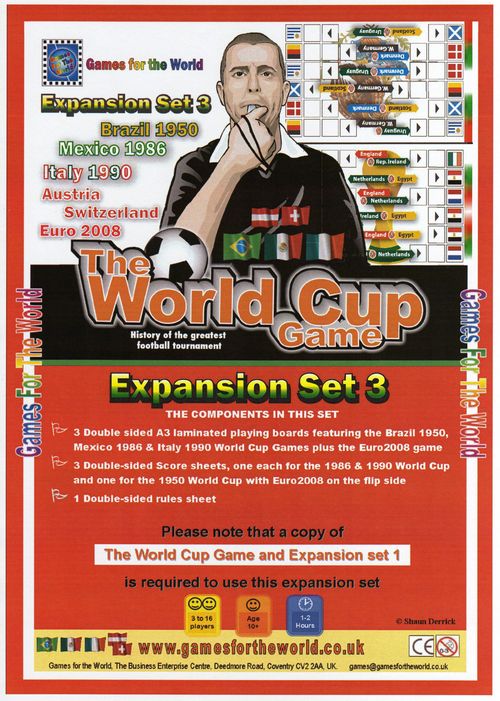
The World Cup Game: Expansion Set 3
The World Cup Game: Expansion Set 3 Rulebook
Table of Contents
Table of Contents
Notes on the Rules
The following rules replace or modify the existing rules. The 1950 World Cup was different from the 1986 and 1990 World Cups and from Euro 2008. The 1950 World Cup had a unique format. The 1986 and 1990 World Cups were identical to each other, but included 24 teams, with the two best teams in each group and the four best third-placed teams qualifying for the round of 16. Euro 2008 is very similar to the old 16-team format of the 1962-70 games, except for the qualification format and the penalty shoot-outs used to decide drawn matches.
(1950) The rules printed in green refer only to the 1950 World Cup.
(1986 and 1990) The rules printed in blue refer only to the 1986 and 1990 World Cups.
(Euro 2008) The rules printed in red refer only to Euro 2008.
The other components needed to play in any World Cup tournament are in the original game box and in Expansion Set 1.
Components
The Expansion Set 3 of THE WORLD CUP GAME contains the boards for the 1950, 1986 and 1990 World Cups and for the Euro 2008 European Championship.
- 1 x board for the 1950 World Cup, with the knockout stages of the 1986/1990 World Cups on the reverse.
- 1 x board for groups A to D of the 1986 World Cup, with groups A to D of the 1990 World Cup on the reverse.
- 1 x board for groups E to F of the 1986 and 1990 World Cups, with the group stages of Euro 2008 on the reverse.
- 3 result sheets: one for the 1986 World Cup, one for the 1990 World Cup, and one for the 1950 World Cup with Euro 2008 on the reverse. Please make copies of these sheets for future use.
- 1 rules sheet.
The Boards
In this expansion there are 3 game "boards", laminated on double-sided A3 sheets in the same style as the last expansions and the original box.
(Euro 2008) The Euro 2008 game is a novelty, since each team has been ranked according to the designers' predictions. However, the board has been modified to allow players to add their own rankings using the ball tokens from the original box. Of course, there are not enough ball tokens to cover all the required spaces, so you may need to use other coloured tokens from other games to complete it. There are no black or grey teams in the Euro 2008 game, so the decision to use these colours is left to the discretion of the players. Although the first box where the tokens are placed has been overlapped, this is STILL used for teams with a ranking in black or red. The Euro 2008 knockout stages are played on the 1958-1970 knockout board from Expansion Set 1.
On the reverse of the 1950 World Cup board are the knockout stages of the 1986/1990 games. There is one board with the first 4 groups of the 1986 World Cup, and on its reverse the first 4 groups of 1990. On another board there is the group stage of Euro 2008, and on its reverse the last two groups of 1986 and 1990.
(1986 and 1990) When you want to play the 1986 or 1990 World Cup, it is advisable that the half of the 1986/1990 groups E and F that are not being used be placed under the board for groups A to D, to avoid confusion. To make things a little clearer, the 1986 game has the Mexican emblem behind each group (an eagle and a serpent), while the 1990 game has a stylised version of the World Cup trophy behind each group.
(1950) The 1950 board uses a different format, since this World Cup was different from any other. The winners of each group qualify for a Final Common Group, which is played as a group: each team plays each other team once, and the group winner wins the World Cup. If you do not have spare flag tokens, you will need to place flag tokens on the spaces provided for the matches of the Final Common Group.
Preparing the Game
Sort the national flag tokens so that you have two of each team taking part in the World Cup you are playing. The teams for each World Cup are as follows:
- (1950) 1950: Bolivia, Brazil, Chile, England, Italy, Mexico, Paraguay, Spain, Sweden, Switzerland, USA, Uruguay and Yugoslavia.
- (1986 and 1990) 1986: Algeria, Argentina, Belgium, Brazil, Bulgaria, Canada, Denmark, England, France, Federal Republic of Germany, Hungary, Italy, Iraq, Mexico, Morocco, Northern Ireland, Paraguay, Poland, Portugal, Scotland, South Korea, Spain, USSR and Uruguay.
- (1986 and 1990) 1990: Argentina, Austria, Belgium, Brazil, Cameroon, Colombia, Costa Rica, Czechoslovakia, Egypt, England, Holland, Federal Republic of Germany, Italy, Republic of Ireland, Romania, Scotland, South Korea, Spain, Sweden, United Arab Emirates, USA, USSR, Uruguay and Yugoslavia.
- (Euro 2008) 2008: Austria, Croatia, Czech Republic, France, Germany, Greece, Italy, Holland, Poland, Portugal, Romania, Russia, Spain, Sweden, Switzerland and Turkey.
(1950) For 1950, remove all the multi-goal cards and use the rest of the deck for the group stages. Use half a deck for the 1950 Final Common Group.
(1986 and 1990) For 1986 and 1990, use half a deck. Remove all the 2+1 multi-goal cards and, once they have been played, remove all the 3-goal cards from the deck. In fact, the 3-goal cards are cards to be played "only at the beginning". This is done to reflect the low average number of points overall in these two tournaments. Once the deck has run out, shuffle again and use only half a deck for the rest of the group stage.
(Euro 2008) For Euro 2008, use the full deck.
End of Round
The 1950, 1986 and 1990 World Cups use 2 points for a win; Euro 2008 uses 3 points for a win.
(1950) In the 1950 World Cup, the winner of each group advances to the Final Common Group.
(1986 and 1990) In the 1986 and 1990 World Cups, the two best teams in each group and the 4 best third-placed teams advance to the round of 16. To determine the allocation of the third-placed teams, please use the following table.
(1986 and 1990) Example: In the 1986 World Cup, the team placed as best third-placed team is in groups A, B, E and F. Therefore the winner of B plays against the 3rd-placed team of A, the winner of C plays against the 3rd-placed team of B, the winner of D plays against the 3rd-placed team of F, and the winner of A plays against the 3rd-placed team of E.
| Best 3rd-placed groups | Winner B vs | Winner C vs | Winner D vs | Winner A vs |
|---|---|---|---|---|
| ABCD | C | A | B | D |
| ABCE | A | B | E | C |
| ABCF | A | B | F | C |
| ABDE | A | B | E | D |
| ABDF | A | B | F | D |
| ABEF |
(Euro 2008) For Euro 2008, the two best teams in each group advance to the quarter-finals. However, for the semi-finals, the winners of matches W and X will play each other, and the winners of Y and Z will play each other (this differs from the knockout boards of 1958 and 1970).
Tied Points
(1950) In 1950, teams that finish the group stage tied on points must replay their match. If 3 or 4 teams finish tied on points, all the matches in which they are involved must be replayed. The same applies to the Final Common Group.
(1986 and 1990) In 1986 and 1990, teams are separated by goal difference, then by goals scored, and then by a coin toss. Teams classified as best third-placed teams are separated in the same way.
(Euro 2008) In Euro 2008, teams that finish the group stage tied on points are separated in the following order:
- Goal difference.
- Greater number of goals scored.
- Result of the match between these two teams.
- At random.
Draws in the Knockout Rounds
This does not apply to 1950, but for 1986, 1990 and 2008 the "penalties" procedure continues, as in the 2002 World Cup.
Here end the additional rules required for this Expansion.