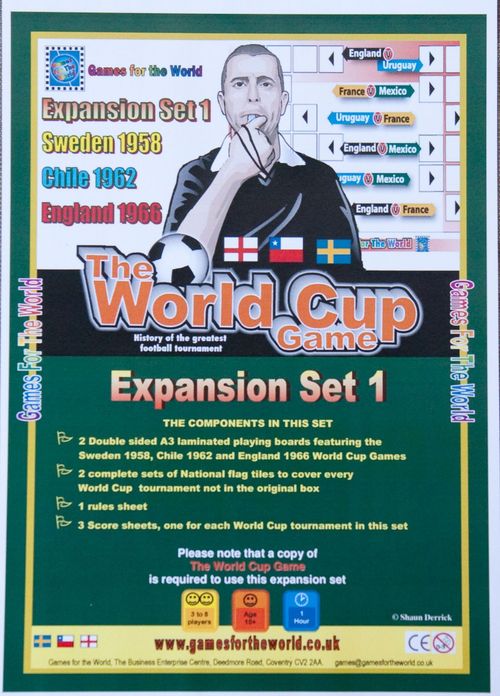
The World Cup Game: Expansion Set 1
The World Cup Game: Expansion Set 1 Rulebook
Table of Contents
Table of Contents
Notes on the Rules
The following rules replace or modify the existing rules. The 1958 World Cup was different from the 1962 and 1966 World Cups, so the rules printed in blue on the original sheet refer only to the 1958 World Cup, and the rules printed in red refer only to the 1962 and 1966 World Cups. In this transcription those colour cues are given as italic labels: (1958) and (1962 and 1966).
The other components needed to play any of those World Cups are in the original game box.
Components
The Expansion Set 1 of THE WORLD CUP GAME contains the components needed to play the 1958, 1962 and 1966 World Cups.
- 1 x Board for the group stages of the 1958 World Cup, with the group stages of the 1962 World Cup on the reverse.
- 1 x Board for the group stages of the 1966 World Cup, with the knockout stages of the 1958, 1962 and 1966 World Cups on the reverse. (Note that the future 1970 World Cup in Mexico will also use this knockout board.)
- 80 national flag tokens: 2 of each team that took part in the World Cups included in this expansion, which were not included in the starter box.
- 3 result sheets, one per World Cup, double-sided. Please make copies of these sheets for future use.
- 1 rules sheet.
The Boards
The group sections on both boards show 4 numbered "Groups", 1 to 4. Within each group there are 6 matches to be played by the 4 teams in that group: 3 matches for each team (1 match against each other team in the group).
The knockout section on the reverse of the 1966 group board shows the format of the quarter-finals, semi-finals, third place match and Final for all 3 games.
Preparing the Game
Sort the national flag tokens so that you have 2 of each team participating in that particular World Cup. The teams for each World Cup are as follows:
- 1958: Argentina, Austria, Brazil, Czechoslovakia, England, France, Federal Republic of Germany, Hungary, Mexico, Northern Ireland, Paraguay, Scotland, Sweden, USSR, Wales and Yugoslavia.
- 1962: Argentina, Brazil, Bulgaria, Chile, Colombia, Czechoslovakia, England, Federal Republic of Germany, Hungary, Italy, Mexico, Spain, Switzerland, USSR, Uruguay and Yugoslavia.
- 1966: Argentina, Brazil, Bulgaria, Chile, England, France, Federal Republic of Germany, Hungary, Italy, Mexico, North Korea, Portugal, Spain, Switzerland, USSR and Uruguay.
The entire deck of action cards is used in the 1958, 1962 and 1966 World Cups.
End of Round
Add up all the goals scored in each match for each team and apply the relevant points for a win or a draw. In the 1958, 1962 and 1966 World Cups there are 2 points for a win and 1 point for a draw. (A result sheet is included with the game; it is advisable to make copies so it can be used several times.) The two best teams in each group advance to the quarter-finals.
Tied Points and Replays
(1958) In the group stage of the 1958 World Cup, the following procedures apply to teams that finish tied on points.
Procedure:
- For teams that finish 1st and 2nd tied on points, they are separated by Goal Average. The number of goals scored is divided by the number of goals conceded. The team with the higher goal difference will be the group winner. (Transcriber's note: the sheet calls this "goal difference" but describes a scored-to-conceded ratio; the wording is kept as printed.)
- If a team has conceded no goals, its goal difference is infinite and it will finish as the group winner.
- If both teams have the same goal difference, the team that has scored more goals will be the group winner.
- If still tied, toss a coin!
- Teams that finish 2nd and 3rd with the same number of points must replay their match, regardless of goal average or goals scored. Follow the same replay rules as the 1930 World Cup. If the replay also ends in a draw, the match must be decided by tossing a coin. (Note: it is advisable to use this rule for the 1930 replays, so that a player who controls both teams cannot deliberately draw the matches to have more options for the next round.)
(1962 and 1966) In the 1962 and 1966 World Cups, teams tied on points after the group stage are separated in the following order:
- Goal Average (goal difference). Number of goals scored divided by number of goals conceded.
- If still tied, then:
- It is decided at random, by tossing a coin or by any other method the players choose.
(1962 and 1966) There are no replays in the 1962 or 1966 World Cups.
Following Rounds
Remove all action tokens from the board and replace the group stage board with the board showing the knockout stage on the reverse of the 1966 group board.
For the 1958, 1962 and 1966 World Cups, follow the same procedure as the quarter-final stage of the 2002 World Cup: use a quarter of the deck for the quarter-finals, 12 cards for the semi-finals, and so on.
Appendix for ALL World Cups: Multi-goal cards (e.g. 1+1 goal) do not need to be used for the semi-finals of a World Cup. The rule requiring full use applies only up to the quarter-final stage.
Draws in the Knockout Rounds
(1958) Matches drawn in the 1958 World Cup are replayed following the rules of the 1930 World Cup. However, if the draw continues in the second replay, a coin toss will decide the winner.
(1958) If the 1958 Final ends in a draw, the match is replayed continuously until there is a winner.
(1962 and 1966) In the 1962 and 1966 World Cups, all drawn matches are decided by a coin toss. The only exception is the Final, which must be replayed until there is a winner.
End of the additional rules required for this Expansion.