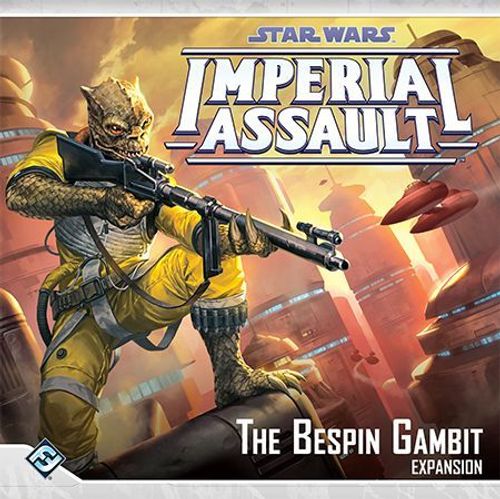
Star Wars: Imperial Assault – The Bespin Gambit
Star Wars: Imperial Assault – The Bespin Gambit Rulebook
Table of Contents
Table of Contents
Component List
- 11 Plastic Figures (2 Heroes, 3 Ugnaught Tinkerers, 6 Wing Guard)
- 12 Map Tiles
- 2 Hero Sheets
- 14 Deployment Cards (4 decks)
- 6 Agenda Cards
- 6 Side Mission Cards
- 6 Item Cards (3 decks, 2 in each)
- 18 Hero Class Cards (2 decks, 9 in each)
- 9 Imperial Class Cards
- 5 Reward Cards
- 2 Supply Cards
- 4 Command Cards
- 4 Condition Cards
- 10 Condition Tokens
- 3 Ally and Villain Tokens
- 3 Companion Tokens
- 3 Companion Cards
- 1 Skirmish Map Sheet
- 2 Skirmish Mission Cards
- 3 Damage Tokens
- 9 Strain Tokens
- 8 ID Tokens with 24 ID Stickers
Inside This Expansion
The Bespin Gambit expansion includes new content to expand all elements of your Imperial Assault experience. There are new heroes, classes, items, figures, and much more to enhance your campaigns and skirmishes. In addition, this expansion contains six new side missions, which can either be incorporated into any full campaign or played in a sequence as the The Bespin Gambit mini campaign.
Before You Play
If you are new to Imperial Assault, make sure to read the Learn to Play guide found in the core game. There you will find a tutorial mission and all the information needed to begin playing both Imperial Assault and The Bespin Gambit.
Expansion Setup
Each Imperial Assault expansion is designed to seamlessly integrate into your collection. Before using this expansion for the first time, carefully punch out all tokens and map tiles from the cardboard frames. Then, perform the following steps:
- Add the Agenda, Command, Side Mission, and Skirmish Mission cards to their respective supplies. Players may choose these cards when building each of these respective decks when playing a campaign or a skirmish.
- Add the Condition, Class, Deployment, Item, Reward, and Supply cards to their respective decks. Set aside the Companion cards to create a Companion deck.
- Add the Hero sheets, plastic figures, tokens, and map tiles from this expansion to their respective supplies.
Players should finish any active campaigns before incorporating the components from The Bespin Gambit into the core game.
Note: In a campaign, players are limited to the number of figures included in this expansion. For example, the Imperial player is limited to two regular and one elite Ugnaught Tinkerer figures, even if he owns multiple copies of this expansion.
Expansion Icon
All cards, sheets, and map tiles found in this expansion are marked with the The Bespin Gambit expansion icon to distinguish these components from those found in the core game and other expansions.
Missions
The Bespin Gambit features six new campaign missions and two new skirmish missions for Imperial Assault.
Campaign Missions
The new campaign missions can be used in one of two ways.
- Each mission corresponds to a Side Mission card and can be incorporated into a full campaign.
- The missions can be played in a specific order to form the The Bespin Gambit mini campaign (see "The Mini Campaign" on page 6).
Skirmish Missions
The Bespin Gambit contains two new skirmish missions to be shuffled into your Skirmish Mission deck. These missions use the "Bespin Tibanna Facility" map, found on the included Skirmish Map Sheet.
Expansion Rules
The following sections describe the new rules featured in the components of The Bespin Gambit.
Companions
A companion is a new type of support figure that is put into play through various game effects and is associated with a hero or a group. The companion shares that hero or group's affiliation and activates before or after the corresponding activation.
When a companion is put into play, place its Companion card faceup in the ready position near its associated Deployment card or Hero sheet. Then, place its token on the map as indicated by the effect putting it into play.
A companion follows all normal rules for figures with the following exceptions:
- A companion does not block line of sight, and a hostile figure does not spend one additional movement point to enter a space containing a companion.
- A companion can end its movement in a space containing another figure, and another figure can end its movement in a space containing a companion.
- A companion is adjacent to each figure and object in its space, and each of those figures and objects are adjacent to the companion.
- A companion cannot interact and cannot use abilities on Class, Item, or Supply cards.
- A companion has a figure cost of 0 (see "Figure Cost" on the right).
- If a companion performs an attribute test, it automatically fails.
- When a group that is associated with a companion leaves play, the companion remains in play but can no longer activate unless a game effect allows that companion to activate as part of a different group.
- During a campaign, only one companion of each type can be in play at a time. During a skirmish, each player may have one companion of each type in play.
- When a companion is put into play under a player's control, if that companion was already in play under that player's control, it is removed from the map first.
- During a skirmish, abilities that specifically affect a companion can affect only your companion.
Deployment Card Restrictions
Some Deployment cards can be used in only one style of play in Imperial Assault. A Deployment card marked with a Campaign Deployment Icon can be used only in a campaign, while a Deployment card marked with a Skirmish Deployment Icon can be used only in a skirmish.
Illustration: the Agent Blaise Deployment card, shown with the Campaign Deployment Icon and with the Skirmish Deployment Icon.
Dice Types
Some abilities refer to a die's type. A die's type is either "attack" or "defense."
- Blue, Red, Green, and Yellow dice are attack dice.
- Black and White dice are defense dice.
Figure Cost
Each figure in Imperial Assault has a figure cost that may be referenced by abilities and game effects. A figure cost is one of two values:
- If a deployment group has a starting group size of 1, that figure's figure cost is equal to the group's deployment cost.
- If a deployment group has a starting group size of 2 or more, each figure in that group has a figure cost equal to the group's reinforcement cost.
Neutral Deployment Cards
Deployment cards with a Neutral icon and card back do not belong to an affiliation. When creating an army for a skirmish, a player may choose to include Neutral Deployment cards as if they belonged to his affiliation.
Neutral Deployment cards cannot be used in a campaign.
Illustration: the Neutral Deployment card back and front (Unshakable Skirmish Upgrade card).
Rules Reference Additions
This section introduces new combinations and clarifications of existing rules that are not included in the Rules Reference Guide in the core game, particularly with relation to new components found in The Bespin Gambit.
If an entry in this section has the same title as an entry in the Rules Reference Guide, treat the information in this section as augmenting that entry in the Rules Reference Guide.
Like in the core game, if a rule in this section contradicts a rule in the core game's Learn to Play booklet or Skirmish Guide, the rule in this section takes priority.
Additionally, if a rule in this section should contradict a rule found the core game's Rules Reference Guide, the rule in this section takes priority.
Attacks
Special Situations Regarding Attacks
- Some abilities allow players to perform an attack with a hostile figure. To resolve such an attack, the player resolving the ability controls the hostile figure for the duration of that attack.
- The player resolving the ability chooses the target of the attack. All non-neutral figures are considered hostile and no figures are considered friendly while performing this attack. The figure cannot target itself.
- During a campaign, while a Rebel player is attacking with an Imperial figure or the Imperial player is attacking with a Rebel figure, that figure is considered to be both Rebel and Imperial by mission rules.
- A figure that uses such an ability does not count as having performed an attack.
Class Cards
Some heroes, such as Davith Elso, have a Class deck that includes Item cards with an XP cost. These cards can be purchased with XP like any other Class card and are used like other items of the same type. If a player wishes to sell any of these items after purchasing them, he may do so for 50 credits like any other Item card without a listed credit cost.
Doors
- Some missions allow heroes to place doors. Doors must be placed on exactly two edges. A door cannot overlap a wall or another door.
Keywords
The keyword Hide is included in The Bespin Gambit in addition to those found in the core game.
The Hidden condition is also used as a keyword to apply the corresponding condition.
Tile Types
Rules in other Imperial Assault expansions may reference a map tile's type. In The Bespin Gambit, tile 11A has the Forest type, tile 12A has the Desert type, and all other tiles have the Interior tile type.
"You"
Many cards use the word "you" to refer to a figure instead of the player. For example, if a Deployment card reads "While attacking, you may reroll 1 attack die," any figure belonging to that card's group may reroll one die while it is attacking.
- If an effect corresponding to a figure instructs "you" to claim a token, gain VPs, or manipulate cards, or refers to "your" army or figures, "you" refers to that figure's player.
The Mini Campaign
In addition to being usable in a full campaign, the missions included in The Bespin Gambit can be played in succession to form a narrative mini campaign that requires only 6-8 hours to complete.
Mini Campaign Setup
Before starting a new mini campaign, perform only steps 1-3 of "Campaign Setup" as outlined on page 7 of the Rules Reference Guide in the core game. Then, perform the following steps:
- Build the Agenda Deck: The Imperial player builds his deck of Agenda cards following the guidelines in "Building the Agenda Deck" on page 4 of the Rules Reference Guide in the core game. Then, he returns all cards in his Agenda deck that are played as side or forced missions to the game box.
- Upgrade Heroes: Each hero receives 3 XP, and heroes collectively receive 400 credits per hero. Then, heroes resolve a Rebel Upgrade Stage. When purchasing Item cards during this Rebel Upgrade Stage, Rebel players draw cards from the Tier 1 Item deck and draw ten cards instead of six.
- Upgrade Imperial Player: The Imperial player receives 3 XP. Then, he performs an Imperial Upgrade Stage, but skips purchasing Agenda cards.
- Set Up Introductory Mission: Players are then ready to set up and play the Introductory mission for the mini campaign. For The Bespin Gambit, the Introductory mission is "Reclamation" (see page 8).
Playing the Mini Campaign
Playing the mini campaign is similar to playing a full campaign (see "Playing a Campaign" on page 10 of the Learn to Play booklet in the core game).
Unlike a full campaign, missions in the mini campaign are all considered to be story missions and are played in a specific order. Side missions are not played during the mini campaign.
During the Mission Stage, Rebel players do not choose the next mission to resolve based upon active Side or Story Mission cards. Instead, each mission's epilogue will determine the next active mission to be resolved.
Epilogues
When playing the mini campaign, each mission's "End of Mission" text will direct players to resolve an additional event. These events are referred to as epilogues (see "The Epilogues" on page 20) and provide additional narrative text as well as rewards specific to mini campaign progression.
Additionally, the epilogue indicates the next active mission the players will resolve. When this happens, players should record the name and page number of that mission in the next mission entry of the campaign log (see "The Campaign Log" below).
After resolving the epilogue, players progress to the "Post-Mission Cleanup" portion of the Mission Stage.
The Campaign Log
Like in a full campaign, players utilize a campaign log to track and record information relevant to the progression of the mini campaign.
The campaign log for the The Bespin Gambit mini campaign is found on the back of this rulebook and is used in a fashion identical to the campaign log in the core game.
Players can print out additional campaign logs online at: www.FantasyFlightGames.com
STOP! Only the Imperial player is allowed to read information contained in the campaign portion of this rulebook. Rebel players can ask the Imperial player to repeat any rules previously read, but they are never allowed to look at or read any of the mission information beyond this page.
Campaign Log
The printed campaign log on the back page of the rulebook is a record sheet. Its printed fields are listed here so the layout is recorded; the sheet is not reproduced as an image.
The log is titled "The Bespin Gambit Campaign Log" and has these printed parts:
- Setup: the same four steps printed on page 6 under "Mini Campaign Setup" (build the Agenda deck, upgrade heroes, upgrade the Imperial player, set up the Introductory mission).
- Mission track: Introduction (the mission "Reclamation" is written in), Story Mission 1, and Story Mission 2. The track is labelled with threat levels 3, 4, and 5 and with a Finale slot. Each mission row has a box for the Rebel Upgrade stage (Tier 1 and 2 Items, Tier 2 Items, and Tier 2 and 3 Items, Spend XP) and for the Imperial Upgrade stage (Agenda, Spend XP).
- Threat Level: a track with boxes for the threat level and a Finale marker.
- Rebels: Experience (XP) with four Name rows, and Credits.
- Empire: Experience (XP), Influence, Ongoing Agendas (with Name rows), and a Target track.