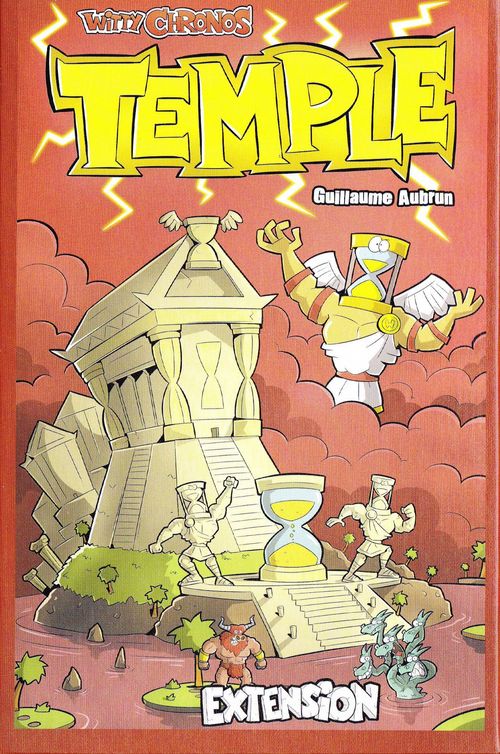
Witty Chronos Temple
Rulebook PDF: Witty Editions · PDF
Witty Chronos Temple Rulebook
Table of Contents
Table of Contents
- Three Levels of Complexity
- Level 1: Fight the Most Fearsome Monsters!
- Level 2: Use the Winds to Sail in Your Kingdom!
- Level 3: Make Offerings and the Gods Will Be Merciful!
- Making Offerings
- The 27 TEMPLE Cards
- HERACLES (Cost 2)
- HELIOS (Cost 2)
- PERSEPHONE (Cost 4)
- ATHENA (Cost 3)
- ARES (Cost 1)
- DIONYSOS (Cost 1)
- EOLE (Cost 3)
- POSEIDON (Cost 1)
- CYCLOPE (Cost 5)
- HERA (Cost 3)
- ZEUS (Cost 8)
- APOLLON (Cost 1)
- CASSANDRE (Cost 1)
- DEMETER (Cost 3)
- APHRODITE (Cost 4)
- PAN (Cost 4)
- SELENE (Cost variable)
- CASTOR and POLLUX (Cost 2)
- CHARON (Cost 2)
- HECATE (Cost 2)
- GAIA (Cost 1)
- OURANOS (Cost 3)
- ARTEMIS (Cost 2)
- EROS (Cost 2)
- EOS (Cost 1)
- HESTIA (Cost 3)
- Precisions on the Rules
- Variant: Core Gamers
- Variant: 2 Players
- Variant: Team Play
- Variant: 3-Player Game
Three Levels of Complexity
The Temple expansion brings three levels of complexity. Add them one at a time, in this order:
- First add the MINOTAUR and HYDRA cards.
- Then add the other cards with red backs (the WIND cards, the Territory cards, and the HEPHAISTOS and CERBERUS cards).
- Then play with the TEMPLE cards (yellow-backed cards).
When playing with 5 or 6 players, it is recommended to play 2 winning rounds instead of 3.
Level 1: Fight the Most Fearsome Monsters!
Compared with the base game, add 6 new cards: the 3 MINOTAUR cards and the 3 HYDRA cards. Shuffle them in with the cards of the base game.
There is now a new way to conquer the throne of Chronos: defeat the two most monstrous creatures, the HYDRA and the MINOTAUR.
The HYDRA and MINOTAUR cards go on the personal pile of the player who takes them, like Territory cards.
HYDRA and MINOTAUR cards do not score points. However, if a player has both a HYDRA card and a MINOTAUR card in his personal pile, he immediately wins the round.
Level 2: Use the Winds to Sail in Your Kingdom!
Add all the red-backed cards to those of the base game. The 27 yellow-backed TEMPLE cards are set aside. From now on, you play with 12 WIND cards.
Your Kingdom can now be surrounded by WIND cards. You can sail between islands with your fleet. To do so, you must tame the winds!
An important difference: a round is now played to 200 winning points.
When a player takes a WIND card, he places it in front of him, next to his personal pile. Its position (above, below, left or right of the pile) follows the direction of the wind.
[Diagram: "Here is the representation of the Kingdom." A dashed oval marks the boundary of the Kingdom. The player's personal pile sits in the middle, with four WIND cards around it labelled "North", "East", "West" and "South".]
Wind Scoring
The winds let a player sail more easily between his islands, which gives more aura to his Kingdom. To calculate a player's score:
- x1: if he has 0 or 1 WIND card, his score is unchanged.
- x2: if he has 2 different WIND cards, his score is doubled.
- x3: if he has 3 different WIND cards, his score is tripled.
- x4: if he has 4 different WIND cards, his score is quadrupled.
The Kingdom
A player's "Kingdom" consists of his personal pile together with the WIND cards that surround it. The TEMPLE cards (gods) that a player has in front of him are not part of his Kingdom.
Level 3: Make Offerings and the Gods Will Be Merciful!
At the start of each round, shuffle the TEMPLE cards (yellow backs) and turn 5 of them face up. These are available at the Temple for that round. The other yellow-backed cards form the reserve and are not used in that round.
Making Offerings
At any time, a player may make an offering to the Temple to win the favour of the gods. To do so, he must discard as many cards as the cost shown on the TEMPLE card he wishes to acquire. The cost is the value printed in the upper left corner of the card.
The discarded cards are chosen by the player from among all the cards of his "Kingdom". He is not allowed to use a TEMPLE card to pay for an offering.
He may choose to discard any card or cards from his personal pile, but the cards he does not discard must remain in the same order. To make the offering, the player must discard exactly the number of cards indicated: no more and no less.
The 27 TEMPLE Cards
Here is the effect of each of the 27 TEMPLE cards. The cost of each card is shown in its name. Cards marked with a star have an immediate and one-time effect.
HERACLES (Cost 2)
Heracles tames Cerberus! When a player uses the power of CERBERUS while the HERACLES card is in front of him, the card cancelled by CERBERUS is not discarded. It goes to his personal pile instead.
HELIOS (Cost 2)
When a player has the HELIOS card in front of him, the cards of value 10 and 20 are worth 30 for that player.
PERSEPHONE (Cost 4)
The player who made the offering removes an hourglass from each of the other players. These players may at any time discard their entire personal pile to recover the use of the hourglasses that were removed.
ATHENA (Cost 3)
A player who has the ATHENA card in front of him is protected against the attacks of the base game's gods (the powers of the HERMES, CERBERUS and HEPHAISTOS cards).
ARES (Cost 1)
A player who has the ARES card in front of him may go and place his hourglasses on the personal piles of other players, and take cards according to the usual rules. The attacked players may defend themselves by placing their own hourglasses on their cards in their "Kingdom". The fact that an hourglass is present on a player's personal pile does not prevent him from adding or removing cards from that pile.
DIONYSOS (Cost 1)
The player who made the offering exchanges his colour marker with the marker of the player of his choice. The change of colour and control of the hourglasses takes immediate effect.
EOLE (Cost 3)
The player who has the EOLE card in front of him may count it as a WIND card of the direction of his choice.
POSEIDON (Cost 1)
The sea is unleashed and it is impossible to sail. All players (including the player who made the offering) must discard all the WIND cards they have in front of them. They may not use the cards discarded in this way to make an offering.
CYCLOPE (Cost 5)
If a player has the CYCLOPE card in front of him, a single "Monster" card (HYDRA or MINOTAUR) in his personal pile is enough for him to win the game.
Note: the booklet says "gagner la partie" (win the game) here, while the other monster rules speak of winning the round. It is transcribed as printed.
HERA (Cost 3)
If a player wins the round with the HERA card in front of him, he takes two "Round Won" tokens instead of one.
ZEUS (Cost 8)
The player who made the offering immediately wins the round.
APOLLON (Cost 1)
You can subjugate another god! Choose a card from the Temple and place it in front of you, under the APOLLON card. That card can no longer be acquired by the other players. Only the player who has the APOLLON card in front of him may acquire it, by paying the usual cost.
CASSANDRE (Cost 1)
When only one card remains at the Temple, the player who has the CASSANDRE card in front of him may take it without paying the cost of the offering. A card subjugated by APOLLON is no longer considered to be at the Temple.
DEMETER (Cost 3)
At any time, a player who has the DEMETER card in front of him may take any visible "Territory" card of value 10 on which there is no hourglass. That card may come either from a pile in the centre of the table or from another player's personal pile.
APHRODITE (Cost 4)
A player who has the APHRODITE card in front of him doubles his score.
PAN (Cost 4)
If a player has the PAN card in front of him, each "God" card he has in front of him, including the PAN card itself, is worth 50 points. The multiplicative effects of WIND cards still apply.
SELENE (Cost variable)
The player who makes the offering discards as many cards as he wishes (minimum 1). He places the SELENE card in front of him. Immediately afterwards, he may choose the same number of cards from his "Kingdom" and put them under the SELENE card. These cards no longer count for the current round. In return, he starts the next round with these cards in his "Kingdom", and reveals them to the other players.
Precision: if the SELENE card was taken thanks to CASSANDRE, the player may put as many cards as he wishes under the SELENE card. Cards placed under the SELENE card cannot be used to make an offering.
CASTOR and POLLUX (Cost 2)
If one of these cards is at the Temple, put the other one there too. There will exceptionally be 6 cards at the Temple.
At the end of the round, if the player who has the CASTOR card wins the round, the player who has the POLLUX card takes one "Round Won" token, and vice versa.
So if CASTOR and POLLUX win the round tied, each of the players takes 2 "Round Won" tokens. If a player has taken both CASTOR and POLLUX and wins the round, he takes 3 "Round Won" tokens.
Advice: do not use CASTOR and POLLUX in 3-player games (or 3-team games).
CHARON (Cost 2)
The player who made the offering looks at all the cards discarded in the centre of the table and chooses one of them. He applies the effect of the chosen card as if he had acquired it normally.
HECATE (Cost 2)
When a player who has the HECATE card in front of him recovers one of the base game's "God" cards (CERBERUS, HERMES, HEPHAISTOS or HADES), he may choose to apply the effect of another base game "God" card instead.
GAIA (Cost 1)
A player who has the GAIA card in front of him may buy a god previously acquired by another player. He pays the price of the god, and the cards used to pay are taken by the player from whom the god is bought.
OURANOS (Cost 3)
At any time, and as many times as he wishes, the player who has the OURANOS card in front of him may discard a card from his "Kingdom" and then recover a card of his choice from among all the cards in the discard pile, except "God" cards. He may also look at the discard pile whenever he wishes.
ARTEMIS (Cost 2)
When a player has the ARTEMIS card in front of him, the "Monster" cards he possesses (HYDRA and MINOTAUR) are worth 100 points. The multiplicative effects of WIND cards apply.
EROS (Cost 2)
The player who made the offering has the right to immediately move the hourglass of another player, whether it is running or not, and place it, turned over or not, on the pile of his choice. His power takes immediate effect and is single-use.
EOS (Cost 1)
When a player has the EOS card in front of him, any other player who knocks over an hourglass incurs a penalty: he must choose a card from his own "Kingdom" and give it to the player who has the EOS card. If the player who knocked over an hourglass has no card in his "Kingdom", the penalty is cancelled. The penalty applies whether the hourglass was knocked over by clumsiness or on purpose.
HESTIA (Cost 3)
A player who has the HESTIA card in front of him, together with three identical cards in his "Kingdom", immediately wins the round.
Precisions on the Rules
As in the base game, at any time a player whose hourglass has been cut off may choose to discard all the cards of his personal pile to recover the use of his two initial hourglasses. WIND cards and TEMPLE cards are not in the personal pile and are not concerned.
The HERMES card allows the contents of personal piles to be exchanged. WIND cards and TEMPLE cards are not concerned.
Likewise, the CERBERUS card cancels only the first card of the personal pile.
At the end of a round, the players return all the cards they have taken, except the cards under the SELENE card.
To win the round, a player must meet one of the victory conditions and announce it! A player who has not announced that he has won cannot claim to have won the round. Sometimes a player may have an interest in not announcing that he has won, for example if he hopes to make an offering to HERA later to win two "Round Won" tokens. If a player announces by mistake that he has won the round, resume play.
Recall that only the last card of the personal pile must be visible. A player who has taken a MINOTAUR card may therefore cover it with a Territory card.
Variant: Core Gamers
A variant for experienced players: "Jealous Hermes". In this variant, it is forbidden to use the power of HERMES (printed as "échange de jeu", the exchange) if you have a God card acquired at the Temple in front of you. Think twice before making an offering!
Variant: 2 Players
This version is reserved for expert players! Play it with the gods of the Temple.
Each player takes 2 colour markers and the 4 corresponding hourglasses. Two hourglasses of a fifth colour are chosen and will be neutral. When a player recovers a card, he incorporates it into his "Kingdom" or applies its effect. The colour of the hourglass that allowed him to take the card has no influence.
Two rules specific to the 2-player game are added.
Set-Up
Prepare 8 piles, face up, and place 3 of them in front of each player. Place a neutral hourglass, sand at the bottom, on each of the two other piles. Count down ("3, 2, 1, 0"). When the countdown is over, each player may begin placing his hourglasses only on the 3 piles in front of him. A few seconds later, count down again. Once that countdown is over, the players may place their hourglasses wherever they wish.
Two Additional Rules
-
At any time, a player may discard a card from his Kingdom to move a neutral hourglass that has run out. The player must turn over the hourglass he moves and must place it on another pile. Moving a neutral hourglass does not allow any cards to be recovered.
-
To avoid blocked situations, the following constraint is added: there must never be more than 2 contested piles. A contested pile is a pile with one hourglass of each player on top; neutral hourglasses do not count. It is forbidden to make a move that would create a third contested pile. If your opponent makes a forbidden move, tell him: he must remove his hourglass and wait until it has run out before putting it back into play.
Other Precisions for the 2-Player Variant
DIONYSOS allows one of your colour markers to be exchanged for one of your opponent's colour markers.
When ARES is in play, the personal pile of the attacked player may be contested.
It may happen that both players simultaneously create two new contested piles by moving their hourglasses, bringing the number of contested piles to three. If it is not possible to determine which player made his move first, the presence of three contested piles is exceptionally allowed.
Variant: Team Play
Since you now have 6 pairs of hourglasses, team play takes on a new dimension: you can play with 6 players (3 teams of 2 players), each player with 2 hourglasses. The team play rules are unchanged (see the base game), except that there is no longer any need to remove the HEPHAISTOS cards.
Variant: 3-Player Game
Even crazier: you can play with 3 players by taking 4 hourglasses each! This variant must be tried right away, as it is a very fun variant!