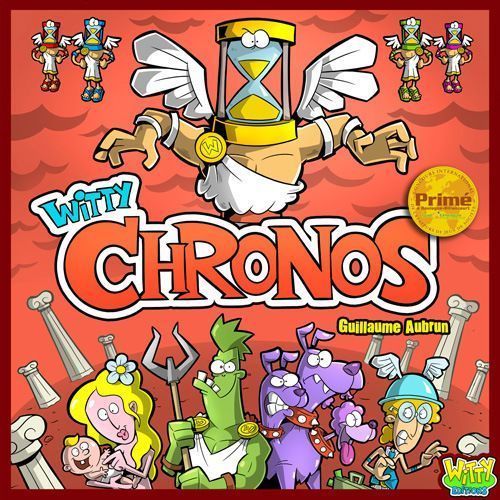
Witty Chronos
Witty Chronos Rulebook
Table of Contents
Table of Contents
Game Overview
- Players: 3 to 10
- Duration: about 30 minutes
- Age: 8 and up
Components
- 10 hourglasses (sabliers), each running for approximately 30 seconds. (Warning: life is unfair, and the hourglasses will not all run for exactly 30 seconds. You will probably notice significant differences. This is not serious: Witty Chronos is above all a game of diplomacy. Know how to play with Time!)
- 10 coloured markers
- 55 cards: 45 "Territory" cards (worth 10, 20, 30 or 50 points) and 10 "God" cards
- 10 "Round Won" tokens (jetons "Manche Gagnée")
- A fabric bag
Principle of the Game
Each player turns over one of their hourglasses and places it on a pile of cards. When the hourglass has run out, if no other hourglass is on the pile, the player may take the top card of the pile and thus conquer territories.
The first player to conquer territories with a combined value of 100 points or more wins the round. The grand winner of the game is the first player to win 3 rounds.
Setup
"To conquer, you must know how to prepare the ground!"
Before your first game, stick two stickers of the same colour on the two faces of each hourglass.
Shuffle all the cards and build piles, face down, in the centre of the table. Build as many piles as there are players, plus 3 (with 3 players, make 6 piles; with 4 players, make 7; with 5 players, make 8). For team play, see the variant below. It is not serious if the piles do not contain exactly the same number of cards. Arrange the piles in a circle in the centre of the table.
Each player chooses a coloured marker and takes the two hourglasses of the matching colour, which they place in front of them (sand at the bottom).
We recommend playing the first rounds without the "God" cards if one of the players is discovering the game, or when playing with young children.
Starting a Round
When all players are ready to start the round, the most punctual player turns over the piles of cards placed in the centre of the table, one at a time. Turn over all the cards of the same pile at the same time, so that if the top card is removed, the second card is face up. The round begins as soon as the first pile of cards is turned over. Players may begin placing their hourglasses on a turned-over pile without waiting for the other piles to be turned over as well.
Rules of Play
There is no turn order: all players play simultaneously. You must know how to steer your galley in order to win the best cards.
A player may only move an hourglass if it is of their own colour and if it is not currently running. It is forbidden to move an hourglass that is running, or an hourglass belonging to another player.
With an hourglass, a player may choose to:
- place it on any pile, turning that pile over;
- place it in front of them, outside the game, without turning the pile over.
A player is not obliged to move an hourglass that has run out.
If a player removes their hourglass from a pile on which there is no other hourglass, they may (without being obliged to) take the first card of the pile. Note that the hourglass necessarily runs for the full duration of one hourglass (approximately 30 seconds) between the moment it is placed on a pile and the moment it can be removed.
When a player takes a "Territory" card in this way, they place it in front of them, face up. The "Territory" cards taken by a player form a pile of which only the top card is visible. It is forbidden to place an hourglass on the pile of cards taken by a player. If a player takes a "God" card, its effect is applied immediately (see below).
If a player takes the last card of a pile, the round stops immediately. Points are counted to determine who wins the round.
The "God" Cards
The gods can help you conquer territories and slow the progress of your opponents. To win at Witty Chronos, you must know how to win their favour! When a player takes a "God" card, they must carry out the corresponding action:
HADES marks the end of the round. Sometimes the end justifies the means! When this card is taken, the round ends immediately. Points are counted to determine who wins the round.
HERMES allows you to appropriate territories by cunning. The player who takes this card may immediately exchange the pile of "Territory" cards they have gathered with the pile of "Territory" cards gathered by the player of their choice. (They may choose to take the HERMES card and not exchange anything.) The HERMES card is then discarded.
HEPHAISTOS allows you to cut off your opponents (be careful not to leave an arm behind!). The player who takes this card immediately chooses an opposing hourglass and puts it in the fabric bag. That hourglass is unusable until the end of the round. The HEPHAISTOS card is then discarded.
CERBERE allows you to cancel an opposing conquest. The player who takes this card immediately removes the first card (the visible one) from the pile of "Territory" cards of the player of their choice. That card is discarded, as is the CERBERE card.
Note: at any time, a player whose hourglass has been cut off may choose to discard all the "Territory" cards they have taken, in order to recover the use of their hourglasses. (If necessary, they must still wait for those hourglasses to run out before putting them back into play.)
The effects of a "God" card must be applied at the moment the card is taken. Place discarded cards face down in the centre of the table; they will no longer be used.
End of the Round
The round stops immediately when:
- a player totals 100 points or more in front of them; they must then shout "Victoire" ("Victory")!
- the HADES card is taken by a player;
- the last card of one of the piles is taken.
The winner of the round is the player with the most points at the moment the round stops. That player takes a "Round Won" token (jeton "Manche Gagnée") and places it in front of them.
In case of a tie, all tied players win the round and each takes a "Round Won" token.
The players may vote for a redistribution of the colours for the next round, notably if one pair of hourglasses is strongly unbalanced compared with the others. The new distribution is made at random using the fabric bag. Sometimes you need luck in life, and this will apply in your games of Witty Chronos too!
The player who won the round turns over the piles of cards at the start of the next round.
End of the Game
When a player has won three rounds, they are the grand winner of the game! They become the successor of Chronos, the master of time!
Other Rules Points
Here are some rules points that may be left out on a first game.
Blocked situation. It may happen that the situation becomes blocked: nobody wants to move, like true warriors dug in on their positions. In that case, and only when all the hourglasses have run out, one of the players may say that they think the situation is blocked and count to 10. If no hourglass has been moved in the meantime, the round ends. The classic victory rules then apply.
Overturned hourglasses. Some players may play too enthusiastically and knock over opposing hourglasses. If this happens too often, the players may agree to apply the following rule: when a player knocks over an opposing hourglass, they must remove all of their hourglasses from play and turn them over; they may only put them back into play once they have run out. Our advice: be patient, play with time, do not try to go faster than it, or you will be penalised!
Consulting scores. During the round, a player may look at the cards of their own pile (without changing their order) to know their score. However, they cannot know the score of their opponents, since only the first card of each opponent's pile is visible.
Talking. Talking during the game is allowed, and even recommended. For example, if two players are blocking each other, they have an interest in negotiating quickly to find common ground. Another frequent situation is the following: if one believes (or wants to make others believe) that a player is about to win the round, the others may be encouraged to block that player. A touch of mischief and a lot of strategy will make you a true conqueror!
Slower hourglasses. Having hourglasses that run slowly is a priori a handicap, but you can turn it into an advantage by using this argument to convince your opponents not to attack you! Since you are slow, you are less inclined to move, and whoever comes onto your lands is warned: they will have a long wait!
Fair play. The players are trusted not to move their hourglass before it has run out. A penalty may be voted collectively against a player who knowingly breaks this rule. Beware: the anger of the god Chronos will then fall upon you if you dare to defy the rules of the game!
Taking a contested card. A card with an opposing hourglass on it can never be taken. Sometimes speed is needed: if you are about to take a card but another player has placed their hourglass on it in the meantime, too bad, you can no longer take it! Stamping a card that an opponent wanted to take with your own hourglass is a delightful moment...
Round start options. At the start of the game, the players may choose between two systems for starting the round, from the two possible options:
- either the piles are turned over one at a time and the game is played as they are revealed, as the main rule indicates;
- or all the piles are turned over at once and play begins afterwards.
Variant: Team Play (6, 8 or 10 Players)
For team play, remove the two HEPHAISTOS cards.
Players form teams of 2 players who stay the same for the whole game. Each team draws a colour at random, and each teammate plays with a single hourglass of that colour. Each player accumulates their "Territory" cards separately from their teammate.
As in the individual game, the round stops when a player reaches 100 points, when the HADES card is taken, or when a pile is empty. Each team keeps only the score of the player who has won the most points. The team with the highest score wins the round and draws a "Round Won" token.
The number of piles to set up at the start of the round equals the number of teams, plus three. With 6 players there are 6 piles; with 8 players, 7 piles; with 10 players, 8 piles.
The first team to win three rounds wins the game. The team then shares the throne, and as they say: if there is room for one, there is room for two!