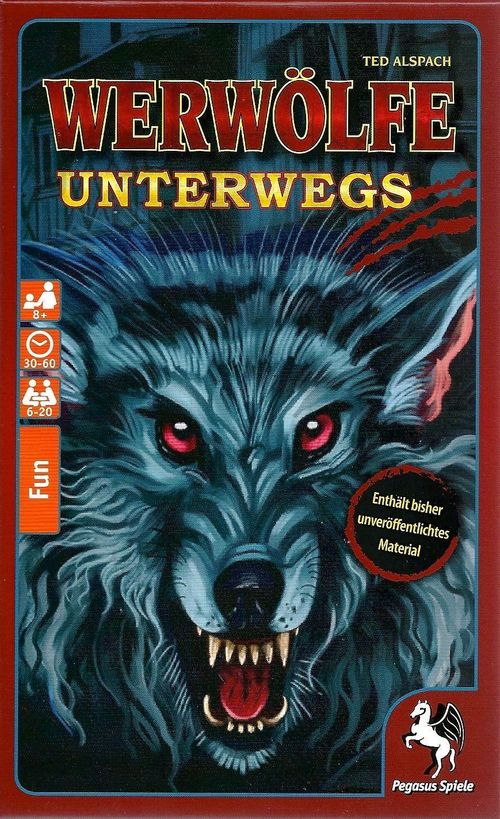
Werwölfe Unterwegs
Werwölfe Unterwegs Rulebook
Table of Contents
Table of Contents
- Contents
- Setup
- The First Night
- The First Day
- The Following Nights
- The Following Days
- Ending the Game
- Discussion After the Game
- The Expanded Game
- Rule Variants
- Moderator Guide
- Scenarios
- Characters
- The Villagers
- Nosy Neighbour (Neugierige Nachbarin) — +4
- Inquisitor (Inquisitor) — +3
- Cupid (Amor) — −3
- Lovers (Liebespaar) (2)
- Mayor (Bürgermeister) — +2
- Tough Guy (Harter Bursche) — +3
- Villager (Dorfbewohner) (9) — +1
- Witch (Hexe) — +4
- Phantom (Phantom) — +3
- Little Red Riding Hood (Rotkäppchen) — +3
- Hunter (Jäger) — +3
- Modern Legends (Moderne Sagen)
- Background and Credits
Contents
26 role cards, 6 "Modern Legends" cards (Moderne Sagen).
Setup
For the basic game the following cards are needed: 1 "Seer" card, "Werewolf" cards (1 for 6-8 players, 2 for 9-11 and 3 for 12-13), and 1 "Villager" card for each additional player.
A moderator is chosen. He or she receives a piece of paper and a pen.
The players sit in a circle (ideally around a large table or a group of tables).
The moderator shuffles all the cards and gives each player a card face down. Each player should look at their card secretly, without showing it to any other player.
At this point nobody except the moderator should speak. This is only allowed again during the next "Day" phase.
The First Night
During the first night the moderator first calls the werewolves and then the seer, so that the moderator knows which players have received these characters, and the werewolves see who the other werewolves are. The villagers are never woken during the night. The players are guided through the night by the following lines from the moderator:
"All the residents of the village fall asleep. All players now close their eyes."
The moderator makes sure that all players have closed their eyes.
"The werewolves wake up and look around."
The werewolves open their eyes and look to see which other players are also werewolves (as quietly as possible, so that nobody hears them). The moderator notes the names of these players on his notepad, marked "Werewolf".
"The werewolves now close their eyes again." (Pause) "The seer wakes up and points to a fellow player."
The werewolves close their eyes first, before the seer opens his or her eyes and points silently at a fellow player. The moderator shows a "thumbs up" if it is a "good" villager, or a "thumbs down" if it is an "evil" werewolf. The moderator also writes down the name of this player on his notepad, marked "Seer".
"The seer now closes their eyes." (Pause) "All players wake up and realise that their peaceful village is threatened by werewolves. It is now up to you to find these werewolves and to eliminate them."
All players now open their eyes.
The First Day
The first day should be used by the players to introduce themselves individually. Starting with any player, each player in turn, clockwise, should say something about themselves. This can be something simple, such as "My name is Andreas, and I am a villager", or something more detailed, such as "My name is Andreas, the local cake baker. As everyone knows, werewolves do not like cake." The players should reveal neither that they are werewolves nor that they play a special character. Instead they should simply claim to be ordinary villagers.
After all the villagers have introduced themselves, the moderator describes how a day proceeds, how other players are nominated for lynching, and how the vote afterwards takes place.
"To nominate someone for lynching, point at that player and say 'I nominate Andreas'. If another player confirms this nomination by also nominating Andreas, the player concerned has the opportunity to defend themselves in a short speech, after which we will vote. I count 1, 2, 3, and at '3' all players either hold their 'thumb up' (the player is innocent) or their 'thumb down' (the player is lynched). If the player is lynched, we reveal their character card for everyone to see, and the whole village immediately falls back into a deep sleep afterwards. If they are allowed to live, you may continue to discuss until another nomination possibly takes place."
If more than half of all players vote against the nominated player, this player is lynched and their character card is revealed for everyone to see. After their card has been revealed this player may no longer speak and should leave their place in the circle (though of course they may continue to watch the game silently).
On the first day the moderator should set a specific time for discussion. If no player has been nominated by the end of this time, the village immediately falls into a deep sleep.
The moderator should inform the village in good time when the time is running out and the next night is approaching, so that the players can still carry out one or another nomination.
The Following Nights
From the second night onwards, when the moderator calls the werewolves, they choose a victim each time whom they want to kill. The werewolves must all agree together on one victim.
Afterwards, each night the moderator also calls the seer, who selects a player and receives from the moderator the sign "thumb up" for a villager, or "thumb down" for a werewolf.
The Following Days
Each morning the moderator announces which player was killed by the werewolves and reveals the character card of this player for everyone to see. After their card has been revealed this player may no longer speak and should leave their place in the circle (though of course they may continue to watch the game silently).
Each day ends with a vote on lynching a player.
Ending the Game
If the villagers manage to lynch all the werewolves, the game ends and the villagers win. As soon as the werewolves reach a tie with the villagers (same number of villagers/seer and werewolves), the werewolves win the game. The moderator announces the victory immediately at the moment one of these events occurs.
Discussion After the Game
An interesting part of Werwölfe unterwegs is the discussion directly after the game. Both the surviving and the killed players can contribute a lot to it. Usually this also leads to a follow-up game as a rematch.
The Expanded Game
After you have played several games of Werwölfe unterwegs, many different variations can be tried. Typically further characters are added to the game to make the flow more interesting. This can however mean that you have to change some basic rules. Some groups prefer very special game variants with certain characters, while other players want to use different rules each time if possible. There is no right or wrong for this game!
Game Preparations
At the start the players decide together which characters and rules they want to use in the game. The moderator makes the final decision if necessary, but should take into account the wishes of as many fellow players as possible.
Look in the table in the section "Quick Start for Scenarios" to get the right combination of characters, werewolves and villagers. However, you can also choose your own mixture.
Rule Variants
The following rule variants can be mixed together as desired. In this way you can let Werwölfe unterwegs games run entirely to your taste. Further variants can be found in the game Werwölfe Deluxe.
Reveal the Faction
The moderator announces the faction of the deceased (werewolf, villager).
No Information
After the death of a player the moderator announces nothing except that the player has been eliminated. This gives the villagers the least information and makes the game easier for the werewolves. Many experienced players prefer this variant, since it offers many further opportunities for deception and concealment on the part of the werewolves (for example, a werewolf can claim to be the seer without the real seer being able to refute it – so the village remains in the dark even after one of the two players has died).
Moderator Guide
As moderator you are responsible for preparing the room, choosing the right mixture of characters for your group, explaining the actual game, answering all questions and then running the game. Ideally you should have played at least one game of Werwölfe unterwegs before moderating for the first time. This is not absolutely necessary, however.
Every moderator has their own style. Some noticeably influence the atmosphere of the game through their storytelling, others behave very quietly and let the players tell their own story.
There is no right or wrong as a moderator, and the players will show during the game whether and how much influence from "outside" they want.
Preparing the Room
Try to find a quiet room for a game of Werwölfe unterwegs and only let one round play per room (unless the room is very large and easily holds two or more game rounds that do not disturb each other's discussions).
Set the chairs up in a circle, so that every player has a little room to move on either side. Some moderators prefer tables at which the round sits, so that name cards can be placed and the players have a place to put their character cards. Some moderators give the players so much space that they can walk between them into the middle of the circle. Wherever possible, make sure that there is enough distance between chairs and wall so that you can walk behind the players, and that killed players can leave the circle without difficulty but still continue to watch.
If you play with players who do not all know each other, provide name cards (folded paper) and pens. This makes the game easier for everyone involved.
The Moderator's Note Sheet
The note sheet helps you keep an overview of the special circumstances that arise from the characters and variants you are playing with.
During preparation, note the characters used on the left side of the sheet. Mark the characters that you must call during the night.
During the first night, write the names of the players next to the characters they received on the right. If you do not use name cards or similar and you are not completely sure of the names, write descriptions such as "checked shirt" to remember the right person for each character.
Use the other columns to write down the names of the victims (this will help you above all in games with many different characters to keep an overview), or to note new cult members and other special circumstances as required.
Tapping on the Shoulder
Sometimes you have to tap players on the shoulder to draw their attention to changes. As a general rule, tell the players that they should open their eyes after the shoulder tap.
Maintaining Game Balance
Different characters have differently large effects on the balance of play between the groups; each character's strength is given as a value in the lower left corner of its character card. The higher the positive value, the more advantageous the character is for the villagers. The higher the negative value, the more advantageous the game becomes for the werewolves. The values are only a guideline, but you should still keep the sum as close to zero as possible to ensure balanced games.
If the game group consists of people who know each other little or not at all, tilt the balance a little in favour of the villagers. Add character cards in favour of the villagers so that they have a "lead" of +5.
If your group consists essentially of people who know each other well and are experienced werewolf players, you should tilt the balance in favour of the werewolves. Add character cards so that the werewolves have a "lead" of -5.
Explaining Werwölfe unterwegs to Inexperienced Players
Once everyone has sat down, explain the rules of Werwölfe unterwegs. The explanation should cover the following points:
- The threat to the village by werewolves
- The victory conditions for both groups
- The normal sequence of day/night
- The rules for the night
- The rules for lynching
- The characters in the current game
- "Dead" players must be silent and leave the circle
After these explanations you should take time to answer questions. (The players should not have to ask questions during the game, as otherwise it may seem as if they have certain characters.)
Keeping the Game Moving
The first game with a larger number of newcomers will take a little longer than follow-up games with experienced players. At the same time, as moderator you must make sure that the game progresses and, when the discussion dies down, encourage the players to nominate someone. Be careful, however, never to express an opinion or information about the ongoing game that the players could use to speculate about who plays which character.
Some groups can be very silent or delay nominations. Sometimes on the first day they are also unsure how the game will proceed, due to lack of information. In such cases, as moderator you should ask the village to nominate any player "because it is already getting dark". After you have pointed this out several times, let the village sleep without a lynching taking place. A good moderator keeps the game moving by giving only one warning each day and letting the village sleep after a few minutes, even if it has not yet voted for enough players or carried out an execution.
Although it is good to keep the game moving, part of the fun of Werwölfe unterwegs lies in the discussions. If the group as a whole is caught up in a heated discussion, let the players keep discussing, even if the day becomes somewhat longer than usual.
Moderator Behaviour at Night
When you call the characters each night, move behind the players, change direction often and take care not to address any player directly. Use different intervals between the calls, so that the players cannot infer from the pauses how long an individual action takes.
Using Pronouns at Night
When you call characters at night, avoid gender-specific pronouns such as "he" and "she" or "his" and "her" wherever possible, apart from the names of the characters. This is a natural part of our language, but it can unintentionally pass on information to the group. This is unfair, especially if it happens by accident. This is particularly important towards the end of the game, especially when only a single werewolf remains. As moderator, be vigilant.
Moderator Mistakes
As moderator you can also make mistakes. Because of the secret distribution of characters, players can usually not point this out to you (for example if you accidentally kill a different victim from the one the werewolves had previously chosen). In most cases it is better to mention a mistake while it can still be corrected and has no negative effects on the course of the game. If it is already too late, and the mistake affects the balance of the game by favouring one or other group, try to compensate for the mistake later on.
If you forget to call a character during the night, or make another mistake, immediately let the whole village fall asleep again and correct it.
Notable Points
In Werwölfe unterwegs the players must be cunning and often lie directly to other players. Even though this happens within the game, you should point out to the players that they will only play successfully if they use these methods. What happens in Werwölfe unterwegs has meaning only there and should not be transferred to the "normal" world. Depending on the group's level of sense, this may need to be pointed out again.
Players who have been eliminated early sometimes feel the urge to make comments or obvious movements/noises when the group of the "deceased" experiences something obviously frustrating or negative. Before the game and after the first few players have been eliminated, the moderator should remind everyone once more that they must be silent and must not tell the players still taking part anything, as otherwise the game is ruined for everyone.
Being eliminated early sounds like something bad. Nevertheless, you should encourage the affected players to observe from outside how the game develops. It is fascinating for these players to see which player has which character, and with this knowledge to watch how the still "living" players act.
Scenarios
Transcriber note: the setup section above refers to a "Quick Start for Scenarios" table. That table is not printed in this document; the scenarios printed in this section are transcribed below.
Use the following scenarios to quickly get an interesting combination of characters for your game. If you or your group are inexperienced with Werwölfe unterwegs, it may be sensible to use fewer than the suggested number of special characters. If you have enough time for more than one game, you may first try a simple game (as described above under the basic game), in which you play only with villagers, werewolves and a seer, and then add additional characters in further games.
Although the following scenarios give figures for the number of players, you can also easily try the scenarios with a different number of players by removing or adding characters. Take into account the balance value of each character. (As explained in the section "Maintaining Game Balance", the characters removed and the remaining characters should together ideally have a value of zero.) All player numbers given do not include the moderator.
Classic Werewolf (12)
This village lets you experience the classic Werewolf. In this scenario the seer is shown a random villager in the second night.
7 Villagers, 1 Seer, 1 Hunter, 3 Werewolves
The Inquisition (14)
In this scenario the village is threatened by 4 werewolves. Can you manage to stop them all?
1 Inquisitor, 1 Tough Guy, 1 Witch, 1 Seer, 6 Villagers, 4 Werewolves
Brothers Grimm (15)
Once upon a time there was a village that was attacked by 4 evil werewolves ...
1 Little Red Riding Hood, 1 Hunter, 1 Seer, 1 Witch, 1 Tough Guy, 5 Villagers, 1 Cupid, 4 Werewolves
The Blind Village (15 players)
This village is bewitched by an evil ritualist, who withholds important information from the village.
1 Nosy Neighbour, 1 Phantom, 1 Witch, 1 Tough Guy, 7 Villagers, 3 Werewolves, 1 Ritualist
Battle of the Leaders (18 players)
The largest village in Werwölfe unterwegs is led by the mayor. On the other side the werewolves have also found a leader, who now leads the pack. Who of the two can assert themselves and show the other the limits?
1 Mayor, 1 Seer, 1 Witch, 1 Hunter, 1 Little Red Riding Hood, 1 Tough Guy, 1 Inquisitor, 6 Villagers, 1 Alpha Wolf, 4 Werewolves
Creating Your Own Scenario
The scenarios listed above are all designed to give you special and unique experiences, but you can of course modify them and add new roles as needed. Part of the entertainment in Werwölfe unterwegs is preparing different games with different characters, and then seeing how they develop. As long as the game is not completely unbalanced (try to keep the balance values shown at the bottom left of the cards as close to zero as possible in total), you should normally always have a great game. Occasionally an unusual combination of characters leads to more exciting games than you imagined beforehand.
Use the following guidelines together with the requirement to keep the balance values as close to zero as possible in total:
-
Always include "normal" villagers. Some players find villagers without any abilities boring; however, they hold the village together and provide a solid foundation for all the other abilities in the game. If you play with the basic rules, in which the character of a dead player is shown to everyone else on their death, you must use a larger number of villagers, so that not all players of the village group reveal their character and the werewolves are thus quickly identified. You can use fewer villagers if you conceal from the other players which characters you use in the current game, but then you must first provide all players with a rules overview of the characters, so that everyone knows the possible abilities. In addition, a larger number of normal villagers gives the players the opportunity to recover from the more stressful characters, and makes the random distribution of special characters all the more appealing.
-
The better the players know each other, the more you must help the werewolves. If a group of strangers plays a balanced game of Werwölfe unterwegs together, the werewolves will always have a large advantage. With a group that often plays Werwölfe together, you must instead come to the aid of the werewolves (or weaken the village), so that both groups have an equal chance of winning.
-
Expect changing player numbers. Often the player numbers still change directly before a game of Werwölfe unterwegs begins. If you are preparing the game and expect a few more players to join, set aside a few characters with small values in the balance that you can add without difficulty, without affecting the balance too much. As soon as more than three or four players join, however, you should check again whether the new combination of characters still makes sense for the scenario originally chosen (in most cases you can add one or two special characters).
-
The more players, the more special characters. In games with few players, each special character has a greater influence on the balance than in games with a large number of players. The ratio of normal villagers to other characters in games with fewer than 15 players should be about 1:1. As more and more players take part, the ratio can be increased in favour of the special characters up to 3:1.
Characters
This section lists all the characters included in Werwölfe unterwegs.
Each character card shows the balance value in the lower left corner. When you put together different characters for a game, you should always aim for a total of all values that is as close to zero as possible. Negative values make the game harder for the villagers, while positive values help the villagers.
The name of the character is at the top, in the colour of its group. The villagers are blue, the werewolves red. Some characters belong to further groups, and others can change group. Their abilities are all explained below. If there are several cards for a character in the game, the number in brackets after the name is given.
In the lower right it is shown how often the character is called during the night. A full moon means the character is called once every night, while a half moon means the character is only called during the first night. If no moon is shown, the character is never called at night.
Transcriber note: the moon symbols printed on the individual cards are icons and are not present in the extracted text of this document. The night-calling frequency is therefore given only as stated in the descriptions below, as printed.
The Villagers
These characters help the villagers win the game. In all scenarios the villagers form the largest group. As a group, however, they know less than the werewolves: neither who the werewolves are, nor who is even on their side.
Nosy Neighbour (Neugierige Nachbarin) — +4
In the first night the Nosy Neighbour learns whether there are werewolves to her left or right. The moderator shows her "thumb up" if both players play village-friendly roles (blue role name), and "thumb down" if at least 1 player plays a character of the werewolves (red role name).
Inquisitor (Inquisitor) — +3
The Inquisitor may torture 1 other player at night once during the game. If this player has a village-hostile role (red or grey role name), that player dies. If, however, the tortured player has a village-friendly role, the Inquisitor dies. Whoever dies, they cannot be saved under any circumstances.
Cupid (Amor) — −3
Cupid only wakes during the first night and points at two arbitrary players (gender is irrelevant here). These players become a pair of lovers and see who the other is (see "Lovers" in the section "Changing Groups"). If one of the two is killed, the other also dies immediately from a broken heart.
Alternative: Add Cupid as an additional card when you distribute the characters. After Cupid has determined the pair of lovers, Cupid receives the remaining character card and plays this in the rest of the game.
Lovers (Liebespaar) (2)
There are no cards for the lovers. They are chosen by Cupid in the first night. The moderator then wakes both lovers so that they can see each other. If both are on the side of the villagers, they win together with the village. If both are on the side of the werewolves, they win together with the other werewolves. If they play in opposing groups, they form their own group and only win if they are the last two living players.
Transcriber note: the printed text refers to a section "Changing Groups" (Wechselnde Gruppen) for the lovers, but that section is not printed in this document. The lovers' rules are transcribed here as printed on the card page.
Mayor (Bürgermeister) — +2
The mayor's vote counts twice when voting on the lynching of a player.
You can introduce the mayor as a normal character (by giving the card to a player). Or the players can elect the mayor on the first day by a vote (according to the nomination and voting rules for lynching), and the mayor then remains in office until their death, so that a new mayor only has to be elected then.
Tough Guy (Harter Bursche) — +3
If the Tough Guy is selected by the werewolves, the Tough Guy only dies in the following night and not already in the same night.
Villager (Dorfbewohner) (9) — +1
The task of the villagers is to find the werewolves and lynch them during the day.
Witch (Hexe) — +4
The Witch may use her arts once per game at night to heal, in order to save a player from certain death. She may additionally use her arts once per game to kill, in order to kill a player of her choice. The moderator should call the Witch every night and ask her whether she wants to use her two abilities, even if she has already used one or both of them. Both abilities may be used in the same night.
Alternative: The Witch may use only one of her two abilities in the game, but may decide which one this is.
Phantom (Phantom) — +3
The Phantom may choose 1 player every night. This player is tapped by the moderator at the end of the night and learns who the Phantom is. The Phantom does not learn the role of the chosen player.
Little Red Riding Hood (Rotkäppchen) — +3
Little Red Riding Hood is protected against attacks by the werewolves as long as the Hunter is still alive. However, it can die through other attacks as normal (for example through the Witch's poison potion). If the Hunter dies in the same night in which Little Red Riding Hood is the victim of the werewolves, Little Red Riding Hood dies. Little Red Riding Hood and the Hunter do not know each other. The Witch is shown Little Red Riding Hood as a victim of the werewolves as normal, regardless of whether the Hunter is still alive or not.
Hunter (Jäger) — +3
When the Hunter is killed (regardless of day or night), they immediately fire their weapon at a target (or into the air) by pointing at a player. There is no discussion before the Hunter shoots. If they shoot into the air, no other player is killed.
Seer (Seher) — +7
Every night the seer points at a player, and the moderator shows them the "thumb up" if it is a villager, or "thumb down" if it is a werewolf.
The Werewolves (Die Werwölfe)
Alpha Wolf (Leitwolf) — −8
The Alpha Wolf may determine the victim of the werewolves at night. The other werewolves may also open their eyes, but do not take part in the choice of the victim. Should the Alpha Wolf be lynched, they may immediately kill 1 other player.
Werewolf (Werwolf) (4) — −6
During the first night the werewolves learn the identity of the other werewolves. In every following night the werewolves must agree together on one victim, who is then killed. If the werewolves cannot agree on a victim within one minute, they may not kill any player in that night. The werewolves may not choose another werewolf as a victim during the night.
Werewolves try to conceal their true character during the day.
Ritualist (Ritualistin) — −4
The werewolves know the Ritualist, but not the other way round.
The Ritualist may point at 1 player every night. If the chosen person is the victim of the werewolves, the character dies as usual, but the character card is not revealed at the beginning of the day. The Ritualist wins together with the werewolves.
Other Cards
Moderator (Moderator) — 0
The moderator card is used to determine a random moderator.
For experienced groups this card can be shuffled into the pile of all character cards used for the game. After all cards have been dealt, the first night begins, and all players close their eyes. The player with the moderator card then begins to run the game.
Modern Legends (Moderne Sagen)
The six "Modern Legends" cards are the additional set in this box. Their rules are given below as printed.
Transcriber note: the Modern Legends text refers to characters that are not included in this set (the Zaubermeisterin, Vampires and Beelzebub). They are transcribed as printed.
Bloody Mary — +1
If Mary stays alive, she helps the village to find the werewolves, so that she and the remaining villagers can finally sleep in peace. Should she, however, die, she will take revenge on the team that killed her. If necessary she switches to that team.
After she herself has been killed, she chooses each night one player whom she kills. She is dead and may not communicate with other players either during the day or at night (at night she must keep her eyes closed – she only opens them when she is called). The moderator indicates to her, according to the rules below, whether she has chosen a permissible victim.
If Mary is killed by the werewolf team, she must choose and kill one person from that team every night (including non-werewolves such as the Zaubermeisterin) until only one player from the werewolf team remains. Mary then wins together with the villagers.
If Mary is killed by vampires, she treats them in the same way as she would treat werewolves.
If Mary is lynched, or killed by someone in the villager team, she must choose and kill one person from that team every night until the villager team has 1 person more in number than the werewolf team. Mary then wins together with the werewolf team.
If Mary is killed by a creature that belongs to no team (such as Beelzebub or the Chupacabra), she may not kill anyone at night and wins together with the villagers.
Chupacabra — +4
Every night the Chupacabra selects a fellow player. If this player is a werewolf, the player dies. If there are no werewolves left, all players selected by the Chupacabra die.
The Chupacabra wins as soon as fewer than 2 other players are alive.
Leprechaun — +5
Every night the Leprechaun learns who the victim of the werewolves is. The Leprechaun may then decide whether, instead, to let one of the two players sitting directly to the left and right of the victim become the victim. The new victim dies in this night, regardless of which character it is (even if the new victim is a werewolf).
Normally werewolves may not choose other werewolves during the night. If, however, the Leprechaun is in the game, the werewolves may also choose a werewolf. If the Leprechaun does not change the target, however, the werewolves kill one of their own.
The Leprechaun may neither choose anyone else if they themselves are the victim, nor make themselves the victim. Furthermore, the Leprechaun may not protect a second time from death a player whom they have already protected from death in the course of the game.
Nostradamus — +1
During the first night Nostradamus predicts which team will win the game. He alone wins the game if he is alive at the end of the game and his prediction has come true. After the first night the village learns which prediction Nostradamus has made.
Nostradamus effectively chooses in the first night the team he wants to belong to. He must take care to stay alive, and counts as a villager with regard to the number of team members.
Variant: Nostradamus predicts that the world will end three days after his death. If after his death the game is not over after the third night, he is the sole winner!
Bigfoot — −2
All his life Bigfoot was wrongly taken for a werewolf (and the seer also perceives him as one). For this reason he very much wants to find and lynch him. If the village cannot agree on anyone to lynch on any day, he becomes angry and switches sides … to the werewolf team. From this moment on, Bigfoot wakes up together with the werewolves.
Wolf-Man (Wolfsmensch) — −9
The Wolf-Man is a werewolf who, however, is seen by the seer as a villager. The Wolf-Man is a very powerful character of the werewolf team.
Background and Credits
The credits, the background text on the origin of the game, the publisher's and designer's attribution, and the publisher's closing notes are not transcribed.