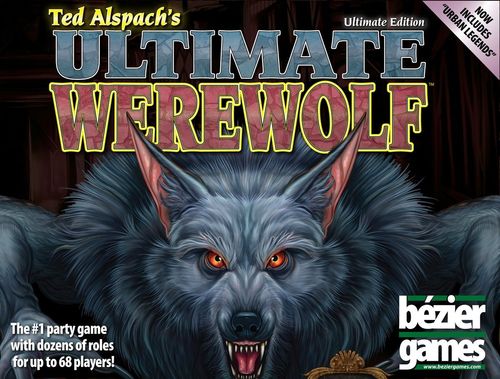
Ultimate Werewolf: Ultimate Edition
Ultimate Werewolf: Ultimate Edition Rulebook
Table of Contents
Table of Contents
Contents
80 role cards (3 blank), a Moderator's notepad, and these rules.
Basics of the Game
The game takes place over a series of game days and nights. During the day, the players work together to figure out who among them is a Werewolf, and then vote to execute a suspect. To win at Ultimate Werewolf, players will need to be cunning and try to lead the other players into dead ends. Each night, the pack of Werewolves chooses a victim, and the lone Seer checks one of the players to find out whether they are a Werewolf or not.
Game Setup
To get comfortable with the rules (especially if you're playing Ultimate Werewolf for the first time), you'll need the following cards: 1 Seer/Seeress, Werewolf cards (1 for 6–8 players; 2 for 9–11; 3 for 12–15), and 1 Villager card for each of the remaining players.
Choose a Moderator, and give them the Moderator's notepad and a pencil. Players sit in a circle (around one table, or several pushed together, if possible).
The Moderator shuffles the cards and deals one to each player. Players should look carefully at their cards without showing them to anyone else.
Note that until the first game day begins, only the Moderator may speak.
The First Night
On the first game night, the Moderator calls the Werewolves separately, and then the Seer separately, to find out which players ended up with those roles. This way, once called, the Werewolves immediately learn who is on their team and who isn't. Night begins when the Moderator says:
"The village falls asleep. Everyone close your eyes."
The Moderator should make sure everyone has closed their eyes.
"The Werewolves wake up and look around."
The Werewolves open their eyes and carefully — so that no one hears them — look around to see the other Werewolves. The Moderator writes down the Werewolves' names in the notepad.
"The Werewolves fall asleep." (Pause.) "The Seer wakes up and checks a player."
The Werewolves close their eyes. The Seer opens their eyes and points at one of the players. The Moderator shows a thumbs-up if the chosen player is a Werewolf, or shakes their head no if the chosen player is a Villager. The Moderator notes in the notepad who received the Seer role.
"The Seer falls asleep." (Pause.) "Everyone wakes up and learns that Werewolves have appeared in what was once a peaceful little village. Now they must be found and executed."
All players open their eyes.
The First Day
The first day is usually devoted to the players introducing themselves to one another. The Moderator goes around asking each player in turn to introduce themselves and say something about themselves. A player might say something simple, like "My name is Alex, and I'm a drunkard Villager," or they might invent something more elaborate, like "I'm Alex, the village baker, and Werewolves make me sick to my stomach — ask anyone." Players are advised not to say they are a Werewolf or a character with any special abilities. On the contrary, players with such roles should pretend to be the most ordinary Villagers imaginable.
Once the players have introduced themselves, the Moderator explains how to accuse someone and how the execution vote works:
"To accuse someone, point at them and say, 'Alex should be executed.' If another player supports you, the accused will be given a chance to speak in their own defense, and then the players will vote."
The Moderator counts to three; on the count of "three," the vote happens: thumb up means "spare," thumb down means "execute." If a player is executed, their role is revealed and the whole village immediately falls asleep. If the player is spared, discussion may continue and someone else may be accused.
If more than half the players vote to execute, the player is executed, their card is revealed, and they leave their seat as the circle of players closes back up. Note that the eliminated player remains to watch the rest of the game unfold, but they are not permitted to say anything.
Usually the Moderator allots a set amount of time for the first day (10 minutes should be enough), and if no one is executed, the village falls asleep immediately. Don't forget to warn everyone that dusk is falling, so they should hurry with their accusations.
Subsequent Nights
On every night except the first, the Moderator asks the Werewolves to point at the player they want to eat — all the Werewolves must agree on the choice of victim.
After the Werewolves fall asleep, the Moderator turns to the Seer and asks them to check one of the players. The Moderator shows the Seer a thumbs-up sign if it's a Werewolf, or shakes their head no if it's a Villager.
Subsequent Days
Each morning, the Moderator announces who was eaten by the Werewolves and reveals that player's role card. The player whose role has been revealed may not speak with anyone and must leave the table (and quietly observe the game from the side).
End of the Game
If the Villagers manage to execute all the Werewolves, the game ends in a Villager victory. If only Werewolves remain alive, they win. However, if the number of Villagers remaining (including the Seer) equals the number of Werewolves, the Moderator may declare a Werewolf victory the moment that equality is reached.
Post-Game Discussion
Part of the fun of Ultimate Werewolf is discussing the events of the game right after it ends. Both surviving and eliminated players take part in the discussion. If you'd like to play another round, now is the time to arrange it.
Advanced Rules
Once you've got a few basic games of Ultimate Werewolf under your belt, you can try one of the advanced rule variants. Usually this means adding new roles to the game to spice up the experience, but you can also change some of the rules. Some groups prefer to always play with a fixed set of rules, adding only a few roles; others play differently every time. Play however you like!
Setting Up for Advanced Rules
Discuss with the players which roles they want to add and which rules to use. The Moderator has the final say, since their job is to make the game enjoyable for everyone.
Use the rule described in the "Scenarios" section on page 18 to determine the ratio of Werewolves, Villagers, and special characters in the game, or create your own scenario.
Splitting Into Subgroups
Once your group has grown to 25–30 people, you can split into several subgroups — the game will move faster this way, and players will have a better chance of getting a special character.
If you decide to split into subgroups, keep in mind that each game needs its own Moderator, and the games should be held some distance apart from each other so no one interferes with anyone else.
Each of your games is special, so if your group has played Ultimate Werewolf before, it's recommended to try one of the variants described in the "Rule Variants" section.
Rule Variants
The rule variants below can be combined however you like — this lets you customize the Ultimate Werewolf experience.
Role Reveal
In the basic rules of Ultimate Werewolf, a player reveals their role after death (the role card is shown to all players), but you can handle reveals differently.
Reveal Only Werewolf/Villager Status. In this variant, the Moderator announces only whether the deceased was a Werewolf. The exact role is not revealed. Still, sometimes a player's role is obvious enough anyway. The Moderator needs to call dead players exactly as if they were still alive. For example, if the Seer was eaten on the second night, the Moderator still asks the Seer to point at a player every following night. Sometimes players will guess who actually died, sometimes they won't. You may skip calling a role at night only when it's obvious to everyone who has died.
Reveal Only the Team. Only the deceased's team is revealed (Werewolves, Villagers, Vampires, Cultists, etc.).
No Reveal at All. After a player's death, nothing is revealed except the fact of their death. This makes it harder for the Villagers and easier for the Werewolves. More experienced players prefer this rule, since it gives the Werewolves more room for various tricks and makes it easier for them to mislead the Villagers. A Werewolf can simply claim to be the Seer, and the real Seer can't prove otherwise, so you may end up with two or more claimed Seers. This can confuse players so much that the situation stays unclear even after the fake Seers die.
If you're playing without role reveals, add more special characters to the game. This makes it harder for participants to fake a role, because no one will know who died when.
Role/Werewolf Count Variants
Some roles, such as the Lone Wolf or the Fool, gain an advantage if the players aren't sure whether they're in the game at all. For this to work well, players need experience and a good knowledge of all the possible roles, since in that case you can add more special characters to the game. It's also more fun if the exact number of Werewolves is unknown — the uncertainty benefits the Werewolves more than it does the Villagers.
To prepare for a game with a nonstandard number of Werewolves or roles, mix those roles/Werewolves in with the Villagers (the more Villagers, the better for the Werewolves) and randomly discard as many cards as the number of Villagers you added. As the Moderator, you may look at the cards you're adding to the rest of the roles so you know what to expect from the game. The key thing to remember is that the game must have at least one Seer and one Werewolf, so don't mix all the Werewolves or the Seer in this way (set those aside separately).
Accusation and Voting
Changing the order of voting and accusing players helps vary the game and control its pace. The following variants change the standard accusation/voting process.
Double Accusation (reality-show style). Voting is held for the first two accused players whose accusations were seconded. The Moderator announces that votes to execute the first — thumbs up; to execute the second — thumbs down. Players vote, and the player who receives the most votes is executed. If the vote is tied, both are executed. In this variant you'll have at least one execution every day, and the game speeds up.
Elimination Method. One player announces that they vouch for another player, since that player is definitely not a Werewolf. At that moment, all players raise their hands — except the one who was vouched for. That player then vouches for someone else. That player lowers their hand and vouches for another player. The process repeats until only one player is left with a raised hand. That player is executed.
Secret Ballot ("Last Hero"). Each player writes another player's name on a piece of paper and hands it to the Moderator. The Moderator reads the names aloud. The player who received the most votes is executed. If two or more players are tied for the most votes, a runoff vote is held, but only among those tied players. If the runoff also ties, all the tied players are executed.
1, 2, 3, Die! (Snap Voting). The Moderator warns everyone that a vote is coming, then says: "1, 2, 3, die!" At that moment, each player must point at someone else. The player pointed at by the most participants is executed. If there's a tie, a revote is held, but only among the tied candidates. The downside of this method is that counting votes takes a while, but it also gives players enough time to remember who's pointing at whom, which adds fuel to the fire in later discussions.
Daytime Twists
To freshen up the game, you can invent something new every game day. If the game is dragging or players are bored, try one of the suggested variants.
Fateful Dice. To make every game of Ultimate Werewolf dynamic and unique, roll two six-sided dice at night and check the table below to determine a rule variant. Read the new rules to the players immediately.
| Roll | Effect |
|---|---|
| 2 | The player targeted by the Werewolves becomes a Werewolf themselves the following night. |
| 3 | If a player is accused and the accusation is seconded, the accused is immediately executed, without a vote. |
| 4 | Two executions instead of one. |
| 5 | Point out the player who was most recently checked by the Seer. |
| 6–8 | Play as normal. |
| 9 | As the previous day. |
| 10 | Vote using the "Elimination Method." |
| 11 | No talking, except to accuse and second an accusation. |
| 12 | The Werewolves' victim doesn't die, but loses their abilities. |
Role Swap. Swapping roles during the game adds a bit of madness. The key is to choose the roles for the swap ahead of time and treat the choice carefully, so as not to spoil the game. The role swap is done secretly during a game night.
As a rule, players shouldn't know the previous holders of the roles they receive. But don't overdo the role-swapping! It's much easier to turn a player into a Werewolf than the other way around, since a player who used to be a Werewolf knows the others, so their new role should be from the Werewolf team (Sorceress, Minion, etc.).
The Charm
The holder of the Charm is protected from execution, from being eaten by the Werewolves, or from death caused by any other means.
Setting Up a Game with the Charm. If the Charm is in play, add it to the deck of roles as an extra card, so there is one more card than players. The card left in the Moderator's hand will be given to the Charm holder as their real role.
If the Charm ends up with the Werewolves, they gain a significant advantage, so if you like, you can first remove all the Werewolf cards from the deck, then shuffle the Charm in with the remaining cards, draw one card from that pile, and then add the Werewolves back in and deal the cards as usual. This method guarantees the first Charm holder isn't a Werewolf. If you use this method, don't tell the players, or they'll know the first Charm holder is definitely not a Werewolf.
Assigning the Charm Holder. On the first night, the Moderator calls the Charm holder first and either hands them the card for their real role, or shows it to them from a distance (depending on the players' positions at the table).
Tell players that if they're tapped on the shoulder on a later night (while the Charm holder is being called), they are the new Charm holder.
Passing the Charm. On each subsequent night, the Charm holder is called last. They're given the chance to point at another player, thereby passing on the Charm.
If the current Charm holder points at a player who already had the Charm, or refuses to pass it on, the Charm is destroyed and is no longer used for the rest of the game. The Charm can go to any player regardless of their role, and anyone at all can claim to have the Charm.
Killing the Charm Holder. If the Charm holder is executed or otherwise killed during the day, they're told that they're the Charm holder and therefore survive (if it was an execution, it still counts as successful and everyone falls asleep right away). At night, the Charm holder must point to the next holder, or the Charm is destroyed.
If the Charm holder is chosen to be killed at night, they survive.
Simultaneous Play Session
If you're running several games at once, all kinds of interesting situations come up, mostly related to participants moving from game to game.
Banishing a Player. Before anyone can be accused, each village votes to banish one player. The banished player immediately moves to another village (or arrives there the following "day," if it's currently night there). A player with any role can move from village to village, but may not reveal it to anyone except the Moderator.
Alternating Votes/Nights. One Moderator can run several games at once, making sure nights don't happen simultaneously. The best way to manage this is to tell the villagers they can't vote until you return. After each failed vote, move on to the vote in the next village. If the players aren't ready yet, move on, and so on. If a village votes to execute someone, transition that village into the night phase, see it through to the end, and then move on to the next village. When using this variant, be sure to keep notes on roles, or you'll quickly get confused.
Joke Variants
As the Moderator, you have almost complete control over how the game unfolds. The most important thing to remember is that the game should be fun. If one of these variants will help your group have a good laugh, use it — just don't overdo it.
No Seer and No Werewolves. As the name suggests, in this variant there is no Seer and there are no Werewolves — you take their place, calling the Werewolves and the Seer every night and playing their roles yourself.
Rest assured, this game won't be forgotten anytime soon. Also be ready to be reminded of it more than once. On the other hand, if in a later game (where you're the Moderator) the players take a very long time to figure out the Werewolves, some truly delightful paranoia will set in...
Everyone's a Werewolf. This game will be very short (and can only be played when the number of players doesn't exceed the number of Werewolf cards), but it's worth playing at least once — believe us, it's a lot of fun. Give every player a Werewolf card, send everyone to sleep, and call the Werewolves. The moment when all the players open their eyes at the same time and awkwardly look around at each other is priceless. Naturally, the game ends immediately in a Werewolf victory.
Moderator's Guide
As the Moderator, you're responsible for preparing the game, choosing roles for your group, explaining the rules, answering questions, and actually running the game. It's great if you get to play Ultimate Werewolf as a regular player before becoming Moderator, but it's not required.
You can't play without a Moderator, but at the same time, you're the least important "player." Your job is to make every other player feel like their contribution to the outcome was decisive. During daytime discussions, you should fade into the background and step in only for voting or when problems arise.
Atmosphere
Every Moderator has their own style of running games: some immerse players in the atmosphere through narration, while others let players tell the story themselves. There's no right or wrong way to run the game, and players will inevitably nudge you in one direction or another as the game goes on. If you like, you can create special "scenery" for the village: write in the degree of "kinship" between various participants, ask players to speak in some elaborate manner, using archaic vocabulary, or, on the contrary, in an overly modern style — your imagination is the limit here. Put in a little effort, show a bit of creativity, and you'll end up with an unforgettable game.
Preparing the Room
Try to make sure the room where you're playing Ultimate Werewolf is as quiet as possible. Limit the number of Ultimate Werewolf games to one per room (unless the room is large enough for two games to run at once). Arrange chairs in a circle so players aren't touching each other. Some Moderators seat players around a table or tables, since role cards and player name placards can be set out on them. Others prefer the sense of privacy created by open space between players, which also lets the Moderator walk inside the circle. If space allows, arrange things so the Moderator can walk behind the players' backs, and "killed" players who've left the circle can watch the game.
If you're playing with people who don't know each other, have slips of paper and pens ready so they can write their names. Name badges or sticky notes work great for this too.
Moderator's Notepad
The notepad helps the Moderator keep track of roles and other circumstances of the game, depending on the chosen roles and rule variants.
When preparing for the game, list the special roles in the left column (the Seer and the first Werewolf are already listed there). Circle the moon icon next to each role that will be called at night.
Write down roles in the order you'll call them each night (for example, list the Werewolves before the Witch), as shown in the list on page 44.
On the first night, write down the names of the players who received each role next to that role. If you're playing with people you don't know well and aren't using name badges, use descriptions instead of names to avoid the hassle of remembering — things like "Bald guy in the ugly shirt," "Hawaiian shirt," or "One-legged guy with the opossum tattoo."
The other columns are used to track victims (especially useful in games with lots of roles that need to be called at night — so you don't forget who chose whom), cultists, and other special conditions, if needed.
Shoulder-Tapping
Some special roles require tapping a player on the shoulder to inform them of a new role, a new ability, or something else. For simplicity, tell players that if they're tapped on the shoulder, they should open their eyes. Tapping is used at the same time as role calls, for example, to pass the Charm, to appoint the Apprentice Seer as the new Seer (if the previous one died), to appoint a new Cult Leader, and so on.
Balancing the Game
Different roles affect their teams differently. Their contribution is noted in the bottom-left corner of each card. Positive numbers strengthen the Villager team, negative numbers strengthen the Werewolves. The numbers are informational, but it's best to keep their sum as close to zero as possible, so the game stays balanced.
If the players don't know each other, the Werewolf team has the advantage. In this case, it's recommended to add special characters worth a total of +5 to the Villagers.
If the players know each other and have played Ultimate Werewolf together before, the Werewolves need to be strengthened. Add special characters worth a total of –5 for balance.
How to Explain the Game to Newcomers
Once participants are seated, the Moderator begins explaining the rules of Ultimate Werewolf. Topics to cover:
- Werewolves in the village
- Victory conditions for each team
- The day/night cycle
- What happens at night
- Accusation and execution
- The abilities of the roles chosen for the game
- Rules of conduct for eliminated players
After the explanation, listen carefully to players' questions (if someone asks a question during the game itself, other players might think they have a special role).
Managing the Pace of the Game
If most participants are playing Ultimate Werewolf for the first time, the game will take a bit longer. At the same time, the Moderator needs to make sure the game doesn't drag, so if discussion dies down, you need to spur participants along somehow to get them moving toward accusations sooner. When interacting with players, it's important not to give away anything that could hint at who is who.
The fewer roles that wake up at night, the faster the game goes and the easier it is for the Moderator.
Some participants put off accusing anyone on the first day, or just stay quiet, because they don't have enough information to make a decision. The Moderator can hurry the accusations along by saying that the sun is already setting. After a few such warnings, cancel the execution and move on to the night phase. A good Moderator can easily set the pace with just a single warning each day, and if players haven't executed or even accused anyone, send the whole village to sleep.
If you like, you can use a timer to limit discussion time. If it's clearly visible (a laptop or smartphone screen works great), players will hurry each other along, and the game will move faster.
A large part of the fun of the game comes from the interaction between players. If players are having a heated, lively discussion about who to execute, don't rush the game, even if the day ends up running longer than usual.
How to Act at Night
Every night, when you call players by their role, be sure to walk around the players, periodically changing direction. Don't address players directly, and pause between requests, so players can't guess anything based on how long an action takes.
Using Pronouns
During the nightly role calls, try to avoid using the pronouns "he" and "she," "his" and "her." This can sometimes be tricky to keep track of, but a slip can give players an extra clue, which isn't fair. You need to be especially careful toward the end of the game, since one carelessly used pronoun can give away the last Werewolf.
Moderator Mistakes
Sometimes even the Moderator makes mistakes, since all the roles in the game are secret and it can be hard for players to communicate something to you (for example, you might accidentally announce that the wrong player was eaten, not the one the Werewolves actually chose). In most cases you can fix the mistake by acknowledging it and undoing whatever action caused it — you probably haven't ruined the game. If it's already too late and the mistake has affected the course of the game, giving one team an advantage, try to come up with something to restore the balance.
If during the night phase you forgot to call someone or forgot to do something, just send all the players back to sleep and correct your mistake.
Team Building
Ultimate Werewolf can be a great corporate team-building exercise. Playing together is a great way to introduce coworkers who don't interact much to each other and give them a chance to become friends. During the game, participants will face a number of tricky challenges that can only be solved by working together effectively. The game encourages interaction, logical decision-making, and communication skills, since players have to formulate and voice their opinions in order to earn the trust of other participants.
Ultimate Werewolf can be played during meetings, presentations, group activities, and breaks between long stretches of seminars, trainings, and educational programs. Every game of Ultimate Werewolf easily adapts to any situation, regardless of the participants' age, number, or cultural background.
Post-Game Analysis
An important part of any team-building event is analyzing and discussing the actions taken, the ways situations were resolved, and opportunities for learning and improvement. The Moderator/organizer should be sure to set aside enough time for this post-game discussion.
Right after the game of Ultimate Werewolf ends, discuss what happened and why different players acted differently over the course of the game.
First, split the players into their respective teams, then have them briefly share their roles and impressions of them. Make clear that ordinary Villagers are no less valuable than any of the special roles, since trying not to draw unwanted attention to yourself, or defending yourself when unjustly accused, is just as engaging.
Second, ask the teams to look back on the game in retrospect. What would they have done differently? What mistakes were made? Were there any faulty logical conclusions?
Third, have players discuss who was the clear leader during the game. Who did they trust the most? Was there good reason to trust them, or were they simply persuasive? Who acted suspiciously? Who stayed quiet the whole time and survived as a result?
Awards and Victory
Everyone loves to win, but memorable prizes (a gift certificate, a T-shirt, etc.) boost engagement and activity for most players. The decision on whether to award participants is up to the Moderator.
Things to Watch Out For
In Ultimate Werewolf, players have to lie to other participants and use all sorts of tricks. Players need to be told plainly that this is part of the game, necessary for victory. Everything that happens in Ultimate Werewolf stays at the game table, and this deserves particular attention, especially with younger participants.
Players eliminated early on often feel the urge to express their feelings about what's happening through gestures or sounds, especially when it concerns their own team. Before the game starts, and after several players have been killed, remind everyone that an eliminated player must sit quietly, and giving hints is strictly forbidden, since it will irreversibly ruin the game.
Suggest that eliminated players stay nearby and watch the game, since knowing the players' roles and observing everyone's behavior is very interesting, and it can also come in handy in future games.
Scenarios
Use one of the ready-made scenarios below to quickly decide which roles to use in the game. If participants are playing Ultimate Werewolf for the first time, reduce the number of special roles. If you have time for several games, you can start with one game using the basic rules — Villagers, Werewolves, and the Seer only — and add special roles in later games.
Next to each scenario's name is the number of participants it's designed for (not counting the Moderator), but you can easily run any scenario with a different number of participants by simply adding or removing roles. Pay attention to the sum of the role values to keep the game balanced (if you remove roles, the sum of the values should stay as close to zero as possible).
Village of Visions (5). A Werewolf with a Witch's abilities has appeared in a tiny village. In this scenario, the Seer doesn't check a player on the first night — instead, the Werewolf-Witch does. 3 Villagers, 1 Seer, 1 Werewolf-Witch.
Village of Judgment (9). The Villagers have only a few days to find and kill a pair of Werewolves, but the Old Hag keeps one player out of the discussion every day. 5 Villagers, 1 Seer, 1 Old Hag, 2 Werewolves.
Village of Uncertainty (10). A lone Werewolf is helped in the hunt for Villagers by a Sorceress and (unwittingly) a Lycan, who both confuse the Seer. 5 Villagers, 1 Seer, 1 Lycan, 1 Hunter, 1 Werewolf, 1 Sorceress.
Village of Retribution (11). Two Werewolves have shown up in a small village, but one of them is a Lone Wolf who only cares about himself. 6 Villagers, 1 Seer, 1 Witch, 1 Werewolf, 1 Lone Wolf, 1 Sorceress.
Small Village, Big Secrets (15). The Cult Leader weaves his web, while the Masons, the Cursed, the Lovers, and the Enchantress jealously guard their secrets. 4 Villagers, 1 Seer, 1 Medium, 2 Masons, 1 Cupid, 1 Enchantress, 1 Lycan, 2 Werewolves, 1 Cursed, 1 Cult Leader.
Classic Werewolf Village (16). This is the scenario you'll want to play after your first basic game — it adds several well-connected roles. Then you can try the "Small Village, Big Secrets" scenario. 8 Villagers, 1 Seer, 1 Witch, 1 Hunter, 1 Mayor, 3 Werewolves, 1 Sorceress.
Village in Chaos (21). The village is a total mess, with several teams racing for victory. 6 Villagers, 1 Seer, 1 Trouble Maker, 1 Mayor, 1 Medium, 1 Bodyguard, 1 Old Hag, 4 Werewolves, 1 Minion, 1 Sorceress, 1 Cult Leader, 1 Tanner, 1 Bandit.
Village of Pain (22). Five Werewolves and a Lycan bode nothing good for the village. 7 Villagers, 1 Seer, 1 Witch, 1 Hunter, 1 Cupid, 2 Masons, 1 Priest, 1 Martyr, 1 Stalwart, 1 Lycan, 4 Werewolves, 1 Wolf Cub.
Village of Tranquility (22). The Apprentice Seer counts as a full Seer, but doesn't check anyone on the first night. 7 Villagers, 1 Apprentice Seer, 1 Sorcerer, 1 Enchantress, 1 Pacifist, 1 Psychic Detective, 1 Ghost, 1 Elder, 1 Diseased, 1 Prince, 4 Werewolves, 1 Cursed, 1 Drunk.
Village of Voices (20). With 20 players at the table, the Ghost and the Trouble Maker help deepen the game (and speed it up at the same time). 6 Villagers, 1 Seer, 1 Witch, 1 Hunter, 1 Mayor, 2 Masons, 1 Ghost, 1 Trouble Maker, 2 Werewolves, 1 Wolf Cub, 1 Sorceress, 1 Lone Wolf, 1 Drunk.
Village Without a Seer (22). The Seer has gone missing, so the Villagers will have to deal with the Werewolves on their own. Fortunately, plenty of special characters are ready to help. 4 Villagers, 1 Medium, 1 Witch, 1 Hunter, 1 Psychic Detective, 1 Bodyguard, 1 Cupid, 1 Ghost, 1 Enchantress, 1 Mayor, 1 Martyr, 1 Old Hag, 1 Pacifist, 1 Fool, 4 Werewolves, 1 Cursed.
Vampire Village (27). Vampires run the village, while a Werewolf keeps killing at night. The Minion belongs to the Vampire team, while the Sorceress teams up with the Werewolf. The Hunter in this scenario is a vampire hunter — if killed by the Vampires, they kill the nearest Vampire before dying. 7 Villagers, 1 Seer, 1 Sorcerer, 1 Bodyguard, 1 Hunter (of vampires), 2 Masons, 1 Ghost, 1 Stalwart, 1 Mayor, 1 Prince, 1 Fool, 1 Psychic Detective, 4 Vampires, 1 Minion, 1 Drunk, 1 Werewolf, 1 Sorceress.
"The Village" Corporation (33). A standard set of roles for a large group playing by the basic rules. 10 Villagers, 1 Seer, 1 Mayor, 1 Prince, 1 Ghost, 1 Apprentice Seer, 1 Sorcerer, 1 Diseased, 1 Martyr, 1 Stalwart, 1 Hunter, 1 Cupid, 1 Old Hag, 1 Elder, 1 Cult Leader, 1 Tanner, 6 Werewolves, 1 Cursed, 1 Sorceress.
Big Village, Small Secrets (35). In this scenario, don't reveal roles after characters die. There are only a few Vampires, so they'll have a hard time. 10 Villagers, 1 Seer, 1 Lycan, 1 Witch, 3 Masons, 1 Medium, 1 Psychic Detective, 1 Enchantress, 1 Priest, 1 Bodyguard, 1 Fool, 1 Pacifist, 1 Trouble Maker, 6 Werewolves, 1 Minion, 1 Lone Wolf, 3 Vampires.
Tourist Trap (40). Three teams (Vampires, Werewolves, Villagers) are in play, but the game moves fast since few characters wake up at night. 19 Villagers, 1 Seer, 1 Hunter, 1 Stalwart, 3 Masons, 1 Fool, 1 Martyr, 1 Prince, 1 Lycan, 1 Apprentice Seer, 1 Mayor, 4 Vampires, 4 Werewolves, 1 Cursed (Vampire or Werewolf).
Village of Unspeakable Deeds (50). A very large village and just two teams — a large-scale battle of good against evil. 20 Villagers, 1 Seer, 1 Hunter, 1 Stalwart, 3 Masons, 1 Medium, 1 Martyr, 1 Prince, 1 Lycan, 1 Apprentice Seer, 1 Witch, 1 Ghost, 1 Enchantress, 1 Cupid, 1 Bodyguard, 1 Fool, 1 Psychic Detective, 1 Diseased, 8 Werewolves, 1 Cursed, 1 Sorceress, 1 Minion.
Overpopulated Village (68). The Ultimate Werewolf scenario with the maximum number of participants. This village is enormous — it doesn't get any bigger. Full teams of Werewolves and Vampires take part, along with both Seers (of both sexes, called separately at night), a Sorcerer, and a Witch. 20 Villagers, 1 Seer, 1 Seeress, 1 Hunter, 1 Stalwart, 3 Masons, 1 Medium, 1 Martyr, 1 Prince, 1 Lycan, 1 Apprentice Seer, 1 Witch, 1 Ghost, 1 Enchantress, 1 Cupid, 1 Bodyguard, 1 Fool, 1 Psychic Detective, 1 Diseased, 1 Mayor, 1 Sorcerer, 1 Priest, 1 Doppelganger, 1 Old Hag, 1 Elder, 1 Pacifist, 1 Trouble Maker, 6 Werewolves, 1 Sorceress, 1 Minion, 1 Lone Wolf, 1 Wolf Cub, 5 Vampires, 1 Tanner, 1 Cult Leader, 1 Cursed (Vampire or Werewolf), 1 Drunk, 1 Bandit.
Composing Your Own Scenarios
Even though each ready-made scenario is well designed and built to feel dramatically different from the others, you can change the roles or how many of each you use. Try experimenting with different scenarios and roles and see what happens. You'll most likely have a great time, as long as you don't break the balance (make sure the sum of the influence values in the bottom-left corner stays as close to zero as possible). Sometimes it's exactly a nonstandard set of roles that makes a game more exciting and unpredictable.
Here are our tips for building your own scenarios:
Always include "ordinary" Villagers. Playing as a Villager may not be as thrilling, but they're the driving force of the game and the foundation for using all the special abilities in play. If you're playing with role reveals (where a player's role is revealed upon death), you should include more plain Villagers than usual, or the Villager team will quickly reveal all its roles, leaving the Werewolves little chance of winning. If players don't know the exact set of roles in play, you can use fewer plain Villagers, but then you should either hand out reference sheets or make sure everyone knows the abilities of every role. If there are lots of Villagers in the game, some players get a break from heavy roles, and getting a special role once in a while feels that much more rewarding.
The more familiar the players are with each other, the more you need to help the Werewolves. If strangers are playing and the game is balanced, the Werewolves have the advantage — but the reverse is also true. The longer the same group has been playing Ultimate Werewolf together, the more you need to strengthen the Werewolves (or weaken the Villagers) to keep the game tense.
Adapt to a changing number of players. Players may suddenly join before the game starts, or drop out. If you think someone might join while you're setting up, set aside a few less significant roles (Villagers, etc.) so they can be added later without hurting the game's balance. If three or four extra players suddenly join, reconsider the scenario to see if the role set still fits (most likely you'll be able to add one or two special roles).
The more players, the more special roles. With a small number of participants, special roles have a much bigger impact on the game than they do with a large group. The ratio of special roles (including Werewolves) to Villagers should be about 1:1 if fewer than 15 people are playing. As the number of players grows, increase the ratio of special roles to 3:1 or even higher.
Role Cards
This section covers all the role cards included in the Ultimate Werewolf set. You can also create your own characters using the blank cards.
Each role's influence on the village is shown in the bottom-left corner of the card. When adding roles to the game, try to keep the sum of all the influence values as close to zero as possible. Negative values make the game harder for the Villager team, while positive values — such as on the Seer's card — make it easier.
The top of the card shows the role's name in its team's color. The Villager team's color is blue, and the Werewolves' is red. Some roles have their own teams, and some switch teams during the game, so they use other colors, described further below.
At the bottom of the role card (on the right) is information about how often the role is called at night. A full moon means the role is called every night, and a half moon means the role is called only once, on the first night. If no moon is shown, the role is never called at night.
Villager Team
These roles help the Villagers win. In every scenario, the Villagers are the largest team, but overall they know much less than the Werewolves. Not only do the Villagers not know who the Werewolves are, they often don't even know who's on their own team.
Cupid (–3, wakes the first night only) Cupid wakes on the first night and chooses two players (Cupid may choose themselves as one of the two). These players become Lovers and know each other by sight (see "Lovers" on page 36, in the "Floating Roles" section). If one dies, the other dies of grief. Alternate variant 1: When dealing out roles, add Cupid as an extra card. As soon as Cupid chooses their targets, they receive the leftover role and keep it for the rest of the game. Alternate variant 2: The Moderator chooses the Lovers randomly (or deliberately), so no one but the Moderator and the Lovers themselves knows about it.
Witch (+4, wakes every night) On any one night, the Witch may use her abilities to heal a player killed that night. She may also, once per game, kill any player of her choosing. The Moderator must call the Witch every night and ask whether she wants to use her abilities, even if she's already used them. Both abilities can be used on the same night. Alternate variant: the Witch may use only one ability (of her choice), and only once.
Sorcerer (+4, wakes every night) The Sorcerer's abilities are identical to the Witch's. Alternate variant: the Sorcerer may cast two spells over the course of the game, in any combination: heal twice, kill twice, or heal once and kill once. Both spells may be cast on the same night.
Fool (+2, no night action) The Fool always votes to execute. Both the Fool and the Pacifist should be added to the deck at random. Players shouldn't know in advance whether one or both of these roles are in the game. Alternate variant: don't deal out this role card at all — instead, secretly designate a random player as the Fool. They won't know they're the Fool, but their vote will always count as a vote to execute when tallied.
Stalwart (+3, no night action) If the Stalwart is attacked by the Werewolves, they only die the following night (not the night they were attacked). Players are told that no one died the previous night. The following night, there may be two or more deaths: the Stalwart, plus anyone else eaten that night.
Lycan (–1, no night action) When checked, the Seer and Seeress see the Lycan as a Werewolf, even though this isn't true — the Lycan's wolfishness never actually manifests; they're an ordinary Villager. Alternate variant: when playing with role reveals, a dead Lycan's role is revealed as a Werewolf.
Mason (+2, wakes the first night only) On the first night, the Moderator calls the Masons. They wake up and get to know each other. No one in the village may mention the Masons directly or indirectly, or else the Masons will kill them the following night to protect their secret. If a player is killed by the Masons, they automatically lose, even if their team goes on to win. The Moderator must pay attention: for the good of the game, participants should never talk about the Masons. If a player says something like, "Well, Oleg's not the Seer, but he definitely knew Kate wasn't a Werewolf," that's a clear hint about the Masons, and that player must be killed. If the Moderator reacts right away, players will usually only make this mistake once.
Medium (+3, wakes every night) The Medium looks for players with special roles — that is, players who are neither plain Villagers nor Werewolves. The more special roles in the game, the stronger the Medium's role becomes. Be sure to add at least one "evil" special role so the Medium isn't just a "Villager-finder." Alternate variant: the Medium finds out whether a player belongs to the Villager team. This variant should only be used if the game includes a large number of non-Villager roles (at least three in addition to the Werewolves). The Cursed, Doppelganger, and Drunk are checked according to whichever team they belong to at the moment of the check.
Martyr (+3, no night action) Immediately after sentencing (before execution), the Martyr may sacrifice themselves to save the condemned player from death. This happens before roles are revealed. The Moderator should say: "You've sentenced this player to death. Does the Martyr wish to take their place?" Alternate variant: the Martyr wakes every night after the Werewolves choose their victim, and may take the victim's place. The Werewolves' chosen target survives, and the Martyr dies instead.
Mayor (+2, no night action) When votes are tallied, the Mayor's vote counts as two. The Moderator secretly doubles the vote while tallying the results. The Mayor can be a dedicated role (dealt as a card), or can be elected on the first day (players vote using the same method as an execution vote). If the elected Mayor dies, the players elect a new one.
Hunter (+3, no night action) If the Hunter dies (during the day or night), they may immediately choose one player to be killed. The Hunter may also fire into the air (that is, kill no one). Discussing who to target isn't allowed. If the Hunter is killed at night, they choose their target in the morning, as soon as the Moderator informs them of their death. Vampire Hunter: in games with Vampires, the Hunter becomes a Vampire Hunter. If killed by Vampires, they kill the nearest Vampire before dying. This role works well in games with both Vampire and Werewolf teams, since it offsets the Vampires' advantage.
Pacifist (–2, no night action) The Pacifist always votes against execution. This means the Pacifist unwittingly helps the Werewolf team, since it's one guaranteed vote for survival that can save a Werewolf from execution. Both the Fool and the Pacifist should be added to the deck at random. Players shouldn't know in advance whether one or both of these roles are in the game. Alternate variant: the Pacifist can't accuse anyone or second an accusation, and must vote against execution.
Ghost (+2, wakes every night) The Ghost dies on the first night. Every night (including the first), they may write a single letter on a piece of paper — a message from beyond the grave. Names or initials may not be written. The Ghost may only observe the game from outside the circle, and may not speak, wink, or communicate with the players in any other way during the game day. The role is quite fun to play, because the hints the Ghost leaves (for example, the first few letters of a color or an object) can be interpreted in different ways, and discussion on the first day can get especially lively. Alternate variant: the first player to die becomes the Ghost, but helps only their own team. If a Werewolf was executed on the first day, that night they become a Ghost, see everyone's roles, and write hints for the Werewolf team. If eliminated players' roles aren't revealed, the other players will have to guess which team the Ghost belongs to.
Prince (+3, no night action) When this player is executed, they reveal their role and survive, and the village immediately falls back asleep after the failed execution.
Seer/Seeress (+7, wakes every night) Every night, the Seer/Seeress points at one of the players. In response, the Moderator gives a thumbs-up if it's a Werewolf, or shakes their head no if it's a Villager. There are two Seer cards, one for each sex. In large games both may be used, and the Moderator calls the Seer and the Seeress separately at night, letting each check a player.
Priest (+3, wakes every night) On one game night, the Priest may bless any chosen player (except themselves). If the chosen player is killed on some later night, they survive, but lose the blessing. If the Priest dies after having blessed a player, the chosen player remains blessed. But the first time that player is killed, the blessing is still removed. Alternate variant: once per game, the Priest may look at the role of a player who has died. This variant is only used in games without role reveals.
Villager (+1, no night action) The Villager's sole purpose is to find and execute the Werewolves.
Trouble Maker (+2, wakes every night) On one game night, the Trouble Maker signals the Moderator that there will be two executions the following day. Every night, the Moderator should ask: "Does the Trouble Maker want to stir up trouble?" If the Trouble Maker nods yes, the Moderator announces the need for a second execution right after the first player is executed.
Old Hag (+1, wakes every night) Every night, the Old Hag chooses one player (not herself). That player leaves the village for the entire following day. They don't take part in discussions, the execution vote, or anything else that happens (the banished player can't be killed by the Hunter's shot or by any other means). Alternate variant: when the banished player returns, the following night they choose who will be banished the next day, and the cycle repeats. If the returning player dies at night, the Old Hag chooses a new player to banish the following night.
Elder (0, no night action) The Elder will die on night X, where X is the number of Werewolves in the game + 1, in addition to any other victims (the Werewolves' targets, etc.). When a Werewolf dies, the Elder's remaining lifespan shortens.
Psychic Detective (+3, wakes every night) On one game night, the Psychic Detective chooses one player. The Moderator tells the Detective whether there are any Werewolves among that player's neighborhood (the chosen player themselves or their neighbors to the left and right). The Moderator never tells the Detective exactly who the Werewolf is — only whether there are any.
Bodyguard (+3, wakes every night) Every night, the Bodyguard chooses a player to protect (they may not choose the same player two nights in a row). That player cannot be killed that night. Alternate variant 1: the Bodyguard may only protect each player once per game. Alternate variant 2: the Bodyguard's target also can't be killed the following day (they can't be executed or killed by any other means).
Apprentice Seer (+4, wakes every night once active) The Apprentice Seer takes the Seer's or Seeress's place if either is killed. From then on, when the Moderator calls the Seer or Seeress at night, the Apprentice should wake up instead of the one called (the Moderator informs the Apprentice of this by tapping their shoulder). Alternate variant: in addition to the first ability, the Apprentice wakes at night (while the Seer is still alive) and checks a player, but must check them twice to learn whether they're a Werewolf. The Moderator will need to take more notes, but the Apprentice Seer gets to contribute to the game even while the Seer is still alive.
Enchantress (+1, wakes every night) Every night, the Enchantress may choose any player (including herself) and silence them for the entire next day (the player can't speak, but can vote and communicate with gestures). The same player can't be silenced twice in one game. Alternate variant: every night, the Enchantress must choose a player and silence them for the next day. In this variant, the fun of the early rounds gives way to hard choices as the game nears its end.
Diseased (+3, no night action) If the Werewolves eat the Diseased player, they don't go hunting the following night due to illness. If roles aren't revealed, the Werewolves still choose a target, but that target doesn't die. If roles are revealed, the Werewolves simply don't wake up that night.
Werewolf Team
Wolf Cub (–8, wakes every night) The Wolf Cub is a Werewolf, so they wake up every night along with the rest. If the Wolf Cub dies, the Werewolves eat two players the following night. The Werewolves may eat the Wolf Cub at night (all the Werewolves, including the Wolf Cub, must agree to this). In exchange for this sacrifice, the Werewolves may immediately eat two more players that same night after eating the Wolf Cub.
Sorceress (–3, wakes every night) Every night, the Sorceress searches for the Seer/Seeress (the Moderator raises both thumbs if the Sorceress points at the Seer/Seeress). Neither the Werewolves nor the Sorceress know each other. The Seer/Seeress sees the Sorceress as a Villager. Alternate variant: on the first night, the Moderator shows the Sorceress which players are Werewolves. This is a considerable advantage for the Werewolf team.
Werewolf (–6, wakes every night) The Werewolves get to know each other on the first night, and on every following night they jointly choose a victim. If the Werewolves take more than a minute to choose a victim, send them back to sleep — the hunt is called off. The Werewolves can't choose another Werewolf as a victim (though they can eat the Wolf Cub, see above). During the day, the Werewolves' goal is to avoid being found out.
Minion (–6, no night action) No card is normally needed for this role. On the first night, the Werewolves choose a player who becomes the Minion and joins the Werewolf team. The Minion knows who the Werewolves are, but doesn't wake up with them at night. The Seer/Seeress sees them as a Villager. If the Minion has another special role, its abilities are retained (it's possible for the Minion to turn out to be the Seer, in which case things have gone very badly for the Villagers). If the game includes both Vampires and Werewolves, each team can have its own Minion. Alternate variant: use this role's card as a normal role card, revealing the Minion to the Werewolves and vice versa. In this variant, the Minion can't have a second role. In either variant, the Minion is an extremely powerful role, especially effective in games where the Moderator can walk behind players' backs and tap shoulders freely.
Floating Roles
These are either dual roles, or roles that can switch teams during the game.
Lovers No card is used for this role: the Lovers are designated by Cupid on the first night. The Moderator calls the Lovers on the first night so they can meet each other and learn that, from that point on, if one of them dies, the other will die of grief. If both Lovers are Villagers, they win together with the Villager team; if both are Werewolves, they win with the Werewolves. If they're on different teams, they form their own team and win only if they end up the sole survivors. Each of the Lovers may additionally have any other role.
Doppelganger (–2, wakes the first night only, and again once active) On the first night, the Doppelganger chooses a player. If that player dies, their role passes to the Doppelganger. While the chosen player is alive, the Doppelganger plays for the Villagers. As soon as the chosen player dies, the Moderator must, on the next night, discreetly tap the Doppelganger on the shoulder to let them know about their new role. Until the Doppelganger receives their new role, the Seer/Seeress sees them as a Villager. Once the Doppelganger has their new role, the Seer/Seeress will see them according to that role. Alternate variant: on the first night, the Doppelganger chooses a player and immediately copies their role (the original role holder keeps their role too). In this variant, the Doppelganger must be called every night so they can use their special ability, if they have one (and if not, they're still called so the other players don't catch on). This role can significantly affect the game's balance, depending on which ability the Doppelganger ends up with.
Cursed (–3, wakes every night once active) The Cursed initially plays for the Villagers (and the Seer sees them as a Villager), but if the Werewolves attack the Cursed, they don't die — instead, they become a Werewolf themselves (and from then on, the Seer identifies them as a Werewolf). The Moderator calls the Cursed separately every night (even after they've become a Werewolf) and gives a thumbs-up if they're already a Werewolf, or shakes their head if they haven't been eaten yet and are still a Villager. If the game includes a Vampire team, after dying from a Vampire's bite the Cursed instead becomes a Vampire, which the Moderator communicates by baring their upper teeth and biting their lower lip.
Drunk (–3, wakes on the 3rd night once active) The Drunk believes they're an ordinary Villager until the third night, when the Moderator wakes them and shows them their real role. The Seer/Seeress sees them according to that role. While setting up the game, mix a Werewolf, a Villager, and all the roles not otherwise in play together, and draw one without revealing it — this becomes the Drunk's role. Alternate variant: the Drunk learns their role on the first night, but can't use its abilities until the third night. For example, if the Drunk turns out to be a Werewolf, they know it, but don't wake up on the first two nights when the Werewolves are called. If the Drunk turns out to be the Seer, they're not allowed to open their eyes on the first two nights when the Moderator calls the Seer.
Other Teams
These roles don't belong to the Villager team or the Werewolf team.
Bandit (0, wakes the first night only) On the first night, the Bandit chooses two players. They win only if they're still alive at the end of the game and the two chosen players are not. The other teams' victory conditions remain unchanged, so for the Bandit to win personally, the Villagers must win. Alternate variant: the Bandit chooses four players, and if all four die while the Bandit survives, the game ends immediately with a Bandit victory, and every other team loses (except the Cult Leader, if all survivors are Cultists).
Vampire (–8, wakes every night) The Vampires are a third major team (the first two being the Werewolves and the Villagers). Every night, like the Werewolves, the Vampires choose a victim, but the other players only learn who it was after voting to execute someone: the Vampires' victim dies in broad daylight. Vampires can't be killed by Werewolves, so they're a little stronger than their furry rivals. If all three main teams are in play, the Vampires or the Werewolves must wipe out both of the other two teams entirely to win. Vampires can be added to games with experienced players, replacing some of the Werewolves (the combined number of Vampires and Werewolves should equal the number of Werewolves in a normal game). All special characters that look for Werewolves (the Seer, the Psychic Detective, etc.) also detect Vampires, but can't tell them apart from Werewolves.
Lone Wolf (–5, wakes every night) The Lone Wolf only wins if they're the last player standing, or if the only other survivor besides them is a non-Werewolf. The Lone Wolf counts as a Werewolf and wakes with them every night to choose a victim. Add some spice by telling the players that a Lone Wolf might be among the roles, then randomly add (or don't add) it to the deck.
Cult Leader (+1, wakes every night) Every night, the Cult Leader chooses a player who joins the cult (the chosen player doesn't know this has happened). The Cult Leader wins only if every player still alive at the end of the game (the Cult Leader themselves may have died) is a Cultist. The other teams' victory conditions remain unchanged. The Moderator needs to keep a list of Cultists. Alternate variant: if the Cult Leader dies, the first player they recruited into the cult becomes the new Cult Leader (the Moderator taps them on the shoulder when calling the Cult Leader at night). The new Cult Leader continues recruiting cultists at night, in addition to the abilities of any other role they may have. The new Cult Leader joins the Cultist team and wins only if every player still alive at the end of the game is a Cultist.
Tanner (+1, no night action) The Tanner's job is so awful that they long for death. If they die, they win. The other teams' victory conditions remain unchanged. This card should be added to the deck at random.
Other Cards
Charm (+1) This card is described in detail in the "Rule Variants" section on page 10.
Moderator (0) The Moderator card is used when the Moderator is chosen at random. Experienced groups add the Moderator card to the deck of roles, which already contains cards equal to the number of players minus one. The cards are dealt, everyone falls asleep, and whoever received the Moderator card starts running the game.
Blank Role Cards You can write anything you like on these and invent your own roles, or duplicate existing cards if you're running two or more games at once. If you create a new role, think its design through carefully.
History
Ultimate Werewolf evolved from the Russian folk game "Mafia" into a form of entertainment for large groups enjoyed all over the world. The 1980s saw a boom of mafia-themed hidden-role games, but a few years later, dons and gangsters gave way to Werewolves, Villagers, and other characters straight out of the 16th century. Many people claim credit for one landmark event or another in the game's history, but the real authors are the players themselves. They're the ones who tried out different roles, scenarios, and rules, keeping what helped the game (such as printing role descriptions on the cards) and discarding what didn't (the Little Girl role).
Over the years, many commercial versions of this kind of game have been released, but each had limitations in its rules, role abilities, or even the number of participants, so many players simply used ordinary playing cards with roles written on them.
About the Author
Ted Alspach is the designer of the games TieBreaker, Ticked Off, Perpetual-Motion Machine, Beer & Pretzels, Rapscallion, Start Player, and many expansions for other well-known games. Ted has written more than 35 books on graphic design and publishing, and he's also the creator of the award-winning comic strip Board 2 Pieces.
About the Artist
Sanjana Baijnath is an illustrator living in Auckland, New Zealand. www.sanjanasart.com
Night Call Order
To call some roles, certain conditions have to be met first — for example, the Witch can't be called until the Werewolves have chosen a victim. Below is the order in which nightly roles are called.
- Charm
- Priest
- Bodyguard
- Werewolves (including the Lone Wolf and Wolf Cub)
- Vampires
- Cursed
- Sorcerer, Witch
- Seer/Seeress
- Psychic Detective
- Medium
- Sorceress
- Enchantress
- Old Hag
- Cult Leader
- Trouble Maker