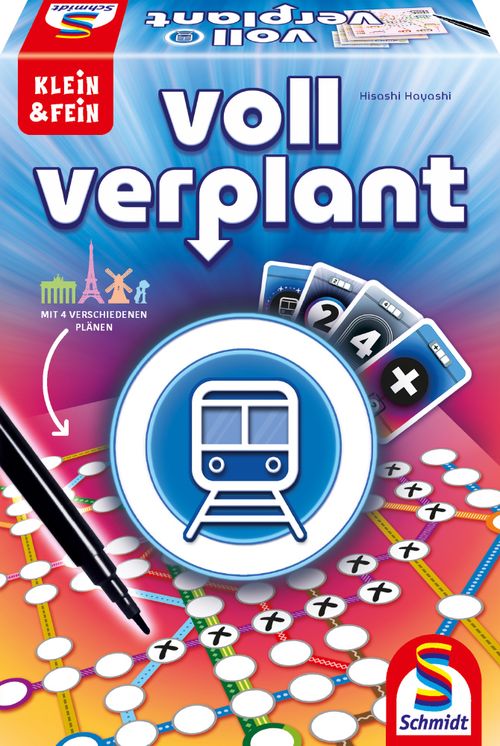
Voll verplant
Voll verplant Rulebook
Table of Contents
Table of Contents
Game Components
- 14 game cards
- 1 pad with 4 different maps, printed on the front and back of each sheet
- 6 felt-tip pens
Game Idea
Mark as many stations as possible on your sheet and be the first to reach the terminus stations of the various subway lines. What makes this special is that the same card value applies to all players every round. This creates an exciting race to see who chooses their lines most cleverly and also plans ahead for the point-rich interchange stations. But beware: each line can only be chosen a limited number of times, and stations you have already crossed off will end your turn early. Before long, some players will find themselves stuck on the tracks — completely overbooked.
Game Setup
The sheets of the pad are printed on both sides and have different background colors. Each color shows a simplified subway map of the cities Amsterdam, Berlin, Paris, and Madrid. Before the game, decide together which map you want to play on. For your first game, we recommend choosing Amsterdam or Berlin. Give each player a sheet of this color and a pen.
Whoever most recently rode a subway is named the "Train Conductor" for this game. The Train Conductor shuffles the 14 game cards thoroughly and places them as a face-down draw pile.
Take a close look at the map and the individual subway lines:
- City symbol — identifies which city's map this is.
- Subway lines and their letters — each line on the map has a letter (A, B, C, D, E, F, G, H, I).
- Victory points — printed along the right-hand edge of the scoring sheet, one row per line letter, showing the points for completing that line.
- Sheet color — identifies the map/city.
- End-game scoring — the boxes at the bottom right of the sheet used for final scoring.
Hint: longer and more difficult routes give higher victory points!
Reading a Subway Line
Each subway line on the map is made up of the following parts, from left to right:
- Line letter — the letter identifying this line, shown at the depot.
- Car window boxes — a row of small boxes at the depot (the "wagon"), one of which you fill in with a card value each time you choose this line.
- The wagon — the depot symbol itself; this is always where you start counting stations from.
- 1st station — the first empty circle along the line, counting outward from the wagon.
- Further stations — the remaining empty circles along the line.
- Terminus (end station) — the final circle on the line.
- Points for the 1st place — the higher of the two victory-point values shown for this line, scored by whoever completes it first.
- Points for all others — the lower of the two victory-point values shown for this line, scored by any other player who later also completes it.
Turn Sequence
You all play simultaneously. Every round follows the same sequence:
- The Train Conductor reveals one card for everyone.
- Each player chooses a subway line and writes the value into an empty car window box.
- Each player marks the corresponding number of crosses on the chosen line.
- If anyone has completed a subway line, they announce it out loud.
The game ends as soon as there are no more empty car window boxes. The players then add up the points they have earned.
The Individual Steps
1. Reveal a Card
The Train Conductor turns over the top card, announces the value shown on it out loud, and places it face up next to the draw pile, visible to everyone. In later rounds, the revealed cards are stacked on top of each other.
Watch out: if the card with the number 6 is revealed during the game, the Train Conductor gathers up all of the cards that have been revealed so far (including the 6) at the end of that turn and shuffles them back into the draw pile, which is then placed face down again.
2. Choose a Line and Enter the Value
Each player chooses a subway line on their sheet and writes the value of the revealed card into one of the empty car window boxes on that line. If there is no empty car window box left on that line, a different line must be chosen.
Hint:
- For the "Interchange Opportunity" card (see the middle card), a "+" is written into the car window box instead of a number.
- For the "Free Ride" card (see the right-hand card), no car window box is filled in at all.
(These two special cards are explained in full under "Special Cards" below.)
3. Cross Off Stations
Each player now crosses off as many stations on the chosen subway line as the number on the revealed card indicates. When doing this, you must observe the following:
- Stations are always crossed off starting from the wagon, i.e. you follow the line, beginning at the wagon, to the first free station and place your first cross there.
- All crosses must be connected; stations may not be skipped.
- You may not leave the chosen subway line.
- If you reach a station that has already been crossed off, you must end your turn (the remainder of the card's numeric value is forfeited).
- If you reach the terminus of the line, your turn also ends.
Example:
- A 4 is revealed.
- The player decides on the dark green line F and writes the number "4" into an empty car window box.
- She then crosses off the first empty stations, starting from the wagon, on the dark green line.
- Stations that were crossed off in previous rounds do not count toward this.
- She cannot place the fourth cross and it is forfeited, because that station is already crossed off. Her turn is now over.
Special Cards
Number Card 6
When the 6 is revealed, the Train Conductor takes all of the cards revealed so far (including the 6) at the end of the turn and shuffles them back into the deck.
Express Cards
If you reach a station that has already been crossed off, you are allowed to skip it (or several such stations) up to the next empty station and continue crossing off from there (possibly more than once). Empty stations, however, may not be skipped. You may also use Express cards completely normally (or only partially) as a plain number card.
Example: An Express card with the 3 is revealed. The player decides to enter further stations on line D. She follows the light blue line from the wagon and places the 1st cross on the first empty station. She is then allowed to skip the red line, place the second cross, and skip further already-crossed-off stations in order to place the third cross. With an ordinary number card, she would have had to end her turn after the first cross.
Interchange Opportunity
Here you write a "+" into the car window box instead of a number. Follow the line from the wagon, just as before, until you reach an empty station. There, count the different lines (i.e. colors) that connect at this station and write that number into the station. Finally, draw a square around the station for easier recognition. The number of your interchange opportunities counts double toward the final scoring at the end of the game (see "End of Game and Scoring").
Example: The player chooses line B for her interchange opportunity and writes a "+" into the car window box. She follows the line from the wagon to the next free station. There she counts the different lines that connect there (red, dark blue, and orange = 3) and writes that number into the station. Finally, she draws a square around it.
Hint: you can also enter an interchange on a station where no further lines cross. In that case you write a 1. At the end of the game that is still worth 2 × 1 = 2 points.
Free Ride
Here, exceptionally, no car window box is filled in, and you may freely decide which empty station to place a cross in. The chosen station does not have to be the first empty station from the wagon — it can be chosen completely independently, anywhere on the map.
NOTE: You may also enter fewer crosses, or none at all, than the revealed number indicates. However, you must always fill in a car window box with a number or a "+", even if you cannot or do not want to mark a station on that line. This also applies, for example, if all stations on a subway line are already crossed off but you still have empty car window boxes for that line.
4. Completing a Subway Line
The victory points for completing each subway line are printed along the right-hand edge of the scoring sheets. If a player is the first to mark all the stations of a subway line, they announce that line's letter out loud to their fellow players and circle the higher victory-point value for that line, shown in the diamond. All other players cross out the value in the diamond on their own sheet and can still achieve the lower point value for that line, shown in the square. To complete a line, it does not matter whether the stations were marked with crosses or with a number from interchanging.
IMPORTANT
- Only the higher value of a subway line is ever crossed out. All other players still have the chance to achieve the lower value if they complete the line later.
- If several players complete the same subway line for the first time in the same round, they all receive the higher point value.
- In a single turn, a player can complete more than one subway line.
End of Game and Scoring
When all car window boxes are filled in, the game ends (*). One last time, it is announced whether anyone has completed a line. Then each player's points are determined as follows:
- Add up all the points you earned for completed subway lines and write the sum into the first box.
- Add up all the points from your stations with interchange opportunities. Double that value, then write it into the second box.
- Count up all of your still-empty stations. Halve the value (rounding down if necessary) and write it into the third box. Watch out: this value counts as negative in the final scoring.
- Write your final result here: add the values for completing lines and interchanging, then subtract the value for empty stations. Whoever now has the most points wins! In case of a tie, the player with fewer empty stations remaining wins. Otherwise, the win is shared.
() This should happen for all players at roughly the same time, since every player always fills in one car window box per round.*
Example final calculation: The player has filled in all of her car window boxes. She adds up the circled points for her completed lines (1 + 2 + 4 + 2 + 3 + 6 = 18) and writes this into the first box. Then she adds up her boxed-in interchange opportunities and doubles the value (2 × [1 + 4 + 1 + 3 + 2] = 22), which she writes into the second box. She counts her still-empty stations and halves the value (9 ÷ 2 = 4.5 → rounded down = 4), which she writes into the third box. In the end, the calculation comes to: 18 + 22 − 4 = 36.
Map Variations
Berlin and Madrid
In Berlin (line C) and in Madrid (line J) there is a loop line. These lines each have 2 arrows at the first station. In every round in which you choose this line, you may decide anew in which direction you want to continue the crosses. The row of crosses must, however, still always be started from the wagon, as usual. There is no terminus. The line counts as completed once all stations on the line are marked.
Paris and Madrid
Experienced Voll verplant players can add the following rule for this station (see illustration): when the special station is marked, the same value with which the station was just reached must immediately afterward be entered into another car window box and carried out. The same line or a different line may be chosen for this. If a special station was filled in using an Express card or an Interchange card, the exact same action applies to the further entry (in other words, the Express function can then also be used, or a number can be entered for interchanging).
Hint: this can result in players having filled in different numbers of car window boxes. In rare cases this can mean that some players play longer, until all of their car window boxes are filled in.
Solo Play
If no fellow players are available, Voll verplant can also be played well alone. In solo play, the goal is to collect as many points as possible. The game rules remain unchanged. When you complete a subway line, you always mark the higher victory-point value in the diamond. In the final scoring, the minus points for empty stations are not halved for this (after all, you had all the time in the world to find the optimal routes).
Using the table below you can see whether you are truly voll verplant (completely overbooked):
| Score | Result |
|---|---|
| 50+ | WOW, you're either a genius or had incredible luck! |
| 40–49 | Respect — you have professional planning talent! |
| 30–39 | Congratulations, the plan worked out! |
| 20–29 | Well done, you can do more than just make plans. |
| 10–19 | The plan didn't quite work out. |
| 5–9 | You're already pretty good at making plans. |
| 1–4 | Did you understand the rules correctly? |
| <0 | Voll verplant? |
General Notes
- At the start of the game there may be a few players who choose the same moves. That should sort itself out as the game progresses. Copying is against the honor of a player!
- You should always have filled in the same number of car window boxes as the other players in every round (though of course not always the same boxes). Because the numbers (and symbols) are written into the car window boxes, the course of play can be traced back on each individual sheet.
Tactical Tips
- Note that some lines are worth more points than others. The point difference for completing a line is also sometimes smaller (and therefore less rewarding).
- Interchanging counts double in the final scoring! It can be worthwhile to leave a lucrative station with many different lines "unclaimed" and wait for the Interchange card.
- The subway lines run every which way. Think about which lines you mark first. Sometimes it pays to let your crosses end early, so that a crossing point stays free.
- It is nearly impossible to cross off every station. It can therefore make sense to "sacrifice" one or more lines in order to enter an unsuitable value, and hope for a better card next time.
- The number of cards is limited. Try to remember which cards have already been revealed and which cards might still come.
The 14 Cards at a Glance
- 8x Number cards — values 3 (×2), 4 (×3), 5 (×2), and 6 (×1). Don't forget to shuffle the cards!
- 3x Express cards — values 2 (×2) and 3 (×1). Already-crossed-off stations may be skipped.
- 2x Interchange Opportunity cards — enter a "+", count the lines at the station, write in the number, and draw a box around it.
- 1x Free Ride card — freely place one cross.
Turn Sequence at a Glance
- The Train Conductor reveals a card for everyone.
- Each player writes the value (or a "+") into an empty car window box.
- Each player marks the corresponding number of crosses (or a number) on the chosen line.
- Check for completed lines.