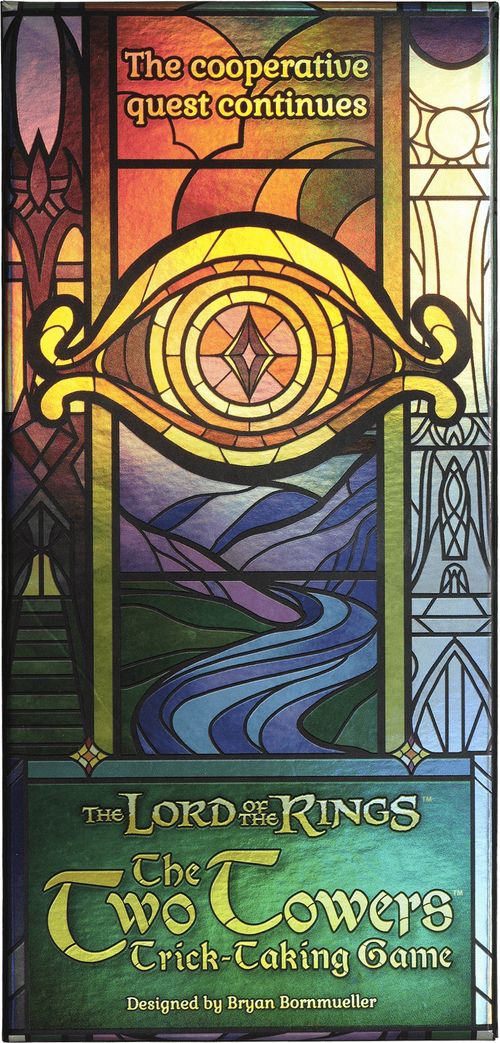
The Lord of the Rings: The Two Towers – Trick-Taking Game
The Lord of the Rings: The Two Towers – Trick-Taking Game Rulebook
Table of Contents
Table of Contents
- Components
- Key Types of Cards
- Chapter 19 Setup
- Trick-Taking
- Tower Cards
- Orcs Cards
- Communication
- Character Goals
- End of the Round
- Additional Rules
- Chapter-Specific Questions (Chapters 19–28)
- Chapter 29 Setup
- The Rings Suit
- Weariness Cards
- Tower Events
- Chapter-Specific Questions (Chapters 29–36)
- Rule Changes for 2 Players
- Solo Setup
- Solo Gameplay
- The Road Goes Ever On...
- Rules Summary
Components
- 1 Chapter 19 Card
- 4 Character Cards
- 37 Main Deck Cards
- 6 Reference Cards
- 11 Wooden Tokens:
- 1 White Tower Token
- 1 Black Tower Token
- 4 Star Tokens
- 1 Ring Token (Part 2)
- 4 Burden Tokens (Part 2)
- Chapters 20–36 Cards (96 cards in a precise order in 2 sealed sections)
Player Reference Card
- Hills 1–8
- Mountains 1–8
- Forests 1–8
- Shadows 1–8
- Black Tower x 1
- White Tower x 1
- Orcs x 3
- Towers: Wins the trick. Cancel if both played in the same trick. If a Tower card is led, the next card sets the suit.
- Orcs: If you are forced to lead with orcs, lose the chapter.
- Rank: The number on a card.
Key Types of Cards
Main Deck Cards
Each Main Deck card shows the card's rank number and the card's suit icon.
Main Deck Makeup:
- Hill 1–8
- Mountain 1–8
- Forest 1–8
- Shadow 1–8
- Orcs x 3
- White Tower x 1
- Black Tower x 1
Character Cards
Each Character card shows the character's name, the character's description, the character's goal, and (sometimes) the character's setup action.
Chapter Cards
Each Chapter card shows:
- The chapter's number and title.
- The characters used in this chapter (a
*indicates that the character must be chosen). - The chapter's victory condition.
Chapter 19 Setup
1. Take the Chapter 19 card "The Departure of Boromir" and put it and the character cards listed faceup in the center of the table.
2. Place a star token next to each character with a * after their name on the chapter card.
3. Shuffle the main deck cards and deal 1 card faceup near the chapter card. This is called the lost card. If the lost card is ever the White Tower or Black Tower, deal another card and shuffle the Tower card back into the deck.
4. Deal the rest of the main deck cards to the players according to the player count. (Players look at their cards but keep them secret.)
- 2 players: 12 cards each (see Rule Changes for 2 Players)
- 3 players: 12 cards each
- 4 players: 9 cards each
5. The player dealt the White Tower card takes Aragorn and the White Tower token. They keep the White Tower card in their hand.
6. Starting to Aragorn's left, each player picks a character card. Characters with a star token must be chosen this round. This means Boromir must be chosen, but the first player to choose does not necessarily need to choose him. Make sure you use the correct side of the Gimli and Legolas cards based on the number of players in the game (3 players or 4 players). Remove all of the star tokens once each player has a character.
Tip: When choosing character cards, take a close look at the cards in your hand and decide which goal you can best accomplish.
7. Starting with Aragorn and proceeding clockwise, each player with a character that has a setup action (indicated by a setup icon) performs that action.
Exchange means the active character passes 1 card facedown to 1 of the indicated characters. The receiving character looks at the passed card, adds it to their hand, then passes any 1 card back facedown. (This may be the originally passed card.)
Any characters not in a given round cannot be part of an exchange. Aragorn may not exchange the White Tower.
8. Once everyone has completed their setup action, you are ready to play.
Trick-Taking
Players have a hand of cards that represent the world of Middle-earth and the forces that seek to control it. Through clever play of these cards, players work together to complete each character's goal and win the game.
Each deal of the deck is called a round, which is played as a series of tricks. A trick consists of each player playing a single card. Below are more details on key terms, how to play cards, and how to determine the winner of each trick.
Lead: The first player in a trick (called the lead player) plays any card from their hand to the center of the table. The suit of this first card sets the trick's lead suit (Hills, Mountains, Forests, or Shadows). Aragorn leads the first trick.
Follow: The remaining players, in clockwise order from the lead player, must then play a card to the table, matching the lead suit if they are able to. This is known as following suit. If a player cannot follow suit, they may play any card from their hand.
Win: Once all players have played 1 card to the trick, check to see who wins. The player with the highest card of the lead suit wins the trick. That player takes all of the cards facedown into a pile in front of themself. The winner of the trick leads the next trick.
Example: Aragorn leads with a 1 of Hills. Boromir is next to play. He has a 3 of Hills and a 6 of Hills and must follow suit. Boromir chooses to play the 3 of Hills. Gimli does not have any Hills cards, so he chooses to play the 8 of Forests. Boromir played the highest card of the lead suit of Hills and wins the trick. Boromir then leads the next trick.
Tower Cards
The White Tower and Black Tower cards are special cards that work differently from other cards in the main deck.
You may play a Tower card into a trick only if you cannot follow suit.
A Tower card will win any trick it is in, regardless of the rank of the other cards. However, if both Tower cards are played in the same trick, then neither wins the trick (they cancel each other out), and the highest card of the lead suit wins as usual.
A player may lead with a Tower card, but since Tower cards do not have a suit, the next card played can be any suit and the next card with a suit will set the suit of the trick (though that player does not count as having led the trick). All players must follow the set suit, if able. If a Tower card is led, you do not have to follow with a Tower card.
The matching Tower token is given to a player as soon as they play or reveal a Tower card from their hand as a reminder to all players. (Knowing which player has each Tower is often important for character goals.)
Example: Aragorn leads with a 2 of Forests. Boromir is next to play. He has a 7 of Forests and a 3 of Forests and must follow suit. Boromir chooses to play the 7 of Forests. Gimli does not have any Forests cards, so he chooses to play the Black Tower. Gimli wins the trick. Gimli then leads the next trick.
Orcs Cards
The 3 Orcs cards are special cards that work differently from other cards in the main deck.
You may play an Orcs card into a trick only if you cannot follow suit.
An Orcs card can never win a trick.
If you are forced to lead with an Orcs card, it immediately counts as failing your goal, and you lose the chapter. Playing an Orcs card after a Tower card is the lead card does not cause you to lose the chapter.
In the unlikely event that a trick is composed of only Orcs card(s) and both Tower cards, then no player wins the trick. It is set aside, and the lead player leads again.
Communication
Players can only discuss information visible to all players during setup and gameplay. Players cannot discuss or show the cards in their hands or any other player's hands. During setup, players should not discuss character preferences, as this may reveal information. Players can remind each other of their characters' goals and special rules, the current status of their goals, or any other information known to all players, such as cards faceup on the table.
Players should keep the tricks they have won facedown to the side so these cards are not confused with the cards in hand. If it is useful, players can keep cards they win that are part of their character's goal faceup as a reminder (Forests cards for Legolas, for example), but make sure there is no confusion about which cards are in hand and which cards are being played.
Character Goals
Each character has a goal that must be completed by the player who selected them during the round.
Marking goals as complete: Once you have satisfied the condition for a character's goal (and cannot later fail the goal), put a star token on your character card to remind other players you have accomplished your goal.
Ending Early: If everyone finishes all of the character goals (and you cannot fail them later in the round), and you have played all of the Orcs cards, you can stop playing early and move on.
Conversely, if a play means you will never be able to finish a character's goal, you can stop the round as soon as you know you've failed the goal.
End of the Round
Once all players have played all the cards in their hands, the round is finished.
If everyone completed their character's goal this round, the players win and have completed the chapter. Set this chapter's card aside and get the next chapter card from the box along with any other new cards required.
If even 1 player failed to complete their character's goal, everyone loses. You may replay the round and try again.
There are many chapters in the game, and it is unlikely you will get through them all in a single play session. Use the ribbons in the box to keep track of where you are so you can come back later and continue from where you left off.
Play Chapter 19 Now!
Additional Rules
Subsequent chapters are similar to the first chapter. You start with a chapter card that will tell you all the cards you will use.
The golden rule always applies: "If any text on a card contradicts these rules, follow the rules on the card."
New Characters
Each new chapter will introduce new characters and new challenges. Some characters from earlier chapters remain in the game, while some depart and some return.
New Setup Action: Tuck
Some characters have a setup action that will allow them to tuck a card. Choose any card in your hand and place it facedown under your character card. This card does not count as being in your hand (and thus you cannot be forced to play it to follow suit, for example). You can add it back to your hand at any time before or after playing a trick. If your hand is empty, you must add it back to your hand.
You can look at your tucked card at any time during the round, but you cannot swap it out. You cannot use a tucked card during an exchange.
Events and Special Rules
Some chapters will have event cards that change the rules. Follow these instructions closely during setup and/or play. Consult Chapter-Specific Questions if you have any questions about how a particular event or chapter works.
Aragorn's Absence
If Aragorn is not part of the chapter, another character or event will indicate who is assigned first based on a card in a player's hand (such as having a specific Tower card), then selection proceeds to their left. A character's setup action will indicate that they lead the first trick.
Card Numbers
The small numbers in the bottom right corner of the cards are useful if you want to sort the game back to factory order to replay the chapters. (Note that the card numbers proceed after the card numbers included in The Fellowship of the Ring: Trick-Taking Game, 1.01 through 3.48.)
Victory Conditions
The chapter card will indicate the length of the chapter and victory condition, either short or long.
Short — "finish all chosen characters": If the players complete all the goals of the chosen characters, they win the chapter and can play the next one. If they miss any goals, they can replay the chapter.
Long — "finish all characters": Long chapters will be played over multiple rounds. If the players complete all the goals of the chosen characters, they set those character cards aside. If the players haven't completed all the characters, they then play another round in this chapter. Some chapters will indicate specific characters that do not have to be completed.
To begin the next round, shuffle the main deck and deal. Players will choose characters and follow all of the round setup using the same chapter card. Players can choose completed characters again in the next round, but they don't have to. (A player may decide to choose a previously completed character because they don't think their hand will work with any uncompleted characters.)
Use required characters (with a *) in every round, even after they have been completed.
If the players have completed all characters and met all the goals of every character they chose for this round, they win the chapter and can move on to the next chapter.
If at any point the players miss a goal, they lose the chapter and may start over. They can choose to start again from the beginning of the chapter or keep the characters they've completed.
Chapter-Specific Questions (Chapters 19–28)
Below are some extra details about specific chapters and characters:
Chapter 19 — The player with the Black Tower card does not announce it. Aragorn won't know who his partner is until the Black Tower is played. If Aragorn plays the Black Tower, he must win a majority of tricks by himself. Boromir can win the trick in which the Black Tower is played, but it won't count for the 2 tricks he needs to complete his goal. If the Black Tower is set aside, because it is in the same trick as the White Tower, Boromir cannot win any more tricks.
Chapter 20 — If Éomer has 2 or more Orcs cards in his hand at the start of card play for the chapter, he cannot achieve his goal. Be careful.
2-Player: If the pyramid controls a character with a tuck setup action, choose 1 of the 5 faceup cards and place it faceup partially under their character card. It doesn't count as being playable. You can move it back to the left of the pyramid anytime or when there are no other playable cards.
Solo: Add 2 Orcs cards to the initial deal of 4 hands, along with the 2 Tower cards.
Chapter 21 — Grishnákh and Uglúk need to win the same number of tricks. If Grishnákh does not have the Black Tower card during his setup, the player who has it passes it to Grishnákh, who passes 1 card back facedown. Uglúk can pass the White Tower card if he likes.
2-Player: Before dealing, remove both Tower cards from the deck. After dealing the first 7 pyramid cards, shuffle the Tower cards back into the deck. Next, finish dealing to the pyramid before dealing to both players.
Chapter 22 — Forests and Fangorn Forest cards are both Forest-suited cards (thus the Forests suit goes from 1 to 16). The Fangorn Forest cards are named that way so they are easy to add and remove from the deck.
Treebeard can be thought of as playing 1 trick later than the other characters. When he leads, the card he places under the White Tower token sets the lead suit (i.e., the card that comes out from under it does not). If Treebeard leads and there is an Orcs card under the White Tower, he does not lose; he loses from an Orcs card only if he is leading and he places an Orcs card under the White Tower. Treebeard cannot exchange the White Tower. If no player plays a card of the lead suit, nobody wins the trick. Set it aside, and the lead player leads again.
Example: Treebeard leads with a 7 of Shadows from his hand, placing it down on the table. The lead suit is now Shadows. Treebeard then takes the 5 of Mountains card that is under the White Tower token and plays it into the trick as his card played. Treebeard puts the White Tower token over his 7 of Shadows. Merry is next to play and must follow the lead suit of Shadows. He plays a 2 of Shadows. Quickbeam is next to play and follows suit with a 4 of Shadows. Quickbeam wins the trick with the highest card of the lead suit.
Example Continued: Quickbeam leads with a 1 of Forests. Treebeard must follow the lead suit of Forests, so he takes a 6 of Forests from his hand, placing it down on the table. Treebeard then takes the 7 of Shadows card that is under the White Tower token and plays it into the trick as his card played. Treebeard now puts the White Tower token over his 6 of Forests. Merry is next to play and must follow the lead suit of Forests, and he plays a 2 of Forests. Merry wins the trick with the highest card of the lead suit.
Example Continued: Merry leads with a 3 of Forests. Quickbeam is next to play and must follow the lead suit of Forests, but he doesn't have any Forest cards, so he plays a 1 of Shadows. Treebeard must follow the lead suit of Forests, so he takes an 8 of Forests from his hand, placing it down on the table. Treebeard then takes the 6 of Forests card that is under the White Tower token and plays it into the trick as his card played. Treebeard now puts the White Tower token over his 8 of Forests. Treebeard wins the trick with the highest card of the lead suit.
Chapter 23 — Be sure to remove the Fangorn Forest cards and return the Hills cards before dealing this chapter.
The 2 Old Man in White characters begin with their Gandalf/Saruman side facedown and randomized so you don't know which is which. The 2 Old Man in White cards flip over once both Old Man in White characters have won at least 1 trick. Any tricks they have won are discarded, and the Gandalf the White player will perform his setup action before the next trick and has to win 2 more tricks to achieve his goal. Discarded tricks are removed from the round and do not count for or against Aragorn's goal. Gandalf will have a card left faceup on the table at the end of the round. If both Old Man in White characters have not flipped by the end of the round, lose the chapter. The Gandalf the White player can use a reference card as a reminder of their faceup card.
2-Player: If the pyramid controls Gandalf the White, add the lost card faceup near the bottom of the pyramid.
Chapter 24 — Éowyn winning a trick with a Tower card does not count towards her goal.
2-Player: Deal the top 4 cards for the pyramid during the Wormtongue's Counsel event.
Solo: For the Wormtongue's Council event, deal the White Tower and a total of 2 cards for each hand, then passing characters before finishing the solo setup as normal.
Chapter 25 — This chapter is always 4 rounds. If you have not completed every character by the end of the fourth round, you lose the chapter. You do not lose the chapter by failing a character's goal (except Aragorn's). The Orcs cards Legolas puts under Gimli's card stay there until Gimli successfully completes his goal. Those Orcs cards are shuffled back in for the next round(s) after Gimli completes his goal. The 6 Orcs cards with unique art are treated the same as other Orcs cards but are removed after the chapter. Being forced to lead an Orcs card causes you to lose the chapter.
2-Player: The dealer plays for the pyramid. In round 3, the pyramid does not discard or draw for The Horn Blows. Deal cards to the pyramid in the specified order shown on the diagram. Flip any uncovered cards.
Solo: Do not set aside the Tower cards each round during setup. Instead, after adding the Tower cards and the specified number of Orc cards to the deck for the round, deal 4 cards randomly to each hand. Deal 1 additional card to each character after a trick as usual until each character has been dealt enough cards to play tricks equal to the card deal specified that round for a 4-player game.
Chapter 26 — Quickbeam and Beechbone will both use the same shuffled deck of Hills cards (but will get different random Hills cards). Beechbone completes his goal if the total number of Forests and Fangorn Forest cards he wins combined equals the rank of his chosen Hills card (e.g., if Beechbone chooses the 2 of Hills, he will complete his goal if he wins 1 Forest card and 1 Fangorn Forest card, 2 Forest cards and 0 Fangorn Forest cards, or 0 Forest cards and 2 Fangorn Forest cards).
Chapter 27 — Be sure to remove the Fangorn Forest cards and return the Hills cards. You will have to cancel Saruman's Black Tower card with the White Tower card to complete his goal.
Chapter 28 — Deal:
- 2 or 3 Players: 9 cards per player and 1 lost card
- 4 Players: 7 cards per player and 1 lost card
Pippin does not draw any more Shadows cards after the Palantír deck runs out.
2-Player: Use the specified diagram for the open hand.
A long-tilted valley, a deep gulf of shadow, ran back far into the mountains. Upon the further side, some way within the valley's arms, high on a rocky seat upon the black knees of the Ephel Dúath, stood the walls and tower of Minas Morgul. All was dark about it, earth and sky, but it was lit with light. Not the imprisoned moonlight welling through the marble walls of Minas Ithil long ago, Tower of the Moon, fair and radiant in the hollow of the hills. Paler indeed than the moon ailing in some slow eclipse was the light of it now, wavering and blowing like a noisome exhalation of decay, a corpse-light, a light that illuminated nothing.
Chapter 29 Setup
Starting with Chapter 29, there are some key changes to the main deck and how the game is played.
1. Take the Chapter 29 card "The Taming of Gollum" and put it and the character cards listed faceup in the center of the table.
2. Place a star token next to each character with a * after their name on the chapter card.
3. Prepare the main deck by removing the rank 8 cards of each suit (4 total) and the 3 Orcs cards. Add the 5 Rings cards and 2 Weariness cards to the main deck. This is the basic deck configuration for the rest of the game.
4. Following the instructions of the Tower event, set aside the White Tower card and place it faceup near the Tower event card The Shadow of Barad-dûr as well as the White Tower token. Shuffle the main deck cards.
5. Deal the rest of the main deck cards to the players according to the player count. (Players look at their cards but keep them secret.)
- 2 players: 12 cards each (see Rule Changes for 2 Players)
- 3 players: 12 cards each
- 4 players: 9 cards each
6. The player dealt the 1 of Rings card takes Frodo and the Ring token with the Cannot Lead Rings side facing up. They keep the 1 of Rings card in their hand. Also give Frodo the 4 Burden tokens (numbered 2–5).
7. Starting to Frodo's left, each player picks a character card. Characters with a star token must be chosen this round. This means Gollum and Sméagol must be chosen, but the first player to choose does not necessarily need to choose them. Make sure you use the correct side of the Gollum and Sméagol cards (use their starting side). Remove all of the star tokens once each player has a character.
Tip: When choosing character cards, take a close look at the cards in your hand and decide which goal you can best accomplish.
8. Starting with Frodo, each player with a character that has a setup action (indicated by a setup icon) performs that action.
Burden Tokens: Frodo must choose a Burden token, which determines the details of his and Sam's goal for the round. Once Frodo chooses a Burden token for the round, place it faceup near his character card and place the 3 unused tokens to the side to avoid confusion.
9. You are ready to play. Frodo leads the first trick.
The Rings Suit
The Rings suit is like the other 4 suits, except there are only 5 cards in the Rings suit (the others have 7), and it has a few special rules associated with it.
Leading Rings: Players cannot lead with a Rings card until someone plays a Rings card into another trick (because a player did not have the lead suit and played a Rings card instead). The Ring token begins on the Cannot Lead Rings (1) side to reflect this.
Once someone plays a Rings card, players can lead with Rings cards in future tricks. Flip over the Ring token to the Can Lead Rings (2) side.
In the unlikely event that a lead player has only Rings cards, they can lead with one even if no one has played the Rings suit yet.
The One Ring: The 1 of Rings is the most powerful single card in the game. When a player plays the 1 of Rings, they may decide that they want to win the trick; if they do, they will win the trick no matter what cards have been or will be played to the trick. The 1 of Rings wins any trick that includes a Tower card. If they decide to not automatically win the trick, treat the card as having a rank of 1 of the Rings suit. The 1 of Rings must follow normal rules for playing a card in the Rings suit.
Important: Only the 1 of Rings can win any trick; the 2 through 5 of Rings win or lose a trick like any other card.
Weariness Cards
The 2 Weariness cards are special cards that work differently from cards in the 5 suits.
Weariness cards can only be led. Since they do not have a suit, the next card played can be anything (even a Rings card). The next card with a suit will set the lead suit of the trick, though that player does not count as having led the trick. If a Weariness card is led, you do not have to follow with a Weariness card.
If you are forced to play a Weariness card without leading it, you immediately lose the chapter.
In the unlikely event that a trick is composed of only a Weariness and both Tower cards, then no player wins the trick. It is set aside, and the lead player leads again.
Tower Events
Each chapter in Part 2 will include a Tower event that will add additional conditions to setup. You do not need to deal a lost card during Tower events. All cards related to Tower events are faceup.
Chapter-Specific Questions (Chapters 29–36)
Below are some extra details about specific chapters and characters:
Chapter 29 — Be sure to rebuild the deck with Rings and Weariness cards (see The Rings Suit and Weariness Cards). As soon as the 1 of Rings is played, check to see if Gollum has won more tricks than Sméagol. If so, his goal is complete for the round; otherwise, flip his card, and he must have fewer tricks than Sméagol at the end of the round. Similarly, when the 1 of Rings is played, check to see if Sméagol has won the fewest tricks of any character. If so, his goal is complete for the round; otherwise, flip his card, and he must win more tricks than Gollum at the end of the round. The trick containing the 1 of Rings does not count when first checking Sméagol's and Gollum's goals, but will count at the end of the round.
2-Player: If the pyramid is Frodo, the player who controls the pyramid's plays also sets Frodo's Burden token.
Chapter 30 — The Dead Marshes event affects all players. If a Weariness card is led, a Shadow card can be played after it without losing due to the Dead Marshes event.
Chapter 31 — For the Black Gate event, if Frodo has multiple highest cards of the same rank, he gets to choose any of the tied cards. (A Tower card is the highest, but the 1 of Rings is not.) For the Wraiths with Wings event, if Frodo plays a Rings card after a Tower card or Weariness card is led, it sets the suit but does not count as leading Rings. For the Hosts of Sauron event, you will need to use 1 of the Helm's Deep Orcs with 4 players. Gollum (Wicked)'s goal is not affected by Tower, Orcs, or Weariness cards, as they do not have a rank.
Solo: Each hand starts with 5 cards (instead of 4) due to the Hosts of Sauron event.
Chapter 32 — The groups of characters are set for 3 and 4 players, though players will get to decide the order they attempt the groups. The trick containing the Black Tower does not count towards Faramir's goal. Multiple exchanges can be made with Henneth Annûn.
Chapter 33 — Be sure to remove the 6 and 7 of Rings cards and return to the deck the 2 Weariness cards from Chapter 32. Sméagol (Wretched) counts as finishing his goal when he wins a rank 2 card for the Stairs event.
Chapter 34 — For simultaneous exchanges, both players pass the cards facedown at the same time and look at the received cards at the same time. You will use both the first and last card, and different players must choose each. Gollum (Servant of the Precious)'s goal means that Sam must win a number of Hills cards exactly equal to Frodo's Burden token.
Chapter 35 — Shelob will have 1 card left in her hand at the end of the round. The rank 8 cards are the 8 of Mountains, 8 of Hills, 8 of Forests, and 8 of Shadows. Shelob may exchange rank 8 cards with Gollum. The Light of Eärendil wins over any card, including the 1 of Rings and the Tower cards. Players are not forced to use The Light of Eärendil.
Solo: Shelob can also play Weariness cards (like Gollum can) and not lose the chapter.
Chapter 36 — Sam cannot give the tower event the 1 of Rings. The players can use a reference card to remind themselves of the faceup card in front of them. All players (including the player with Sam) reveal a card.
Rule Changes for 2 Players
The 2-player setup is similar to the 3-player setup, with some changes. One of the players will control an open hand represented by a card pyramid. This pyramid will have a character card and act as the third player in the round. Position the pyramid between the 2 players, treating it as though a player is sitting there.
Setup: Deal cards as you would in a 3-player game and take 1 hand of 12 cards to build the card pyramid. Follow the diagram. Deal 3 cards in the top row first (2 faceup and 1 facedown), then cover it slightly with 4 cards for the middle row (all facedown), then cover that slightly with the bottom row (5 faceup).
The first player to be assigned a character will control the pyramid, including picking a character for it during setup and playing cards from the pyramid hand during tricks. Use the 3-player side of any character card.
The pyramid can exchange or be exchanged with but uses only uncovered cards in the bottom row for these exchanges. If the character assigned to the pyramid adds cards to their hand during setup, it is added faceup to the left or right of the bottom row, not covering any cards.
The player controlling the pyramid can play only the cards that are uncovered. The bottom row is the only uncovered part of the pyramid's hand at the start of a round. Facedown cards in the pyramid's hand flip faceup when there are no cards covering them at the end of a trick.
Solo Setup
1. Take a chapter card and put it and the character cards listed faceup on the table.
2. Place a star token next to each character with a * after their name on the chapter card.
3. Set aside special card(s) depending on which part you're in: the White Tower and Black Tower cards in Part 1, and the 1 of Rings in Part 2.
4. Shuffle the main deck cards and deal 1 card faceup near the chapter card. This is called the lost card.
5. Remove any card(s) that are part of a character's setup (the White Tower, for example) and mix them with enough random cards from the deck to make 4 hands of 4 cards each. The remaining cards form a draw deck.
6. The hand with the special card(s) takes the corresponding character for the chapter.
7. Starting to the special card holder's left, each hand is assigned a character card. Characters with a star token must be assigned. Remove the star token once you have assigned a character with a token.
8. Starting with the special card holder's character, each character that has a setup action (indicated by a setup icon) performs that action. Choose only 1 character's exchange to use per round.
Solo Gameplay
Each of the 4 characters will have their own hand that will lead or play into each trick.
After determining the winner of a trick, deal each hand 1 new faceup card from the draw deck if there are any cards left in the deck.
You must complete all 4 character goals.
Gameplay is otherwise the same as a multiplayer game.
The Road Goes Ever On...
After you've finished the chapters, you can keep playing. First, grab all the cards with a black number box in the bottom right corner of the card. Cards with a white number box are not used.
Then, set up the deck as instructed for Chapter 19. You will always use Aragorn (Hunter) each round. Now randomly take 8 (for 2 or 3 players) or 12 (for 4 players) of the characters listed below:
Boromir, Legolas (Hunter), Gimli (Hunter), Éomer, Merry, Pippin, Gandalf the White, Saruman, Théoden, Éowyn, Háma, Erkenbrand, Gamling the Old, Shadowfax, Gollum (Wicked), Faramir, Sméagol (Wretched), Gorbag, and Shagrat
Play the chapter as you would play a long chapter.
If you own The Fellowship of the Ring: Trick-Taking Game, you can add the following characters to this version of the Road Goes Ever On…:
Bilbo (Peculiar), Gandalf (Grey Wizard), Gildor Inglorion, Fatty Bolger, Tom Bombadil, Goldberry, Barliman, Glorfindel, Bill the Pony, Glóin, Arwen, Boromir (Captain of Gondor), Gwaihir, Shadowfax (Lord of Horses), Radagast, Gandalf (Servant of the Secret Fire), Galadriel, and Celeborn
To Isengard! Though Isengard be ringed and barred with doors of stone; Though Isengard be strong and hard, as cold as stone and bare as bone, We go, we go, we go to war, to hew the stone and break the door; For bole and bough are burning now, the furnace roars – we go to war! To land of gloom with tramp of doom, with roll of drum, we come, we come; To Isengard with doom we come! With doom we come, with doom we come!
Rules Summary
If you're familiar with trick-taking games, here is a brief overview of the gameplay.
If you're new to this style of game, please read the full rules first.
Card play is standard must-follow trick-taking. Players must follow the lead suit if they can, with the highest ranked card of the lead suit winning the trick.
The player leading a trick can play any card.
The White Tower card and the Black Tower card win any trick (unless both are played in the same trick).
You may not lead with an Orcs card. If you are forced to lead with an Orcs card, lose the chapter.
The round ends when everyone has played all of their cards. Certain characters may have a card left in hand at the end of a round.
To win the round, all players must meet the goals of their characters by the end of the round.
Players cannot discuss or show the cards in their hands.