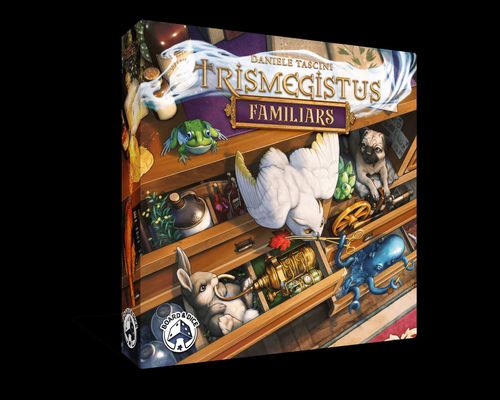
Trismegistus: Familiars
Trismegistus: Familiars Rulebook
Table of Contents
Table of Contents
Components
- 4 potency markers
- 8 young familiar tiles (indicated by I in the bottom right corner)
- 8 adult familiar tiles (indicated by II in the bottom right corner)
- 1 potency sideboard
- 1 homunculus familiar tile (solo mode)
Setup
After preparing the game as described in the core game rules, resolve the following steps:
- Place all Young Familiar tiles (indicated by I in the bottom right corner) in a stack next to the Experiment decks.
- Place all Adult Familiar tiles (indicated by II in the bottom right corner) in a stack next to the Experiment decks.
- Place the Potency sideboard next to the Main board. Each player places their Potency marker on space '0'.
Preparation Phase
During the Preparation phase of the first round, shuffle all the Young Familiar tiles, draw a number of tiles equal to the number of players, and place them Mischievous side up (indicated by the horned icon in the upper right corner) next to the Potency sideboard. Return all unused Young Familiar tiles to the box.
During the Preparation phase of the second round, shuffle all the Adult Familiar tiles, draw a number of tiles equal to the number of players, and place them Mischievous side up (indicated by the horned icon in the upper right corner) next to the Potency sideboard. Then, flip all the Benevolent Young Familiar tiles that are in play to their Mischievous side. Return all unused Adult Familiar tiles to the box.
During the Preparation phase of the third round, flip all Benevolent Familiar tiles in play to their Mischievous side.
Action Phase
From now on, the Potency of the dice you draft must be tracked on the sideboard. When you draft a new die during the Action phase of the 1st and 2nd round of the game, move your Potency marker on the sideboard a number of steps equal to the Potency of that die.
At the end of the Action phase in rounds 1 and 2, after each player has passed, but before proceeding to the Preparation phase of the next round, each player takes a Familiar tile and places it below their Player board in the same manner as you do with the Artifacts. It does not affect the 2 Artifact limit and you may end up with 2 Familiars in the same section.
Starting with the player that took the most Potent dice (the player that is highest on the Potency track) and proceeding with the next player lower on the Potency track, each player takes the Familiar with the highest value (shown in the upper right corner of the tile). In case of a tie, the player earlier in the turn order takes the Familiar with the higher value.
After taking a tile, each player places it below their Player board below the Transmutation section matching the color of which they have the most dice. In case of a tie, they may decide in which section they place the Familiar tile. Always place it Mischievous side up below the Artifact tiles in that section.
Finally, when all players have placed their Familiar tiles, reset their Potency markers on the Potency sideboard to the "0" space.
Example: The red player is the 1st on the Potency track so they take the Familiar tile with the highest number, which is 6. They place it below their Player board in the white section because the majority of their exhausted dice are white. The next player on the Potency track takes the Familiar tile with the second highest number: 4. Finally, the last player takes the only remaining tile: 1.
Playing the Game
The Familiar tiles may be in play on their Mischievous or Benevolent side. The Mischievous side comes with a disadvantage, while the Benevolent side provides a benefit to players. During the Action phase you may spend indicated Metals to change Familiars' behavior from Mischievous to Benevolent.
Familiar Tiles
At any time during your turn as a Free action, you may spend the required Metal(s) in order to flip the Familiar tile to its Benevolent side.
Each time you Transmute in a section with a Familiar, resolve its effect. While on its Mischievous side, Familiars add an additional cost, requirement, or other disadvantage. If you cannot meet the requirement, you cannot perform the Transmutation. While on the Benevolent side, Familiars provide you with an additional reward or a passive positive effect you may gain during a Transmutation in the corresponding section.
All Familiar effects apply only to the section they are in!
Example 1: The red player performs a Transmutation in the White section. Since they have not flipped the Familiar tile, they must pay an additional cost. They spend 1 Aqua Regia. If they did not have it, they could not perform the Transmutation.
Example 2: The red player decides to flip the Familiar tile. They pay the cost, in this case 2 unrefined Metals, and flip the Familiar tile to its Benevolent side. From now on, whenever they perform the Transmutation action in the white section they may perform an extra Transmutation in that section.
Solo Mode
All animals seem to avoid the Homunculus. It watches them, puzzled by the commotion they cause in the workshop. It must have noticed that Familiars can be helpful when calmed. One day, the Homunculus comes into the lab looking… agitated. In its hands rests a strange package — a small cage draped with a red cloth. What kind of creature might it conceal? Time will tell. For now, you have more than enough to worry about.
Solo Mode Components
- 1 homunculus familiar tile
Solo Mode Setup
Resolve according to the normal rules. Place the Homunculus Potency marker on the "0" space of the Potency sideboard. Place the Homunculus Familiar tile next to the Homunculus's player board, face down.
Solo Mode Playing the Game
In the Preparation phase of the 1st and 2nd round, display 2 Familiars, as you normally would in a 2-player game. You need to track your and the Homunculus's Potency.
At the end of the 1st and 2nd round, resolve the following:
- If the Homunculus is the highest player on the Potency sideboard, it discards the Familiar tile with a higher number, and places 1 Element marker on the Homunculus Familiar tile (flip it face up if needed).
- If the Homunculus is not the highest player on the Potency sideboard, it discards the Familiar tile with a lower number, and places 2 Element markers on the Homunculus Familiar tile (flip it face up if needed).
During the Action phase, when the Homunculus resolves a Decision card that requires exhausting an Artifact and there is at least one Element marker on the Homunculus Familiar tile, discard that marker to double the effect from the Decision card. When there are no more Element markers on the Homunculus Familiar tile, flip it face down.
Example: According to the current Decision card, the Homunculus must exhaust one Artifact to gain an advancement on the Fire Mastery track and 2 VP. As there is an Element marker on the Homunculus Familiar tile, it is discarded and the Homunculus gains 2 advancements and 4 VP (but only 1 Artifact tile is exhausted).
Appendix
The Familiar tiles are listed below by their printed number (the upper right corner value). Each tile shows its Mischievous side (the horned icon) and its Benevolent side (the icon in the middle of the tile). Icons printed on the tiles are named in words where they can be read; the symbol on Young Familiar 5 is a path symbol, and the Metal icons in the Transmutation examples are not reproduced as words.
Young Familiars
Young Familiar 1
- Mischievous side: Spend an additional 1 Essence. (This does not advance your marker on a Mastery track.)
- Benevolent side: Refine any 1 Metal.
Young Familiar 2
- Mischievous side: Lose 1 VP (to a minimum of 0).
- Benevolent side: You may perform 1 Transmutation via a black path. You may choose not to pay an Essence or Mercury, but if you do so, you do not advance on the Mastery tracks.
Young Familiar 3
- Mischievous side: Instead of advancing on the Mastery track corresponding to a spent Essence or Mercury, advance on your lowest Mastery track.
- Benevolent side: Gain 1 Aqua Regia.
Young Familiar 4
- Mischievous side: Spend additional 1 Essence. (This does not advance your marker on a Mastery track.)
- Benevolent side: Gain 1 VP.
Young Familiar 5
- Mischievous side: Effects marked with the path symbol allow you to only Transmute via paths in a color matching the section with this Familiar.
- Benevolent side: You may perform 1 Transmutation via a red path. You may choose not to pay an Essence or Mercury, but if you do so, you do not advance on the Mastery tracks.
Young Familiar 6
- Mischievous side: Spend 1 Aqua Regia.
- Benevolent side: You may perform 1 additional Transmutation via path in a color matching the section with this Familiar (regular rules apply).
Young Familiar 7
- Mischievous side: Instead of advancing on the Mastery track corresponding to a spent Essence or Mercury, advance on your lowest Mastery track.
- Benevolent side: Gain 1 Extra Potency token.
Young Familiar 8
- Mischievous side: Spend 1 Potency (each Transmutation in this section effectively costs 2 Potency).
- Benevolent side: You may move the Metal you Transmuted via the next path, even if it moves that Metal to another section (you spend Essence and Mercury as normal).
Adult Familiars
Adult Familiar 1
- Mischievous side: Lose 2 VP (to a minimum of 0).
- Benevolent side: Advance on the Earth Mastery track.
Adult Familiar 2
- Mischievous side: You may only Transmute if you move a Metal of a type you have more of (both unrefined, and refined) than the type it is Transmuted to. (Example: You want to Transmute Tin to Mercury. The printed example shows the Metal tokens held; you may perform this Transmutation.)
- Benevolent side: Gain 2 VP.
Adult Familiar 3
- Mischievous side: Spend 1 Aqua Regia.
- Benevolent side: You may move the Metal you Transmuted via the next path, even if it moves that Metal to another section (you spend Essence and Mercury as normal).
Adult Familiar 4
- Mischievous side: You cannot use any Artifact in this section.
- Benevolent side: Gain any 1 Essence.
Adult Familiar 5
- Mischievous side: Spend an additional 1 Essence. (This does not advance your marker on a Mastery track.)
- Benevolent side: You may perform 1 Transmutation via a white path. You may choose not to pay an Essence or Mercury, but if you do so, you do not advance on the Mastery tracks.
Adult Familiar 6
- Mischievous side: You cannot use any Artifact in this section.
- Benevolent side: Gain 1 Aqua Regia.
Adult Familiar 7
- Mischievous side: You may only Transmute if you move a Metal of a type you have more of (both unrefined, and refined) than the type it is Transmuted to. (Example: You want to Transmute Tin to Mercury. The printed example shows the Metal tokens held; you may perform this Transmutation.)
- Benevolent side: Refine any 1 Metal.
Adult Familiar 8
- Mischievous side: Spend 1 Potency (each Transmutation in this section effectively costs 2 Potency).
- Benevolent side: You do not have to spend Essence or Mercury when Transmuting (it makes Transmutations easier, but as a result you do not advance on the Mastery track). You may still decide to pay the Essence or Mercury (and advance on the corresponding Mastery track).