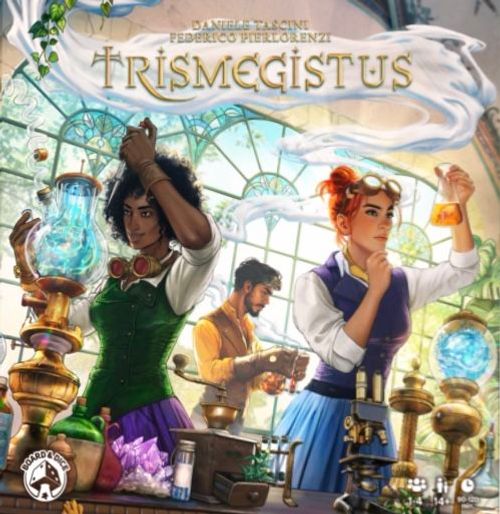
Trismegistus (2026 Edition)
Trismegistus (2026 Edition) Rulebook
Table of Contents
Table of Contents
Game Overview
In Trismegistus, players take on the role of 19th-century researchers who have discovered Trismegistus' notes and attempt to follow his formula for creating the Philosopher's Stone. Over the course of three rounds—representing the years of their doctoral studies—they perform various experiments, gaining and transmuting metals with the aid of mysterious artifacts. At the end of the game, players are awarded points based on their published research and their knowledge of the primal elements, as well as their progress toward creating the Philosopher's Stone itself.
Game Components
- 1 main board (composed of 3 pieces)
- 4 player boards
- 16 dice (6 black, 5 red, 5 white)
- 4 publication sideboards
- 16 theory tiles
- 60 element markers
- 43 artifact tiles (17 tier I, 13 tier II, 13 tier III) — each has a ready side and an exhausted side
- 56 experiment cards (20 tier I, 20 tier II, 16 tier III)
- 60 essence tokens (20 salt, 20 aether, 20 sulfur)
- 4 battery tiles — each has a ready side and an exhausted side
- 20 extra potency tokens
- 16 aqua regia tokens
- 8 patron tiles
- 10 wheels for the player-board VP counter (see instructions on page 5)
- 15 mastery reward tiles
- 16 mastery markers (4 in each player color)
- 4 "+100/+200" VP markers
- 40 metal markers
- 10 pins
- 8 player markers (2 in each player color)
- 32 book markers
- 8 player aids
- 1 bag
Modules' Components
Rules for the modules are described on page 17.
- 1 expert study tile
- 1 patron tile
- 2 mastery reward tiles
- 10 event tiles
- 12 battery tiles
- 12 experiment cards
Solo Components
- 3 homunculus patron tiles
- 6 homunculus theory tiles
- 4 study tiles
- 1 homunculus player board
- 12 decision cards
Note: Metal and Element markers, as well as Essence, Aqua Regia, and Extra Potency tokens are considered unlimited. Should they run out, use any necessary substitute. All other game pieces are strictly limited and if they run out, do not use replacements.
Player Board Assembly
Attach the two wheels of the player board's VP counter with a pin through the marked holes: the "L" wheel (numbered 9 down to 0 on its outer ring) sits behind the "R" wheel (numbered 0 up to 9), so that the counter can track scores above 9 by combining both dials.
Living Rules Pledge
We pledge to support every game well after its initial release. Despite rigorous play testing and multiple rounds of both internal and external proofreading and editing, occasionally the need for rules corrections or minor game play adjustments are discovered only several months or years after the game was manufactured. We promise to produce timely rules updates as necessary, along with expanded FAQ clarifications if needed, available for download from our website in digital PDF format.
Missing or Damaged Components
Although we take a lot of care to make sure that your game is complete, manufacturing mistakes can still leave you with a missing or damaged component. If that happens, please contact us to receive replacements swiftly and with our sincere apologies.
Customer support: https://boardanddice.com/customer-support/
Game Setup
Before your first game, carefully punch out all the cardboard components. Set aside the components from the Modules.
- Connect the Main board pieces and place it in the middle of the table.
- Depending on the number of players, place the correct dice next to the Main board:
| Number of players | 1–2 | 3 | 4 |
|---|---|---|---|
| Black dice | 5 | 5 | 6 |
| White dice | 5 | 5 | 5 |
| Red dice | 4 | 5 | 5 |
- Divide all Experiment cards into 3 decks with matching backs. Divide Artifact tiles into 3 stacks by the number on the front. Place the decks and the stacks next to the Main board. Place the "I" Artifact tiles in a linen bag and mix them.
- Divide the Theory tiles by type — Element, Experiment, Artifact, and Artifact & Experiment (see Theory Tiles in the Appendix). Shuffle each stack separately and place them face down next to the Main board.
- Place all Metal and Element markers, Essence, Aqua Regia, and Extra Potency tokens next to the Main board, creating a general supply.
- Shuffle all Mastery Reward tiles and place the indicated number of them (see table below) next to both reward sectors on the left and right of the Main board.
| 2 players | 3 players | 4 players |
|---|---|---|
| 4 tiles | 5 tiles | 6 tiles |
- In the middle of the play area, place a number of Patron tiles (random side up) equal to the number of players.
Player Setup
A. The last person who concocted a potion becomes the First player.
B. Randomly give 1 Player board and 1 Publication sideboard to each player. For new players, we recommend using the A side, while experienced players use the B side.
C. Each player:
- Sets their VP dials to 0.
- Chooses a color and takes all the pieces in that color.
- Places one Player marker on the Turn Order track, according to the order (the First player places it on the 1st space, and the remaining players place theirs on the consecutive positions clockwise), and the second marker in the top left corner of their Player board as a reminder.
- Places the Mastery markers on space "0" of each Mastery track.
- Draws 4 Theory tiles–1 of each type–without showing them to other players.
- Places their Book markers in the corresponding sections of their Player board.
- Takes 1 of each Essence token.
- Takes a Battery tile, ready side up.
- Takes both Player aids.
- Places 1 Metal marker in each of the following sections of their player board: Lead, Copper, Tin, Mercury.
- According to the turn order, players additionally receive the following:
| 2nd player | 3rd player | 4th player | |
|---|---|---|---|
| Extra Potency tokens | 1 | 2 | 2 |
| Unrefined Mercury | — | — | 1 |
- Draws 2 "I" Experiment cards and 2 "I" Artifact tiles.
- In reverse turn order, each player chooses a Patron tile and adds it to their Player board.
D. Each player discards 1 of the Experiment cards from their hand. Then, each player discards 1 Artifact tile and places the other below any Transmutation section of their Player board, ready side up. Then, they cover the Element icon matching their Artifact type on their Publication sideboard with the Element marker and assign your first Theory tile (see Publications on page 10). Important: do not activate that Artifact.
E. Shuffle discarded Experiment cards back to the corresponding deck, draw 6 cards and place them above the Main board to create the Experiments offer.
F. Place discarded Artifact tiles in the bag with round 1 Artifacts, mix them and draw 6 tiles. Place them below the Main board to create the Artifacts offer.
Boards' Anatomy
The Player board is labeled with the following areas: Potency track, Space for exhausted dice, VP counter, Book markers, Study, Patron, Metals, Transmutation section, Discounts, Study rewards.
The Main board is labeled with the following areas: Experiment offer, Essence related to dice and track, Metal related to dice, Dice pool, End game VP (and Element bonus), Mastery reward offer, Bonus space, Mastery track, Artifact offer.
Key Concepts
Metals
There are 7 main resources in the game called Metals, each is represented by an alchemical symbol: Lead, Copper, Tin, Mercury, Iron, Silver, Gold.
These Metals are split into 3 categories, indicated by the shape of their frame:
- common unrefined (square)
- common refined (pentagon)
- uncommon - only Silver and Gold (round)
You track your Metals by placing the markers in the indicated sections of your Player board. To spend a Metal discard the Metal marker from the indicated section.
During the game Metals are transmuted into other Metals by resolving the Transmutation icon, which allows you to move the Metal markers along the transmutation paths (see page 14).
Metals may be refined only by resolving the refine effect, which allows you to move the Metal markers from the common unrefined to the common refined section above. It may also be used to move Metal markers from Silver to Gold. It is not considered a Transmutation.
Important: Whenever you must spend unrefined Metal, you may always spend refined Metal of the same type instead. You may always spend Gold instead of any other Metal.
Experiments
Experiment cards are the main way for players to progress within the game. To perform an Experiment, you must spend the indicated Metals and reach the required level on the Elemental Mastery track. In return you gain Victory Points (VP), move Books to the Study, and gain various other rewards. (See Perform an Experiment on page 15.)
Publications
Throughout the game, players assign Theory tiles to the sections of their Publication sideboard. At the end of the game, players score VP if they manage to cover all Element icons in the corresponding section (see Final Scoring on page 17).
Mostly you will cover the Elements on your sideboard when gaining Artifacts and performing Experiments. You either cover the Element of the matching icon, or the Wild Element icon. If gained Element cannot be covered, because it does not match any icon on the sideboard, and all Wild Element icons are already claimed, you gain 1 VP instead.
Each time you cover the first Element icon in any sideboard section, you must place one of your Theory tiles face down in that section. Players may look at their own Theory tiles at any time during the game.
Mastery Tracks
The four tracks on the Main board, known as Mastery tracks, represent your knowledge of the four base elements. To resolve an Experiment, you must have reached at least the space required on one of these tracks.
Upon reaching the 4th space on any Mastery track, gain any tile from the left side of the Main board (if there are any available), and resolve it immediately. Upon reaching the 6th space, gain indicated Metal(s). Upon reaching the 8th space, gain the tile from the right side of the Main board (if there are any available), and resolve it immediately. Spaces 9 to 11 provide additional VP at the end of the game. Reaching the 11th step allows you to cover the Element icon on your Publication sideboard. For each additional step on the track, where you already reached the top, gain 1 VP.
Books
Your knowledge about the legendary Philosopher's Stone is represented by the books you collect in your Study. There are two ways to acquire a Book:
- By performing the first Experiment of each Element (1st Air, Fire, Water, and Earth).
- By spending Gold: 1/2/3/4 Gold for the 1st/2nd/3rd/4th Book.
Book markers corresponding to the same Element must be acquired in different ways, though in any order (i.e., you may spend Gold to move the first Book from any section). As a result, players gain various benefits:
- A discount on any common Metal and/or one step of a Mastery track requirement when performing an Experiment of the matching Element.
- When a whole row or column is filled with Books, the player immediately resolves the bonuses at both ends in any order.
- VP at the end of the game: 1/2/3/4/5/6/7 Book markers in your Study, are worth 1/2/4/8/16/25/36 VP.
Important: You must always claim Books of each Element from left to right (see example on page 13). Throughout the game you may only move up to 7 Book markers—the last one will remain on its starting space.
Golden rule: All rewards in the game are optional, and you may always choose to forfeit any part of any reward without any compensation.
Round Overview
The game is played over 3 rounds. Each round is divided into the 2 phases:
- Preparation phase
- Action phase
After the Action phase of round 3, players proceed to the Final Scoring. Then, the player with the most Victory Points wins!
Preparation Phase
During the Preparation phase, resolve the following steps (skip 1-5 in the first round):
- Move the Turn Order markers from the upcoming order to the current Order track.
- Players flip all of their exhausted Battery and Artifact tiles back to the ready sides.
- Discard all cards from the excess offer and place the 3 rightmost Experiments from the offer next to the Main board - they are now a new excess offer. Discard the remaining Experiment cards and Artifact tiles from the main display. Take out all Artifact tiles from the linen bag and put it, back to the box.
- Shuffle the Experiment cards with the number matching the current round. Place 1 Experiment card face up on each space of the Main offer. Place the remaining cards in a face down deck next to the Main board.
- Take the stack of Artifact tiles with the number matching the current round. Place them in the linen bag. Refill the Main offer of Artifacts drawing the tiles from the bag and placing them ready side up.
- Roll all the dice. Then assign them to the Main board sections that match the icon on their faces. If any one section has 6 or more dice, reroll all the dice of that section, and assign them again. If needed, keep rerolling until no section has 6 or more dice.
Action Phase
During the Action phase in turn order, each player performs one Main action, and may perform each Free action once (see Free Actions below). Check the following conditions and resolve your turn accordingly:
A. If, at the beginning of your turn, there are 3 exhausted dice on your Player board, you must pass. Move your Turn Order marker to the topmost free space of the upcoming Order track. You may still resolve the free actions this turn, but you do not resolve any other turns during this round.
B. If, at the beginning of your turn, you do not have a die on the Potency track, start by drafting a new die. Choose any die from the Main board, and place it on the Potency track on your Player board in a space matching the number of dice that were in that pool (including the one you took). Gain the unrefined Metal matching the face of the taken die (if it is the Mercury-face wildcard, set it to any other face first). Then, in any order, perform a Main action and one or more Free actions.
C. Otherwise, in any order perform a Main action and one or more Free actions.
After all players have passed, proceed to the Preparation phase of the next round. If it is the third round, proceed to the Final Scoring (see page 17).
Example: The purple player begins their turn without an active die and they have only 1 exhausted die. They draft a new die from the Main board. They decide to take a red die showing the wildcard face, changing its face to Iron. They immediately gain 1 unrefined Iron. They place the die on the space "3" of their Player board Potency track, as the number of dice in the chosen pool equals 3.
Whenever the rules refer to a matching color or symbol, it means the color or Metal symbol of the active die.
Main Actions
To perform a Main action, you must spend Potency of your die by moving it on the Potency track to a lower value. If your die moves from space "1" on the Potency track, place it on a space for exhausted dice.
Available Main actions:
- Gain Metal
- Gain Essence
- Take an Experiment
- Take an Artifact
- Perform Transmutations
Gain Metal
Spend any amount of Potency to gain 1 unrefined Metal of the matching symbol for each Potency spent. Indicate this by placing the Metal markers on the matching space of your Player board.
Example: The red player spends 3 Potency from their white Tin die, moving the die to the exhausted space, to gain 3 unrefined Tin.
Gain Essence
Spend any amount of Potency to gain 1 Essence token of the matching symbol for each Potency spent. Not all dice provide you with Essence tokens.
| Metal | Lead | Copper | Tin | Mercury | Iron |
|---|---|---|---|---|---|
| Provides | Salt | Aether | Sulfur | Does not provide Essence tokens | Any of the 3 Essences — you may choose a different Essence token for each Potency spent |
Example: The purple player spends 2 Potency from their black Iron die, to gain 1 Aether token and 1 Sulfur token.
Take an Experiment Card
Spend 1 Potency to take an Experiment card into your hand. If you take a card from the Main offer, you must take a card from the section that matches the color of your active die. Refill the offer with a new card from the current deck. If you take a card from the Excess offer (available in 2nd and 3rd round), you may take any card, regardless of your active die color. Do not refill the Excess offer!
Important: You cannot have more than 2 Experiment cards in your hand and you cannot discard Experiment cards. The only way to take out an Experiment card from your hand is to perform that Experiment.
Example: The red player spends 1 Potency from their red Copper die, to take an Experiment card from the red display section. This is the second card in their hand, so in order to take a new card, they must perform one of those Experiments.
Take an Artifact Tile
Spend 3 Potency to take an Artifact tile from the section that matches the color of your die and immediately resolve its effect. Then place it face up below your Player board below any Transmutation section that has fewer than 2 Artifact tiles. Cover the Element icon matching the one on the Artifact on your Publication sideboard. Alternatively, you may cover a Wild Element icon.
Refill the offer with a new Artifact from the bag.
Important: If you have 6 Artifact tiles, you cannot gain any more Artifacts.
Example: The beige player spends 3 Potency from their black Copper die, to take an Artifact tile from the black section. They resolve its effect, by spending 1 refined Copper and 1 refined Tin to gain 6 VP. Then, they place it below the white Transmutation section since both the black and red sections already have 2 Artifacts. Lastly, they cover a Wild Element icon on their Publication sideboard.
Perform Transmutations
Spend Potency to move Metal markers along the transmutation path(s) of the color matching your die. Each movement of a Metal marker along a black, white or red path is a Transmutation. For each Transmutation, you must spend 1 Potency and also 1 Essence/Mercury. For each Essence/Mercury spent, move your Mastery marker along the matching Mastery track (see details on Mastery tracks on page 10).
You may activate one of your ready Artifact tiles below the section in which you resolve Transmutation(s). You may do this after fully resolving any Transmutation during your turn. To do so, resolve Artifact's effect, then flip this tile to its exhausted side.
Example: The teal player spends 2 Potency from their red Iron die to perform 2 Transmutations. They change 1 unrefined Iron to Silver by spending 1 Aether, thus also moving up on the Air Mastery track by 1. Then, they activate their Artifact from that section, gaining 1 refined Iron and an advancement on any Mastery track. They choose to advance again on the Air Mastery track, reaching space "8". As a result, they may gain one of the Mastery Reward tiles on the right side of the board, so they take the one with Extra Potency token. Finally, the teal player Transmutes 1 Silver (the one gained in previous Transmutation) to 1 Gold, by spending 1 Sulfur, thus also moving on the Fire Mastery track by 1.
Important:
- No matter how many Transmutations you perform, you may activate only 1 Artifact tile per turn.
- You may resolve moves across different paths, as long as they match the color of your die.
- When resolving a wild Transmutation you may Transmute across different colors of paths.
Essences and Mercury
To perform the Transmutation action you need Essences or Mercury. Spending them allows you to advance on the Mastery tracks.
Mercury may be spent to advance on the Earth Mastery track, but is not represented by an Essence token and cannot be gained via the Gain Essence icon.
When resolving the refine effect, you do not spend any Essences, and you do not advance on any Mastery track.
Trivia: Many ancient sources believed that Mercury, in its adaptability between solid and liquid, could transcend and represent all realms simultaneously. Similar—but in opposition and the one thing Mercury could never have—was Essence. Essence is the truest, most pure spirit of a thing. When all else was burned away from it, only the Essence of an item would remain.
Free Actions
Important: You may resolve each of the following free actions only once per turn!
Available Free actions:
- Use Aqua Regia
- Use Extra Potency
- Use a Battery
- Spend Gold for Knowledge
- Perform an Experiment
Use Aqua Regia
Before you perform the Main action, you may spend an Aqua Regia token to treat your active die as if it had either different color or face for the remainder of the current turn.
When Performing an Experiment you may also spend any number of Aqua Regia tokens to lower the Mastery track requirement.
Use Extra Potency
Before you perform the Main action, you may spend exactly 1 Extra Potency token to add +1 Potency to the Main action that you are performing this turn. You must still spend at least 1 Potency from your die when performing the Main action.
Note: You won't be able to use the Extra Potency token while performing the Take an Experiment card action.
Use a Battery
Use a ready Battery tile to either:
- Resolve Transmutation(s) through the indicated path(s) (you must still spend Potency / Essence or Mercury for each Transmutation).
OR
- Refresh one of your Artifact tiles.
After you use a Battery, flip it to its exhausted side.
Perform an Experiment
Play an Experiment card from your hand. To do so, you must meet the requirements and pay the depicted cost. Follow these steps in order:
| Step | Notes |
|---|---|
| Be on or higher than the indicated space of the indicated Mastery track. | One of the benefits of claimed Book spaces on your Player board lowers this requirement for the corresponding type of Experiment by 1. You may spend Aqua Regia to lower this requirement even more - each spent token lowers the requirement by 1. |
| Spend the indicated Metals. | You may always spend refined Metals if unrefined Metals are required. You may always spend Gold as any Metal. One of the benefits of claimed Book spaces on your Player board provides a discount of refined (or matching unrefined) 1 Metal for the corresponding type of Experiment. |
| Gain the indicated rewards. | You gain the rewards from the card as well as VP. |
| Place an Element marker on the matching or Wild icon on the Publication sideboard. | If you cannot place an Element marker, because it does not match any icon on the sideboard, and all Wild icons are already claimed, you gain 1 VP instead. |
| If it is the first Experiment of this Element performed by you, move the leftmost Book marker from the matching Element section to your Study. | Resolve the rewards from Study if you filled a row or a column. |
Keep resolved Experiment cards face up next to your Player board.
Example: Purple player performs an Experiment. It requires a level 3 mastery of Earth Element and purple's marker is on the 2nd step of the track. Nevertheless, they meet the requirement thanks to the claimed Book marker of the Earth section. They spend 1 refined Copper, 1 unrefined Mercury and 1 refined Mercury (as cost requires unrefined, and refined may be always used instead). As this is not the first Earth Experiment they perform, they do not move the Book marker from the Earth section. They place the Element marker on the Publication sideboard covering the Earth icon. They resolve the rewards: refresh the Artifact, gain 1 Extra Potency token and 5 VP.
Spend Gold for Knowledge
Spend Gold in order to move the leftmost available Book marker from any Element section to the Study section. You may only resolve this free action once for each Element section. Place 1 Metal marker in the space from which you moved the Book marker. For the first Book marker, you must spend 1 Gold. Each subsequent Book costs 1 additional Gold for each Metal marker on the Element section of your Player board. If you fill a row or a column, resolve the rewards on both ends in any order.
Example: Red player has 3 Gold. They want to claim a Fire book. As red already claimed one Book with Gold (from the Water section), they must pay 2 Gold now. Red player moves the book to the space in the middle row. As it is now complete, they collect rewards from both ends: 2 unrefined Mercury; 1 advancement on any Mastery track. They leave a Metal marker in the emptied space as a reminder. This way they know the next Book they decide to claim by paying Gold will cost 3 Gold. They also gain a new discount for the Fire Experiments.
Final Scoring
After all 3 rounds are finished, each player resolves the following steps:
- Score completed Publications. Reveal all Theory tiles in sections of the sideboard with all of the icons covered. Gain VP for each revealed Theory tile multiplied by its Publication value.
- Mastery tracks. Gain the highest reached VP on four Mastery tracks - each marker on space 9/10/11 is worth 2/4/7 VP.
- Book markers in the Study. For 1/2/3/4/5/6/7 Book markers in your Study, gain 1/2/4/8/16/25/36 VP.
- Remaining components. Gain 1 VP for each remaining Gold and Extra Potency token you have. Gain 1 VP for every 3 of your remaining Metals (except Gold), Essences, and Aqua Regia tokens combined.
The player with the most VP wins the game and becomes the Master Alchemist. In the case of a tie, the tiebreakers are in order: number of Books in Study, then number of performed Experiments. If there is still a tie, the players share the victory.
Modules
You may use these modules one at a time or all at once to add variety to the game.
Batteries
This module introduces new Battery tiles that players may gain during the game, as well as new Experiment cards and Mastery Reward tiles. You can find all the details on each of them in the Appendix on page 20.
Setup
Before the base game setup add the Experiment cards (marked as SG1 in the bottom right corner), Patron tile and Mastery Reward tiles to the respective pools. After you finish the game setup, shuffle the Battery tiles from this module (marked as SG1) and place them in a face up stack next to the Main board. Draw the first tile and place it next to the stack.
Playing the Game
Whenever you resolve this icon, you may choose one of the 2 Battery tiles available in the offer and add it to your play area. After taking a tile, immediately refill the offer with a new tile from the stack, if needed. The Battery tiles work in the same way as the basic Battery tile, they just provide more varied effects. You may only have at most 3 Battery tiles (including the basic Battery).
The new Experiment cards have two new kinds of requirements:
- 4+: Some cards require you to have a minimum number of already resolved Experiment cards or Artifact tiles in your play area.
- 1-3: Some cards require you to pay 1-3 Metals matching the symbol on your active die, and award VP accordingly.
Events
This module introduces additional effects that trigger when you draft a die.
Setup
Shuffle all Event tiles and place them in a face down stack next to the Main board.
Playing the Game
In the Preparation phase of each round, after you roll and assign the dice, draw one Event tile and place it in the corresponding dice section on the Main board. It will stay there for the remainder of the game. Each dice section may contain only 1 Event tile. If you would draw an Event tile corresponding to a dice section that already has a tile assigned to it, discard it and draw a new one.
Each time you draft a die that has an Event tile assigned to it, you may activate the effect of that tile. You can find the details on each Event tile in the Appendix on page 21.
Expert Study
During setup place the Expert study tile next to the Main board.
The Expert Study tile is divided into two sections – one for the Book tokens, and one for Element markers.
- When you gain an Element, but cannot cover the indicated icon (as all of this Element has been already covered, ignoring the Wild icon), you may cover the available matching space on the Expert Study tile instead and gain the corresponding reward. Do not gain the 1 VP reward you would usually get.
- During the game, you may claim your 8th Book and move it to an empty space of the Expert Study tile to gain indicated VP.
Appendix
Patron Tiles
Jābir ibn Hayyān When you reach the 4th/8th step of any Mastery track: A. Gain any 2 Essences. B. Refine any 2 Metals.
Judah Loew ben Bezalel When you draft a unique die: A. Advance on any Mastery track. B. Gain 1 unrefined Tin. A unique die has a different color and symbol than the exhausted dice on your Player board. The first drafted die in a round is always unique.
Christina, Queen of Sweden A. Each time you move the Book marker to your Study, gain any 1 refined Metal. B. Study Metal discounts include the discount for Silver and Gold, and lower the Mastery track requirement by 2 instead of 1.
Maria the Jewess When Taking an Artifact: A. Pay 1 Potency fewer. B. Gain 2 Aqua Regia.
Perenelle Flamel Whenever you draft a die from a pool that does not have the most dice: A. Flip your exhausted Battery tile back to the ready side, and gain 1 Aqua Regia. B. Take an Experiment card from the offer, and gain refined Metal instead of unrefined from the drafted dice.
Nicolas Flamel Whenever you do at least 2 Transmutations at once (i.e., spending 2 Potency or from any game effect): A. Refine any 1 Metal. B. You may activate 1 more Artifact during the Transmutation.
Caterina Sforza Whenever you use a Battery tile: A. Resolve both effects instead of choosing one. B. Gain 2 VP.
Zosimos of Panopolis Any time during your turn but only once per round you may: A. Activate any of your Artifact tiles without exhausting it (this does not exhaust your limit of 1 Artifact activation per turn!) B. Perform 1 Transmutation in each section (1 black, 1 white and 1 red). Regular rules apply. When you use the Patron's ability, place 1 Metal marker on it to mark that it was already activated this round. Remove that marker in Preparation phase of the next round.
Ge Hong Use only with the Batteries module. In addition to normal game Setup: A. Gain 1 Battery from the offer, and gain 3 different Essence tokens. B. Take 1 Artifact from the offer for free, and gain 3 Aqua Regia.
Battery Tiles
Base game Battery tile. Perform 2 Transmutations along any path (regular rules apply). OR Flip one of your exhausted Artifact tiles back to the ready side.
Perform 2 Transmutations along red paths (regular rules apply). OR In any order: discard an Experiment card from your hand, and take an Experiment card from the offer.
Perform 2 Transmutations along black paths (regular rules apply). OR Activate any of your ready Artifact tiles and flip it to the exhausted side.
Perform 2 Transmutations along white paths (regular rules apply). OR Advance on any Mastery track.
Perform 3 Transmutations along any paths. For each Transmutation you may choose not to pay an Essence or Mercury, but if you do so, you do not advance on the Mastery tracks. OR Gain any 2 Essence tokens.
Refine any 2 Metals. OR Gain 2 Lead.
Gain 1 unrefined Iron. OR Advance on any Mastery track.
Gain 1 Silver. OR Flip one of your exhausted Artifact tiles back to the ready side.
Gain any 2 Essence tokens. OR In any order: discard an Experiment card from your hand, and take an Experiment card from the offer.
Perform 3 Transmutations – 1 along the black path, 1 along the white path, and 1 along the red path (regular rules apply). OR Refine any 2 Metals.
Gain 2 different Essence tokens. OR Activate any of your ready Artifact tiles and flip it to the exhausted side.
Gain 2 Lead. OR Gain 1 Aqua Regia and 1 Extra Potency token.
Gain 1 unrefined Mercury. OR Gain 1 Aqua Regia and 1 Extra Potency token.
Event Tiles
- When you draft a Tin die you may take an Experiment card from any offer.
- When you draft a Tin die you may pay any 1 unrefined Metal to gain 3 VP.
- When you draft a Mercury die you gain any 1 Essence token.
- When you draft a Mercury die you may flip one of your exhausted Artifact tiles back to the ready side.
- When you draft a Lead die you may also advance any of your lowest Mastery tracks.
- When you draft a Lead die you gain 2 Lead tokens instead of 1.
- When you draft an Iron die you may perform one Transmutation along any path (regular rules apply).
- When you draft an Iron die you may gain 1 Silver instead of 1 Iron.
- When you draft a Copper die you gain 1 Aqua Regia.
- When you draft a Copper die you may Refine any 1 Metal.
Theory Tiles
There are 4 types of the Theory tiles, the only difference is the indicated Element:
- Gain X VP for each performed Experiment and additionally X VP for each Experiment of the indicated type.
- Gain X VP for each of your Artifacts and additionally X VP for each Artifact of the indicated type.
- Gain X VP multiplied by the number of steps you have reached on the lower of the 2 indicated Mastery tracks.
- Gain X VP for each performed Experiment and Artifact tile of the indicated type.
Trivia
Jābir ibn Hayyān (c. 721–815) Jābir ibn Hayyān, was a Persian polymath often called the "Father of Chemistry." His vast body of writings blended philosophy and experimental practice, introducing techniques such as distillation, crystallization, and filtration, as well as discovering the strong sulfuric and nitric acids, which were documented in his voluminous "Jabberian corpus". His philosophical theory suggested all metals are composed of the abstract elements Mercury and Sulfur, a concept crucial to his practical work in purifying and transforming substances that connected laboratory processes with cosmological ideas. Through the transmission of his texts into both Islamic and European traditions, Jābir left a heritage that profoundly shaped the development of alchemy and early science.
Judah Loew ben Bezalel (c. 1520–1609) Judah Loew ben Bezalel, the Maharal of Prague, was a rabbi, philosopher, and mystic whose life became entwined with both history and legend. Remembered for his scholarship and for his fabled creation "The Golem of Prague", his reputation was also linked with alchemical and Kabbalistic traditions in the Renaissance era. While no laboratory texts survive under his name, his legacy reflects the symbolic side of alchemy, where spiritual wisdom and transformative creation merged. Through this union of myth and philosophy, the Maharal came to embody the mystical heritage of Jewish alchemy.
Christina, Queen of Sweden (1626-1689) A Swedish princess of the Vasa dynasty. She lived within the intellectual circles of the Polish–Lithuanian court, where alchemy, astrology, and medicine flourished under royal patronage. Though little evidence survives of her direct practice, her life reflects the cultural role of noblewomen who supported and participated in esoteric traditions. The courtly environment in which she moved wove together politics, science, and mysticism, making her a symbolic figure of alchemical heritage. Through her, the intersection of power and experiment in early modern Europe becomes visible.
Maria the Jewess (1st–3rd century) Maria the Jewess was a pioneering Hellenistic alchemist in Alexandria and one of the earliest names recorded in the alchemical tradition. She is credited with inventing key laboratory apparatus, including the alembic, the tribikos, and the bain-marie, devices that became foundational to the art of distillation and purification. She incorporated lifelike attributes into her descriptions of metal such as bodies, souls, and spirits, and she believed that metals had two different genders, that when joined together a new entity could be made. Her surviving teachings, preserved by later authors such as Zosimos, combined symbolic reflection with technical innovation, linking material transformation with spiritual meaning. As the earliest female alchemist known by name, Maria's heritage stands at the very foundation of Western alchemy.
Perenelle Flamel (c. 1320–1397) Perenelle Flamel, the wife of Nicolas Flamel, is remembered as his companion in both life and alchemy. Her reputation as an alchemist stems from the "Book of Hieroglyphicall Figures" published in 1612 and attributed to her husband Nicolas. In it Nicolas outlines his quest for the philosopher's stone, while Perenelle conducts alchemical experiments and aids in chrysopoeia (gold-making). Known also for her wealth and charitable works, her reputation became intertwined with the mystery of how that fortune was gained. Together with Nicolas, she came to symbolize the union of wisdom and persistence in the alchemical quest, leaving a legacy inseparable from Europe's most enduring legend.
Nicolas Flamel (c. 1330–1418) Nicolas Flamel, a Parisian scribe and philanthropist, became one of the most celebrated names in European alchemy. Although records portray him as a successful manuscript seller and benefactor, later traditions claimed he discovered the Philosopher's Stone after deciphering a mysterious manuscript. These stories described his ability to transmute base metals into gold and hinted at his pursuit of immortality, legends that spread widely in the sixteenth century. Whether fact or myth, Flamel's name became inseparably linked with the great dream of alchemy, embodying its enduring fascination with ultimate transformation.
Caterina Sforza (1463–1509) Caterina Sforza, the countess of Imola and Forlì, was an Italian noblewoman who combined political power with experimental science. Her passion in alchemy, is evidenced by her remarkable manuscript Experimenti, which contains over 400 alchemical, medicinal, and cosmetic recipes. Those recipes demonstrate an interest in practical results, for health, beauty, and power through substances like poisons and their antidotes, that reflect the broader scientific culture of the era, including the production of alchemical gold, and counterfeit coins, which served her to maintain political power. Her experimentation was empirical - a hallmark of early modern science, prioritizing direct experience and observation over theoretical explanations, laying groundwork for the Medici interest in alchemy.
Zosimos of Panopolis (3rd–4th century) Zosimos of Panopolis, a Greek alchemist and Gnostic mystic, is the earliest alchemical author whose works survive. His treatises describe furnaces, distillation processes, and metallurgical recipes, but also contain visionary passages in which metals and souls undergo death, purification, and rebirth. He used what he called ϋδωρ θείον, meaning both divine water, and sulphurous water. For Zosimos, the alchemical vessel was imagined as a baptismal font, and the tincturing vapours of mercury and sulphur were likened to the purifying waters of baptism, which perfected and redeemed the Gnostic initiate. Zosimos drew upon the Hermetic image of the "krater" or mixing bowl, a symbol of the divine mind in which the Hermetic initiate was "baptized" and purified in the course of a visionary ascent through the heavens and into the transcendent realms. For Zosimos, alchemy was at once a practical art and a spiritual discipline, fusing technical experiment with mystical salvation.
Ge Hong (283–343) Ge Hong, a Chinese scholar and Daoist adept, was one of the most influential figures in the history of Chinese alchemy. In his writings, collected in the Baopuzi, he described two main approaches: "external alchemy," which used an "alchemical furnace" - a stove and a crucible, to create elixirs of immortality from minerals such as cinnabar and gold, and "internal alchemy," which emphasized meditation and spiritual transformation. Together, these practices expressed his vision of alchemy as a union of practical chemistry and mystical cultivation, where the furnace itself symbolized the human body and its refinement. His legacy shaped centuries of Daoist tradition, blending science and philosophy into a lasting system of transformation.
Icons Legend
- Gain/Spend; Potency; Aqua Regia
- Discount; Extra Potency token; Element/Mastery track (Earth, Fire, Air, Water)
- Victory Point; Transmutation along black/white/red path; Cover indicated icon on the Publication sideboard with the Element marker
- Any common unrefined/refined Metal; Transmutation along any path; Cover any icon on the Publication sideboard with the Element marker
- Exhausted dice; Mastery track requirement (minimum, e.g. "5+"); Experiment card
- Lead; Advance on any track; Fulfilled Experiment card
- Copper; Any Essence; Artifact
- Tin; Aether; Take an Artifact for free
- Mercury; Salt; Activate your Artifact (flip it to exhausted side)
- Iron; Sulfur; Refresh an Artifact
- Silver; Refine; Refresh Battery
- Gold; Any claimed Study reward; Book marker