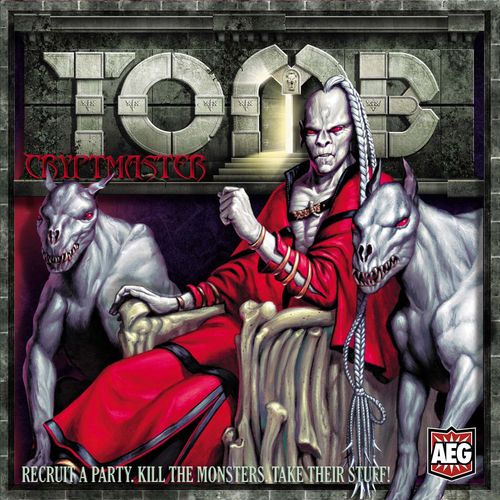
Tomb: Cryptmaster
Tomb: Cryptmaster Rulebook
Table of Contents
Table of Contents
Contents
- Character Bag
- Inn Board
- Tomb Board (double-sided)
- 6 Adventuring Party Markers
- 21 Tomb Dice (7 Green, 7 Blue, 7 Red)
- 24 Wound/Tomb Tokens
- 24 XP/Tomb Tokens
- 25 Cryptmaster Cards
- 25 Item Cards
- 25 Prayer Cards
- 25 Spell Cards
- 25 Tactic Cards
- 40 Character Stands
- 84 Characters
- 190 Crypt Cards
Guided Tour and Setup
The Tomb
The Tomb board is the main area where parties adventure; full of crypts, rooms, hallways, doors, stairs, and possibly a few hazards.
The Tomb board is double sided. You may play on either side, or you may use either side of the board included in the original Tomb game.
Hallways
Hallways are the regular square spaces that connect everything together on the crypt board. Most party movement happens here.
Crypts and Doors
Adventuring parties face monsters, curses, traps, and treasure in the crypts scattered around the board. These are the larger rectangular walled areas on the board, with doorways showing the way (or ways) in and the number of crypt cards to be found within.
Although they look similar to hallway spaces, doors are not considered hallway spaces for card effects.
Some crypts have special rules that apply while your party is inside. These special rules are printed inside the crypt itself.
When a crypt has no cards, it is considered a hallway space for card effects and movement.
Rooms
Along with crypts, some boards have smaller special rooms marked on them. These have no special doorways and hold no crypt cards. They contain special instructions for parties that stop within. These are not considered hallway spaces for any purpose.
Tomb Entrances
The walls around the Tomb have one or more openings where parties enter the Tomb, marked with torches and different color stonework.
Hazards
Hazards are special squares on the board that have their own rules. These rules are printed on the border of the Tomb board.
Fill the Tomb
To begin, each player rolls seven blue dice. The player with the highest roll (the most axes showing) is the first player. Shuffle all the crypt cards together into a single pile. This is the crypt deck. For convenience, this deck can be split into multiple piles and placed in easy reach of all players.
- Each player draws a setup hand of three crypt cards.
- Starting with the first player, each player places a crypt card face down into any non-full crypt, and draws a card from the crypt deck to replace it.
- Play proceeds in a clockwise fashion until all crypts are filled.
All players discard their setup hand.
DURING SETUP, A CRYPT IS FULL IF IT HAS CARDS EQUAL TO THE NUMBER ON ITS DOOR.
Crypt Cards
As the party delves the mysteries of the Tomb, they will find cards with grey backs in each crypt. These crypt cards provide experience points (XP), and the intrepid party that collects the most XP will win the game!
Treasure — Treasures, with their golden border, are the ultimate prize of any party. Treasures can be equipped to party members or banked for XP immediately after successfully raiding a crypt. Treasure may never go into your hand.
Traps — Traps wait to snare the unwary. All must tread cautiously, lest one of these purple-bordered cards slay those unprepared to disarm it.
Monsters — Grey bordered monsters lurk throughout the Tomb, opposing those who dare to invade their lairs. Monster pelts are highly prized for their trophy value, proving the party has truly great adventurers.
Curses — Legends abound of hideous curses cast upon those who have disturbed the ancient, dusty crypts. These brown-bordered cards are a terrible burden to their victims until they are dispelled.
The Inn
The Inn is a separate, single-sided board. The Inn has a large main area, where new characters gather and can be recruited, as well as special areas where parties can study new tactics, learn spells, gather equipment, meditate and pray, and plot against other parties.
Characters
Character tiles have a portrait on the back and a stone border. Characters are the heroes: they slay monsters, disarm traps, dispel curses, and reclaim lost treasure.
CHARACTERS ARE CONSIDERED 5 XP FOR CARD EFFECTS.
Inn Cards
There are five different types of Inn cards. Each type has a different colored back (blue, red, yellow, green, and grey) that corresponds to an area on the Inn board. The decks are placed on the Inn board, and during the game discarded cards will go nearby. When a deck runs out, the discards are reshuffled.
Over the course of the game you may draw Inn cards into your hand and attach them to your characters. Be warned: Some monsters attach Inn cards as well!
Prayers — Prayers are used by clerics and other holy people to bring healing and strength to their parties, so the entire party may smite enemies with the blessing of the gods. Prayers have blue borders and backs.
A CHARACTER MUST HAVE AT LEAST ONE DIE OF HOLINESS TO USE A PRAYER.
Spells — Wizards and other magical beings use spells to cast fiery destruction on their foes and manipulate the fabric of reality to their own advantage. Spells have a red border and back.
A CHARACTER MUST HAVE AT LEAST ONE DIE OF MAGIC TO USE A SPELL.
Items (aka Blacksmith Cards) — No adventurer would ever think of delving into the darkness without some basic equipment, such as weapons, armor, and a ten-foot pole. Items have a yellow border and back. Items may be used by anyone.
Tactics (aka Bar Cards) — In the heat of battle, victory often goes not to the strongest but to the most cunning. The wise party makes good use of clever tactics. Tactics have a green border and back. Tactics can be used by anyone, but are a favorite of Rogues.
Cryptmaster Cards — When a party raids a crypt, sometimes fate intervenes to make the party's life harder – or shorter! And sometimes, the cryptmaster helps fate along. Cryptmaster cards have a grey border and back.
Fill the Inn
- Shuffle the prayers, spells, items, tactics, and cryptmaster cards into separate face-down decks.
- Place each deck on the Inn board in their appropriate spaces (match the colors).
- Each player selects a party marker. Place all markers in the Inn.
- Place the character tiles in the bag, and mix up the tiles within the bag.
- Starting with the second player, each player draws five characters, selects one to join his starting party, and places the remaining characters in the Inn. If there are any Pariahs in the five characters drawn, one must be chosen to join the party – but a second character may be immediately recruited as well.
- Each player draws one cryptmaster card.
Basic Rules of Adventuring
There is certain lore all adventuring parties must know before delving into the Tomb.
Goal
To collect as many experience points (XP) as possible!
XP is found on monsters, traps, curses, and treasure found within the Tomb. All XP on cards in your party and in your XP bank are counted toward your XP total at the end of the game.
When all the crypts in Tomb are cleared, the game is over!
Rule "Zero"
WHENEVER A CARD CONTRADICTS THE BASIC RULES, THE CARD TEXT TAKES PRECEDENT.
Sometimes more than one card is written to take effect at the same time. In those cases:
- Traits always happen before reacts.
- The CM (if any) resolves all reacts and traits first, followed by the current player, then each player in a clockwise fashion from the current player.
Sometimes a triggered trait or react may result in a player drawing more reacts to the same trigger. These reacts may be resolved in the same way as multiple reacts to the same trigger (see above).
Attachments
Many cards can be attached to characters and monsters. Attachments have the following restrictions:
- A character may not have multiples of the same keyword attached (such as two "weapon", or two "armor"), with the exception of the "cursed" keyword.
- Prayers may only be attached to characters with at least one die of holiness.
- Spells may only be attached to characters with at least one die of magic.
- Only curses, spells, prayers, items, tactics, and treasure may ever be attached to a character.
If you ever fail to meet the above restrictions you must move non-Cursed attachments to other characters in your party until all restrictions are met. If you cannot do this, you must discard the minimum number of non-Cursed cards of your choice to meet all restrictions.
There is no explicit limit to the number of cards that may be attached to a single character.
You may only discard cards when instructed to do so by a card effect or due to attachment restrictions (detailed above).
Rolls/Attributes
Each character and monster has four attributes: attack, skill, magic, and holiness. Each attribute has three numbers (blank is zero) associated with it: one number for each color of die (green, blue, and red).
Before making a roll, add up the character's printed dice plus any bonuses in the specified attributes. Roll the appropriate number and color of dice then count the number of successes (face up axes) rolled. This number may be used in a number of ways:
Basic (default) — The number is used directly; such as counting the number of times a character hits a monster while attacking.
Target Number (TN) — The number determines if a roll is successful or not. If a roll has a TN, it is successful if there are at least as many successes as the target number.
Opposed — Two rolls are made in opposition, whichever roll has more successes wins. Ties go to the "defending" roll by default (whoever did not initiate the action).
Combined — Sometimes cards will call for a roll using more than one character. In such a case add together all the dice for the given attributes from each character involved, including all bonuses. If an effect calls for a party roll, then all members of the party roll that attribute and the successes are added together.
Important Definitions
Turn — The time from the start of one player's turn to the start of the next player's turn. If a card or rule refers to "a turn", this is the meaning.
Use — A card is only "used" when an action on the card is taken. Cards without any actions on them may not be "used" (although you may still attach them and gain bonuses and effects from their traits). For a character or monster to use an action, the action must fulfill one of the following:
- Be printed on the character or monster,
- Be printed on a card already attached or being attached while acting, or
- Be targeted by an action initiated by its player.
Enemy — An "enemy" is any character or monster on the opposite side of a fight. During a raid, monsters in the crypt are enemies of the raiding party, and vice versa. During party vs. party (PVP) combat, characters in one fighting party are enemies of characters in the other fighting party.
Friend — A "friend" is any character or monster fighting on your side during a raid or PVP combat. During a raid, monsters revealed from the crypt are all considered friends with each other, and the members of the raiding party are friends — along with any mercenaries and temporary characters or monsters which are part of the party. Card effects that simply target a "friend", such as many prayers, may target the character or monster using it.
Card Text Definitions
Actions — There are four types of actions: "Free", "Turn", "React", and "Battle". All actions start with one of these tags (or a combination thereof).
ALL ACTIONS ARE ONCE PER TURN. ALL ACTIONS ARE OPTIONAL. ALL ACTIONS MAY BE USED FROM YOUR HAND.
When you use an action from your hand, you must immediately attach it to a character and then apply all the action's effects.
Free — You may use any number of different Free actions at the beginning of your turn.
Turn — You may use of these actions as your full turn.
Battle — These actions may be used during combat.
React — These actions always have a trigger followed by a comma. Reacts may only be used when their trigger is met and must be used immediately (or held until they are triggered again).
You may use any number of different reacts on any turn so long as their triggers are met. The one exception is that you may not play any action (including Reacts) during a combat where none of your characters are present, unless the action has the CM trait.
Traits — Some cards have text that is not an action. This text is known as a trait.
ALL TRAITS ARE UNLIMITED USE. ALL TRAITS ARE MANDITORY. NO TRAITS WORK FROM YOUR HAND.
Triggered — These traits react to a trigger like a React action. Remember that these are not optional!
Ongoing — These traits have an ongoing effect. Item bonuses are a type of ongoing trait.
Keyword — These traits are descriptive of the card (generally found on Items and Treasure). Keywords are always located by themselves above all other text on the card.
Turn
After the decks are shuffled and the crypts are filled, it is time to recruit your party and ransack the tomb! Starting with the player to the left of the original first player, play proceeds in a clockwise fashion.
Each turn consists of three phases:
- Use free actions
- Use a turn action
- End of turn
Free Actions
Use ANY or ALL free actions on cards in your party or from your hand.
The following standard free actions are available as well:
Equip — Free: Any number of times per turn, you may attach a card from your hand to a character in your party.
Share — Free: Any number of times per turn, you may move any non-Cursed attached card between characters in your party.
Bank — Free: If you are in the Inn, you may Bank any attached non-Cursed treasure. These are added to your XP bank used to determine your score at the end of the game.
Rest — Free: If you are in the Inn, you may remove all wound tokens from your party. You may also visit the local bishop at the Inn, who will remove and discard any curses you no longer want attached to your party. (This does not apply to Cursed treasures or characters – only to true curses, with the brown borders.)
Dispel Curse — Free: Once per curse per turn, you may attempt to dispel a curse by succeeding at a combined roll with your whole party using the attribute and TN listed on the curse. Add any dispelled curses to your XP bank.
Turn Actions
During your turn, your party may use ONE Turn action on a card in your party or from your hand, or may perform one of the following standard Turn actions:
Draw — Turn: If you are in the Inn and have fewer than ten Inn cards in your hand and party, you may draw two Inn cards. The cards may be drawn from any deck or pair of decks in the Inn. For each Fighter in your party, one Item does not count against the party limit of ten cards.
Recruit — Turn: If you are in the Inn and have fewer than five characters in your party, you may recruit one character from the Inn. When you recruit a wizard draw one spell. When you recruit a cleric draw one prayer. If a character has more than one class, draw cards from each appropriate deck. If there are one or more Pariahs in the Inn, you must recruit one of them in addition to your first choice. If this would take you above five party members, you may only recruit the pariah.
Move — Turn: Move up to ten spaces in the Tomb. If you are in the Inn, start from the Tomb entrance. Otherwise start from your current location. Each consecutive space must be adjacent (and not diagonal) to the previous space. You may not move through walls. Moving into or out of an empty crypt costs 1 point of movement. More than one party may occupy the same space.
Heal — Turn: If you have at least one cleric in your party, make a party holiness roll. For each success, remove one wound from your party.
Pickpocket — Turn: If you are in the Tomb, have a rogue, and are within move distance from another party with at least one item or treasure, you may attempt to pick a pocket. The other player chooses one character in his party to try to catch your rogue.
Make a contested skill roll between your rogue and the defending character. If you succeed, you may attach one item or treasure from the other party to your rogue. If you fail, the defending character may make an attack roll inflicting one wound per success on your rogue. This counts as an attack.
If your rogue dies, the other player claims all cards attached to the rogue. Treasures and curses must immediately be attached to party members, and Inn cards go to the player's hand.
Return to the Inn (Flee) — Turn/Battle: Move your party to the Inn regardless your current location and movement.
If you cannot move to the Inn due to a game effect, move to the Tomb entrance. If you cannot move to either, then you may not use this action.
Raid a Crypt — Turn: If you are on a crypt door, you may raid the adjacent crypt.
End of Turn
At the end of each turn there is an "upkeep" phase. Resolve each of the following steps in sequential order.
Pay Mercenaries — Return all allied Mercenaries to their home player fully healed and with their currently attached cards (even if they died or joined another party).
If you have any characters in your party you must give each mercenary's player either two cards of your choice from your hand, or one card of their choice from your attached cards.
Refill Slain Parties — If your party has no characters in it at the end of any player's turn:
- Move your party token to the Inn.
- Draw one character from the character Bag and add it to your party.
When a party dies or is otherwise emptied, that player's banked XP and hand are unaffected.
Dismiss Extra Members — If you have more than five characters (or monsters acting as characters) in your party you must discard characters until you have five in your party. You must move all attached cards to your other characters before discarding a character. This may move Cursed cards. You must follow all normal attachment restrictions (see The Basics/Attachments)
You may not discard Pariahs or Cursed cards if you have any non-Cursed cards of the same type in your party.
Cleanup — Discard all cards not in a crypt, a player's hand, a party, or a draw deck (such as unclaimed pillage cards — see Death/The Pillage Pile).
If any deck has no cards in it, shuffle its discard pile into the deck.
Is the Tomb empty? — If there are no crypt cards in the Tomb the game ends.
Each player adds up all XP in their XP bank as well as any attached treasure and curses.
The player with the most XP wins. In case of a tie, the tied player with the most XP attached to the party wins.
Raid
When a party chooses to raid a crypt, the raid begins.
- Raiding Party/Player (Raider) - This is the party that has chosen to raid the crypt.
- Cryptmaster (CM) - This is the player who runs the crypt and controls the dangers within, determined by the symbol on the crypt door. An "L" indicates one player to the left, an "R" is one player to the right, and an "LL" or "RR" is the player two seats away in the appropriate direction. A few crypts may give alternate instructions for determining the CM.
IF AT ANY TIME THERE ARE NO SURVIVING MEMBERS OF THE PARTY IN THE CRYPT, THE RAID ENDS AND ALL REMAINING CRYPT CARDS ARE RETURNED TO THE CRYPT FACE DOWN.
Hire Mercenaries
You may invite any player or players with a party in the Tomb, except the CM, to assist in the raid. Each player who does so chooses one character from their party who temporarily joins the group raiding, and is considered a mercenary for the turn. If a player has a character with the Mercenary trait, it may assist in the raid without being invited.
The raiding player may designate a mercenary to help disarm a trap, take a blow from a monster, and take an action during a combat round. When it is a mercenary's turn to take an action, its normal controller chooses what the action will be (i.e. attack, use a printed ability, use a spell or other Inn card, etc.). However, the mercenary may not choose to flee. Only regular raiding characters have that option.
At the end of the raid, each player with a mercenary present receives 1 XP for each Tomb card successfully resolved during the raid. (i.e. trap successfully disarmed, monster killed, Treasure attached or banked by the player, and curse dispelled during the raid.) If the raiding party kills an Overlord, each mercenary's player gains 5 XP. If the mercenary died during the raid, it is returned to the original player alive at the end of the turn with all cards it had attached at the time of death, and enough wounds such that one more would kill it. Otherwise, it returns to its owner at the end of the raid, with any effects that happened to it (i.e. wounds, curses, lost attachments) remaining.
Begin the Raid
- The CM looks at all the crypt cards in the crypt being raided, keeping them hidden from the other players.
- The raider moves the party token into the crypt.
Curses
Some ancient builders did not want the crypts to be disturbed, so they cast powerful curses to punish those who would disturb their final rest!
First, the CM reveals each curse and attaches it to a member of the raiding party. As each curse is attached, the party may make an immediate Holiness check to attempt to lift the curse. If successful, the curse is banked. Otherwise, it remains on the character until the character dies, the curse is lifted, or an effect moves it.
After all curses are resolved, the party may choose to return to the door of the crypt, ending the turn. Return all remaining crypt cards to the crypt face down. Otherwise, it is time to resolve any traps.
Traps
Other builders opted for the more direct physical approach. An overlooked trap can delay the party, cause it great damage, or even force it to run away!
If there are no unresolved traps, move on to the next section. Otherwise, the CM chooses the first trap to resolve, and announces that there is a trap. The CM reads the first and second lines of the trap, telling the raider how many characters must attempt to disarm the trap and what attribute or attributes will be required to disarm. The CM does not announce the target number! The raider chooses who will roll the dice attempting to disarm the trap.
If the raider meets or exceeds the TN for each listed attribute, he succeeds in disarming the trap, and it is added to the party's XP bank! Otherwise, the raider fails, and he suffers the failure effects listed on the trap. The trap is then discarded.
After each trap, before any further cards are revealed, the raider may return to the door of the crypt and immediately end the turn. Return all remaining crypt cards to the crypt face down. Otherwise, repeat the process for each trap until none remain.
Monsters
Stories are whispered of horrible creatures that lurk in the dark, forgotten places under the ground, away from the light… Monsters prepared to feast on the unwary…
If there are no monsters, skip this section and proceed to the treasures.
Otherwise, the CM announces that there are monsters, and reveals all of the monsters simultaneously. Some monsters have dire effects upon being revealed. At this time, those effects take place. If any monsters have magic dice, each such monster draws and attaches one spell, in addition to any dictated by the card's or crypt's text. Likewise, if any monsters have holiness dice, each such monster draws and attaches one prayer, in addition to any dictated by the card's or crypt's text. If the party has any special reactions to the monsters appearing, those happen next. Then, combat begins!
If the party dies or flees, return all remaining crypt cards face down to the crypt. However, if all the monsters are dead or otherwise removed at the end of combat, and there are still any raiding party members alive in the crypt, it is time to pillage!
Treasure
If any characters in the raiding party survive the curses, traps, and monsters in the crypt without running away, it is time for their reward: fabulous treasures!
The CM hands all the treasures to the raiding player. At this time, the raider has a choice to make with each individual treasure card. It may be immediately banked, safe until the end of the game but of no further use, or it may be attached to a surviving member of the raiding party where it can be used until it is banked later or lost due to its bearer's untimely demise.
Combat
Crypt Combat represents a mortal struggle for life and limb (and loot!) between an attacker and a defender. Usually these are an adventuring party and a pack of monsters, but occasionally special circumstances may pit one party against another.
During a raid, the CM and monsters are the defenders and the raider is the attacker. During party versus party combat, the player initiating the attack is the attacker, and the other player is the defender.
Combat Sequence
If there are no attackers or no defenders, skip to resolution.
- A round of combat begins.
- A defending character or monster that has not yet used a battle action during this combat round uses a battle action, if able. If this is a raid, a CM battle action may be used.
- An attacking character or monster that has not yet used a battle action during this combat round uses a battle action, if able.
- Repeat from step 2 until either: a. No one can legally use a battle action b. OR There are no defenders c. OR There are no attackers.
- Repeat from step 1.
Resolution
During a Raid — If there are no attackers remaining, the turn ends. If there are no defenders, proceed to the treasure phase.
During PvP Combat — If there are no defenders, the attacker claims all pillage. Otherwise, the defender claims all pillage. (See Death/The Pillage Pile)
Battle Actions
A character in your party may use ONE battle action per round. This can be a printed battle action on a card, or one of the two following standard battle actions:
Attack — Battle: Choose a party member, or denizen of the crypt (if you are the CM), to attack the hapless foes! If you are the raiding player, you choose which monster will be attacked. Otherwise, the victim chooses a brave soul who will step up and take the blow to protect the rest of the team. Your character or monster rolls its attack dice. Inflict one wound per success on the target.
Return to the Inn (Flee) — Turn/Battle: Move your party to the Inn ignoring your current location and movement.
If you cannot move to the Inn, move to the staircase. If you cannot move to either, then you may not use this action.
This action may not be used by the CM.
Acting in Combat
Presence
The raiding player and any players with mercenaries present may play cards from their hand and effects attached to the characters present in the raid, except those reserved for the cryptmaster. (Such effects are labeled "CM".)
The CM may use actions and effects on monsters present, and may also use effects on his own characters and cards that have the "CM" identifier. Also, he may use any number of cryptmaster cards that he has in hand. Discard cryptmaster cards after use. Collectively, these are referred to as CM effects. There is no limit on the number of different CM effects the cryptmaster may use during a raid. Other players with parties in the Tomb, who do not have mercenaries present and are not the raider or CM, may each use one CM effect per raid.
Location
Any action printed on a character, monster, or Inn card must be on a card at the current combat.
Actions may only target cards at the current combat, unless they move the target into combat.
Traitors
Whenever a character joins the monster party it is considered a monster (and not a character) until it leaves the monster party.
Whenever a monster joins a player party it is considered a character (and not a monster) until it leaves the player party.
In both cases, all references to monsters reference characters instead and vice versa. The only exception to this is any reference to "when monsters are revealed" as this is referring to a step in the raid sequence and not monsters in general. This also applies to all cards attached to monsters.
Death
Dead Characters
If a character ever has at least as many wounds as he has hit points, he dies and is discarded.
Whenever a character dies, another character is added to the Inn from the character bag.
All characters in the discard pile are considered "dead," regardless of how they got there.
If the dead character is a mercenary borrowed from another player, return it to that player with all items still attached and one hit point remaining. The player still receives the XP and card rewards in exchange for loaning the mercenary.
The Pillage Pile
Whenever a character dies during PvP combat all his attached cards are added to the pillage pile.
Monsters
If a monster ever has at least as many wounds as it has hit points, it dies and is immediately added the raider's XP bank.
Discard all cards attached to the monster when it dies, including treasure.
All monsters in the discard pile are considered "dead," regardless of how they got there.
Variants
Overlords
Overlords represent paragons of evil and power. They command the forces of the Tomb and are a fearsome sight to behold in combat!
Setup — Before crypt cards are placed in crypts, select an overlord card to control the denizens of the Tomb. You may select the overlord randomly or by group consensus. The starting player places the overlord face-up in any crypt of his choice after all the crypts have been filled normally.
Special Rules — The game ends when the overlord is defeated, even if other crypt cards remain in the Tomb. Alternately, if all crypts except the one containing the overlord are empty, the game ends.
The overlord may not be damaged, discarded, or otherwise destroyed while there are any unresolved crypt cards other than treasures in the same crypt.
Any wounds suffered by the overlord and cards attached to the overlord during any combat remain until the overlord dies, or special effects cause them to be removed. This includes curses and Inn cards.
Player vs. Player
Normally, parties may only attack each other with the aid of a card effect. In PVP Tomb, however, the action is much more deadly! Play with the normal Tomb rules, with the following changes:
Special Rules — Once a party enters the Tomb, it may never return to the Inn for any reason. Effects that would send a party to the Inn instead move the party up to 20 spaces away from its current location.
When fleeing from a raid or from PVP combat, the fleeing party moves up to 20 spaces away from the raid/combat location.
A party ending its movement at the same location within the Tomb as another party attacks the other party.
All players in the Tomb can perform the action: "Turn: Discard at least 10 XP from your bank: Kill a character in the Tomb."
If all characters within a party die, that party is eliminated and the player is out of the game. If only one player remains in the game, that player wins.
Quick Reference Guide
Free Actions (start of turn)
- Equip cards to party members
- Share cards between party members
- Bank treasures (Inn only)
- Rest to heal wounds and discard curses (Inn only)
- Dispel curses on your party
- Perform any free actions printed on your party's cards
Turn Actions (one per turn)
- Draw two Inn cards (Inn only)
- Recruit one character, plus a Pariah (if any) (Inn only)
- Move within the Tomb
- Heal your party
- Pickpocket another party in the Tomb
- Flee to the Inn
- Raid one crypt
- Perform one turn action printed on your party's cards
Order of Crypt Cards Revealed in Raids
- Curses (all at once)
- Traps (one at a time)
- Monsters (all at once)
- Treasures (all at once)
Actions During Combat
- Attack an enemy
- Flee to the Inn
- Perform a printed battle action