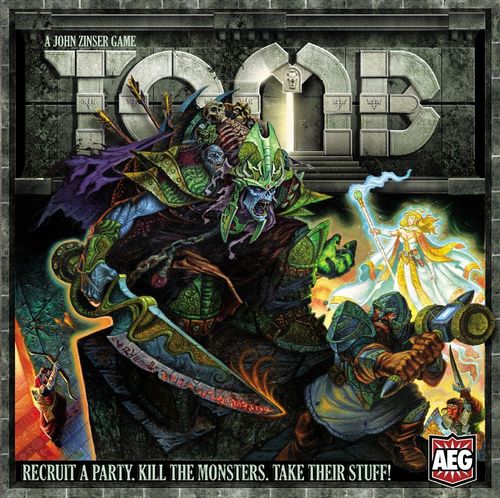
Tomb
Tomb Rulebook
Table of Contents
Table of Contents
- Contents
- Object of the Game
- The Basics: Rolling Dice
- Set Up
- Meet at the Inn
- Free Actions
- Standard Actions
- The Card Types
- Heal
- Move
- Pickpocket
- Recruit
- Play a Card
- Return to the Inn (Flee)
- Raid
- Traps
- Monsters
- Battle Actions for Characters
- Wounds
- Death
- Treasure Cards
- Banking
- Actions and Effects
- End of the Game
- Glossary Terms
- Solitaire Play
- Campaign Play
- Example of Play: Into the Crypt
Contents
- Tomb Board (double-sided)
- Inn Board
- Character Bag
- Character Poster
- 6 Adventuring Party Markers
- 84 Characters
- 40 Character Stands
- 25 Spell Deck Cards
- 25 Prayer Deck Cards
- 25 Item Deck Cards
- 25 Tactics Deck Cards
- 200 Crypt Deck Cards
- 21 Tomb Dice (7 Green, 7 Blue, 7 Red)
- 48 Wound/Tomb Tokens
Object of the Game
Gain the most XP by fighting monsters, disarming traps, and collecting treasure.
The Basics: Rolling Dice
Whenever a die roll is required, an Attribute is named — Attack, Skill, Magic, or Holiness. Character and Monster Cards have tables showing how many of each color Tomb Dice are rolled for each Attribute. If no number appears for an Attribute, then no dice of that color are rolled.
Each Tomb Dice rolled with an axe showing face up indicates a success.
Only one Character rolls Tomb Dice, unless an effect states otherwise (i.e. Adventuring Party rolls). Some effects state a Target Number (TN) — this is the number of successes required on the Tomb Dice for a successful roll.
Any time an effect raises the Tomb Dice type for a Character or Monster, Green Tomb Dice are replaced by an equal number of Blue Tomb Dice, and Blue Tomb Dice are replaced by an equal number of Red Tomb Dice. All Red Tomb Dice become automatic successes.
Any time an effect lowers the Tomb Dice type for a Character or Monster, Red Tomb Dice are replaced by an equal number of Blue Tomb Dice, and Blue Tomb Dice are replaced by an equal number of Green Tomb Dice. All Green Tomb Dice become automatic failures.
Set Up
Select a side of the Tomb map to play — Goldenaxe Catacombs or Tomb of the Overseers. If this is your first time playing, we recommend the Goldenaxe Catacombs.
Place the Character pieces in the bag for use as the Character Pool. Place the Inn Board next to the Tomb Board. Shuffle the Item, Prayer, Spell, and Tactics Decks, and place each on their respective locations on the Inn Board. Shuffle the Crypt Deck and set it to the side of the board. There are enough Crypt Cards to have a deck on each side of the table.
Determine the order of play by having each Player roll all seven Blue Tomb Dice. The Player with the most successes (highest number of Tomb Dice with an axe showing) becomes Player One and selects an Adventuring Party Marker and places it on the Inn Board. Re-roll ties. Play then proceeds in clockwise order.
Each Player draws three cards from the Crypt Deck. Starting with Player One and continuing in clockwise order, each player places a Crypt Card face down in any of the open Crypts and then draws a new Crypt Card. A crypt is considered open until it has a number of cards in it equal to the number on the Crypt Door, at which point it cannot hold any more Crypt Cards.
Once all of the Crypts are full, the Tomb is ready for exploration and the unused Crypt Cards are discarded.
Meet at the Inn
Starting with the second player, players now begin recruiting adventurers and exploring the tomb. On his or her first turn, each Player draws five Character Cards from the Character Pool, selects one to be part of his or her Adventuring Party, and places the rest in the Inn. If the Character is a Cleric, the Player draws a Prayer Card. If the Character is a Wizard, the Player draws a Spell Card. If the Character is both a Cleric and a Wizard, he draws both a Prayer Card and a Spell Card.
Optional Rules
During the Lean Years, this place grows deathly quiet. I've seen weeks go by without a new face. This place grows as empty as a tomb... no pun intended. Players draw only three adventurers from the Character Pool.
During the Fat Years, I've seen this place filled with people; drink in one hand, story in another. I've seen people come and go, so many I've forgotten more faces than I remember. And I've seen a dozen men march out for adventure in an afternoon, hungry for glory. Players draw five adventurers from the Character Pool and keep two before returning the rest to the Inn.
After each Player has drawn a Character, the second phase of Tomb begins. From here on out, players may take as many Free Actions as they would like before taking one (and only one) Standard Action on a Turn. Free Actions include Attaching items and moving equipment between Characters, as well as using React Cards.
Free Actions
At the beginning of each Player's Turn (before performing any other actions), the Player may redistribute Attached cards among the Characters in his Adventuring Party. Just as with any other time Cards are being Attached, no Character may have more than one card with each of the following traits — Armor, Bow, Glove, Helm, Shield, and Weapon. Players may not move Cards while they are resolving Crypt Encounters (Traps, Monsters, etc.).
If an Adventuring Party begins a Turn at the Inn, they immediately heal all Wounds as a Free Action.
Standard Actions
- Act
- Draw (Inn)
- Heal (Tomb)
- Move
- Pickpocket (Tomb)
- Play a Card
- Recruit (Inn)
- Return to the Inn (Tomb)
- Raid (Tomb) a. Combat Turn Actions b. Flee
While at the Inn, Players and Characters may not Pickpocket. Raylor oversees the place and he makes sure everyone behaves in his establishment.
Act
As a Player's Turn, he can use a Turn Action on a Character, Card, or a Space on the Board with an associated Turn Action.
Draw
If the Adventuring Party is at the Inn, a Player may Draw two Cards (in any combination) from any of the four Decks in the Inn as a Draw Action and put them in his hand. Weapon and Item cards must be Attached immediately and Cards that cannot be Attached are discarded. A Character may never possess more than one Item Card with a special trait at one time. There is no limit on Attaching other Item Card types.
Spells can only be cast by Characters with at least one Die of Magic and Prayers can only be cast by Characters with at least one Die of Holiness. A Player may keep them in his hand until cast.
There is no hand limit in Tomb.
The Card Types
Example cards shown in the manual: Double-Bladed Sword (Item — Weapon; "Perform one extra combat action each Combat Round"); Weaken (Prayer; "React: Before a Monster attacks, remove one die of each color from its Attack roll"); Another Way In (Tactic; "Turn: If your Party is adjacent to a Crypt, but not at the Crypt Door, Raid the Crypt"); Stone Skin (Spell; "React: Before entering a Crypt, one Character gains +2 HP until the end of the Turn"); Keziah's Orb (Treasure, XP 5; "Gain +3 Blue Skill. React: Before entering a Crypt, look at one Card in the Crypt").
Item Cards — Item cards must be played immediately when drawn by Attaching them to a specific Character. Item Cards provide a Character with bonuses or abilities. While bonuses can stack (for example, two rings that provide a bonus to Magic), no Character may Attach more than one Item or Treasure each with the following traits — Armor, Bow, Glove, Helm, Shield, Weapon. If there are ever more such traited Items in play than Characters, the extra Item(s) are discarded.
Prayer Cards — These are special cards that can only be cast by a Cleric or a Character with at least one Die of Holiness. If you do not have a Cleric in your Adventuring Party (or a Character with one or more Holiness Dice), you cannot Attach or use a Prayer Card.
Tactics — Tactics are special cards that can be played from your hand by any Character in your Adventuring Party. Some can be Attached to Characters while others are discarded after use.
Traps Cards and Monster Cards are explained in greater detail on pages 7 and 8.
Spell Deck — These are special cards that can only be cast by a Wizard or a Character with at least one Die of Magic. If you do not have a Wizard in your Adventuring Party (or a Character with one or more Magic Dice), you cannot Attach or use a Spell Card.
Treasure Cards — Treasure Cards work much the same way as Item cards, with one important distinction. Treasure cards can be "Banked" for XP immediately, or they can be Attached to a Character. If a Treasure is Attached, it cannot be Banked until the Character returns to the Inn. Be careful, however. Rogues from other mercenary companies can Pickpocket Treasure Cards Attached to your Characters and then rush back to the Inn to Bank them.
Treasure Cards can only be found in Crypts.
Heal
An Adventuring Party with at least one Cleric may take a Turn to Heal injured Characters. The Player rolls a number of Tomb Dice equal to the combined Holiness of all Clerics in the Adventuring Party, which in turn Heals (removes) a number of Wounds on the Characters in the Adventuring Party up to the number of successes rolled. These Wounds are healed in whatever order the player wishes. Wounds are explained in depth under Monsters and Combat Resolution.
Move
If the Adventuring Party is at the Inn, they may immediately enter the Tomb and move their maximum Movement (see below). If they are already in the Tomb, they may move their maximum Movement, stopping on any Crypt Door if they wish to Raid the Crypt on the following Turn. An entire Adventuring Party moves together. The maximum Movement of an Adventuring Party is ten squares, plus any bonus movement due to Characters, Item Cards, or Treasure.
Movement is horizontal and vertical, never diagonal. Multiple Parties may occupy the same space.
Pickpocket
If an Adventuring Party has a Rogue in it, the Player may use his turn to Pickpocket any Character the Adventuring Party could reach in one Turn of Movement.
The acting Player selects one Rogue from his Adventuring Party, who selects any Item or Treasure Card on a Character from an Adventuring Party in range. The acting Player rolls the Skill Dice for the Rogue. The target Party's Player rolls the Skill Dice of any one Character in his Party (Target Player's choice). If the acting Player rolls more successes than his opponent, the Card is stolen and Attached to the Rogue, and discarded if it cannot be Attached. If the Rogue fails, the Character making the opposing Skill roll "catches" the Rogue.
The Character catching a Pickpocketing Rogue is allowed one Attack on the Rogue before he gets away, following the standard rules for attacking. The Rogue suffers Wounds from this Attack, like any other, before returning to his Party. If the Rogue is killed, any Attached Cards are given to the attacking Player.
For example, Player One decides to have Dread, a Rogue in his Adventuring Party take a Pickpocket Action to acquire an Item Card from Player Two's Adventuring Party. Player One rolls Skill Dice equal to Dread's Skill Trait (two Green, two Blue, and two Red), and rolls three successes. Player Two selects Captain Dukat with one Green, three Blue and one Red Skill Dice. Player Two rolls only two successes. Dread rolls more successes than Captain Dukat, allowing him to successfully Pickpocket an Item Card from a Character in Player Two's Adventuring Party.
Rogues cannot steal from their own Adventuring Party.
Recruit
If the Adventuring Party is at the Inn, a Player may Recruit one Character from the Inn Board. The Character is placed in front of the Player and added to his Adventuring Party. If the Character recruited is a Cleric, the Player draws a Prayer Card. If the Character is a Wizard, the Player draws a Spell Card. If the Character is both a Cleric and a Wizard, he draws both a Prayer Card and a Spell Card.
Play a Card
Some Prayer, Spell, and Tactics Cards require a Turn Action to use. In this instance, the Card may be played in either the Inn or the Tomb. In such an instance, the entire Turn is spent playing the Card.
Other cards can only be used as a Battle Action inside a Crypt. In this case, one Character plays the Card for his Battle Action for the Combat Turn.
"React" cards do not require a Full Turn to play and can be played in addition to any Standard Turn Action.
Unless stated otherwise all Inn cards are revealed and placed in front of the Character using or casting them. They are considered Attached to that Character for the rest of the game and are discarded if the Character is killed. Cards that are not discarded can be used again and again throughout the game. Each card may only be used once per Turn.
Return to the Inn (Flee)
During Combat, the Adventuring Party may Flee from a Crypt to the Inn. This can only be done as a Character Battle Action.
Alternatively, an Adventuring Party may use its Standard Action for the Turn to return to the Inn.
Once the Adventuring Party has reached the Inn, the Player may choose to Bank any Treasure Cards Attached to Characters. The Player's turn ends.
Trap Card Anatomy
A. Title B. Disarm requirements C. Failure consequence D. XP value
Raid
If an Adventuring Party is standing on a Crypt Door at the start of a Turn, they may Raid the Crypt. If the Crypt is empty, the acting Player's Turn ends. Otherwise, the appropriate Player (determined by the symbol on the Crypt Door — L for Left, R for Right) becomes the Crypt Master (CM) and draws the face down cards from the Crypt, beginning the Encounter. It is the role of the CM to navigate the Raid and make the encounter as difficult as possible for the Acting Player.
The Raid Begins
Raids are resolved in the following order:
- Traps
- Monsters
- Treasures
All Trap cards must be defeated before the Adventuring Party encounters any Monsters (if any), and all Monsters must be defeated before the Treasure Cards (if any) can be Attached or Banked. If the Adventuring Party flees, dies, or otherwise fails to advance the Raid, unrevealed cards are returned face down into the Crypt and only the CM knows their true value.
Traps
The CM decides the order of the Traps, revealing each in turn. He does not need to reveal how many traps there are, only that there are traps. The CM reads the first and second lines of the trap, telling the Raiding Player how many Characters may attempt to disarm the trap and what Attribute is used. The CM does not reveal the Target Number for disarming the trap, nor the effect of failing. Each Trap Card is essentially its own set of internal rules, requiring the Adventuring Party to be vigilant for the deadliest traps in the game.
The Target Number to disarm a Trap remains a secret for the purpose of the element of risk for the Raiding Player.
The Raiding Adventuring Party selects which Characters will Disarm the trap. Characters assigned to Disarm a trap must roll a combined number of successes, equal to or greater than the trap's Target Number or Numbers, rolling dice equal to the value of the appropriate Attribute.
If the Trap is disarmed, the Raiding Player banks the XP from the Trap (see Banking XP below).
If the Adventuring Party fails to Disarm the Trap, the CM reveals the Trap and announces the "Failure" consequences of the Trap on the Raiding Adventuring Party. The Trap is then placed into the Crypt Card Discard Pile.
This process repeats until no Traps remain in the Crypt.
After any Trap has been resolved, the Raiding Player may choose to leave the Crypt (whether the Trap was disarmed or not) without seeing the other cards in the Crypt. If so, move the Adventuring Party Marker back to the Crypt Door. All remaining Crypt Cards are returned face down into the Crypt.
For instance, a Trap Card might indicate: Characters: 1 Disarm: Skill 3 Failure: Each Character in the Raiding Party suffers one Wound.
Only one Character may Disarm this trap. The Player rolls a number of Tomb Dice equal to the Character's total Skill Attribute (including Items, Treasures, and other effects), and successfully Disarms the Trap if three or more successes are rolled. If he fails, each member of his party suffers one Wound each.
Monsters
After all the Trap Cards have been resolved (or if there are no Trap Cards), Monster Cards are encountered and the Raiding Player decides whether his Adventuring Party will continue in the Crypt. If the Adventuring Party remains, Combat occurs.
Combat only occurs when an Adventuring Party encounters a Monster run by a CM, unless otherwise stated. This includes all Encounters with Monsters in Crypts as well as events triggered by Inn Cards. Combat does not occur when two Adventuring Parties occupy the same space. Adventuring Parties cannot attack other Adventuring Parties, unless a card effect allows it.
Each Combat has one or more Combat Rounds, with the following steps:
- Monsters Revealed. The CM reveals all of the Monsters at the same time and resolves any revealed effects immediately, as stated on the cards (first Monsters, then Characters in the Raiding Adventuring Party).
- Battle Actions. Beginning with the CM, the CM and the Raiding Player take turns performing Battle Actions until all living Monsters and Adventuring Party members have acted. Each Monster and each Adventuring Party member may act once per combat Round. This step repeats until all of the Characters or all of the Monsters are dead (see Death below).
Battle Actions for Monsters
- Attack. The CM selects a Monster for the Combat Action, and the Raiding Player selects a Target Character. The CM rolls a number of Tomb Dice equal to the Monster's Attack Attribute, inflicting one Wound for each success on the Target Character. If an Attack inflicts one or more Wounds, the target is "wounded".
- Battle Action. Some Monsters have special Battle Actions or Inn Cards that can be used in Combat. These may be used as the Monster's Action for a Combat Round. When a Monster is using an ability on an Inn Card, it treats any printed reference to the word "Monster" on the card as if it said "Character," and vice versa. This action does not count as an Attack, but does count as the Monster's action for the Round.
Example: Komodo (Attack 2/1, Skill 2/1, Magic –, Holiness 2/1; "Reveal this Card when the first Trap in this Crypt is announced. All Traps in this Crypt gain +1 TN to disarm." HP 4, XP 6).
Monster Card Anatomy
A. Title B. Attributes C. Special Ability D. Hit Points E. XP value
Example: Sir Guerin (Attack 3/1, Skill –, Magic –, Holiness 1/1; "Sir Guerin only suffers wounds from Blue or Red dice." HP 4).
Battle Actions for Characters
- Attack. The Raiding Player selects a Character for the Combat Action and a Target Monster. He rolls a number of Tomb Dice equal to the Character's Attack Attribute, inflicting one Wound for each success shown. These Wounds are then applied to the Target Monster.
- Battle Action. Some Characters have special Battle Actions or Inn Cards that can be used in Combat. These may be used as the Character's Action for a Combat Round. This action does not count as an Attack, but does count as the Character's action for the Round.
- Flee. The Raiding Player may choose to immediately return the Adventuring Party to the Inn. All remaining Monster and Treasure Cards are returned face down into the Crypt. Any Inn Cards drawn for the Monsters or other special effects are discarded, and any Wounds inflicted on the Monsters are removed. This does not count as a Move Action for the purpose of other Character and card effects.
A new Combat Round begins once all of the Characters and Monsters have acted. When a new Combat Round begins all Characters and Monsters "reset" allowing them to attack again in the new Round.
If a Monster is somehow resurrected, it returns to the game fully healed and is treated the same as any other Character or Monster entering the game for the first time.
Example: Elithe (Attack 1/1, Skill 1/1, Magic –, Holiness 1/1; "When revealed, make a contested Skill vs. Skill roll against a Character in the Raiding Party (Raiding Player's choice). If successful, the Raiding Party must give one attached Treasure to another Party." HP 3). Darkhelm (Attack 1/1/1/1, Skill 1/1/1/1, Magic –, Holiness 1/1/1/1; "When revealed, draw one Inn Card from each deck and attach them to Darkhelm." HP 6, XP 6).
Wounds
Whenever a Character or Monster suffers a Wound (either during Combat or as the result of another Card effect), a Wound marker is placed on it. In many instances, the Player may decide which Character in his Adventuring Party suffers Wounds. Unless stated, a Character always takes the full damage of a single action and can suffer more Wounds than it has Hit Points.
Death
When a Character or Monster suffers a number of Wounds equal to or greater than its Hit Point total, it is killed. Dead Monster Cards are immediately Banked. Dead Characters are removed from play and all of their Attached Cards are discarded. Any actions to heal a Character or abate Death must be taken immediately. If a Character ever dies, the dead Character is removed from play, and a new Character is drawn from the Character Pool and placed in the Inn.
If an entire Adventuring Party is killed (or the last remaining Character is somehow removed from the Adventuring Party), all cards Attached to Adventuring Party members are discarded. The Adventuring Party Marker is returned to the Inn, and the Player draws a new Character from the Character Pool to start a new Adventuring Party. The Player's turn ends.
Treasure Cards
Once all of the Traps and Monsters are defeated (or if none were present), the Raiding Player receives all of the Treasure Cards from that Crypt.
Treasure Cards must immediately be Banked or Attached. Treasure Cards that are not Banked must be Attached to a Character in the Adventuring Party.
Unless an Attached card states otherwise, it only affects the Character it is Attached to.
While Treasure Cards Attach to Characters just like Item Cards, the two are not the same. Whenever a Card refers to Treasure, it only means Treasure Cards. Likewise, when a Card refers to Items, it only means Item Cards.
Whenever a Character is moved to another Adventuring Party or another location within the Tomb, all Attached Cards move with the Character. If a Character is moved to the Inn (without the rest of the Adventuring Party), killed, or returned to the Character Pool, all Attached cards are discarded.
Treasure Card Anatomy
A. Title B. Mechanics C. XP value
Example: Bruntor's Shield (Treasure; "This Character gains +1 HP for each other Character in your Party." XP 4).
Banking
When Traps or Monsters are defeated, the cards are immediately Banked by the Raiding Player. Banked Treasure Cards also advance the score marker and cannot ever be returned to play. Banked cards are kept separate from cards in play and are used to determine a Player's final score at the end of the game.
Actions and Effects
Most Cards and Characters have text granting special abilities. Many have actions printed on them — optional abilities that can be used at a specific time. These take three forms:
- Battle Actions: Actions that say "Battle" can be used as a Character's or Monster's action during a combat round.
- Turn Actions: Actions that say "Turn" are used outside of combat, and require the use of the Adventuring Party's Standard Action for the Turn. Only one can be used per Turn.
- Reactions: Actions that say "React" can be used any time the condition of the React applies. When more than one Player wants to play a React in response to a trigger, the Player whose turn it is gets the first opportunity to play a React, then opportunity passes to the left around the play area until all Players have no more Reacts to that trigger.
Some cards can be used as a Turn Action or Battle Action — these say "Turn/Battle".
To use an Action, the Player must meet or exceed all conditions and requirements listed on the Action, such as timing, number, and type of Tomb Dice a Character can roll, and Adventuring Party makeup. Adventuring Party or Character requirements for using Cards are listed at the top of the text area of the card.
Whether or not the Player uses an action is always optional. Text on cards that is not part of an action happens automatically, with no choice involved. Effects from such text are resolved before Reacts, if timing conflicts.
Item Card Anatomy
A. Title B. Attribute Bonus C. Special Ability
Example: Throwing Daggers (Item — Weapon; "React: When Monsters are revealed, roll three Green dice. For each success, inflict one wound on one Monster.").
End of the Game
The game ends when all Crypt Cards have been removed from the Crypts. Total the Experience Points (XP) for all cards in the Player's bank and all Treasure Cards Attached to surviving Characters in a Player's Adventuring Party. The Player with the most Experience Points wins.
Glossary Terms
Adventuring Party. An Adventuring Party consists of one to five Characters. Should an Adventuring Party ever reach zero, it immediately returns to the Inn Board and Recruits one new Character.
Attribute. This is how many dice a Character rolls for a given effect. There are four Attributes in Tomb – Attack, Skill, Magic, and Holiness, and they are in three different colors (associated with the same color of dice) – Green, Blue, and Red.
Cards. Tomb includes Crypt (Monster, Trap, and Treasure), Item, Prayer, Spell, and Tactics cards.
Character. The terms Character and Character Card are interchangeable.
Character Pool. The place characters not yet in the game are drawn from, such as a bag.
Cleric. Clerics are part fighters and part healers, helping the Adventuring Party when they are close to death.
Crypt. A region of the Tomb Board that holds Monsters, Treasure, and Traps.
Crypt Door. The space located in front of each Crypt. This space indicates the entrance to a Crypt and how many Crypt Cards it can hold.
Crypt Card. A Monster, Trap, or Treasure Card that is placed in a Crypt.
Dead/Death. Any Character who suffers Wounds equal to or greater than his or her Hit Point total is destroyed.
Dice. See Tomb Dice below.
Fighter. Fighters are the most common Characters. They kick down doors, kill monsters, and absorb the most hits.
Hallway Space. Any space on the Tomb Board that is not a Crypt or Crypt Door is considered a Hallway Space where Adventurers move about.
Hit Points. This represents how hardy and strong a Character is.
Inn. The terms Inn and Inn Board are used interchangeably.
Rogue. Rogues are fast and skillful, capable of disarming traps and picking the pockets of their enemies.
Tomb. The terms Tomb and Tomb Board are used interchangeably.
Tomb Dice. 21 ten-sided dice are included, seven each of three different colors (Green, Blue, and Red). Each of these dice has the axe symbol on them a specific number of times, indicating the chance of a success on each die type. Green Dice have three symbols each (30% chance of success), Blue Dice have five symbols each (50% chance of success), and Red Dice have seven symbols each (70% chance of success). Whenever dice are rolled, the number of symbols that appear face up on the dice are totaled to determine the success of the die roll.
Wizard. Wizards cast magic spells and support the Adventuring Party with a wide array of alternative talents.
Solitaire Play
To play Tomb as a single Player, shuffle all decks as if it were a multiplayer game. Deal two Crypt Cards to each Crypt without looking at them (deal only one card to any Crypt that can only hold one). Draw three Crypt Cards. Add a third card from your hand to a Crypt that can hold at least three, and then draw another Crypt Card. Repeat until all Crypts that can hold at least three cards have a third card. Deal a fourth Crypt Card from the deck to all Crypts that can hold four. Fill any Crypts that can hold more from your hand until all are full.
Draw 20 Characters from the Character Pool and place them in the Inn. Recruit Characters from this group as usual. When there are no remaining Characters in the Player Adventuring Party or at the Inn, the game ends. Any time you use a Turn Action to draw any Inn Cards, you must select a Character from the Inn and destroy it. The only exceptions are cards drawn because of effects on Characters, Inn Cards, Crypts, or Crypt Cards. No Characters are added to the Inn unless dictated by a card or Crypt effect.
Play through the Tomb as usual with your Adventuring Party. The maximum Adventuring Party size is four Characters. When raiding a Crypt, resolve the cards in the usual order (Traps, Monsters, Treasures). Resolve Traps in any order you see fit. Monsters act in order from highest XP to lowest XP. When a Monster has to select whether to attack or to use an ability, always select the option that involves the most Tomb Dice being rolled. Ignore abilities that refer to other Adventuring Parties.
The game ends when either there are no more Characters in the Adventuring Party and Inn, or all Crypts are empty – whichever happens first. You do not gain XP for Treasures, regardless of whether they were used or banked. You gain +5 XP for each surviving Character in the Adventuring Party and the Inn if you successfully cleared all Crypts. Your adventuring rank is based on the following chart:
| XP | Rank |
|---|---|
| 0 XP or fewer | Hireling |
| 1 XP – 10 XP | Henchman |
| 11 XP – 20 XP | Slime Mold |
| 21 XP – 30 XP | Recruit |
| 31 XP – 40 XP | Sergeant |
| 41 XP – 50 XP | Mercenary |
| 51 XP – 60 XP | Adventurer |
| 61 XP – 70 XP | Gamer |
| 71 XP – 80 XP | Slayer |
| 81 XP – 90 XP | Tomb Raider |
| 91 XP – 100 XP | Dungeon Master |
| 101 XP or more | Power Gamer |
Campaign Play
Players may select to play a series of games, with their adventures making up a long-term campaign. If so, each Player keeps a running tally of XP from one game to the next. As the Player gains XP, the Player goes up in level – and gains benefits for each new level! The Player receives the following benefits:
| XP | Level | Title | Benefit |
|---|---|---|---|
| 50 XP or fewer | Level 1 | Monster Fodder | No benefit. |
| 51 XP – 100 XP | Level 2 | Greenhorn | Re-roll two Tomb Dice when determining who goes first. |
| 101 XP – 200 XP | Level 3 | Page | Draw six Characters instead of five during the Recruitment Phase (choosing one for the starting Adventuring Party as usual). |
| 201 XP – 400 XP | Level 4 | Squire | When one of the Player's Characters is destroyed, the Player may return it to the Character Pool instead of the discard pile. |
| 401 XP – 700 XP | Level 5 | Journeyman | Once per game, after drawing an Inn card, the Player may immediately discard it and draw another. |
| 701 XP – 1100 XP |
All benefits are cumulative. For example, if the Player has 150 XP, the Player may re-roll two Tomb Dice to see who goes first and then draw six Characters instead of five when choosing his initial Adventuring Party.
Example of Play: Into the Crypt
Your party creeps quietly to the door. As the rogue carefully checks for traps, the sounds of breathing and moaning echo from within.
In your party are Mirin Faithbringer, Lady Eryne, Dunbar, Kadin with Mkono-Djarat Attached (from an earlier crypt raid), and Slayer the Unkind with Teleport Attached (because he used it earlier). In your hand are Bless and Fireball — neither of which you have used yet. This crypt holds five cards, and the player to the left is the Crypt Master.
The turn begins, and you announce that your Party is going in. The CM picks up the cards and looks at them, showing no one else.
A Trap!
The CM reveals that there is a trap, which only one character can face. It requires a Skill test/check. You choose Lady Eryne, your character with the best Skill — three Blue Dice. She rolls two successes and the CM reveals the trap — Wards of Peril, with a disarm TN of 2.
Success!
The trap is banked with no ill effects, and you have two more experience points. You may now flee if you want to, but your party chooses to press on fearlessly.
Another Trap!
This one also requires Skill, so Lady Eryne steps up again. She rolls three Blue Dice again, this time gaining three successes. The CM reveals the trap is Unholy Light, requiring four successes.
Failure!
Because she failed, the member of the party with the fewest Attack dice dies. Kadin only has one printed Attack die, but gets three more from his Attached sword — so he is safe. Eryne has three, Dunbar has five (three of his own plus two red because of the two wizards in the party), Mirin has two, and Slayer only has one. Slayer dies heinously and goes to the discard pile, taking the Attached spell with him. A new Character is added to the Inn from the Character Pool. The trap is discarded (not banked), since it has done its damage. Again, your party may choose to run away before anything else is revealed — but there are only three cards left, and you feel brave.
Two Monsters
The CM reveals Brine Spawn and Crusher. Due to card text, the CM draws an item card, Kama, and Attaches it to Crusher. The CM goes first and chooses for the Brine Spawn to attack. Your party lets Dunbar take the attack. Unfortunately, Brine Spawn rolls well — five hits! Dunbar suffers five wounds, which is more than enough to kill him. Dunbar is discarded and a new Character is added to the Inn from the Character Pool.
Now your Party acts. Kadin has one blue and two red Attack dice (thanks to Mkono-Djarat), so he attacks Crusher, hoping to take it out before it can do any damage. The roll shows... two hits. Not enough! Crusher takes two wounds, and now rolls its attack. Lady Eryne steps up to take the hit, hoping to survive for her attack. On Crusher's six dice are three successes. Crusher uses the Kama to re-roll one of the misses, but it's still a miss. This would be enough to kill Eryne, but Mirin uses his react to save her. He rolls his six Holiness dice, and gets four successes. One wound goes away, and Eryne lives on.
It is the party's turn to act again. Eryne attacks Crusher, and it is a complete bust. No successes. Crusher is not hurt at all. It would be the monsters' turn again, but they have all acted this Combat Round. That leaves Mirin. His react did not count as his action for the Combat Round, so he acts now. He could attack, or the Party could flee, but instead he casts Bless, giving the Party one additional Red Die for the rest of its rolls this combat. The Prayer Card Attaches to Mirin, and he cannot cast it again this Turn.
Time for the next round of combat.
Brine Spawn attacks first again, and Eryne steps forward to take the blow. This time, Brine Spawn rolls three successes. With two wounds already on Eryne, nothing can save her. She is discarded and a new Character is added to the Inn from the Character Pool.
Kadin means business now.
Fireball!
Kadin rolls one green die, four Blue Dice, and one red die (thanks to Bless)... three times. He rolls eight successes! One is applied to Crusher, killing it. The Kama is discarded, and Crusher goes to the party's XP bank. Three successes go to Brine Spawn. Another kill! And another Monster Card for the XP bank. But there are still four Wounds left to apply and only the Characters remain. One more success is applied to Kadin, so he survives. The last three are placed on Mirin. While that might kill him, he makes a Holiness roll for the react printed on him and succeeds, suffering only two wounds, not enough to kill him.
With the monsters dead, the last card is revealed — Gloves of Mercy, a Treasure.
You now have a choice. Does your party Attach the treasure to one of your Characters, so you can use it? Or do you bank it for XP, keeping it safe? Your answers to such questions can determine victory or defeat...