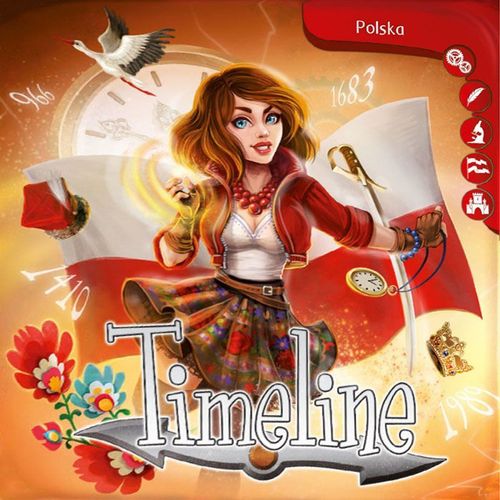
Timeline: Polska
Timeline: Polska Rulebook
Table of Contents
Table of Contents
In Brief...
- During your turn you try to place one of your cards in the correct position on the timeline.
- If you succeed, you will have 1 card fewer in front of you.
- If you fail, you discard the card to the box and draw a new one from the deck.
- If you are the only player in the round to correctly play your last card, you win!
Contents
110 cards bearing a name and an illustration on the front, and the same information together with the date on the back.
Card front and card back (with the date):
- Illustration
- Date
- Card name
- Coloured background for easier classification of the cards
Topics covered in this set: Inventions, Art, History, Science, Monuments.
Goal of the Game
To be the only player who has no cards in front of them.
Setup
- Sit around the table.
- The youngest of you becomes the first player.
- Shuffle the cards, making sure that the date side is hidden on all cards (the date is on the underside).
- Each of you receives the number of cards shown below (date side down) and places them in front of you. Under no circumstances may a player check the back of a card (the date side)!
| Number of players | 2 to 3 | 4 to 5 | 6 to 8 |
|---|---|---|---|
| Number of cards | 6 | 5 | 4 |
Experienced players, depending on their familiarity with the game, may agree to start with a different number of cards. Generally, more cards in front of a player means a higher difficulty level.
- The remaining cards form the deck, which is placed in the middle of the table.
- Reveal the first card from the deck so that the date side is visible. This begins the construction of the timeline, against which players will try to fit the historical event cards they hold in front of them.
- You can start the game!
Diagram key: 1 first player; 2 play area; 3 starting card; 4 card deck; 5 cards dealt to players.
Course of the Game
A game is played over several rounds. In each of them the players take their turns clockwise. The round ends when all players have taken their turns.
To start the game, the first player must play one of their cards next to the starting card (placed in the middle of the play area during setup).
- If the player thinks the event on their card happened earlier than the one shown on the first card of the timeline, they place their card to the left of it.
- If the player thinks the event on their card happened later than the one shown on the first card of the timeline, they place their card to the right of it.
After placing the card, turn it over so that the date is visible, and check whether the card was placed correctly (chronologically) on the timeline.
- If the card was placed correctly, it stays in its place date side up, and the player's turn ends.
- If the card was not placed correctly, it must be discarded to the box. The player then must draw the top card of the deck and put it in front of them (date side down), next to their other cards.
Now the next player (sitting to the left of the first player) takes their turn.
- If the first player placed their card on the timeline correctly, the second may choose between 3 spots in which to place their card: to the left of the 2 cards already played, to the right, or between them.
- If the first player did not play their card correctly, the second player has only 2 places to choose from (to the right or to the left of the first card on the timeline).
If the second player places their card correctly, it stays in place date side up. The cards forming the timeline should be laid out so as to leave space between them for a new card.
Then the third player's turn follows.
- If the first 2 players played their cards correctly, the third player may now choose between 4 spots... and so on.
Players continue taking their turns in the same way until at least one of them manages to place all of their cards on the timeline. See "End of the Game".
Exceptional Situation
During the game a player may place on the timeline a card with the same date as a card already there. In that case the player places their card on either side of that card.
End of the Game
At the end of each round, check whether any player has got rid of all their cards (in other words, whether any player has correctly played their last card).
- If no player was able to correctly play their last card, begin the next round.
- If only 1 player has no cards left, they immediately win the game!
- If more than 1 player correctly plays their last card in the same round, the game continues. All players who correctly played their last cards remain in the game; the rest are eliminated. Each remaining player draws 1 card from the deck, and play continues until only 1 player in a round correctly plays their last card!