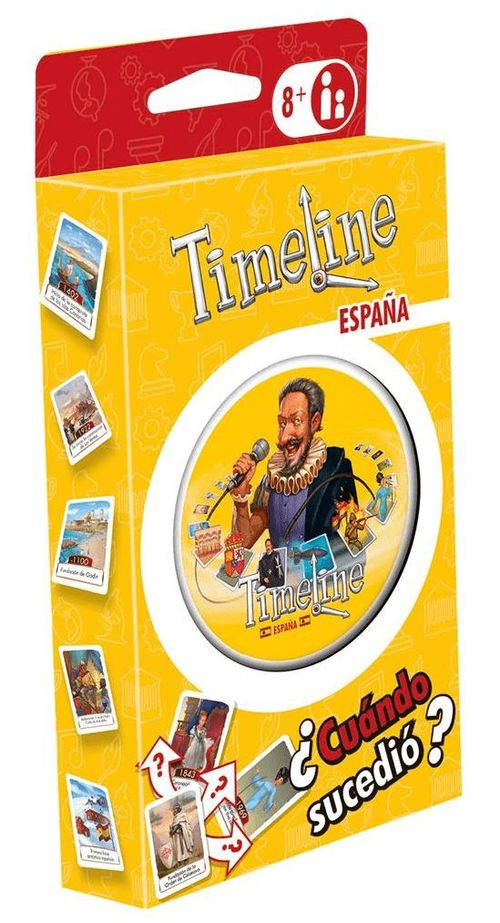
Timeline: España
Timeline: España Rulebook
Table of Contents
Table of Contents
In Brief...
- On your turn, try to place one of your cards in the correct "time gap" (temporal interstice).
- If you fail, return the card to the box and draw a new one.
- The winner is the player who is the only one in a round to correctly place their last card.
Example timeline: -1100 Foundation of Gadir; 711 Start of the Muslim conquest; 786 Start of the construction of the Mosque of Córdoba; 1492 The Castilian Grammar, Elio Antonio de Nebrija; 1970 First Oscar won by a Spaniard, Juan de la Cierva y Hoces. The spaces between cards are the "time gaps".
Contents
55 cards, each with its name and illustration on the front and its date on the back.
- Illustration
- Date
- Text
- Background colour to help sort and store the cards by theme
Goal of the Game
Be the only player without cards.
Setup
- Players sit around the play area.
- The youngest player is the "starting player".
- Shuffle the cards.
- Deal 4 cards to each player, face down (dates hidden), and place them in front of them. Players may not look at the date side. However, players are free to decide the number of cards dealt based on their knowledge of the game.
- Place the deck face down (dates hidden) on the table.
- Take the top card of the deck, turn it so the date is visible, and place it in the centre of the play area. This is the reference card of the timeline on which players will place their cards.
- You can start the game!
Diagram key: 1 Starting player, 2 Play area, 3 Reference card, 4 Deck of cards, 5 Players' cards.
Gameplay
The game is played in rounds, in which each player takes their turn clockwise. Starting with the starting player, on their turn each must place one of their cards next to the reference card (the one previously placed in the centre of the play area):
- If they think the date of their card is earlier than that of the reference card, they place it to the left of the reference card.
- If they think the date of their card is later than that of the reference card, they place it to the right of the reference card.
After placing their card, the player turns it over to check by its date whether it is correctly placed in the timeline:
- If the card is correctly placed, it stays where it is, face up.
- If the card is not correctly placed, discard it. Then the player must draw the top card of the deck and place it face down beside their other cards without turning it over.
Then the second player (to the left of the first) may take their turn.
If the first player did not place their card correctly, the second player must place one of their cards next to the initial card.
If the first player placed their card correctly, the second player may choose among three time gaps in which to place one of theirs: to the left of the two cards already placed, to their right, or between them.
If the second player places their card correctly, it stays where it is, face up. The timeline is rearranged to leave space between the cards. Now it is the third player's turn.
If the first two players both placed their cards correctly in the timeline, the third player may choose among four time gaps.
And so on. When all players have taken their turn, a new round begins.
If the draw deck is empty, shuffle the discarded cards to create a new deck (with dates face down).
Special Case
During the game, a player may have to place a card with the same date as another card already played. In that case, they place both cards next to each other, regardless of their order.
End of the Game - Victory
If during a round a single player correctly places their last card, that player is immediately declared the winner of the game.
If several players correctly place their last card in a round, they keep playing and the other players are eliminated. The remaining players draw a card during each round and follow the standard rules until one of them is the only one to correctly place their card during a single round. That player is then declared the winner.