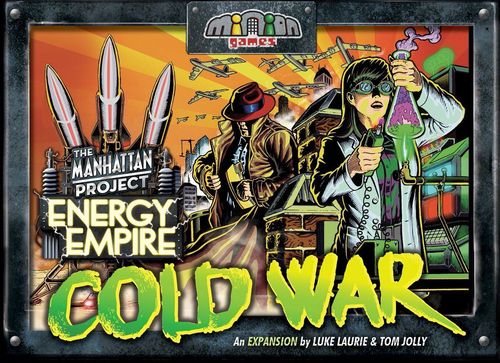
The Manhattan Project: Energy Empire – Cold War
The Manhattan Project: Energy Empire – Cold War Rulebook
Table of Contents
Table of Contents
Module Components
The Cold War Expansion is made of six modules:
- New Nations Cards – 7 cards
- Megastructures – 9 cards
- Espionage – 5 cards
- New Global Impact Cards – 6 cards
- New Structures – 18 minicards
- The Doomsday Clock and Cold War Cards – 30 minicards (15 minicards ×2) and 1 small board with dial
New Nation Cards
This module introduces seven new nations for players to choose from.
Changes to Setup
To use these cards, simply add them to the Nation cards from Energy Empire. If you wish, you may deal three Nations to each player instead of two. Each player still chooses only one to use.
The new Nation cards are used in the same way as the Nation cards in Energy Empire.
Megastructures
Megastructures are like Structures, and are purchased in a similar way from the appropriate Structure markets. But, for all game purposes, they do not count as Structures. They confer large amounts of victory points and powerful abilities.
Changes to Setup
Shuffle the Megastructure cards, and then draw a number of them equal to the number of players plus one. Place the Megastructures face up near the top of the board. Return the unused Megastructure cards to the box.
Buying a Megastructure
You can purchase a Megastructure instead of a Structure when you place a Worker in the corresponding market: Industry, Government, or Commerce. In addition, you must meet the Minimum Qualifications listed in the bottom left corner of the Megastructure card you wish to purchase and you must pay the resource cost listed in the bottom right corner.
Once you have purchased a Megastructure, place it in your tableau. If the Megastructure indicates pollution in the top right corner, take the token from the Global Impact track, as normal. Megastructures are scored at the end of the game.
Minimum Qualifications for Megastructures
- Have two or more Government Structures.
- Have two or more Industry Structures.
- Have two or more Commerce Structures.
- Have advanced at least two times on the United Nations Track.
- Own two or more dice.
Espionage
Secret agents and spies were an important tool for nations during the Cold War, and being able to use the other players' buildings was a key part of the original Manhattan Project game. Now, in Energy Empire, every player has a limited ability to use the other players' Structures by using their Espionage cards.
Changes to Setup
At the beginning of the game, each player takes one Espionage card. This card is placed next to their Nation card.
Using Espionage
You can use your Espionage card during any Work turn, just like your Nation card. After placing a Worker on the main board (or the Doomsday Clock), you may activate your Espionage card along with any other cards in your tableau, in any order, following the normal rules.
After placing one Worker or Energy token on your Espionage card, you may immediately use any other player's Structure by placing the required Workers and/or Energy on your opponent's Structure card action plank. The chosen card must be available for use: that is, it must have at least one action plank that is not filled up with Workers and/or Energy. The chosen card must also be of the appropriate type, matching the location of the main board where you placed your Worker that turn.
The target of your Espionage gains $1 from the general supply.
Example: If you place a Worker on a Commerce location of the main board, you may activate your Espionage card to use another player's Commerce Structure, but not an Industry or Government Structure.
Of course, the action plank on your opponent's Structure will be unavailable for use as long as your Workers or Energy tokens remain on that card.
New Global Impact Cards
The new Global Impact cards can be shuffled in with the other Late Global Impact cards during setup.
A new rule is needed because some of the new Global Impact cards can cause players to lose Workers:
If an effect would cause you to lose your last active Worker, ignore that effect.
New Structures
The new Structure cards can be shuffled in with the other Structure cards during setup.
It is not recommended that the new Structures be used without the original cards. It is important that there is some mixing of the old and new cards.
There are some new concepts on the new Structure cards that may require additional explanation:
"Wild" Cards: Govt. Contractor, Retooled Factory, and Developer
When you activate one of these Structures, choose one of the cards in the matching Structure market and use the effect of the chosen Structure as if you had just activated it.
You do not place any Workers or Energy on the Structure in the market, only on your own Wild Structure. You must still pay any resource cost required by the Structure you have chosen to use. You may not choose a card if you cannot pay its costs, nor can you choose a card that only activates during Generate turns.
Example: You could place two Workers on your Developer in order to use the Bank while it is on the main board in the Commerce market.
"Generate" Cards
Several Structures now give you a benefit when you take a Generate turn, either at the beginning of the turn or when Energy is actually produced. These benefits are gained automatically without paying any cost.
"Bridge" Cards: Stone Bridge, Suspension Bridge, and Highway Overpass
These cards allow you to place Workers on the main board more than once during a single turn.
After activating your Bridge, place a single Worker from your player mat onto an unoccupied location of the same Structure type on the main board and use that location's effect.
Each Bridge is limited to placing one single worker (without any Energy) on an unoccupied space—meaning a location that is not occupied by one or more Workers. The location can have tokens or resources on it and still be considered unoccupied. Also, you may only choose a location if you can actually use its effect, and you must use the effect.
Example: After placing a Worker on the Scientific Research location of the main board, you could place an Energy token or Worker on your Stone Bridge Structure in order to place 1 Worker on the unoccupied Government Market location of the main board and buy a new Government Structure.
The Doomsday Clock
The Cold War was a time of great fear. To counter threats posed by their rivals, nations invested massive amounts of resources into armaments and spacecraft, and struggled to forge alliances through diplomacy. This module enables players to compete in the Cold War by acquiring Cold War cards while raising the stakes and the threat of nuclear war.
Historical Note: In 1947, scientists created the "Doomsday Clock" as a warning that the arms race was increasing the threat of all-out nuclear war.
Changes to Setup
Place the Doomsday Clock miniboard near the main board. Set the hand of the clock to "1." Shuffle the Cold War cards to form a face-down Cold War deck and place it on the appropriate area of the miniboard.
Using the Doomsday Clock
Placing a Worker on the Doomsday Clock
The Doomsday Clock counts as a location, as if it were a part of the main board. Instead of placing on the main board during a Work turn, you may place a Worker on the Doomsday Clock, following the same rules as a regular placement, including placing Energy with your Worker if necessary or desired.
There is an additional cost that must be paid in order to place a Worker on the Doomsday Clock. The cost is indicated by the hand of the clock, and increases during the game.
Example: At the beginning of the game, when the hand points to 1, the cost to place a Worker on the Doomsday Clock is $2. Later, when the clock reaches 7, the cost is $2 plus 2 Oil, and the player must take a Pollution token, too.
Pollution tokens taken as a result of using the Doomsday Clock must be taken from the Global Impact track.
After you place a Worker on the Doomsday Clock, carry out the following effects:
A) Advance the Clock: Move the hand of the Clock up one space.
B) Draw Cold War Cards: Draw three cards from the Cold War deck. Choose one to place on the bottom of the deck and keep the other two, placing them near your player mat. One of those cards must be placed face up and the other must be placed face down. You may look at your own face-down Cold War cards at any time.
C) Activate Cards in Your Tableau: Then, you may continue your turn by activating the cards in your tableau as normal. Unlike when you place a Worker on the main board, you are not limited to activating only one of the three card types. You may use any of the cards in your tableau: Industry, Commerce, and Government, as well as your Nation and Espionage cards, placing Workers and Energy normally.
Striking Midnight
If the hand of the Clock reaches 12, the end of the game is triggered. Once the active player's turn ends, each player takes one more turn, including the player who advanced the Clock to 12.
Scoring the Cold War
At the end of the game, players receive victory points for their efforts in the Cold War:
Cold War Cards: Each Cold War card you have is worth 1 VP.
Leader Bonuses: In addition, bonuses are awarded separately to the top two leaders in each of the three Cold War values: Military (missiles), Space Race (satellite), and Diplomacy (globe). To determine the leaders of the Cold War values, all players reveal their Cold War cards, and total the numerical values beside each of the symbols. The player with most Military receives the Military Leader bonus. The number of VP received for this bonus is equal to the current time on the Doomsday Clock. The player in second place receives half of the Military Leader bonus, rounded down.
A player can only claim a bonus if they have at least one Military symbol.
Example: If the hand of the Clock is pointing to the 7, then the Military Leader bonus is 7 VP. The player with the second highest Military value would get 3 VP.
Example: Blue is first so advances 7 VP on the Score track. Green is second so advances 3 VP.
Bonuses for the Space Race and Diplomacy are determined in the same manner.
Ties: If there is a tie for the highest value, each of the tied players receives half of the bonus, rounded down. Do not award any bonus for second place.
If there is no tie for first place, but there is a tie for second place, the players tied for second place do not receive any bonus.
Clash of Nations Solo Mode
This expansion module allows you to play a solo game of Energy Empire in a whole new way!
Clash of Nations consists of two decks of 24 cards each. These cards direct the placement of Workers and Energy on the main board, representing the efforts of a Rival Nation, to create a challenging and dynamic play environment that will test the skills of even the most experienced players!
When using this module, follow all the standard rules for setup and gameplay unless otherwise indicated below. These solo rules replace the solo rules on page 19 of the Energy Empire rulebook.
Clash of Nations Setup
Rival Nation Pieces: After you have chosen your player color, choose an unused color to represent the Rival Nation. Designate an area of the table to use for the Rival Nation's pieces and the Clash of Nations cards. Place the player mat of the Rival Nation's color in this area. Take all of the Workers (6) and Energy (10) of the Rival Nation's color and place them on the mat. Shuffle each of the Clash of Nations decks separately and place them nearby, face down.
Board Setup: Stack four Pollution tokens on each space of the Global Impact track. Fill all three spaces of each Structure market with Structure cards of the appropriate type. Do not place any Neutral Workers on the board. Place one of your colored disks and one for the Rival Nation on the zero spot of the Score track, and do the same for the leftmost space of the United Nations track.
Energy Dice: Use only the following Energy dice, and return the rest to the game box: 2 Green, 1 Blue, 2 Black, 4 Brown, 2 Yellow.
Nation Cards: You may select any starting Nation, or for an additional challenge, use a random Nation. You may select a Nation card for the Rival Nation, but their Nation has no impact on the game.
Using Expansion Modules
You can combine Clash of Nations with other expansion modules, but you may need to make some adjustments:
New Global Impact Cards: Remove the "Proxy War" card and return it to the game box. All other Global Impact Cards may be used.
New Structures and New Nations: All of the expansion Structures and Nations may be used.
Megastructures: Shuffle the Megastructures and draw three of them. Place these Megastructures face up beside the board, near the Structure markets. Each is available for you to purchase from the appropriate market if you have met the Minimum Qualifications.
Doomsday Clock: Take a single Worker from an additional unused player color and place it on the Doomsday Clock. That Neutral Worker remains "on guard" for the entire game, forcing you to use energy in order to place on the Doomsday Clock.
Espionage: This module cannot be used when playing solo.
Gameplay Differences for Solo Play
Clash of Nations Decks: At the beginning of the game, use the Early Clash of Nations deck. Immediately after the third Early Global Impact Card has been triggered, you must switch to using the Late Clash of Nations deck for the rest of the game.
No Opponent Supply: If you are instructed to give a resource to another player, instead return that resource to the general supply.
Finance Board Location: Instead of the choices listed on the board, you gain $3 when you place a Worker at this location.
The Rival Nation's Turn
You start the game by taking the first turn. After each of your turns, you must perform a turn for the Rival Nation. If the Rival Nation has any Workers remaining on their player mat, then the Rival Nation must Work, otherwise the Rival Nation must Generate, creating a sequence of three Work turns followed by one Generate turn.
The Rival Nation Works and Generates in a similar way to how a player would:
A Work Turn
- Draw one card from appropriate Clash of Nations deck and place it face up in the Rival Nation's area.
- Place one of the Rival Nation's Workers on each of the main board locations indicated on the Clash of Nations card, going from top to bottom. If Energy is required to place a Worker, use the minimum amount of Energy needed. If the Rival Nation doesn't have enough Energy for a placement, it skips that placement (but still set the Worker aside to preserve the sequence of Work and Generate turns). If a Worker is placed in a Structure market, remove the Structure card indicated (the X icon) from that market and place it in the discard pile. Refill the market normally. If a Worker is placed on a location that contains any Pollution tokens, Nuclear Contamination tokens, or resources, those tokens or resources are immediately returned to the supply.
- Consult the icon, if any, in the top right corner of the Clash of Nations card, and resolve its effect:
- United Nations icon: Move the Rival Nation's marker one space to the right on the United Nations track.
- Contamination icon: Remove one Contamination token from the Global Impact track and place it on this card.
- Achievement icon (the Achievement tile shown on the card, with the X): Remove the indicated Achievement from the board and place it on this card. By placing Achievements on the cards, you can keep track of what was removed.
- Doomsday Clock icon: If you are using the Doomsday Clock, advance the Clock one space.
- If necessary (due to removed Contamination) resolve the next Global Impact card.
- After resolving Clash of Nations cards, arrange them in columns of four: three face-up for Work turns, and one face-down for each Generate turn.
A Generate Turn
- Without looking at it, take one card from the appropriate Clash of Nations deck and place it face down in the Rival Nation's area. Remove one Pollution token from the Global Impact track and place it on this card.
- Take all of the Rival Nation's Workers and Energy off the board and return them to the Rival Nation's player mat.
- If necessary (due to removed Pollution), resolve the next Global Impact card.
Special Rules for the Rival Nation
The Rival Nation never gains or loses resources, never really owns any Achievements or has any Pollution tokens, and does not score Victory Points in any of the ways that a player does. The Rival is not affected in any way by Global Impact cards.
Ending the Game
The end of the game can be triggered either by you, the player, or by the Rival Nation. As in a normal game of Energy Empire, whoever removes the last token from the Global Impact track will also be the last to take a turn after each player takes one more turn.
Scoring Victory Points
You determine your score normally.
The Rival Nation's score comes from the following sources:
- Clash of Nations cards played: Total all VP on all of the Clash of Nations cards that were played, including all face down cards.
- The United Nations Track: The Rival Nation scores points for the position of its marker on the United Nations track. Determine the Leader Bonus normally.
- The Doomsday Clock (if used): The Rival Nation does not draw Cold War cards, but instead it has symbols on the Clash of Nations cards. Total all of the values for Military, Space Race, and Diplomacy on the Clash of Nations cards that were played and compare them to your own. The Rival Nation receives VP for winning first or second place (or none at all), as appropriate.
The Rival Nation does not receive VP from any other sources (Achievements, Environment, etc.)
If your score is higher than the Rival Nation you won! If not, perhaps you can schedule a rematch!
Two Player Clash of Nations Variant
Instead of using the two-player rules in the Energy Empire rulebook, you can instead play a two-player game using the Clash of Nations deck to control a Rival Nation player. When doing so, use all of the rules above for the Rival Nation. During setup, place six Pollution tokens on each space of the Global Impact track. The Rival Nation goes third in turn order.