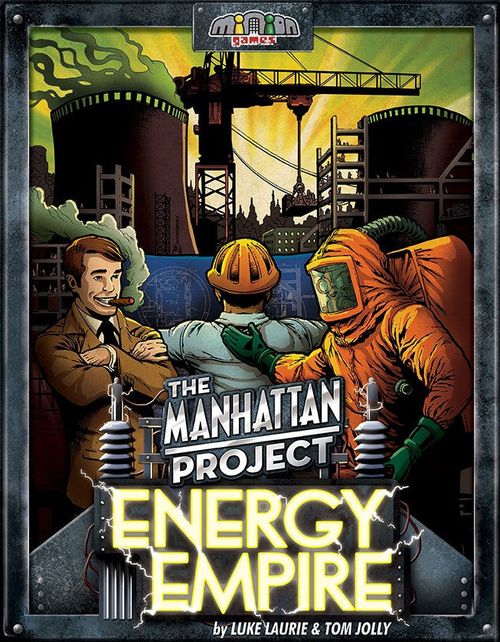
The Manhattan Project: Energy Empire
The Manhattan Project: Energy Empire Rulebook
Table of Contents
Table of Contents
Your Objective
You score victory points (VP) by acquiring Structure cards and Energy dice, claiming Achievement tiles, keeping your environment clean, and gaining influence in the United Nations. There are a variety of ways to achieve these goals, but generating large amounts of energy and using that energy efficiently are keys to building a strong nation.
The winner of the game is the player with the most Victory Points. That player has built the most powerful Energy Empire!
For 1-5 players, ages 13+, playing time 1-2 hours. A game by Luke Laurie & Tom Jolly.
Symbol Glossary
The rulebook and components use pictograms; rendered here as words:
- Money ($1) — the money resource, worth $1 each.
- Plastic — a resource (pink cube).
- Steel — a resource (grey ingot).
- Science — a resource (atom disc).
- Oil — a resource (oil barrel).
- Plastic OR Steel — either resource may be used.
- Victory Point (VP) — a purple star.
- Worker — a worker meeple.
- Energy — an energy token (lightning bolt).
- Oil Well — an oil derrick / oil rig token.
- Drilling Space — an environment space where an Oil Well may be placed.
- Government — the Government structure/location type.
- Industry — the Industry structure/location type.
- Commerce — the Commerce structure/location type.
Game Components
- 1 Main Board — with a Government section, Industry section, and Commerce section, plus the Oil Prices & Global Impact Track, Score Track, United Nations Track, and Available Achievements.
- 24 Energy Dice: 5 Green (Solar-Wind), 5 Blue (Hydro-Geo), 5 Black (Coal), 4 Brown (Petroleum), 5 Yellow (Nuclear).
- 30 Workers — 6 in each player color. (All workers function identically even though they are illustrated differently.)
- 50 Energy Tokens — 10 in each player color.
- 10 Nation Cards — each has a player aid on the back.
- 5 Player Mats — 1 in each player color, showing an Environment, Achievements area, Worker Storage, Resource Storage Areas, Dice Chart & Energy Storage, and Energy Dice Storage.
- 78 Structure Cards — 26 each of Government, Commerce, and Industry.
- 15 Global Impact Cards — 9 Early Global Impacts and 6 Late Global Impacts.
- 10 Player Markers — 2 in each player color.
- 20 Achievement Tiles — private goals that earn VP for you alone (each has a maximum value of 5 VP).
- 54 Pollution Tokens — each shows Pollution on the front and Nuclear Contamination on the back.
- 12 Oil Well Tokens — each shows a land-based Oil derrick on the front and a sea-based Oil rig on the back.
- 54 Money Tokens — 42 $1 tokens and 12 $5 tokens (players may make change with the supply whenever they wish).
- 27 Science Discs.
- 25 Steel Tokens.
- 25 Plastic Cubes.
- 30 Oil Barrels.
Resource note: Unlike other components, resources (money, Science, Steel, Plastic, and Oil) are unlimited. If you run out of a resource's pieces, use a suitable substitute.
Setup
Getting Started. Place the main board in a central location. Create stockpiles of resources, dice, Pollution tokens, and Oil Well tokens within reach of all players.
Shuffle cards and tiles. Shuffle each of the six decks of cards separately, leaving the decks face down. Also shuffle the Achievement tiles and leave them face down as a supply stack.
Main Board
Global Impact cards. Without revealing them, draw three Early Global Impact cards and three Late Global Impact cards. Place them face down in a row along the bottom edge of the board, with the Early cards to the left. Return the rest of the Global Impact cards to the game box; they won't be used in this game.
Global Impact track. Stack the appropriate number of Pollution tokens from the supply (according to the chart) on each of the six pollution spaces of the Global Impact track.
| Players | 2 | 3 | 4 | 5 |
|---|---|---|---|---|
| Pollution tokens per spot | 4 | 5 | 6 | 7 |
For example, in a 3-player game you'd stack 5 tokens on each spot.
Structure Markets. Place the three Structure card decks beside the board in a convenient location. (Leave room for separate Structure discard piles beside each deck.) Fill each Structure market from right to left by drawing three cards from the corresponding Structure deck and placing them face up in the appropriate market (Government cards into the Government market, and so on).
Achievements. Draw 3 Achievement tiles and place them face-up on the Achievement spaces. Keep the face-down Achievements stack nearby.
Player markers. Each player chooses their color for the game. Place 1 colored marker for each player on the zero space of the Score track, and the other colored marker for each player on the leftmost space of the United Nations track. Unused colors are returned to the box.
Neutral Workers (2-player Only). Take 3 Workers of an unused color, and place one on each of the three Structure market locations (Government, Industry, and Commerce). These workers remain on these locations for the entire game.
Player Setup
Player Mats. Each player takes the player mat of their color.
Starting Pollution. Each player takes one Pollution token from the supply and places it in the top-left space of their Environment grid.
Workers and Energy. Each player takes 3 Workers and 2 Energy of their color and places them on their player mat in the indicated spaces. Keep remaining Workers and Energy in a supply clearly separate from these ones so that there is no confusion about which ones are legitimately in play.
Nation & Achievement. Deal two Nation cards and two Achievement tiles face down to each player. Each player peeks at and selects one of each. The selected Achievement is placed face down on the player mat in the indicated space; the other is shuffled back into the supply. Players reveal their selected Nation card and turn the other card face-down to use the reference on the back. Players may peek at their own Achievements at any time.
Bonus Starting Resources. Each player takes the bonus starting resources, money, dice, and/or Workers indicated on their Nation card and places them on the appropriate spaces of their player mat.
Start Player. The start player is the person who used the least amount of fuel to get from their home to where the game is being played. Play order is clockwise from the start player. Each player receives extra starting money based on turn order, according to the chart:
| Turn order | 1st | 2nd | 3rd | 4th | 5th |
|---|---|---|---|---|---|
| Starting money | $0 | $1 | $2 | $3 | $4 |
How to Play
Game Structure
The Manhattan Project: Energy Empire is a turn-based game. Beginning with the start player and proceeding clockwise, players take turns until the game ends; each turn may be either a Work turn or a Generate turn. The end of the game is triggered when the last Pollution token is removed from the Global Impact track. At that point, each player gets one more turn, including the player who triggered the endgame. Then points are tallied to determine the winner!
Player Turns
On your turn, choose one of these two options: Work or Generate. Then, carry out the phases in order for the choice you have made.
Restrictions:
- If you have no Workers remaining on your player mat, you must choose to Generate.
- If you Generated on your previous turn, you must choose to Work.
A Work Turn
Work turns are where most of the action happens in the game. During Work turns you will be using the Workers, Energy, and other assets you have gathered to build Structures, visit other board locations, and activate your built Structures and Nation card for a variety of benefits.
A Work turn's phases:
- Place a Worker on the main board.
- Activate Structures (and/or Nation card).
1. Place a Worker on the main board
Take one of your Workers from your player mat and place it on one of the 13 locations on the main board. This is not optional and must be done. Each location is connected to a grey box with a white Worker symbol; this box is where you should place your Worker.
- The four Government locations are on the left (green) binder. They are the Government Structure market, Scientific Research, Education, and Clean Up.
- The five Industry locations are on the middle (brown) binder. They are the Industry Structure market, Mine, Oil Drilling, Chemistry, and Power Plant.
- The four Commerce locations are on the right (yellow) binder. They are the Commerce Structure market, Finance, Buy/Sell Oil, and Trade.
Requirements for placing on a location
To place on a location, you must have sufficient resources to perform the location's action (if that action has a cost associated with it, indicated by the red Spend arrow).
Spend arrow: When you see it on a location or a card, it means that you must discard something (from your player mat into the general supply) in order to gain something. For example, the Clean Up location on the main board tells you that you must spend 1 Science to gain 2 Cleanup.
To place on a location, you also must be placing the tallest stack in the location. If there are no Workers already in the location, this means that your single Worker will be enough, since it will be the tallest. However, if the location is occupied (by any Workers, including your own from previous turns), you must stack your Worker on top of Energy before placing it so that your new stack is the tallest in the location.
Stacking your Worker on Energy
- Energy used for stacking must come from your player mat. If you don't have enough Energy to create the tallest stack in a location, you may not place a Worker there.
- You may choose to place more Energy than is required (even if the location is unoccupied), in order to create a higher stack and make it more difficult for players to use that location later.
- You may not use additional Workers to make your stack taller; a stack may only be composed of any number of Energy with 1 Worker on top.
- You may use a board location that you used on a previous turn, by building a new stack of Energy with a Worker on top, following the same rules; you may not add to a stack of your own that is in the location from a previous placement.
Neutral Workers (2-player Only): The permanent neutral Worker on each of the three Structure markets is taken into consideration for this purpose, which means you will never be able to place a single unstacked Worker in any of those locations.
After placing your Worker, you must carry out the action for that location. Pay costs (if any) by discarding the appropriate resources from your player mat to the general supply.
2. Activate Structures and/or Nation card
You begin with no Structures but will acquire them as the game goes on. For easier management, keep your acquired Structures arranged into three separate tableaus by type: Government, Industry, and Commerce.
Activating Structures
You may only activate your own Structures. You may activate as many Structures as your Energy and Workers will allow, as long as the following requirements are met:
- The Structure must have an unoccupied action plank. Action planks are found at the bottom of all Structure cards. A plank is unoccupied if no Workers or Energy are currently on it. To activate a card, place Workers and/or Energy on its plank:
- Single Plank. 1 Worker or 1 Energy placed on the plank.
- Double Plank. 2 Workers or 2 Energy or 1 Energy and 1 Worker, placed side-by-side on the plank at the same time.
- Two Single Planks. 1 Worker or 1 Energy placed on one plank activates the card. The card may be activated a second time (on a later turn, not on the same turn) using 1 Worker or 1 Energy on the second plank.
- The Structure must be of the same type as the location on the main board (Government, Industry, or Commerce) where you placed your Worker this turn. For example, if you placed a Worker in a Government location in phase 1, the only Structures you may activate in phase 2 are Government Structures.
- You must possess the correct resources to perform the Structure's action, if it has a Spend arrow.
Activating your Nation card
Your Nation card functions just like a Structure, except that it may be activated on any Work turn, regardless of which type of location you used on the main board.
As with Structures, you may not activate your Nation card if the plank is already occupied, or if you don't have the resources available to perform the action.
Activating your Nation card allows you to progress on the United Nations track.
Once activated, the action of a Structure or Nation card must be carried out. Structures (and/or your Nation card) may be activated in any order. When you are unwilling or unable to activate anything further, your turn is over.
A Generate Turn
After a few turns of placing Workers and Energy, you'll run out; time to regroup and generate more Energy! A steady supply of Energy gives you more options, and lets you activate more Structures.
A Generate turn's phases:
- Claim Achievement.
- Return Workers and discard Energy.
- Refine Oil to gain Petroleum dice.
- Roll Energy dice and gain Energy.
- Pollute.
1. Claim Achievement
If you have unused Workers + Energy totaling 2 or more remaining on your player mat, you may claim one Achievement. Choose one of the available Achievements on the main board, and place it face down on your player mat. Draw a new Achievement from the supply and place it face up on the main board to replace the one you took.
2. Return Workers and discard Energy
Collect all of your in-play Workers from the main board and from your action planks, and return them to your player mat. Discard all your Energy from everywhere — the main board, your action planks, even your player mat — to the supply. You now have no energy.
3. Refine Oil to gain Petroleum dice
To refine an Oil barrel, discard it from your player mat to the general supply. For each Oil barrel you refine (up to a maximum of 4 per turn) you gain one brown Petroleum Energy die. These gained Petroleum dice are temporary, and may only be used this turn.
4. Roll Energy dice and gain Energy
You (usually) begin the game with no Energy dice, but you will gain dice as the game progresses. During this phase, you may choose to roll zero or any number or all of your Energy dice to produce Energy, including any temporary Petroleum dice you gained this turn. Roll your chosen dice all at once.
The results of your rolled dice determine the amount of Energy you gain, and determine if and how you pollute your Environment (see Pollute, below). The amount of Energy you produce is equal to the total number of Energy symbols displayed on the rolled dice; take that many Energy tokens from your supply and place them on your player mat.
Each type of die can produce a different amount of Energy depending on its face (as shown on the dice chart on your player mat). For example, a Petroleum die produces 1 Energy on a roll of 1, 2 Energy on a roll of 2-5, and 3 Energy on a roll of 6.
Do not disturb the dice yet; you need to look at them for the next phase, Pollute.
5. Pollute
Look at the numbers on your die results. The die with the highest number is the one that determines what you should do. If more than one die is tied for highest, you choose which one of the tied dice counts as the highest one.
- If you did not roll any dice, or if the highest die is a green Solar-wind or a blue Hydro-geo die, your Environment does not get polluted. Take 1 Pollution token from the leftmost spot on the Global Impact track that still has any, and discard it into the general supply.
- If the highest die is a black Coal or a brown Petroleum die, your Environment gets polluted. Take 1 Pollution token from the leftmost spot on the Global Impact track that still has any, and place the token into your Environment, Pollution-side up, on any unpolluted space you choose. (An Environment space is unpolluted if it doesn't have Pollution, Nuclear Contamination, or an Oil well already in it.)
- If the highest die is a yellow Nuclear die, your Environment becomes polluted with Nuclear Contamination (which is more difficult to clean up than regular pollution). Take 1 Pollution token from the leftmost spot on the Global Impact track that still has any, and place the token into your Environment, Nuclear Contamination-side up, on any unpolluted space you choose.
Return any brown Petroleum dice that you rolled back to the supply. All other rolled dice are returned to your mat.
Your Environment
Your nation's Environment is represented by a grid of three rows (Air, Forest, and Ocean) on your player mat. You begin the game with one Pollution token in your Air row, but as the game progresses, you will likely be adding Pollution, Nuclear Contamination, and Oil Wells to the grid.
Each space of your grid can hold a single token. When a space is occupied by a token of any kind, it is considered to be polluted. An empty space in your grid is considered to be unpolluted.
The column bonuses in the top right indicate bonus VP won at the end of the game if the respective full column is unpolluted.
Gaining Pollution and Nuclear Contamination
Pollution is gained mostly from rolling Energy dice and from acquiring Structures, but there are a few other ways you might gain pollution as well. Unless otherwise instructed, when you gain a Pollution token (regardless of whether it is Pollution or Nuclear Contamination), take the token from the leftmost spot on the Global Impact track that still has any, and add it to your Environment with the correct side up. Once placed, tokens in your Environment may not be rearranged.
- Unless specifically instructed to place the token in a particular row of your Environment, you may place a gained Pollution token in any unpolluted space.
- Sometimes, you will be instructed to gain Pollution in a particular row. In that case, you may place the token in any unpolluted space in that row.
- If you are instructed to place a Pollution token into a specific row of your Environment that is already full, place that token instead into any unpolluted space in your Environment.
- If you gain a Pollution token, but have no unpolluted spaces remaining in your Environment, discard that token to the supply.
Cleanup
Although you may not rearrange tokens in your Environment, there is a way to remove them. The cleanup symbol appears on the Clean Up location on the main board, and also on several Structures that you might acquire. For each cleanup symbol you activate, you may choose one of these actions to perform:
- Remove a Pollution token (Pollution-side up only, not Nuclear Contamination) from any space of your Environment, and return it to the general supply.
- Remove one Oil Well token from your Environment and return it to the general supply.
- Choose one Nuclear Contamination token in your Environment and flip it over to become Pollution. The token must stay in the same space of your Environment.
The Global Impact Track
The Global Impact track is a timeline for the game. During the game, Pollution tokens will steadily be removed from the leftmost spot that still has any. When a spot first becomes empty of tokens, a new Global Impact is triggered and a new price of Oil comes into effect.
Triggering a Global Impact
The current player finishes resolving the action they are performing (not their entire turn). If there is a face up Global Impact card remaining from an earlier triggering, discard it. Reveal the leftmost Global Impact card from the row of face down cards below the main board, and carry out its effects. After carrying out the Global Impact card, the current player continues the rest of their turn.
"Peek at an upcoming Global Impact" symbol: Found on the Scientific Research location on the main board, and also on several Structure cards. When you activate this symbol, you may peek at one face down Global Impact card of your choice along the bottom of the main board. Knowing which Global Impacts are approaching can be a great advantage!
Carrying out a Global Impact
Each Global Impact card is divided into three parts. Global Impact cards affect all players, not just the active player. Resolve the card's three parts in this order:
- The Environment row that will be scored. (See Scoring Environment Rows.)
- The Structure market that will be reset. (See Resetting Structure Markets.)
- The special effect of the card. Each Global Impact card has a unique special effect. Read the card out loud and follow its instructions. Some cards have an immediate effect, and some cards have a persistent effect that lasts until the next Global Impact card is triggered.
Scoring Environment Rows
A triggered Global Impact card causes all players to score a particular Environment row, indicating which row with one of these icons: all players score their Air row, their Forest row, or their Ocean row.
When scoring a row, each player gains 1 VP for each unpolluted space in the indicated row. A space is unpolluted if it holds no tokens of any kind.
Resetting Structure Markets
A triggered Global Impact card also causes one of the three Structure markets to be reset, indicating which market with one of these icons: reset the Government market, the Industry market, or the Commerce market.
To reset a market simply discard all of the Structures in the indicated market, and draw new Structures of the appropriate type to replace them, filling in from right to left.
If a Structure card deck ever runs out while resetting, shuffle its discard pile and form a new Structure deck.
Game Pieces on Locations
Some Global Impact cards instruct you to place game pieces such as resources or Pollution tokens on main board locations. These are taken from the supply and then placed on the board in the indicated locations.
If you place a Worker in a location which contains any resources or tokens, you immediately gain all of the resources and/or tokens in that location, before resolving the action. Note that you may use that resource immediately to pay a cost associated with that placement, and this may also fulfill the requirement for being able to use that location.
Oil Prices
The price of Oil is always the value showing beneath the leftmost spot on the Global Impact track that still has any tokens in it. That value equals the price of 1 barrel of Oil. At the beginning of the game, the price of Oil is therefore $1 per barrel.
Endgame Trigger
When the last Pollution token is removed from the last (rightmost) spot on the Global Impact track, this triggers the end of the game (in addition to triggering a Global Impact as usual). See Ending the Game and Scoring for details.
Locations
You begin a Work turn by selecting from the thirteen locations on the main board. These locations enable you to carry out a variety of actions to build your empire. They are arranged into three types: Government, Industry, and Commerce. Remember, the location you visit on the main board determines the type of your own Structures you may use on that turn.
Markets
There is a Structure market for each type: Government, Industry, and Commerce. Placing a Worker in one of the three Structure markets allows you to buy one of the three Structures in that market.
After you have placed a Worker in a market location, indicate which Structure you wish to build, then pay the cost for that Structure depending on which spot in the market the Structure occupies; the cost is shown right above the card, and can be paid with either money or with resources (but not a combination of the two). Spent money or spent resources are discarded into the general supply.
The three market spots (right to left) cost:
- Government market: $2 or 1 Science; $3 or 1 Science; $4 or 2 Science.
- Industry market: $2 or 1 Steel; $3 or 1 Steel; $4 or 2 Steel.
- Commerce market: $2 or 1 Plastic; $3 or 1 Plastic; $4 or 2 Plastic.
Gaining a new Structure. Once you have paid for a Structure, take it and place it in your tableau. (Keep your Government, Industry, and Commerce Structures separated for easy management.) The new Structure is available to be used immediately.
Each Structure card has a VP value. These VP are added to your score at the end of the game. Some Structures also have a symbol indicating Pollution or Nuclear Contamination. This token is gained one time: immediately when you gain the card. Take a Pollution token from the leftmost spot of the Global Impact track that still has any, and add it to the indicated row of your Environment with the correct side up.
Refilling the market. Any time a card is removed from a market, immediately slide the remaining cards in that market to the left to fill in the empty space, then draw a new card from the appropriate deck and place it in the rightmost space of the market. (If a Structure card deck ever runs out while refilling, shuffle its discard pile and form a new Structure deck.)
Other Government Locations
- Scientific Research. Gain 1 Science from the general supply. Then peek at one face down Global Impact card of your choice, being careful not to reveal the card to other players. Return the card to the same position.
- Education. Spend $3 to gain 1 Worker of your player color and place it on your player mat; the new Worker is available immediately for use. Also, gain 1 Pollution from the leftmost spot of the Global Impact track that still has any and place it in your Environment.
- Clean Up. Spend 1 Science to perform two Cleanup actions. (See Cleanup for details.)
Other Industry Locations
- Mine. Gain 1 Steel from the general supply.
- Oil Drilling. Take 1 Oil Well token from the supply, and place it in your Environment. Then gain three Oil barrels from the supply. An Oil Well may only be placed in an unpolluted space marked by the Drilling symbol. (There are four such spaces in your Environment.) If no such space is available, you may not drill for Oil. (Oil Well tokens have an Oil Derrick on the front and an Oil Rig on the back. It doesn't affect gameplay, but it's nice to use the Derrick in the Forest row and the Rig in the Ocean row!)
- Chemistry. Spend 1 Oil to gain 2 Plastic, 1 Science, and gain 1 Pollution from the leftmost spot of the Global Impact track that still has any and place it in your Environment.
- Power Plant. Spend the displayed resources to gain one Energy die, and place the die on your player mat. Dice are limited to the available supply. These dice are kept permanently, and may be used on each Generate turn.
- Gaining Energy dice. You are limited to owning 5 Energy dice at a time. (There are 5 slots on the right edge of your player mat to hold your dice.) Temporary Petroleum dice are not placed in those slots and do not count towards that limit. You may discard any Energy die back to the supply at any time, to make room for obtaining a new different one. Dice are worth victory points at the end of the game.
- The Hydro-geo die. You are limited to one blue Hydro-geo die. When you gain a Hydro-geo die, you must also take one Pollution token from the leftmost spot of the Global Impact track that still has any and place it in the Forest row of your Environment.
Other Commerce Locations
- Finance. Choose one of the following three options:
- Gain $2.
- Gain $3, each opponent gains $1.
- Gain $4, each opponent gains $2.
- Buy/Sell Oil. Make only a single exchange. Choose one:
- Spend money equal to the current price of Oil to gain 3 Oil barrels.
- Return 3 Oil barrels to the supply to gain money equal to the current price of Oil.
- Trade. Make any number of exchanges between yourself and the general supply. Resources eligible for trade are $2, Steel, Plastic, and Science. For example, you may trade $2 and 2 Science for 2 Steel and 1 Plastic.
The United Nations
As described in Activating Your Nation Card, you may use your Nation card in the same way you would use a Structure. The Nation card ability allows you to spend the indicated resources to move your player marker one space to the right on the United Nations track on the main board.
At the end of the game, you receive the victory points indicated at the top of the column occupied by your marker. In addition, there is a leader bonus of 3 VP for the player who has moved the farthest on track. This leader bonus is split between players tied for furthest (see Ending the Game and Scoring for details).
Player markers may occupy the same spaces on the track, except for the last space, which may only be occupied by one marker. (Once a player has moved into that space, no player on the previous space may advance.)
Some General Rules
Understanding Structures
Obtaining and using Structures well is vital to building your energy empire. Each Structure has several common characteristics:
- Structure Type. Tells you whether a Structure is Government, Industry, or Commerce.
- VP Value. Tells you how many Victory Points you receive at the end of the game for owning this Structure card.
- Pollution Type. Some Structures cause you to gain Pollution or Nuclear Contamination, only at the moment you acquire the card.
- Effect. Structures have a variety of effects. Some effects have costs; costs always sit to the left of a red Spend arrow (the benefits sit to the right of the arrow). If there is no Spend arrow, the shown benefits are gained without resource costs.
- II Symbol. This tiny II symbol means that there are 2 of this card in the game.
- Action Plank. This is where you place Workers and/or Energy during a Work turn to activate the Structure.
Some example Structure card effects:
- Science Academy: Gain 1 Science or spend 2 Science to gain 1 Worker.
- Space Program: Spend 1 Science to get 1 VP, 1 Plastic or 1 Steel, and 1 peek at a Global Impact.
- Iron Mine: Gain 2 Steel.
- Computer Factory: Spend 1 Plastic to gain 1 Science and $2.
- Stock Market: Gain $3; all other players gain $1.
- Port: Spend $1 to gain 1 Oil or 1 Plastic or 1 Steel or 1 Science.
- National Park (Government): Gain $1 for each unpolluted Forest space in your Environment.
- Airport (Commerce): Discard an Oil barrel to gain $2 and 1 VP; gain 1 Pollution in the Air row when acquired.
- Farm (Commerce): Gain $2 and 1 VP.
- Shopping Mall (Commerce): Spend a Plastic to gain $3.
- Chemical Plant (Industry): Spend 1 Oil to gain 2 Plastic; gain 1 Pollution in the Ocean row when acquired.
Gaining Victory Points
Whenever you gain VP, advance your player marker on the Score track by that many spaces. (Note that some VP are scored immediately and some are scored at the game's end.)
Gaining Resources
Unless otherwise specified, whenever any aspect of the game instructs you to gain any resource, take the appropriate amount of that resource from the general supply and store it in the appropriate section of your player mat.
Staying Organized
It is important that you keep all of your assets (resources, Workers, Energy, Energy dice, and Achievements) properly stored on your player mat. This will help limit confusion during the game about which assets are legitimately owned and in play.
Achievements
Achievement tokens provide a way to make use of surplus Energy or Workers with the potential to gain additional VP. You begin the game with one Achievement and may claim one additional Achievement each time you begin a Generate turn with at least 2 Workers/Energy left over (see Claim Achievement).
You are limited to owning a maximum of five Achievements at any one time. However, you may discard any Achievement at any time to make room for a new one. (Discarded Achievements are removed from the game.) Keep your Achievements face down on your player mat until the end of the game; you may peek at your own Achievements whenever you want.
Achievements provide VP to their owners at the end of the game as described on the tiles. Each Achievement has a maximum value of 5 VP. (This simply means that if you merit more than 5 VP according to the Achievement, earn 5 VP instead.)
All 20 Achievement tiles:
- Award Winning: 1 VP per Achievement you hold, including this one.
- Clean Air: 1 VP per unpolluted Air space in your Environment.
- Commercial Empire: 1 VP per Commerce Structure in your own tableau.
- Cultural Heritage: 1 VP per Government Structure in your own tableau.
- Diversified: 1 VP per type of resource (money, Plastic, Steel, Science, Oil) remaining on your player mat.
- Energy Empire: 1 VP per Energy die (of any type) remaining on your mat (this excludes temporary Petroleum dice).
- Energy Reserves: 1 VP per Energy token remaining on your player mat.
- Global Influence: 1 VP per space your marker has moved on the United Nations track during the game.
- Healthy Forests: 1 VP per unpolluted Forest space in your Environment.
- Healthy Ocean: 1 VP per unpolluted Ocean space in your Environment.
- Leading Consumer: 1 VP per Structure (of any type) in your tableau that has a red Spend arrow on it.
- Nuclear Capability: 1 VP per Nuclear Contamination token in your Environment.
Ending the Game and Scoring
When the last Pollution token is removed from the Global Impact track, the end of the game is triggered. Once the active player's turn ends, each player takes one more turn, including the active player.
- The price of Oil remains $5 during the final turns.
- Players may still gain Pollution as a result of their actions; Pollution tokens gained during these final turns are drawn from the general supply instead of from the Global Impact track.
- The final turn each player takes might be either a Work turn or a Generate turn; it is up to the players to anticipate the endgame's approach and to time their gameplay accordingly.
Once all players have taken their final turn, the game is over and the scores are determined!
Determining Scores
Players tally the VP they earn from all of the below sources, advancing their markers along the Score track to reflect the gains and adding to whatever VP were earned during the game from various sources.
- Structures: Total the VP of your owned Structures.
- Energy Dice: Gain 2 VP for each Energy die on your player mat.
- United Nations track: Score VP for the space your player marker is in. The player who moved furthest on the track receives the leader bonus of 3 VP. (If there is a tie, split the leader bonus evenly between tied players, rounding down.)
- Achievements: Reveal your Achievements and determine the value of each. Remember that each Achievement has a maximum value of 5 VP.
- Environment: Score 1 VP for each unpolluted space in your Environment. Score column bonuses for the 3rd, 4th, and 5th columns, for each column that is entirely unpolluted.
The winner of the game is the player with the most Victory Points. That player has built the most powerful Energy Empire!
Tiebreaker: Remaining resources; Money (divided by 2 and rounded down) + Plastic + Steel + Science + Oil.
Solo Energy Empire
Energy Empire can be played solo! It's probably best to be familiar with the normal game before you try to play it solo, so that you'll clearly understand the difference that these rules make.
Setup Differences for Solo Play
Follow the setup rules for a 2-player game, with the following differences:
- Neutral Workers: In addition to the Neutral Workers you place (1 in each of the Structure markets) for 2-player setup, place two more: one each on the Power Plant and Clean Up locations.
- Structure Cards: For each of the three Structure markets, use only the leftmost and rightmost card spaces. For the entire game, leave the middle card space in each market empty. (It's not a bad idea to place a Nuclear Contamination token in each middle spot to remind you that those spaces are off limits.)
- Achievements: Remove the following two Achievements before shuffling and return them to the box: Award Winning and Global Influence.
- Energy Dice: Keep only the following Energy dice in the general supply; return all others to the box: 2 Green (Solar-Wind), 1 Blue (Hydro-Geo), 2 Black (Coal), 4 Brown (Petroleum), 2 Yellow (Nuclear).
- Global Impact Track: Stack only 2 Pollution tokens on each space of the track.
- Nation Card and Starting Achievement: Select your starting Achievement following the normal rules. For your Nation card, choose any one Nation card from the 10 possibilities, and return the rest to the supply. (You may keep one to use the reference side.)
Gameplay Differences for Solo Play
Gameplay follows all of the rules for Energy Empire with the following small differences:
- No Opponents: If you are instructed to give a resource to another player, instead return that resource to the general supply. Neutral Workers are considered to belong to other players.
- Finance Board Location: Instead of the choices listed on the board, gain $3 when you place at this location.
- Claiming Achievements: When you claim an Achievement, remove the other two Achievements from the board. Return those Achievements to the game box, and draw three new Achievements from the supply and place them on the board.
- U.N. Track Leader Bonus: You receive no Leader Bonus for your position on the track. (It's not a bad idea to place a Nuclear Contamination token on the Leader Bonus VP to remind you that it is not applied for solo play.)
Objectives
To win a solo game of Energy Empire, you must accomplish all of the following:
- A) Reach the last space of the United Nations Track.
- B) Receive 20 or more Victory Points from Achievements. (Reminder: you are limited to 5 Achievements, and each Achievement is limited to 5 points.)
- C) Have a total final score of 100 points or higher.
If you can satisfy all of these objectives, congratulations! Your score determines your rank as follows:
- 100 to 109 Points: Secretary of State
- 110 to 119 Points: President
- 120 to 129 Points: Secretary General
- 130 Points or more: Nobel Prize Winner