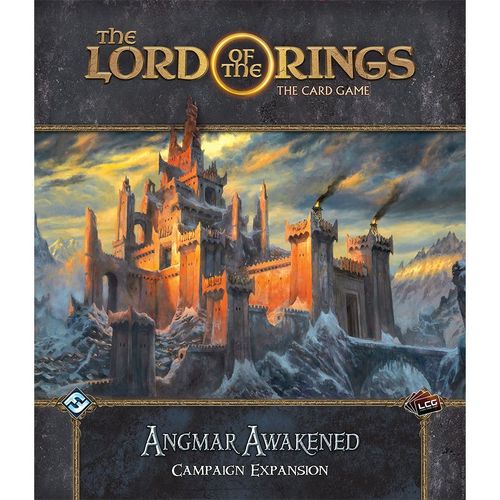
The Lord of the Rings: The Card Game – Angmar Awakened Campaign Expansion
The Lord of the Rings: The Card Game – Angmar Awakened Campaign Expansion Rulebook
Table of Contents
Table of Contents
- Component Overview
- Expansion Symbol
- Campaign Mode
- Rules & New Terms
- Side Quests
- Scenario 1: Intruders in Chetwood
- Scenario 2: The Weather Hills
- Scenario 3: Deadmen's Dike
- Scenario 4: Wastes of Eriador
- Scenario 5: Escape from Mount Gram
- Scenario 6: Across the Ettenmoors
- Scenario 7: The Treachery of Rhudaur
- Scenario 8: The Battle of Carn Dûm
- Scenario 9: The Dread Realm
Component Overview
The Lord of the Rings: The Card Game – Angmar Awakened campaign expansion includes the following components:
- This rulebook
- 359 cards, consisting of:
- 24 Quest Cards
- 290 Encounter Cards
- 9 Campaign Cards
- 36 Boon and Burden Cards
Expansion Symbol
The cards in the Angmar Awakened campaign expansion can be identified by this symbol before each card's collector number.
Campaign Mode
The scenarios in the Angmar Awakened campaign expansion can be played individually or in campaign mode. When playing in campaign mode, all nine scenarios are played in sequential order, using the campaign cards, boons, and burdens to modify each scenario. For full campaign mode rules, see pages 30–31 of the Learn to Play book included in the core set.
When playing campaign mode, the Amarthiúl hero cannot be used until indicated by a campaign card.
Rules & New Terms
The following new keywords and card types appear in multiple scenarios in this expansion. Rules that are unique to a specific scenario are included alongside that scenario's narrative and setup text later in this rulebook.
Battle
While characters are committed to the quest, if the quest card has the battle keyword, those characters count their total attack instead of their total willpower when resolving that quest. Enemies and locations in the staging area still use their threat in opposition to this quest attempt.
Immune to Player Card Effects
Cards with the text "immune to player card effects" ignore the effects of all player cards. Additionally, cards that are immune to player card effects cannot be chosen as targets of player card effects.
Indestructible
An enemy with the indestructible keyword cannot be destroyed by damage, even when it has damage on it equal to its hit points.
Objective-Allies: Iârion & Amarthiúl
Iârion and Amarthiúl are objective-allies that appear in several scenarios in this expansion.
During setup for a scenario featuring Amarthiúl, the first player takes control of him. Amarthiúl has the text: "Response: After an enemy engages a player, give control of Amarthiúl to that player." As with any response ability, this ability is optional. Control of Amarthiúl does not pass from one player to another when the first player token is passed.
Iârion and Amarthiúl both have the text: "If this character leaves play, the players lose the game." This text cannot be modified by card effects.
Time X
The Time X keyword represents the urgency of the heroes' quest. When a card with the Time X keyword is revealed, the players put X resource tokens on that card. These tokens are called "time counters." At the end of each refresh phase, remove one time counter from each card with the Time X keyword, if able. When the last time counter is removed, there is a triggered effect that resolves on that card.
Side Quests
Side quests are a new type of quest card in the Angmar Awakened expansion. Side quests represent secondary adventures that the heroes may undertake while pursuing the main goals of the quest deck. Side quests are never considered to be a part of the quest deck. The top card of the quest deck is called the "main quest."
Encounter Side Quests
A side quest with an encounter card back is called an "encounter side quest." An encounter side quest is both a quest card and an encounter card. Each encounter side quest is part of an encounter set and it is shuffled into the encounter deck when setting up a scenario that uses that encounter set. When an encounter side quest is revealed from the encounter deck, it is added to the staging area. Because side quests are quest cards as well as encounter cards, the "when revealed" effects of side quests cannot be canceled by player card effects. If a side quest is dealt to an enemy as a shadow card, it functions as any other encounter card without shadow text.
Anatomy of Encounter Side Quests
- Card Title: The name of the side quest.
- Encounter Set Icon: Each encounter side quest has an encounter set icon that indicates to which set of encounter cards it belongs. This is used in conjunction with the "Encounter Information" icons on side A of the quest cards of any scenario to determine which encounter sets are used to build the encounter deck.
- Game Text: The special abilities and italicized flavor text unique to the side quest while it is in play.
- Set Information: The encounter side quest's unique identification number within its encounter set.
- Quest Points: The number of progress that must be placed on the side quest in order to defeat it.
- Victory Points: Each side quest has a victory point value to indicate that it should be added to the victory display when it is defeated.
Side Quests in Play
While any side quest is in the staging area, it functions like a quest card with the following exception: when a side quest is defeated, the players do not advance to the next stage of the quest deck. Instead, the side quest is added to the victory display.
At the beginning of each quest phase, if there are one or more side quests in the staging area, the first player may choose one to be the current quest until the end of the phase instead of the quest card that is currently active via the quest deck. While a side quest is the current quest, any progress that the players make is placed onto that side quest and any card effects that affect the current quest affect that side quest. Progress must still be placed on the active location before it can be placed on a side quest. Any progress that is made beyond the current quest's total quest points is discarded; do not place progress on any other quest card in play.
Scenario 1: Intruders in Chetwood
Difficulty level = 6.
Setup
The Intruders in Chetwood encounter deck is built with all the cards from the following encounter sets: Intruders in Chetwood, Iârion, Eriador Wilds, and Angmar Orcs. These sets are indicated by the following icons:
Campaign Setup
When setting up this scenario in campaign mode, the following additional cards are needed: Intruders in Chetwood campaign card (156), Iârion's Pendant (157), and Protect the Innocent (158a).
Scenario 2: The Weather Hills
Difficulty level = 5.
Setup
The Weather Hills encounter deck is built with all the cards from the following encounter sets: The Weather Hills, Angmar Orcs, Foul Weather, and Ruins of Arnor. These sets are indicated by the following icons:
Campaign Setup
When setting up this scenario in campaign mode, the following additional cards are needed: The Weather Hills campaign card (159), Mysterious Omens (160), and every card in the Campaign Pool.
The Orc Deck
When setting up The Weather Hills, the players are instructed to create the "Orc deck." The Orc deck represents the scattered Orcs hiding among the Weather Hills that the heroes must find and destroy. To create the Orc deck, remove each enemy card with the Angmar Orcs encounter set icon, as well as all copies of Concealed Orc-camp, from the encounter deck and shuffle them into a separate deck. This is the Orc deck. When a card from the Orc deck leaves play, it is placed in the encounter deck discard pile. If the Orc deck is depleted, ignore any effects that refer to the Orc deck.
Scenario 3: Deadmen's Dike
Difficulty level = 7.
Setup
The Deadmen's Dike encounter deck is built with all the cards from the following encounter sets: Deadmen's Dike, Iârion, Dark Sorcery, and Cursed Dead. These sets are indicated by the following icons:
Campaign Setup
When setting up this scenario in campaign mode, the following additional cards are needed: Deadmen's Dike campaign card (166), Iârion's Pendant (157), Amarthiul's Courage (167), Thaurdir's Legacy (168), Thaurdir's Majesty (169), Thaurdir's Spite (170), and every card in the Campaign Pool.
Scenario 4: Wastes of Eriador
Difficulty level = 7.
Setup
The Wastes of Eriador encounter deck is built with all the cards from the following encounter sets: Amarthiúl, The Wastes of Eriador, Eriador Wilds, and Foul Weather. These sets are indicated by the following icons:
Campaign Setup
When setting up this scenario in campaign mode, the following additional cards are needed: Wastes of Eriador campaign card (171), one copy of Determination (172) per player, Fend Off Despair (173), and every card in the Campaign Pool.
Daybreak & Nightfall
This scenario includes a double-sided objective, Daybreak / Nightfall. The Daybreak side of this objective has the text "It is Day" and the Nightfall side of this objective has the text "It is Night." The condition of "Day" or "Night" has no inherent effect. However, many encounter cards in this scenario (including Daybreak and Nightfall) have additional or different effects, depending on whether it is currently Day or Night.
Scenario 5: Escape from Mount Gram
Difficulty level = 4.
Setup
The Escape from Mount Gram encounter deck is built with all the cards from the following encounter sets: Escape from Mount Gram and Angmar Orcs. These sets are indicated by the following icons:
Campaign Setup
When setting up this scenario in campaign mode, the following additional cards are needed: Escape from Mount Gram campaign card (174), Loot the Dungeons (175), and every card in the Campaign Pool.
The Captured Deck
When setting up Escape from Mount Gram, stage 1A instructs each player to prepare a separate captured deck. A captured deck represents the allies, heroes and equipment taken from each player's party that they must find and recover before they can be played.
To prepare a captured deck, remove all allies, Item attachments, Mount attachments, and Artifact attachments from a player's deck and shuffle them together. This pile is now referred to as that player's captured deck. A captured deck does not have its own discard pile; any cards that are discarded from a captured deck are placed in its owner's discard pile.
After preparing their captured deck, each player chooses 1 hero to be their starting hero. Then, each player randomly sets aside 1 of their remaining heroes, facedown. Shuffle any remaining heroes into their owner's captured decks; then place each facedown set aside hero on top of its owner's captured deck.
Capture X
Capture is a new keyword in Escape from Mount Gram that represents locations or enemies that guard one or more captured cards. When an encounter card or quest card with the capture X keyword enters play, before resolving that card's "when revealed" effects, each player takes the top X cards of their captured deck and captures them by placing them facedown underneath that card. (If the players are at different stages of the quest, players do not perform this act for cards entering play at quest stages they are not currently at.)
Captured Cards & Rescuing Cards
When cards are captured facedown underneath an encounter card, those cards are called "captured cards," and are considered to be out of play, under no player's control. This can occur from the capture X keyword, or from encounter or campaign card effects that instruct a player to capture 1 or more cards underneath a specified card. If a card is captured from play, all tokens on that card and attachments on that card are discarded.
When an encounter card or quest card with 1 or more captured cards underneath it leaves play, all of the captured cards underneath it are "rescued" by their owners. Rescued cards are placed in their owners' hands. If a hero card is rescued, immediately put it into play under its owner's control.
Creating a Staging Area
When each player is instructed to "create their own staging area," each player sets aside an area across from their heroes to serve as their own private staging area. Only players that share a common staging area can interact with each other in any way. Players continue to resolve each phase of the game in turn order, starting with the first player (which continues to move), but the resolution of each phase occurs as if only the player or players that share any given staging area are currently in the game.
- Players cannot affect players (or cards controlled by players) that do not share a common staging area. This means that you cannot lower another player's threat, play an attachment on one of their characters, etc., unless that player shares a staging area with you.
- During the encounter phase, players only reveal 1 card per player that shares their staging area. So in a 4 person game, where 4 players have been separated, each player would add 1 card to their staging area.
- Encounter card effects are limited to each staging area. For example, if an effect references "each player," then that effect only refers to each player that shares the staging area to which the encounter card would be added.
Joining Another Player
On stage 2B players are instructed to "join another player" if there are no captured cards underneath it. Joining another player happens at the beginning of the travel phase. The joining player(s) must add any encounter cards in their own staging area to the staging area of the player(s) they are joining with, keeping any enemies engaged with them and discarding any active location in the staging area being left. If multiple players have no captured cards underneath stage 2B during the same phase, they join quests starting with the first player and proceeding clockwise around the table. If there is no player to join, then players must continue to stage 3.
Scenario 6: Across the Ettenmoors
Difficulty level = 4.
Setup
The Across the Ettenmoors encounter deck is built with all the cards from the following encounter sets: Amarthiúl, Across the Ettenmoors, Eriador Wilds, and Foul Weather. These sets are indicated by the following icons:
Campaign Setup
When setting up this scenario in campaign mode, the following additional cards are needed: Across the Ettenmoors campaign card (182), five copies of Losing Time (183), and every card in the Campaign Pool.
Objective-Locations
During this scenario, there are four objective-location cards: Patch of Woods, Secluded Cave, Abandoned Camp, and The Hoarwell. These cards are objectives that are also considered to be locations for all purposes, except they do not have a threat value, and have the guarded keyword, like other objectives.
While an objective-location is guarded by another encounter card (including a side quest), it cannot be the active location. Like other guarded objectives, after the attached encounter leaves play, the objective-location returns to the staging area. Only then may the players travel to it. (If an objective-location is guarded by a location, the players are not considered to be traveling to the objective-location if they travel to the location guarding it.)
Safe
Safe is a new keyword in the Across the Ettenmoors scenario, representing havens in which the players can take refuge from the harsh weather and vicious Trolls of the Ettenmoors.
When players travel to a location with the safe keyword, immediately return all engaged enemies to the staging area.
While a location with the safe keyword is the active location, ignore the "when revealed" effects of all treachery cards, treat the printed text box of all encounter side quests as if they were blank, and enemies do not make engagement checks. At the end of the quest phase, if a safe location is the active location, add it to the victory display.
Scenario 7: The Treachery of Rhudaur
Difficulty level = 6.
Setup
The Treachery of Rhudaur encounter deck is built with all the cards from the following encounter sets: Amarthiúl, The Treachery of Rhudaur, Cursed Dead, and Ruins of Arnor. These sets are indicated by the following icons:
Campaign Setup
When setting up this scenario in campaign mode, the following additional cards are needed: The Treachery of Rhudaur campaign card (184), Daechanar's Brand (185), Heirloom of Iârchon (186), Orders from Angmar (187), and every card in the Campaign Pool.
The Investigation
This scenario includes 3 side quests which are added to the staging area during setup with the quest side faceup. These cards are double-sided, with a side quest on one side and a Clue objective on the other side. While they are quest side faceup, they function as an encounter side quest. Each of these quests has the text, "When this quest is defeated, flip it over." This means it should be turned so that it is objective side faceup. As an objective, each of these cards has text that allows the players to claim the objective and attach it to Amarthiúl, or to a hero. Therefore, by completing each of these side quests, the players are able to claim objectives that aid them in their quest.
Scenario 8: The Battle of Carn Dûm
Difficulty level = 9.
Setup
The Battle of Carn Dûm encounter deck is built with all the cards from the following encounter sets: The Battle of Carn Dûm, Angmar Orcs, and Dark Sorcery. These sets are indicated by the following icons:
Campaign Setup
When setting up this scenario in campaign mode, the following additional cards are needed: The Battle of Carn Dûm campaign card (188), Elrond's Champion (189), Lore of Ancient Arnor (190), Raiment of the Second Age (191), Rivendell Skirmishers (192), and every card in the Campaign Pool.
Thaurdir
Thaurdir is a double-sided enemy card who is added to the staging area when setting up The Battle of Carn Dûm. One side has the Captain trait, and the other side has the Champion trait. Each of his sides has a Forced effect that triggers after a Sorcery card is revealed, or after he is "flipped." Whenever an effect flips Thaurdir from one side to another, after he is flipped to his new side, trigger his new Forced effect.
When Thaurdir flips from one side to another, keep all tokens and attachments that were on him. He does not leave play during this transition.
Thaurdir cannot be placed or shuffled into the encounter deck for any reason.
Scenario 9: The Dread Realm
Difficulty level = 8.
Setup
The Dread Realm encounter deck is built with all the cards from the following encounter sets: The Dread Realm, Cursed Dead, and Dark Sorcery. These sets are indicated by the following icons:
Campaign Setup
When setting up this scenario in campaign mode, the following additional cards are needed: The Dread Realm campaign card (193) and every card in the Campaign Pool.
Reanimated Dead
Many encounter cards in The Dread Realm scenario instruct players to "reanimate" a card. When a player is instructed to reanimate a card, place that card facedown in front of that player, as if it had just engaged that player from the staging area. Facedown cards that have been reanimated are called "Reanimated Dead" and act as if they are Undead enemy cards with 0 engagement cost, 2 threat, 2 attack, 2 defense, and 2 hit points. As a reminder, each quest card has the text: "Reanimated Dead are Undead enemies with 2 threat, 2 attack, 2 defense and 2 hit points." If a Reanimated Dead is destroyed or leaves play for any other reason, it is placed in its owner's discard pile.