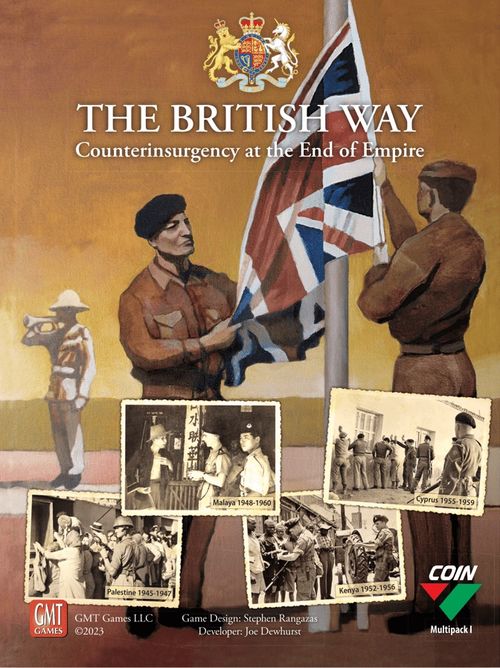
The British Way: Counterinsurgency at the End of Empire
The British Way: Counterinsurgency at the End of Empire — Campaign Booklet
Table of Contents
Table of Contents
- Introduction
- End of Empire Campaign
- Campaign Event Notes
- Pre-War Options Tables Notes
- A British Way?
- The Firm Smack of Government
- Thugs, Bandits, and Gangsters
- Reaching the Wind of Change
- Designer Notes
- Developer Notes
- Bibliography
- Counter Manifest
- Quickstart Guide
Introduction
The British Way is a multipack of four two-player COIN games that strive to depict Britain's attempts to "manage" the emergencies, as the British referred to them, in their colonies during the period of decolonization that swept the world after WWII. The historical simulations that comprise The British Way multipack are designed to depict the full range of strategies used by the British during these conflicts, ranging from the more benevolent but still coercive provision of material benefits through pacification programs to the horrific measures used to gain control over the local population. Although many myths have arisen about an enlightened British approach to counterinsurgency that avoids large-scale violence and focuses on winning the population's 'hearts and minds', new scholarship on these conflicts have confirmed the brutality of the methods commonly used. This volume is intended to help synthesize and present this crucial scholarship, even if the simulations depicted are at times more unpleasant than fun. The main goal is that players find these thought-provoking and the gameplay encourages them to seek out the included discussion of sources and historical background material.
This booklet also includes rules for a linked End of Empire campaign that allows you to play each game in historical sequence, with additional Campaign Events that impact gameplay and, along with the outcome of the games, determine the outcome of British decolonization between 1945 and 1960. The campaign rules also include a Pre-War Options Table for each game, which can be used to determine a variable setup for both campaign and regular play.
Component Manifest
A complete set of The British Way includes:
- Two 17"x22" mounted game boards, each double-sided.
- Four decks of 35 Event cards.
- Two decks of 9 End of Empire Campaign Event cards.
- 15 blue cubes, 15 tan cubes, 15 red embossed octagonal cylinders, 5 flat red discs, 4 embossed cylinders (two red, two blue).
- Three black and five white pawns.
- One counter sheet.
- Eleven player aid sheets.
- Two six-sided dice (one red, one blue).
- Four rules booklets.
- This campaign and background booklet.
The Rules of Play booklet for each game in the multipack includes a list of which components you should use when playing that game.
End of Empire Campaign
The End of Empire Campaign allows players to connect the four games included in the multipack into a linked campaign. The campaign also allows players to explore the broader history of the British experience of decolonization between 1945-1960. Players will play each of the four games sequentially in historical order (Palestine, Malaya, Kenya, and Cyprus). Additional rules include a campaign scoring system, the ability for the British player to set a colonial policy during each game, and campaign event cards depicting broader influences and impacts of decolonization in the British Empire. Players are recommended to also use the Pre-War Option Tables while setting up each game, but are not required to do so, and these tables may also be used outside of campaign play.
DESIGN NOTE: Although some effort was made to make the campaign roughly balanced, it is included mainly as an additional narrative framework rather than a finely tuned competitive experience, due to the additional randomness from the Campaign Events and Pre-War Options Tables (if used).
Campaign Factions. One player will play as the British Faction in each of the four games. The other player (referred to as the 'Insurgent') will play as the Faction opposing the British in each of the four games (Irgun, MCP, Mau Mau, EOKA).
1.0 Campaign Components
The components listed here will be used throughout the campaign, in addition to the components required for each game:
- The End of Empire player aid display.
- Additional markers from the counter sheet: 1x Imperial Prestige, 1x Colonial Policy, 9x Exit/Scuttle, 9x Influence/Surrender.
- Two decks of End of Empire Campaign Event cards: 9 Early Period and 9 Late Period.
2.0 Campaign Setup
Set up the campaign as follows:
2.1 Deck Preparation
Shuffle each of the Campaign Event decks separately to form one deck of nine Early Period cards and one deck of nine Late Period cards. Once players finish playing Malaya, any remaining Early Period cards should be set aside.
2.2 Display Preparation
Set the End of Empire display within easy view of each player. Place the Imperial Prestige marker on the '13' space of the Imperial Prestige Track, and the Colonial Policy marker in the 'Stay the Course' box.
2.3 Game Setup
Set up Palestine as normal, first rolling on the Pre-War Options Table (5.0, if desired) and implementing the result, then draw and resolve a Campaign Event (4.0) before beginning play. Once Palestine is finished and any adjustments to Imperial Prestige (3.0) have been made, return the Colonial Policy counter to 'Stay the Course' and set up for Malaya as above. Repeat the same process for Kenya and then Cyprus to complete the campaign.
3.0 Imperial Prestige and Colonial Policy
Imperial Prestige is measured across the campaign on the numbered track on the End of Empire display. Imperial Prestige may never go below 0 or above 15. It is affected by the outcome of each game (3.2), depending on the current Colonial Policy (3.1). The position of the Imperial Prestige marker at the end of the campaign (after Cyprus is finished) determines the outcome of the campaign (3.3).
3.1 Colonial Policy
The British player is able to set a Colonial Policy in each game that allows them to mitigate their failures or capitalize on their successes—if they choose the correct policy. Colonial Policy begins each game at 'Stay the Course', and then at the end of the first Propaganda Round (before drawing a Campaign Event) the British player must choose to either leave it there, or change it to 'Stand Firm' or 'Concessions'. Once this decision is made the Colonial Policy may not change again for the duration of the game, and will be reset to 'Stay the Course' before the next game begins.
NOTE: The British player should be careful when selecting Colonial Policy, since they must make an estimate of the final outcome of the game based only on the result of the first Propaganda Round. If they choose poorly, they may exacerbate the impact of a defeat or fail to take advantage of a victory. The 'Concessions' Policy is generally a safer bet, but it is extremely difficult to achieve the best British campaign outcome by choosing this Policy for every game.
3.2 Game Outcomes
Each campaign game will have one of four outcomes: Influence (major British victory), Exit (minor British victory), Scuttle (minor Insurgent victory), or Surrender (major Insurgent victory). The outcome is determined slightly differently depending on the game.
For Palestine and Cyprus:
- Influence if the game ends with Political Will 6 or higher.
- Exit if the game ends with Political Will between 1 and 5.
- Scuttle if the game ends with Political Will on 0 during the final Victory phase (third Propaganda Round).
- Surrender if the game ends with Political Will on 0 during the first or second Victory phases (an early victory in the first or second Propaganda Round).
For Malaya and Kenya:
- Influence if the game ends with Political Will 18 or higher (including an early victory in the first or second Propaganda Round).
- Exit if the game ends with Political Will between 10 and 17.
- Scuttle if the game ends with Political Will between 3 and 9.
- Surrender if the game ends with Political Will 2 or lower (including an early victory in the first or second Propaganda Round).
The outcome of each game can be tracked on the End of Empire display with a matching counter placed on the country box corresponding to that game. The effect of each outcome on Imperial Prestige will depend on the current Colonial Policy when the game ends, as indicated below.
Stand Firm
- Influence: +2 Imperial Prestige
- Exit: +1 Imperial Prestige
- Scuttle: –3 Imperial Prestige
- Surrender: –5 Imperial Prestige
Stay the Course
- Influence: +1 Imperial Prestige
- Exit: +0 Imperial Prestige
- Scuttle: –2 Imperial Prestige
- Surrender: –4 Imperial Prestige
Concessions
- Influence: +0 Imperial Prestige
- Exit: –1 Imperial Prestige
- Scuttle: –1 Imperial Prestige
- Surrender: –3 Imperial Prestige
Apply any Imperial Prestige adjustment once the winner of each game is determined, then set up for the next game (2.3).
3.3 Campaign Outcome. The final position of the Imperial Prestige marker after Cyprus is complete will determine the campaign outcome—there is no instant loss or victory possible before the end of the campaign. Players should continue until the end of the Cyprus game and then check for the outcome of their campaign below.
- Imperial Prestige 11-15: Colonial Retrenchment. Britain continues to 'stand firm' on empire and fights to control how they will leave their remaining colonies. The withdrawal from the empire is celebrated back in Britain as a triumph, with lasting British influence in former colonies.
- Imperial Prestige 5-10: Wind of Change (Historical). Britain stands aside from challenging independence in the remaining British colonies in Africa. The memory in Britain of the withdrawal from the empire will be contested in the decades ahead.
- Imperial Prestige 0-4: Colonial Flight. Britain rapidly abandons its remaining colonies, having lost any influence in the former colonies where they fought against independence. The withdrawal from the empire is highly criticized in Britain as chaotic and violent.
Colonial Retrenchment and Colonial Flight are clear wins or losses for the British player respectively. Players may discuss whether a Wind of Change outcome represents a draw or a minor British victory depending on how their campaign progressed (the campaign map might provide some clues).
4.0 Campaign Events
Campaign Events add variability to the campaign while also modeling the broader flow of decolonization outside of each individual conflict.
4.1 Event Periods
There are two Campaign Event decks, Early Period and Late Period, which should be shuffled separately during campaign setup (2.1). The Early Period deck is used during Palestine and Malaya, and the Late Period deck is used during Kenya and Cyprus.
4.2 Drawing Campaign Events
One Campaign Event should be drawn from the appropriate Period deck at the start of the game (after rolling on the Pre-War Options Table, if desired) and resolved before play begins (2.3). A second Campaign Event should be drawn and resolved after the first Reset phase (after the British player has selected a Colonial Policy, 3.1), and a third Campaign Event should be drawn and resolved after the second Reset phase. Each Campaign Event should be removed from the campaign after it is resolved.
4.3 Campaign Event Effects
Implement the effects of each Campaign Event immediately when it is drawn, including any adjustments to the current game state or to Imperial Prestige. If a Campaign Event raises or lowers Imperial Prestige, you may indicate this by placing an Exit or Scuttle marker on the End of Empire display in the corresponding named box. Some Campaign Events have variable effects depending on which game is being played—only implement the text corresponding to that game. Some Campaign Events have an ongoing effect until the next Propaganda Round—place the card next to the game board as a reminder, then remove it from play during the next Reset phase. Some Campaign Events give the British player an option to place Troops on the card to potentially mitigate its effects—these Troops remain out of play until the next Reset phase, when they are returned to the board as indicated on each card.
5.0 Pre-War Options Tables
The Pre-War Options Tables allow for alternative historical setups that explore counterfactual possibilities and add some variability to the start of each game. They are recommended (but not required) for use during campaign games (2.3), and may also be used in standalone games. One player should roll on the appropriate table before setting up the game and implement the result during setup, or alternatively both players can agree to select one option without rolling in order to explore a particular counterfactual situation.
NOTE: Some results put an Event Capability into play at the start of the game, so you should roll on the table and implement the result before constructing the game's Event Deck.
Each Pre-War Options Table is centered around a core issue in the run up to each Emergency. The '2' and '5' results of each table represent slight variations from the historical situation (the '3-4' result), favoring the British or Insurgent player respectively. The '1' and '6' results on each table represent more major historical divergences, with mixed effects that favor neither player. The Pre-War Options Tables can be found on the reverse of the End of Empire display and are also repeated here for convenience during campaign play.
5.1 Jewish Agency (Palestine)
- Jewish Agency Rejects United Resistance Movement: Haganah Track starts at Support (3)—place one Base and two Cells from Available on the Track. British Political Will starts at 16.
- Pre-emptive British Crackdown: After setup, British remove a Cell in one City to Prison and place a Curfew there. 3-4. United Resistance Movement Forms (Historical): No change.
- Coordination Against Railways: After setup, Irgun places two Cells from Available on any Railways.
- Irgun-Haganah Alliance: The shaded PALMACH (P13) Capability begins in play. Irgun may not use the Terror Special Activity while the Haganah Track is at Support (3) or Coordinate (4).
5.2 Labor Unrest (Malaya)
- Planters Demand Suppression: After setup, replace one Guerrilla in each of Johore and Perak with a Terror marker. Political Will starts at 10 and MCP Resources starts at 8.
- Gent Requests Reinforcements: Place four additional Troops in Kuala Lumpur during setup. 3-4. Planters Murdered, Emergency Declared (Historical): No change.
- MCP Organizes Labor Strikes: Place a Guerrilla in each Economic Center during setup.
- British Overlook MCP Threat: Political Will starts at 14 and MCP begins the game as 1st Eligible.
5.3 Nairobi Repression (Kenya)
- British Repress Militants: Pipeline Track starts at Villagization (2) and Political Will starts at 13. After setup, remove all Mau Mau pieces from Nairobi to Available and set it to Resistance.
- King's African Rifles Arrive: Place four additional Troops in Nairobi during setup. 3-4. Operation Jock Scott (Historical): No change.
- Urban Oathing Spreads: During setup, place an additional Guerrilla in Nairobi and set it to Resistance.
- Mau Mau Networks Undetected: The shaded PASSIVE WING (K3) Capability begins in play. Political Will starts at 14.
5.4 EOKA Preparations (Cyprus)
- Navy Patrols Increase: The unshaded ROYAL NAVY (C9) capability begins in play. International Opinion Track starts at Criticized (3).
- Makarios Opposes Guerrilla Tactics: After setup, remove the Cell in Troodos Mountains to Available and EOKA must move the Arms Cache there to any Town with a Cell. 3-4. Agios Georgios Seized (Historical): No change.
- Riots Break Out: After setup, place an Active Cell and a Sabotage marker in one random Town (roll a die to determine which).
- Agios Georgios Barely Escapes: During setup, place a Cell and an Arms Cache in Kyrenia Mountains, and British draw 2 Intel Chits.
Campaign Event Notes
Some Campaign Events have effects that will remain in play until the next Propaganda Round. Place any active Campaign Event card next to the board as a reminder, then remove it when indicated on the card.
Some Campaign Events give the British player an option to place Troops on the Event card in order to mitigate its effects. Any Troops placed on a Campaign Event card will be returned to the board at the next Reset phase, as indicated on the card. Keep the card with any Troops on it next to the board until the next Reset phase.
There are many useful books for understanding the decolonization of the British empire after World War II. One book that focuses specifically on the period covered by the End of Empire campaign (1945-1960) is Imperial Endgame by Benjamin Grob-Fitzgibbon. I also highly recommend Martin Thomas' Fight or Flight. His book offers a comparative history of the British and French retreat from empire in the post-war period, allowing for comparisons between The British Way and Colonial Twilight (COIN Series Volume VII).
E1. Partition
Mass migration and violence: Reduce Imperial Prestige by 3. British may place up to 4 Troops on this card to lower the loss of Imperial Prestige by 1 per 2 Troops placed. Return Troops on this card to any City at the next Reset phase.
Tips: Troops placed on the card may come from anywhere on the board, including Available. Imperial Prestige is reduced by 1 if 4 Troops are placed on the card, by 2 if 2 Troops are placed, and by 3 if 0 Troops are placed. Placing odd numbers of Troops on the card has no additional benefit for the British player. Any Troops placed on the card will be returned to one City of the British player's choice (or Kuala Lumpur if playing Malaya) during the next Reset Phase.
Background: The partition of India in 1947 resulted in mass population movements. The population movements were often characterized by intercommunal violence and forced displacement. The Punjab region experienced particularly high levels of displacement and violence with an estimated twelve million displaced there alone. More effective security force protection and a less hasty division of the two countries would have likely mitigated, but not totally prevented, the crisis.
E2. Burma
Chaotic transition: British may place up to 3 Troops on this card, then must roll a die. If the result is less than or equal to Troops on this card, increase Imperial Prestige by 1. Otherwise, reduce Imperial Prestige by 2. Return Troops on this card to any City at the next Reset phase.
Tips: Troops placed on the card may come from anywhere on the board, including Available. Any Troops placed on the card will be returned to one City of the British player's choice (or Kuala Lumpur if playing Malaya) during the next Reset phase.
Background: As with Britain's exit from India and Palestine, the exit from Burma was far from orderly. Civil war was looming by the time of the independence declaration in January 1948. The post-war Labour government hoped to hand over power to an independent state friendly to Britain; however, the Burmese independence movement was divided with many independence leaders, including Aung San, being assassinated. Civil war would break out a few months after independence, between the new Burmese government and the Communist Party of Burma (CPB).
E3. Gold Coast
Protests and unrest: British may either reduce Imperial Prestige by 1, or place 2 Troops on this card and roll a die. If the result is 1-4, increase Imperial Prestige by 1. If the result is 5-6, reduce Imperial Prestige by 2. Return Troops on this card to any City at the next Reset phase.
Tips: Troops placed on the card may come from anywhere on the board, including Available. Any Troops placed on the card will be returned to one City of the British player's choice (or Kuala Lumpur if playing Malaya) during the next Reset phase.
Background: In the late 1940s, a rising Ghanaian nationalist movement led by Kwame Nkrumah was pushing for the independence of the Gold Coast colony. The failure of the cocoa crop, the colony's main export, added to the rising pressure for change. In February 1948, major demonstrations in Accra were met with repression as police fired on the crowd. News of the shooting led to riots in Accra and other towns. Following continued activism, the Gold Coast became independent Ghana in 1957.
E4. Cold War Crisis!
Strategic value of bases (Palestine): Increase Political Will by 2 and Imperial Prestige by 1.
Contain communism (Malaya): If British Resource at 20, increase Imperial Prestige by 1, otherwise set British Resources to 20.
Tips: Execute the top option if playing Palestine and the bottom option if playing Malaya.
Background: The British government used the Cold War to justify the need for preserving colonies as strategic bases in regions such as the Middle East. Early on in several of the emergencies, British officials had a tendency to exaggerate the role of communism, despite the ideology being significantly present only in Malaya. Likewise, only in Malaya did their opponent pursue a Maoist strategy of insurrection. None of the insurgent groups covered in The British Way received significant external assistance, and certainly not from the Soviet Union. The two groups that did receive external assistance, Irgun and EOKA, received aid from America and Greece respectively, fellow NATO allies. The political emphasis on a looming threat from communist groups could also distract British officials from more pressing threats from nationalist groups. In Cyprus, British forces cracked down on the communist party AKEL, rather than focusing their efforts against the larger threat from EOKA.
E5. "Gangsters, Thugs, and Bandits"
Delegitimize opponent:
- If Palestine, British may Search in 1 space then Mass Detention there, then Irgun may Rob in 1 space.
- If Malaya, British may Reprisal in 1 space, then MCP may Extort in 2 spaces.
Tips: Execute only the relevant event text for the game you are playing. If the British player chooses to Search in Palestine they must also perform Mass Detention in that space if possible, but must meet all the usual requirements for doing so. The Irgun or MCP player may execute their part of the relevant event text regardless of what the British player chooses to do.
Background: British colonial governments repeatedly refused to acknowledge that the insurgents they faced had legitimate political grievances. By labeling their opponents as "gangsters, thugs, bandits, or terrorists", British officials hoped to delegitimize the armed opposition by equating them with criminals and fringe elements devoid of popular support. This delegitimization was also intended to justify the harsh measures used against those supporting the insurgency, by treating them as criminals rather than enemy combatants. At times, insurgent activities seemingly vindicated the British framing by relying on criminal activity to raise funds.
E6. Dirty War
Extralegal violence: British may reduce Imperial Prestige by 1 to remove up to 3 Cells or Guerrillas to Available from spaces with more British pieces than enemy (if Malaya, place a Terror marker in each selected space).
Tips: British may remove up to three pieces total if they choose to reduce Political Will, not three per selected space (although the three pieces could all come from the same space). If playing Malaya, British add a Terror marker to any space that pieces are removed from.
Background: The sweeping emergency regulations granted at the start of each of the conflicts legalized many repressive measures. British officials were able to use collective punishments such as fines, house burnings, curfews, resettlement, and deportation within the confines of the law. In all of the conflicts, instances of extralegal violence outside of the law were also committed. These included massacres, shooting prisoners 'trying to escape', abuses by pseudo-gangs and other irregular forces, and the use of torture during interrogations. Although the use of extralegal violence was often not systematic or explicitly condoned, the frequent refusal to seriously investigate and punish isolated incidents created an environment where such excesses could easily occur.
E7. War Exhaustion
Resources stretched thin:
- If Palestine, British may only select up to 2 spaces for Operations until next Reset phase.
- If Malaya, British must place a Sabotage marker on 1 of the Economic Centers.
Tips: Execute only the relevant event text for the game you are playing. If playing Palestine, the British player could still spend an Intel Chit to perform an Operation in an additional space (up to 2 spaces if the Operation is Limited, or up to 3 spaces if not). If Palestine and the shaded Capability from ERNEST BEVIN (P9) is in play, then this event will have no further effect.
Background: Britain faced a difficult economic situation at the end of WWII. These difficulties were made harder when President Truman ended the lend lease agreements, requiring Britain to seek American loans, a situation deemed a "financial Dunkirk" by the prominent economist John Maynard Keynes. Just as the war ended, Clement Attlee's newly elected Labour government faced widespread and costly strategic commitments and crises in Greece and Palestine. The British colonies that had been occupied during World War II, such as Malaya, dealt not only with economic recovery, but also the reassertion of colonial authority and administration that had collapsed during the war. The returning colonial government in Malaya faced labor unrest, food shortages, and epidemics.
E8. United Nations
General Assembly meets: During the next Political Will Phase:
- If Palestine, reduce Imperial Prestige by 1 if more than 1 Curfew is on the map.
- If Malaya, reduce Imperial Prestige by 1 if more Population at Opposition than at Support.
Tips: Keep this card by the board until the next Political Will phase, then execute only the relevant event text for the game you are playing. Implement the effect before checking to see if anyone has won the game.
Background: With the consolidation of the newly formed United Nations in the late 1940s, Britain faced increasing pressure to advance decolonization, and close scrutiny over the conduct of its counterinsurgency campaigns. The United Nations brought significant attention to the British exit from Palestine, and the repeated attempts by the Greek government to raise the question of Cyprus at the General Assembly also brought attention to British conduct in Cyprus. Although their campaign in Malaya received far less international attention than Palestine or Cyprus, a counterinsurgency campaign perceived to be waged against widespread popular support would have likely received condemnation at the UN, had it been discussed there.
E9. Special Relationship
American influence:
- If Palestine, Irgun Propagandize lowers Political Will by 2 per selected space until next Reset.
- If Malaya, during the next Support phase, each shift or Terror marker removed costs 0 Resources for the British.
Tips: Execute only the relevant event text for the game you are playing. If Palestine and the shaded Capability from MENACHEM BEGIN (P25) is in play, then this event will have no further effect.
Background: Despite being allies during World War II and the Cold War, the United States' relationship with Britain varied considerably across the process of decolonization. In some cases, US presidents pressured the British government to make concessions, leveraging Britain's dependence on American loans after WWII, while in other cases they supported British counterinsurgency campaigns as noble struggles against communism, with lessons to be learned and utilized elsewhere. Finally, in other conflicts such as Kenya, the United States attempted to remain neutral or showed complete indifference.
E10. Nyasaland
Emergency declared: British may either reduce Imperial Prestige by 1 or place 2 Troops on this card and roll a die. If the result is 1-4, increase Imperial Prestige by 1. If the result is 5-6, reduce Imperial Prestige by 2. Return Troops on this card to Nairobi or any British Base at the next Reset phase.
Tips: Troops placed on the card may come from anywhere on the board, including Available. Any Troops placed on the card will be returned to Nairobi (if Kenya) or any British Base (if Cyprus) during the next Reset phase.
Background: In 1959, rising nationalist mobilization against British and white settler rule led to a declaration of Emergency in Nyasaland. As with similar Emergency declarations in Kenya, Malaya, and Cyprus, the colonial government carried out mass arrests. Those arrested included key nationalist leaders such as Hastings Banda. Rather than deterring resistance, the arrests led to widespread protests. British reinforcements sent to manage the protests, including elements of the King's African Rifles, fired on protesters, killing twenty. The news of the killings in Nyasaland arrived simultaneously with news of eleven prisoners being beaten to death at the Hola Detention camp holding Mau Mau prisoners in Kenya. An inquiry led by Sir Patrick Delvin condemned the repression, adding further disgrace for the Macmillan government. In 1964, Nyasaland achieved independence from Britain as the new nation of Malawi, with Hastings Banda as its first Prime Minister.
E11. Canal Zone
Low-level violence: British may either reduce Imperial Prestige by 2, or may permanently remove 2 Troops from the current game and reduce Imperial Prestige by 1.
Tips: Troops removed from the game may come from anywhere on the board, including Available. Place removed Troops back in the game box to indicate that they are currently unavailable to the British player, then return them to play when setting up the next campaign game.
Background: The 1936 Anglo-Egyptian treaty gave Britain basing rights in the Canal Zone. The limitation on the number of their troops in the Canal Zone was significantly exceeded during World War II, and this continued after the end of the war. Low level attacks were committed against British forces stationed there until their withdrawal was negotiated in 1954 and completed in early 1956.
E12. Operation Musketeer
Last gamble: British may either reduce Imperial Prestige by 1 or both players must roll a die. If the British result is greater, increase Imperial Prestige by 2. Otherwise, reduce Imperial Prestige by the difference between the results.
Tips: If the result on both die rolls is equal then Imperial Prestige would be reduced by 0, otherwise it is either increased by 2 if the British die roll is higher, or reduced by the difference if the British die roll is lower.
Background: Operation Musketeer, conducted during the Suez Crisis, was a rapid British military intervention, with French and Israeli assistance, attempting to regain control of the Suez Canal and remove the Egyptian President Gamal Abdel Nasser. Although the operation was an initial military success, the whole affair became a humiliating defeat when Soviet and US pressure brought an abrupt halt to the fighting. The British government had hoped the operation would reverse setbacks in the Middle East, but the defeat resulted in Prime Minister Anthony Eden's resignation and a major loss of prestige for Britain's standing as a great power.
E13. Local Civil War
Kikuyu civil war (Kenya): British may place 1 Police each from Out of Play into 2 spaces with British Control and Guerrillas.
Intercommunal riots (Cyprus): EOKA may place a Sabotage marker in 1 space with Cells and Police.
Tips: Execute the top option if playing Kenya and the bottom option if playing Cyprus. If playing Kenya, British are limited to placing Police from Out of Play, so may only be able to place 1 or 0 Police.
Background: A significant number of police were recruited from local populations during nearly all of Britain's counterinsurgency campaigns. In several cases, due to intimidation by the insurgents, the local police were recruited from another ethnic group less beholden to insurgent pressure, such as Malay police against the largely Chinese MCP and Turkish police against the Greek EOKA. Although the expansion of local police became a force multiplier, their use could increase ethnic tensions and violence between two communities. Even when recruited from among the same ethnic community, such as Kikuyu Home Guard in Kenya, the use of local police could intensify historic disputes, leading to a civil war alongside the nationalist struggle against British rule.
E14. Lessons Learned
Success inspires others: If previous game resulted in Influence or Exit, British may conduct 2 free Limited Operations, then the Insurgent faction may conduct 1 free Limited Operation; if the previous game resulted in Scuttle or Surrender, then reverse the effect.
Tips: If playing Kenya, then Malaya was the previous game; if playing Cyprus, then Kenya was the previous game. If the result of the previous game was Scuttle or Surrender, the Insurgent Faction may conduct 2 free Limited Operations, then the British may conduct 1 free Limited Operation.
Background: British officials attempted to transpose lessons from one counterinsurgency campaign to the next, though often with limited success. Debates occurred between British commanders about whether the lessons of the previous Arab Revolt (1936-39) in Palestine could be applied against the Jewish insurgency (1945-1947), sometimes without acknowledging the very different nature of the two conflicts. The use of forced population relocation in Malaya was repeated in Kenya, though with significantly less success in the latter case. The same tactic was rejected during the Cyprus Emergency due to the greater international scrutiny of the conflict. British units also served in multiple counterinsurgency campaigns, such as the King's African Rifles (KAR) in Malaya (depicted in the card image) and Kenya. Insurgent leaders could also learn from previous campaigns, with Irgun's success against the British in Palestine inspiring Grivas' strategy for EOKA in Cyprus.
E15. Operation Legacy
Atrocity documents destroyed:
- If Kenya, no Outrage rolls until next Reset phase.
- If Cyprus, only lower Political Will by half the International Opinion Track value (round down) during the next Political Will phase.
Tips: If playing Kenya, Outrage rolls triggered for any reason would be ignored, including Resettle, Reprisal, and some event effects.
Background: Operation Legacy was the eventual name for a program managing sensitive documents in British colonies, by either destroying them or moving them to secret archives (which were only subsequently released in the 2010s). Although the earliest use of the name 'Operation Legacy' is from 1961, the policy occurred throughout the period covered in the campaign scenario. Documents were removed that might embarrass Britain or reveal local collaborators. Operation Legacy allowed colonial administrators to shape the historical memory of the end of British rule in their respective colonies.
E16. Human Rights Convention
Condemns repression: During the next Political Will phase:
- If Kenya, reduce Imperial Prestige by 1 if the Pipeline value is greater than 2.
- If Cyprus, reduce Imperial Prestige by 1 if there are more than 2 Curfews on the map.
Tips: Keep this card by the board until the next Political Will phase, then execute only the relevant event text for the game you are playing. Implement the effect before checking to see if anyone has won the game.
Background: The European Convention on Human Rights (ECHR) came into effect in 1953, but the expansion of human rights law in the post-WWII period did not significantly impact British counterinsurgency until the Cyprus campaign. With support from the Greek government, EOKA brought cases of counterinsurgent abuses under public scrutiny. The increased international attention to human rights made British officials wary of using repression in Cyprus, and EOKA made sure to broadcast any excesses committed by British forces. Although international human rights attention did not impact the Kenya campaign, domestic journalists and Labour MPs did attempt to publicize the atrocities committed as part of the widespread repression used to crush the Mau Mau insurgency.
E17. Conservative Party
Backbenchers pressure: During the next Political Will phase, after adjusting the Political Will Track:
- If Kenya, increase Imperial Prestige by 1 if Political Will is greater than 10.
- If Cyprus, increase Imperial Prestige by 1 if Political Will is greater than 5.
Tips: Keep this card by the board until the next Political Will phase, then execute only the relevant event text for the game you are playing. Implement the effect before checking to see if anyone has won the game, but after adjusting the Political Will Track.
Background: Many Labour MPs, such as Barbara Castle, actively advocated in favor of decolonization and investigated British abuses during counterinsurgency campaigns, and some Conservative MPs served a similar role in defense of the empire. However, even defenders of the empire within the Conservative party had their limits. One of the harshest critics of the massacre of prisoners at the Hola detention center in Kenya was the Conservative backbencher Enoch Powell, who delivered a major speech in Parliament condemning the violence, despite earning later notoriety for his anti-immigration "Rivers of Blood" speech.
E18. Movement for Colonial Freedom
Campaign against Empire: During the next Political Will phase, after adjusting the Political Will Track:
- If Kenya, reduce Imperial Prestige by 1 if Political Will is less than 10.
- If Cyprus, reduce Imperial Prestige by 1 if Political Will is less than 5.
Tips: Keep this card by the board until the next Political Will phase, then execute only the relevant event text for the game you are playing. Implement the effect before checking to see if anyone has won the game, but after adjusting the Political Will Track.
Background: The Movement for Colonial Freedom (MCF) was a social movement with the goal of promoting full independence for Britain's colonies. The movement sought to spread information against the preservation of the British empire through a wide range of mediums including meetings, debates, demonstrations, leaflets, and many more. In the 1950s, much of their focus concentrated on British abuses committed during the Kenya Emergency. The MCF had over 100 affiliated MPs and sought to put direct pressure on Parliament to advance the cause of decolonization.
Pre-War Options Tables Notes
Each Pre-War Options Table (5.0) is based on a major issue in the months leading up to the start of the conflict. The historical outcome is represented by the '3-4' result, while the other results represent plausible counterfactuals of how the conflict could have started differently. Options '1' and '6' on each table explore major deviations from the historical outcome, including a positive effect for both factions. Options '2' and '5' represent more minor deviations from the historical outcome and favor only one faction. If selecting options rather than rolling randomly, options '1' and '6' will give the start of the game a significantly different feel, while options '2' and '5' are useful for giving one side a minor boost to their starting position and could be used as a handicap.
Jewish Agency (Palestine)
With the conclusion of WWII and the election of a Labour government in Britain, the Jewish Agency had high hopes in the fall of 1945. The leaders of the Jewish Agency expected the new government under Clement Attlee to grant concessions, particularly on expanding Jewish immigration into Palestine. However, the new government instead focused on strengthening Britain's strategic position in the Middle East, and chose to maintain the limits on Jewish immigration. The decision historically drove the Jewish Agency to cooperate with the other more radical Jewish armed groups, Irgun and Lehi, to form the United Resistance Movement, an attempt to unify and coordinate the efforts of the three major resistance groups. Options 1 and 6 explore alternative possibilities in the fall of 1945. The Labour government might have granted enough minor concessions (in game terms, lowering Political Will) to keep the Jewish Agency from fully joining the United Resistance Movement (option 1). Alternatively, option 6 explores the possibility of the Jewish Agency's armed wing, Haganah, forming an even closer partnership with Irgun. This option allows Irgun to benefit from Palmach, Haganah's elite force, but such a close partnership would have only been possible if Irgun had agreed to limit its most extreme uses of violence (Terror).
Options 2 and 5 explore more minor deviations from the historical outcome of the United Resistance Movement forming. With better intelligence or a bit of luck, British forces might have been able to anticipate its formation and respond with crackdowns as represented in option 2. After the United Resistance Movement formed, the three groups coordinated sabotage attacks on the railway system, and option 5 explores the possibility that the groups moved to target the railways sooner, giving the Irgun faction a stronger starting position.
Labor Unrest (Malaya)
Although British forces and the Malayan Communist Party (MCP) cooperated against the Japanese occupation during WWII, they began to clash in the immediate post-war years. The MCP supported trade unions and strikes (Card M7), while the British colonial government attempted to repress them. In addition, due to the vacuum of power in the countryside caused by the occupation, low-level violence was rising from a variety of sources: criminals, labor militancy, and the MCP itself. The colonial government struggled to distinguish among these sources, which slowed their response to the MCP's clandestine organizing. On June 19, 1948, following the deaths of three plantation managers, a state of emergency was declared. The emergency declaration caught the MCP off guard—they had been hoping for more time to prepare for the insurgency. Option 1 represents greater British repression to placate planters after the MCP's attacks on plantations, with a corresponding cost to Political Will. The British would face additional demands of protection from planters throughout the conflict (Card M25). Option 6 explores the MCP's hopes that the British would continue to overlook them, giving the MCP faction the option to act first and shape the opening moves of the conflict, but increasing starting Political Will as the British underestimate the threat posed by the MCP.
Option 2 investigates the possibility that the British High Commissioner requests reinforcements to handle the rising labor unrest, giving the British more Troops at the start of the conflict. Option 5 explores the possibility that the emergency was declared in response to a major MCP-supported strike, rather than an attack on plantation managers.
Nairobi Repression (Kenya)
Many of the 'militant' nationalists who organized the Mau Mau resistance to the British were concentrated in the Eastlands section of Nairobi. In the years leading up to the emergency, criminal gangs and violence were increasing in the Eastlands and many of these violent entrepreneurs switched their skills over to armed insurrection in support of the militants. Militants focused on spreading support among the masses through oaths and isolating the more moderate nationalists of the Kenya African Union (KAU), such as Jomo Kenyatta (Card K2). After the killing of prominent loyalist Chief Waruhiu by Mau Mau fighters (Card K30), the colonial government declared a state of emergency and launched Operation Jock Scott, carrying out a wave of arrests in Nairobi. However, given the lack of reliable intelligence on militants, the British mainly arrested moderates, including Kenyatta. Many of the militants managed to flee to the mountain jungles of Aberdares and Mount Kenya to organize the armed struggle. The outcomes of options 1 and 6 represent major counterfactual alternatives to the historical Operation Jock Scott. Option 1 represents the possibility that the British forces' indiscriminate repression successfully targeted many of the militant nationalists, at the expense of alienating Kikuyu civilians in Nairobi. Option 6 represents the alternative extreme that the Mau Mau networks in Nairobi went completely undetected, giving the British a false sense of complacency (increased Political Will) but at the cost of a stronger Mau Mau supply network (shaded PASSIVE WING capability in play).
The more minor outcomes represented by options 2 and 5 give either faction a slightly stronger start. Option 2 represents the King's African Rifles being deployed earlier than they were historically, offering the British faction a more rapid response to the spreading Mau Mau insurgency. On the other hand, option 5 explores the possibility of a better entrenched Mau Mau organization in Nairobi, slowing the British clearing of the city, as they eventually managed to achieve historically with Operation Anvil (Card K1).
EOKA Preparations (Cyprus)
Prior to the emergency, EOKA's leader Grivas (Card C2) made several trips to Cyprus to scout the potential of the island for the formation of an armed group. Based on these visits, Grivas devised his strategy of wearing down British prestige through repeated sabotage attacks and arousing international opinion against Britain. To make this strategy possible, Grivas focused next on supplying the incipient organization with arms shipments from Greece. In January 1955, the Royal Navy intercepted a fishing boat, Agios Georgios, that was carrying arms and explosives for EOKA. The outcomes of options 1 and 6 represent major counterfactual alternatives to the Agios Georgios capture. Option 1 represents the British ramping up their earlier blockade of the island in response to the capture, even at the expense of angering international opinion. Option 6 represents the possibility that the boat manages to evade the Royal Navy, delivering additional supplies to EOKA at the start of the emergency.
Options 2 and 5 depict more minor deviations from the historical outcome. The major political leader of Enosis, Archbishop Makarios III (Card C1), opposed Grivas' strategy of adopting guerrilla warfare in the mountains and hoped that a limited campaign of sabotage would be enough to convince Britain to grant concessions. Option 2 represents the possibility that Makarios manages to better control Grivas in response to the capture of the Agios Georgios. Alternatively, there were many public demonstrations and riots in response to political events leading up to the start of the conflict, such as the rejection of the enosis issue at the United Nations. Option 5 represents greater disruptive demonstrations in response to the seizure of the Agios Georgios.
A British Way?
The British may have talked as though they believed that counter-insurgency was a popularity contest, and that the prize was the 'hearts and minds' of the people. That was good public relations. It helped to disguise the sometimes unpalatable reality from both the British public and the wider international community of what they were really doing on the ground. They were applying heavy-handed policies of coercion to secure control over the civil population. On balance, where they won they did so by being nasty, not nice, to the people.
~ David French, The British Way in Counter-Insurgency, 1945-1967
The phrase 'The British Way' is commonly used by scholars in a debate on whether British forces had a uniquely successful and enlightened approach to counterinsurgency in the post-World War II period, compared to the counterinsurgency experiences of other countries such as France and the US. In this article, I'll focus on this debate and then outline some of the comparative characteristics of the four counterinsurgency campaigns covered in the multipack.
A widely held view up until the recent wars in Iraq and Afghanistan was that the British military formulated an "ideal" set of counterinsurgency practices from their experiences in the campaigns following World War II (Palestine, Malaya, Kenya, and Cyprus). This view of a particular British "way" of counterinsurgency emphasized the focus on hearts and minds and the minimum use of force as the reason why Britain was more successful than other countries at counterinsurgency in the 20th century. Robert Thompson, a veteran of the Malaya campaign, consolidated the lessons of British counterinsurgency in Defeating Communist Insurgency: The Lessons of Malaya and Vietnam (1966). Defeating Communist Insurgency contains ideal principles extracted from the Malaya campaign, rather than a detailed history of the conflict. His text, alongside works by French scholar David Galula, had a major impact on Western theories of population-centric counterinsurgency. Thompson went on to serve as an advisor for the Ngo Dinh Diem regime in South Vietnam and again for the Nixon administration at the close of the Vietnam War. He contrasted ideal British counterinsurgency tactics with those being used by American forces in Vietnam.
Although the British counterinsurgency in Northern Ireland strained the belief in a benevolent 'British Way' of counterinsurgency, many continued to adopt this view into the early 21st century. In 2001, the British Ministry of Defense COIN manual stated "the experience of numerous small wars has provided the British army with a unique insight into this demanding form of conflict." This view was widely accepted by some scholars, and even by US officials trying desperately to formulate COIN practices after the 2003 invasion of Iraq resulted in a protracted insurgency. The first edition of the US Counterinsurgency Field Manual 3-24 (2007) depicts the Malayan conflict as being stalemated until police reforms occurred in 1952, while omitting any mention of coercive tactics contributing to the eventual British victory.
However, the view of a particularly British "way" of counterinsurgency is increasingly contested, with a new wave of scholars using a wider set of historical sources to question the earlier portrayal of ideal British counterinsurgency. This new wave of scholars (see the Bibliography for many examples) argues that coercion played a far larger role than previous accounts acknowledged, and that the British experience with counterinsurgency was not as unique or enlightened as has been claimed. Many of these works have explored new sources, including previously unreleased government records, documenting British coercive strategies omitted or inaccessible to previous scholarship. For instance, Karl Hack's newest (2021) work on the Malaya campaign demonstrates that British coercive tactics, such as the forced relocation of the local population through the Briggs Plan, played a major role in weakening the insurgency. Many of the coercive tactics that turned the campaign around occurred a few years prior to the 1952 police reforms depicted as essential in Counterinsurgency Field Manual 3-24. The later expansion of the police among Chinese squatter communities, the insurgency's key base, only occurred due to the heightened British control over those communities.
This new wave of scholarship provides a necessary corrective on the nature of the 'British Way' of counterinsurgency. The British Way multipack is designed to synthesize this scholarship and allow players to make their own comparisons about British counterinsurgency across the four conflicts. The role of coercion in British counterinsurgency, prominent in each multipack game, is covered in-depth in the second historical comparative article below. In the rest of this article I provide an overview of the British campaigns covered in the multipack. More detailed descriptions of specific aspects of each counterinsurgency campaign can be found in the "Event Tips and Background" section of each rulebook.
British Counterinsurgency, 1945-1960
Just as the Second World War was ending with Japan's surrender in September 1945, Britain faced its first postwar counterinsurgency campaign in Palestine. In the fall of 1945, Jewish resistance groups resumed operations after British officials announced continued limits on Jewish immigration. At the beginning of the resumed insurgency, the three main Jewish resistance movements, Haganah, Irgun, and Lehi, formed a loose alliance to coordinate their pressure on Britain. Unlike insurgencies seeking to control territory and conquer the state by direct force, the resistance groups in Palestine operated in clandestine cells that sought to humiliate the British government into making concessions on issues such as Jewish immigration. British counterinsurgency operations consisted of large-scale sweeps that screened thousands of people in a clumsy attempt to find hidden cells. Without better intelligence and expanded local police, British forces struggled to develop more effective tactics. Curfews were used to lock down the population during searches and coerce them into providing information; however, they produced few results and provided material for insurgent propaganda. In 1946, the alliance between Haganah, the largest of the Jewish resistance groups, and the other two groups fell apart due to controversial high fatality terrorist attacks by Irgun, such as the King David Hotel bombing, and the British response that ended up targeting Haganah more than the two smaller groups. By the fall of 1947, the continued ineffectiveness of British counterinsurgency and additional high-profile hits to British prestige resulted in the declaration of a British withdrawal from Palestine. Civil war and ethnic cleansing between Jewish and Arab communities broke out shortly after the declaration of British withdrawal. British forces chose not to intervene in the ensuing violence, and all were withdrawn by spring 1948.
While British counterinsurgency failed to halt sabotage and terrorist attacks in Palestine, labor unrest and violent attacks were rising in Malaya. Malaya had been occupied by Japan during World War II with the Malayan Communist Party (MCP) and British special forces working together to form resistance to the Japanese occupation. After World War II, the MCP and British colonial government began clashing over labor rights, with the former eventually beginning to prepare clandestinely for an insurgency in the countryside. The rising unrest led the colonial government to declare a state of emergency in June 1948. Unlike Irgun or Haganah in Palestine, the MCP sought, particularly early in the conflict, to follow the strategy used by Mao in China and Vietnamese communists in Indochina, of establishing a liberated area in the countryside. Early British counterinsurgency efforts in Malaya consisted of large-scale sweeps and collective punishments against communities perceived to be sympathetic to the MCP. These tactics prevented the MCP from forming a liberated area over large parts of the Malayan peninsula, but failed to halt MCP attacks or secure British control over the population primarily supporting the insurgency, the Chinese squatter communities. To address the continued MCP threat, British forces adopted a strategy of forced population concentration that relocated or regrouped over a million people into fortified villages known as 'New Villages'. Although conditions for the relocated population were initially poor and many resented the forced movement, the provision of benefits and services in New Villages increased over the course of the conflict. Increasingly cut off from the population and lacking any external support, the MCP retreated to the sparsely populated border with Thailand. In 1957 Malaya was granted independence, further undermining the political purpose of the MCP's insurgency. Small sporadic resistance continued until the emergency was declared over in 1960.
The British again used a strategy of forced population concentration in their next counterinsurgency campaign that began during the middle of the Malayan emergency. In October 1952, a state of emergency was declared in Kenya in response to rising violence attributed to militant nationalists, often referred to as 'Mau Mau'. The colonial government launched an immediate wave of arrests that ended up targeting more moderate nationalists, with many of the militants escaping to organize the insurgency in the mountainous jungles of Mount Kenya and Aberdares. Even though the Mau Mau insurgency received significant support from the Kikuyu population, they possessed few firearms, and the insurgency did not expand beyond central Kenya. Mau Mau attacks targeted isolated police outposts, settler farms, and loyalist Kikuyu communities. The British response combined kinetic operations against Mau Mau forces in the mountain jungles, population control measures such as forced relocation into protected villages and mass detention of Mau Mau supporters, and the elimination of the Mau Mau's supply networks in Nairobi. Although these combined measures inflicted widespread harm on the Kikuyu people and generated outrage back in Britain, they wore down the Mau Mau. In 1956, with the capture of one of the last Mau Mau leaders, Dedan Kimathi, British officials declared the campaign over. Following British counterinsurgency success, Britain granted Kenya independence in 1963 with power passing to one of the moderate nationalist leaders arrested at the start of the emergency, Jomo Kenyatta.
The final British counterinsurgency campaign of the immediate postwar period began as the campaigns in Malaya and Kenya had clearly turned in Britain's favor. Like the Jewish resistance groups in Palestine, the insurgent group in Cyprus, EOKA, did not seek to defeat British rule directly but instead sought to humiliate Britain internationally and wear them down to force concessions. EOKA sought to achieve enosis, the political union of Cyprus and Greece. The Cyprus Emergency began in late 1955 in response to a wave of EOKA attacks. EOKA operated primarily in clandestine cells, although small guerrilla groups were organized in the mountains to distract British forces. EOKA focused on conducting sabotage attacks, organizing demonstrations against British rule, and spreading propaganda that highlighted British atrocities. These tactics aimed to draw international attention to the enosis issue and secure a British retreat from Cyprus, as had happened in Palestine. British forces repeated many of the tactics used in Palestine, such as large-scale searches and the use of curfews. However, British forces were able to gradually collect greater intelligence on EOKA's cells and maintained police numbers by recruiting from the Turkish Cypriot minority. The later years of the conflict were characterized by sporadic but increasing ethnic tensions and violence between Greek and Turkish Cypriot communities. The Greek and Turkish governments helped Britain secure an end to the conflict that declared Cyprus independent but also granted British basing rights. Although EOKA's goal of enosis was blocked, British counterinsurgency in Cyprus was hardly a success. The solution to the conflict came more from external factors than the actual defeat of the insurgency, as had occurred in Kenya or Malaya.
Characteristics of British Counterinsurgency
British counterinsurgency tactics across the conflicts varied on four major characteristics: winning popular support, controlling the population, kinetic operations against insurgents, and intelligence gathering. Although British counterinsurgency is often associated with the first characteristic, winning popular support, measures to win the population's 'hearts and minds' were in fact relatively rare. As the historian David French (2011) argues, British economic exhaustion following WWII prohibited more expansive benefits provisions. Only Malaya experienced a widespread program of benefits provided to those relocated in New Villages to ameliorate the effects of relocation and win them over to Britain's side. The funding of the New Village program was partially due to the outbreak of the Korean War, which raised colonial Malaya's revenue during the critical years of the program. In Kenya, selective benefits were provided to 'loyalists' through the granting of land and positions; however, these often came at the expense of communities perceived to have links to the Mau Mau. In Palestine, few 'hearts and minds' policies were explored, and although a development program was established in Cyprus, most of the funds were to come from taxes on the Cypriot people.
Since attempts to win hearts and minds were rare, it is not surprising that British forces focused considerable effort on controlling the local population across the conflicts. Both Malaya and Kenya experienced massive population concentration strategies that forcibly relocated over a million people in each conflict into 'protected villages'. These efforts were primarily aimed at preventing connections between insurgents and the population. In addition, British forces often used selective benefits and punishments within the villages to coerce the relocated population into participating in their own 'protection' from the insurgency. The expansion of Chinese police in Malaya and Kikuyu Home Guard in Kenya occurred mostly after the populations were already firmly under British control in protected villages. In Cyprus and Palestine, where insurgents operated mostly in urban areas with small clandestine cells, the British relied on punitive curfews to facilitate the searching of communities and to pressure them to give up information on the insurgents. These temporary curfews proved far less effective than the more drastic population control measures used in Kenya and Malaya.
All four conflicts involved kinetic operations against insurgents. In all the conflicts, these operations struggled to produce results without reliable intelligence. As the table below notes, the intensity of clashes varied dramatically across the conflicts. In Cyprus and Palestine, small clandestine cells were better able to evade British sweeps while security forces remained exposed to surprise attacks as they guarded fixed positions. Security forces suffered greater casualties than insurgents, although many arrested insurgents are not reflected in these figures. In contrast, the insurgents suffered far heavier casualties in Malaya and Kenya. In larger clashes with security forces, the firepower advantage of counterinsurgents made a distinct difference, particularly in Kenya where the insurgency was lacking in firearms. Both conflicts involved significant Royal Air Force bombing, although the air strikes were also limited by reliable intelligence. Attempts at blind bombings of jungle areas produced few results.
| Campaign | Casualties (Security Forces) | Casualties (Insurgent) | Casualties (Civilian) | Outcome (Counterinsurgency) |
|---|---|---|---|---|
| Palestine (1945-1947) | 1,016 | 63 | 493 | Failure |
| Malaya (1948-1960) | 4,341 | 9,158 | 4,651 | Success |
| Kenya (1952-1956) | 1,166 | 10,000-20,000 | 25,000 | Success |
| Cyprus (1955-1959) | 944 | 90 | 823 | Mixed |
Casualty figures from French (2011), 133.
The success of kinetic operations relied on collecting reliable intelligence; however, at the beginning of each conflict, British forces were plagued by poor intelligence gathering. Police forces lacked local participation, and intimidation by insurgents limited further expansion. In Palestine, the intelligence problems were never resolved, with British forces struggling to ever launch focused operations against Irgun. Intelligence gathering improved in Malaya and Kenya through the expansion of the local police and the use of surrendered insurgents who provided intelligence and participated in 'pseudo-gangs' against their former allies. British intelligence gathering in Cyprus gradually improved as well, with much of the intelligence coming from interrogations, raising accusations of torture from EOKA. Greek Cypriot participation in the local police collapsed after intimidation and infiltration by EOKA, and recruiting from the Turkish Cypriot minority alleviated the issue to a degree, but also furthered ethnic tensions between the two communities. Ultimately, British forces faced a similar problem to many other counterinsurgency efforts: intelligence is needed for successful counterinsurgency, but is difficult to gather without counterinsurgent successes.
The following comparative articles focus on specific aspects of British counterinsurgency: the use of coercion, Britain's insurgent opponents, and the broader context of decolonization. I hope players will draw comparisons from their experiences across the four games to reach their own conclusions about whether there is a distinctive 'British Way' of counterinsurgency. I also encourage anyone seeking more information on how British counterinsurgency evolved over time to consult the sources in the Bibliography featured after these articles.
The Firm Smack of Government
[W]e had if I can use a cant phrase to "win the hearts and minds of the people." But how could we as strangers win the hearts and minds of the Kikuyu in opposition to their brothers and cousins who were in the forests? It was a vain hope, all the same in the end we did wear them down and wearing down is the proper word.
~ Sir Richard Turnbull, Chief Secretary in Kenya
British counterinsurgency between 1945 and 1960 involved several strategies that intentionally targeted civilians, to either coerce them to stop supporting the insurgency or to physically force them to stop. Civilians are critical to the success or failure of many insurgencies who rely on them for support, making civilian populations targets to be shaped and 'won' by both sides. Although insurgents and counterinsurgents alike may both utilize strategies to win the 'hearts and minds' of the civilian population, through the promise and provision of political reforms and material benefits, armed actors frequently intentionally target civilians with violence (or the threat of violence) to deter them from supporting the other side. Violence used in this manner is aiming to coerce the civilian population into altering its behavior. Coercive violence is used to communicate a threat of future violence if the behavior of the target does not change. For instance, when insurgents commit acts of terror, such as publicly executing a local government official, they are communicating to the local population the consequences of collaborating with the government. Violence can also be used in a brute force manner that physically prevents people from performing some activity, rather than pressuring them psychologically to change their behavior. British forces across the counterinsurgency campaigns in The British Way used both coercive and brute force measures against civilian populations to deny the insurgency their support.
However, intentional violence used for strategic purposes, even if unethical, does not capture all the civilian victimization conducted by British forces in their counterinsurgency campaigns, for two reasons. First, although many of the coercive and brute force measures involved significant violence, defined here as direct physical harm against persons or property, other measures consisted of non-violent collective punishments. Punitive curfews and searches were used to 'punish' uncooperative communities through the disruption of people's daily lives, even if these tactics did not utilize direct violence. Second, some of the violence in Britain's counterinsurgency campaigns was not intentional violence used for strategic purposes, but instead arbitrary violence committed by lower-level officers and soldiers in contravention of official policy. Violent excesses often occurred as a byproduct of broad 'emergency' measures that allowed the intentional targeting of civilians through collective punishments, with only vague limits on how far forces could (or should) take the measures. For instance, during the early years of the Malayan campaign, collective punishments such as house-burnings or deportations were permitted, while the killings of suspected civilians or insurgent prisoners were not.
Varieties of British Counterinsurgency Violence
British forces used collective punishments as a coercive measure to demonstrate to communities the costs of supporting the insurgency. Prior to World War II, collective punishments as a solution to unrest were a common practice in Britain's counterinsurgency campaigns and colonial wars. In Malaya and Kenya, collective punishments involved significant violence, including property destruction, deportation, and other forced population movements, and in some cases even summary executions. These tactics are grouped under the 'Reprisal' Special Activity in the Malaya and Kenya games. In contrast, in Cyprus and Palestine, collective punishments resulted in less direct harm to people or their property. However, the imposition of curfews, disruptive searches and screenings, and fines on communities were all forms of less violent collective punishments. The Curfew mechanics shared across the Cyprus and Palestine games are intended to cover these effects.
The collective punishments used in all four conflicts are coercive measures used by British forces; however, brute force measures were also used in Malaya and Kenya. The counterinsurgency strategy of population concentration seeks to directly sever the ties between the population and insurgency by forcibly relocating the population into tightly controlled fortified sites. Once within the fortified sites, or 'protected villages', civilians are commonly subjected to the use of punishments and rewards to encourage them to collaborate with counterinsurgents and prevent infiltration by insurgents. British colonial governments used population concentration on a massive scale in Malaya and Kenya. In Malaya over 500,000 people were concentrated into 'New Villages', with another 600,000 regrouped into fortified worksites. In Kenya, the villagization program targeted the Kikuyu population and ultimately relocated over 1,000,000 people, more than two-thirds of the entire Kikuyu population. The population concentration strategies were complemented by the mass detention, and in the case of Malaya, deportation, of civilians perceived to be hardline supporters. Nearly 50,000 Chinese squatters were deported over the course of the Malayan emergency, and low estimates of those detained in Kenya exceed 70,000. These measures are covered by the 'Resettle' Special Activity and the 'Relocate' Operation in Malaya and Kenya respectively. Unlike collective punishments, these strategies sought to entirely remove the possibility of supporting the insurgency from the local population.
An astute reader may have noticed the difference in severity and scope of civilian victimization in Kenya and Malaya compared to Palestine and Cyprus. The former two conflicts were conducted without significant international attention, although a few journalists and members of Parliament criticized British brutality in Kenya. Lack of international attention may explain part of the difference; however, another plausible explanation put forth is that the victims of British repression in Cyprus and Palestine were perceived by British officials to be European, necessitating greater restraint than towards non-European civilian supporters in Malaya and Kenya. Evidence documents that British propaganda utilized racists tropes to dehumanize the Mau Mau, in order to deflect criticism of the harsh methods used against the population in defeating the insurgency. However, the campaigns in Palestine and Cyprus were not free of controversial acts of violence. There is evidence of instances of extrajudicial killings by soldiers and mistreatment during interrogations, and these excesses likely occurred more frequently than British records indicate, although likely also less frequently than the wildest accusations made by Irgun and EOKA, who both made highlighting British atrocities a key part of their propaganda efforts.
Effectiveness of British Counterinsurgency Violence
Evidence from the four conflicts indicates the effectiveness of collective punishments was at best mixed and often counterproductive. In the early years of the conflicts in Malaya and Kenya, violent collective punishments paired with large-scale sweeps temporarily disrupted civilian support bases and forced larger insurgent groups to disperse; however, the measures did little to separate the population from the insurgency and fueled resentment toward British forces among the affected populations. Non-violent punishments, such as punitive curfews and searches in Palestine and Cyprus, may have been even less effective, with widespread evidence that they struggled to prevent connections between the insurgents and population while likely encouraging the population to sympathize with the insurgency. In addition, Irgun and EOKA used the curfews to discredit British rule internationally with effective propaganda campaigns. The commander of British forces during the latter half of the emergency in Cyprus, Sir Hugh Foot, nicely summarized the failure of these measures:
[I]n Palestine and again in Cyprus there was often a tendency to attempt to make up for lack of intelligence by using the sledgehammer—mass arrests, mass detentions, big cordons and searches and collective punishments. Such operations can do more harm than good and usually play into the hands of terrorists by alienating general opinion from the forces of authority.
However, not all British counterinsurgent violence backfired. Brute force measures, particularly the use of population concentration on a massive scale, is commonly cited as decisively contributing to the British forces ability to turn around the conflicts in Malaya and Kenya. Neither the MCP nor the Mau Mau had access to external support, making them heavily reliant on the local population for recruitment and supplies. Once British forces had placed most of the local population out of the insurgents' reach, by forcibly relocating them into tightly controlled sites, the insurgencies struggled to maintain themselves. Food became short in both conflicts, and attempts by desperate guerrillas to collect food from the British-controlled protected villages resulted in heavy casualties. The denial of supplies from the local population was complemented with aggressive military operations in remote areas to apply continual pressure on the insurgents. As indicated by the quote from Sir Richard Turnbull at the start of the article, these measures did not 'win' the support of the people but nevertheless succeeded by wearing down the insurgencies.
Even though the population concentration strategies were effective at weakening the insurgencies in Malaya and Kenya, they caused enormous harm to the local population. Civilians were forcibly relocated, with many losing much, if not all, of their property during the move. Benefits and services to make up for the losses from the move came only slowly, if at all. Civilians within the 'protected villages' found them to be highly coercive. As one inhabitant in Malaya noted, "Everybody was always under pressure as we were treated like prisoners with all our movement being watched". In Kenya, violence against inhabitants was common, with little oversight of locally recruited Home Guards who often abused the population they were assigned to 'protect'. Unfortunately, there is strong evidence that widespread civilian victimization contributed to British counterinsurgency success in Malaya and Kenya. This fact should lead those looking to discover 'successful' counterinsurgency tactics or principles from these cases to proceed with caution.
The success of British population concentration, particularly in Malaya, contributed to the adoption of similar strategies by other subsequent counterinsurgents. Two prominent cases are the use of a strategic hamlet program in South Vietnam under the Ngo Dinh Diem regime, featured in GMT's upcoming Sovereign of Discord, and the protected village program in Rhodesia. Although initially experiencing similar success to the British programs in Malaya and Kenya, both programs ultimately failed to weaken their insurgent opponents. There are several key factors that distinguished the counterinsurgency campaigns in Malaya and Kenya from those in South Vietnam and Rhodesia. First, the MCP and Mau Mau both lacked external support that could serve as a partial substitute for resources lost from population concentration. The lack of external support also prevented them from acquiring significant weapons to raise the cost of expanding and defending the concentrated population. In contrast, the insurgencies in Rhodesia and South Vietnam received significant external aid. Second, the MCP and Mau Mau both had narrow support bases even among the local population, meaning that the British only had to target relatively small numbers for population control. Although nearly a million people each relocated in Malaya and Kenya are massive figures in absolute terms, this pales in comparison to the potential support bases of the insurgencies in South Vietnam and Rhodesia. Population concentration strategies in South Vietnam and Rhodesia therefore struggled to keep pace with the rapid expansion of an insurgent support base in larger populations, while also fighting better supplied insurgents with sources of external aid.
Thugs, Bandits, and Gangsters
Far from accepting their enemies had genuine grievances and that their readiness to resort to violence was an expression of them, the British explained this otherwise inexplicable phenomenon by marginalizing and criminalizing their opponents. They were 'thugs', 'bandits', 'gangsters', or 'terrorists.'
~ David French, The British Way in Counter-Insurgency, 1945-1967
The conflicts included in The British Way represent decolonization struggles where the nationalist movement transformed into an insurgency seeking to force a British exit from empire. It is worth noting that not all decolonization struggles resulted in an armed conflict. Instead, many were led by nationalists using non-violent means, such as those used in the struggle for Indian independence featured in GMT's Gandhi (COIN Series Volume IX). In Palestine, Malaya, Kenya, and Cyprus, the nationalist struggles adopted violent tactics due to decisions made by their leaders, but also in response to British colonial policies. For instance, British repression of moderate nationalist leaders in Kenya helped open the way for more marginal militant leaders to rise to the forefront of the nationalist movement. British refusals to discuss the genuine political grievances of opposition movements also lowered the possibility of non-violent political solutions. In Palestine, Britain's postwar declarations against expanding Jewish immigration pushed the most moderate of the three Jewish resistance groups, Haganah, into an alliance with the two more violent groups, participating in a campaign to force concessions from Britain through violent attacks.
British officials' perceptions of their opponents as apolitical criminals or 'thugs, bandits, and gangsters' lacking political grievances continued throughout each conflict. Framing the armed opposition as apolitical criminals was used to justify harsh measures against insurgents and their civilian support bases, as discussed in the second comparative article above. Although many of the insurgencies covered in the multipack engaged in theft and intimidation as a means of collecting resources or preventing collaboration with British forces, the denial of their political grievances by British officials escalated their violent measures while delaying the possibility of a political solution. Each of the insurgencies are responsible for choosing to violently escalate their nationalist struggles, often adopting unethical tactics such as targeting civilians, but British colonial policy played a major role in shaping the tactics adopted by their nationalist opponents. Below I'll briefly outline the major characteristics of the four insurgencies covered in the multipack: the Irgun Zvai Leumi b'Eretz Israel or 'Irgun' (Palestine), the Malayan Communist Party or MCP (Malaya), the Mau Mau (Kenya), and the Ethniki Organosis Kyprion Agoniston or EOKA (Cyprus).
Britain's Insurgent Opponents
Although all four insurgencies sought to end British colonial rule, each had their own unique goals for what would follow Britain's exit. Their goals for the post-colonial period often faced local opposition from other political groups within each colony. In Palestine, Irgun sought to humiliate Britain by lowering its prestige and raising the costs of colonial rule to pave the way for an independent Jewish state. After contributing to Britain's decision to withdraw in the fall of 1947, civil war broke out between the Jewish resistance groups, including Irgun, and Arab groups, leading to ethnic violence between the two communities. Similarly, in Cyprus, although EOKA fought to end British rule, the group sought to achieve the goal of enosis shared by many Greek Cypriots, the political union of Cyprus and Greece. Enosis was opposed not only by Britain but also by the Turkish Cypriot community, backed by the Turkish government. The MCP and Mau Mau insurgencies, meanwhile, possessed narrow support bases and failed to form widespread movements. The MCP received most of its civilian support from Chinese squatters, and attempts to broaden their insurgency to Malay communities failed. The MCP's goal of a communist revolution did not allow them to circumvent the ethnic divides intensified by the Japanese occupation. The Mau Mau's support base did not spread to all of Kenya, but remained limited to Central Province communities of the Kikuyu, Embu, and Meru ethnic groups. Their violent struggle for independence also faced division within the Central Province communities. Many local leaders benefiting from British rule or seeking a slower transition sided with British forces. In summary, although there may be a temptation to view these conflicts as clear-cut struggles between nationalist movements with widespread support and British colonial forces, the reality was far messier, with insurgents' visions of the future generating local opponents who frequently assisted British counterinsurgency.
The organizational structures of the four insurgencies varied widely. Irgun and EOKA mostly operated as small clandestine cells in urban areas. Although Irgun mostly operated in major cities such as Tel Aviv or Jerusalem, many of their sabotage attacks in rural areas targeted railways. EOKA's cells carried out sabotage attacks in towns and against British bases. EOKA also possessed a rural strategy of forming guerrilla bands in Cyprus' mountain ranges to distract British forces and create a refuge for cells in the towns to flee to. In contrast, the MCP and Mau Mau formed more traditional rural-based insurgencies. The MCP and Mau Mau contested whole communities, and the sizes of their armed groups dwarfed the highly trained clandestine cells of Irgun and EOKA. Despite facing weapon shortages, the Mau Mau reached a strength of 20,000. At their peak, the MCP forces approached 8,000 and posed the greatest threat to British armed forces out of the four insurgencies. In comparison, at their peak, EOKA's operatives numbered only in the hundreds. One major difference between MCP and Mau Mau organizational structure was their level of centralization. The MCP, carrying over their experience from the Japanese occupation, possessed a highly centralized command structure. In contrast, the Mau Mau's armed wing, the Kenya Land and Freedom Army, was a decentralized force led by several commanders who operated largely independently of each other. As a consequence, the Mau Mau did not possess the MCP's ability to disseminate directives or concentrate forces.
Although the organizational structure of the insurgencies varied, they used many of the same tactics. All the insurgencies relied on the intentional targeting of civilians, although to varying degrees. Each group used selective terrorism, where an individual target is carefully selected for their collaboration with the British, communicating the costs of assisting British forces to the wider civilian base. The targets of selective terrorism included civilian officials and often members of the police. EOKA and Irgun succeeded in undermining the police through these measures, while in Malaya and Kenya the insurgents only partially succeeded. The British gained greater control of the rural insurgencies' support bases through their strategy of forced population concentration, allowing for the expansion of police recruitment among the Chinese and Kikuyu respectively. In addition to selective terrorism, several insurgent groups used indiscriminate terror to intimidate civilians or to coerce Britain into concessions. The former goal is represented by the Mau Mau's massacre of Kikuyu loyalists at Lari village to signal the consequences of loyalism to other communities. The latter goal of coercing Britain itself is characterized by Irgun's deadly bombings, such as the infamous King David Hotel bombing. Although indiscriminate terror achieved horrific damage on their targets, the political effects were more ambiguous. Mau Mau terror against loyalists drove many to further support British forces, sometimes carrying out reprisals against Mau Mau supporters. Irgun's terror attacks generated widespread condemnation and undermined their alliance with Haganah.
In addition to terrorism against civilians and police, insurgents launched direct attacks against the British colonial government and forces. Irgun and EOKA carried out many sabotage operations to raise the costs of British rule and bring international attention to their causes. Many of these attacks targeted infrastructure, such as railways or government buildings. The MCP also carried out sabotage operations to disrupt the production of Malaya's two major exports: tin and rubber. EOKA, Mau Mau, and MCP all carried out small attacks and ambushes against police forces and occasionally British regular troops. Although the Mau Mau were the largest insurgent force, they were also the least well equipped and faced severe arms shortages. The Mau Mau inflicted very few casualties on British military formations and instead focused on attacking loyalist communities or Home Guard units. Only the MCP possessed forces capable of forming larger units, though rarely greater than a company, and had sufficient arms to inflict deadly ambushes on British troops. EOKA inflicted a low level of casualties on British forces through roadside ambushes and bombings. Finally, Irgun rarely initiated direct clashes with British forces, but instead kidnapped several soldiers over the course of the conflict as part of their strategy to coerce Britain through terrorism.
Unlike other nationalist insurgencies, such as the Viet Minh in French Indochina or FLN in Algeria, who received extensive external support to arm and finance their insurgencies, the insurgent opponents of Britain received more modest external aid. Irgun and EOKA both received sporadic external aid: Irgun launched fundraising abroad, particularly in the United States, to help finance the movement, and EOKA received arms shipments smuggled into Cyprus from networks in Greece. Neither of the groups operated on these supply sources alone and mostly relied on acquiring supplies within Palestine and Cyprus, often by theft or robbery from the British. The MCP and Mau Mau did not receive external funding or arms, limiting their ability to grow and pose a threat comparable to the rural insurgencies challenging French colonial rule in Indochina or Algeria. The MCP did utilize the sparsely populated border with Thailand as a sanctuary; however, the insurgency became a marginal threat and struggled to challenge British rule once contained to this border area. The location of the Mau Mau revolt in Kenya's Central Province limited the insurgency's ability to receive any form of external aid. The lack of external aid, particularly to the Mau Mau and MCP, should raise questions about the applicability of lessons from Britain's counterinsurgency successes to other conflicts. Readers seeking to further understand how greater external support intensifies insurgent violence and increases the difficulty of counterinsurgency should seek out GMT's games on Algeria (Colonial Twilight, COIN Series Volume VII), Vietnam (Fire in the Lake, COIN Series Volume IV), or Afghanistan (A Distant Plain, COIN Series Volume III).
Outcomes and Inspirations
Of the four insurgencies, only Irgun's campaign against British rule can truly be said to have achieved their goals, and even in the case of Palestine, Irgun's success was only one of several factors that contributed to British withdrawal. EOKA survived British counterinsurgency and succeeded in humiliating Britain, but failed to achieve their stated goal of enosis. British counterinsurgency succeeded in crushing the MCP and Mau Mau, allowing Britain to control their exit from empire in each colony. Although arguably both groups contributed to the eventual declarations of independence, alternative non-violent paths to independence existed through more moderate political parties such as the Kenyan African Union (KAU), United Malays National Organisation (UMNO), and Malayan Chinese Association (MCA). In summary, the insurgencies facing Britain, while providing costly resistance, struggled to achieve decisive outcomes through violent means. Perhaps the greatest impact of these insurgencies was their influence on subsequent insurgent movements, particularly Irgun and EOKA's strategies of urban terrorism, which served to inspire urban guerrillas in Latin America during the 1960s and 1970s, such as the Tupamaros in Uruguay who studied the methods used by both groups against Britain. The memoirs of the leaders of Irgun and EOKA were studied by other insurgents, even in radically different contexts, such as Jonas Savimbi, the leader of UNITA, a rural insurgency in Angola. Savimbi cited studying the writings of Grivas, EOKA's leader, claiming to admire him for fighting "a protracted campaign in restricted terrain, with virtually no external aid, against a superior adversary". Even when particular insurgent strategies might not have been transferable, the example of spirited resistance by insurgent groups against the British could prove inspirational.
Reaching the Wind of Change
Historians have offered four main options for explaining the end of empire. These may be put in the form of a cricketing analogy. Either the British were bowled out (by nationalists and freedom-fighters), or they were run out (by imperial overstretch and economic constraints), or they retired hurt (because of a collapse of morale and 'failure of will'), or they were booed off the field (by international criticism and especially United Nations clamor).
~ Historian Ronald Hyam (2006)
By focusing on British counterinsurgency, The British Way primarily addresses the role of the first option outlined in Hyam's quote above: nationalists and freedom fighters. The End of Empire Campaign scenario and this comparative article are designed to give players greater context on the other three options that shaped British withdrawal from empire. Violent attempts to drive Britain from their colonies only achieved modest success, with their failures only in part due to the effectiveness of British counterinsurgency. Economic exhaustion from World War II alongside internal and external pressures for withdrawal helped push British governments to relinquish their colonies. These political and economic pressures outside of the armed conflicts meant that the outcomes of the counterinsurgency campaign were less about deciding whether Britain would leave than about how the British left.
Between the end of World War II in 1945 and Harold Macmillan's "Wind of Change" speech in 1960, which recognized the desire for independence in Africa, British governments had conflicting views on the continuation of empire. The economic exhaustion of the postwar period necessitated a reduction in Britain's global commitments, raising questions about the value of maintaining certain colonies. In addition, a wave of successful independence movements following the immediate aftermath of World War II, most notably in India, inspired other movements and undercut British attempts to 'stand firm' on empire. However, with the beginning of the Cold War and a desire to remain a great power capable of playing an important role in international affairs, strategic arguments were put forth for retaining certain colonies, or at a minimum ensuring a friendly relationship with the post-colonial state after withdrawal. The loss of one colony as a strategic base could also increase the perceived value of another colony. For example, the loss of Palestine increased the value of Cyprus as Britain's 'unsinkable aircraft carrier', giving them a strategic air and naval base near the Middle East. Britain's counterinsurgency campaigns were fought to preserve key colonies, but not at any price. A successful counterinsurgency campaign that militarily defeated the armed opposition did not necessarily mean that Britain would attempt to keep colonial control in the long term.
Internal and External Pressures
Beyond the weighing of ongoing costs against strategic value, Britain faced internal pressures to withdraw from within the colonies and back at home. Although the main pressure from within the colonies depicted in The British Way are the violent insurgencies against British rule, they do not represent the entirety of the nationalist movements in each of the four colonies. Major political parties or organizations would press for independence alongside the armed struggle and play a major role in securing British withdrawal in Palestine, Malaya, and Kenya. For instance, scholars note that despite Irgun's success against British counterinsurgency in Palestine, their contribution to achieving British withdrawal was more limited than the far larger Jewish Agency, which exerted pressure on Britain through less direct confrontations. Independence would be granted to moderate nationalist leaders, such as Jomo Kenyatta in Kenya or Tunku Abdul Rahman in Malaya, after the militant nationalists in each insurgent movement were crushed.
The pressures from nationalists within the colonies were at times aided by movements in Britain that opposed the continuation of empire. Some of these were outside the formal government, such as the Movement for Colonial Freedom (MCF). Founded in 1954, the MCF launched a social movement campaign to persuade the public about the need to grant independence to British colonies. The MCF also received support from a group of outspoken Labour MPs who opposed the counterinsurgency campaigns to maintain empire. These Labour MPs, such as Barbara Castle, were particularly outspoken against the detention camps and other abuses by British forces in Kenya. Their public outrage about British crimes in Kenya helped raise awareness and broke the British government's earlier monopoly over the framing of the campaign, a luxury not shared in Palestine and Cyprus where the conflicts received significant international attention.
The campaigns in Kenya and Malaya did not receive the same level of international scrutiny as those in Palestine and Cyprus. The Mau Mau struggled to broadcast their isolated revolt to the broader world and the MCP's struggle in Malaya quickly became viewed as one of many battlegrounds of the Cold War between communists and anti-communists. The significant international attention during the struggle in Palestine, the earliest of the four campaigns, arose from three sources. First, the discovery of the extent of the Holocaust and the number of Jewish refugees seeking to move to Palestine brought greater international attention and sympathy to the issue of Jewish immigration. The United States would play a particularly important role as a sympathetic audience to the Jewish resistance movement's struggles. President Truman put pressure on Britain to allow greater Jewish immigration, while fundraising campaigns in the US helped keep the groups operating. Finally, Menachem Begin, Irgun's leader, excelled at the use of propaganda to help raise further sympathy in the United States and amongst the international community.
Although EOKA also benefited from an external state sharing great sympathy with its cause, in the form of the Greek government, there were two additional international factors in play that the other insurgencies lacked. By the start of the insurgency in Cyprus in 1955, the United Nations had become an established forum for international disputes since its founding in 1945. As a non-state actor EOKA struggled to raise issues at the United Nations; however, the Greek government raised the issue of enosis on EOKA's behalf. The legitimacy of enosis was never accepted by the General Assembly, but the Greek government's repeated raising of the issue drew international attention to EOKA's cause and humiliated Britain. In addition to the forum of the United Nations, EOKA also benefited from the European Convention of Human Rights (ECHR), which had come into effect by 1953. Britain had extended the legal protections of the convention to its colonies, including Cyprus. Lawyers from Cyprus, alongside the Greek government, would claim that abuses by British forces violated the ECHR. Human rights committees were formed in Cyprus to investigate the abuses, which often involved complaints about 'rough handling' during interrogation. This allowed EOKA to highlight British crimes and increase international pressure for a resolution to the conflict. The issue of human rights would bring international attention and criticism of British conduct during subsequent counterinsurgency campaigns in Aden and Northern Ireland, of a kind that British officials did not have to face in Malaya and Kenya. For an excellent source on how the evolution of human rights affected British counterinsurgency and beyond, see Brian Drohan's 2017 book Brutality in an Age of Human Rights.
Conclusion and Legacies
The British colonial emergencies between 1945 and 1960 illustrated how their counterinsurgency campaigns became increasingly shaped by factors outside of the conflicts themselves, as British counterinsurgency methods came under increasing scrutiny at home and abroad. With each costly campaign, the value of retaining colonies seemed smaller. Although Harold Macmillan's 1960 "Wind of Change" speech indicated an increased desire to stand aside from demands for independence, violent campaigns against independence movements nonetheless continued. One of Britain's last major colonial counterinsurgency campaigns, the struggle in South Arabia and Aden, would result in a humiliating withdrawal in 1967. In Aden, the insurgents received extensive external support, and Britain faced international criticism over accusations of torture and its 'hunger war' policy in the remote Radfan region. Rhodesia's decision to declare unilateral independence from Britain to maintain white minority-rule would lead them to fight their own protracted counterinsurgency campaign from 1964 to 1979, eventually resulting in the formation of Zimbabwe.
Even after the end of empire, Britain's involvement in counterinsurgency continues. British forces supported the former colonies of Malaysia and Oman in small wars over the course of the 1960s and 1970s. Oman's war in the Dhofar added to Britain's record of successful counterinsurgency, and later became studied as a 'model' campaign. However, in recent decades British counterinsurgency struggled to produce decisive results in Northern Ireland, Iraq, or Afghanistan. These campaigns raised increasing doubts about Britain's 'uniquely' successful approach to counterinsurgency. In 2011, these doubts were amplified with the release of thousands of documents from the counterinsurgency campaign in Kenya that highlighted British abuses. Many of these documents were released as part of a push by victims of abuses, including Mau Mau veterans, to hold the British government accountable for their historic actions. Victims in other campaigns, such as Cyprus or Palestinians during the Arab Revolt (1936-1939), are currently making similar appeals for recognition and compensation from the British government. These efforts are reinforced by increasing scholarship that highlights the role of Operation Legacy, a program to hide or destroy controversial documents, in preserving the outdated image of an orderly and effective British exit from empire.
The debate over how to remember Britain's empire, its eventual exit, and its colonial counterinsurgency campaigns continues in the United Kingdom today. The legacy of empire is still present in many aspects of British society, such as the granting of the 'Order of the British Empire' to notable public figures every year—an award once granted to Chin Peng for his service resisting Japanese occupation in Malaya, before he led the MCP against British colonial rule. The issue of how the British empire is remembered became especially politically salient during debates about Brexit, with anti-EU rhetoric appealing to positive memories of empire. In 2020, the Guardian newspaper reported a YouGov poll that found nearly a third of Britons felt the British empire did more good than harm in the colonies. A third also expressed being proud of the British empire. In September 2022, this debate renewed after the death of Queen Elizabeth II, with many raising the issue of how much the violence in the colonies during her rule is still generally overlooked. The debate is unlikely to end any time soon.
Designer Notes
Differences from the COIN Series
COIN series veterans will notice that The British Way deviates from the existing volumes by offering a new approach, the COIN 'multipack', and through mechanical deviations from previous games to capture unique characteristics of the four conflicts included in the pack.
The first major difference is that instead of receiving another COIN volume covering a single conflict, players are experiencing the first COIN multipack. We've defined a COIN multipack as a single product that offers multiple thematically related but mechanically distinct COIN games. The goal is to let players experience a period of history or world region where multiple insurgencies occurred, while also allowing room for some conflicts that might be too small for a full COIN volume. I felt the four British campaigns at the end of empire perfectly fit the criteria for a multipack. All the conflicts were limited campaigns with lower intensity compared with many of the wars covered in previous COIN volumes, such as Algeria, Vietnam, and Afghanistan. Likewise, although Malaya and possibly Palestine would work as more complex single-volume games, designing and selling COIN volumes covering Kenya or Cyprus would likely be difficult, if not impossible, outside of the multipack framework. In addition, multipacks allow new players to experience in a single box one of the greatest features of the COIN series: the huge variety in topics and factions covered. My hope with multipacks is that players curious about the series will get to try out different insurgent and counterinsurgent strategies and make comparisons across campaigns, before making a costly leap into the series by buying multiple volumes.
Another feature of the multipack structure that is new to the COIN series is the inclusion of a linked campaign. Although Falling Sky and Fire in the Lake's expansions allow players to expand the campaign scenarios provided in the base game, The British Way's End of Empire campaign scenario provides players with a new 'mini-tournament' campaign experience, where they will play through the four separate conflicts provided in the pack. The campaign also features new decisions for the British player on how to balance the needs of an individual campaign against the broader withdrawal from empire. In testing, we've found that the campaign scenario has helped reinforce the unifying theme of the pack, British counterinsurgency during decolonization, while bringing a brand-new experience to the series. The positive experience of designing the campaign scenario for The British Way has made the inclusion of a campaign scenario linking multipack conflicts a requirement for any future multipack I design.
The major mechanical deviation used in all four games from existing COIN series games is the new approach to two-player gameplay. Smaller conflicts with two major factions fit the needs of multipacks well by lowering complexity, piece count, and playtime. At the time of writing, Brian Train's Colonial Twilight is still the only two-player COIN volume. I'm indebted to Brian for doing most of the hard work of translating COIN mechanics to a two-player format. I was able to learn from his game and player's reactions to it, and could focus on streamlining the two-player experience and looking for areas to increase strategic complexity. The latter is crucial, since the two-player COIN experience loses some of the richness of strategic interactions found in multiplayer volumes. I introduced two major changes: a stream-lined initiative track and a new way of approaching victory. These changes came out of collaborative design discussions with Fred Serval, who was designing his own excellent two-player COIN-inspired game, A Gest of Robin Hood. The stream-lined initiative track reduced the choice set available to players from five to three, while also making the determination of first and second eligible a bit clearer for new players. For determining victory, multiplayer COIN volumes commonly use static combinations, such as Opposition + Bases, as a faction's victory condition. In multiplayer volumes where players must keep track of two to three other factions' goals alongside their own, the simpler approach makes good sense. However, when only facing one other faction in a zero-sum conflict, I felt more options could be explored without a significant increase in rules complexity. Instead, all four conflicts in the pack track British Political Will, the willingness of Britain to keep fighting to control their exit from empire. There are multiple ways that each player can raise or lower Political Will, both immediately during turns and at the beginning of the Propaganda Rounds, forcing players to consider multiple paths to victory and defeat. I've been glad to see both features singled out for positive feedback by testers and hope players of the final version also enjoy them!
The next major mechanical change introduced in The British Way is how to depict insurgent organizations that operated in small clandestine cells, often in urban areas. These types of insurgents differ greatly from the predominantly rural-based insurgencies covered in many COIN games, such as the FARC, M-26, Taliban, Viet Cong, or FLN. Players will note that the battles over Population Control and Support or Opposition featured in many previous COIN volumes are not present in Cyprus or Palestine. In these two conflicts, the small clandestine cells carried out sabotage and terror attacks to lower British prestige and coerce them into withdrawing. The insurgencies in these conflicts lower British Political Will by placing Sabotage or Terror markers in a variety of spaces with different values, rather than directly contesting control and political attitudes of the population like many of the other insurgencies in the series. In addition, the usual COIN series tracking of resources has been replaced with a key resource for each side: Arms Caches for insurgents and Intel Chits for the British. In Cyprus and Palestine, the main limit on insurgents was their access to arms and explosives. The groups' small cellular structure made financing and recruiting less pressing than in larger rural insurgencies. Likewise, British forces had overwhelming advantages in numbers and resources, but struggled to use them effectively without reliable intelligence.
The final difference I'll highlight is the centering of coercive strategies and civilian victimization in each of the designs. As an academic specializing in civilian victimization during civil wars, I've found the COIN series does a fairly good job of highlighting the logic behind why civilian victimization occurs, and depicting its human costs. However, at least in some previous volumes, I find these strategies and their effects can be left a little vague or kept in the background, included but not emphasized. In contrast, I've tried to emphasize how the insurgents and British alike utilized strategies including civilian victimization to advance their goals. Players of The British Way should be able to easily spot British forces' coercive strategies: Curfews and Mass Detention in Palestine, Reprisals and Resettle in Malaya, Relocate and Reprisal in Kenya, and Curfews in Cyprus. A discussion of these strategies is featured in the second comparative article in this booklet. Insurgent coercion is also factored into major mechanics such as the effect of Irgun's Terror on the Haganah Track or the role of Terror and Intimidate by the MCP to remove Support. In none of the conflicts is the centering of civilian victimization more apparent than Kenya. I will not be surprised if players find Kenya to be a struggle between factions to 'out victimize' the civilian population, rather than an attempt to win over the population's 'hearts and minds'. It was a difficult conflict to research and design, and I'm sure it will be difficult for many to play. However, I think that including Kenya is a good corrective, alongside Brian Train's Colonial Twilight, to some of the previous COIN volumes that perhaps give an overly positive depiction of counterinsurgency. If players would like to further research any of the conflicts in the pack, I'd strongly recommend moving onto David Anderson's Histories of the Hanged (2006) to provide greater context to the Kenya game.
A Note on Civilians' Perspectives
The British Way games and articles offer players the perspective of insurgents and counterinsurgents. I hope players will learn a lot about these specific conflicts, and civil wars more broadly, from exploring those perspectives. However, civilians' perspectives are largely omitted from the games. Civilians are instead abstracted into the general structure of the games and are the target of many of the players' actions. Player factions aim to mobilize, control, terrorize, or persuade civilians in order to achieve their political objectives. This abstract depiction of civilians is the price one pays for modeling the conflicts from the perspectives of armed political organizations.
Although abstracted in the games, civilian actions are present behind many of the game mechanics. Civilians endure coercive and violent strategies, but they are not only victims in civil wars. They exert agency and make crucial decisions, such as whether to give information on the whereabouts of the insurgents, or whether to shelter and supply them instead. Modeling civilians' perspective during civil wars is difficult and would likely require a very different game structure than the ones provided in the multipack, or that are commonly found in wargaming more generally. A game like This War of Mine (Awaken Realms and 11 Bit Studios, 2017) goes some way towards providing this perspective, and I hope that designers continue to explore this topic in future games.
Even though The British Way games may neglect civilians' perspectives, Joe and I have tried to include ways of reminding players of the civilians behind the mechanics. For instance, on the front of each rulebook players will find an image of civilians caught between the warring sides, and several of the event cards in each game refer to both the actions and victimization of civilians. As players refer back to the rulebooks and consult the event notes, we hope they are reminded of who, rather than what, they are fighting over.
Acknowledgements
A lot of people directly or indirectly helped make The British Way happen. The British Way would not have been finished without my developer, Joe Dewhurst. Joe encouraged me to continue designing the three other games after Malaya. He pushed me to polish gameplay mechanics and check the framing of sensitive parts of the design. Developing a multipack is no easy task given the need to playtest, edit, and manage four distinct games and a campaign scenario. Joe did a fantastic job at every step, making the overall process easy for me. I can't imagine designing a game without him.
As the creator of the COIN series, Volko Ruhnke was a major inspiration for my decision to start designing. My first design was not The British Way, but a prequel expansion to Mark Herman's and Volko's Fire in the Lake, called Sovereign of Discord and available on P500 at the time of writing. Volko encouraged me to pass the expansion design onto Jason Carr and GMT, which started the process that eventually led to the creation of this COIN multipack. Brian Train is another major inspiration with his extensive catalogue of designs on insurgency and counterinsurgency. Two of his designs particularly influenced this game, Colonial Twilight's two-player approach to the COIN series and Brian's print and play game EOKA, where I got the broad inspiration for the Intelligence chits used in Palestine and Cyprus.
Even with a superb developer like Joe, there is still a crowd of people behind the scenes of any GMT game. Conversations with Fred Serval about his design A Gest of Robin Hood had an important role in the design process. Fred also played a major role in testing the games, and his interview with me on the Homo Ludens channel helped spread news of the game. Peter Evans extensively playtested the games, and provided valuable insights from his research on empire and the Palestine campaign. We were also lucky to have a large pool of testers once we opened to public testing, who provided excellent feedback on balance and the clarity of the rules.
Finally, I'd like to thank two people outside of the world of wargame design and development. First, the chair of my dissertation and co-author, Dr. Alex Downes. Dr. Downes invited me to collaborate on a research paper on population concentration as a counterinsurgency strategy where I first researched the cases of Malaya and Kenya. The theory of that paper, seeking to explain variation in the effectiveness of population concentration, had a major influence on the mechanics for New Villages in Malaya and Relocation in Kenya. The last acknowledgement goes to my loving partner Jordan Malone, who has supported me throughout the whole process and also did the artwork for the playtest maps for each of the four games. She helped throughout the process, despite the fact she doesn't like playing COIN games, but I suppose I'll have to keep designing them until she finally does.
Stephen Rangazas — Washington D.C., USA — October 2022
Developer Notes
Stephen and I spent some time debating the title of this multipack, and discussed several alternative options before we settled on The British Way. My main concern with this title had been that it risked coming across as jingoistic or somehow in favor of British actions during the years of imperial decline, but eventually Stephen convinced me that the clear reference to ongoing debates about British counterinsurgency was important to include. As it turned out, once we went public with the title the only significant pushback we got was from a few people voicing entirely the opposite of my concern, who were worried that the multipack would unfairly associate current British citizens with 'long-settled' debates about the sins of their ancestors—although of course all four conflicts took place within living memory, and many combatants on each side are still alive today.
Furthermore, as Stephen described in his final comparative article above, the debate over the legacy of empire in the UK is by no means settled. Positive sentiment about the British empire seems if anything to be increasing, while surviving victims of British counterinsurgent violence in Kenya, Palestine, and elsewhere continue to seek recognition and restitution. I grew up in the UK and learned practically nothing about these recent conflicts in school, despite choosing to study history at an advanced level (we did cover Ireland, but only until the 1920s, and even that was unusual). I became more aware of these conflicts later on, but still did not know much of the details, and working with Stephen on these difficult topics has been an important and personally moving experience for me. My hope is that these four games will not only offer an interesting and engaging play experience, but also go some way towards raising awareness of the incredible (and largely pointless) violence that Britain inflicted upon its colonial subjects little over half a century ago. The consequences of this violence are still felt around the world, and it is something that Britain is still struggling to recognize, remember, and come to terms with, far from being a dead piece of history that we can simply put beyond us.
Joe Dewhurst — Glasgow, UK — October 2022
Second Edition Postscript (2026)
Shortly before we printed the second edition of The British Way, I attended an exhibition titled Emergency Exits at the Imperial War Museum in London. The exhibition gave an excellent overview of the Emergencies in Malaya, Kenya, and Cyprus, including comparative analysis, interviews with civilian victims, and a section on the ongoing legacy of colonial violence. Although the timing is no doubt coincidental, it seemed notable and worth mentioning that at least some small progress has been made towards acknowledging the trauma of the Emergencies in the three years since we first published this multipack.
Bibliography
General Sources
- Drohan, Brian. Brutality in an Age of Human Rights: Activism and Counterinsurgency at the End of the British Empire. 2017.
- French, David. "Nasty Not Nice: British Counter-Insurgency Doctrine and Practice, 1945-1967." Small Wars & Insurgencies, 2012.
- French, David. The British Way in Counterinsurgency, 1945-1967. 2011.
- Gildea, Robert. Empires of the Mind: The Colonial Past and the Politics of the Present. 2019.
- Grob-Fitzgibbon, Benjamin John. Imperial Endgame: Britain's Dirty Wars and the End of Empire. 2011.
- Hyam, Ronald. Britain's Declining Empire: The Road to Decolonisation, 1918-1968. 2006.
- Jasanoff, Maya. "Misremembering the British Empire." Atlantic, 2020.
- Jasanoff, Maya. "Mourn the Queen, Not Her Empire." New York Times, 2022.
- Mumford, Andrew. The Counter-Insurgency Myth: The British Experience of Irregular Warfare. 2012.
- Mumford, Andrew. "Unnecessary or Unsung? The Utilisation of Airpower in Britain's Colonial Counterinsurgencies." Small Wars & Insurgencies, 2009.
- Newsinger, John. British Counterinsurgency. 2015.
- Reis, Bruno. "The Myth of British Minimum Force in Counterinsurgency Campaigns During Decolonisation (1945-1970)." Journal of Strategic Studies, 2011.
- Sato, Shohei. "'Operation Legacy': Britain's Destruction and Concealment of Colonial Records Worldwide." Journal of Imperial and Commonwealth History, 2017.
- Thomas, Martin. Fight or Flight: Britain, France, and Their Roads from Empire. 2014.
- Thompson, Robert. Defeating Communist Insurgency; the Lessons of Malaya and Vietnam. 1966.
Palestine Sources
- Bell, J. Bowyer. Terror Out of Zion: Irgun Zvai Leumi, LEHI, and the Palestine Underground, 1929-1949. 1977.
- Cesarani, David. "The War on Terror That Failed: British Counter-Insurgency in Palestine 1945-1947 and the 'Farran Affair.'" Small Wars & Insurgencies, 2012.
- Charters, David. The British Army and Jewish Insurgency in Palestine, 1945-47. 1989.
- Hoffman, Bruce. Anonymous Soldiers: the Struggle for Israel, 1917-1947. 2015.
- Hoffman, Bruce. The Failure of British Military Strategy Within Palestine, 1939-1947. 1983.
- Hoffman, Bruce. "The Rationality of Terrorism and Other Forms of Political Violence: Lessons from the Jewish Campaign in Palestine, 1939-1947." Small Wars & Insurgencies, 2011.
- Rose, Norman. A Senseless, Squalid War: Voices from Palestine, 1945-1948. 2009.
- Segev, Tom. One Palestine, Complete: Jews and Arabs Under the British Mandate, 2000.
- Zadka, Saul. Blood in Zion: How the Jewish Guerrillas Drove the British Out of Palestine. 1995.
Malaya Sources
- Barber, Noel. The War of the Running Dogs: Malaya 1948-1960. 2004.
- Bennett, Huw. "'A Very Salutary Effect': The Counter-Terror Strategy in the Early Malayan Emergency, June 1948 to December 1949." Journal of Strategic Studies, 2009.
- Goodman, Joshua. "Shirking the Briggs Plan: Civilian Resistance to Reform and the Army's Struggle for Control in Malaya, 1950–1952." Journal of Imperial and Commonwealth History, 2021.
- Hack, Karl. "Detention, Deportation and Resettlement: British Counterinsurgency and Malaya's Rural Chinese, 1948–60." The Journal of Imperial and Commonwealth History, 2015.
- Hack, Karl. "'Devils That Suck the Blood of the Malayan People': The Case for Post-Revisionist Analysis of Counter-Insurgency Violence." War in History, 2018.
- Hack, Karl. "Everyone Lived in Fear: Malaya and the British Way of Counter-insurgency." Small Wars & Insurgencies, 2012.
- Hack, Karl. "Malaya - Between Two Terrors." in Hearts and Minds: A People's History of Counterinsurgency, edited by Hannah Gurman, 17-49. 2013.
- Hack, Karl. "The Malayan Emergency as Counter-Insurgency Paradigm." Journal of Strategic Studies, 2009.
- Hack, Karl. The Malayan Emergency: Revolution and Counterinsurgency at the End of Empire. 2022.
- Harper, T. N. The End of Empire and the Making of Malaya. 1999.
- Jackson, Robert. The Malayan Emergency: The Commonwealth's Wars, 1948-1966. 1991.
- Komer, Robert. The Malayan Emergency in Retrospect: Organization of a Successful Counterinsurgency Effort. 1972.
- Leary, John. Violence and the Dream People: the Orang Asli in the Malayan Emergency, 1948-1960. 1995.
- O'Ballance, Edgar. Malaya: The Communist Insurgent War, 1948-60. 1966.
- Peng, Chin. Alias Chin Peng: My Side of History. 2003.
- Short, Anthony. The Communist Insurrection in Malaya, 1948-1960. 1975.
- Stubbs, Richard. Hearts and Minds in Guerrilla Warfare the Malayan Emergency 1948-1960. 1990.
- Sunderland, Riley. Resettlement and Food Control in Malaya. 1964.
- Ucko, David H. "Counterinsurgency as Armed Reform: The Political History of the Malayan Emergency." Journal of Strategic Studies, 2019.
Kenya Sources
- Anderson, David. Histories of the Hanged: Britain's Dirty War in Kenya and the End of Empire. 2006.
- Barnett, Don, and Karari Njama. Mau Mau from Within: Autobiography and Analysis of Kenya's Peasant Revolt. 1966.
- Bennett, Huw. Fighting the Mau Mau: The British Army and Counter-insurgency in the Kenya Emergency. 2013.
- Bennett, Huw. "The Other Side of the COIN: Minimum and Exemplary Force in British Army Counterinsurgency in Kenya." Small Wars & Insurgencies, 2007.
- Branch, Daniel. Defeating Mau Mau, Creating Kenya: Counterinsurgency, Civil War, and Decolonization. 2010.
- Carruthers, Susan. "Being Beastly to the Mau Mau." 20th Century British History, 2005.
- Clayton, Anthony. Counterinsurgency in Kenya: A Study of Military Operations Against the Mau Mau, 1952-1960. 1984.
- Elkins, Caroline. Imperial Reckoning: The Untold Story of Britain's Gulag and Kenya. 2006.
- Feichtinger, Moritz. "A Great Reformatory: Social Planning and Strategic Resettlement in Late Colonial Kenya and Algeria, 1952–63." 2017.
- Gopal, Priyamvada. "A Terrible Assertion of Discontent: 'Mau Mau' and the End of Imperial Benevolence." in Insurgent Empire: Anticolonial Resistance and British Dissent, 395-441. 2019.
- Maloba, Wunyabari. Mau Mau and Kenya: An Analysis of a Peasant Revolt. 1993.
- Ogot, Bethwell A. "Review Article: Britain's Gulag." Journal of African History, 2005.
Cyprus Sources
- Anderson, David. "Policing and Communal Conflict: The Cyprus Emergency, 1954-60." in Holland, R. F. Emergencies and Disorder in the European Empires after 1945, 177-207. 1993.
- Crawshaw, Nancy. The Cyprus Revolt: An Account of the Struggle for Union with Greece. 1978.
- Dimitrakis, Panagiotis. "British Intelligence and the Cyprus Insurgency, 1955-1959." International Journal of Intelligence and Counterintelligence, 2008.
- French, David. Fighting EOKA: The British Counter-Insurgency Campaign on Cyprus, 1955-1959. 2015.
- Holland, R. Britain and the Revolt in Cyprus, 1954-1959. 1998.
- Hynd, Stacey. "Small Warriors? Children and Youth in Colonial Insurgencies and Counterinsurgency, ca. 1945–1960." Comparative Studies in Society and History, 2020.
- Johnson, Edward. "Britain and the Cyprus Problem at the United Nations, 1954-58." Journal of Imperial and Commonwealth History, 2000.
- Novo, Andrew R. "Friend or Foe? The Cyprus Police Force and the EOKA Insurgency." Small Wars & Insurgencies, 2012.
- Robbins, Simon. "The British Counter-Insurgency in Cyprus." Small Wars & Insurgencies, 2012.
- Van der Bijl, Nicholas. The Cyprus Emergency: The Divided Island 1955-1974. 2010.
Counter Manifest
The counter manifest page of the booklet shows the front and back of the single counter sheet as a diagram. The counters it contains are:
Front (blue/British side): British Control markers, New Village markers, Political Will, Haganah, Commander, Pipeline, International Opinion, and Colonial Policy markers; Imperial Prestige; Capability (Unshaded) markers; Support markers; Intel chits; Loyal markers; Population value markers ('1'); Terror markers; Curfew markers; Exit markers; Influence markers.
Back (red/Insurgent side): New Village markers; MCP Control and Mau Mau Control markers; Curfew markers; Colonial Policy, International Opinion, Pipeline, Gurney Killed, Haganah, and Political Will markers; Imperial Prestige; Capability (Shaded) markers; Population value markers ('0'); Resist markers; Intel chits (values 1, 2, and 0); Oppose markers; Surrender markers; Scuttle markers.
Quickstart Guide
Returning COIN series players are advised to abandon their preconceptions and carefully study the rules for each game in this multipack before beginning to play—or at the very least, to read this quickstart guide and refer to the rules whenever anything seems unfamiliar or unclear.
Beyond the changes to the Initiative Track and victory conditions, COIN veterans will find the rules for Malaya to have the most in common with other modern volumes such as Andean Abyss, Cuba Libre, A Distant Plain, Fire in the Lake, or Colonial Twilight. Kenya is similar but possesses a few important deviations from the core model. Cyprus and Palestine should offer COIN veterans the newest experience, and may require rethinking some prior rules and strategies from the series.
Initiative Track: As in Colonial Twilight, only the current Event card is revealed. The new Initiative Track removes the 'Op Only' option, leaving Limited Operation, Event, or Operation and Special Activity. Players may now select any option and Pass by forgoing that option in exchange for Resources or a specific action (this is the only way to 'block' an Event from occurring). First Eligibility on the next Event is determined by the leftmost cylinder on the Initiative Track, and is not guaranteed by Passing.
Victory: Rather than static victory conditions such as Opposition + Bases for each faction, victory is determined by the position of a single British Political Will marker. The position of Political Will decides the outcome of the game at the last Propaganda Round, or may trigger automatic victory at any Propaganda Round. There are multiple ways of raising or lowering Political Will, listed on the player aids. Some occur immediately 'During Campaigns', and others occur only during the Political Will phase at the start of a Propaganda Round, before checking for automatic victory.
Resources: In Malaya, both factions track Resources as in previous COIN volumes. In Kenya, only the Mau Mau track Resources, with the British player possessing unlimited Resources similar to the US in Fire in the Lake or Coalition in A Distant Plain. Neither faction tracks Resources in Cyprus and Palestine. Instead, players may select up to three spaces during Operations, with the number sometimes being modified by other factors. In Cyprus and Palestine, factions also have a unique type of asset: Arms Caches for Insurgents (Irgun and EOKA) and Intelligence Chits for British, that modify some of their Operations or allow them to select an additional space.
Support and Opposition: Malaya uses the three level Support, Neutral, Opposition scale used in previous COIN volumes such as A Distant Plain. In Kenya, there is a similar three-level scale: Loyal, Neutral, Resist, except players do not spend Resources to shift spaces using Agitate/Sharia or Pacification/Civic Action as in other COIN volumes. Instead, each faction shifts spaces using only their Operations and Special Activities. In Cyprus and Palestine, the political attitudes of the population are not tracked.
Control: In Malaya and Kenya, Control is tracked in each space based on the usual comparison of wooden units, and changes in Control have an immediate effect on Political Will. In contrast, there are no Control markers in Cyprus and Palestine. In these games, Insurgent players aim to drag Political Will down with the placement of Sabotage and Terror markers across various spaces on the map, rather than fighting over Control or the political attitudes (Support and Opposition) of each Populated space.
Pieces Used Across Games: Not all the wooden pieces are used in every game in the multipack. Players should double check set up to make sure they include the designated amount. Similarly, the Terror side of the Sabotage/Terror marker is not used in Cyprus while the Sabotage side is not used in Kenya. Several other counters are used in only one or two games, and this should be checked while setting up.
Other Changes in Cyprus and Palestine: Unlike Insurgent March that selects destination spaces, Travel allows Cells to move from one origin space to many different destinations, allowing Irgun and EOKA greater flexibility with a Limited Operation. Travel and Patrol are also not limited to adjacent destinations. Insurgent Sabotage Operations in these two games are not guaranteed, requiring a die roll similar to Attack in other COIN volumes. The Insurgent 'base discs' for Irgun and EOKA are instead Arms Caches that may be spent to augment their Operations.
The values on the maps for Cyprus and Palestine do not represent the Population of the spaces, but instead the value of Sabotage or Terror markers in the space for lowering Political Will at the Propaganda Round. The circular spaces on the Cyprus map represent British Bases, not Cities as in other COIN series volumes. The Railway spaces on the Palestine map are similar to LoC spaces that the Irgun player will want to Sabotage; however, they do not contribute to British Resources or improve British mobility.