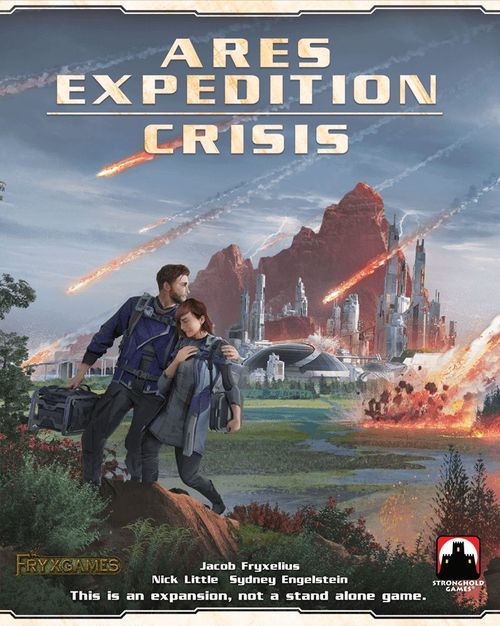
Terraforming Mars: Ares Expedition – Crisis
Terraforming Mars: Ares Expedition – Crisis Rulebook
Table of Contents
Table of Contents
Overview
In Ares Expedition: Crisis, players play as corporations, just as in the original Ares Expedition. You choose phases and play project cards as normal. The difference is players are working together to keep Mars habitable after a natural disaster has landed the planet in crisis. Every round, a new Crisis card will be drawn that will require the players to achieve a certain goal to remove that crisis from play. Each turn that a Crisis card is not completely dealt with, it will lower one or more of the terraforming metrics that keep Mars habitable.
Handle all the crises as they arise. Eventually, a Crisis card will be drawn that allows the players to win the game once they have completed re-terraforming Mars.
Contents
- 4 corporation cards
- 10 dummy player phase cards
- 1 Co-op game board
- 85 Crisis cards
- 7 card dividers
- 1 Crisis board
- 16 Crisis counters
- 3 double-sided detriment tokens
- 22 1VP tokens
- 9 ocean tiles
Setup
Follow the setup instructions in the Ares Expedition rulebook, with the following alterations:
-
Set the Co-op specific game board in the middle of the table. Set the Crisis board near this board.
-
Place the two clear cubes on the top space of the temperature track and the top space of the oxygen track.
-
Place the ocean tiles orange side down on the nine ocean spaces on the board.
-
Before shuffling the project card deck, go through and remove any cards with temperature, oxygen, or ocean requirements. Also remove the cards that reference Milestones if you are playing with the Milestones expansion, which have this icon next to the card number: A. Additionally, remove the cards Adaptation Technology, Conserved Biome, and Special Design. (You don't have to do this during setup if you want to just remove them as they are drawn during gameplay.)
-
Divide the Crisis cards by their player number shown on the front. Return to the box the Crisis cards that don't have a player number matching your player count.
-
Sort the cards that do have your player count by the tier number shown on the back of the card. Shuffle the tier 5 cards facedown and place them on the Crisis board. Place the tier 4 card facedown on top of the tier 5 cards. Shuffle the tier 3 cards, return two of them to the box, then place the rest facedown on top of the tier 4 card. Repeat this for the tier 2 cards, returning two cards to the box, and tier 1 cards, returning only one card to the box, so that the Crisis cards are all in one pile. This is the Crisis deck.
If it is your first game or you want the game to be a little easier, shuffle the three tier 0 cards and place them on top of the Crisis deck.
-
Place the three detriment tokens in a supply near the game board. These are the yellow and red tokens that correspond to the three terraforming metrics.
-
Set the Crisis counters in a pile near the Crisis deck. Set the 1VP tokens near the game board.
-
Before dealing out corporation cards, remove the Inventrix corporation. Then, shuffle in the four corporation cards included with this expansion.
Note: Awards and Milestones are not used in Crisis Mode. Additionally, you are encouraged to use the advanced play variant which allows you to discard and redraw project cards once during setup, but do not use the drafting variant introduced in the Discovery expansion.
Gameplay
Play the game as normal with the following additions:
Communication
You are allowed to talk about anything.
Round Structure
The Crisis Co-op Mode has a few additional steps in each round. The new round structure is:
- Crisis Step (new) a. Check metrics b. Resolve persistent Crises c. Draw a Crisis card d. Draw a card from the dummy hand
- Planning Step
- Resolve Phases Step
- End Step a. Spend VP tokens (new)
Crisis Step
The Crisis step is a new step that happens at the beginning of every round. During this step, players check the terraforming metrics to see if they will play the round with any hindrances, resolve persistent effects of any Crisis cards that they have not completed, and then draw a new Crisis card.
a. Check Metrics
- At the start of each turn, check the current state of the temperature and oxygen. If any of these metrics are currently in a yellow or red zone on their track, take the matching detriment token, flip it to the corresponding side, and set it out in the middle of the table.
- Effects on the temperature and oxygen detriment tokens will impact all players for the duration of the round.
- Use the Ocean zones chart on the main game board to determine the state of oceans. Place and immediately resolve the yellow or red detriment token if applicable.
If any of the three metrics are currently in the purple zone of their track, you lose the game!
Note: Use the Ocean zones chart on the main game board to keep track of the white/yellow/red/purple zones of oceans.
b. Resolve Persistent Crises
During this part, resolve the persistent effects of all Crisis cards currently in play in the order they came into play. If this causes a metric to go into the purple zone, you will need to raise it before the beginning of the next round.
c. Draw a Crisis Card
Draw a new Crisis card from the deck and place it into play. There is no limit to the number of Crisis cards that can be in play at one time. Resolve any immediate effects in the Immediately box on the card. Place a number of Crisis counters on the card equal to the amount shown on the lower right-hand of the card. Do not resolve the persistent effect of this Crisis card this turn.
Crisis Cards
Crisis cards represent the aftermath of the asteroid that has knocked Mars into crisis. Players will need to meet the goal shown on the card a number of times equal to the number of Crisis counters that are placed on it in order to handle the crisis. For each round that the crisis is not dealt with, one or more of the terraforming metrics will decrease based on the persistent effect. Crisis cards can have up to eight pieces of information on them:
- Card name.
- Persistent Effect: An effect that occurs during the Resolve persistent Crises step while this Crisis is in play. In this field you will find the following three icons. If any of these icons is preceded by a number, then resolve the effect that many times. a. Flip a faceup ocean of your choice facedown. b. Decrease oxygen 1 step. c. Decrease temperature 1 step.
- Immediate Effect: When the Crisis card is drawn from the deck, this effect will happen immediately and then never be repeated. This effect can be positive or negative.
- Goal: When a player performs the task written here, they remove a counter from the Crisis. When a Crisis has no counters on it, it is discarded.
- Counters: How many counters to place on the Crisis card when it comes into play.
- Tier number: During setup, Crisis cards will be divided by tier before being shuffled so that a tier 1 Crisis will happen first, followed by tier 2, and so on.
- Player count: Only use the cards that correspond to the player count you are playing with.
- Card number.
Completing Goals
When you play a card or take a game action that fulfills a goal, you remove a Crisis counter from the corresponding card. You may fulfill the goals of multiple cards at the same time if the card you played qualifies for both (ie. playing a blue card with a space tag would allow you to remove one counter from a goal that requires you to play blue cards and one counter from a goal that requires you to play space tags).
When you remove the last counter from a Crisis card, discard that card.
There are a few cards that allow you to discard cards, heat, or plants to remove counters. In those cases, one player must discard the required amount during the action phase to remove a counter. This cost cannot be split over multiple players. However, another player may pay the cost again to remove a second counter.
d. Draw a Card from the Dummy Hand
During this step, draw one or two cards from the dummy hand based on your player count. The effect of the cards drawn varies based on player count:
- In a solo game, draw two cards from the Crisis solo mode cards. These cards have two phases on them. Draw both, and then choose which phase you want to play for each one. Rotate the card so that the chosen phase is at the top. You will resolve both of those phases this turn, as well as the one you choose from your own phase cards. You may choose to play the same phase from your own phase cards as the dummy hand revealed this round in order to gain the Bonus, but the phase will only resolve once.
- In a 2-player game, draw one card from the dummy hand. Both players will resolve this phase as if it had been chosen by a player. You may choose to play the same phase from your own phase cards as the dummy hand revealed this round in order to gain the Bonus, but the phase will only resolve once.
- In a 3- or 4-player game, draw one card from the dummy hand. Players cannot choose that phase this round.
Once all of the dummy player's phase cards have been revealed, shuffle them facedown at the start of the next round. If you need to draw a phase card and there are none while playing solo, shuffle all of the phase cards from previous rounds together facedown.
Planning Step
There are no changes to this step.
Resolve Phases Step
There are only a few changes to this step. They are covered below.
Facedown Oceans
When you play a card or take an action that flips an ocean faceup, you can flip over any ocean tile that is facedown. The ocean rewards are visible on both sides of the tile, but they are only gained when the ocean is flipped faceup.
Action Phase
You are not required to spend heat and plants to increase terraforming metrics during the action phase.
VP Bank
The VP Bank is a section next to the Crisis board where 1VP tokens are held to reward players for scoring VP during the game. These tokens can be used to remove Crisis counters in the End step.
Whenever a player gains a forest VP, they place 1VP in the VP Bank instead. Whenever they play a card with VP on it or fulfill the condition of a card with variable VP, that player also places 1VP tokens equal to the amount of VP gained there. There is no limit on how many VP tokens may be there at one time. Players may choose to spend these tokens during the End step.
If a card that holds resources has variable VP scored at the end of the game, when the requirement to score a VP is hit, remove the corresponding resources from the card and place a VP token in the VP Bank. For example, if a card scores 1 VP for every two animals on it at the end of the game, when this card has two animals on it, remove them and add one VP token to the VP Bank.
Do not place these tokens into the VP Bank when gaining TR.
Cards with Negative VP
There are some cards with negative VP value. In order to play those cards, you must spend VP tokens from the VP Bank equal to the negative value.
End Step
At the end of the End step, players may choose to spend VP tokens in the VP Bank to remove Crisis counters from a Crisis card at a ratio of two VP tokens for each Crisis counter removed. They may remove any number of Crisis counters this way. When the last counter is removed from a Crisis card, discard that card.
End of the Game
The game ends when one of the following happens:
- If the Dwindling Supplies Crisis card (which is the only card in tier 4) has come out of the deck and all three terraforming metrics are completed during the End step, the players win!
- If the oceans, the oxygen, or the temperature is in the purple zone during the Check metrics step at the beginning of the round, the players lose.
- If you are forced to decrease temperature or oxygen and the cube is on the last purple space, the players lose. The same is true if you have to flip an ocean facedown and all of them are already facedown.
- If you would draw a Crisis card but the deck is empty and the terraforming metrics are not completed, the players lose.
Added Difficulties
The rules provided in this rulebook are for the normal difficulty of Crisis Mode. There are three additional difficulties: beginner, expert, and nightmare.
- Beginner difficulty: For your first few games, you should add the three tier 0 Crisis cards to the top of the deck once it has been formed. Once you have won a few times, try to win without them. Additionally, as you try the harder difficulties, if you find them too hard, you can add some or all of the tier 0 cards back in.
- Expert difficulty: In expert difficulty, each Crisis card that comes into play with Crisis counters comes into play with an additional counter.
- Nightmare difficulty: Nightmare difficulty is the same as expert, except during setup you decrease the oxygen and temperature 2 steps and flip two oceans facedown.