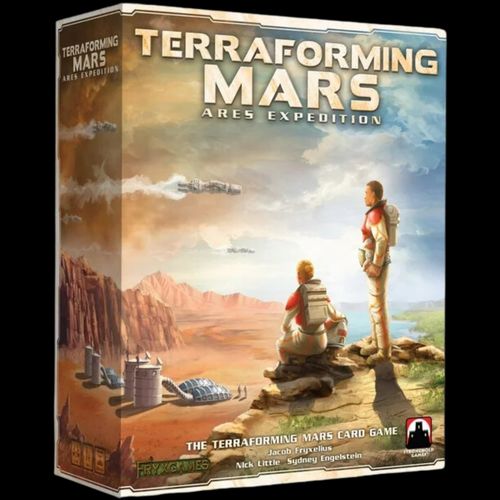
Terraforming Mars: Ares Expedition
Terraforming Mars: Ares Expedition Rulebook
Table of Contents
Table of Contents
Overview
Terraforming Mars: Ares Expedition is an engine-building game in which players control interplanetary corporations with the goal of making Mars habitable (and profitable). You will do this by investing mega credits (MC) into project cards that will directly or indirectly contribute to the terraforming process. In order to win, you will want to accumulate a high terraform rating (TR) and as many victory points (VP) as you can. Players raise their TR by increasing global parameters: oceans, oxygen, and temperature. TR also determines each corporation's basic income, and, at the end of the game TR counts as VP. Additional VP and production capabilities are awarded for building project cards and other actions taken during the game.
The game is played in rounds, and each round the players will choose one of five phases, which determines which activities will take place during that round. This means every round is different, but can consist of building new project cards, taking general and project-specific actions, producing income and resources (plants and heat), or researching to draw more project cards. Every player will take all the phases selected for the round, and will receive a special bonus during the phase that they selected. To speed up the game, players should resolve each phase simultaneously!
The game board has tracks for oxygen, temperature, and terraform rating, as well as a place for all of the ocean tiles that will be flipped over the course of the game. The game ends when there is enough oxygen to breathe (14%), oceans enough to allow Earth-like weather (9), and the temperature is well above freezing (+8°C). It will then be possible, if not comfortable, to live on the surface of Mars!
The winner is the player with the most VP at the end of the game.
Components
- 1 game board
- 208 project cards
- 9 ocean tiles
- 24 forest VP tokens (16 '1' VP tokens and 8 '5' VP tokens)
- 4 player boards
- 12 corporation cards
- 148 resource cubes (100 copper cubes, 24 silver cubes, 24 gold cubes)
- 20 phase cards (5 cards each in 4 different player colors)
- 52 player cubes (13 for each player in four different colors)
- 2 clear cubes (for temperature and oxygen tracks)
- 5 phase tracking tokens
Game Board
The game board has four sections:
- Terraforming Rating Track - When you gain TR, you advance your player cube on this track.
- Oceans - This is where the ocean tiles are placed facedown at the start of the game. When you flip an ocean, pick an ocean that has the orange side faceup and flip it over, then gain 1 TR and the reward listed on the back of the flipped ocean tile.
- Phase Tracking Tokens - Place the phase tracking tokens along this side of the board.
- Oxygen Track - When you raise the oxygen, advance the cube on this track and gain 1 TR.
- Temperature Track - When you raise the temperature, advance the cube on this track and gain 1 TR.
The oxygen and temperature tracks are each divided into four colors: purple, red, yellow, and white. Certain cards will require the oxygen or temperature to be in certain color zones.
Card Anatomy — Project Cards
Project cards are the backbone to building a powerful corporation in order to win the game. It is important to note that at any time you may discard a project card in your hand to gain 3 MC. Project cards have the following pieces of information on them:
- Name
- Cost - This is how much MC you must spend in order to play the card.
- Requirement - Some cards have additional requirements in order to play them. This is shown in brief here and in more detail in the ability section (11) of the card.
- Tags - Cards can have up to three tags. Tags have no inherent value but are referenced in the ability section of many cards.
- Color - There are three colors of cards: blue (active), green (automated), and red (event).
- A. Blue cards either have effects that trigger when certain things happen or actions that can be used during the action phase.
- B. Green cards have resources that are gained in the production phase or have steel/titanium capabilities which are used to reduce the cost of playing certain cards. See "Capabilities — Steel and Titanium" for more info on steel and titanium.
- C. Red cards have effects that happen immediately and do not provide any additional impact after they are played, other than the tags they provide that can be referenced by other cards.
- Effect (Purple) - This appears only on blue cards and shows icons representing an effect which triggers when certain criteria are met. If an effect's condition is met multiple times when a card is played, then resolve the effect multiple times.
- Production (Orange) - This appears only on green cards and shows the icons of what this card produces during the production phase.
- Capability (Gray) - This appears only on green cards and shows that this card has steel or titanium capabilities.
Corporation Cards
These cards represent the corporation each player is acting as. Corporation cards have five parts:
- Name
- Tag - Tags have no inherent value but are mentioned in the ability section of many cards.
- Logo
- Starting Resources - This section tells you how many mega credits (MC) you gain at the start of the game. It may also tell you if you start with any production or other abilities.
- Effect/Action - This shows any ongoing effects or actions you have access to during the game.
Player Board
The player board keeps track of your current resources and production. Resource cubes are placed in their respective boxes, and player markers are used on the production tracks.
- Phases - A brief description of the phases.
- Production Tracks - When you gain production of a resource, move the corresponding cube on its track. Add a second cube to the right column if needed. There are four types of production: (a.) MC, (b.) card, (c.) heat, and (d.) plant. The production tracks show how much of each resource you will gain during the production phase.
Example: If you gain two heat production on the first turn, move your player cube on the heat production track from 0 to 2.
- Resources - Whenever you gain (a.) MC, (b.) heat, or (c.) plants, place the copper, silver, and gold cubes into the section corresponding to the resource gained. The copper cubes are worth 1, the silver 5, and the gold 10.
Example: If you produce 6 plants, place 1 copper cube and 1 silver cube into the green resource section to the right of the plant production track on your player board.
- Capabilities - When you gain (a.) steel or (b.) titanium capabilities, move the corresponding cube on its track. Add a second cube to the right column if needed.
- Standard Actions - During the action phase, players may perform as many of these actions as they want, any number of times.
Reminder: All resources are either tracked on the player board or on a card if it is a special resource. Use the copper, silver, and gold cubes to track the number of each resource you have. The copper cubes are worth 1, the silver 5, and the gold 10.
Note: Some production cards increase their production when you have more of a specific tag. You'll need to update your player mat every time you play that tag.
Note: You will always be able to calculate your current production and capabilities by looking at your cards in play. The player board is just more convenient.
Phase Cards
Players use phase cards to choose which phases they want to play this round. Phase cards have four parts:
- Phase Number - The phases are resolved in order based on this number.
- Name
- Ability - This is the effect that all players will resolve during this phase.
- Bonus - This is the additional effect that you will resolve during this phase only if you selected this phase this round.
Resources
There are four different kinds of resources in Terraforming Mars: Ares Expedition: mega credits, heat, plants, and special resources.
- Mega Credits (MC) - MC is used to play cards and activate actions.
- Heat - Heat is used to raise the temperature of Mars. During the action phase, players may spend 8 heat to raise the temperature one step and gain 1 TR.
- Plants - Plants are used to make forests, which raise the oxygen on Mars. During the action phase, players may spend 8 plants to gain a forest VP, raise the oxygen one step, and gain 1 TR.
- Special Resources - Some cards allow you to place special resources (animals, microbes, and science) on that or other cards. These resources do different things, as specified by the different cards.
Other Tokens
- Forest VP Tokens - Awarded when a forest is built. Worth 1 VP at the end of the game. There are 5 VP forest tokens in case you run out of 1's.
- Phase Tracking Tokens - Show which phases were selected by all players during the round.
- Ocean Tiles - During setup, place these on the board with the orange side faceup. When you flip an ocean over to the blue side, you will receive the benefit shown on that side. For example, if you flip the tile shown, you gain 2 plants. Once an ocean tile is blue side up, it cannot be flipped over again.
Setup
-
Set the game board in the middle of the table.
-
Set the phase tracking tokens next to the game board with the closed door side up.
-
Set all of the forest VP and the copper, silver, and gold cubes next to the game board.
-
Place the two clear cubes on -30°C on the temperature track and 0% on the oxygen track.
-
Give each player a player board and the 13 cubes in their player color. Each player places a cube on the '0' space of each of the six production tracks on their player boards and a cube on the '5' of the TR track on the game board. Use the other cubes when you have 10 or more production/capabilities.
-
Shuffle the ocean tiles blue side down and place them on the nine ocean spaces on the board.
-
For your first game instead of performing step 7, find the sixteen green project cards that have a star next to the card number. Shuffle them and deal each player four of those cards. Place any remaining cards with a star in the discard pile. The rest of the project cards are already shuffled. Feel free to cut the deck, then deal four more cards to each player.
Shuffle all of the project cards together facedown to form the project card deck. Deal each player eight project cards. You will keep all of them. Split the deck into two piles so that all players can easily reach one of the decks.
-
For your first game, instead of performing step 8, deal each player one of the corporation cards with a star next to its card number.
Shuffle all of the corporation cards facedown and deal each player two corporation cards. Each player picks one to use for the game and discards the other. Return all unused corporation cards to the box.
Advanced Rule: Once you have been dealt your corporations, but before you have chosen which one you want to use, you may discard any number of project cards and draw that same amount.
Gameplay
The game is played over the course of several rounds. Each round is divided into three steps:
- A. Planning Step
- B. Resolve Phases Step
- C. End Step
In each step and phase, players play simultaneously. Not all phases will happen every round. Each round will always start with a planning step in which players will determine which phases will occur that round.
A. Planning Step
Each player simultaneously chooses a phase card from their hand and places it facedown.
Starting with the second round, players will place this card at a 90° angle on top of the last phase card they chose. Players are not allowed to pick the same phase two rounds in a row. After revealing the played phase card, players will return the phase card they chose from the previous round to their hand.
Once all players have done this, the chosen phase cards are revealed. These cards determine which phases are resolved this round. For each phase that was chosen for this round, flip the associated phase tracking token faceup so that the name of the phase is showing.
A player is not allowed to pick the same phase two rounds in a row.
B. Resolve Phases Step
During this step, players resolve the phases that were chosen during the planning step. The chosen phases are always resolved in the following order:
- I. Development Phase
- II. Construction Phase
- III. Action Phase
- IV. Production Phase
- V. Research Phase
Each player resolves each of the chosen phases (and only the chosen phases) once in the round. Players resolve each chosen phase simultaneously. Once all players have finished with a phase, they all move onto the next chosen phase.
If multiple players choose the same phase, that phase is resolved only once. If a phase is not chosen, each player skips that phase this round.
When you choose a phase, you will receive the specific bonus in that phase that is listed at the bottom of the phase card.
I. Development Phase
During this phase, each player may play one green project card from their hand by paying its cost. See "Playing Project Cards" below. Bonus: If you chose this phase, the cost of the card you play this phase is reduced by 3 MC.
After playing a green card, make sure to adjust the corresponding capability or production track on your player board.
Reminder: Players may discard project cards in hand at any time to gain 3 MC. This can be done for any reason. Whenever a player discards a card for any reason, it is discarded facedown to the project card discard pile.
II. Construction Phase
During this phase, each player may play one blue or one red project card from their hand by paying its cost. Bonus: If you chose this phase, you can either: Draw a card before or after playing a card this phase OR you may play an additional blue or red card this phase.
Tip to save table space: Play green cards along the bottom of your player board on the right side. You can overlap them so that just the production box and tags along the left side are showing. Play blue cards in a row above your green cards. You can overlap them so that just the ability icons and tags along the left side are showing. Play red cards in either row, you can overlap them so just the tags are showing.
Playing Project Cards
The cost to play a project card must be paid with MC. You can use MC cubes you have and/or discard other project cards in your hand at a rate of 3 MC per card. Any overpayment in cards is returned to you using cubes. (Ex. You can play an 8 MC card by discarding two cards and paying 2 MC, or by discarding three cards in hand. If you discard the three cards, you will receive 1 MC back.)
Requirements: Some cards have additional requirements in order to play them. Cards with requirements have a checkmark icon next to the cost of the card. These requirements are listed in the text box at the bottom of the card next to the same checkmark icon and shown in icons at the top. If a card has an ocean, oxygen, or temperature requirement, that requirement needs to have been met at the start of the phase in order for you to be able to play it. If the requirements of a card are not met, you cannot play that card.
Steel and Titanium: The cost of Project cards with a building tag, regardless of color, is reduced by 2 MC for each steel you have. The cost of Project cards with a space tag, regardless of color, is reduced by 3 MC for each titanium you have. The cost to play a card cannot be reduced below zero.
You may play cards that raise parameters beyond their maximums or add special resources when you don't have a card to add them to. You will simply not receive the benefits of those effects.
Example: Bob wants to play Microprocessors, which is a green card that costs 17 MC. Microprocessors has a building tag. Bob has two steel, so his cost to play cards with building tags is reduced by 4 MC. Bob chose the development phase this turn, so his cost to play this green card is reduced by 3 MC. Thus, Bob's cost to play Microprocessors is 17-4-3=10. Bob has 4 MC cubes which he can use to pay for the card, but that leaves Bob 6 MC short of playing it. Bob can discard two project cards from his hand at a rate of 3 MC each to pay for the remaining 6 MC. Bob chooses to discard two cards and spends his 4 MC cubes, and places Microprocessors into play. Bob resolves the immediate effect of the card which is "Draw two cards. Then, discard a card." Finally, Bob is done with the development phase.
III. Action Phase
Each player may resolve the "Action:" ability on each of their cards in play once during this phase. Each player may resolve any number of the standard actions any number of times. Bonus: If you chose this phase, you may resolve the "Action:" ability on one of your cards in play an additional time.
Standard Actions: During the action phase, players may use the standard actions printed on their player boards. Those actions are:
- Spend 8 plants to gain a forest VP and raise the oxygen one step.
- Spend 20 MC to gain a forest VP and raise the oxygen one step.
- Spend 8 heat to raise the temperature one step.
- Spend 14 MC to raise the temperature one step.
- Spend 15 MC to flip an ocean tile. When a player flips an ocean tile, they immediately receive the reward shown on the back of the tile.
Reminder: Whenever you raise oxygen, raise temperature, or flip an ocean, you gain 1 TR. This happens for each step you raise those parameters.
During the phase in which a global parameter reaches its maximum (temperature at +8°C, oxygen at 14%, or 9 ocean tiles flipped), all players can continue to take actions or play cards to increase that parameter. They will receive all of the benefits, such as forest VP and TR. During the phase that the last ocean tile is flipped, any player who continues to take actions or play cards to flip oceans will gain the reward on the last ocean tile that was flipped in addition to the TR.
After the phase in which the parameter reached its maximum, players can no longer gain rewards for increasing that parameter.
Players may continue to gain forest VP tokens for building forests after the phase when oxygen reaches 14%, but won't gain TR for increasing oxygen when they do.
Important Rule: At the end of the action phase, if you are able to spend heat or plants for a standard action, you must do so unless the associated terraforming parameter has already been raised to its maximum.
IV. Production Phase
During this phase, each player collects resources equal to the production on their green cards, corporation card, and place on the TR track. Bonus: If you chose this phase, gain 4 MC.
Gain MC equal to your MC production + your TR. Gain heat and plants equal to your production for those resources. Place copper (1), silver (5), and gold (10) cubes to track these resources in the appropriate resource section of your player board. For each card production, you draw a card during this phase.
Example: Bob has played four cards so far this game. When he played these cards, he adjusted his player board accordingly. During the planning step of this round, he chose to play the production phase. During the production phase, Bob will gain all of the resources shown on his player board plus MC equal to his TR, which he can verify by checking the production boxes on the cards he has played. He gains the following: 4 MC for his MC production and 6 MC for his TR; 1 card; 3 heat; 1 plant; 4 MC as a bonus for choosing the production phase.
V. Research Phase
Each player draws two cards, keeps one, and discards the other. Bonus: If you chose this phase, you draw three additional cards and keep one additional card. Meaning, in total, you draw five cards and keep two, discarding the other three.
If at any point, a player needs to draw a project card and the project card deck is empty, shuffle all of the discarded project cards together to form a new project card deck.
C. End Step
During this step, each player discards down to ten cards in hand. For each card discarded this way, that player gains 3 MC as normal.
Flip all of the phase tracker tokens so that the closed door side is faceup, and start the next round.
End of the Game
The end of the game is triggered when all three of the following are true:
- All nine ocean tiles have been flipped blue side up.
- The temperature is at +8°C.
- Oxygen is at 14%.
Once this happens, players finish the current phase and then proceed to final scoring. The round does not continue to any other phases that were picked. For example, if all of the global parameters are capped during the construction phase, and the action and production phases were also chosen for this round, the game does not continue to the action or production phase.
Tip: If the game ends during the action phase, players will likely want to convert all of their cards in hand and MC into standard actions that gain TR.
Final Scoring
Players score VP for the following things:
- 1 VP per TR
- VP equal to their forest VP tokens
- VP equal to what is printed on the project cards they played, including cards that have variable VP denoted with an asterisk*
The player with the highest total VP wins the game. In the event of a tie, the tied player with the most heat, MC, and plant resources added together is the winner. Be sure to convert project cards in hand to MC beforehand.
Example: At the end of the game, Bob totals his final score: He has 25 TR as shown on the TR track. He has 6 forest VP. He has four project cards with VP on them, for a total of 9 VP. He also has a project card with variable VP worth 1 VP per 2 animals on the card. Bob added 6 animals (resource cubes) to this card over the course of the game, so it is worth 3 VP. Bob's final score is 25+6+9+3=43.
Symbols
All abilities and requirements on project cards are shown both with symbols and explained in text. Below is a glossary of all symbols you will see on project cards.
Victory Points and Terraforming Rating
- Victory Points (VP) - Points that will add to your score at the end of the game. Some cards have either a set number of VP on them, or a number contingent on another factor (such as resources on the card or certain cards in play). You win the game by having the most VP.
- Terraform Rating (TR) - Points that will both produce MC throughout the game and add to your score at the end of the game. TR is the measure of how much you have contributed to the terraforming process. Each time you raise the temperature, the oxygen level, or flip an ocean tile, your TR increases.
Parameters
There are three parameters that gauge how much Mars has been terraformed: temperature, oxygen, and oceans. You and your fellow players are competing to contribute the most to the terraforming of Mars. Each of these symbols indicates raising the associated parameter one time. Each time you raise one of these parameters, you will gain 1 TR.
- Temperature - Raise the temperature by 2°C. Heat, MC, or effects on cards can be used to increase the temperature. The temperature starts at -30°C and can be raised 2°C at a time up to +8°C. This will create an equatorial zone where water stays liquid.
- Oxygen - Raise the oxygen by 1%. Plants, MC, or effects on cards can be used to raise the oxygen level. The oxygen starts at 0% and can be raised 1% at a time up to 14%. At 14% the atmosphere resembles that of Earth at a 3000m elevation.
- Oceans - Flip one ocean tile. MC or effects on cards can be used to flip ocean tiles. Each ocean tile represents 1% ocean coverage. The ocean coverage starts at 0% and can be raised 1% at a time to 9% (or, 9 ocean tiles). With 9% of the surface covered by oceans, Mars will have a hydrological cycle, creating rain and rivers.
Resources
There are four types of resources that can be used in your corporation's work to terraform Mars: MC, plants, heat, and special resources (animals, microbes, and science).
- Mega Credits (MC) - This is the currency used in the 24th century and is how your corporation will pay to complete projects and take certain actions.
- Plants - Plants represent the hard work your corporation is putting in to increase the forest coverage on Mars. Plants are a resource you can use to build forests and raise the oxygen.
- Heat - Heat represents your corporation's efforts to make the temperature of Mars habitable. Heat is a resource you can use to raise the temperature 2°C.
- Special Resources - Your corporation can invest itself in the animals, the microbes, or the science resources of humanity's future home. These three special resources are collected on project cards to be used for specific effects.
Capabilities — Steel and Titanium
Some green cards give a player steel and titanium capabilities. They reduce the cost of playing project cards. The proper building materials are essential when starting an expensive project!
- Steel - This represents building materials used on Mars. Each steel capability lowers the cost of playing project cards with a building tag by 2 MC.
- Titanium - This represents building materials used in space. Each titanium capability lowers the cost of playing project cards with a space tag by 3 MC.
Tags
Project cards can have up to three tags on them, which can be referenced by some cards' effects.
- Building - This project involves construction on Mars, and can be cheaper to produce using steel.
- Space - This project uses space technology, and can be cheaper to produce using titanium.
- Power - This project involves the creation of energy, and the conversion of energy into other resources.
- Science - This project helps invent new, cutting edge technology to streamline the terraforming process.
- Jovian - Jovian means 'having to do with Jupiter.' This project represents infrastructure in the outer solar system.
- Earth - This project is related to activities on Earth.
- Plant - This project involves plant life or other photosynthesizing organisms.
- Microbe - This project involves introducing various kinds of microbes into the Martian ecosystem.
- Animal - This project involves introducing various kinds of animals into the Martian ecosystem. These cards generate VP.
- Event - This project is a one-time operation to permanently alter Mars. All events are red cards.
- Asterisk - When an icon has an asterisk (*) next to it, there is a special rule that you must read in the ability text on the card.
Two-Player Co-op Mode
In this mode, two players work together to completely terraform Mars before time runs out. All the rules of the game are the same with the following exceptions:
Setup: After you have finished setting up the game, in the upper right hand section of the game board, place 27 copper cubes and 3 cubes of a player color you are not using in a pile.
Gameplay: Players should give each other advice and encouragement! We recommend that you don't discuss specific cards in your hand, but rather keep your statements broad, like, "I have a lot of heat production, so don't worry about that" or "I'm going to choose the production phase this round." After players have revealed their phase cards each round, each player takes a cube from the pile on the game board. If you take a copper cube, add it to your MC. If you take one of the player color cubes, discard the cube and you may trade one project card in hand for a project card in your partner's hand.
End of the Game: The game ends at the end of the round in which the last cube is taken from the pile (15 rounds). At the end of the game, if all of the terraforming parameters have been completed and the players have a total score of at least 80 VP, the players win! Otherwise, the players lose. Record your VP and try to beat your high score the next time you play.
Solo Rules
The goal of the solo game is to fully terraform Mars before time runs out. All the rules of the game are the same with the following exceptions:
Setup:
- Set aside an additional set of five phase cards as a dummy hand. Shuffle that set of cards facedown.
- Place a player cube of a color you are not using on the 1 on the TR track.
- Choose a difficulty level: Novice, Advanced, or Expert.
Gameplay: Once you have selected a phase card during the beginning phase, play the top card of the dummy hand faceup. That phase is also played this round (without a bonus). Continue to play rounds, playing a card from the dummy hand each round.
When all five dummy hand cards have been played, shuffle them all facedown to reform the dummy hand. Each time you reshuffle the dummy hand, advance the dummy player cube (that started on 1) to the next space on the TR track. Once that cube reaches 5, play five final rounds. You are allowed to pick the order in which the dummy hand phase cards are played in these final rounds. After all of the phase cards from that hand have been played (25 rounds in total), the game ends.
Difficulty Levels: Solo mode can be a great way to learn the game, but it is not easy to win if you aren't experienced with the game and its many strategies. If you aren't experienced, consider choosing one of the lower difficulty settings below. In a lower difficulty setting, the terraforming parameters will advance each time the dummy player's cube moves (4 times per game), to help you reach your terraforming goals. Note - raising terraforming parameters in this manner does not provide TR nor Forest VP tokens.
- Novice Mode: Increase oxygen or temperature 2 steps after advancing the dummy player's cube.
- Advanced Mode: Increase oxygen or temperature 1 step after advancing the dummy player's cube.
- Expert Mode: No bonuses are given.
End of Game: Once five full dummy hands have been played (25 rounds), the game ends. If Mars is fully terraformed, you win. Otherwise, you lose. Finally, you score VP, attempting to achieve as high a score as possible.