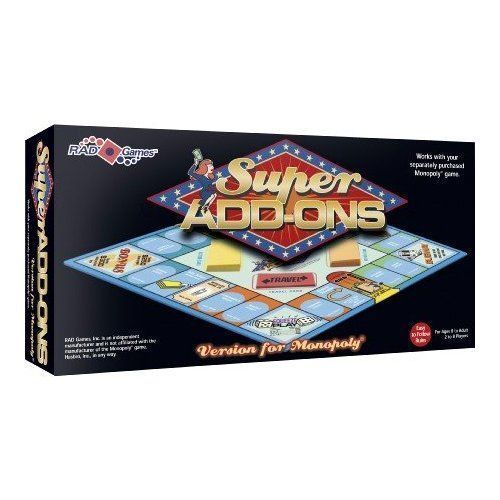
Super Add-Ons: Monopoly
Super Add-Ons: Monopoly Rulebook
Table of Contents
Table of Contents
Rules
Object
The object is to become the wealthiest player through buying, renting, and selling property.
Equipment
The equipment consists of a Super Add-Ons Game Board, one die, 16 Action Cards Cards, 17 Houses, 7 Hotels, 12 Property Deeds, 2 Utility Deeds, 20 Travel Cards, and 20 Roll Three Cards.
(Printed as "16 Action Cards Cards" in the source. The preparation below shuffles 8 + 8 Action Cards, which is consistent with 16.)
Preparation
First follow the instructions for preparation in your Monopoly rules. After setting out the original Monopoly board, place the Super Add-Ons Game Board in the center of the original board with the Roll Three corner located next to the FREE PARKING corner and the Squeeze Play corner located next to COLLECT $200.00 SALARY AS YOU PASS GO. Shuffle 8 of the new Action Cards with the Chance Cards and shuffle the remaining 8 Action Cards with the Community Chest Cards and put them in their respective places on the board. Deal one Travel Card face down to each player. Deal one Roll Three Card face up to each player. Place the remaining Travel Cards and the Roll Three Cards in their respective places on the board. The yellow hotels and blue houses may be mixed and matched with original Monopoly houses and hotels and are used in exactly the same manner as original Monopoly houses and hotels.
(Source typo "remianing" corrected to "remaining" and the layout break "newAction" read as "new Action".)
The Play
Use the same rules as you would for Monopoly, along with the following additions:
Riding the Elevator. The Elevator Spaces contain horizontal and vertical arrows labeled ODD and EVEN to indicate which direction to move when passing the Elevator Spaces, and the adjacent Railroad spaces below them. If a player rolls an EVEN number that moves their piece past an Elevator space or the Railroad space below it, the player's piece shall ride the Elevator onto the Super Add-Ons Game Board and continue to move in a clockwise direction. For example: a player starts their turn with their piece on States Avenue and rolls a SIX, the move would take the player's piece over: (1) Virginia Avenue, (2) Pennsylvania Railroad, (3) The Elevator, (4) Fifth Avenue, (5) Madison Avenue, while finally landing on (6) the Roll Three space where the player would follow the Roll Three instructions. If a player rolls an ODD number that takes their piece past an Elevator space or the Railroad space below it, the player's piece shall continue its move forward on the original Monopoly board.
Roll Three. When a player lands on the Roll Three space, they first pick up a Roll Three Card from the center pile. They then roll three dice to see if their or another player's Roll Three numbers match the dice rolled. The three dice are read in order from lowest to highest number. If any one die matches any one number of a player's Roll Three number, that player wins $50 from the bank. If two of the dice match a player's Roll Three numbers, that player wins $200 from the bank. If all three dice rolled match a player's Roll Three numbers, that player wins $1000 from the bank. If the player who rolled the dice rolled their own Roll Three number, they win $1500 from the bank. For example, if the Roll Three dice rolled were 1-3-6 and the players had the following Roll Three numbers, the winnings would be as follows:
| Player | Roll Three numbers | Result | Winnings |
|---|---|---|---|
| Player 1 | 4-4-5 | No Numbers Match | $0 |
| Player 2 | 2-4-6 | One Number Matches | $50 |
| Player 3 | 1-3-3 | Two Numbers Match | $200 |
| Player 4 | 1-3-6 | Three Numbers Match | $1,000 |
If the player who landed on the Roll Three space had the 1-3-6 Roll Three number they would win $1,500 from the bank. Roll Three numbers may be bought, sold, or traded among players.
Travel Cards. When a player lands on an Elevator space they draw a Travel Card from the center pile. A player may use a Travel Card on their turn, instead of rolling the dice. The use of Travel Cards count as a player's turn. After a Travel Card has been used it is returned to the bottom of the Travel Card pile face down. More than one Travel Card may be combined at a time. Travel Cards may be bought, sold or traded among players. Players using a backward Travel Card that takes them past GO or BONUS do not collect any money during that turn. The player would, however, collect money on their next turn that takes their piece onto or past the GO or BONUS space.
Squeeze Play. When a player lands on Squeeze Play the player rolls two dice to determine how much money he or she will collect from the other players. Rolls of 5, 6, 7, 8, or 9 entitles the player to collect $50 from each player. Rolls of 3, 4, 10, or 11 entitles the player to collect $100 from each player. Rolls of 2 or 12 entitle the player to collect $200 from each player.
Tax Refund. All Monies from Community Chest Cards, Chance Cards, Luxury Tax, Income Tax, and Get Out of Jail charges that need to be paid to the bank are placed onto the middle of the board. A player who lands on the Tax Refund space collects 50% from the current pool of money in the middle of the board.
(The Alternate Rules section below gives a different Tax Refund rule, 100% of a pool that holds only tax money. That is an optional rule and does not change this one.)
Subway. When a player lands on the Subway space the player may travel to any space on the board on his or her next turn. If the property is unowned, the player may purchase it from the bank. Since traveling via Subway is a direct route, players do not collect any money by passing GO or BONUS.
Bonus. When a player passes BONUS they collect $250. When a player lands on BONUS they collect $300.
Utilities. The two new utilities properties (Wireless Telephone Company and Gas Company) accompany the original utilities properties (Electric Company and Water Works). The potential revenue a player can earn from the utilities properties is now greater. The charge rates for owning more than two utilities are reflected on the Wireless Telephone and Gas Title Deeds.
Reverse Direction. On your next turn, roll the dice as normal, but instead of moving forward, move backwards the number rolled. Follow the ODD/EVEN directions for the Elevator just as you would if going forward. After a player has moved his or her piece in the reverse direction, their next turn will be moving forward again.
(The Reverse Direction space text printed on the board's "Alternate Rules" sheet is: "Instead of moving backward when landing on this space, move the Super Add-Ons Game Board counterclockwise 90 degrees. On your next turn continue moving forward. This one addition to the RULES completely changes the dynamics of the game." It is transcribed in the Alternate Rules section below.)
Alternate Rules
These optional rules are printed on the 2004 sheet and may be used together or by themselves.
Preparation. Do not deal out any Travel Cards or Roll Three Cards at the start of the game. Rotate the Super Add-Ons Game Board to a different position as instructed in the "Rules" section.
Travel Cards. Players may use Travel Cards in conjunction with the roll of the dice. For example, if a player rolled an eight and held a 2 space forward card, his or her total move would be ten.
Squeeze Play. If a player rolls doubles, they receive $200 from every player. On any other roll, the player does not collect any money.
Tax Refund. Only Monies that are related to TAX penalties from Community Chest Cards, Chance Cards, and Luxury Tax go into the middle of the board. A player who lands on the Tax Refund space collects 100% from the current pool of money in the middle of the board.
Reverse Direction. Instead of moving backward when landing on this space, move the Super Add-Ons Game Board counterclockwise 90 degrees. On your next turn continue moving forward. This one addition to the RULES completely changes the dynamics of the game.
Stand-Alone Play and Action Card Rules (2005 Companion Sheet)
The following is transcribed from the 2005 RADGames "Game Rules Final Final 5.0" sheet (2 pages, © 2005 RADGames, Inc.). That sheet is a shorter, later version of the same rules. Where it differs from the 2004 sheet above, the 2005 wording is given here and the 2004 wording stays in the Rules section. The 2005 sheet's Equipment line reads "20 Action Cards" and its Preparation shuffles 10 orange-backed and 10 yellow-backed Action Cards, instead of the 16 and 8 + 8 of the 2004 sheet.
Where the 2005 sheet's main Rules differ from the 2004 sheet's main Rules (the Rules section above is the 2004 text): Tax Refund pays 50% of the pool, as in 2004, but the pool also takes Income Tax and Get Out of Jail money, not only Community Chest, Chance and Luxury Tax; Travel Cards may be used "on any turn"; Subway reaches "any space on either board"; and the Elevator rides to "the opposite board" (the 2005 Elevator wording is given below). Both sheets have the same split on Tax Refund: 50% in the main Rules and 100% in the Alternate Rules. The 2005 Alternate Rules Squeeze Play, Tax Refund and Reverse Direction wording is the same as the 2004 Alternate Rules above.
Stand-Alone Play. Super Add-Ons can be played as a stand-alone game using the following directions: First, place the board in the center of the table. Put the yellow-backed Action Cards inside the yellow center box. Place the orange-backed Action Cards inside the orange center box. Deal one Travel Card face down to each player. Deal one Roll Three Card face up to each player. Place the remaining Travel Cards and Roll Three Cards in their respective places on the board. Distribute $700 to each player as follows: (5) each of $1's, $5's, $10's; (6) $20's, (4) $50's, and (3) $100's. Each player can use a token of his or her choosing. Start game play by placing your tokens on "Bonus". When a person lands on an Elevator space, take the Elevator to the one on the opposite side of the board. Makes for a quick and exciting game!
Hurricane and Tornado Action Cards. Each of these cards require you to remove one house from each property in a property group, IF you own any (or if any other player owns any). For example, if you draw the "Hurricane" card, you can remove one house from each property in any other player's property grouping. If the player owns hotels, replace them with (4) houses per property. If you draw the "Tornado" card, you must do the same to one of your own property groups. These cards must be used immediately, and cannot be saved or traded.
Riding the Elevator (2005 wording). The Elevator Spaces contain horizontal and vertical arrows labeled ODD and EVEN to indicate which direction to move when passing them, and the adjacent Railroad spaces below them. If a player rolls an EVEN number that moves their piece past an Elevator space or the Railroad space below it, the player's piece shall ride the Elevator onto the opposite board, and continue to move in a clockwise direction. If a player rolls an ODD number, they shall continue on their current board.
For example: if a player starts their turn on States Avenue and rolls a SIX, the move would take the player's piece over: (1) Virginia Avenue, (2) Pennsylvania Railroad, (3) The Elevator, (4) Fifth Avenue, (5) Madison Avenue, while finally landing on (6) the Roll Three space where the player would follow the Roll Three instructions. If a player rolls an ODD number that takes their piece past an Elevator space or the Railroad space below it, the player's piece shall continue its move forward on the same board it is currently on.
If a player lands directly on the Elevator space, they should draw a Travel Card for future use. On their next turn, an EVEN roll means they ride the Elevator to the original Monopoly board; an ODD roll means that they continue on the Super Add-Ons board.