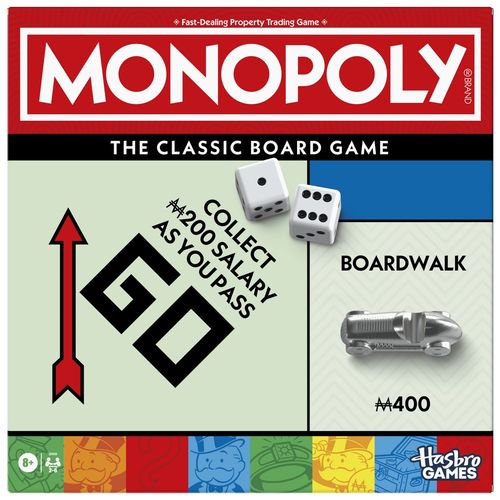
Monopoly
Monopoly Rulebook
Table of Contents
Table of Contents
Object of the Game
Become the wealthiest player through buying, renting, and selling property. The goal is to force every other player into bankruptcy; the last player remaining in the game wins.
Equipment
Gameboard; 2 dice; tokens (player pieces); 28 Title Deed cards (22 properties, 4 railroads, 2 utilities); 16 Chance cards; 16 Community Chest cards; 32 houses; 12 hotels; play money.
Setup
- Each player picks a token and places it on GO.
- Choose a player to be the Banker (they also manage the auctions). The Banker keeps their personal funds separate from the Bank's.
- The Bank pays each player $1,500, divided: two each of $500, $100, and $50; six $20s; five each of $10, $5, and $1.
- Place Chance and Community Chest cards face down on their spaces. The Bank holds all Title Deeds, houses, and hotels.
The Bank never "goes broke" — if it runs out of money it may issue as much as needed by writing on ordinary paper.
Play
Starting with the highest roller and going left, each player in turn rolls both dice and moves their token clockwise the indicated number of spaces. Two tokens may rest on the same space. Depending on where you land, you may buy property, pay rent, pay a tax, draw a Chance or Community Chest card, go to Jail, or otherwise act on the space.
Doubles
If you roll doubles, you move as usual, then take another turn. But if you roll doubles three times in a row in one turn, you go directly to Jail — do not pass GO, do not collect $200.
Passing GO
Each time your token lands on or passes over GO, the Bank pays you $200 salary.
Buying Property
When you land on an unowned property (street, railroad, or utility), you may buy it from the Bank at its printed price, receiving the Title Deed.
If you choose not to buy it, the Banker immediately auctions it to the highest bidder, starting at any price. Any player, including the one who declined, may bid; the property goes to whoever bids highest, who pays the Bank that amount.
Paying Rent
When you land on a property owned by another player, that owner collects rent per the Title Deed — but only if they ask for it before the second player after them rolls.
- Streets: rent doubles if the owner holds all properties of that color-group (a monopoly) and it is unimproved. Rent rises steeply with houses and hotels.
- Railroads: rent depends on how many of the four railroads the owner holds ($25 / $50 / $100 / $200).
- Utilities: if one utility is owned, rent is 4× the dice roll that landed you there; if both are owned, 10× the roll.
- A property that is mortgaged collects no rent.
Building Houses and Hotels
Once you own all the properties of a color-group, you may buy houses from the Bank to raise rents on those properties (even if the color-group properties are not all improved you must build).
- You must build evenly: you cannot build a second house on a property until each property in that group has one, and so on.
- When you have four houses on each property in the group, you may buy a hotel (returning the four houses to the Bank plus the hotel price). Only one hotel per property.
- Building shortages: if the Bank has no houses, you must wait for another player to return some. If several want the limited supply, the Banker auctions them one at a time.
Selling and Mortgaging
- Houses/hotels may be sold back to the Bank at half their purchase price. You must sell evenly (in reverse of the way you built). A hotel sells back for the price of the five houses it replaced.
- Unimproved property may be mortgaged for the value printed on its Title Deed; flip the deed face down. To lift the mortgage, pay the Bank the mortgage value plus 10% interest. You cannot mortgage a property that still has buildings — sell those first.
- You may sell unmortgaged, unimproved properties to other players in private deals for any agreed amount.
Jail
You land "In Jail" only when: you land on Go To Jail, draw a card ordering you there, or roll doubles three times in one turn. (Landing on the "Just Visiting" corner space by normal movement does not put you in jail.)
To get out of Jail:
- Pay $50 before rolling, on any of your next turns, or
- Use a Get Out of Jail Free card, or
- Roll doubles on any of your next three turns — if you succeed, move the shown amount (you do not take another turn for these doubles).
If you fail to roll doubles by your third turn in Jail, you must pay the $50 and then move the amount you last rolled. While in Jail you may still collect rents and trade.
Taxes, Chance, and Community Chest
- Income Tax: pay the amount shown to the Bank (classic editions let you pay a flat sum or a percentage of total worth).
- Luxury / Super Tax: pay the fixed sum shown.
- Chance / Community Chest: draw the top card and follow it, then return it to the bottom of its pile (keep any "Get Out of Jail Free" card until used or sold).
Bankruptcy and Winning
You are bankrupt if you owe more than you can pay, even after selling buildings and mortgaging property.
- If you owe another player, you turn over all your cash and assets to them. Mortgaged properties transfer too; the new owner must immediately pay the Bank 10% interest and may lift the mortgage then (for its value + 10%) or later.
- If you owe the Bank (taxes or penalties), you turn all assets over to the Bank, which then auctions each property.
Once bankrupt, you are out of the game. The last remaining player wins. (For a timed game, agree an end time in advance; the richest player by total assets then wins.)