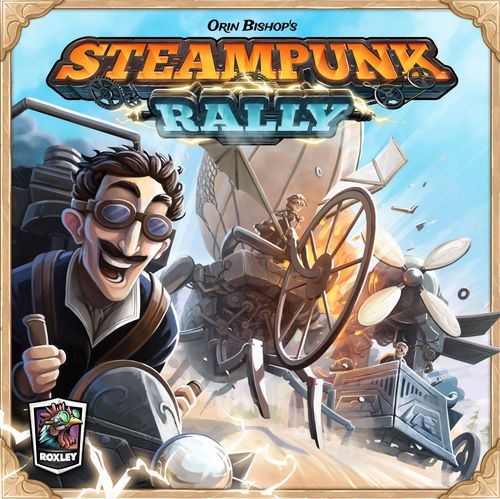
Steampunk Rally
Steampunk Rally Rulebook
Table of Contents
Table of Contents
- Gameplay Basics
- Components Included
- Game Setup
- Player Area Setup
- Valve Connections
- Playing the Game
- Draft Phase
- Vent Phase (Skipped during first round)
- Race Phase
- Damage Phase
- End of Round
- Using Boost Cards
- Building Your Invention
- Discarding & Shuffling Cards
- Race Effects
- Race Effects List
- Terrain
- Running Out of Dice
- Challenge Spaces / Tiles
- Challenge Spaces List
- Determining Your Position
- And The Winner Is...
- Example Round
- Inventors
- Quick Reference - refer to full rules inside for greater detail
Gameplay Basics
Game designed by Orin Bishop.
Steampunk Rally is a card-drafting, dice-placement game. You will be rolling and placing dice on your Invention to generate Motion, gain more dice, prevent & repair damage, and discard used dice. Improve the efficiency of your Invention by adding Machine Parts. Harness the power of various Boost technologies, utilizing them to thwart your rival Inventors and achieve victory!
The game is played over a series of rounds until one player's Invention crosses the Finish Line, at which point one final round is played. The player furthest past the Finish Line after the final round is declared the winner!
Components Included
- 120 Machine Part cards in 3 colors (Gold, Silver and Copper Bordered)
- 40 Boost Cards (Black Bordered)
- 1 Play Direction token
- 16 Inventor Pawn tiles with bases
- 32 Inventor Machine Part & Cockpit cards
- 8 Player aids
- 8 Light Bulb tokens
- 36 Steam dice
- 36 Heat dice
- 36 Electricity dice
- 6 Challenge tiles
- 8 Damage Gauges
- 41 Cog tokens in 3 denominations
- 8 Double-Sided Track tiles (1 Start, 5 Middle, 1 Finish Line, 1 End)
Video Tutorial
Are you more of a visual learner? We've got you covered. Open your web browser and head over to roxley.com/steampunk-rally to watch a video tutorial on how to play!
Game Setup
- Select which Racetrack you'd like to play (Swiss Alps or Hoverdrome) and ensure that all the Track tiles are flipped to the selected side.
- Select three of the five available Middle Track tiles and build a continuous Racetrack of any shape.
- Place the Start tile at one end of your newly created Racetrack.
- At the other end of the Racetrack, attach the Finish Line tile as directed.
- Complete your Racetrack by attaching the End Track tile to the Finish Line tile.
- Place the supply of dice and Cogs within reach of all players.
- Sort all Machine Part and Boost cards into four separate decks according to the color of their borders (Gold, Silver, Copper and Black).
- Shuffle and place each deck face down within reach of all players. Then take the top card from each deck and place it face up beside the deck to create four separate discard piles.
- Flip the the Play Direction token like a coin, and place it between two random players.
Optional Setup: Challenge Tiles
- Challenge tiles can provide new and exciting variations for experienced players. After the Racetrack has been assembled, you may add a Challenge by placing any one of the six Challenge tiles beside a space on the Racetrack that does not already feature a Challenge.
- We recommend adding no more than three Challenge tiles to the Racetrack.
- Be careful when placing Challenge tiles! When placing one on a single side of a forked path, the best route becomes clear, potentially making the game a little less interesting.
Your First Setup
If this is your first time playing the game, we recommend the following changes to Game Setup:
- Play with six or fewer players.
- Use the Swiss Alps Racetrack.
- Play without the optional Challenge tiles (you still use the Challenge spaces on the Racetrack).
Player Area Setup
A. Select an Inventor. Take the associated Inventor Cockpit, Inventor Machine Part, and Inventor Pawn. We recommend that players who didn't fare as well in a previous game be allowed to select first.
B. Place your Inventor Pawn on the Racetrack Start space.
C. Construct your Invention by placing your Inventor Cockpit and Inventor Machine Part face up in front of you, with both cards rotated upright (so the words are not upside down). Your starting Invention must have a complete valve connection (see "Valve Connections" below).
D. Leave space below or to the side of your Invention for your Dice Pool.
E. Place a Light Bulb token in your Player Area with the "On" side facing up.
F. Place a Damage Gauge in your Player Area and set it to "0".
G. Once all players have finished setting up, return all unselected Inventor cards and Pawns to the box.
Valve Connections
When the valve graphics of two Machine Parts come together to form a circle, it is considered to be a "complete" valve connection.
Playing the Game
Steampunk Rally is played over a series of rounds. Each round consists of four Phases:
- Draft: add Machine Parts to your Invention; gain dice, Cogs, and Boost cards.
- Vent: spend Cogs to subtract pips from dice currently occupying Die Slots on your Machine Parts. The Vent Phase is skipped during the first round of the game.
- Race: Roll your dice and use them to activate your Machine Parts.
- Damage: if your Damage Gauge is below 0, discard Machine Parts.
After you have completed all four Phases, perform End of Round tasks. A new round then begins with another Draft Phase.
Draft Phase
During the Draft Phase, you will receive two types of cards to perform actions with: Boost cards and Machine Parts.
Boost Cards
Boost cards feature a Black border. Boost cards gained during the Draft Phase may be played to receive the effects on the card.
Machine Part Cards
Machine Parts are used to build your Invention, and can be activated using dice or the Light Bulb token during the Race Phase. There are three types of Machine Parts. Each has a defining characteristic identified by its border color in addition to any other Race Effects it may generate:
- Gold border — Generates Motion. Your Invention needs to move, so consider carefully before passing these cards.
- Silver border — Generates more dice, providing more power for your Invention.
- Copper border — Has four valve connections, allowing you to easily expand your Invention.
Draft Phase - continued
At the beginning of the Draft Phase each player draws one card from each deck to create a hand of 4 cards. Then all players perform each of the following steps simultaneously. Do not proceed to the next step until all players have finished performing the current one.
- Select a card from your hand and place it face down in front of you.
- Perform one of the following actions using your selected card:
Construct — Reveal your selected Machine Part and immediately attach it to your Invention (see "Building Your Invention" section). If you cannot attach your selected card, you must instead discard it to Generate Power or Gain Cogs as noted below.
Generate Power — Discard your selected card to its appropriate discard pile. Take dice from the supply matching the amount and color displayed in the upper-right corner of the card. Place them in your Player Area to form your Dice Pool. You will roll and use these dice later, during the Race Phase.
Gain Cogs — Discard your selected card to its appropriate discard pile and take Cogs from the supply matching the amount displayed in the upper-right corner of the card.
Stash Boost — Place your selected Boost card face down under your Damage Gauge. You are now able to play this Boost card.
- Pass the remaining cards in your hand to the player sitting next to you in the direction indicated by the Play Direction token. The cards you receive from an adjacent player become your new hand. Repeats Steps 1-3 until you have no cards left to pass, then proceed to the Vent Phase.
Important!
A unique element of Steampunk Rally is that each Phase in a round is resolved by all players simultaneously; there are no "turns" in the game. To ensure your game maintains order, it is important that the players communicate regarding the round's current Phase. Before proceeding to a new Phase, check with the other players to make sure they are ready to continue. This ensures that all players have had an opportunity to complete their actions. Do not proceed until all players are ready.
Vent Phase (Skipped during first round)
During the Vent Phase, you may spend any number of Cogs to reduce the pip values of dice that currently occupy Die Slots on your Invention.
- Each Cog you discard allows you to reduce the value of your dice by a total of up to 2 pips (e.g. one die by 2 pips, or two dice by 1 pip each).
- Discard any die you reduce to less than 1 pip.
Vent Phase Boost Cards
Certain Boost cards are only playable during the Vent Phase. If multiple players wish to play Boost cards, resolve them in the order determined by the Play Direction token, starting with the player closest to the token. Each player resolves all Boost cards they wish to play before moving to the next player. Normal Boost cards (that do not specify "Play during Vent Phase") may still be played during this time.
Race Phase
At the start of the Race Phase, roll all the dice in your Dice Pool, as well as any dice stored in a diagonally shaped Storage Die Slot (e.g. Flywheel cards and Marie Curie's Inventor card).
For the remainder of the Race Phase, you may use these dice to activate Machine Parts in your Invention and gain their associated Race Effects. The Race Effects you gain are represented by the icons shown on the Machine Part's copper panel.
Cogs
At any time during the Race Phase you may modify dice in your Dice Pool by spending Cogs:
- Discard a Cog to re-roll a die.
- Discard a Cog to increase the value of a die by 1 pip. You cannot increase a die beyond 6 pips.
Activating Machine Parts Featuring Die Slots
Most Machine Parts feature Die Slots and can be activated by placing the type of die shown (Steam, Heat, or Electricity) into these Die Slots from your Dice Pool. There is no limit to the number of activations that you can perform during the Race Phase, as long as you have available Die Slots and the matching dice in your Dice Pool.
-
Choose the Machine Part that you would like to activate.
- Only one Machine Part may be activated at a time.
- You may activate Machine Parts in any order.
- A Machine Part may be activated multiple time during a single race phase.
-
Place dice from your Dice Pool into open Die Slots on the Machine Part.
- The type of die placed into a Die Slot must always match the type of die pictured in the Die Slot.
- Provided there are enough open Die Slots on a card, you may perform an activation using multiple dice.
- The sum of the pips on all dice placed during a single activation represents the activation power (example represents an activation power of 10).
- Dice placed during a previous activation and already occupying Die Slots do not add to the current activation power.
-
Divide the activation power by the value shown on the divider icon (disregarding the remainder). This is how many times you generate the card's Race Effects.
- A Machine Part featuring a star icon allows you to perform its Race Effects only one time, with an activation power of 1 or more.
- You may only place dice in Die Slots if it results in being able to activate the Machine Part at least once.
-
Immediately resolve all Race Effects generated by the activation. This is not optional, you must resolve all generated Race Effects.
Note: After a die is placed in a Die Slot on a Machine Part and any Race Effects have been resolved, the die serves no further purpose. It must remain until removed (e.g. during the Vent Phase, via a Race Effect or Boost card, or when the Machine Part is discarded). Each Die Slot may only be occupied by a single die.
Activating Machine Parts Featuring Light Bulb Icons
Inventor Cockpits and Machine Parts that contain the Light Bulb icon are not activated with dice. Instead, flip your Light Bulb token at any time during the Race Phase from the "On" side to the "Off" side, which activates them all at once. Resolve each of the activated Machine Parts individually in any order, resolving all Race Effects before moving to the next.
If you do choose to flip your Light Bulb token, you must resolve all Light Bulb icon Machine Parts on your Invention.
Your First Game: During the first rounds of your first game, we suggest resolving the Race Phase one player at a time according to the Play Direction token. Example: if the token has the clockwise direction face up, the player to the left of the token would perform their first activation, followed by the next person in clockwise order, and so on continuously until all players are unable (or don't wish) to perform any further activations.
Damage Phase
During the Damage Phase, damage you accumulated during the round may cause you to lose Machine Parts from your Invention.
- If your Damage Gauge is at 0 or above, do not adjust it.
- If your Damage Gauge is lower than 0, you must select and discard a number of Machine Parts from your Invention equal to the number shown in red on your Damage Gauge and then reset your Damage Gauge to 0.
- Remember to always follow all the rules in the "Building Your Invention" section.
Santos-Dumont loses one Machine Part and resets his Damage Gauge to 0.
Exploding
Whenever you would be forced to discard your Inventor Cockpit, your Invention violently explodes. If your Invention explodes, you must:
- Move your Inventor Pawn to the space behind the player in last place. If you were already the player in last place, move backward one space toward the Starting Line.
- Discard all of your Machine Parts except for your Inventor Cockpit.
- Reset your Damage Gauge to 0.
Santos-Dumont's Invention explodes during the Damage Phase because his Damage Gauge (-3) would result in him discarding his Inventor Cockpit.
Santos-Dumont moves into last place, resets his Damage Gauge to 0, and discards all Machine Parts except his Inventor Cockpit.
End of Round
After all players complete the Damage Phase, the round is over. Before beginning a new round, perform the following tasks:
- Flip your Light Bulb token to the "On" side.
- If any of your Machine Parts feature Storage Die Slots, you may place a die in each one of these Die Slots from your Dice Pool. Stored dice are retrieved and added to your Dice Pool at the beginning of the next Race Phase.
- Return all remaining unused / unstored dice in your Dice Pool to the supply. Cogs may be kept in your Player Area from round to round.
- Flip the Play Direction token to the opposite side.
A new round now begins, starting with the Draft Phase.
Using Boost Cards
Boost cards feature a Black border and can be played at any time from your Stash to generate the Race Effects and Boost Effects described on the card.
- Boost cards may be played at any time during any Phase, unless otherwise specified by the card.
- After a Boost card is resolved, immediately discard it to its appropriate pile.
- Some Boost cards create an effect that remains in play for the duration of the current Phase or round. When a Boost of this type is played, leave it face up near the Racetrack to serve as a reminder to all players. Once it is no longer applicable, discard it as normal.
- There is no limit to the number of Boost cards you may keep in or your Stash, or use in a single round.
Building Your Invention
At all times, your Invention must adhere to the following rules:
- All Machine Parts in your Invention must always connect to your Inventor Cockpit through a chain of complete valve connections (see "Valve Connections" section).
- It is legal for two adjacent Machine Parts to share borders where only one of those cards has a valve (as long as rule 1 is followed for both Machine Parts).
- At any time, you may freely rearrange any/all of the Machine Parts in your Invention, including your Inventor Cockpit. Machine Parts that you are unable to properly connect back to your Inventor Cockpit are discarded.
- At any time, you may discard unwanted Machine Parts from your Invention.
- All dice occupying Die Slots on discarded Machine Parts are also discarded.
- You do not Generate Power (dice) or Gain Cogs for discarding Machine Parts previously attached to your Invention.
- If you discard your Inventor Machine Part return the card to the game box, not a discard pile.
- Your Inventor Cockpit may not be discarded for any reason (see "Exploding" under the Damage Phase).
- All Machine Parts must be placed so that the card's name appears in the upper-left corner.
- Machine Parts with a background image of the ground may be freely connected like any other Machine Part, and are are not restricted in placement.
Discarding & Shuffling Cards
Always discard cards to the discard pile with a matching border color. At the start of the Draft Phase, if there are fewer cards in a given deck than there are players:
- Shuffle the deck and its discard pile to form a new deck.
- If the remaining deck still has fewer cards than the number of players, all players must discard cards of the required color until they have no more than four cards of that border color remaining in either their Invention or Boost card Stash.
- Reshuffle the deck and its discard pile.
- Turn over the top card of the deck to create a new discard pile.
- Continue the Draft Phase as normal.
Race Effects
Race Effects are represented by symbols received from Boost cards, Machine Parts, and Challenge Spaces.
- If at any time you receive a group of multiple Race Effects, you can resolve them in any order, but you must resolve all of them before you can do anything else (you may not omit unwanted Race Effects).
- Sometimes you will see multiple groups of Race Effects shown on a card separated by a slash. In this case, select one group and resolve all Race Effects within the selected group.
- Race Effects gained when playing Boost cards are resolved immediately, regardless of the current Phase.
Race Effects List
Gain a Die — Take a die of the specified color (Steam / Heat / Electricity) from the supply and add it to your Dice Pool. Dice gained in this manner during the Race Phase are immediately rolled and available for use.
Discard a Die — You may remove a die of the specified color (Steam / Heat / Electricity) from any Die Slot on your Invention (regardless of pips) and put it back in the supply. This die may be discarded from a Machine Part that generated this effect. This Machine Part may now be activated using these Die Slots.
Take Damage — Your Damage Gauge measures the structural integrity of your Invention. Any time you receive the Take Damage Race Effect, reduce the value displayed on your Damage Gauge by 1. If Take Damage causes your Damage Gauge to reveal the discard icon, immediately discard one Machine Part from your Invention and return your Damage Gauge to -7. If discarding Machine Parts in this fashion would force you to discard your Inventor Cockpit, your Invention explodes (see "Exploding" under the Damage Phase).
Reinforce Invention — Any time you Reinforce your Invention, increase the value displayed on your Damage Gauge by 1. If Reinforcing your Invention causes your Damage Gauge to reveal a Cog icon, gain a Cog from the supply and return your Damage Gauge to +3.
Gain a Cog — Immediately take a Cog from the supply.
Motion — Immediately move your Inventor Pawn one space forward on the Racetrack. Resolve any Terrain icons traveled over.
Smooth Motion — Immediately move your Inventor Pawn one space forward on the Racetrack, ignoring all Terrain icons traveled over.
Terrain
Whenever you move your Inventor Pawn forward on the Racetrack and you enter a space featuring a Terrain icon, apply the Take Damage Race Effect equal to the number shown on the icon. If you gain multiple Motion at once, you must advance your Inventor Pawn an equal number of spaces, taking damage from all Terrain icons present on all spaces you enter (you can't choose to ignore unwanted Motion).
Example: You gain 3 Motion and move your Inventor Pawn 3 spaces. The first space you enter features a Terrain 3, the second space you enter features a Terrain 2. You must Take Damage 5 times. Moving backward for any reason (e.g. a Boost card or Challenge space) does not inflict Terrain damage.
Running Out of Dice
In the rare situation that players need to take dice from the supply and there are none available, players may substitute dice currently occupying Machine Part Die Slots with Cogs or dice of another color from the supply.
- If replacing with Cogs, stack one Cog for each pip on the die being replaced.
- If replacing with dice of another color, ensure the pip values of the dice being replaced remain the same.
- Dice substituted in this manner still represent the type of die indicated by the Die Slot and may still be vented or discarded as normal.
- As soon as practical, replace the substitutes with the correct color die.
Challenge Spaces / Tiles
Some spaces on the Racetrack feature Challenges. These spaces provide various Race Effects if a certain requirement is fulfilled. Some Challenges are represented on the Challenge tiles, which can be placed on the board during setup. The following rules apply to Challenges, unless stated otherwise by a specific Challenge:
- If a Challenge requires that you discard something, but you don't have the necessary resources, you cannot generate the associated Race Effect(s).
- When moving your Inventor Pawn multiple spaces, you cannot pause at Challenge spaces to execute them along the way. Exceptions to this rule include Glaciers and Crowds, which are automatically activated immediately when your Inventor Pawn enters that space.
Challenge Spaces List
Power Station, Newcomen Atmospheric Engine, Coal Mine — If your Inventor Pawn is at rest on one of these spaces at any time during a round, you may spend a Cog to receive the Gain a Die (Steam / Heat / Electricity) Race Effect. You may do this as many times as you wish while your Inventor Pawn is at rest on on this space, as long as you have Cogs available to spend.
Rails — If your Inventor Pawn is at rest on one of these spaces at any time during a round, you may discard a die of the indicated type from your Dice Pool to immediately gain Motion equal to the number of Motion icons indicated (some spaces on the Racetrack containing Rails generate Smooth Motion, which ignores Terrain).
Steam Pony — If your Inventor Pawn is at rest on one of these spaces at any time during a round, you may discard a die of the indicated type from your Dice Pool to gain the number of Cogs indicated. Each player may only execute this Challenge once per game.
Glaciers — A Glacier is a special type of Terrain. When your Inventor Pawn enters one of these spaces, you may discard a die of the indicated type from your Dice Pool to ignore all Terrain on this tile.
Jumps — If you end the Race Phase on a space with a Jump icon, you unfortunately did not make it across the Jump and you must move your Inventor Pawn backward toward the Starting Line until you are on a space which does not feature a Jump icon.
Crowds — The moment your Inventor Pawn enters one of these spaces when travelling forward, immediately gain 5 Cogs minus 1 for each incomplete valve connection in your Invention. A half-valve that shares a border with another card is still considered to be incomplete. If you have 5 or more incomplete valves, ignore the jeers of the crowds and continue on your way. This Challenge is not activated if you enter it when moving backward. In the above example: Ferdinand von Zeppelin gains no Cogs from the crowd because he has 5 incomplete valve connections.
Determining Your Position
Some Boost cards refer to players that are behind or in front of you (i.e. further ahead) on the Racetrack. If a player is on the same forked track tile as you but on the opposite side of the fork, they count as being neither behind nor in front of you for the purposes of these cards.
In the scenario shown to the right, neither of the Inventors in the fork are considered to be in front or behind one another. Both of these Inventors are considered to be in front of the Inventor who hasn't entered the fork.
And The Winner Is...
It is important to note that just because your Invention crosses the Finish Line first, you are not necessarily the winner.
- When a player crosses the Finish Line, it signals the next round will be the last. The final round is still played out as normal. Note: If the player crossing the Finish Line explodes during the Damage Phase, the final round is still triggered.
- After the final round, the player with the Invention Pawn furthest past the Finish Line is declared the winner!
- If there is a tie, the player with the most Machine Parts left in their Invention wins.
- If there is still a tie, the game ends in a draw and the tied players form a bitter lifelong rivalry.
Marie Curie crosses the Finish Line, triggering the final round.
Example Round
Guglielmo Marconi, Thomas Edison and Marie Curie are playing the first round of a three-player game. For the Draft Phase, they each draw four cards, one of each border color.
Draft Phase
From his first hand, Marconi selects the Ion Thrusters Machine Part and places it face down on the table. When he sees that Thomas Edison and Marie Curie have also chosen their cards, he reveals the Ion Thrusters Machine Part and attaches it to his Invention (he could get two Cogs or two yellow Electricity dice, but he hopes to get Electricity dice from other cards). His remaining cards are passed to Edison, who is on his right, since the Play Direction token (between Edison and Curie) currently shows counter-clockwise.
From the next three cards (passed to him by Curie) he selects Thermocouple, attaches it to his Invention, and passes the remaining two cards to Edison.
From his next hand of two cards he selects the Boost card Weather Machine, which states that it can be played during the Vent Phase. He Stashes it under his Damage Gauge for safekeeping (rather than discard it for a die or Cogs) and passes one last card. The final card he is passed is Steam Vent, which he discards for two red Heat dice.
Vent Phase
Marconi currently has no dice occupying Die Slots on his Invention and no Cogs, so he does not need to vent anything during the Vent Phase. He declares that he wishes to play his Weather Machine Boost card. Curie and Edison also declare they wish to play boost cards during the Vent Phase. The Play Direction token is between Curie and Edison, so Curie (who is the first player counter-clockwise from it) is allowed to play Boost cards first. She plays Optimization, which gives her 2 Motion because of the 6 Cogs she gained during the Draft Phase (from discarding a Machine Part, and from playing the Difference Engine Boost card). She does not lose Cogs from doing this, and moves forward two spaces on the Racetrack.
Now Marconi has the chance to play Weather Machine, which gives him one Electricity die and also gives all spaces that do not contain the Terrain icon on the Racetrack a Terrain icon for the remainder of the round (the card is placed near the board to remind everyone).
Finally, Edison is allowed to play Boost cards. He plays Faraday Cage, which allows him to ignore the effects of Boost cards this round, including Weather Machine.
Race Phase
Everyone is now ready to move on to the Race Phase. Marconi rolls the three dice in front of him. The Heat dice come up 5 and 2, and the Electricity die comes up 1.
He flips his Light Bulb token to activate his Inventor card and chooses to receive the Reinforce Invention Race Effect rather than take Cogs or an Electricity die.
He then activates the Thermocouple with the 2-value Heat die (he could alternatively use the 5-value Heat die, but this would be harder to remove with Cogs later), which grants him a Cog and an Electricity die, which he immediately rolls. It comes up 3.
He uses the Cog he just got to add +1 to this Electricity die, making it a 4. He then activates his Ion Thrusters by placing this Electricity die along with the 1-value Electricity die, which gains him three Race Effects (he must resolve all of them): 2 x Motion and 1 x Discard a Die.
He decides to resolve the Discard a Die Race Effect first by removing the Heat die from his Thermocouple. The Thermocouple is now able to be used again.
He must then resolve the 2 Motion Race Effects. He moves his Inventor Pawn 2 spaces along the Racetrack (if he had 10+ pips on his Electricity dice, he could have received 4 Motion from the Ion Thrusters).
Normally, he would take no damage, since there are no Terrain symbols printed on the spaces he enters. However, his Weather Machine adds 1 Terrain to each of the spaces he entered, so he rotates his Damage Gauge down 2, putting him at -1.
Since it now has an open Die Slot, he can activate the Thermocouple again with his 5-value Heat die, gaining a Cog and an Electricity die. He rolls a 1 with it. This die will not provide a sufficient activation power to activate his Induction Motor (which requires at least a 3). Marconi could spend his Cog to reroll the die in the hopes of getting a value of 3 or more, but he decides he has taken enough damage this turn. He decides to end his Race Phase and return the unused Electricity die to the supply (but keeps the Cog). The other players concurrently finish their Race Phase.
Damage Phase
Because he is at -1 on his Damage Gauge, he must now discard one Machine Part. He discards his Thermocouple, because Venting a 5-value die would be too inefficient. He keeps his Induction Motor and Ion Thrusters, as they will provide his Invention with Motion in a future round. Then he resets his Damage Gauge to 0.
End of Round
Before the round ends, Marconi, Edison and Curie all flip their Light Bulb tokens to the "On" side. Marconi flips the Play Direction token to the clockwise side. A new round and Draft Phase begins. If Marconi wants to use his Ion Thrusters in the next Race Phase, he might Gain Cogs during the Draft Phase and use them during the Vent Phase to discard the dice currently occupying the Die Slots.
Inventors
Ada Lovelace
(1815-1852+) The mathematical talents of Augusta Ada King, Countess of Lovelace, led her to become involved with Charles Babbage’s Difference Engine, an entirely mechanical calculator based on principles similar to later Turing machines, and eventually the modern computer, possibly making Ada the world’s first computer programmer. Pushed towards mathematics by her mother at a young age in the hope that she wouldn’t go down the path of her father, the poet Lord Byron, she became inspired by the innovations of the industrial revolution and created fanciful designs for ships and steam-powered flying machines. Unknown to reputable historians, Ada’s ongoing poor health drove her to develop the Difference Engine to a level that eventually allowed her to upload her consciousness into her invention, thereby achieving immortality, thenceforth interacting with the physical world via a construct of iron and porcelain.
Albert Einstein
(1879-1955) The academic world began to take notice of this dapper young college professor in 1905, later touted as his miracle year. Einstein published four mindblowing papers that would forever revolutionize physics, covering the photoelectric effect, Brownian motion, special relativity, and equivalence of mass and energy. Initially shying away from celebrity, Einstein used his fame to promote pacifism, internationalism, and Zionism. Despite his fervent belief in peace and cooperation, fears of Nazi research into nuclear weapons compelled him to sign a letter to Roosevelt that led to the creation of the Manhattan Project, a weaponization of his famous formula, E=mc2. He would look back on this as his one great mistake. He was frustrated with the direction Quantum Physics built upon his work, and until his dying day he adamantly insisted that “God does not play dice.”
Alberto Santos-Dumont
(1873-1932) Credited in Brazil as the Father of Aviation, the charming and charismatic Santos-Dumont spent most of his adult life in Paris studying physics, chemistry, mechanics, electricity, and most devotedly aviation, which he hoped could usher in a prosperous new era for humanity. His aircraft designs were inspired by the coffee plantations he grew up on, as well as the works of Jules Verne. In 1901 he was awarded the Deutsch de la Meurthe prize for flying his dirigible from the Parc de Saint-Cloud to the Eiffel Tower and back in just 30 minutes. In a charitable gesture, he gave half the prize to his crew and then donated the other half to the poor of Paris. By 1908 he had designed the world’s first series production fixed-wing aircraft, the Demoiselle, the design for which he made freely available. Santos-Dumont is also credited with popularizing the wristwatch.
Alexander Graham Bell
(1847-1922) Born in Edinburgh, Bell designed a wheat de-husking machine for his father’s friend’s mill at the age of 12. His mother’s concurrent loss of hearing compelled Bell to become obsessed with the science of acoustics. His continued work with the deaf, and his research into hearing and speech, led him to discover a means of transmitting sounds via electrical current, earning him the first patent for the telephone. Granted numerous awards, prizes and honorary degrees, Bell spent much of his later life at his estate in Nova Scotia applying his endless curiosity to a broad range of inventions including patents for hydroplanes and other aerial vehicles, and overseeing construction of experimental boats as well as workboats for the Royal Canadian Navy. He considered the telephone an intrusion and refused to have one in his study.
Elijah J. McCoy
(1844-1929) Born in Canada the son of runaway slaves, McCoy’s family moved back to the U.S. where he would start his career as a locomotive fireman, stoking fires and oiling engines. Despite obtaining a degree in Edinburgh, racial discrimination prevented him from finding work as a mechanical engineer. This did not stop him from revolutionizing steam engine maintenance with his automatic lubricator in 1872, and he ultimately patented 50 designs that dealt with lubricating systems. The authenticity of McCoy’s lubricating cups is rumored to be the origin of the phrase “the real McCoy”.
Hertha Ayrton
(1854-1923) Phoebe Sarah Marks, AKA Hertha Ayrton, was a pragmatic and driven English engineer and inventor who held 26 patents for mathematical dividers, arc lamps, electrodes, and air propulsion. Like her close friend Marie Curie, she faced institutional sexism, and was denied a mathematics degree from Cambridge and entry into the Royal Society. Undeterred, she pursued a certificate from Girton, Cambridge’s women’s college, founded a fire brigade and a mathematics club, and led their choral society. Hertha’s studies of the electric arc had a huge impact on the design of public lighting solutions, her Ayrton flapper fan helped defend British soldiers against poison gas attacks in WWI, and her amazing successes in the fields of physics, mathematics and engineering led to the removal of restrictions that denied women in the U.K. the right to serve on scientific committees.
Ferdinand von Zeppelin
(1838-1917) Descendant of a noble family dating back to the 1400s, Zeppelin served in the Prussian Engineering Corps in several wars. He also traveled to the USA to observe the civil war, where he joined the Union Army as a volunteer. It was there that he took his first ascent in a balloon. This led to a fascination that compelled him to pursue airship engineering. Zeppelin pioneered the use of airships for military use by the German army, and his LZ series provided inspiration for many successive designs.
Sakichi Toyoda
(1867-1930) Known as the “King of Japanese Inventors” and the Father of the Japanese industrial revolution, Sakichi Toyoda was born the son of a humble carpenter. He developed the wooden hand loom, founded Toyoda Industries, and developed a troubleshooting concept still used today called the “5 Whys,” a question-asking technique used to illuminate the root cause of technical problems. A recession led him to take a trip to Europe and America where he saw the enormous potential for automation and was inspired to complete his most famous invention, the automatic power loom, and to convince his son Kiichiro to found the subsidiary company Toyota Motor Corporation, which now produces one 21st century automobile every 6 seconds.
Margaret Knight
(1838-1914) Never formally trained, Knight was around machines from the young age of 12 when she started working at a cotton mill, developing strong mechanical intuition. In 1868 she invented a machine that folded and glued the famous paper shopping bags that we still use today. While an iron model of her machine was being constructed, a man named Charles Annan stole and patented her design. Her victory in a patent interference lawsuit against him made her one of the first women to receive a U.S. patent. Her many other inventions included a numbering machine and various devices relating to rotary and internal combustion engines. In total she held 87 patents and was awarded the Decoration of the Royal Legion of Honour by Queen Victoria in 1871.
Wright Brothers
(Wilbur c. 1867-1912 - Orville c. 1871-1948) Collaborators and business partners from a young age, the Wright Brothers gained a competitive advantage by boasting a set of complementary skills. Orville’s imaginative flights of fancy and Wilbur’s shrewd, practical mind made them an unstoppable duo. Neither brother finished high school. After working in the print industry for several years, they opened a shop for manufacturing their own brand of bicycle. The Wright Cycle Company provided them with enough capital to start exploring aeronautics, and they were credited with inventing, building, and successfully flying the first controlled, powered, and sustained heavier-than-air human flight on December 17, 1903, a tremendous leap towards the age of air travel.
Lise Meitner
(1878-1968) Born into a Jewish family in Austria as Elise, Meitner later shortened her name, as well as changed her date of birth from November 7th to the 17th for unknown reasons. She worked on radioactivity and nuclear physics, was the first woman to become a full professor of physics at Berlin University, and was part of the team that discovered nuclear fission, an achievement for which her colleague Otto Hahn was awarded the Nobel Prize. She administered x-rays to wounded Austrian soldiers in WWI. Later, she moved to Sweden to escape the Nazi party and was active at Siegbahn’s Nobel Institute for Physics at the Swedish Defence Research Establishment (FOA) and the Royal Institute of Technology in Stockholm. There she had a laboratory and participated in research on R1, Sweden’s first nuclear reactor. Meitner refused an offer to work on the Manhattan project, declaring “I will have nothing to do with a bomb!”
Nikola Tesla
(1856-1943) Arch-rival of Thomas Edison, Tesla was a mad genius. Hailing from Serbia, his notions of death-rays, earthquake machines and alien communication devices terrified and enthralled the masses. His quest for free electricity for all humanity terrified businessmen, who repeatedly hindered his projects to improve the world. Simultaneously a recluse and a showman, his mystique was matched only by his strange intuition; he claimed that flashes of light revealed to him the workings of nature and theoretical machines which he was then astoundingly able to construct. Though he associated with such luminaries as Mark Twain and Antonín Dvořák, Tesla largely shunned human companionship as an impediment to his work, instead sharing perhaps his deepest connection with a street pigeon.
Marie Curie
(1867-1934) Born into poverty as Marie Skłodowska in Russia-controlled Warsaw, Curie Poland to study at the University of Paris where she began her investigations into radioactivity. Through years of painstaking chemical processing, she discovered and proved the existence of Radium and Polonium (named for her beloved homeland) and shattered the scientific assumption that the atom was the smallest unit of matter. She overcame xenophobic and sexist vilification to win two Nobel prizes, then offered to have both medals melted down in order to help the war effort in WWI in which she also performed as a field medic, aiding French surgeons with her portable x-ray machines. Curie never patented her work. Sadly would not live to see her daughter Irene also win a Nobel prize; Curie succumbed to leukemia caused by a lifetime of experiments in radioactivity. Not knowing the dangers of radioactivity, she was known to regularly keep radioactive isotopes in her pocket or desk drawer.
Thomas Edison
left (1847-1931) Dubbed the “Wizard of Menlo Park,” Thomas Alva Edison was a shrewd businessman, letting nothing divert his path of going down in history as one of the greatest inventors of all time, even when it necessitated dangerous x-ray experiments or electrocuting a circus elephant to death in the street to discredit his rival Nikola Tesla. He is credited with the statement “I have successfully discovered 1,000 ways to NOT make a light bulb.” Largely homeschooled, Edison went to work at an early age selling newspapers and candy on the Michigan railroads, and became an she apprentice telegraph operator after saving the life of a station agent’s son. He would go on to accrue more than 1000 patents over his lifetime. Despite a hearing impairment from an early age, Edison’s ingenuity, combined with his business savvy, made him a force to be reckoned with.
George Washington Carver
(c. 1861-1943) Born a slave and granted freedom with the Civil War, Carver wandered Missouri from a young age, determined to acquire knowledge so he could improve the world. Researching and teaching for 47 years at the underfunded Tuskegee Institute made him adept at making the most of minimal resources. He marketed dozens of products utilizing peanut oil and sweet potato, spurred improved farming techniques, and made forays into genetic engineering. Endlessly optimistic, patient and affable, Time Magazine dubbed him the “Black Leonardo.” His epitaph reads: “He could have added fortune to fame, but caring for neither, he found happiness and honour in being helpful to the world.”
Guglielmo Marconi
(1874-1937) Born a nobleman, Marconi’s gentle personality hid a volatile, passionate and intensely loyal man determined to prove the superiority of his nation. Building on the work of Heinrich Hertz and Nikola Tesla, Marconi pioneered long-distance radio telegraphy. Credited by many as the inventor of the radio, in 1901 he transmitted the first wireless signal across the Atlantic Ocean. He shared a Nobel prize with Karl Ferdinand Braun, was appointed Honorary Knight Grand Cross of the Royal Victorian Order and made a marchese and senator by the Kingdom of Italy, and later joined the Italian fascist party.
Quick Reference - refer to full rules inside for greater detail
Round Phases
Draft Phase — Add Machine Parts to your Invention / gain dice / gain Cogs / Stash Boost cards.
- Construct: Attach a Machine Part to your Invention.
- Generate Power: Gain the dice shown in the upper-right corner of the card.
- Gain Cogs: take Cogs from the supply according to the amount displayed in the upper-right corner of the card.
- Stash Boost: Gain the Boost card and stash it beneath your Damage Gauge.
Vent Phase — Spend Cogs to subtract pips from dice currently occupying Die Slots on your Machine Parts. This phase is skipped during the first round.
Race Phase — Roll dice in your Dice Pool, then activate Machine Parts. Spend Cogs to reroll or add 1 pip to dice in your Dice Pool.
Damage — If your Damage Gauge is below 0, discard Machine Parts.
End of Round — After you have completed all four Phases, perform End of Round tasks; then a new round begins with another Draft Phase.
Terrain
Whenever you move your Inventor Pawn forward on the Racetrack and you enter a space featuring a Terrain icon, apply the Take Damage Race Effect equal to the number shown on the icon.
Race Effects (quick reference)
- Gain a Die — Take a die of the specified color (Steam / Heat / Electricity).
- Discard a Die — Remove a die of the color (Steam / Heat / Electricity) from a Die Slot on your Invention.
- Take Damage — Reduce the value on your Damage Gauge by 1.
- Reinforce Invention — Increase the value on your Damage Gauge by 1.
- Gain a Cog — Take a Cog from the supply.
- Motion — Move one space forward.
- Smooth Motion — Move one space forward, ignoring Terrain.
Challenge Spaces / Tiles (quick reference)
- Coal Mine, Power Station, Newcomen Atmospheric Engine — Spend Cogs to gain the dice (Steam / Heat / Electricity) shown.
- Rails — Discard the die shown from your Dice Pool to gain Motion.
- Steam Pony — Discard the die shown to gain Cogs. (once per game)
- Glaciers — Discard the die shown to ignore this tile's Terrain.
- Jumps — If you end the Race Phase here, move backward until you are on a space which does not feature a Jump icon.
- Crowds — Gain 5 Cogs minus 1 for each incomplete valve connection in your Invention.