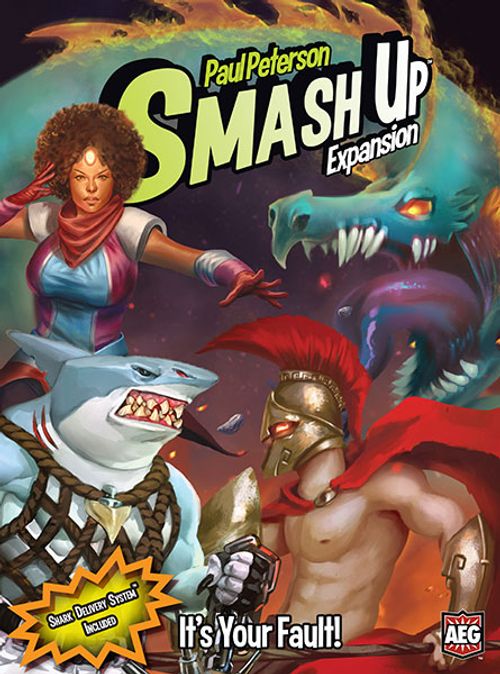
Smash Up: It's Your Fault!
Smash Up: It's Your Fault! Rulebook
Table of Contents
Table of Contents
Game Contents
This set contains:
- 5 factions with 20 cards each (100 cards total)
- 10 base cards
- 5 card dividers
- 1 token sheet (used as both Victory Points tokens and +1 power counters)
- This rulebook
Use the snazzy dividers in this set with the Big Geeky Box, the ultimate in high-performance Smash Up storage. Look for it in stores!
Growing On You
It's Your Fault! is an expansion to the Smash Up core set. It is still a fully operational battle station for 2 players though!
These rules sometimes talk like you've got more than just five factions, or mention cards that aren't in this expansion. If you don't already have the core set, just think of it as viral advertising.
Look for these expansions to Smash Up in stores now!
Setup
Each player shuffles together two different 20-card factions to make a 40-card deck.
Superheroes! + Sharks! = Superhero Sharks!
If you have two copies of It's Your Fault!, different players can use the same faction, pitting Superheroes against Superheroes, for instance. But one player can't play with two copies of the same faction. I mean, come on.
Kickin' It Queensberry
For formal play, put at least 8 factions in the middle of the table. Randomly determine who goes first. The first player chooses one faction. Choice continues clockwise. When everyone has chosen one faction, the last player chooses a second faction. Choice continues in reverse order.
Building the Base Deck
Shuffle the base cards together to make a deck. Draw one base per player, plus one (for example, use four bases for three players). Place the bases face up in the middle of the table.
Each player draws five cards. If you have no minions in your opening hand, you may show your hand, discard it, and draw a new hand of five cards. You must keep the second hand. Whoever got blamed for something most recently goes first. Play continues clockwise. You're ready to smash up some bases.
The Smash Up world has grown from the original 8 factions to 42, and there's still more to come. That's great! But you don't have to play with all the bases at once. Each set comes with bases meant to go along with the factions in that set: Cthulhu bases deal with Madness cards, Munchkin bases deal with monsters and treasure. If you just shuffle all 84 bases together, there isn't much chance for a player to get to see the bases that are best for the factions they are playing!
So, after everyone chooses their factions, grab just the bases from the sets they came from. For example, if you have Greek Ninjas vs. Vampire Tornadoes, take the bases from the original game, Monster Smash, and It's Your Fault! to make your base deck. There you go!
This Is How You Roll
1. Start Turn
Some abilities happen at the start of your turn. This is when that goes down. Yo.
2. Play Cards
On your turn play one minion, play one action, or play one of each… for free! You can play your cards in any order. You don't have to play any cards.
Minions
To play a minion, choose a base and put the minion card beside it, facing toward you. Do what the card says. (Cards that start with Special are a special case. See page 11 for an explanation.)
Actions
To play an action, show your card and do what it says. Boom! Then discard the action (unless it told you to play it on a base or minion).
3. Score Bases
After you are done playing cards, check to see whether any bases are ready to score (see page 7). If any are ready, you must start scoring.
4. Draw 2 Cards
Just what it says: draw 2 cards. If you need to draw, reveal, search for or look at a card and your deck is empty, shuffle your discard pile and put it on the table face down— that's your new deck. Start drawing from there.
The maximum number of cards you can have in your hand at this time is 10.
If you have more than 10 after drawing, discard down to 10.
5. End Turn
Anything that happens at the end of the turn happens here. Then check to see if any players have 15 or more victory points. If so, see Game Over, Man! on page 8. Otherwise play passes to the player on the left.
Cheater! Y U Action Twice?
Abilities only happen when you play a card from your hand, or any time a card says "play." When minions just move around, that's not playing them.
Get to Know Your Cards!
Minions have: Power, Name, Ability, Minion Identifier, Faction Symbol.
Actions have: Name, Ability, Action Identifier, Faction Symbol.
Bases have: Breakpoint, Name, Third Place VP, Winner VP, Runner Up VP, Ability.
This is what the base does. Its ability always operates while the base is in the middle of the table. It's sort of a combination of Special, Ongoing, and Awesome.
The Big Score
Score a base if the total power of all minions on that base equals or exceeds the base's breakpoint (see page 6). If more than one base is ready to score, the player whose turn it is decides which one to score first.
When a base has been chosen to score, each player first gets to use any Special abilities that happen "before" the base scores. If the total power on a base drops below its breakpoint after it is chosen, you still finish scoring the base.
For example, the Shark player has Megalodon destroy a Cyclone, so the Tornado player plays Over the Rainbow and moves Megalodon to another base. Even though the total power is below the breakpoint, it still scores.
Me First!
If more than one player wants to use a Special ability, starting with the current player and going clockwise, each player uses a Special or passes. You can use a Special after passing, but it stops when all players pass in sequence. If your Special allows you to play extra cards, you must play those immediately or not at all.
Awarding VP
The players with the highest, the 2nd highest, and 3rd highest power on a base are the winner, runner up, and third place! They get victory points equal to the 1st, 2nd and 3rd number on the base card respectively. Anyone with the 4th highest power or lower gets nothing. If there are less than 3 players on a base, no one gets the VPs for the unclaimed spots. Dispense VP tokens in the appropriate amounts to everyone who scored. Special abilities that happen "when" a base scores may change how this happens. You must have at least one minion on a base to get victory points.
Back to Your Corners
After scoring, players can use Special abilities that happen "after" a base scores. Then all cards still on that base go to their owners' discard piles. This does not destroy them, but might trigger abilities that happen when they go to the discard pile.
Put the scored base into the base discard pile. Replace it with the top card of the base deck. Shuffle the base discard pile if needed. Check to see if another base is ready to be scored. Score it too, the same way.
Tie Fighter
If players are tied on a base, all involved players get points for the best position they tied for. So, if three players had 10, 10, and 5 power on a base when it scores, the winners with 10 power each get first place points! The player with 5 power then gets third place, not second. If two players tie for runner up, no one gets third place. Harsh.
If players tie for a base's ability, they each get to use it. See Me First! on the previous page to settle conflicts.
Scoring order:
- Bases are checked to see if any are ready to score. If none are, go to the next Phase.
- The current player chooses a base that is ready.
- Players may play and/or invoke any "Before scoring" special abilities.
- VPs are awarded according to the current power totals. "When scoring" abilities may trigger now.
- Players may play and/or invoke any "After scoring" special abilities. This may affect steps 6-8.
- All cards on the base are discarded.
- The base is discarded.
- A new base is chosen to replace it.
- Go to step 1.
Game Over, Man!
At the end of any turn that someone reaches 15 VP, the player with the most victory points wins. If there is a tie for the most, keep playing turns until there isn't. No sharing! Except for your two factions. You guys are BFFs.
Terms and Restrictions
Some restrictions apply. See rules for details. Supplies limited.
Affect: A card is affected if it is moved, returned, destroyed, placed, or is changed in power or controller, has an action attached, or its ability canceled.
After: "After X do Y", means X is completely resolved before Y is done. (Unless X is "a base scores", page 7.)
Cancel: This means the ability is treated as if it does not exist.
Control: By default, each card you play is controlled by you. If you take control of a card, it is just like you were the person who played it: minions add to your power total, abilities on the card apply to you and you can use them, etc. Controlling a minion does not mean you control any actions played on it, but their abilities apply normally. When the card leaves play, it returns to its owner, not its current controller.
Destroy: This lets you remove a card that's in play and put it in its owner's (or the base) discard pile.
Discard: This lets you put a card that is not in play into the discard pile. It comes from your hand unless it says otherwise.
Extra: An extra minion or action is one you can play in addition to the normal quota of one of that type per turn. Extra cards are optional, and you don't have to play the extra card right away, unless the extra card was gained by a Special ability or outside the Play Cards phase.
In Play: Cards in play are in the middle of the table, i.e. an active base or any card on it. Cards in the hand, deck or discard pile are not in play.
Move: This lets you move a minion from one base to another, along with any actions on it. Moving a card does not count as playing it. Minion abilities do not happen when you move a card, but Ongoing, Special and Talent abilities still have their effects.
Ongoing: Most abilities happen and then they're over, or else they end at the end of the turn. Ongoing abilities are active for as long as they're around.
On your turn: This means during the normal Play Cards phase of your turn.
Owner: The player whose deck the card originally came from. Monsters and treasures have no owner.
Place: This lets you relocate a card in a way not covered by other terms, such as from a base to the bottom of your deck, or from the discard pile to your hand.
Play: You play a card when it's one of the free cards you get in step 2, or any time an ability specifically says that you're playing it. A card's ability happens when you play it. When cards are moved, placed, or returned, they're not being played, and their abilities don't happen.
Return: This means that a card goes back where it came from. When a card returns from a base, discard attachments on that card.
Special: Most abilities happen when you play a card. Special abilities happen at unusual times or in unusual ways. Special abilities might trigger on a card already in play, or in your hand or discard pile. A card's ability will describe how it can be used. If you use a Special ability to play a card on your turn, it doesn't count as one of your free cards for that turn.
Talent: This is an ability that the minion or action may use once during the Play Cards phase of each of your turns. You don't have to use it if you don't want to.
To: Some cards say, "Do X to do Y" (e.g. "Discard cards equal to a minion's power to destroy it.") With these cards, if X gets thwarted for any reason (e.g., you don't have enough cards in hand), then you can't do any of X, or Y, either. So there.
Transfer: This lets you relocate action cards or power counters from one minion to another. When adding counters to your minions (from the pool), or discarding counters from your minions (to the pool), that's not transferring.
Clarifications
Argonaut: If this is played as an action, it doesn't count towards the 1 minion quota, but it is still a minion in other ways. Whether played as an action or minion, it triggers Spartan, Jason, etc.
Burn It Down: Actions on minions are not destroyed. You may not look at the top base deck card before choosing a base.
Chum: The minion destroyed can be at any base.
Great Wyrm, Ruins: This has no effect on VPs awarded by abilities.
Hammerhead: If several minions at its base are destroyed at once, it gets a power counter for each one.
Heracles, Odysseus: These trigger after every action, not just the first in a turn. "Any player" includes the controller.
Imperial Dragon: Moving this minion activates it.
Jason: Minions played after Jason in the same turn get his benefit. Minions moved off the chosen base lose the benefit.
Mind Lady: The cancelation lasts even if Mind Lady is no longer in play.
Not In Kansas: Actions on minions are also destroyed.
Spartan, Jason: If you play an action before this card in the same turn, there is no benefit from this card this turn.
Twister: Twister can move itself.
Void Where Prohibited
Often, card text and rules text will conflict. When there's a fight, card text wins. It has a black belt in rule-fu.
Exception: Minion power and base breakpoint are never reduced below zero.
If cards conflict, the one that says you can't do something beats the one that says you can.
If multiple effects would happen at the same time, the player whose turn it is chooses the order.
You can play a card even if its ability can't happen. For example, you can play an action that destroys a minion even if no minions are in play. This helps you get unneeded cards out of your hand.
You must follow a card's ability, even if it's bad for you. However, if a card says you "may" do something, you have a choice whether to do it.
If an ability says "any number" you may choose one, or even zero. You may play a card that says "all" even if there are no targets.
If you get to play extra minions or actions while a base is being scored, you must play those extra cards immediately or not at all.
When a card goes to the hand, deck or discard pile, it goes to the one belonging to the card's owner (i.e. the player whose deck the card came from), no matter who played or controlled it.
When a card leaves play, any cards on it are discarded.
Specials may be played at any time they are applicable, even on other players' turns.
Anyone may look through any discard pile at any time.
"A minion" or "minions" means any minion in play, unless stated otherwise.
The power of a minion not in play is only the number printed on it, but once in play its power includes all modifications. If not stated, the effects of an ability expire at the end of the turn, or when its card leaves play, whichever is sooner.
"You" on a minion or action means the controller of the card; on a base it means any player it describes, often the current player. "Other players" means everyone except "you".
"Here" means the base the card is at; "there" means the base just referred to on the card.
If you "look" at a card, show it to no one else. If you "reveal" it, show it to everyone else.
The Factions
This set of Smash Up features five factions, which combine to make 10 possible decks. As more factions join and try to take over the world in future expansions, the full number of possibilities will grow. Mix and match factions to suit your play style.
Dragons
Here there be Dragons! These massive monstrosities of legend have come to Smash Up, and they took smashing bases literally. They have little time for your opponent's shenanigans, for other factions are crunchy, and taste good with ketchup.
Mythic Greeks
This is the story of a time long ago – a time of myth and legend. When the ancient gods were petty and cruel, and they plagued mankind with suffering... The ancient gods and heroes of Greek myth have returned, bringing their favors and curses, heroics and bravery to your Base battles!
Sharks
The most perfect killing machines. Predators that have evolved to the apex of their realm. And now they want our realm! Sharks are coming on land to show that they have what it takes to be at the top of the food chain in and out of the water. Just when you thought it was safe to go back to the convenience store…
Superheroes
Faster than a speeding bullet. More powerful than an aggromotive. Able to leap tall Nukebots in a single bound... The mighty power of the comic page comes to life! Defeat your arch-nemesis with super strength, speed, and toughness. Then find out who wins the base in the next exciting issue!
Tornados
Ok, yes, we hope you get the obvious joke. But hey, Tornados are pretty awesome in this game (not as much in real life). Get ready to spread minions all over the place with these excellent Shark Delivery Systems™.
Moar Factions!
Does more than one person want to play Sharks? Great! Combine two sets of Smash Up so people can draft and play the same factions against one another. Remember, you can't put two of the same faction together though! Just use one set of bases when combining.
All Your Basics
Set Up
Each player chooses two factions and shuffles them together to make a 40-card deck. Draw a hand of five cards. Place one more base card than you have players in the middle of the table (for example, use five bases for four players).
On Your Turn
Play 1 minion and 1 action in either order. You can play less if you want to. Follow all instructions on card abilities as you play them.
Check to see whether any bases can be scored. If they can, score them.
Draw two cards. Discard down to a hand of 10 if necessary.
Scoring
After you are done playing minions and actions, if the total power of all minions meets or exceeds a base's breakpoint, that base scores. The player with the highest power at that base is the winner and scores first place victory points. Second highest is the runner up and scores second place. Third highest scores third place. In case of a tie, each player receives full victory points for the highest place he or she qualified for.
Resolve the ability on the base, discard minions there, and then replace it.
Winning
When a player has 15 or more victory points at the end of a turn, he or she wins. If two or more players have more than 15 VP, the one with the most victory points wins. In case of a tie, play another turn.
Additional Rules
When a card disagrees with the rules, the card wins.
If cards conflict, the one that says you can't do something beats the one that says you can.
If multiple effects happen at the same time, the player whose turn it is determines their order.
You can play a card even if its ability can't happen.
You must follow a card's ability, even if it's bad for you. If a card says you "may" do something, you have a choice whether to do it.
If an ability says "any number" you may choose zero. You may play a card that says "all" even if there are no targets.
Anyone may look through any discard pile at any time.
If you are playing with the Obligatory Cthulhu Set, remember to check for Madness cards VP reduction at the end of the game. If, after players have counted their Madness cards up, any players are tied for most victory points, the player with the lowest number of Madness card wins.