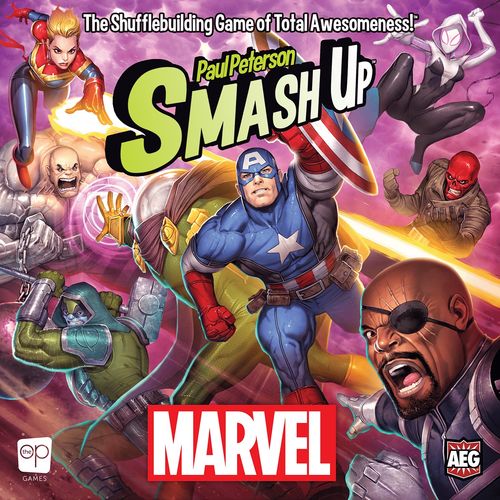
Smash Up: Marvel
Smash Up: Marvel Rulebook
Table of Contents
Table of Contents
- Objective
- Game Contents
- Growing on You
- Get to Know the Cards!
- Setup
- The Phases of a Turn
- Resolving Cards and Abilities
- The Big Score
- Me First!
- Awarding VP
- Fighting to a Draw
- Back to Your Corners
- Scoring Order
- Declaring Victory
- New Terminology
- Game Terms and Restrictions
- Game Terms and Restrictions Continued
- Clarifications
- Clarifications Continued
- Void Where Prohibited
- The Factions
- All Your Basics
Objective
Your goal is to be the strongest force! Use your characters to exert control at bases to earn Victory Points. The first player to have 15 VPs at the end of a turn wins!
Game Contents
This set contains:
- 160 Game Cards (8 Factions with 20 cards each)
- 16 Base Cards
- 8 Card Dividers
- 1 VP Token Sheet
- Rulebook
Growing on You
Smash Up: Marvel is a stand-alone game, that is also fully compatible with the original Smash Up and all its expansions.
The snazzy dividers in this set don't just summarize what the factions do, they are made to be used with the Bigger Geekier Box, the ultimate in high-performance Smash Up storage. Look for it in stores!
Get to Know the Cards!
Characters
Each character card shows: Power, Name, Character Identifier, Ability, and Faction Symbol.
Example: Captain America — Power 5. Character. Talent: Give each of your other characters currently here +1 power until the end of the turn. Faction: Avengers.
Actions
Each action card shows: Name, Action Identifier, Ability, and Faction Symbol.
Example: Two More Shall Take Its Place — Action. Destroy one of your characters. After it is destroyed, play up to two characters of power 2 or less as extra characters onto that base. Faction: Hydra.
Bases
Each base card shows: Breakpoint, Name, Winner Victory Points (VP), Runner Up VP, Third Place VP, and Ability.
Example: Helicarrier — Breakpoint 24. Winner VP 5, Runner Up VP 3, Third Place VP 2. Ability: On your turn, if you have a character here, you may move one of your other characters from another base to here.
This is what the base does. Its ability always operates while the base is in play. It's sort of a combination of Ongoing and Awesome.
Setup
Each player selects two different factions to play with, and is considered the owner of the cards they choose, for game play purposes. Shuffle together your two factions to make a 40-card deck.
Who's On Your Side?
For formal play, put at least 2 factions per player in the middle of the table. Randomly determine who goes first. The first player chooses one faction. Choice continues clockwise. When everyone has chosen one faction, the last player chooses a second faction. Choice continues in reverse order.
Shuffle all the base cards together. Draw one base per player, plus one (e.g., four bases for three players), and place them face up in the middle of the table.
Each player draws five cards from their deck. If you have no characters in your opening hand, you may show it, draw a new hand, and shuffle the old hand into your deck; you must keep the second hand.
Whoever most recently read a Marvel comic book goes first. Play continues clockwise.
The Phases of a Turn
1. Start Turn
Some abilities talk about "the start of your turn." This is the phase when they can all happen — not just the first one. Abilities which last until the start of your turn end, and then any abilities which happen at the start of your turn happen in whatever order the current player wants.
2. Play Cards
This is when you play your cards. You can play one character, one action, or both, but you don't have to play any cards. You may also have abilities on cards you've already played that you can activate during this phase. All of this can be done in any order.
Character
To play a character, choose a base and put the character card beside it, facing toward you. Then do what the card says. A character's main job is to add its power to its controller's total power on a base.
Actions
To play an action, show the card and do what it says. If it's a modifier it is played next to a base or character, and it stays there; otherwise you discard the action after using it.
Abilities
Each set of instructions on a card is called an ability. Most cards only have one, but some have more. Abilities come in different types:
Unless an ability has one of the labels below, it is an On-play ability and is resolved immediately after the card is played. (But not after it is moved.)
Ongoing: Ongoing abilities either are always taking effect as long as their conditions are met – which may start once the card is in play – or they are resolved after a particular trigger.
Special: Special abilities are resolved at unusual times, as the card itself explains. (See p. 10.)
Talent: A Talent can be activated once during each of your turns, during the Play Cards phase only.
3. Score Bases
After you are done playing cards, check to see whether any bases are ready to score. If any are ready, you must start scoring. See pp. 6-7.
4. Draw 2 Cards
Do what it says: draw two cards.
If your hand is empty at other times of the game, you don't get an automatic draw; you have to wait for this phase of your turn. But if your deck is empty when you need to draw, reveal, search for, or look at a card, shuffle your discard pile to make your new deck, and keep going.
After drawing, the maximum number of cards you can have in your hand is 10. If you have more, discard down to 10. If your hand is bigger than 10 at other times of the game, that's OK: you wait until now to discard down.
5. End Turn
Just like the start, there's a phase for the end of the turn. Things that happen now (like destroying a character or drawing a card) happen first; if there is more than one, the current player chooses their order. After that, all abilities that expire now (like "+1 power until the end of the turn") expire at the same time.
Finally, check to see if any players have 15 or more Victory Points. If so, see Declaring Victory on p. 7. Otherwise the turn is over and play passes to the player on the left.
Resolving Cards and Abilities
Sometimes it can be difficult to decide what order to do things in. If you play an action while a card in play says "When someone plays an action…", do you finish your action first, or stop to deal with the card in play first? Let's lay it all out.
A newly played card's On-play ability is resolved before any abilities on other cards.
If an ability has multiple effects, they are resolved in the order they appear on the card.
- If the effects are ordered in a dependent way – e.g. "Do X to do Y", "You may do X; if you do, do Y" – then if X is not resolved for any reason, Y is not resolved. (For example, if for Sonic Shockwave you target Hawkeye on Avengers Tower, you do not gain 1VP since Hawkeye isn't destroyed.)
- If the effects are ordered in an independent way – e.g. "Do X and then do Y", "Do X. Do Y" – then later effects are resolved even if the earlier effects cannot be. (For example, if you play Modular Tech and have no modifiers in play you still may play an extra action.)
After an ability is resolved, all abilities that are triggered by its effects are resolved. After a card is played, all abilities triggered by playing a card are resolved, along with those triggered by its On-play ability if it has one. If more than one ability is triggered, see "Me First" (p. 6) to figure out their order.
For an ability to respond to a trigger, its card needs to be in play when the triggering event happens. (For example, if you use Nick Fury to play Maria Hill, she doesn't get +1 from the play of Fury.) It also needs to be in play when the event finishes resolving, unless the trigger itself made the card go out of play. (If you use Red Skull's ability on itself you still get to draw cards.)
If one card (A) causes another card (B) to be played immediately, B's resolution takes precedence, and the resolution of A pauses until B is finished resolving. If the card is not played on another card (on a base or on a character), then it is discarded after it is resolved and all other cards triggered by it are resolved.
The Big Score
Each character on a base adds its power to the total power on the base. During the Score Bases Phase of any turn, if the total power on a base equals or exceeds that base's breakpoint (p. 3) the base will score. If more than one base is ready to score, the player whose turn it is decides which one to score first.
After a base has been chosen to score, abilities that happen "before" the base scores are triggered and resolved.
Once a base has been chosen to score, nothing can stop it. Even if the total power is reduced to below the base's breakpoint, you still keep scoring.
For example, before a base scores, one player plays Widow's Bite to give all other players' characters there -1 power each. Even if the total power goes below its breakpoint, the base still scores.
Me First!
When resolving abilities while scoring a base, just as when responding to any trigger, you first resolve abilities of cards in play that do not say "may", or that say "each player may". These abilities are mandatory. They are resolved in the order chosen by the current player.
Then you resolve optional abilities, which includes cards in play that say a single player "may" do something, as well as all triggered Special abilities in the hand. If more than one player wants to use an optional ability, then each player, starting with the current player and going clockwise, uses one such ability (in-play or from the hand) or passes. You can use an ability each time it comes around to you, and you can use one after passing, but once all players pass in sequence, that ends it.
If while resolving optional abilities, a card with a mandatory Ongoing or Special ability enters play, it is resolved immediately before continuing with the next player.
Awarding VP
The players with the highest, 2nd highest, and 3rd highest power on a base are the winner, runner up, and third place! They get victory points equal to the 1st, 2nd and 3rd number on the base card, respectively.
Anyone with the 4th highest power or lower gets nothing. If there are fewer than 3 players on a base, no one gets the VPs for the unclaimed spots. Dispense VP tokens in the appropriate amounts to everyone who scored. Abilities that happen "when" a base scores may change how this happens, or add to it (e.g. A Portent of Doom). You must have at least one character or 1 power on a base to get victory points. A character with 0 power can earn VPs if zero is one of the three highest power totals.
Fighting to a Draw
If players are tied on a base, all involved players get points for the best position they tied for. So, if three players had 10, 10, and 5 power on a base when it scores, the winners with 10 power each get first place points! The player with 5 power then gets third place, not second. If two players tie for runner up, no one gets third place. Harsh.
If players tie for use of a base's ability, they each get to use it, starting with the current player and going clockwise. If using it twice doesn't make sense, then only the first player gets to use it.
Back to Your Corners
After awarding points, players can use abilities that happen "after" a base scores, in the same order described under "Me First". They are carried out immediately if possible, but they may need to wait until conditions allow it (e.g. if it affects how the next base is chosen).
Then all cards still on that base go to their respective discard piles simultaneously. Going to the discard pile after scoring is not the same as being destroyed; however, it still might trigger other abilities.
Put the scored base on the base discard pile. Replace it with the top card of the base deck; shuffle the base discard pile if the deck ran out. Check to see if another base is ready to be scored. If so, score it too, the same way.
Scoring Order
- Bases are checked to see if any are ready to score. If none are, go to the Draw 2 Cards phase.
- The current player chooses a base that is ready.
- Players may play and/or invoke any "Before scoring" abilities.
- VPs are awarded according to the current power totals. "When scoring" abilities trigger now.
- Players may play and/or invoke any "After scoring" abilities. This may affect steps 6-8.
- All cards on the base are discarded.
- The base is discarded.
- A new base is chosen to replace it.
- Go to step 1.
Declaring Victory
Check for a game winner at the end of each turn: if at least one person has 15 VP, the player with the most victory points wins! But if there is a tie for the most, everyone keeps playing until there is no tie. No sharing! Except for your two factions. You guys are BFFs.
Once one player gets a winning VP total, you should still play until the end of the turn -- unless everyone agrees that there is no chance for anyone else to catch up.
New Terminology
While Smash Up Marvel plays with the same rules as other Smash Up sets, it talks about the rules a little differently. Here is a guide to the differences:
Characters
The word "character" is an exact synonym for "minion" in the other sets. Any reference in Smash Up Marvel to characters also refers to minions in the other sets, and vice versa.
Modifiers
A card that says "Base/Character modifier" is the same as one that says "Play on a base/minion" in the other sets. A card in Smash Up Marvel that refers to modifiers also refers those similar actions in the other sets. Cards in the other sets that refer to actions that are played on bases or minions also refer to modifiers.
Move
In the other sets, the word "move" was used for relocating minions from one base to another, and "transfer" was used for relocating actions from one card to another. In Smash Up Marvel, "move" is used to relocate both characters and modifiers.
Game Terms and Restrictions
Some restrictions apply. See rules for details. Supplies limited.
Affect: A card is affected if it is moved, removed from play (i.e. destroyed, returned, shuffled, or placed), changed in power or controller, or has a modifier attached to it, or its ability cancelled.
After: "After X do Y", means X is completely resolved before Y is done (unless X is "a base scores", p. 7.), and that Y is done right after X.
Cancel: Cancelling an ability means the ability is treated as if it does not exist.
Control: By default, each card you play is controlled by you. If you gain control of a card, it is as if you had played it: characters add to your power total, abilities on the card apply to you and you can use them, etc. Controlling a character does not mean you control any modifiers on it, although their abilities apply normally. When the card leaves play, it goes to the hand, deck, or discard pile of its owner, not its current controller. To "have" a card or power at a base means you control it. "Your" cards are the ones you control.
Destroy: This lets you remove a card that's in play and put it in the discard pile.
Discard: This lets you put a card that is not in play, or that is on a base that has just been scored, into the discard pile. It comes from your hand unless it says otherwise.
Extra: An extra character or action is one that is not counted against your normal limit of one per type per turn. Extra cards are optional.
You may always play an extra card immediately. If an ability gives you an extra card during the Play Cards phase, you may choose to wait and play it later in that phase, unless it was given by a Special ability, or a later part of the ability depends on playing the card (e.g. giving +1 power to an extra character), or if it refers to a specific card (e.g. a card revealed from the top of the deck). An extra card with constraints (e.g. a character of power 2 or less) is not a specific card and can be played later.
In Play: Cards in play are in the middle of the table, i.e. an active base or any card on it. Cards in the hand, deck, or discard pile, or set aside, or in the box, are not in play.
Modifier: An action that is played on a card of a specified type, e.g. base or character. The modifier stays with the card it is attached to until that card leaves play, or the modifier is moved or removed from play. The modifier is controlled by the person who played it, even if it is attached to a character with a different controller. You don't need any characters at a base to play a base modifier there or use its ability, unless the card says otherwise.
Move: This lets you relocate a character or modifier from one card to another, along with any cards on it. Moving a card does not count as playing it. On-play abilities do not trigger when you move a card, but Ongoing, Special, and Talent abilities still have their effects.
On your turn: This means during the normal Play Cards phase of your turn. You can only do it once per turn unless it says otherwise.
Ongoing: Ongoing abilities are active for as long as they're in play, and/or they trigger at some later time while in play. They do not work from the hand, deck or discard pile.
Owner: The player who had the card at the start of the game.
Place: This lets you relocate a card in a way not covered by other terms (play, move, return), such as from a base to the bottom of your deck, or from the discard pile to your hand.
Play: You play a card when it's one of the free cards you get in the Play Cards phase, or any time an ability specifically says that you're playing it. A card's On-play (i.e. unlabeled) ability happens when you play it. When cards are moved, placed, or returned, they're not being played, and their abilities don't happen.
Game Terms and Restrictions Continued
Return: This means that a card goes back where it came from. When a card returns from a base, discard attachments on that card, and put it in its owner's hand.
Special: Most abilities happen when you play a card. Special abilities happen at unusual times or in unusual ways. Special abilities might trigger on a card already in play, or in your hand or discard pile. A card's ability will describe how it can be used. If you use a Special ability to play a card on your turn, it doesn't count as one of your free cards for that turn.
Talent: This is an ability that you may use once during the Play Cards phase of each of your turns. You don't have to use it if you don't want to.
To: Some cards say, "Do X to do Y" (e.g. "Discard cards equal to a character's power to destroy it.") With these cards, if X gets thwarted for any reason (e.g., you don't have enough cards in hand), then you can't do any of X, or Y, either. So there.
Clarifications
A Portent of Doom: Once this card is in play, it does not stop other players from playing or moving their characters to its base.
Agent Coulson, First to Arrive, Hydra Agent, Ichor Base, Mysterio, Proving Ground, S.H.I.E.L.D. Base, Troop Drop, Two More Shall Take Its Place: Though there are constraints on the extra card played, you can choose to play them later in the same Play Cards phase; they do not refer to specific cards (as Hawkeye's Arrows does, for instance).
Aid from Allies: You draw a card both when the card is first played, and after moving characters to its base. Moving multiple characters with a single ability (e.g. Heroic Landing) lets you draw only one card, but each other ability that moves characters there lets you draw another card.
America Chavez: When this character is moved at the same time as other characters (e.g. with Heroic Landing), it gets +1 power for each other character moved from its same base, but it does not get +1 power for any characters moved to the same base, since it wasn't at that base before they moved there.
Arnim Zola: Characters whose printed power is 2 or less help this card even if abilities make their actual power higher.
Baron Strucker, Two More Shall Take Its Place: The part "after it is destroyed" is triggered by the earlier "destroy", so it can be resolved before or after other abilities that are triggered by the destruction. In particular, Baron Strucker can destroy a Hydra Agent, play its extra characters, and move them to his base.
Black Mamba, Ulysses Klaw: Round the VPs down, e.g. if you have 7VP you only get +1 power or draw one card.
Captain Marvel: This gives +1 power only if it is moved by its Talent, not if it is moved by other cards.
Castle Zemo, Manhattan: Although these say "may", they apply to multiple players, so treat them as mandatory abilities when considering the order of resolving abilities (see Me First p. 6). Players choose whether to use the ability in turn order starting with the current player.
…Comes Great Responsibility, Repulsor Boots, With Great Power…: If you use its Special ability, you do not use its On-play ability.
Cosmic Knowledge: You can choose to place zero cards on the bottom of your deck and still draw one card.
Doctor Octopus: If its ability makes the breakpoint less than or equal to the total power there, the base doesn't score yet; it's still the Start of Turn phase, and you don't score until the Score Bases phase later in the turn.
Fanatical Devotion: This affects your characters on that base whether they were there already or played later. It stops affecting a character that moves away, or if Fanatical Devotion itself is moved or destroyed. Destroying more than one character there in a turn does not trigger this again.
Hulk Smash: If you destroy the base, all base modifiers there are discarded because their base left play. This card keeps the characters in play onto the new base but they are not replayed; characters keep any modifiers they have. Destroying a base doesn't score it.
Miles Morales: You can play one, two, or all three copies of this card onto the same breaking base, as long as you already have a character there.
Clarifications Continued
Prepare to Engage, Hawkeye's Arrows, The View from Above: If your deck is empty before you reveal any cards, shuffle your discard pile to make a new deck. If your deck runs out before you find the appropriate card(s), stop revealing and continue with the rest of the instructions.
Pressure from All Sides: All characters there count, not just yours. If the number of characters on the base changes after the talent is used, the reduction is unchanged.
Red Skull: Using its Talent lets you draw two cards, one for the Talent and one for the Ongoing ability. It may destroy itself and still draw two cards.
Repulsor Boots: When using its Special ability, you can move Iron Man to or from any base, not necessarily the scoring base.
S.H.I.E.L.D. Base: You don't need anything on the base to use its ability.
Spider-Man: This still gets +1 power if you play a card that has a Special ability without using it, e.g. if you play Miles Morales normally.
Supreme Intelligence, America Chavez, Blue Marvel, The Daily Bugle, Downtown, Maria Hill, Exo-Space, Stark's Lab, Spider-Man, The Triskelion: These are resolved every time their trigger happens, not just once per turn.
Webbed Up: This does not cancel the abilities of any other character modifiers attached to the same character.
Work Together, Captain America, Captain Marvel, Widow's Bite: They only affect characters in play when the ability is resolved, not those played afterward, but their effects continue even if they leave play before the end of the turn. The word "currently" helps make this clearer, but is not present in similar cards in other Smash Up sets.
World Domination, Doctor Octopus, Reroute the Power: The effect remains in force until its expiration time, even if the card causing the effect is moved or destroyed.
Your Friendly Neighborhood Hero, Baron Zemo, Cover the Exits, Rescue Mission: Several other Smash Up sets have cards that take or give control of characters, which is why these cards say "its owner's deck" instead of "your deck", in case you control characters you don't own.
Void Where Prohibited
Sometimes, card text and rules text will conflict. When there's a fight, card text wins. So there's an invisible "unless stated otherwise" with every rule in this book. Exception: Character power and base breakpoint are never reduced below zero.
If cards conflict, the one that says you can't do something beats the one that says you can.
If multiple effects would happen at the same time, the player whose turn it is chooses the order.
You can play a card even if its ability can't or doesn't happen. For example, you can play an action that destroys a character even if no characters are in play, or if the character you choose is immune to destruction.
You must follow a card's ability, even if it's bad for you. Exceptions: Talents and extra cards are optional, as are abilities that say you "may" do something.
If an ability says "any number" you may choose one, or even zero. You may play a card that says "all" even if there are no targets.
If you get to play extra characters or actions outside the Play Cards phase of your turn, you must play those extra cards immediately or not at all.
Anyone may look through any discard pile at any time. If you take a card out of the discard pile, show it to everyone.
"A character" or "an action" means any character/action in play, unless stated otherwise. Exception: "Play a character/action" means one from the hand.
When a card that others can see goes to the hand, deck, or discard pile, it goes to the one belonging to the card's owner (i.e. the player whose deck the card came from), no matter who played or controlled it.
When a card leaves play, any cards on it are discarded.
Specials may be played at any time they are applicable, even on other players' turns.
The power of a character not in play is only the number printed on it, but once in play its power includes all modifications.
"You" on a character or action means the controller of the card; on a base it means any player it describes, often the current player. "Other players" means everyone except "you". "Your" cards are those you control, whether or not you own them.
"Here" means the base the card is at; "there" means the location just referred to on the card.
If you "look" at a card, show it to no one else. If you "reveal" it, show it to everyone else. If you "search" your deck for a card, or choose a card to take from the discard pile, you must reveal the card chosen. After searching a deck it must be shuffled.
The Factions
Smash Up: Marvel features eight factions, which combine to make 28 possible decks. Counting all the Smash Up sets, there are now over 3300 possible faction combos! Mix and match factions to suit your play style.
Avengers
The Avengers faction assembles six mighty heroes whose different skills can handle any situation. Each has a signature action that can be used at any time, but is stronger when used with its hero. Though their numbers are few, they have several ways to cycle through their deck and recycle discarded cards to get what they need when they need it. Complexity: Low
Hydra
Cut off one head and two shall take its place! Hydra is not afraid of character destruction since it makes them stronger, especially when their leaders order it. Hydra characters can overrun a base, and since they have several ways to swell their numbers, it won't be long until they are ready for more conquests. Complexity: Medium-High
Kree
The Kree are an advanced militaristic race who strike down their foes with ruthless efficiency. Their strengths are in extra action play, additional power, and card draw. Their cards can be deployed for either long-term advantage or for devastating combos. Complexity: Low-Medium
Masters of Evil
The Masters of Evil seek to control the world through any means! In addition to the VP rewards from bases, they've developed alternate methods of getting VPs, and they get stronger the more VPs they have. They are also good at destroying characters, to slow other players, and increase their strategic gain. Complexity: High
S.H.I.E.L.D.
S.H.I.E.L.D. carefully monitors the world and stands ready to jump in to stop their foes. Its agents excel at both calling in extra characters for help and strengthening each other. Careful planning allows them to play cards in the right order to maximize their assets. Complexity: Low
Sinister Six
The Sinister Six love to prey on weakness. They have many ways to make bases weak, and get many benefits from weaker bases. They have several base modifiers and ways to reuse them and their characters. Since they make base breaking easier, they need to be careful to have the most power there when it happens. Complexity: Medium-High
Spider-Verse
Web-slinging heroes from parallel universes have come together in a common fight to protect their neighborhoods. They specialize in swinging in before and after bases score to sway things in their favor – as long as they have someone already there. But they can be even stronger when they join forces during their own turn, so they can be busy no matter whose turn it is. Complexity: Medium
Ultimates
The Ultimates patrol the universe looking for cosmic threats. They are strong in movement, and movement makes them stronger. They also work well together, so they can spread out, and then unite as a powerful team where the need is greatest. Complexity: Low-Medium
All Your Basics
Set Up
Each player chooses two factions and shuffles them together to make a 40-card deck. Draw a hand of five cards. Place one more base card than you have players in the middle of the table (for example, use five bases for four players).
On Your Turn
Play 1 character and 1 action in either order. You can play fewer if you want to. Follow all instructions on card abilities as you play them.
Check to see whether any bases can be scored. If they can, score them.
Draw two cards. Discard down to a hand of 10 if necessary.
Scoring
After you are done playing characters and actions, if the total power on a base meets or exceeds its breakpoint, that base scores.
The players with the highest, second highest, and third highest power get the victory points for the winner, runner up, and third place, as shown on the base. In case of a tie, each player receives full victory points for the highest place they qualified for.
Resolve the ability on the base, discard cards there, and then replace it.
Winning
When one or more players have 15 or more victory points just before a turn ends, the one with the most victory points wins. In case of a tie, play another turn.
Additional Rules
When a card disagrees with the rules, the card wins.
If cards conflict, the one that says you can't do something beats the one that says you can.
If multiple effects happen at the same time, the player whose turn it is determines their order.
You can play a card even if its ability can't happen.
You must follow a card's ability, even if it's bad for you. If a card says you "may" do something, you have a choice whether to do it.
If an ability says "any number" you may choose zero. You may play a card that says "all" even if there are no targets.
Anyone may look through any discard pile at any time.
USAopoly Customer Service: 5999 Avenida Encinas, Ste. 150, Carlsbad, CA 92008 — 1-888-876-7659 (toll free) — [email protected]
USAOPOLY is a trademark of USAopoly, Inc. © 2020 USAOPOLY. All Rights Reserved. © MARVEL. Manufactured by USAopoly, Inc. MADE IN CHINA. Colors and parts may vary from those pictured.
© 2020 Alderac Entertainment Group. Smash Up and all related marks are ™ and © Alderac Entertainment Group, Inc. 2505 Anthem Village Drive, Suite E521, Henderson, NV 89052. All rights reserved.
Smash Up mechanic designed by Paul Peterson, used under license by Alderac Entertainment Group.
Smash Up the Interwebs: www.alderac.com/smashup