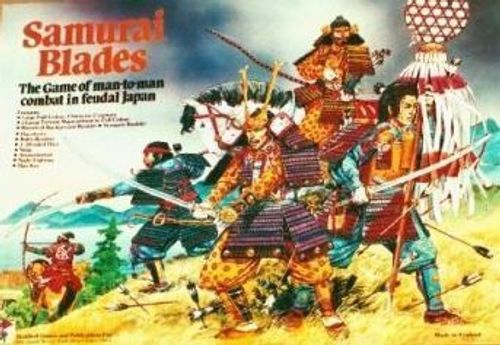
Samurai Blades: The Game of Man-to-Man Combat in Feudal Japan
Samurai Blades: The Game of Man-to-Man Combat in Feudal Japan Rulebook
Table of Contents
Table of Contents
- 1. Samurai Blades
- 2. Terrain Types
- 3. Game Turns
- 4. Shooting
- 5. Movement
- 6. Combat
- 7. Challenges
- 8. Seppuku, Glorious Suicide
- 9. Monks
- 10. Ninja
- 11. Lanterns
1. Samurai Blades
Introduction
Samurai Blades is both a self-standing game and a companion for Siege and Cry Havoc. On its own Samurai Blades has five different scenarios. There is a further scenario for use with Cry Havoc. Rules for using the system for competitions are included at the end of the Scenario Booklet. When used in conjunction with Siege and Cry Havoc, Samurai rules supersede those of the previous games. If playing a game using the castle, use Siege terrain rules.
Note: In this game the terms 'he', 'his' and 'him' have been used for convenience of expression. These terms include the feminine versions 'she', 'hers', 'her'.
2. Terrain Types
| Hex Type | Movement Point Cost Per Hex | Cover Type | Terrain Advantage |
|---|---|---|---|
| Bridge | 1 Foot. 2 Horses. No entry from river. | Light | 0 |
| Door in building wall | 1 | Medium | + |
| House interior | 1 Foot. Impassable to horses (except door hexes). | None | + |
| Rice paddy | 4 Foot. Impassable to horses. | None | - |
| River | Impassable to samurai and horses. 5 Foot. | Light | - |
| Scrub | 2 | Light | - |
For elaboration of cover types see section 4.9 Cover (Page 8).
3. Game Turns
"There is timing in everything. Timing in strategy cannot be mastered without a great deal of practice." - Musashi
Each game turn is played in two phases. First one player or side moves, shoots and engages in combat, then in turn the second player or side moves, shoots and engages in combat. Where a side is controlled by more than one player, all the players of that side move, shoot and engage in combat in one phase.
3.1 Sequence of Play
Each player's phase of a game turn is divided into six distinct steps. In each phase the term 'all' refers to all the characters of one player or side. The sequence of play is as follows:
3.2 First Player's Phase
- All bowmen on foot may shoot except for those who were in combat last turn.
- All horse archers may fire except for those who were in combat last turn.
- All characters may move.
- All bowmen on foot may shoot again, including those who were in combat in the previous game turn.
- All characters next to enemy characters may engage in combat. Some may advance after combat.
- All friendly characters stunned during the enemy phase are flipped back over.
End of first player/side's phase.
3.3 Second Player's Phase
Follow the same sequence of steps as for the first player.
4. Shooting
"One of the virtues of the bow is that you can see the arrows in flight and correct your aim accordingly. You must appreciate the importance of this." - Musashi
To shoot at an enemy:
- Calculate the range to the target (so many hexes excluding the shooter's hex). Add one to die roll for medium range, add two for long range.
- Note the target type. For mounted samurai refer to the first Missile Results Table. For dismounted samurai or other targets use the second Missile Results Table. Samurai monks count as samurai - ordinary monks as "others".
- Find what cover the target is in (none, light, medium or heavy). Refer to the appropriate column in the Missile Results Table.
- Throw the die and read the result of the shot from the table.
Players should also refer to section 4.4 Restrictions on Shooting (Page 6).
4.1 Missile Weapon Ranges
Ranges are given in hexes.
| Short Range | Medium Range | Long Range | |
|---|---|---|---|
| Foot Longbow | 1-30 | 31-90 | 91-150 |
| Mounted Longbow | 1-20 | 21-40 | 45-100 |
4.2 Missile Results Table
Missiles against mounted targets (Longbow). Heavy cover is impassable to horses.
| Die | None | Light | Medium |
|---|---|---|---|
| 1 | D | C | B |
| 2 | C | B | B |
| 3 | B | B | A |
| 4 | B | A | |
| 5 | A | ||
| 6-10 |
Key
- A - Defender retreats 4 hexes. +
- B - Horse killed - Rider wounded and dismounted.
- C - Horse unharmed - Rider wounded and dismounted.
- D - Horse killed - Rider wounded and dismounted.
- Defender must retreat immediately. He may retreat through friendly characters. He must not retreat through hexes adjacent to enemy characters. If unable to retreat the full distance defender is "wounded" instead.
Special - Stunned and wounded characters are considered dead if they receive further injury.
4.3 Missiles Against Infantry
Target Type: Dismounted Samurai and Samurai Monks
| Die | None | Light | Medium | Heavy |
|---|---|---|---|---|
| 1 | C | B | B | A |
| 2 | B | B | A | |
| 3 | B | A | A | |
| 4 | A | A | ||
| 5 | A | |||
| 6-10 |
Target Type: Other Infantry and Monks
| Die | None | Light | Medium | Heavy |
|---|---|---|---|---|
| 1 | C | C | B | A |
| 2 | C | B | B | A |
| 3 | B | B | A | |
| 4 | B | A | A | |
| 5 | A | A | ||
| 6 |
Key
- A - Defender retreats 2 hexes. +
- B - Wounded.
- C - Killed.
- Defender must retreat immediately. He may retreat through friendly characters. He must not retreat through hexes adjacent to enemy characters. If unable to retreat the full distance defender is 'wounded' instead.
Special - Stunned and wounded characters are considered dead if they receive further injury.
(Blank cells in the tables above: no effect.)
4.4 Restrictions On Shooting
General
For clarification of cover types, see section 4.9 Cover (Page 8).
A character may shoot at a target if an unobstructed 'line of sight' exists between the shooter's hex and the target hex. The 'line of sight' is a straight line drawn by the shooting player from any part of the shooter's hex to any part of the target's hex.
If this 'line of sight' crosses a hex containing either a character or terrain other than flat ground, then shooting is restricted as explained in the following sections.
Shooting over intervening characters
Longbowmen may shoot over a maximum of 4 intervening characters subject to all other cover limitations providing:
- The target is at medium or long range.
- The target is either in no cover or light cover.
Mounted archers may shoot over characters adjacent to them within the limitations of other shooting restrictions. This is because they are at a slightly higher elevation. See diagram.
Diagram caption: Character A is a mounted archer. Because he is higher than B he may shoot over him at character C. Character D is not mounted so may not shoot over E to hit F. A could not shoot over E to hit G because he is not adjacent to E.
Shooting over intervening terrain
If there is a scrub hex between the shooter and the target, the latter receives light cover.
If the line of sight crosses the lip of a slope hex (see diagram) AND the slope hex is closer to the character on the lower ground than to the character on the higher ground, then the line of sight is blocked and the shooter may not shoot at the target. Note that if the slope hex is an equal distance between the shooter and target, then the line of sight is blocked and the target cannot be shot at.
EXCEPTION: If there are two inward-facing slope hexes between the shooter and the target, then the slopes have no effect, as they form a 'dip' rather than a 'ridge'. Terrain in the shooter's or target hex does not block line of sight.
EXAMPLE (from the diagram)
- A may shoot at D, because the slopes form a 'dip'.
- A may not shoot at E, because the lip of the slope intervenes (slope hex is one hex from both A and E).
- B may shoot at D, because the slopes form a 'dip', but D receives light cover because the line of sight passes through a scrub hex.
- B may not shoot at E, because the slope hex intervenes.
- C may shoot at E, because no slope lip intervenes.
- C may shoot at D, because no slope lip intervenes (note that terrain in shooter's hex does not apply).
- D may shoot at C, but C receives medium cover.
4.5 Shooting Through Windows
Characters may shoot from window hexes at any angle provided that other characters and/or terrain do not intervene.
Characters shooting into buildings through windows may only shoot at targets occupying window hexes. EXCEPTION: if the shooter is outside the building and directly adjacent to the window, he may shoot at any target inside the building subject to normal cover limitations.
A character may shoot from a window hex into another door or window hex; he may not shoot from one window hex through another window or door hex.
4.6 Shooting Through Doorways
Characters may shoot from door hexes at any angle provided that other characters and/or terrain do not intervene.
Characters wishing to shoot in, or into the interior of, a building must be inside the building, or directly adjacent to a window of the same building, or in a doorway hex of the same building. They may then shoot at anyone in the building subject to normal cover limitations.
Characters shooting through gaps in exterior walls (i.e. entrances to courtyards) may shoot at any target that is not in infinite cover, and into door and window hexes subject to normal terrain and cover limitations.
4.7 Shooting At Targets In Tree Hexes
Characters may shoot into tree hexes. Characters may not shoot over or through tree hexes.
4.8 Wounded Characters Shooting
Characters who are wounded add one to the die roll when shooting. This is in addition to any modification for range.
4.9 Cover
Doors/Corners
Characters in door or exterior corner hexes receive medium cover.
Rivers
Characters in rivers do not block shooting. They may be freely fired over. Characters in rivers may not fire bows but may throw shuriken (ninja only).
Scrub
Characters may shoot missiles into, over or through scrub hexes. Characters in scrub hexes receive light cover. EXCEPTION: see Rule 4.4 (Page 7).
Slopes
Characters in slope hexes are in medium cover from missiles crossing the top lip of the slope. If the missile does not cross the top lip of the slope the target receives no cover.
Trees
Characters may shoot missiles into tree hexes, but missiles may not be shot over or through tree hexes. Characters in tree hexes receive light cover.
Walls
Characters behind walls receive infinite cover and may not be shot at.
Windows
Characters in window hexes receive medium cover from missiles passing through the window.
Horsemen in cover
A mounted character occupies two hexes. For cover classification, if he is in two different terrain types, he is considered to be totally in cover of the heavier type. EXAMPLE: a mounted character occupies a 'flat ground' hex and a 'scrub' hex; he is considered to be in light cover for cover purposes.
Barricades
Characters occupying barricade hexes only receive medium cover if the line of sight crosses the dark line at the front edge of the barricade marker. Characters in barricade hexes being shot at from the rear receive no cover. Once placed barricades may not be moved. Barricades may only be placed on flat ground hexes.
5. Movement
"Whether you move fast or slow, with large or small steps, your feet must move always as in normal walking." - Musashi
Each character has a movement point value printed on his piece (printed in blue on the counter). As he moves through each hex he expends points depending on the amount that each hex costs to pass through. Each turn a player may move all, some or none of his characters up to the maximum movement point value shown on the character counter. Unused movement points may not be accumulated and used in later turns.
5.1 Restrictions On Movement
Characters may not pass through hexes containing live enemy characters. Note that characters may pass through hexes containing live friendly characters.
Bridge hexes may not be entered from the river.
Walls are impassable and buildings and temples must be entered via doors and windows.
Horses may not enter the following hexes: temple, river, stairs, trees. Horses may not enter the interior of any buildings; they may however occupy door hexes and may enter courtyards.
Hexes containing a dead horse have their terrain movement cost doubled.
Hexes containing 3 or more dead men have their terrain movement cost doubled.
Hexes containing 2 dead horses or 6 dead men become impassable.
Note that where a hex contains a mixture of dead men and horses three dead men are considered to be of equal mass to one dead horse.
It takes two men an entire phase to clear a hex of bodies. During this time they may not move, shoot or attack. The owning player must specify to which hex the corpses are being moved to. Any bodies thrown into the river will be washed away and removed from the board.
Corpses may only be moved one hex per turn. Each two men clearing corpses may move one horse or three men per phase.
River
Neither mounted nor dismounted samurai may enter a river hex. Lighter infantry only may enter the river at the rate of five movement points per hex. Horses and samurai forced to retreat into the river are assumed drowned and are taken from the board.
Moving through windows
Only dismounted characters may move through windows. Characters may not move through a window if a hex adjacent to the other side of the window is occupied by a live enemy character.
NB Players will note that due to their low movement factor wounded characters may not move through windows as the movement cost required is 4 movement points.
5.2 Mounting and Dismounting
To mount/dismount from a horse takes a character 1 complete turn. To mount, a character must be in a hex adjacent to the horse.
Only samurai or other characters who started the game as mounted characters may remount horses acquired as a result of combat. If they do so, remove the dismounted horse piece from play and substitute that character's normal mounted character piece.
Samurai who have no counter showing them as mounted should use the foot counter on top of the riderless horse counter. Samurai thus mounted may add a further five points to their attack factor.
Wounded characters may not mount/remount horses.
5.3 Riderless Horses
Unharmed riderless horses remain stationary until remounted or led.
Horses do not have independent movement, they may only move when attended by a character (wounded or healthy).
Horses may be led by an infantryman at his appropriate movement allowance. To lead a horse move a character to a hex adjacent to the horse and continue to move the character as normal, treating the horse as an extension of the character piece. Note that horses which are led are still restricted in the types of terrain they can enter.
5.4 Draft Horses
Draft horses have a movement point value of four. They may be ridden by samurai or other character who began the game mounted. Draft horses may only move if a character rides them or leads them. To lead a draft horse a character must be next to it at the start of the movement section. A draft horse remains under the control of a player until he has no living or conscious men next to it. Control of the horse may pass from one character to another owned by a player. To take control of a horse a player must start a movement section with only his men next to it. He may then move the horse in his movement phase even if it means that the horse has moved twice in the turn.
5.5 Carts
Carts may be pulled by one draft horse or by two men. A draft horse must always be at the front of the cart i.e. the rear of the horse must always occupy one of the three hexes marked in the diagram. If pushed or pulled by men there must always be a character in one of the three marked hexes.
It takes one man an entire turn to detach a draft horse from a cart whether the animal is alive or dead. Before a cart may be pushed by hand a dead horse must be detached. To be able to push the cart characters must begin the movement phase next to the cart.
A cart pushed by two men has a movement point value of two, if pushed by three or more men, it has a movement value of three.
Carts count as impassable terrain, no characters may move through them.
6. Combat
"Knowing the Way of the long sword means we can wield with two fingers the sword we usually carry. If we know the path of the sword well, we can wield it easily." - Musashi
When two or more characters are in adjacent hexes they may engage in combat; EXCEPTION: combat is not permitted if the terrain prevents movement between the two hexes concerned; EXAMPLE: characters on either side of a wall could not fight each other except through a door or window. Characters could not fight from the river to the bridge.
To resolve combat the attacking character divides his attack strength by the defending character's defence strength; this produces a "combat odds" which is then referred to the "Combat Results Table" (CRT). A die is thrown by the attacking player and the result is read off the CRT.
When computing 'combat odds' attack strengths are always rounded down to the nearest divisible figure; EXAMPLE: an attack strength of 8 against a defence strength of 3 would give a combat odds of 2-1.
Attacks at less than 1-1 are made at 1-1.
Special - 'Combat odds' may be altered depending on the terrain over which the combat is being fought, see 'advantage of terrain in combat' (6.1).
6.1 Advantage of Terrain in Combat
If two characters involved in combat are in different types of terrain, one may have an advantage which would modify the combat odds. For classification of advantageous terrain see terrain chart (2) and check 'effect of terrain on combat' chart (6.3).
NB A mounted character is considered to be in the most disadvantageous terrain of the two hexes he occupies.
6.2 Multiple Combat
When a character enters a hex which is adjacent to 2 or more opponents he may elect to fight some, all or none of them. If a character elects to give combat to 2 or more opponents he must combine his opponents' defence strengths into 1 defensive factor. If the defender or attacker sustain a casualty on the combat results table, the controlling player chooses which of his characters is affected.
When 2 or more characters attack a single character they may make individual attacks or they may combine their attack strength into one attack.
If the attacking characters are in different types of terrain, the most disadvantageous terrain modifier applies to the attackers; EXAMPLE: two characters attack one enemy, combining their attack strengths; one is at '+' terrain modifier and one is at '-', while the enemy is at '0', so the attack is at '-', and the odds column is shifted one to the left on the CRT.
6.3 Effect of Terrain on Combat
- = Disadvantage; 0 = Neutral; + = Advantage
| Attacker in | vs Defender in | Result |
|---|---|---|
| - | + | Move left 2 columns on CRT |
| - | 0 | Move left 1 column on CRT |
| 0 | + | Move left 1 column on CRT |
| 0 | - | Move right 1 column on CRT |
| + | 0 | Move right 1 column on CRT |
| + | - | Move right 2 columns on CRT |
If both sides are in terrain that places them at a mutual advantage/disadvantage this does not affect the CRT.
Horses in combat
When a horseman is dismounted as a result of combat or missile attack the appropriate counter is placed by the owning player in a hex adjacent to the now riderless horse.
Only samurai or other characters who started the game as mounted characters may remount horses acquired as a result of combat. If they do so, remove the dismounted horse piece from play and substitute that character's normal mounted character piece. See also 5.2 (Page 10).
Wounded characters may not mount/remount horses.
6.4 Combat Results Tables
Combat against mounted opponents
Die roll rows 1-10; columns are combat odds 1-1 through 12-1+. Blank = no effect.
| Die | 1-1 | 2-1 | 3-1 | 4-1 | 5-1 | 6-1 | 7-1 | 8-1 | 9-1 | 10-1 | 11-1 | 12-1+ |
|---|---|---|---|---|---|---|---|---|---|---|---|---|
| 1 | C | C | D | D | E | E | F | F | G | G | H | H |
| 2 | B | C | C | D | D |
Key
- A - Attacker wounded.
- B - Attacker retreat 1 hex. +
- C - Defender retreat 1 hex. +
- D - Horse killed rider stunned and dismounted.
- E - Horse unharmed rider wounded.
- F - Horse killed rider wounded and dismounted.
- G - Horse unharmed rider killed and dismounted.
- H - Horse killed rider killed and dismounted.
6.5 Combat Against Infantry
| Die | 1-1 | 2-1 | 3-1 | 4-1 | 5-1 | 6-1 | 7-1 | 8-1 | 9-1 | 10-1 | 11-1 | 12-1+ |
|---|---|---|---|---|---|---|---|---|---|---|---|---|
| 1 | C | D | E | E | F | F | F | F | F | F | F | F |
| 2 | B | C | D | E | E |
Key
- A - Attacker wounded.
- B - Attacker retreat 1 hex. +
- C - Defender retreat 1 hex. +
- D - Defender stunned.
- E - Defender wounded.
- F - Defender killed.
- Retreating character may not displace other characters, nor may it move adjacent to an enemy. If unable to retreat, the character is wounded instead.
Special - Stunned and wounded characters are considered dead if they receive further injury.
Advance after combat
After a combat result has been resolved, one character who was involved in the combat may be moved up to half of his movement points if:
- The moving character is in a hex adjacent to an enemy character who was forced to retreat or killed in the combat.
AND
- Before he is moved, the advancing character is not adjacent to any other living enemy character.
If the advancing character is adjacent to another living enemy character, he may advance one hex only.
Note that, depending on the combat result, the advancing character could be from EITHER side.
The movement points used in 'advance after combat' do not count against the movement point allowance for the next turn.
Characters who have not been involved in combat cannot move in the combat step.
6.6 Attacking Draft Animals
When a player wishes to attack a draft animal, resolve the combat/missile attack in the normal manner referring to the relevant result table. Use tables for mounted target/opponent. When obtaining a result ignore rider casualties. Treat stunned or wounded results as killed.
7. Challenges
"In single combat also, you must use the advantage of taking the enemy unawares by frightening him with your body, long sword, or voice, to defeat him. You should research this well." - Musashi
At any time during his phase a specific mounted samurai may challenge the mounted samurai of the other side to single combat. The challenged player may respond with acceptance by choosing one (and only one) of his mounted samurai to fight the challenger.
Once the challenge has been accepted neither player may move any characters other than the two samurai. Any player moving other troops or shooting with them immediately loses the game and his honour.
Neither side may move troops again until either or both of the samurai are dead. A side refusing a challenge may not win under the seppuku rule unless of course he has no mounted samurai to accept the challenge.
If a player refuses a challenge, play continues as normal.
8. Seppuku, Glorious Suicide
If during the course of a game the player feels that he has lost the battle he may commit seppuku (hari kiri) to atone for his failure. To qualify for seppuku a player may have only one samurai left. He may already be wounded but he may not be stunned. The samurai must remain stationary for a whole turn to commit seppuku. He may not initiate combat or be attacked in combat to qualify. Archery does not affect seppuku. During the phase in which he remains stationary the player must compose a short death poem for his character. The poem must be poignant and preferably in a recognised Japanese verse form.
8.1 Poem
If the poem can be remembered by other players from game to game, that samurai could be said to be the posthumous winner.
Example of a poor death poem:
My life is like / A bowl of rice pudding. / Fully rounded / But over too soon.
Example of a good death poem:
I could not return, I presume, / So I will keep my name / Among those who are dead with bows. (Kusunoki Masatsura, 1348)
9. Monks
At many times in Japanese history military orders of monks have held the balance of power. Mental discipline enabled them to exhibit great feats of arms.
Because of their special training monks may catch or deflect arrows. They may not deflect shuriken.
If hit in missile fire a monk may attempt to reduce the effect of the arrow. If successful:
- Kill results become wounds,
- Wound results become retreats,
- Retreat results have no effect.
9.1 Deflection of Missiles
Each may make only one attempt for each phase of firing. The player owning the monk character throws the ten sided die.
- 1-4 Successful deflection.
- 5-10 Unsuccessful deflection, arrow takes full effect.
10. Ninja
At night Ninja may not be seen unless they enter an illuminated hex or are adjacent to an enemy character.
10.1 Shuriken
As well as melee weapons, Ninja carried shuriken, star shaped throwing knives. All Ninja carry enough shuriken to last the game. Shuriken are thrown in the same phase as the mounted archery section. They may not be used by a character who took part in melee the previous turn. Instead of using the normal missile table use the shuriken table. Cover does not affect shuriken, neither does armour.
10.2 The Shuriken Table
| Die Roll | Range 1 | Range 2 | Range 3 | Range 4 | Range 5 |
|---|---|---|---|---|---|
| 1 | D | D | D | D | D |
| 2 | D | D | D | D | W |
| 3 | D | D | D | W | |
| 4 | D | D | W | ||
| 5 |
- D = Character dead.
- W = Character wounded.
- Otherwise no effect. Character may raise the alarm.
Ninja add one to their die roll on the shuriken table if the target is not in an illuminated hex, see 11. Lanterns (Page 18).
11. Lanterns
At night, characters may not be attacked unless seen. Lanterns cast light in the hex that they occupy and the six surrounding hexes. Light from lanterns does not pass through walls except at window or door hexes. Characters in illuminated hexes are assumed to be as visible as in daylight. Unless specified, lanterns may not be moved once placed on the map. In night time scenarios they are lit at the start of the game. They may be re-lit by a character next to them in the melee phase.
They may be extinguished by a character standing next to them in the melee section.
They may also be put out by missiles. A result of D or W on the shuriken table means they are put out.
A result of A, B or C on the missile table extinguishes them. When firing arrows at them use the table "Other Infantry", do not count terrain except infinite cover.
Lanterns are fixed on poles. If a character occupies the same hex as a lantern he is not assumed to be holding it. If the character is killed, the lantern is not affected.