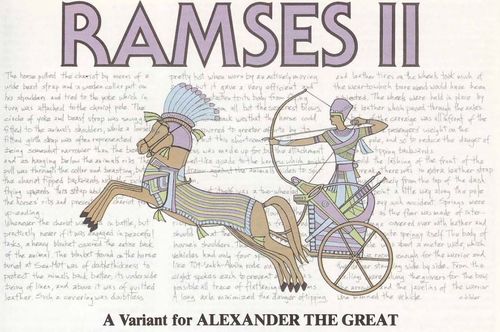
Ramses II (Alexander the Great Variant)
Rulebook PDF: Avalon Hill (The General magazine) · PDF
Ramses II (Alexander the Great Variant) Rulebook
Table of Contents
Table of Contents
Historical Background
The Campaign
In the year 1289 B.C., Ramses II brought war against the Hittites in Syria. The Hittites were a migrant Indo-European race who had risen to become a viable nation, called Hatti in their own tongue, around 1900 B.C. in Anatolia with their capital sited at Hattusas. They dominated Asia Minor and, over the next few centuries, gradually extended their influence into Mesopotamia, often raiding as far east as Babylon and as far south as Kadesh. At the conclusion of one such raid into his lands, Ramses determined to end the threat which perpetually hung over his northern territory. He cleared the area as far north as the site of the modern city of Beirut of outland stragglers. At, or near, here he formed a base for the operations he had planned for the following year and returned with the bulk of his army to Egypt.
In the following spring, Pharaoh took the field at the end of April and, marching through Palestine, reached his base on the coast three weeks later. Here he paused to organize and refit his forces. Meanwhile, the Hittite tribes had grouped themselves around Hamah, with an advanced base at Aleppo, nearly a hundred miles to the north. The two armies which were soon to meet had not had but minor brushes the previous year and both commanders were eager to take the offensive.
Ramses' halt at his base was brief; he continued his march at the rapid rate which had characterized the first part of his operation. Crossing a mountain chain by a pass near Beirut, he reached the River Orontes. He then moved down the valley and reached the town of Kamu. He had penetrated the Hittite lands only thirty days after leaving Egypt, a total of over 400 miles with an average rate of march of thirteen miles per day over some of the most barren terrain in the known world.
Every sign pointed to the fact that the Hittites were still far to the north. The walled city of Kadesh was now only fifteen miles distant and Ramses decided to make this his next objective. Marching next day through the town of Ribleh, he reached the broad flat plains of the lower Orontes. At this juncture, Pharaoh received information from two Bedouin spies that the Hittites were no closer than Aleppo. The spies showed the Egyptians a ford over the river north of Ribleh which would allow them an easier march route along the far bank. Thinking the Hittites far away, the Egyptian army took the ford and became dispersed as each element of the army crossed the ford and commenced to march northward.
Unknown to Ramses, the Hittite army was not at Aleppo, but rather was in position just to the east of Kadesh, with a force detached to hold the town itself. The Bedouins Pharaoh had trusted had come from the enemy camp to mislead his commanders, and had done a good job of it. The Hittites, under the direct command of their king Muwatallis, planned to induce the Egyptians to march along the left bank of the Orontes. When they arrived opposite Kadesh, which was situated on a hill and almost entirely surrounded by a loop of the river, the Hittite army would be concealed from view by the hills and town. The enemy would by this time be well dispersed and disorganized owing to the narrow defiles and the forest of Baui a few miles to the north. As soon as the Egyptian advanced elements came opposite Kadesh, a strong force of Hittite chariots would cross the river south of the town, cut the enemy column, roll up the head of it, and then engage the tail as it debouched piecemeal from the forest.
Meanwhile, after watering, feeding and crossing the ford above Ribleh, Ramses' army continued on to Kadesh with Pharaoh himself in the lead. One element of the army became badly dispersed in crossing the ford; consequently the head of that column halted on the far side of the river to allow the remainder to close up. By this means a gap of some two miles was created between the halves of the Egyptian army. Passing through the forest of Baui, about three miles farther on, the rear columns again lost distance. Ramses, however, did not allow his force to pause but continued to press north in order to reach the area of Kadesh, which he had been informed offered excellent camping grounds. Therefore, the lead division, Amon, under Ramses, reached the fields of Kadesh in midafternoon, after having marched fifteen miles in but a short day. Once there, the weary soldiers made camp, still unaware of the close presence of the hidden Hittite army.
The Opposing Armies
Before turning to the Battle of Kadesh itself, it would be of interest to examine the opposing armies. Prior to the time of Ramses, the Kingdom had had a standing army, of sorts. It began with an elite force that served as the palace guard and then was given the task of garrisoning the key cities of the kingdom. This was around 2200 B.C.; from that small beginning the armed forces grew around the core of the Palace Guard to a force composed of native levies. By 2000 B.C., this force had been transformed into an army with a high proportion of mercenaries, mostly Nubians, whose loyalty was not strong. Indeed, these mercenaries were a factor in bringing on the civil wars which ended the Old Kingdom (about 2181 B.C.) and brought about the military reforms of the Middle Kingdom (2134 B.C.-1786 B.C.). These reforms led to the employment of fewer outlanders and more native Egyptians to ensure loyalty.
By the time of the Battle of Kadesh, during the New Kingdom (1570 B.C.-1075 B.C.), the Egyptian army was organized into units of approximately 1000 men each. When on a war footing, five such units were formed into a division; five such divisions would be established. At Kadesh, Ramses commanded four of these divisions. Each division was named for a god: Re (the Sun), Amon (the god of Thebes), Ptah (the god of Memphis) and Sutekh (the god of Lower Egypt). The infantry fought in a phalanx formation, while the chariots fought in groups of fifty to a hundred each. The Egyptians used cavalry primarily for communications on the battle field. In addition, they developed a crude supply system to support the army in the field; however, the bulk of the provisions were still supplied by scouring the countryside over which the army marched.
Of vital importance to the Egyptian war effort was its chariot arm. This force would at times comprise almost half of the campaigning army, as it did at Kadesh. The chariots were drawn by two-horse teams, with a third hitched as an outrigger or used as a reserve. This extra horse and the length of their axles gave the Egyptians greater stability in turning and greater speed than their opponents. Further, the Egyptians employed their chariots differently than the other peoples of the Near East; while the Egyptian crews too carried javelins, they abandoned the spear and adopted the bow as the primary chariot weapon. As a result, the Egyptian chariot force was superior in firepower to any of its counterparts of the time. The normal complement on an Egyptian chariot included a driver, warrior and shield bearer.
Of weapons to be found in the Egyptian forces of this period, the most commonly used by the infantry were the axe, the sword, the spear and the double convex bow. Unfortunately, by and large, the hand weapons they fought with were crafted of bronze and were no match for the iron weapons that were being used in the area.
The Hittite army at this time was a trained organization, rather than an ad hoc force raised for a limited campaign. However, even this army was not a standing force. It was raised and trained in the spring and returned home in the fall. Each tribe supplied a complement. But the Hittites did have a small regular elite force in the form of the Palace Guard.
The Hittites used iron weapons which were superior in every way to those of their Egyptian adversaries. They also used the chariot as their primary attack weapon and crewed them with three men, a driver and two warriors. The warriors carried long spears as their main weapon. As a result, they were vastly inferior in fire power to the Egyptians, but superior in a melee.
The favorite battlefield tactic of the Hittites was the surprise attack with their chariots delivering the main blow. They used chariots for shock, trying to scatter the enemy with their successive charges. If this failed, they would try to circle their enemy and, by so doing, unnerve them to such a degree that they lost their formation and routed away. In contrast to the chariots, the infantry, although well-armed with short swords and broad axes, was decidedly a subordinate arm and rarely used in the critical moments of the battle.
The Battle of Kadesh
As noted above, Ramses with the division Amon was making camp west of Kadesh while the rest of the Egyptian forces were strung out for a distance of eight miles south of that city. The Hittite army, well-concentrated, was poised to strike. King Muwatallis ordered some 2500 chariots to cross the ford just below Kadesh and strike the unprotected flank of the invaders. These troops, of the division Re, were taken completely by surprise. The leading Hittite chariots charging down upon them cut the division in two near its center; the following chariots proceeded to fan out to roll up the two flanks. Word of this disaster was sent to Ramses.
Upon hearing of the plight of the division Re, Pharaoh instructed his Grand Vizier (whose name is lost to history) to hasten the arrival of the divisions Ptah and Sutekh on the field of battle. He then ordered Amon to counterattack and he himself would lead the attack despite the pleas of his priests. Before the order could be carried out, fugitives from the division Re swarmed into camp and swept most of Amon's troops out to the north. The Hittites roared in in hot pursuit. Surrounded and having few men at his side, Ramses cut his way out of the confusion and rejoined the bulk of the division Amon where the Vizier had rallied it to the north.
The fall of the camp proved a lucky stroke for the Egyptians; instead of following up their advantage by pursuing the broken enemy, the Hittites stopped to plunder the royal camp and thus gave Ramses a chance to redeem his fortunes. Rallying the remnants of Re and Amon, Ramses initiated three hours of charge and countercharge against the enemy. In the course of the melee, Muwatallis sent another 1000 chariots across to support his hard pressed troops, but did not himself nor his infantry cross.
During this time, the Vizier had travelled around the western fringe of the raging battle and gathered up the Beirut garrison (hastening to join the main force) and the division Ptah. He then led them into an attack upon the enemy from two directions, the garrison troops hitting the Hittites from the west and Ptah attacking from the south. The division of Sutekh was too far south to effectively intervene. Tired and still contesting fiercely with the forces under Ramses command in the north, the Hittite chariotry could not resist the onslaught of the fresh Egyptian forces that had been thrown into the struggle by the Vizier. They held briefly looking for support from their infantry; but upon realizing that this was not forthcoming, the Hittite chariot force routed toward the ford over which they had crossed the river. Then, as in all ancient battles when one side broke in panic and flight, butchery became the standard. The Hittites were cut down by the scores until none remained alive on the west bank of the river.
Conclusion
Although Ramses had won a great victory, it was far from a decisive one. The Hittite infantry was still intact, and the exhausted condition of the Egyptians prevented them from pursuing the enemy across the river. Also, losses among the divisions had been very heavy; so heavy, in fact, that instead of attempting to storm Kadesh in the days that followed, he patched up a hasty truce with Muwatallis and marched his army back to Egypt. So ended Egypt's last successful offensive campaign in the era of the Pharaohs, if one can call a pyrrhic victory a success. Its immediate result was to confirm in Ramses' own mind that he was a military genius, which is questionable in light of the fact that his army was surprised and nearly wiped out. In the long run, the Battle of Kadesh restored the balance of power in Syria and halted the further spread of the Hittite empire.
Ramses II - The Variant
Ramses II is a variant based on Avalon Hill's tactical battle game ALEXANDER THE GREAT. The mapboard, with a few modifications, and the game system are used in the variant. The vast majority of the rules for ALEXANDER THE GREAT are employed; those modified or not utilized are noted below. New game counters, which represent the Hittite and Egyptian forces, are provided on the insert of this issue. With these (mapboard, rules, counters) at hand, one can recreate the bloody Battle of Kadesh, fought over 3200 years ago.
The Mapboard
Camps:
- The camp at M6 is now the north edge of the playing area.
- The camp at M6 represents the town of Kadesh.
- The camp at U24 represents the town of Ribleh.
- Treat the camp at C33 as a clear terrain hex.
River and Fords:
- The river hexes (found on the insert of this issue) are to be placed such that the hex coordinates correspond to those of the mapboard. Thus, for example, the first river hex on the north edge should overlay hex K7. Plastic is recommended as a non-permanent adhesive which is inexpensive and easily obtained.
- The river hexes placed as per above represent the River Orontes beside which the battle took place. All units that enter such hexes must end their turn on that hex but may proceed normally on their next turn. If a unit travels from one river hex to another river or ford hex, it must likewise end its movement upon entering the river/ford hex. Only one unit may occupy a river hex. Units that attack enemy units from a river hex have their attack factors halved (rounded up). Likewise, units that are attacked while they are in a river hex have their defense factors halved (rounded down). No unit in a river hex may fire missile weapons; defense against missile fire is also halved for any unit defending while in a river hex. Units that are forced to retreat or rout on or through a river hex are eliminated instead.
- Units that attack from or that are attacked when in a hex containing a ford marker are treated as if in a river hex (see above). As in a river hex, only one unit may ever occupy the hex containing the ford at any given time. A unit entering a ford need not end its movement in the ford hex, but may treat the ford as clear terrain for movement purposes (exception: units forced to rout or retreat on or through a ford hex are eliminated).
Woods:
- The woods hexes (likewise found on the insert of this issue) representing the Baui near the battlefield are placed on hexes L19, L20, M19, O18, O19, P18, P19, Q18, R18 and S17. No units may ever enter any hex containing a woods marker; if a unit is forced to do so as a result of combat (rout or retreat), the unit is eliminated.
Towns:
- Units that are defending in towns (at M6 and U24) are tripled in defense factors. Units that attack out of a city hex receive no modifier to their attack strength for being in a city hex.
- As is the case of Baggage Camps in ALEXANDER THE GREAT, there is no charge bonus (i.e., doubling of attack factors) against towns.
The Rules
Rule Deletions:
All rules of play utilized for ALEXANDER THE GREAT are used for this variant except the following:
- There is no five point morale drop assessed against the side that abandons completely the "center plain" of the playing area; nor does the other side receive a five point bonus in morale. (Basic Game)
- Cavalry may not move one extra hex when charging; neither may they double their attack factor when charging under the Charge Bonus Rule. (Basic Game)
- Retrograde Movement (exception: archers, not chariot units, may use Skirmisher Retrograde Movement). (Advanced Game) All units of both armies designated PAL GD may perform normal retrograde movement.
- Sidestep Movement. (Advanced Game)
- Cavalry Maneuver. (Advanced Game)
- Persian or Macedonian Play-Balance. (Advanced Game)
- Phalanx Immunity. (Advanced Game)
- Combined Arms Attacks. (Advanced Game)
Rule Modifications:
The following are a few modifications to the rules of ALEXANDER THE GREAT necessitated by the play of Ramses II to reflect the less developed state of tactical warfare in that period:
- Chariot units are to be treated as horse archer units for the purposes of the Horse Archer Rule found in the Advanced Game section of the rules. In other words, when reading this rule, substitute "chariot" for "horse archer".
- In the Morale section of the Basic Game rules, the notations concerning morale gain or loss for the capture/loss of baggage camps or transport units are altered. Substitute "Kadesh" and "Ribleh" for "Baggage Camp" where morale gains or losses are referred to.
- Under the Basic Game rules, chariots are not considered missile type units for the purposes of Cavalry and Chariot rules. In the Ramses variant, chariots are considered missile units for the purposes of these rules. Attacks on chariot units by enemy chariot and cavalry units frontally are resolved with only half (rounded up) of the attack factors. Further, the defensive factors of standing chariot units which are attacked by missile units are halved for the purpose of that attack (round up).
- Chariot units are considered missile type units in the variant for the purposes of missile fire (as described under Missile Units in Basic Game rules in ALEXANDER THE GREAT).
- Chariot units are considered missile type units in the variant for the purposes of combat resolution (as described under Battle Resolution in all rules).
- All units in Ramses II are either Class B or Class C units; there are no Class A units in this variant.
New Rules:
- All chariot units in Ramses have a missile firing capacity. The missile fire power for the Egyptian chariots is their printed frontal combat factor and that of the Hittite chariots is 2.
- Chariots fire missiles according to the same rules and same range as set down for missile units in the Basic Game rules of ALEXANDER THE GREAT. (Exception: Hittite missile range is only one hex, i.e., any adjacent hex.)
- When a chariot unit loses a step due to combat and is flipped over to the reduced strength side, the unit's missile fire strength is likewise reduced. When an Egyptian chariot loses a step, the new missile fire factor is reduced to its new printed frontal strength; when a Hittite chariot suffers such, to 1.
Initial Placement
Egyptian Initial Placement:
- On hexes R4, Q4, P5 or P4 facing any direction: Ramses, Vizier, all infantry units of the division Amon.
- On hex R4, Q4 or P5 facing any direction: Palace Guard.
- On hexes O5 and P5 facing any direction: all chariot units of the division Amon.
- On hexes N10, N11, N12 and N13, facing north: all units of the division Re.
- On hex N21, facing any direction: the two Garrison units.
- On hex N22, facing any direction: the Syrian Allies.
- On hexes U21, U22, U23 and T21, facing any direction: all units of the division Ptah.
- On hex Q21, facing any direction: one cavalry unit.
- On hex O6, facing any direction: one cavalry unit.
- On hexes T25, U23, U24 and V24, facing any direction: all units of the division Sutakh. (SPECIAL RULE: these units must roll in order to be placed on these hexes and, thus, enter the game. On the first turn, a single die result of "1" allows the units to enter; on the second turn, a result of "1-3"; on the third, a result of "1-4". The units enter automatically through the designated hexes on the fourth game turn. All entry die rolls are made by the Egyptian player at the beginning of his player turn and the reinforcements may move normally if they enter play.)
Hittite Initial Placement:
- On hexes I11, I12, I13, J11, J12, J13 and J14, facing any direction: any ten chariot units.
- On hex M6, facing any direction: no more than two infantry type units (exception: no unit designated Palace Guard may be so placed).
- On hexes B12, C12, D11, E10, E11 and F10, facing any direction: King Muwatallis, all units designated as Palace Guard and all remaining infantry units.
- On hex J8, facing any direction: one cavalry unit.
- On hex G12, facing any direction: one cavalry unit.
THE HITTITE PLAYER ALWAYS MOVES HIS UNITS AND CONDUCTS COMBAT FIRST DURING EACH GAME TURN.
Victory Conditions
Egyptian Victory Conditions:
The Egyptian player wins if either of the following occurs:
- King Muwatallis is eliminated and the town of Kadesh is captured and held; or
- The Hittite morale is reduced to "0".
Hittite Victory Conditions:
The Hittite player wins if either of the following occurs:
- Ramses is eliminated; or
- The Egyptian morale is reduced to "0".
In case the game ends with neither player having achieved its Victory Conditions, then the game is awarded to the side with the highest morale, winning a partial victory (as was the historical case for the Egyptians). If both sides have equal morale at the conclusion of play, the game is a draw.
Source Notes
Transcriber's notes: the magazine text layer read "Eqypt" and "Pharao'h" and similar letter/digit confusions in hex labels ("111", "NI0", "05", "Fl0"); these were read as the printed "Egypt", "Pharaoh" and hex labels I11, N10, O5, F10 and so on. The text layer read "Haiti" where the page prints Hatti; the printed spelling is used. "Sutakh" in the Egyptian initial placement and "Sutekh" in the historical section are both as printed. The article's convention calendar, byline and magazine page numbers are omitted.