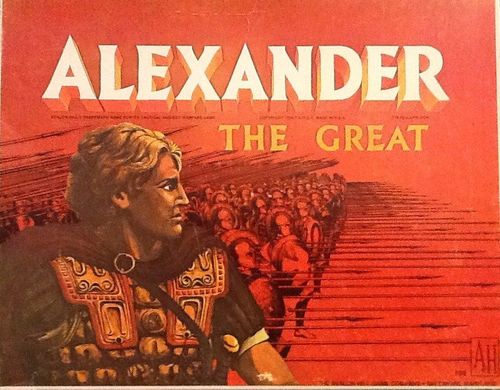
Alexander the Great
Alexander the Great Rulebook
Table of Contents
Table of Contents
- Game Equipment
- Basic Game Rules
- Advanced Game
- Official Tournament Game
- Historical Summary
- Designer's Notes
- Q&A on Conduct of Play
- Points to Remember
- How to Play the Battle of the Hydaspes
Game Equipment
- Playing Board
- Set of Die-cut playing pieces
- Combat Results Tables Card
- Rule Booklet
- Die
- Game Box
Basic Game Rules
Unit Counters
Your playing pieces represent each unit that fought in the battle. These playing pieces will henceforth be referred to as units or counters.
The Macedonian counters are blue, and the Persian units are red. Each counter contains information which differentiates it from every other unit and which is necessary for the play of the game. Note the following:
- Movement Factor: The maximum number of movement points a unit may expend in any turn.
- Attack & Frontal Defense Factor: Strength of a unit while defending against a frontal attack or while attacking.
- Flank Defense: Strength of a unit while defending against a flank attack.
- Rear Defense: Strength of a unit while defending against a rear attack.
- Facing Direction: Serves to identify which surrounding hexes border on the unit's front, flank, and rear.
- Type: Classification of unit which determines its attack capabilities.
- Identity: The historical reference of a unit by nationality, commander, or similar means for historical reference.
Losses
Every unit (except Class C units) is composed of two steps or strength levels. A unit is at full strength when displayed normally on the board. When a unit, through combat, loses factors amounting to half or less of its strength, it is said to have lost 1 "step" and is inverted for the duration of its time on the board.
Inverted counters are easily identifiable by the overall smaller print size and the lighter hue of the color.
All losses are subtracted in terms of frontal combat factors. Whenever a unit must lose more than exactly one-half of its frontal combat factors it is removed immediately, not inverted. Whenever an inverted counter takes additional losses it is immediately eliminated.
The Mapboard
The playing board represents the type of terrain over which the actual battle was fought. A hexagonal grid has been superimposed on the mapboard to help determine movement. Hereafter, these hexagons will be referred to as hexes. The terrain features shown on the playing board consist of:
Level Ground: any hex other than a slope containing any amount of green; example V7, S3, Q10. Hexes that have even a small amount of green are clear.
Rough Terrain: any hex consisting entirely of various shades of brown; example W3, K10, C19.
Slopes: the continuous yellow-brownish line of hexes extending from A12 to X1. The high side of the slope is bordered by brown hex sides; the low side by green. Example: B12, J9, P5, U2.
Grid Co-ordinates: The letters A through X appear along the south of the mapboard. The numbers 1-34 are printed along the north (Persian) edge, and along the east side of the playing board. Thus, each hex has both a letter and number identifying it from the others. For example, the co-ordinates of the Macedonian Baggage Camp are M6 and, the 2 Persian Baggage Camps are C33 and U24. Grid co-ordinates do not affect the play of the game. They are provided only as a means of locating specific points on the board. Hexes on which units according to the actual Historical Order of Battle start have had the names of those units printed on the hexes to aid in preparing for play when using the historical set-ups. Other hexes can be cited for play-by-mail or interrupted games by cross indexing the row of letters vertically with the numbers diagonally.
Prepare to Play
The Persian commander sets up all of his counters as he chooses on or behind the hexes which bear the names of his units. Players may match their set-up exactly with the designations which appear on the board or not as they choose-but in no case may units be set up in front of the area marked as their side's respective starting line.
After the Persians are deployed, the Macedonian commander sets up all of his counters, as he chooses, on or behind the area where his side's historical designations appear. The morale markers are set at 20 on the Morale Status Gauge and at 0 on the Temporary Morale Scale.
Routine of Play
- The Macedonian commander moves all, some, or none of his counters, as he desires. a. Defensive Fire Phase: The Persian player may fire any of his missile units now in range of opposing units. Attacks are calculated and morale adjusted as in 3a, b, and c.
- The odds of any attacks the Macedonian player wishes to make are now computed.
- Attacks are resolved battle by battle: a. The first battle is resolved on the Attacker's Combat Table applicable to current Macedonian morale, and at the defensive line applicable to the current level of Persian morale; b. Any factors added to or lost from morale due to the first battle are computed on the Temporary Morale Scale and that morale marker adjusted accordingly up or down the Temporary Morale Scale. c. The second and successive battles are resolved in exactly the same manner as the first, without any change in morale due to current battles being considered when selecting either the Attacker's Morale Table or the defender's Morale line on that Combat Table. This ends the Macedonian turn.
- The Persian commander becomes the attacker and goes through steps 1-3 above, as applicable. This ends the Persian turn.
- The amount currently recorded on the Temporary Morale Scale is added to the current amount showing on the Morale Status Gauge for both players respectively.
- Turn 1 is over. Repeat steps 1-5 until a winner is declared.
Sequence of Play (for each player – Macedonian first):
a) attacker may move all, some, or none of his units. b) the defender announces all missile defensive fire and missile defensive support c) the attacker announces all attacks against missile units (thereby diverting those units' fire). Firing between missile units is simultaneous. d) defensive fire is resolved e) the attacker announces all attacks f) odds are calculated and the battles resolved
How to Win
The Macedonians win if:
- Darius is eliminated and both Persian baggage camps are captured and held simultaneously, or:
- The Persian morale is reduced to 0.
The Persians win if:
- Alexander is eliminated, or
- The Macedonian morale is reduced to 0.
Should the game end with neither side having achieved the victory conditions, then the side with the higher morale wins a partial victory. If both sides have equal morale, then the game is a draw.
Movement
- You may move all, some, or none of your counters, up to the maximum movement ability shown on each counter within the limitations of the rules of movement.
- Your units may move all, some, or none of their movement factor.
- Each counter may be moved in any direction or combination of directions in accordance with its movement capabilities.
- Movement factors are not transferable nor can they be accumulated from turn to turn.
- All movement must be completed prior to the resolution of battles. Exception: movement after combat is allowed in accordance with the dictates of the Combat Results Table wherein advances and retreats are called for.
- You may never move your counters during your opponent's movement portion of a complete turn.
- A counter may not be moved through a hex containing an enemy unit, nor one occupied to capacity by friendly units.
- The maximum number of hexes a counter may move is shown on the upper right of the counter. This number is called its movement factor.
- All cavalry, chariots, and elephants may always move one extra hex when charging.
- Units may only use their charge movement factor when they end their move in an attack.
- Terrain affects both movement and combat. For particulars refer to Terrain Effects.
- When you move your counters be sure to face them exactly in proportion to the hex they are in. The facing is indicated by the directional arrow shown on the counter. The top of the counter is thus the front and the counter is considered facing in the direction the arrow points to. Units not correctly faced will be penalized by allowing the opposing player to face them right or left by a turn of not more than 45 degrees to correct the facing.
- When two class B units occupy the same hex they must be placed parallel to each other, one behind the other. Units may not be partially or wholly stacked on top of each other.
- Class C units are the only units which can be stacked. If there are 2 Class B units in a hex, the Class C unit is considered stacked on both of them, and should one be eliminated, the Class C unit is transferred to the other.
Hex Capacity Limitations
Note that there are 3 different sizes of counters in both the Persian and Macedonian Army. The largest (phalanx-sized units) entirely fill a hex. These are class A units. The smaller square counters are Class B and allow room for up to two such counters in a hex. The circular counters are Class C units, representing the respective commanders, and may occupy any hex regardless of the number of friendly counters already therein.
- Enemy units may never occupy the same hex with friendly units. Nor may counters move through a hex which is fully occupied as described above.
- The limitations given above must be considered when moving through hexes with units in them. For example, a Class A unit may only move through hexes which are unoccupied or occupied only by Class C units; a Class B Unit may not move through hexes containing a Class A unit, or two Class B units, but it can move through hexes containing one or more commander units (Class C), or a single Class B unit.
Attacking
- Whichever side is moving its counters is considered the attacker. (Exception: missile units firing defensively.) The side not so moving is the defender.
- Counters do not control the hexes around them. They control only the hex which they are in.
- To attack, a unit must be placed so that its front facing is directed towards the unit(s) to be attacked. The attack is then announced, for a unit need not attack simply because it is adjacent to an enemy.
- Attacks may only be made from the front face of a unit. Note that the frontal combat factor is always the largest combat factor. In order to attack, the attacking counter must be adjacent to the hex(s) in which the enemy unit(s) is located. Exception: Missile units may attack from 2 hexes away.
- The front face of a unit is defined as the hex side which the directional arrow of the counter points to-as well as the hexes to its immediate right and left.
- Enemy units, even though adjacent, do not have to attack-attacking is optional. (Exceptions: see Melee.)
- The attack factor is the numerical expression of a unit's strength when attacking. All cavalry, chariots, and elephant units may have their attack factor doubled when charging. This bonus is further described under the Charge Bonus section of the rules. Attack factors may never be split between two battles.
- Odds worse than 1-6 are not allowed. If a unit is forced to attack by a melee at odds worse than 1-6, it is eliminated.
Defending
You defend whenever the player who is currently moving announces an attack on one or more of your units. Your counters may be attacked from front, flank, rear, or any combination of the 3.
Whenever a question arises as to the area of attack utilized by a missile unit from 2 square range, always use the area which most benefits the defender.
Each counter has 3 defense factors. The strength used in defense from an attack in an adjacent hex is the lowest one that is exposed to attack. For example, a counter attacked from both front and rear defends at its Rear Defense Factor.
Whenever units are attacked from a facing with a 0 defense factor, they are removed under the provisions of Automatic Victory regardless of the strength of attacking units.
Units defending against an attack coming from lower terrain (attacking up a slope) and units defending in a baggage camp have their defense factors doubled: a 0 becoming a 1.
Multiple Unit Battles
- A unit may not attack more than once per turn. Exception: Missile units can fire in the defensive phase.
- A unit cannot be attacked more than once per phase. If two or more units wish to attack an enemy unit they must combine their factors into one joint attack.
- Similarly, if one attacking unit attacks two or more defending units the defense factors of the defending units are totaled into a single, combined defense factor.
- A unit must be adjacent to any unit it attacks unless it is a missile unit.
- Combat factors may never be split between battles. The entire applicable strength of a unit must be used in each attack or defense.
- Should two Class B counters occupying the same hex be attacked, they must be attacked separately:
- Attacks from hexes A, B, & C affect only the first counter.
- Attacks from hexes D, E, & F affect only counter 2.
- Attacks from a combination of hexes A-C and D-F are not allowed and must be split into two separate attacks.
- Exception: If the 2nd unit is a missile unit it may choose to add its defense factor to unit 1.
- Units 1 and 2 above could be faced in any parallel direction and if counter 2 was faced to the rear, both counters could only be attacked frontally.
- Missile units may attack either or both of the units in the illustration from any surrounding hex within missile range.
Special Units
Missile Units
- Missile units may engage in combat normally, or they may missile attack but they may not do both.
- Missile units include archers, javelinmen, and horse archers.
- Missile units have two attack zones. They may attack normally or they may missile attack units two hexes away from them.
- Missile units may always select their target from any unit within range, by firing missiles over adjacent units, either friendly or enemy.
- In addition to missile attacks during their portion of a complete turn, missile units may also add their frontal combat factors in defense of friendly units which are in the same or an adjacent hex providing at least 1 attacking unit is in that missile unit's zone of fire. Of course, if the missile unit itself is being attacked it must defend itself and can not aid others.
- Missile units may also fire offensively at enemy units during the defensive phase. This fire occurs after enemy movement but prior to enemy attacks. The effects of this fire may alter enemy attacks-either by retreating or eliminating part or all of the attacking force.
- Missile Fire may only be diverted to hexes covered by the unit's frontal combat factor.
- A missile unit firing at enemy units in the secondary zone (including enemy missile units) is not subject to adverse combat results as a result of its attack. It may, however, be counterattacked by a missile unit.
- If a missile unit is partially or wholly eliminated by opposing missile fire during the Defensive Fire Phase, it may still return fire at its strength previous to the loss, for all missile fire during one combat portion of a turn is considered simultaneous.
- Missile units that are being attacked by any means, melee or missile, can't give defensive support to other units.
- When an attacking missile unit is being attacked (fired upon) by a missile unit during the defensive fire, defensive fire against an attacking missile unit does not force the attacker to divert his missiles. This means that only the attacker can divert defender missile fire as per the rules above, but not vice versa.
Leaders
Class C units may be stacked with other friendly counters. The effects of having a Class C unit with other units in a hex are:
- When Army Commander units attack or defend, all friendly units involved in that battle use Morale Table 1 regardless of the current standing on the Morale Status Gauge.
- Anytime an Army Commander is involved in an attack or defense it may call for an additional two die rolls to be made. It may then choose the most advantageous result.
- If Army Commanders are involved on both sides they nullify each other's effect and the first die roll counts.
- The Class C unit must be adjacent to the enemy units in question to demand additional die rolls. He can not call additional die rolls for participating in an attack or defense due to being stacked on a missile unit which is firing from 2 hex range or in defense of an adjacent unit not in the same hex.
- Class C units have no combat factors. If attacked while alone in a hex they are automatically eliminated.
- Class C units can not attack by themselves.
- Class C units in a hex with other units are eliminated only if all other units in that hex are eliminated.
- When Commanding Officer units are involved in a battle all friendly units involved in that battle raise their morale factor 5 points during that attack.
- Commanding Officer units involved in a battle may request one additional die roll and select the most advantageous result.
- The effects of Commanding Officer and Army Commander units are cumulative. Should two friendly Commanding Officer units be involved in the same attack they would raise the morale of units in that battle 10 points, rather than just 5. Similarly, if a Commanding Officer and an Army Commander unit are involved in the same attack they could request 3 additional die rolls; two for the Army Commander and 1 for the Commanding Officer.
- Should two Commanding Officer units be involved in a battle against an Army Commander unit, the effect would balance out and only the first die roll would be used. Similarly, if an Army Commander unit opposes a Commanding Officer unit, the Army Commander unit would be allowed to call for 1 additional die roll: the Commanding Officer unit none.
Cavalry & Chariots (+ Charge Bonus)
- The attack factor of cavalry and chariots is halved when they attack missile units frontally.
- The halving does not apply when missile units are merely adding their defense to an adjacent unit, rather than being attacked frontally themselves.
- Neither cavalry nor chariots are allowed to frontally attack Phalanx counters unless it is in co-ordination with an attack against both the front, and the flank and/or rear of the phalanx.
- The factors of standing chariot units which are attacked by missile units are halved for the purpose of that attack.
- Such "halving" as described above applies only to the determining of odds. The units are returned to their original strength for all other purposes after the battle, including calculations of losses in an Exchange or 12 D Elim.
- Chariots defend at half factors vs missiles but only "standing chariots," so only if they haven't moved in your turn, or if they are fired on in your opponent's turn.
- Chariots defend at half factors vs missiles but only if attacked exclusively by missile units not in conjunction with other type of units.
Charge Bonus
Whenever cavalry, chariot, or elephant units are moved one or more hexes to attack, their attack factor is doubled.
Elephants
Elephants will not frontally attack phalanx units unless the phalanx is also being attacked from the flank or rear.
Mercenaries
- Mercenaries will automatically desert when the Morale Factor of their side drops below 10, unless they are with either the Army Commander unit or a Commanding Officer Unit.
- When the Morale Factor of a side drops to 5 on the Morale Status Gauge all of its Mercenary units are removed from the map-board. These units are not counted against morale losses however.
- Once removed from the board, Mercenary units can not be brought back even if Morale standards climb above the necessary levels to maintain them.
- When a mercenary unit is completely surrounded by enemy units it will surrender. No battle need take place against it. The Mercenary unit will defect to its captors, and on the turn after it was surrounded and captured, it may be used by the captors just as any other friendly unit.
- The Mercenary unit may be recaptured by the side it formerly fought for, and all of the above rules will once again apply.
Morale
The morale of each side is indicated by the total number of morale points shown on the Morale Status Gauge. At the start of the game each side has 20 points. The Morale Status Gauge is reset after the completion of the Persian turn by adding the number shown on the Temporary Morale Scale to the previous total. The Temporary Morale Scale is then reset to 0 to await the outcome of the next turn's events. The Temporary Morale Scale is subject to change after every battle as follows:
| Event | Morale Change |
|---|---|
| Loss of a Baggage Transport Unit | -1/2 pt |
| Loss of less than 3 frontal combat factors from a single unit | -1 pt |
| Loss of 3 or more frontal combat factors from a single unit | -1 1/2 pt |
| Loss of a Baggage Camp | -5 pt |
| Loss of a Commanding Officer unit | -5 pt |
| Loss of an Army Commander unit | -10 pt |
| Elimination of less than 3 enemy combat factors from 1 unit | +1/2 pt |
| Elimination of 3 or more enemy frontal combat factors from 1 unit | +1 pt |
| Capture of an enemy baggage transport unit | +2 pt |
| Capture of an enemy baggage camp | +10 pt |
| Elimination of an enemy Commanding Officer unit |
Gains and losses in Morale points due to battles are computed by unit. Thus, if the Persians attacked three Macedonian units and won two battles in which they eliminated less than 3 frontal combat factors in each, while losing one battle with the elimination of more than 3 frontal combat factors from a single unit, the net change in morale points for both sides would be:
Persians:
- Elimination of less than 3 enemy factors: +1/2 pt.
- Elimination of less than 3 enemy factors: +1/2 pt.
- Loss of 3 or more factors from 1 unit: -1 1/2 pt.
- Net Change = -1/2 point
Macedonians:
- Elimination of more than 3 enemy factors: +1 pt
- Loss of less than 3 factors from 1 unit: -1 pt
- Loss of less than 3 factors from 1 unit: -1 pt
- Net Change = -1 point
Neither side's morale may ever exceed 20 points.
Each side has two morale marker counters which are used to record the morale of the two opposing armies. One morale counter from each side is needed on both the Morale Status Gauge and the Temporary Morale Scale. The markers are pushed along the scales and left on the appropriate box to record current morale standings for that side. Note that all the boxes on both tracks are split into two equal triangles, representing halves of whole numbers. Note also that the morale counters are colored in the same fashion. So to record half points of morale one merely places the counter with the color portion predominating on top for a whole number, and on the bottom for a fraction.
NOTE: If either player abandons completely the "center plain" of the playing board (the green area encircled by rough terrain) his side takes an immediate 5 point morale drop for deserting the field of battle, while the enemy gains a like number.
Automatic Elimination
- Odds of 5-1 with the defender completely surrounded by attackers or odds of 7-1 in any case, result in Automatic Elimination of the defending unit(s) prior to the normal combat phase.
- Whenever automatic elimination occurs, units not involved in the attack may simply move over the eliminated unit as if it were not there.
- Hex capacity rules must still be observed when moving through hexes containing attacking and automatically eliminated units. The automatically eliminated unit is counted towards the hex capacity of the hex which it occupies.
- If one of 2 Class B units in the same hex is automatically eliminated no additional movement into that hex is allowed until after all combat has been resolved, because it would violate the hex capacity rule.
- A Class A unit may not move into an Automatic Victory hex nor can any unit move into a hex in which a Class A unit was destroyed until after the combat portion of the turn.
- It is not possible to gain an Automatic Victory against a Class B unit in a hex so as to be able to attack another Class B unit in that same hex. To do so would violate the hex capacity limits.
- After all combat has been resolved, attackers may occupy the hex of a unit eliminated by automatic victory in the same manner as is done with conventional attacks. The eliminated unit no longer counts towards the hex capacity limit and any other friendly units in that hex must retreat before the advancing attackers.
- See: Missile units, in Advanced Game.
Battle Resolution
There are 4 different Combat Results Tables, each corresponding to a different Morale rating. The Morale rating is determined by the number of Morale points accumulated at the beginning of each turn as shown on the Morale Status Gauge. Each of the 4 Combat Results Tables also contains appropriate lines for different Morale ratings of the defender.
The sum of attacking factors is expressed in terms of a comparative ratio to the total defense factors involved. Odds are always rounded down in favor of the defender; a 3 to 2 becoming a 1-1. Such a ratio, always expressing the attacker's strength first, is called the "odds" for the battle. It is by these "odds" that the CRT's are divided into attack categories.
To resolve a battle:
- Determine the odds ratio.
- Select the Combat Table corresponding to the attacker's current Morale; i.e., 1, 2, 3 or 4 shown on the Morale Status Gauge.
- Find the odds ratio of the battle along the left hand side of the Combat Results Table.
- Find the line corresponding to the defender's current Morale as shown by the Morale Status Gauge in the odds ratio section along the right hand side of the Combat Results Table.
- Roll a die, and find the result under the number rolled. Victorious units may always occupy the losers square whenever an elimination, retreat, or rout occurs. The various results on the CRT are explained below:
Melee
- All attacking and defending units are frozen in place. Neither side may withdraw from the melee nor change the facing of any involved units.
- The defender must attack with all his meleed units during his turn. He may add units to the melee so long as all the original attackers are themselves attacked. Missile units which had attacked from a 2 square range or aided the defense without actually being attacked themselves may be released from the melee.
- The original attacker may call upon any adjacent missile units in range to aid its defense against the counterattack.
- The former attacker loses any advantage he may have had for charge bonuses on attacks made while held motionless in the melee. Neither, of course, does he receive the benefit of the charge bonus while on defense.
- A unit which is meleed from flank or rear does not have to attack in its own turn but can not move. The original attacker must attack again in his next turn and may add units to the attack, but the meleed units involved can not move.
- Missile units held in melee (either on attack or defense) have their combat factors halved while they remain in melee.
Back
- The losing counter is moved back the stated number of hexes at the loser's option as to direction.
- The front face of the retreating unit must face the vacated hex.
- Victorious units may always advance into the vacated hex at their option. Exception: missile units firing from 2 hex range may never advance after combat.
- Restrictions regarding terrain and hex capacity apply to the retreat of losing units. Units which can not move back due to terrain restrictions, hex capacity, or the edge of the board are eliminated.
- The "Back" result applies to all units in a hex even though only one of them was actually attacked, or was the attacker. If those other units in the hex with the defended unit were either being attacked or attacking in a separate action, they must delay their retreat until the results of that attack are known. Then, regardless of those results, they must retreat if not eliminated.
Rout
- The routed counter is moved back the number of hexes equal to its normal movement factor, at the Winner's option as to direction and route.
- The rear of the routed counter must face the vacated hex.
- Friendly units in the same hex as the routed must also retreat as if routed. Friendly units adjacent to the routed unit must also retreat as if routed, unless they are involved in a different attack, in which case they may ignore the rout.
- All units involved in a rout which can not meet rout requirements due to terrain restrictions, hex capacity, or the edge of the board are eliminated.
- The victorious units can always advance one hex less than the number of hexes the loser routed but the first hex of advance must be the loser's vacated hex.
Exchange
- The attacker has the choice of eliminating any number of his factors involved in the attack, i.e., one or two steps from one or more units. The defender must then remove enough factors to equal the attacker's losses if he has that many in the battle. Exception: Missile units from 2 sq. range-see step 5.
- Losses are taken by elimination of units or reducing them by a step at the owner's choice.
- A player may not maintain only part of a step. If the losses to be taken exceed one step, the entire unit must be eliminated.
- Exchanges include doubling considerations due to terrain and charge bonuses such that a "charging 3" removed in an exchange would require a loss of 6 defense factors, or 2 defense factors if the attacker chose to eliminate only one step from the unit.
- Missile units firing from 2 square range are immune to adverse effects (such as exchange) and may never cause casualties of more than 1 step to any unit fired on from that range due to an exchange result. Example: The Cretan archers fire at the Mardian archers at 2 hex range and get an exchange. The Cretans lose nothing; the Mardians lose a step and are reduced to their half strength, but get to return fire once at full strength.
- If two or more missile units combine in a missile attack at maximum range and get an exchange, the defender must remove an amount equal to one-half the number of attacking missile factors, whether it exceeds one step or not.
- If missile units attack in conjunction with other arms a full exchange can be taken with no limitations but the attacker must suffer losses from the other arms which are adjacent to the defender(s). He can not take losses from the immune archers.
1/2 Elim
1/2 of 1 unit (i.e., one step) is eliminated. A previously undamaged counter must lose 1 step and is turned over. Counters already half eliminated are removed. The unit to be 1/2 eliminated is decided by the losing side in cases where more than 1 counter could be affected.
Elim
- One unit is totally eliminated.
- Units in the same hex with the eliminated unit must retreat (same as back).
- The unit to be eliminated is decided by the loser in cases where more than one counter could be affected.
- If applicable, two units may be 1/2 eliminated rather than eliminating 1 unit altogether, at the loser's option.
- In case of 4 above, both partial strength units involved in the loss must be retreated (same as Back) as well as any other units which are in the same hex(es).
Play Balance
If the Macedonian player is superior, he should be required to use the Historic Set-Up which is printed on the board, while the Persian player is allowed to set his units up without this restriction, anywhere on or behind the hexes in which his units historically started.
If the Persian player is superior, the Persian morale should be lowered. The number of points it is lowered is dependent upon the relative superiority of the Persian, and in no event should be lowered more than 5 points.
Historically speaking, were one to abandon the thought of a competitive game for an accurate simulation, the Persian morale would have to be lowered at least 5 points to duplicate Alexander's feats in the actual battle.
Advanced Game
After mastering play of the Basic Game, players will find much more realism, challenge, and complexity in the Advanced Game. By varying the optional rules in effect you can vastly alter play balance as well.
Be sure to play the Basic Game before reading the Advanced Game rules. The special rules found herein change play drastically. All Basic Game rules still apply except where amended herein.
Movement (Advanced Game)
Movement of units in the Advanced Game is both more complicated and more realistic. Instead of moving randomly to any hex at a cost of 1 movement factor, unit counters can only move directly through the hex side in which they are facing.
- Movement must be through the hex side corresponding to the front facing of the counter as determined by the arrow on each counter.
- Units may always change their facing one hex side per turn in either direction at no movement point cost in each hex they occupy.
- Units may always change their facing two hex sides per turn in either direction at a cost of 1 movement point in each hex they occupy.
- Units may always change their facing three hex sides per turn in either direction at a cost of 2 movement points in each hex they occupy.
Specialized Maneuvers
Retrograde: Highly trained infantry units were able to hold ranks while slowly walking backwards. Therefore, allow all Class A units and all Greek infantry to maintain their facing while moving backwards (through the hex side corresponding to the unit's rear defense factor) at a cost of two movement points per hex. Units using retrograde may still change 1 hex side free of cost in each hex.
Skirmisher Retrograde: Archers and Javelinmen were customarily used as skirmishers and subsequently did not maintain close order ranks at all times. Therefore, allow them to pay a movement point cost of 2 movement points for the first retrograde hex in any given turn and 1 for the second. This rule does not apply to horse archers as they are not infantry-type units.
Sidestep: Another maneuver which took considerable training was the sidestep by which a unit moved to either right or left while maintaining the same facing toward the enemy. Allow all Greek infantry and Macedonian phalanx and missile units to move 1 hex to either side while preserving their present facing. The Sidestep maneuver can not be used in conjunction with other movement in the same turn by the units involved. Neither can it be used with enemy units adjacent at either the beginning or end of the move.
NOTE: The only units capable of the above maneuvers are the Persian Foot Guards, Greek Mercenaries on either side, and all Macedonian infantry types.
Cavalry Maneuver: The main problem in maneuvering with cavalry was in making one's orders heard over the din of battle. Away from the battle this was less of a problem. Therefore, allow cavalry unlimited facing changes within a hex at a cost of 1 movement point if they begin their turn without enemy units in adjacent hexes.
Charge Bonus Qualification: No unit qualifies for a charge bonus unless its last movement point expended in the turn was used in moving into the attack hex. That is, units may not change facings within a hex side to expend movement points so as to qualify for a charge bonus.
The extra movement point granted any charging unit can be taken only if the last normal movement point of the charging unit is expended in moving into a new hex. Neither the bonus movement point or the last normal movement point may be expended to turn within a hex.
Horse Archers
Persian Horse Archers may make what is known as a split move. To perform a split move, the Horse Archer unit moves part of its normal move, fires missiles at any enemy units in range, and then continues to move out the balance of its normal movement factor. In the case where the target is an enemy unit not capable of missile fire, the Horse Archers continue to move without the combat results affecting them. However, in the case where the attacked unit is a missile unit, or enemy missile units are within range of the hex where the Horse Archers pause to fire missiles, the attacked unit, or other missile units within range, may return fire at the Horse Archers. Neither missile unit can be affected by adverse results of its own attacks, but can be affected by the results of the opponent's attack.
Horse Archers, as in the Basic Game, do not receive a charge bonus while missile attacking from a 2 square range.
May move and participate in an AE during the movement phase.
Skirmishers
Archers (not Horse Archers) and Javelinmen may freely pass through hexes which are fully occupied, either in advance or retreat, voluntary or involuntary; but these units can not end their turn on a hex occupied to such an extent as to disallow a unit of that size. Thus, Archers and Javelinmen are not subject to the hex capacity rule while moving, but they are subject to the hex capacity rule when they end their turn. These units were in loose order and customarily skirmished, moving forward and back through the close order infantry or cavalry. N.B. Skirmishers can pass through phalanx but other units can't pass through skirmishers.
Missile Units (Advanced Game)
Missile units can participate in an Automatic Elimination to increase odds only if:
- Archers, Javelinmen: if they don't move
- Horse Archers: can do movement and fire (and continue moving)
Play Balance (Advanced Game)
Play Balance in the Advanced Game consists of choosing the proper optional rules to balance out the differences in player skill. If you find one side consistently losing, add the following optional rules one at a time until you feel that the game has been balanced according to the relative abilities of you and your opponent; given the side each player is commanding. The best course of action is to allow one player to choose the optional rules to be used and the other player to choose the side he wants to play.
Persian Play-Balance Rules
Chariot Charges: Besides acting as previously explained, chariots can attempt to attack the front face of Phalanx units. The chariots are moved into attack position (charge requirements must be met) and before combat resolution begins the following results table is consulted:
| Die Roll | Result |
|---|---|
| 1 | Chariots successfully attack. Use combat results tables as in normal battles. |
| 2-5 | Chariots harmlessly pass through the Phalanx, stopping directly behind it and making no facing changes. If the hex directly behind the phalanx counter is already occupied by either a Class A or Class B unit, the chariot unit is automatically eliminated. |
| 6 | Chariots stop directly in front of the phalanx, horses balking and swerving. No attack is made and the unit must change its facing so as to expose either a flank or rear defense factor to the phalanx it just attacked. |
Historical Set-Up: Force the Macedonian to use the Historical set-up as provided for in the Basic Game and as printed on the mapboard. The Persian player may set up as he wishes.
Morale Cut: Force the Macedonian player to start the game with a morale factor of less than 20; the amount of the cut to be determined by mutual consent but in no case to exceed 5 points.
Elephant Rule: If the elephant unit is engaged in combat and the results of the battle call for either "Rout" or "Back 2," the elephants immediately stampede. The direction of the stampede is determined by a die being used to determine which hex face the elephant counter is to be moved through. Stampeding elephants will go in a straight line at the charge movement rate until off the board, and any unit in their path is trampled (eliminated) unless it is a phalanx whose front face faces the Elephant Unit in which case it will turn and stampede in another random direction as determined by another die roll. However, if the die roll indicated that the new line of retreat is over the same phalanx unit, the elephants are considered to have trampled it! NOTE: both enemy and friendly units are subject to elimination in this way.
Macedonian Play-Balance Rules
Better Training: Because they were elite units and actually saved the day numerous times in Alexander's many battles, allow the 1st Phalanx, Hypaspists, Companion Cavalry and the Lancers unlimited hex side changes within a hex at a cost of only 1 movement point per hex regardless of the presence of enemy units.
Morale Cut: Force the Persian player to take a morale cut of from 1 to 5 factors prior to the start of the game. In real life it was the lack of discipline and training among Darius' barbarian levies which marked the great difference in fighting ability between the two armies. In fact, Darius himself fled at the peak of the battle causing his own forces to lose heart and precipitate a rout. The amount of the morale cut should be mutually agreed upon between the two players but should never exceed 5 points.
Phalanx Immunity: Just as Phalanxes cannot be frontally attacked by Cavalry, Chariots, or Elephants, any attack made by a Phalanx unit on Cavalry, Chariot, or Elephant unit(s) cannot adversely affect the Phalanx unit. Therefore, results of Attacker Back or Rout or Eliminated (partially or wholly) are ignored, and this remains true regardless of any support given by missile units to the defending units. Exchanges do not hurt the phalanx but cause an automatic loss of step for the defender.
Combined Arms Attacks: Only the Macedonians are permitted to combine different types of units in a single attack. That is, they can attack with any combination of cavalry, infantry, and phalanx units. The Persians must employ only 1 type of unit in each battle; either cavalry, or infantry, or chariots, or elephants. The restriction does not apply to missile units who are firing missiles. This rule reflects the innovation made by the Macedonians in using combined arms to attack.
Historic Set-Up: The use of the positions printed on the board will approximate as nearly as possible the actual dispositions made by Alexander and Darius for the battle of Gaugamela. It is recommended that at least half a dozen games be played in this manner, using all Advanced Game rules, for it will generate the greatest sense of realism. Note that the hexes where units start according to the historical placements have been inscribed with the names of the units which should start thereon.
Official Tournament Game
Because bickering over the optional rules to be used in a game can sometimes be upsetting, the following is provided as the official tournament-level game of Alexander the Great:
- All Advanced Game Rules
- Chariot Charges
- Elephant Rule
- Better Training
- Phalanx Immunity
- Combined Arms Attacks
Historical Summary
In the spring of 334 BC Alexander of Macedonia finally achieved his long proclaimed aim of revenging Persian attacks upon Europe by invading the Asian homeland of Darius. The Persian lord ruled over a vast empire, stretching from the Mediterranean Sea eastwards to the Altai Mountains north of the Indian subcontinent. Alexander had but one purpose in mind, the subjugation of this empire to his own overlordship. Alexander brought with him the finest army of ancient times, a weapon forged and tempered by his father Philip II, and polished by Alexander to his own specifications in the revolts which ensued when Philip died. It numbered perhaps 20,000 infantry and 5,000 cavalry.
The satraps and nobles of the western Persian Empire responded to this invasion immediately, without awaiting word or aid from the "Great King." The Persians fielded a force of local cavalry supported by mercenary Greek hoplites, an army of perhaps 7,000 horsemen and 8,000-10,000 foot. Although the defenders were weaker in numbers, and their cavalry more lightly armed and armored, they lacked nothing in spirit, and their commanders chose an excellent position behind the Granicus River. The battle raged for hours, with the Macedonian attackers finally gaining a crossing with their cavalry. The bridgehead was quickly exploited by Alexander, and in the ensuing rout of the defenders the Persians were virtually destroyed, and the only survivors of the Greek forces were 2,000 who unconditionally surrendered in order to escape slaughter. Alexander had secured his base.
Darius began to raise the levies of his empire, calling in contingents from the far-flung provinces, and rapidly set forth to halt the methodical reduction of the western portion of Persia. Darius and his Host surprisingly out-maneuvered the Macedonians, and before the young conqueror knew what was transpiring the Persians had slipped behind him and were across the enemy line of communications. Alexander was forced to turn west and again meet the Persians on ground of their own choosing. This was a position behind the Pindarus River, with the Lake of Issus covering the Persian right flank. Undismayed by such a river line defense, Alexander managed to force the position after a pitched battle. Alexander had received reinforcements of javelin-men, and archers between this meeting and the first contest at the Granicus and was probably stronger than before, although there is disagreement among scholars on this point. In any event Darius' Host was about 40,000 strong, some 4,000 being cavalry. It was Alexander's horsemen who again won the day for the invaders, and Darius must have strongly felt this arm was the key to victory. While he supposedly fled the field ignobly, it was only to save himself. Without their leader, the heterogeneous contingents of the Persian Empire could not function, and Darius planned to fight another day.
Alexander was now ready to march towards the heart of the enemy, and he did so, crossing the Tigris River, and threatening to disrupt all Persian authority in the Empire from Assyria to the Mediterranean. Darius was not idle, and the Great King only regretted that he was not allowed more time in which to shape and train his newly raised Host. Ready or no, he was forced to meet Alexander before the young Macedonian caused further depredations.
The opponents joined battle on the 20th of September 331 BC, about 60 miles from the town of Arbela (Erbil) from which the decisive battle for the empire draws its name. Actually the little village of Gaugamela was much closer to the field of combat, and most historians now refer to it by the latter name.
Realizing that another defeat would spell disaster for his realm, Darius had managed to speedily amass a vast horde of not less than 100,000 troops. The bulk of this number was comprised of infantry which was of little value considering their hasty formation as an army. However, the lesson of Issus had been stamped deeply in Darius' mind, and he had gathered at least 30,000 superb horsemen to oppose the enemy cavalry! This was unquestionably excellent generalship on the Persian King's part, for it gave him a numerical superiority of about five to one over the Macedonians in this decisive arm. The Persians also resurrected the fearsome scythe chariot, manning and equipping 200 of them with which to mow down the enemy. Finally, Darius brought fifteen war elephants to the field. Truly an impressive Host.
Alexander was not idle during this time either, for the marked difference in the enemy's conduct of the Battle of Issus as compared to that at Granicus, made him realize that he would need a stronger force with which to decide the issue. He sent to Greece and Macedonia for replacements and reinforcements. Alexander's army was brought up to a strength of nearly 50,000, with another phalanx and more cavalry added, making some 6,000 or 7,000 horsemen in all. Only a few mercenaries were detailed to garrison the newly gained territories, leaving the prime fighting men for use against Darius.
The Great King had maneuvered so as to be able to once again select the field where the battle was to be fought, and he acted with particular care. A large part of the site was cleared and leveled so as to assure maximum effect for the Persian cavalry, chariots, and elephants. After being apprised of the Macedonian approach, Darius elected to await their onslaught where he was, certain that every possible measure had been taken to assure a favorable outcome in the ensuing battle. Besides which, Alexander was once again in a poor tactical position, with a broad river behind his army and a formidable foe poised before him. Yet, Darius then made several costly errors in judgement.
Fearing a night attack, altogether unlikely considering the worn condition of the Macedonian force, Darius kept the Host on alert throughout the hours of darkness, so that by morning all were in poor condition from lack of sleep. Alexander did not move to attack until after dawn, for his men were tired from just having completed a long march in hot weather. So the Macedonians were fresh when their commander ordered the advance that morning, and after viewing the enemy positions he carefully arrayed their ranks before marching them towards the Persians. As his force was about half the size of Darius', he posted units on both flanks to delay any attempt to turn them, and the second phalanx (Greek and Illyrian hoplites) was posted behind the main line of battle in order to cover the rear in case the Persians managed to get behind during the melee. Alexander advanced, obliquing to the right.
When he saw the dreaded Macedonian array rolling towards his positions like a juggernaut, Darius ordered the chariots forward across the smooth ground. Surely these engines of destruction, scythes spinning on each side of the axle, would reap bloody swathes in the Macedonian center, the Phalanx. The Persian monarch placed much confidence in these weapons, and all were posted in the front rank. However, the taxes of the phalanx opened their files, and the horses drawing the chariots chose the easiest route. The vehicles passed harmlessly through the front, and the light troops in the rear easily disposed of their crew. So much for the scythe chariots. The Persian horse were not idle during this time, however, and while a large force moved from right to left of the Host, paralleling Alexander's movement, another group fell upon the left wing of the Macedonians like a thunderbolt. Soon the hard-pressed commander, Parmenion, was pleading for reinforcements in order to withstand this hurricane. None were forthcoming, for another cavalry battle was taking place on the right, and the balance of the army was being held by Alexander to make the decisive thrust at the left center of the Persian line.
Parmenion was forced inward (right and back) but not broken. Perhaps the Persian cavalry could have then neutralized the success Alexander was winning elsewhere, for they were on his left flank, and another body of horse had broken through a gap which developed in his center, but these savage horsemen rode off in hopes of gaining loot from the Macedonian baggage wagons and the baggage camp far to the rear. Thus, a large portion of Darius' most effective troops were (self) removed from the battle, just as its most critical phase was developing.
While the Persian's attention was fixed upon the bristling sarissas of the phalanx, the Royal Companions, the Lancers, and the light cavalry stationed on the Macedonian right came forward at the charge and broke through the enemy line. Once among the Persians, the horse were wheeled left and driven like a sword towards the center where the Great King directed the battle from his chariot. The Macedonian cavalry were hard pressed, but in another moment the rolling tide of the phalanx struck the Persians, and began to rapidly bear the line down. Persian resistance remained heroic, but Darius lost confidence at this crucial moment, and when he elected to flee in the face of the supposed disaster panic began to spread through the lesser elements of the Host. General disintegration of the Persian army became marked, and much of the remaining battle was little more than slaughter. During the whole of the affair the Persian infantry, excluding the Persian Royal Foot Guard, stood idly by, watching from a distance, and it was these troops who routed. Of the elephants nothing is said, so it can only be assumed that they never took part in the combat.
The field, the day, the battle, and the Persian Empire belonged to Alexander. Soon virtually all of the known world would be ruled by the young Macedonian. He had conquered and was now Alexander the Great.
Still, a word must be said yet in defense of Darius. The Persian monarch had fled at Issus, but in a relatively short time he reappeared at Gaugamela with a larger and more formidable army, a force which came near to defeating the greatly strengthened Macedonian army. If Darius had not been brutally murdered by one of his own officials, there is every reason to believe that he would have again fielded an army, for while there is no doubt that the Persian Empire had been sundered at Gaugamela, the eastern provinces were yet intact. The difficulty Alexander faced in subduing these provinces after the battle leads to the conclusion that had Darius been alive to rally them, Persia, Carmania, Hyrcania, Parthia, Gedrosia, Drangiana, Aria, Margiana, Sogdiana, Bactria, Arachosia, and Gandhara would have furnished contingents sufficient to seriously contest the Macedonian's claim to the whole of the Empire. Despite former denigration, Darius was a noble and worthy opponent, and Alexander was by no means assured of victory from the onset.
Designer's Notes
Every school child is familiar with Alexander the Great, and even a rather generalized knowledge of his accomplishments is common. This is what made a game based on his most important battle-the decisive battle of the Persian Wars-a natural subject for design. However, the motivation goes well beyond that. There is no practical way to actually study the organization and tactics of the forces involved in the epic struggle for domination of the Western World, but a kind of second hand knowledge can be obtained by a study of what is recorded regarding the period. By perusing the histories-political, military-sufficient data can be gained to begin to formulate "laws" under which a simulation of a typical engagement between a Macedonian-Greek force and a (conglomerate) Persian army can be conducted with some hope of accurately reflecting the historic actuality. These "laws" are first tested in small skirmishes involving opposing units of the same era, say all infantry or all cavalry. Gradually factors are added until the whole has become the recreation of a battle, in this case Gaugamela. During the course of this evolutionary process the "laws" must perforce be augmented, altered, or deleted in order to force a result consistent with historical documentation, tempered by probable possibilities, i.e., the results of the Persians being able to bring their war elephants into action. By this method the game remains historical, but the end result is not fixed, for the tactical conduct of the opposing players will differ from the tactics of their historic counterparts even while the potentials of their forces remain relatively identical to the actual armies involved.
Alexander's army was a well-tempered fighting machine, the nucleus of which was bequeathed to him by his Father, Philip II. It was Philip who took the already excellent hypaspists (heavy infantry who fought as lights!) and used them to act as flank guards to the phalanx he developed. Likewise, the Macedonian cavalry was a polished arm when Alexander inherited it. Philip, probably following the Theban example, increased the depth of the spear-armed heavy infantry, the phalanx, from eight men per file to sixteen. This mass was able to bear down upon the enemy without fear for its flanks due to the protection offered by the hypaspists-more than a match for any light (peltast) infantry opposing it. And while the foe stood transfixed by this threat the Macedonian horsemen could strike at will at the weakest spot in the enemy line, break it, and roll up the whole in co-operation with the attacking infantry. Alexander perfected these tactics, and when his army finally stood on the field of battle at Gaugamela its core of veterans knew well what would be expected of them; they were sure of both their own abilities and role and the capability of their leader. Alexander used the tried and true method. Screening his left, he echeloned to the right, fixed the Persian center by threat of the forthcoming shock of the phalanx, and then he struck with his companion cavalry, shattering the Persian left wing and turning to finish the center.
The Persian Host was an army of an entirely different nature. While part of it was "regular" it was by no means the veteran, basically national, force fielded by his enemy. In fact, Darius had changed the whole character of the Persian army since its last engagement with the invaders fought at Issus. Learning of the Macedonian tactics first by reports from survivors of Granicus and then through personal experience, the Great King brought a mass of horsemen to Gaugamela and revived the superannuated scythe-bladed chariot. Both arms failed him in the test.
Design of the mapboard required no real skill whatsoever, for Darius selected the battle field and carefully leveled it. Likewise, placing the main camps was simply a matter of selecting appropriate places at each end of the board. Time-scale was somewhat arbitrarily set at one turn equalling 30 minutes, and this proved to be right when the system of combat resolution was considered. Morale affects combat, but rather than having the typical "stand, fall back, or flee" result of miniature warfare, it was decided that morale would first affect the ability to fight, with the results of the engagement modified by the morale status. The outcome of individual battles isn't historically correct, but the overall result is. Actually the casualties on an ancient battlefield were relatively low until morale broke, and only at that point, when the defeated side routed, did a real slaughter ensue. This effect is not possible to duplicate and still retain an interesting playable contest. However, with step elimination and increasing losses as morale drops, ALEX' follows reality closely enough to be a difficult and challenging simulation.
Valuation of the units proved to be the most difficult part of the design. As a starting point it was decided to use the phalanx brigade of two taxes (each taxis being 1,500 men) as the basic unit. The Macedonian phalangite was protected by shield, helmet, corslet, and greaves from enemy attack. In Alexander's time the sarissa (pike) of the infantryman was probably far shorter (based upon the short Macedonian cubit) than the 18 foot plus weapon common in later centuries, so that the phalanx's weaponry was not overly cumbersome. Additionally, the phalanx was exceptionally well trained, so that it could move in either open or close order, oblique, or even back step in slow retreat. The phalanx was, then, a reasonably flexible shock force protected by its armor and the pikes projecting from its front face. What could stand before its advance? Only a similar phalanx, considering the troops of the day. Its weaponry protected it from frontal assault by any force other than one similarly armed, and its armor protection made it reasonably safe from normal missile attacks. In addition, men from the fifth row on back rested their sarissa on the preceding rank's shoulder, forming a deflecting umbrella against arrows. The phalanx, therefore, was unquestionably the most powerful force in either army, and only similarly armed shock units or missile troops could attack it with any reasonable hope of success.
Once the base value of a phalanx battalion was fixed, it was no problem to use it as a gauge with which to evaluate the balance of the Macedonian army, including the Companion cavalry, and the allied Greek and Balkan troops which fought under Alexander. The evaluation of the missile units was somewhat more difficult. Adcock, in The Greek and the Macedonian Art of War, tells us that the javelin had a range of but 20 yards, and that the penetration power of the javelin was not great. This, however, does not consider the lack of armor protection of the Persians, to say the least. In fact, Alexander was always careful to place his javelineers in the forefront of every battle, as they served so well. For this reason the Agranians and Balkan javelin units are valued as highly as the Macedonian archers. Furthermore, although the missile units were of but 1,000 men, they were often split into half-units so it was necessary to allow this in the design.
The Alexandrian cavalry was of three types: heavy (shock) cavalry such as the eight squadrons of Companions and the lancers. Although relatively small in numbers, their employment and its result dictated that these units be of very high combat value; medium cavalry, specially trained to form in open order to receive attacks and to form in close order for attacking, such as the Thessalion units; and finally light (skirmish) irregular bodies of horse used to screen and annoy the enemy such as the Allied Greek Light cavalry. In developing the combat and movement values of the Persian Host the relative values of the Macedonians could be used, with the starting point being the Greek mercenaries and the Persian cavalry units engaged against the Macedonians at Gaugamela. From these known quantities some extrapolation for the unengaged units could be made. Valuation of the Persian units was modified by the nature of their arms, armor, and their tactics. Comparatively speaking, the Host was missile armed (javelins), lightly armored, and fought in loose skirmish formations. Generalizing, the Persian army at Gaugamela could be described as follows:
Infantry: Only the guard-types and the mercenaries could be relied upon to be steady. The other formations were not completely trained, so the polyglot of foot units were basically second-line troops.
Cavalry: While much of the Persian cavalry force was of a light nature it was by far the best arm in the Host. Certain shock units, as well as the horse archer contingents, were elite formations, and with the balance of the cavalry form the arm upon which all hope of victory rested.
Chariots and Elephants: These exotic arms were little more than desperate measures, but given the proper opportunity either could do serious harm to the enemy. Chariots are of small use against disciplined troops who are able to maneuver, however, and elephants are easily located and avoided.
So in comparison we see the Macedonians with a homogeneous force of veteran troops with high morale from a series of triumphs over any enemy who dared to oppose them; the Persians on the other hand, had a polyglot force of mixed experience and morale, all of whom must have been at least a little awed by Alexander's previous successes. This brings us to the commanders themselves. Alexander is popularly and authoritatively accredited as the first of the "Great Captains" of history. Regardless of the relative judgement, there can be no doubt that his men looked upon him as something higher than themselves, and thus the rule regarding "Army Commanders."
Does this rule apply with as much merit to Darius? A careful and thorough study of the entire war can only result in an unprejudiced affirmative. Darius, for example, returned with a larger and better force (outnumbering the enemy in cavalry by some five to one!) at Gaugamela despite the severe handling he received at Issus. Again, he outmaneuvered Alexander at Gaugamela and forced him to fight on ground especially prepared by the Persians to favor their force. While Darius made tactical errors, there can be no doubt that he had the complete loyalty of the better units of his Host, and the new levies only lacked this loyalty-if in fact they did-because of their rawness. The rule regarding "Commanding Officers" applies in the same manner.
There are, of course, many areas which have been glossed over here simply because the explanation of why a certain value or rule is as it is stated would entail a very lengthy discussion. Such a study will, I trust, reveal that historical fact was bent as little as possible in bringing the game design to you.
Of all the questions asked about the game in the past, numbers has been the single most argued point. This is mainly due to a naive acceptance of the figure of one million men fielded by the Persians according to ancient writers. Modern scholarship has pretty well demolished this misconception (Marsden, for example in his The Campaign of Gaugamela) and much earlier Dr. Delbruk in his Numbers in History caused the military historians to take a second look at the inflated claims of many histories. By determining the geography of the battlefield the researcher is able to bring some sanity to these wild estimates, and the figure of approximately 100,000-a huge army by any ancient standards-was used for the Persian Host, about 35,000 of which were horsemen. With this force the Persian player has a reasonably good chance of defeating the Macedonians despite the actual contrary outcome; yet if he makes mistakes as did Darius the enemy will triumph. In short, the design is offered as a reasonable reflection of the warfare of the period, especially modified to the circumstances of this particular battle, with qualitative and quantitative differences enhanced and as little emphasis on commander differences as possible, for that is properly the function of the contestants, those who play the game.
Q&A on Conduct of Play
The following were selected as representative of rules of the game our playtesters felt needed additional clarification and augmentation.
A. What happens when mercenaries desert? They are removed from the board with no adjustments made to morale. They cannot be brought back even if morale climbs back above the 10 mark.
B. At what rate is movement made from rough terrain to slope or vice versa? One hex per turn.
C. What happens when a missile unit rolls an exchange against a non-missile unit? Against a missile unit? The same in both cases; the target loses a step. The only difference is that if the target were a missile unit it could return fire at its strength prior to the loss of step.
D. What is a secondary zone for a missile unit? Firing at two hex range.
E. May missile units interdict a square to cut off a retreat? No!
F. Just when exactly may a missile unit fire during an opponent's turn? After the enemy has finished declaring all his attacks, the defender may declare his defensive missile fire at any targets within range. Note that a nearby missile unit could add its defense factor instead and in some cases prevent an automatic victory attack so it behooves the defender to watch automatic victory situations closely.
G. At whom may the missile unit in step 5 of the exchange rule fire? The missile unit attacking it? Any enemy missile unit? Any enemy unit? Missile units may fire defensively at any unit but when they have been attacked themselves their target must be the attacking missile unit.
H. May a missile unit fire at more than one unit in one attack? No-except in Melee situations, in which case it is no longer fighting as a missile unit anyway but in a hand-to-hand combat role.
I. What happens to morale if a captured baggage camp is recaptured? Nothing-the spoils would have already been lifted and morale would not be seriously affected either way. The tents would be burnt or trampled, the livestock run off, camp followers ravaged, and the valuables carried away. One doesn't worry about locking the barn door after the horse is gone.
J. If Darius has already been eliminated and both Persian baggage camps are captured, do the Persians get a chance to recapture one camp in their half of the complete turn, or do the Macedonians win immediately? The Macedonians win immediately.
K. What happens when cavalry charges a missile unit-halved then doubled? Yes-in other words, it remains the same.
L. What happens if elephants are attacked by a phalanx and a melee results? Do the elephants attack next turn? Yes-but the phalanx will suffer no adverse effects-only the elephant unit can suffer losses-unless the phalanx is also attacked from the flank or rear.
M. If a missile unit is attacked by any unit from an adjacent hex does it still get the advantage of defensive missile fire? No-unless the unit attacking it is a missile unit.
N. May non-attacking units in the same square as a victorious attacker participate in the advance of the victorious unit? No-but if it were an automatic victory situation it could move through the hex of the defender during the movement phase, providing hex capacity limits were not violated.
O. In the Advanced Game, may units change direction in rough terrain? Yes, but every MP expended in turning is 1 less hex that can be moved.
P. Assume a Class B unit must retreat into a hex occupied by another Class B unit. The rules state that the retreating unit must face its vacated hex, yet in this case it is not possible because Class B units in the same hex must be parallel-i.e., facing the same or exact opposite directions. What happens? The retreating unit must be moved into a vacant hex or one in which it can be placed parallel to a unit already there and still facing the vacated hex. Barring this, the retreated unit is placed by the winner of the battle in the legal placement he prefers and the requirement of facing the vacated hex is dropped.
Q. May a non-attacked missile unit fire in the defensive phase at a unit at 1 hex range? Yes-but only if it is not attacked itself, and if a melee results the missile unit is held in melee like any other unit. Similarly, if the unit fired upon is currently in a melee, the defensive fire by the missile unit removes the target from any obligation to continue in that melee.
R. When using the Combined Arms rule may the Persian player attack a Macedonian unit with both infantry and phalanx units? Yes.
S. May routed units be forced off the edge of the board when other avenues of retreat exist? No.
T. May horse archers fire during their split move and then end movement in a charge against an enemy unit, in effect getting to attack twice in the same phase? No.
U. May horse archers fire during their split move at a meleed unit? No.
V. Darius is in a hex with a Class B unit which is forced to retreat but unable to due to hex "stacking" limitations. Is Darius eliminated with the Class B unit or can he move to the fully "stacked" hex because he is a Class C unit and not subject to stacking limits? Darius can escape to the adjacent hex.
W. Suppose an AV situation is altered by defensive missile fire after units have advanced through the AV hex, what happens to these units? This situation cannot occur. The defender must state that he is committing defensive fire to the hex to alter AV odds before movement into the hex or forever hold his peace.
X. Which units compose the 1st Phalanx described on Pg. 14, 3rd paragraph? Coenus and Craterous.
Y. Can the skirmisher rule be reversed so that friendly units may move through them instead of vice versa? Yes.
Z. Suppose a Phalanx attacks cavalry in the Advanced Game and gets a melee-must the cavalry counterattack even though it can't hurt the Phalanx-or is it eliminated? It must counterattack but all unfavorable results against the Phalanx are ignored. The melee must be continued until broken by a non-melee result with unfavorable results counting against the cavalry.
AA. Special units rule #3 states that opposing Army Commanders nullify each other's effect and consequently only the first die roll counts. Does this apply to morale tables to be used also? No-it pertains to die rolls only.
Points to Remember
- The game can only end due to a morale victory criterion at the end of a Persian turn, because only then is the Morale Status Gauge adjusted.
- Unlike some other games, defenders in melee must attack.
- Morale markers are always adjusted according to the frontal combat factor of the unit just eliminated or reduced-despite the fact that you may have attacked his flank or rear defense factor.
- Exchanges are always calculated using doubled strengths for charging units or units with terrain advantages.
How to Play the Battle of the Hydaspes
(from The General)
All Alexander the Great rules apply unless otherwise stated. Ignore historical placement designations and the baggage camps. The Macedonian-Persian player sits on the side of the mapboard next to row A which is now the east side. The Indian player sits on the other side!
Mapboard:
- Level ground: green hexes
- Muddy ground: brown hexes next to the river bank (2 hexes wide)
- River bank: The slope line (the spotted line running the length of the board by the Macedonian baggage camp)
- Ridge: the hexes in rows O to T, 22 to 28 inclusive, which contain hill contour lines with pinkish crests.
Start of Play
- The Indian player sets up his army on or behind row O.
- The M-P player sets up on or behind row E.
- The M-P player moves first.
How to Win
- The M-P player wins by reducing the Indian morale to 0.
- The Indian player wins by killing Alexander or reducing M-P morale to 0.
Special Terrain
- Chariots must stop when entering a mud hex. Thereafter they may move 1 square per turn. They receive no charge bonus when attacking into or out of a mud hex.
- The ridge is treated as a slope.
Elephants
- M-P cavalry may not move adjacent to elephants. If the elephants move adjacent to the cavalry it must move away in its turn.
- Indian cavalry may not be in the same square as elephants.
Elephants may attack phalanx units frontally. When the elephant unit reaches the adjacent square consult the following table:
| Roll | Result |
|---|---|
| 1,2 | Proceed with attack. |
| 3,4 | Halt. No attack possible on phalanx or any other adjacent unit. May try again next turn. |
| 5 | Unit routs immediately (see elephant rule in battle manual). |
| 6 | Roll again. |
- If an elephant is attacked by missile units only and the result is any D back the elephant routs immediately.
Better Training This rule applies to Phalanx, hypaspists, Agema and the veteran mercenaries.
Combined Arms Attacks The M-P army is permitted combined arms attacks. The Indian army is not.