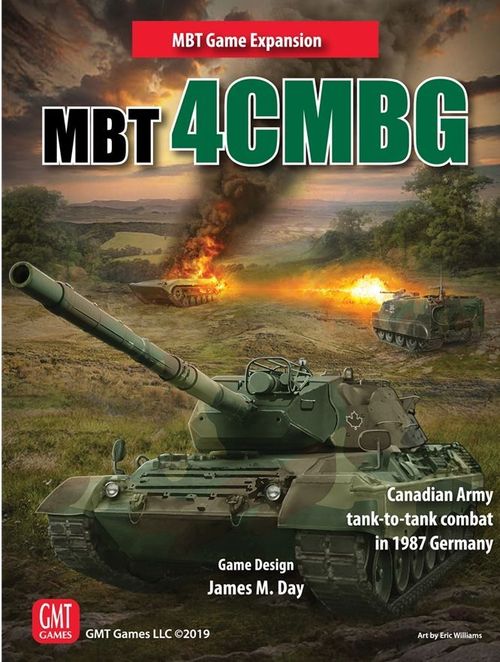
MBT: 4CMBG
Official rulebook: GMT Games · PDF
MBT: 4CMBG Rulebook
Table of Contents
Table of Contents
- Parts Inventory
- Introduction
- Units
- 4CMBG TO&E
- Terrain Features
- Combat Units
- Counters
- 7.51 Leaders
- 7.52 Voluntary Bail Out
- 7.53 Delayed Reaction
- 7.54 Random Recon
- 4CMBG Unit Summary Chart
- Scenarios
- Scenario 31: Beans and Bullets: Southeastern FRG, 29 September 1987
- Scenario 32: Race for the Prize: Southeastern FRG, 30 September 1987
- Scenario 33: Infiltrate: Southeastern FRG, 1 October 1987
- Scenario 34: Hold Fast: Southeastern FRG, 2 October 1987
- Scenario 35: Corps Level: Southeastern FRG, 3 October 1987
Parts Inventory
A complete package of 4CMBG includes the following:
- 1 Playbook
- 2 double-sided geomorphic maps #27–#30
- 5 Data Cards
- 1 Counter sheet
Introduction
Included in this expansion are the most significant Canadian units serving with the 4th Canadian Mechanized Brigade Group (4CMBG) that were available in 1987. While ownership of MBT is required, BAOR and FRG are not.
Five scenarios cover a wide range of situations reflecting various actions during the hypothetical Soviet invasion of Western Europe. The scenarios are fictional battles and are not intended to represent any specific historical situations or to characterize any actual circumstances or events.
Note that the new terrain features and Optional Rules presented here are surely applicable to all MBT, FRG and BAOR scenarios as desired.
Units
Individual vehicles and leg units do not operate alone as an unorganized mob. Instead, they form the building blocks for larger formations.
Royal Canadian Dragoons
As the brigade's armoured contingent, the RCD was slated to rotate out of Europe in 1987, but with the threat of hostilities looming on the horizon those plans were cancelled. Instead, its fourth tank squadron was fully mobilized in preparation for action.
The regiment is actually a battalion-sized formation, as is also common for British armoured regiments. Originally formed in 1883 as a horse cavalry unit, it served in that role in 1900 in South Africa and as both dismounted and mounted roles during the Great War, from 1915 to 1918. During WWII, it was deployed as an armoured car regiment in Italy. However, due to the difficult mountainous terrain, the RCD served the majority of its time as dismounted infantry.
1er Bataillon, Royal 22e Régiment
As one of the brigade's two mechanized infantry battalions, The Van Doos (an anglicized pronunciation of the French twenty-two, vingt-deux), remains the largest regiment in the Canadian Army. While its official creation date is 1869, it traces its history back to the War of 1812.
As the 22nd (French Canadian) Battalion, it served in World War I from 1915 as part of the 2nd Canadian Division until the end of the war. During WWII it landed in Sicily in 1943, then transferring to the Italian mainland. The regiment finished the war in 1945 in Northwest Europe. Three battalions saw action in Korea from 1951 until the armistice in 1953.
2nd Battalion, Princess Patricia's Canadian Light Infantry
As the brigade's other mechanized infantry battalion, the Patricia's were established in 1914. The regiment was named for Princess Patricia of Connaught (Queen Victoria's granddaughter), the daughter of the then Governor General of Canada.
During World War I, the Patricia's was the first Canadian infantry unit to enter Europe arriving in 1914. There it served until the armistice in 1918. During World War II, it mobilized and arrived in England in December 1939. The regiment spent three and a half years training and providing coastal defense. It landed in Sicily in 1943 as part of the 1st Canadian Infantry Division during Operation Husky. Later that year the unit transferred to Italy where it fought until 1945 finishing the war in Northwest Europe.
During the Korean War, the regiment's 2nd battalion was the first Canadian infantry unit to serve in Korea. As part of the 27th British Commonwealth Brigade, US 8th Army, in April 1951, it was awarded the United States Presidential Unit Citation for service during the Battle of Kapyong. At least one of the regiment's three battalions was in place until the armistice in 1953.
1st Regiment, Royal Canadian Horse Artillery
As the brigade's artillery contingent, its six self-propelled heavy batteries are listed as Organic Artillery assets; its anti-aircraft battery is listed as three Blowpipe equipped Air Defense Sections.
The regiment was formed in 1898 in Ontario and Quebec. It deployed to South Africa in 1900. During World War I, it landed in France in 1915 where it provided artillery support as part of the Canadian Cavalry Brigade until the end of the war. For its World War II service, it departed for England in 1939 and landed in France in 1940 as part of the Second British Expeditionary Force. The entire force was soon evacuated as part of the general retreat from France. The regiment landed in Sicily in 1943 as part of the 1st Canadian Infantry Division during Operation Husky. Later that year the unit transferred to Italy where it fought until 1945 finishing the war in Northwest Europe. During the Korean War, the regiment served from 1952 to 1953.
4CMBG TO&E
The brigade organization of 4CMBG (regiments, battalions, and troops) is provided for reference and for use in constructing scenarios. These organizations contain the military formations fielded by 4CMBG's fighting units. Note that only combat formations and the units they field are depicted. Support and administrative units and organizations are not included.
When selecting the forces for scenarios, use the formations and lower echelon formations to select the desired forces. Always keep in mind that formations are often not at full-strength; losses, breakdowns and other forms of attrition typically keep them under-strength.
Subordinate to US VII Corps, the brigade has at its disposal corps-level assets including artillery and air support. These may be fielded as part of the scenarios and in conjunction with US forces.
In September 1987, when MBT's hypothetical hostilities commenced, 4th Canadian Mechanized Brigade Group (4CMBG) fielded three combat maneuver battalions plus support elements. The following is a summary of those forces.
- CFm1: 4th Canadian Mechanized Brigade Group
- Brigade HQ: (2) RHQ Mech Inf Squad w/LAW [CM-4A], (2) Heavy Mech Inf Squad w/MAW & LAW [CM-4A], (4) M113A1 [CM-1B], (6) FO Section [CM-4A], (6) M113A1 [CM-1B]
- (1) Organic Artillery
- (6) SP Heavy Battery [CM-3A]
- (1) Combat Engineer Company
- Company HQ: (1) CHQ Mech Inf Squad w/MAW & LAW [CM-4A], (1) M113A1 [CM-1B], (1) Beaver AVLB [CM-3B]
- (4) Engineer Platoon: (3) Engineer Mech Inf Squad w/LAW [CM-4A], (1) Engineer Heavy Mech Inf Squad w/MAW & LAW [CM-4A], (4) M113A1 [CM-1B]
- (1) Reconnaissance Section: (3) Recon Lynx [CM-2A]
- (3) Air Defense Section: (2) Blowpipe Section [CM-4A], (2) M113A1 [CM-1B]
- (3) Helicopter Reconnaissance Troop: (2) CH-136 [CM-5B]
- (1) Armoured Regiment
- Regiment HQ: (1) BHQ Leopard C1 [CM-1A], (1) BHQ Mech Inf Squad w/LAW [CM-4A], (1) M113A1 [CM-1B], (1) Leopard C1 [CM-1A], (1) Heavy Mech Inf Squad w/MAW & LAW [CM-4A], (1) M113A1 [CM-1B]
- (1) AVLB Section: (2) Beaver AVLB [CM-3B]
- (3) Reconnaissance Troop: (7) Recon Lynx [CM-2A]
- (4) Armoured Squadron
- Squadron HQ: (1) CHQ Leopard C1 [CM-1A], (2) Leopard C1 [CM-1A]
- (4) Tank Troop: (4) Leopard C1 [CM-1A]
- (2) Mechanized Infantry Battalion
- Battalion HQ: (2) BHQ Mech Inf Squad w/MAW & LAW [CM-4A], (1) FO Section [CM-4A], (3) M113A1 [CM-1B]
- (6) Anti-Tank Section: (3) M150 [CM-2B]
- (2) Mortar Section: (2) Section w/L16 81mm mortar [CM-4A], (2) M113A1 [CM-1B]
- (3) Reconnaissance Section: (3) Recon Lynx [CM-2A]
- (4) Mech Infantry Company
- Company HQ: (1) CHQ Mech Infantry 1/2 Squad w/LAW [CM-4A], (1) Hvy Mech Inf Squad w/MAW & LAW [CM-4A], (2) Section w/L19 60mm Mortar [CM-4A], (4) M113A1 [CM-4A] (as printed; the M113A1 is listed as [CM-1B] everywhere else on the TO&E)
- (3) Mech Infantry Platoon: (1) Hvy Mech Inf Squad w/MAW & LAW [CM-4A], (3) Mech Inf Squad w/MAW & LAW [CM-4A], (4) M113A1 [CM-1B]
Notes (as printed):
- The Royal Canadian Dragoons, the brigade's armoured regiment, is actually a battalion-sized formation and therefore has a BHQ-sized headquarters.
- The 1er Bataillon, Royal 22e Régiment, and the 2nd Battalion, Princess Patricia's Canadian Light Infantry are the brigade's two mechanized infantry battalions.
- The brigade HQ FO sections [CM-4A] are typically allocated to the armoured regiment and mechanized infantry battalions.
- The engineer platoons, air-defense sections, and helicopter troops are typically allocated to the armoured regiment and mechanized infantry battalions.
- Additional artillery and air support assets provided by US VII Corps.
Terrain Features
4CMBG introduces a new terrain element and objective based situations.
Tracks
Track terrain represents the third tier of movement benefit after Roads and Paths. Hexes 29F4, 29F5, 29S5, 29Z3, and 29AA3 are examples of Track terrain.
Vehicles do not possess a specific Track movement rate. Vehicles moving on a Track ignore the actual terrain costs in a hex expending only 1 of their Movement Speed Allowance for each hex entered (2 for reverse moves). Unlike Roads and Paths, vehicles are not required to start their move on a Track hex or to follow the route described by the Track for their entire move, or ending their move on a Track, but must enter a track hex and exit a track hex from a Track hexside to benefit.
Vehicle moves along a route that combines Track with Path and/or Road movement, use the Track rate for the entire move.
Tracks may be designated as narrow (see 7.30 Narrow Roads & Paths).
Supply Depot
Wolf-27 is the code name for the supply depot located within the confines of village Papa-27 on mapboard 27. It is a typical staging area for POL (petrol, oil and lubricants), ammunition, rations, and other military stores. It could also represent a pre-positioned staging area for military vehicles and hardware.
The ten individual depot hexes, e.g., 27V3, 27X5, and 27Z6, are treated as Brick Buildings for all purposes. All hexes are two stories high.
Controlling Objectives
The scenarios included with 4CMBG introduce some additional considerations for controlling objectives. Unless otherwise indicated in a Scenario's Special Conditions, utilize the following criteria for controlling the objective.
- Wolf-27 (two-seven): Typically, to control the Supply Depot, a force must occupy or be the last to occupy, for a full turn, Hill Δ 27.07 free of opposing ground units. All of the Level 1 hexes making up Hill Δ 27.07 must be completely free of opposing combat ground units (opposing aircraft do not exert control). Once this requirement is met, place the appropriate Control counter in any convenient hex on the hill. Scenario 31 has Wolf-27 as its objective.
- Combination Hex Objectives: Some scenarios require control of multiple hex objectives. To meet the control requirements, the listed hex combinations must be controlled at the conclusion of a scenario. They need not be controlled during the same turn. Place the appropriate Control counter on each hex as it is controlled. Scenario 32 has multiple two-hex bridge combination objectives.
- Turn Specific Objectives: Some scenarios require control of an object only on a specific turn during the scenario. This is not unlike controlling objectives at the conclusion of a scenario (see 3.6 Controlling Objectives), except in this case the control requirement need only be met on the specific turn designated. Scenario 34 has a turn specific objective.
Combat Units
Blowpipe
4CMBG includes a new type of MANPADS AA unit – Blowpipe. It is manually guided by an operator in a similar manner to MCLOS ATGMs. It is an all aspect system.
As a result, Blowpipe is subject to ATGM CL: 4 (see 5.1.3.3.6 ATGM Under Fire). The AA modifiers is -10.
ITOW Section
The ITOW ATGM system mounted on the M150 vehicle may be utilized as a section-sized crew-served weapon. In the context of the scenarios, these ATGM sections may not be transported; they start the scenarios dismounted and must remain so for the duration of the scenario. During the course of a scenario, M150s may not dismount their ITOW systems. Scenarios 31 and 34 include ITOW ATGM sections.
Leopard C1 – APFSDS
As they are very similar in appearance, some confusion exists as to specifically when the Canadian Leopard C1 uniformly fielded the more powerful APFSDS ammunition (below, third from left) over the previous standard APDS (below, far right). Therefore, the Leopard C1 Data Card lists both types. Either may be employed. A tank would field only a single type.
(The Playbook shows a photo of the ammunition types, labelled HESH, WP-HE/FI, APDSFS-T, HEAT-T, HEAT and APDS-T, here.)
Counters
4CMBG includes a few new reference counters to aid in play.
Spot Small Arms
Includes dedicated SPOT counters for marking Small Arms (see 6.1.3). If the target unit fired a weapon classified as Small Arms (see 5.7 Small Arms), it is marked with a Spot/Fire SA counter.
ATGM Dodge
Includes dedicated ATGM DODGE counters for marking the movement path avoiding an ATGM (see 5.1.3.3.4).
NATO Target Acquisition Bonus
Includes dedicated NATO TARGET ACQUISITION BONUS counters for marking eligible targets (see 7.50). The counters are available in matched numerical sets. One is place on the NATO unit with its corresponding counter placed on the Soviet unit.
Helicopter Landed and Hover
Includes counters to easily identify landed helicopters and helicopters flying in hover mode.
VP Reference
Includes VP Reference counters, in four colors, to mark specific Victory Point hexes or to use as a reminder as to the location of critical hexes.
7.51 Leaders
Leaders add a powerful new dynamic to the MBT series. They represent individuals of various ranks and skills that can influence gameplay in a number of unique ways. In almost all cases, scenarios do not indicate the presence of any particular leader or leaders.
Players may freely add any number of leaders or none at all. Just decide by mutual agreement. Follow the recommended command structure below, or just go with whatever works. There is no correct or incorrect approach as battlefield conditions make for very fluid situations. There may be occasions where junior officers or NCOs find themselves in overall command or senior officers are commanding only a small contingent.
For the purposes of these rules, RHQ level (regiment/brigade) commanders are not addressed. Those commanders are considered to operate off-map or, when on-map, without a named leader.
7.51.1 Leader Employment
At the start of a scenario, leaders must attach to any vehicle or leg unit; they may not attach to fixed-wing aircraft or helicopters. They may also arrive later in a scenario as part of a relief or reinforcement formation, again attached to any vehicle or leg unit.
Leaders never operate independently. They must attach to a combat unit at all times; place the leader counter under the attached unit. A unit may only have a single attached leader. The attached unit's Grade or its Formation Grade is unaffected by the presence of a leader.
Leaders are never individually targeted. If in play, they are visible at all times unless part of a hidden unit. If the attached unit is lost (elimination, bail out, knock out or brew up), the leader is permanently removed from play. Leaders do not have VPs and, therefore, do not factor in when determining victory in a scenario whether they are present, survive or are lost.
No VPs? What value can be placed on the impact a leader or leaders does or does not have on the outcome of a scenario? In many cases, it could be purely subjective or emotional. There may be a favorite leader or one that turns the tide of battle or for that matter has no measurable impact. It is really up to the players to make that determination.
If attached to a vehicle or leg unit designated in a scenario as an FO or command unit (BHQ or CHQ), the leader automatically assumes the role as that FO or command unit. Leaders do not gain or lose FO or command status when transferring to a new unit even if that new unit is also an FO or command unit. Integrated vehicle crew based FO leaders may dismount; exception to below (see 7.39).
Leaders attached to a vehicle may never transfer to another unit; they remain with that vehicle for the duration of the scenario.
Leaders attached to leg units, may transfer to another leg unit from the same company when located in the same hex; they may not transfer to vehicles. If an FO or command unit (BHQ or CHQ) that status transfers with the leader.
No specific command is required to transfer, just shift the leader counter to the new leg unit at the conclusion of the Adjustment Phase after all of the adjustment steps are complete.
Leaders may not transfer from a leg unit that is suppressed, hesitating and/or broken. However, they may transfer to a suppressed, hesitating and/or broken leg unit.
7.51.2 Leader Effects
- (A) AP Combat: + AP Hit modifier
- (G) GP Combat: + GP dice roll modifier
- Also used for Close Assault, Hand-to-Hand and Overrun combat resolutions
- (S) Suppression Recovery: - dice roll modifier
- (M) Morale: + dice roll modifier
- (P) Spotting: + Spotting Ranges modifier
- (R) IF Response: + Indirect Fire Response modifier
General
Command: in the same manner as Recon units, all leaders automatically command the attached unit; this command does not count towards its formation's command limit.
Leader modifiers are cumulative with all other combat, suppressed, morale, spotting or IF response modifiers. Leaders may apply any and all applicable modifiers during a turn. If more than one leader could be applicable, only the modifiers from a single leader come into play. Multiple leader modifiers are never applicable at the same time on the same unit.
It is not necessary to utilize the same leader for all actions; if there is a choice, utilize the leader that offers the greatest advantage.
AP and GP Combat
(A) AP and (G) GP Combat modifiers apply to all of the attached unit's weapons and any attached weapons. If the leader is also acting as a command unit (BHQ or CHQ), a single leader's (A) AP or (G) GP Combat modifiers are applicable to all other units' weapons and any attached weapons from the same formation within command range.
Close Assault and Hand-to-Hand Combat
Close Assault and Hand-to-hand Combat modifiers apply singly per combat, not per unit in the combat, and only to the combat including the leader regardless if the leader is also acting as a command unit (BHQ or CHQ). The attached unit does not need to be the primary attacker.
Overrun Combat
Overrun modifiers apply only to the attached vehicle. They do not apply to any other Overrun combats even against the same target unit regardless if the leader is also acting as a command unit (BHQ or CHQ).
Suppression
The (S) Suppress modifier applies only to the attached unit unless the leader is also acting as a command unit (BHQ or CHQ). In those cases, a single leader's (S) Suppress modifier is applicable to all other units from the same formation within command range.
Morale
The (M) Morale modifier applies only to the attached unit unless the leader is also acting as a command unit (BHQ or CHQ). In those cases, a single leader's (M) Morale modifier is applicable to all other units from the same formation within command range. This modifier is an exception and is in addition to the +20 Command Unit with in Cmd Rng limit (see 7.1.4).
Spotting
The (P) Spotting modifier applies only to the attached unit regardless if the leader is also acting as a command unit (BHQ or CHQ).
If attached to a recon unit, this modifier is in addition to the +1 Recon Spotting modifier (see 6.1.3.3).
Spotting modifiers do not apply to optional rules 7.4 and 7.7; the application of those rules is unaffected by attached leaders.
IF Response
The (R) IF Response modifier applies only to leaders when acting as FOs, command units (BHQ or CHQ), or attached to recon units and applies only to the attached unit regardless if the leader is also acting as a command unit (BHQ or CHQ).
If the result is an unmodified 1, a Danger Close friendly fire incident may still occur (see 6.5.1.10).
7.51.3 Force Leaders
Ten double-sided leader counters are included for a total of twenty individual leaders – two of each rank.
Rank titles are not included on the individual Leader counters. Some are just too long or the requisite abbreviations would not be clear. So, just the leader surnames along with their national rank insignia are included.
Within NATO, equivalent ranks do not exist across all of the nations. Some interpretations were made to keep the information consistent.
The following tables summarizes the leaders to assist in associating the various rank insignia with the rank titles and leaders. Also included is the recommended command structure.
- CHQ: Major or Captain; additional CHQ from same formation the same rank or one or two ranks lower.
- BHQ: Lt. Colonel; additional BHQ from same formation the same rank or one rank lower.
- FO: Typically a junior officer or senior NCO.
- Platoon: Typically a Captain or junior officer.
With the unification of the Canadian armed forces in 1968, the old style army officers' "pips and crowns" insignia was replaced with a common officer insignia across all three military branches. It most closely resembled the original naval sleeve stripe rank insignia. The army returned to the traditional officer insignia in 2013.
4CMBG Leaders
| Leader | Rank |
|---|---|
| Smith | Private (T) |
| Allen | Private (T) |
| Clarke | Corporal |
| Robertson | Corporal |
| Pelletier | Master Corporal |
| Chan | Master Corporal |
| Martin | Sergeant |
| Cote | Sergeant |
| Taylor | Master WO |
| Landry | Master WO |
| Wilson | Second Lieutenant |
| Graham | Second Lieutenant |
| Bouchard | Lieutenant |
| Harris | Lieutenant |
| Macdonald | Captain |
| Williams | Captain |
| Campbell | Major |
| Young | Major |
| King | Lt. Colonel |
| Leblanc | Lt. Colonel |
(Leader counter sides and rank insignia are shown as images in the Playbook.)
7.52 Voluntary Bail Out
Bailout is normally a non-player controlled event triggered by specific combat results. However, this may result in challenging situations when employing the Command Span optional rule (see 7.43).
Vehicles with Hull Damage and Track hits will invariably fall behind, causing gaps in the required command span when commanding moving units.
Players may prefer to place those vehicles out of action. When the situation arises, during the Adjust/Remove Counters Step (see 6.8.6) of the Adjustment Phase, place a Bail counter on or next to the vehicle.
7.53 Delayed Reaction
Units may not be prepared for action or may be surprised by the appearance of opposing forces. Therefore, there is a delay in responding to sighting opposing units. This is represented by a delay before the unit may operate normally. Until that time, the unit must have an N/C command marked.
Scenario 33 has Delayed Reaction. For example, if any Soviet unit spots a Canadian unit during turn 5, the remaining units in the Reconnaissance Company located in Hotel-10 and the off-map units in the Motor Rifle Company (mixed) may mark any command starting in turn 6.
7.54 Random Recon
This simulates units searching for an opposing force that may or may not exist within a search grid. The searching units move in a quasi-random manner varying their direction and amount of movement.
Scenario 33 employs Random Recon for a section of the Soviet 9th Guards Reconnaissance Battalion.
7.54.1 Movement
All units designated as Random Recon must have MOVE commands. Units individually determine movement, in any order, as determined by the controlling Force.
Before moving:
- Roll (d6); the result represents the direction of movement. Reference the directional hex on the mapboard to determine the direction of movement.
- Roll (10); and reference the Random Recon table listed in the scenario to determine how many hexes the unit may move.
- A unit must move at least 1 hex in the indicated direction unless prevented by prohibited terrain, e.g., vehicle into Heavy Woods or moving off-map. Amphibious units may treat an amphibious move as prohibited terrain; they are not required to enter traversable water hexes.
- The unit may move 2 or more hexes, as determined by the controlling Force, in the indicated direction up to and including the value determined from the Random Recon table as long as it follows the Movement rules.
- A unit may never exceed its Movement Factor or enter prohibited terrain. As such, a unit may be limited to less than the maximum number of hexes or no movement or pivoting if facing prohibited terrain.
7.54.1.1 Roads, Paths & Tracks
Random Recon vehicles starting their movement on Road, Path or Track hexes may employ the following special conditions. Leg and towed units are not eligible.
- Vehicles are eligible for the Road, Path and Track movement bonus. They may combine Road, Path and track movement.
- They may continue to follow the route described by the Road, Path or Track deviating from the direction of movement. They are not required to exit the Road, Path or Track. For the first hex of movement, the vehicle must first move in the direction that matches or is closest to the direction of movement determined above. For example, if the direction of movement is '4' and a Road faces hexsides '5' and '2', the unit must move in direction '5'. If more than one hexside is closest to the direction of movement, the controlling force chooses the direction of movement. The vehicle may then follow the route described by the Road, Path or Track up to and including the value determined from the Random Recon table as long as it does not exit the Road, Path, or Track and follows the Movement rules and does not exceed its Movement Factor.
7.54.1.2 Sounds
Combat and vehicles, especially tracked vehicles, create sound when moving that may be detected by Random Recon units. Note that detection just provides a point of reference as to where a unit may be located. It must still be spotted.
- Any opposing tracked 'T' or half-tracked 'H' vehicle that moves (Move or Short Halt command) within 10 hexes at any point during its movement, regardless of intervening terrain, of a Random Recon unit, is detected.
- Any opposing wheeled 'W' vehicle that moves (Move or Short Halt command) within 5 hexes during its movement, regardless of intervening terrain, of a Random Recon unit, is detected.
- Moving leg and towed (manhandling) units are never detected.
- Any non-small arms fire, impacting artillery, mortar, or an explosion, e.g., aircraft bombs or bridge destruction by engineers, anywhere on the map, regardless of intervening terrain, of a Random Recon unit, is detected.
- Any small arms fire (including Close Assault and Hand-to-Hand combats) within 10 hexes, regardless of intervening terrain, of a Random Recon unit, is detected.
- Random Recon units may move to the hexside facing the direction of the detected sound following a straight path ignoring both the direction of movement and the value determined from the Random Recon table as long as it follows the Movement rules and does not exceed its Movement Factor. If more than one hexside faces a detected sound, the controlling force chooses the direction of movement.
- Random Recon units may continue movement to a detected sound by marking the hex with a VP counter.
7.54.2 Spotting
Random Recon units spot normally. Once an opposing unit is spotted, Random Recon is immediately cancelled and normal game play commences. Any Random Recon units that have not yet resolved their movement may move normally.
4CMBG Unit Summary Chart
| Unit | Card | Elite | Veteran | Seasoned | Regulars | Green | Raw |
|---|---|---|---|---|---|---|---|
| Artillery, Counter Battery | CM-3A | --- | --- | 50 | --- | --- | --- |
| Artillery, Light Battery | CM-3A | --- | --- | 40 | --- | --- | --- |
| Artillery, Medium Battery | CM-3A | --- | --- | 54 | --- | --- | --- |
| Artillery, Heavy Battery | CM-3A | --- | --- | 83 | --- | --- | --- |
| Artillery, Super Heavy Battery | CM-3A | --- | --- | 98 | --- | --- | --- |
| Beaver AVLB | CM-3B | 78 | 62 | 52 | 41 | 26 | 15 |
| CSW, 81mm L16 Mortar | CM-4B | 51 | 40 | 34 | 27 | 17 | 10 |
| CSW, 60mm L19 Mortar | CM-4B | 34 | 27 | 23 | 18 | 11 | 6 |
| CSW, ITOW ATGM | CM-4B | 94 | 75 | 63 | 50 | 31 | 18 |
| CSW, LAW HHATW | CM-4B | 25 | 20 | 17 | 13 | 8 | 5 |
| CSW, MAW HHATW | CM-4B | 57 | 45 | 38 | 30 | 19 | 11 |
| CSW, Blowpipe MANPADS | CM-4B | 13 | 10 | 9 | 7 | 4 | 2 |
| Fixed-wing, CF-18B Hornet | CM-5A | 150 | 120 | 100 | 80 | 50 | 30 |
| Helicopter, CH-136 Kiowa | CM-5B | 100 | 80 | 67 | 53 | 33 | 20 |
| Leg, Heavy Mech Infantry Squad/Half-squad | CM-4A | 45/33 | 36/26 | 30/22 | 24/17 | 15/11 | 9/6 |
| Leg, Mech Infantry Squad/Half-squad | CM-4A | 39/28 | 31/22 | 26/19 | 20/15 | 13/9 | 7/5 |
| Leg, Section | CM-4A | 16 | 13 | 11 | 8 | 5 | 3 |
| Leopard C1 | CM-1A | 228 | 182 | 152 | 121 | 76 | 45 |
| Lynx | CM-2A | 57 | 45 | 38 | 30 | 19 | 11 |
| M113A1 | CM-1B | 73 | 58 | 49 | 39 | 24 | 14 |
| M150 | CM-2B | 106 | 85 | 71 | 56 | 35 | 21 |
Scenarios
The order of battle for each scenario is transcribed from the Playbook's force graphics. Each element is listed by its printed counter label(s), quantity (x) and point value (@). The per-element stat strings printed on the graphics (for example the armour and crew figures on vehicle counters) are not repeated here; the unit cards and the base MBT rules govern them.
Obvious misspellings and irregular wording in the Playbook's own text are transcribed as printed.
Scenario 31: Beans and Bullets: Southeastern FRG, 29 September 1987
Situation
After mobilization, the third day of the war finds elements of the 4CMBG deployed in defense of key US VII Corps assets -- Wolf-27. The supply depot is surrounded by Papa-27, a strategic village located in the Corps's AO.
In its initial action, the 18th Guards Motor Rifle Division is pressing forward to seize the depot along the CCF's route of advance, while its other four divisions engage US VII and FRG II Corps' forces.
Map
Utilize maps 2, 4, & 27.
Setup
- Conditions: Normal visibility. No adverse terrain.
- 4CMBG ...:
- Force places 3 Improved Position counters in any legal hexes on the mapboard.
- Force sets up first anywhere on maps 2, 4, and/or 27 at least 5 hexes from the Soviet edge.
- Wolf-27 is under 4CMBG control at the start of the scenario whether occupied or unoccupied.
- Soviet ...: Force enters the mapboard on turn 1 with the 1st MR Company and on turn 2 with the 2nd MR Company anywhere along the Soviet edge. Units are eligible for the Road movement bonus. The helicopter section may enter on any turn anywhere along the Soviet edge.
- 4CMBG ... (Relief Force): Relief Force has the potential of arriving starting on Turn 7 based on the arrival table. Before the Initiative Phase of turn 7, and each turn thereafter as necessary, the 4CMBG Force rolls (100). If the result falls within the listed range for that turn, any unit from the Relief Force may move on during the Movement Phase of that turn or the Movement Phase of any turn thereafter.
- 4CMBG ... (Relief entry): A second roll (100) is required to determine where the Relief Force enters. It must enter on the indicated Entry hex or adjacent to that hex. If entering on the Entry hex units are eligible for the Road movement bonus.
Relief Force Arrival
| Turn | Range | VP Adjustment | Entry Hex | Range |
|---|---|---|---|---|
| 7-8 | 01-10 | -565 | 2A5 | 01-20 |
| 9-10 | 01-20 | -375 | 27A5 | 21-32 |
| 11-12 | 01-40 | No adjustment | 27F10 | 33-44 |
| 13-14 | 01-60 | +375 | 27Q10 | 45-56 |
| 15 | 01-00 | +565 | 27BB10 | 57-68 |
| 27GG5 | 69-80 | |||
| 2GG5 | 81-00 |
Victory Conditions
- Length: 20 turns.
- 1,800 VPs: To the force that controls Wolf-27. To control the Supply Depot, a force must occupy or be the last to occupy, for a full turn, Hill Δ 27.07 free of opposing ground units. If neither side meets this requirement, these VPs are not awarded.
- VP Adjustment: Potential 4CMBG VP Adjustment based on the Relief Force's initial turn of arrival.
- Unit VPs: For elimination, knock out or brew up.
- 360 VPs: Required victory margin.
Special Conditions
- When determining the Initiative, the 4CMBG Force applies a +20 DRM.
- The half-hexes along both long outer edges of the mapboard are impassable.
- Across the map, all Stone Building hexes are 3 stories high; Brick Building hexes are 2 stories high.
- The Stream is impassable except at the Bridges or Ford hexes. Amphibious vehicles (7.34) may traverse.
- The Bridges on Map 2 may be destroyed by GP Fire (6.5.4.2.5); the Bridges have a GP Defense of 5.
- The AVLB Rules (7.49) are in effect. Its bridge may be destroyed (see above); its GP Defense is 6.
- The Staggered Initiative Rules (7.5) may be employed on a company-level basis.
- If special ammo types are available, utilize Ammo Limits.
- If Morale Rules (7.1) are in effect, utilize the listed point information.
- Only the 4CMBG Force may employ the Hidden Unit Rules (7.2). A maximum of 4 Hidden Unit Markers may deploy.
- If the Command Span Rules (7.43) are in effect, the 4CMBG Holding Force CHQ has a Command Span of 9 hexes; the Relief Force CHQ 10 hexes. The Soviet CHQs have a Command Span of 9 hexes.
- Both Forces may add Leaders (7.51) as desired.
- The 4CMBG Force may employ Quickdraw (7.44).
- Requires MBT & 4CMBG
Order of Battle
4CMBG Force: Elements of 4CMBG, Veteran [3,760]
Holding Force
- Improved Position (IMP POS) counter: x3 @ 25
Mech Infantry Company (mixed): Veteran, Excellent, 21, CP-13 [1,470]
- CHQ, MI, LAW (squad): x1 @ 63
- M113A1 [CM-1B]: x1 @ 58
- FO: x1 @ 26
- L19 (mortar section): x2 @ 40
- Blowpipe: x1 @ 23
- Leopard C1 [CM-1A]: x2 @ 182
- MI, LAW (squad): x3 @ 51
- HMI, MAW, LAW (squad): x1 @ 101
- M113A1 [CM-1B]: x4 @ 58
- ITOW: x3 @ 88
- L16 (mortar section): x2 @ 53
Relief Force
Armoured Squadron (mixed): Veteran, Excellent, 17, CP-10 [2,215]
- Leopard C1 [CM-1A], CHQ: x1 @ 273
- Leopard C1 [CM-1A]: x4 @ 182
- Leopard C1 [CM-1A]: x4 @ 182
- MI, LAW (squad): x3 @ 51
- HMI, MAW, LAW (squad): x1 @ 101
- M113A1 [CM-1B]: x4 @ 58
Soviet Force: Elements of 275th Guards Motor Rifle Regiment, Seasoned [3,509]
1st Motor Rifle Company (mixed): Seasoned, Excellent, 20, CP-12 [1,911]
- Mi-8T [15B1 327], Low: x1 @ 122
- MR, Saxhorn, RPG-22 (squad): x1 @ 89
- HMR, RPG-22 (squad): x1 @ 53
- MR, RPG-22 (squad): x1 @ 49
- Artillery, Sm-7A, Medium, Attached: x1 @ 81
- HMR, CHQ, RPG-22 (squad): x1 @ 79
- BTR-70 [Sm-6B 277]: x1 @ 52
- MT-55A AVLB [Sm-7B 190]: x1 @ 76
- HMR, RPG-22 (squad): x3 @ 53
- BTR-70 [Sm-6B 277]: x3 @ 52
- MR, Saxhorn, RPG-22 (squad): x1 @ 89
- HMR, RPG-22 (squad): x2 @ 53
- BTR-70 [Sm-6B 277]: x3 @ 52
- T-55M [Sm-4A 427]: x4 @ 161
2nd Motor Rifle Company (mixed): Seasoned, Excellent, 17, CP-10 [1,598]
- Artillery, Sm-7A, Medium, Attached: x1 @ 81
- HMR, CHQ, RPG-22 (squad): x1 @ 79
- BTR-70 [Sm-6B 277]: x1 @ 52
- MT-55A AVLB [Sm-7B 190]: x1 @ 76
- HMR, RPG-22 (squad): x3 @ 53
- BTR-70 [Sm-6B 277]: x3 @ 52
- MR, Saxhorn, RPG-22 (squad): x1 @ 89
- HMR, RPG-22 (squad): x2 @ 53
- BTR-70 [Sm-6B 277]: x3 @ 52
- T-55M [Sm-4A 427]: x4 @ 161
Scenario 32: Race for the Prize: Southeastern FRG, 30 September 1987
Situation
As the reserve Soviet 1st Guards Tank Army is committed to the war, its 20th Guards Motor Rifle Division races to secure bridge crossings along the Army's route of advance with its 11th Guard Tank division right on the 20th's heels.
The 4CMBG is tasked with blunting the Soviet advance while the other NATO elements are locked in a struggle with the Soviet forces.
4CMBG air assets fielded from US VII Corps' combat aviation brigade.
Map
Utilize maps 3, 8, 9, 28 & 30.
Setup
- Conditions: Normal visibility. No adverse terrain.
- Both ...:
- Forces roll (10). The force rolling the lower result (reroll ties) selects its edge first. The other force utilizes the other edge.
- Forces enter the mapboard on Turn 1 anywhere along their respective edges. Units are eligible for the Path movement bonus. The 4CMBG helicopter section may enter on any turn anywhere along the 4CMBG edge.
- The Soviet Force controls 30Q4-30Q5, 30R4-30R6, 30BB2-30AA9, and 30BB2-30BB9 combination bridge crossings at the start of the scenario.
- 4CMBG ...: Force first places 2 Block counters in any legal hexes on the mapboard at least 5 hexes from the Soviet edge.
- Soviet ...: Force then places 2 Block counters in any legal hexes on the mapboard at least 5 hexes from the 4CMBG edge.
Victory Conditions
- Length: 20 turns.
- 1,750 VPs: To the Soviet Force for controlling three or more combination bridge crossings spanning the stream on Map 30. The combinations include bridge hexes 30H5-30F8, 30Q4-30Q5, 30R4-30R6, 30BB2-30AA9, or 30BB2-30BB9. To the 4CMBG force for limiting the Soviet Force to no more than two combination bridge crossings on Map 30.
- Unit VPs: For elimination, knock out or brew up.
- 440 VPs: Required victory margin.
Special Conditions
- When determining the Initiative, the 4CMBG Force applies a +20 DRM.
- The half-hexes along both long outer edges of the mapboard are impassable.
- Across the map, all Stone Building hexes are 3 stories high; Brick Building hexes are 2 stories high.
- The Stream on Map 30 is impassable except at the Bridges or Ford hexes. Amphibious vehicles (7.34) may traverse.
- The 4CMBG Force may plot 2 Pre-Registered Points for its Organic Heavy Battery. One FASCAM and three ICM fire missions are available.
- The Soviet Force may plot 2 Pre-Registered Points for its Organic Heavy Battery. One CLGP, one FASCAM, and two ICM fire missions are available.
- Both Forces may use Planned Artillery Fire for their Organic Heavy Batteries.
- The Blocks may be destroyed by GP Fire (6.5.4.2.5); they have a GP Defense of 7.
- The Staggered Initiative Rules (7.5) may be employed on a company-level basis.
- If special ammo types are available, utilize Ammo Limits.
- If Morale Rules (7.1) are in effect, utilize the listed point information.
- If the Hidden Unit Rules (7.2) are in efffect, each Force may deploy a maximum of 6 Hidden Unit Markers.
- If the Command Span Rules (7.43) are in effect, the 4CMBG CHQs have a Command Span of 9 hexes. The Soviet CHQs have a Command Span of 8 hexes.
- Both Forces may add Leaders (7.51) as desired.
- The 4CMBG Force may employ Quickdraw (7.44).
- Requires MBT & 4CMBG
Order of Battle
4CMBG Force: Elements of 4CMBG, Veteran [4,488]
- Artillery, CM-3A, Heavy, Organic SP: x1 @ 83
- Block: x2 @ 15
Armoured Squadron (mixed): Veteran, Excellent, 22, CP-13 [2,554]
- Leopard C1 [CM-1A], CHQ: x1 @ 273
- FO: x1 @ 26
- M113A1 [CM-1B]: x1 @ 58
- MI, LAW (squad): x3 @ 51
- HMI, MAW, LAW (squad): x1 @ 101
- M113A1 [CM-1B]: x4 @ 58
- Leopard C1 [CM-1A], 1x Mine Plow: x4 @ 182
- Leopard C1 [CM-1A]: x4 @ 182
- M150 [CM-2B]: x3 @ 85
Mech Infantry Company (mixed): Veteran, Excellent, 22(19), CP-13 [1,821]
- CHQ, MI, LAW (squad): x1 @ 63
- FO: x1 @ 26
- M113A1 [CM-1B]: x2 @ 58
- UH-1H Iroquois [UH-11A2 265], Low: x4 @ 105
- MI, LAW (squad): x3 @ 51
- HMI, MAW, LAW (squad): x1 @ 101
- MI, LAW (squad): x3 @ 51
- HMI, MAW, LAW (squad): x1 @ 101
- M113A1 [CM-1B]: x4 @ 58
- M150 [CM-2B]: x3 @ 85
- Lynx [CM-2A], Recon: x3 @ 67
Soviet Force: Elements of 29th Guards Motor Rifle Regiment, Seasoned [4,328]
- Artillery, SM-7A, Heavy, Organic SP: x1 @ 83
- Block: x2 @ 15
1st Motor Rifle Company (+): Seasoned, Excellent, 25, CP-15 [2,107]
- HMR, CHQ, RPG-22 (squad): x1 @ 79
- BMP-2 [SM-4B 150]: x1 @ 80
- ZSU-23-4 [SM-12A 309], 5T 7-11: x1 @ 47
- MR, Saxhorn, RPG-22 (squad): x1 @ 89
- HMR, RPG-22 (squad): x2 @ 53
- BMP-2 [SM-4B 150]: x3 @ 80
- MR, Saxhorn, RPG-22 (squad): x1 @ 89
- HMR, RPG-22 (squad): x2 @ 53
- BMP-2 [SM-4B 150]: x3 @ 80
- MR, RPG-22 (squad): x3 @ 49
- BMP-2 [SM-4B 150]: x3 @ 80
- T-55M [SM-4A 427], 1x Mine Plow: x4 @ 161
2nd Motor Rifle Company (+): Seasoned, Excellent, 25, CP-15 [2,108]
- HMR, CHQ, RPG-22 (squad): x1 @ 79
- BMP-2 [SM-4B 150]: x1 @ 80
- ACRV [SM-10B2 225], FO: x1 @ 48
- MR, Saxhorn, RPG-22 (squad): x1 @ 89
- HMR, RPG-22 (squad): x2 @ 53
- BMP-2 [SM-4B 150]: x3 @ 80
- MR, Saxhorn, RPG-22 (squad): x1 @ 89
- HMR, RPG-22 (squad): x2 @ 53
- BMP-2 [SM-4B 150]: x3 @ 80
- MR, RPG-22 (squad): x3 @ 49
- BMP-2 [SM-4B 150]: x3 @ 80
- T-55M [SM-4A 427], 1x Mine Plow: x4 @ 161
Scenario 33: Infiltrate: Southeastern FRG, 1 October 1987
Situation
Picketing all along its front, the 1st Guards Tank Army's 11th Guards Tank Division is preparing to continue its advance at first light.
The 4CMBG is utilizing the cover of darkness to destroy key bridge crossings in an attempt to hold the Soviets at their present position.
The following Optional Rule is recommended: Defensive Fire (7.15).
Map
Utilize maps 2, 10 & 29.
Setup
- Conditions: Limited visibility conditions in effect; apply turn based Spotting modifiers (see table). No adverse terrain.
- Soviet ...:
- Reconnaissance Company sets up first with the dismounted HMR&MR squads and BMP-1Ps in any hexes of Hotel-10; and a single BRDM-2 with a mounted section in hexes 2I5, 2V7, and 2CC5.
- Motor Rifle Company (mixed) sets up off-map along the Soviet edge (9.1.3).
- 4CMBG ...: Force sets up second anywhere on map 29 within 3 hexes of the 4CMBG edge. Any unit may set up off-map along the 4CMBG edge (9.1.3). Off-map units may enter on any turn.
Victory Conditions
- Length: 20 turns.
- 425 VPs: To the 4CMBG Force for each of the bridges, 2I5, 2V7, or 2DD4 destroyed. To the Soviet Force for each of the bridges not destroyed.
- Unit VPs: For elimination, knock out or brew up.
- 250 VPs: Required victory margin.
Special Conditions
- When determining the Initiative, both Forces apply a +20 DRM until the Soviet Motor Rifle Company (mixed) activates. From that point on, the Soviet Force applies a +20 DRM just in those cases where it won the Initiative the previous turn, otherwise, it applies no Force Grade modifier.
- The Staggered Initiative Rules (7.5) may be employed on a company basis.
- Across the map, all Stone Building hexes are 3 stories high; Brick Building hexes are 2 stories high.
- The Stream on Map 2 is impassable except at the Bridges or Ford hexes. Amphibious vehicles (7.34) may traverse.
- The Bridges on Map 2 may be destroyed by GP Fire (6.5.4.2.5). 4CMBG engineers may directly attack the Bridges (7.19). Bridges have a GP Defense of 4.
- The 4CMBG Organic Heavy Battery has two ICM and one FASCAM fire missions available. The 4CMBG Force may call indirect fire on Bridge hexes without a separate spotted target (exception to 6.5.1). A Bridge is treated as a moving vehicle for spotting purposes.
- If special ammo types are available, utilize Ammo Limits.
- If Morale Rules (7.1) are in effect, utilize the listed point information.
- The Soviet Force is subject to Delayed Reaction (7.53). The dismounted MR squads and BMP-1Ps located in Hotel-10 may not place commands (activate) until the turn following when a 4CMBG unit is spotted. The off-map Motor Rifle Company (mixed) may not place commands (activate) until the turn following when a 4CMBG unit is spotted.
- The three Soviet BRDM-2s must employ Random Recon (7.54). Their sections may not dismount until a 4CMBG unit is spotted.
- Only the 4CMBG Force may employ the Hidden Unit Rules (7.2). A maximum of 6 Hidden Unit Markers may deploy.
- Night Fighting Rules (7.36.4) are in effect.
- If the Command Span Rules (7.43) are in effect, the 4CMBG CHQ has a Command Span of 8 hexes; the Soviet CHQ has a Command Span of 7 hexes.
- Both Forces may add Leaders (7.51) as desired.
- The 4CMBG Force may employ Quickdraw (7.44).
- Requires MBT & 4CMBG
Limited Spotting
| Turn | Mod | Turn | Mod |
|---|---|---|---|
| 1-10 | -5 | 15-16 | -2 |
| 11-12 | -4 | 17-18 | -1 |
| 13-14 | -3 | 19+ | 0 |
For each turn, the listed value is the Spotting Modifier. With a -4 or -5 modifier, leg units may not Quickmarch and no Road/Path movement bonus applies.
Order of Battle
4CMBG Force: Elements of 4CMBG, Veteran [2,200]
- Artillery, CM-3A, Heavy, Organic SP: x1 @ 83
Mech Infantry Company (mixed): Veteran, Excellent, 30, CP-18 [2,117]
- CHQ, MI, LAW (squad): x1 @ 63
- L16 (mortar section): x1 @ 54
- M113A1 [CM-1B]: x2 @ 58
- MI, LAW (squad): x3 @ 51
- HMI, MAW, LAW (squad): x1 @ 101
- M113A1 [CM-1B]: x4 @ 58
- MI, LAW (squad): x3 @ 51
- HMI, MAW, LAW (squad): x1 @ 101
- M113A1 [CM-1B]: x4 @ 58
- Leopard C1 [CM-1A], 7T 9-14: x2 @ 182
- MI, Engineer, LAW (squad): x3 @ 63
- HMI, Engineer, MAW, LAW (squad): x1 @ 127
- M113A1 [CM-1B]: x4 @ 58
Soviet Force: Elements of 11th Guards Tank Division, Veteran/Seasoned [2,737]
Elements of 9th Guards Reconnaissance Battalion, Reconnaissance Company (-), Veteran, Excellent, 12(0), CP-7 [1,185]
- MR, Recon, Saxhorn, RPG-22 (squad): x1 @ 159
- MR, Recon, RPG-22 (squad): x2 @ 87
- BMP-1P [SM-5A 243], Recon: x3 @ 118
- Elite, Recon, RPG-22 (squad): x3 @ 75
- BRDM-2 [SM-9A 200], Elite, Recon: x3 @ 91
Elements of 249th Guards Motor Rifle Regiment, Motor Rifle Company (mixed): Seasoned, Excellent, 18, CP-11 [1,552]
- Artillery, SM-7A, Medium, Attached: x1 @ 81
- HMR, CHQ, RPG-22 (squad): x1 @ 79
- BTR-80 [SM-6A 261]: x1 @ 58
- MR, RPG-22 (squad): x3 @ 49
- BTR-80 [SM-6A 261]: x3 @ 58
- T-62MV [SM-3B 423], 5T 7-11: x4 @ 161
- MR, Saxhorn, RPG-22 (squad): x1 @ 89
- HMR, RPG-22 (squad): x2 @ 53
- BTR-80 [SM-6A 261]: x3 @ 58
Random Recon Table (Scenario 33)
| Result | Hexes | Result | Hexes |
|---|---|---|---|
| 1 | 1 | 6-7 | 4 |
| 2-3 | 2 | 8-9 | 5 |
| 4-5 | 3 | 10 | 6 |
Scenario 34: Hold Fast: Southeastern FRG, 2 October 1987
Situation
The 4CMBG is conducting a pinning action while flanking elements of US VII Corps are maneuvering in support. The brigade looks to delay the 11th Guards Tank Division at the village of Golf-6.
The Canadians have taken the opportunity to position emplacements, obstructions and minefields along the suspected route of advance.
Map
Utilize maps 2, 4, 6 & 28.
Setup
- Conditions: Normal visibility. No adverse terrain.
- 4CMBG ...:
- Force sets up first anywhere on Maps 2, 4, 6 and/or 28 at least 5 hexes from the Soviet edge.
- Force places 2 Block counters in any legal hexes on the mapboard at least 3 hexes from bridge hexes 2I5 and 2V7 or the Soviet edge.
- Force places 2 Improved Position counters in any legal hexes on the mapboard at least 3 hexes from bridge hexes 2I5 and 2V7.
- Force secretly deploys the two minefields in any legal hexes on Maps 2, 4 and/or 28 at least 3 hexes from bridge hexes 2I5 and 2V7.
- All objective building hexes in Golf-6 and bridge hexes 2I5 and 2V7 are under 4CMBG control at the start of the scenario whether occupied or unoccupied.
- Soviet ...: Force enters the mapboard on turn 1 anywhere along the Soviet edge. Units are eligible for the Road movement bonus.
Victory Conditions
- Length: 20 turns.
- 800 VPs: To the force that controls bridge hexes 2I5 and 2V7 on Turn 12.
- 1,000 VPs: To the force that controls Golf-6. To control Golf-6, a force must occupy or be the last to occupy at least 7 of the 11 building hexes (or remaining rubble hexes) for a full turn. If a building hex is on fire, a force must occupy an adjacent hex. If neither side meets this requirement, these VPs are not awarded.
- Unit VPs: For elimination, knock out or brew up.
- 360 VPs: Required victory margin.
Special Conditions
- When determining the Initiative, the 4CMBG Force applies a +20 DRM. The Soviet Forces applies a +10 DRM just in those cases where it won the Initiative the previous turn, otherwise, it applies no Force Grade modifier.
- The Staggered Initiative Rules (7.5) may be employed on a company basis.
- Across the map, all Stone Building hexes are 3 stories high; Brick Building hexes are 2 stories high.
- The Stream on Map 2 is impassable except at the Bridges or Ford hexes. Amphibious vehicles (7.34) may traverse.
- The Soviet Force may use Planned Artillery Fire for its Organic Medium Battery.
- The AVLB Rules (7.49) are in effect. Its bridge may be destroyed by GP Fire (6.5.4.2.5); its GP Defense is 6.
- The Blocks may be destroyed by GP Fire (6.5.4.2.5); they have a GP Defense of 6.
- If special ammo types are available, utilize Ammo Limits.
- If Morale Rules (7.1) are in effect, utilize the listed point information.
- Only the 4CMBG Force may employ the Hidden Unit Rules (7.2). A maximum of 6 Hidden Unit Markers may deploy.
- If the Command Span Rules (7.43) are in effect, the 4CMBG CHQ has a Command Span of 8 hexes; the Soviet CHQs have a Command Span of 8 hexes.
- The 4CMBG Force may employ Quickdraw (7.44).
- Both Forces may add Leaders (7.51) as desired.
- Requires MBT & 4CMBG
Order of Battle
4CMBG Force: Elements of 4CMBG, Veteran [2,989]
- Improved Position (IMP POS) counter: x2 @ 25
- Block: x2 @ 10
- Mines, Deliberate Vehicle: x4 @ 20
- Mines, Deliberate Vehicle: x4 @ 20
Mech Infantry Company (+): Veteran, Excellent, 36(33), CP-22 [2,759]
- CHQ, MI, LAW (squad): x1 @ 63
- FO: x1 @ 26
- M113A1 [CM-1B]: x2 @ 58
- ITOW: x2 @ 88
- L16 (mortar section): x2 @ 53
- M113A1 [CM-1B]: x2 @ 58
- MI, LAW (squad): x3 @ 51
- HMI, MAW, LAW (squad): x1 @ 101
- M113A1 [CM-1B]: x4 @ 58
- MI, LAW (squad): x3 @ 51
- HMI, MAW, LAW (squad): x1 @ 101
- M113A1 [CM-1B]: x4 @ 58
- Leopard C1 [CM-1A], 7T 9-14: x4 @ 182
- M150 [CM-2B]: x3 @ 85
- Lynx [CM-2A], Recon: x3 @ 67
Soviet Force: Elements of 7th Guards Tank Regiment, Seasoned [4,242]
- Artillery, SM-7A, Medium, Organic SP: x1 @ 54
Tank Company (+): Seasoned, Excellent, 18, CP-11 [2,541]
- T-72AV [SM-2B 150], CHQ: x1 @ 276
- FO: x1 @ 22
- BMP-2 [SM-4B 150], K: x1 @ 80
- MT-55A AVLB [SM-7B 279]: x1 @ 76
- T-72AV [SM-2B 150], 7T 9-14: x3 @ 184
- T-72AV [SM-2B 150], 1x Mine Plow: x3 @ 184
- MR, Saxhorn, RPG-22 (squad): x1 @ 89
- MR, RPG-22 (squad): x1 @ 49
- HMR, RPG-22 (squad): x1 @ 53
- BMP-2 [SM-4B 150], 7TA 9-14: x3 @ 80
- T-72AV [SM-2B 150], 7T 9-14: x3 @ 184
Motor Rifle Company (mixed): Seasoned, Excellent, 17, CP-10 [1,647]
- Artillery, SM-7A, Light, Attached: x1 @ 66
- HMR, CHQ, RPG-22 (squad): x1 @ 79
- BMP-2 [SM-4B 150], 7TA 9-14: x1 @ 80
- MR, Saxhorn, RPG-22 (squad): x1 @ 89
- HMR, RPG-22 (squad): x2 @ 53
- BMP-2 [SM-4B 150], 7TA 9-14: x3 @ 80
- MR, Saxhorn, RPG-22 (squad): x1 @ 89
- HMR, RPG-22 (squad): x2 @ 53
- BMP-2 [SM-4B 150]: x3 @ 80
- T-72AV [SM-2B 150], 1x Mine Plow: x3 @ 184
Scenario 35: Corps Level: Southeastern FRG, 3 October 1987
Situation
Sensing a possible opportunity, the Soviets commit the lead brigade from its 1st Unified Corps to move forward. These reserve forces are tasked with exploiting a small gap that has developed between the 4CMBG and elements of the US 3rd Infantry Division (Mech).
CENTAG orders the Canadians to hold position, while maneuvering US forces to support its flanks.
Map
Utilize maps 5, 7, 28 & 30.
Setup
- Conditions: Normal visibility. No adverse terrain.
- VII Corps ...:
- Holding Force sets up first anywhere on maps 5, 7, 28 and/or 30 at least 5 hexes from the Soviet edge.
- The objective, Quebec-30, is under VII Corps control at the start of the scenario whether occupied or unoccupied.
- Soviet ...: Force enters the mapboard on turn 1 anywhere along the Soviet edge. Units are eligible for the Road movement bonus.
- VII Corps ... (Relief Force): Relief Force has the potential of arriving starting on Turn 10 based on the arrival table. Before the Initiative Phase of turn 10, and each turn thereafter as necessary, the VII Corps Force rolls (100). If the result falls within the listed range for that turn, any unit from the Relief Force may move on during the Movement Phase of that turn or any turn thereafter.
- VII Corps ... (Relief entry): A second roll (100) is required to determine where the Relief Force enters. It must enter on the indicated Entry hex or adjacent to that hex. If entering on the Entry hex units are eligible for the Road movement bonus.
Relief Force Arrival
| Turn | Range | VP Adjustment | Entry Hex | Range |
|---|---|---|---|---|
| 10-11 | 01-10 | -630 | 30F10 | 01-10 |
| 12-13 | 01-20 | -420 | 30Q10 | 11-23 |
| 14-15 | 01-40 | No adjustment | 30BB10 | 24-36 |
| 16-17 | 01-60 | +420 | 30GG5 | 37-50 |
| 18 | 01-00 | +630 | 28A5 | 51-64 |
| 28F10 | 65-77 | |||
| 28Q10 | 78-90 | |||
| 28BB10 | 91-00 |
Victory Conditions
- Length: 25 turns.
- 1,900 VPs: To the force that controls Quebec-30. To control Quebec-30, a force must occupy or be the last to occupy at least 13 of the 23 building hexes (or remaining rubble hexes) for a full turn. If a building hex is on fire, a force must occupy an adjacent hex. If neither side meets this requirement, these VPs are not awarded.
- 800 VPs: To the VII Corps Force if fewer than 6 Soviet combat units exit from the VII Corps Edge.
- Unit VPs: To the Soviet Force for up to the first 12 combat units that exit from the VII Corps Edge.
- VP Adjustment: Potential VII Corps Adjustment based on the Relief Force's initial turn of arrival.
- Unit VPs: For elimination, knock out or brew up.
- 475 VPs: Required victory margin.
Special Conditions
- When determining the Initiative, both Forces apply a +20 DRM.
- The Staggered Initiative Rules (7.5) may be employed on a company-level basis.
- Across the map, all Stone Building hexes are 3 stories high; Brick Building hexes are 2 stories high.
- The Streams are impassable except at the Bridges or Ford hexes. Amphibious vehicles (7.34) may traverse.
- The Soviet Force may use Planned Artillery Fire for its Organic Medium Battery.
- The AVLB Rules (7.49) are in effect. Its bridge may be destroyed by GP Fire (6.5.4.2.5); its GP Defense is 6.
- If special ammo types are available, utilize Ammo Limits.
- If Morale Rules (7.1) are in effect, utilize the listed point information.
- Both Forces may employ the Hidden Unit Rules (7.2). The VII Corps Force may deploy a maximum of 4 Hidden Unit Markers; the Soviet Force may deploy a maximum of 6.
- If the Command Span Rules (7.43) are in effect, the 4CMBG CHQ and the Soviet CHQs have a Command Span of 9 hexes; the US CHQ has a Command Span of 10 hexes.
- Both Forces may add Leaders (7.51) as desired.
- Requires MBT & 4CMBG
Order of Battle
VII Corps Force: Elements of 4CMBG and US 3rd ID (Mech), Veteran [4,212]
Holding Force
Mech Infantry Company (mixed): Veteran, Excellent, 19, CP-11 [1,701]
- CHQ, MI, LAW (squad): x1 @ 63
- L16 (mortar section): x1 @ 53
- M113A1 [CM-1B]: x2 @ 58
- Leopard C1 [CM-1A], 7T 9-14: x4 @ 182
- M150 [CM-2B]: x3 @ 85
- MI, LAW (squad): x3 @ 51
- HMI, MAW, LAW (squad): x1 @ 101
- M113A1 [CM-1B]: x4 @ 58
Relief Force
Mechanized Infantry Company (-): Veteran, Excellent, 17, CP-10 [2,511]
- CHQ, MI, LAW (squad): x1 @ 63
- M2A1 Bradley [UM-4A 120], 7TA 9-15 +5: x1 @ 133
- M901 ITV [UM-5B 150], 6TA 8-13: x3 @ 103
- M1IP Abrams [UM-1B 130], 7T 9-14 +5: x4 @ 283
- MI, LAW (squad): x1 @ 51
- HMI, Dragon, LAW (squad): x1 @ 120
- M2A1 Bradley [UM-4A 120], 7TA 9-15 +5: x2 @ 133
- MI, LAW (squad): x1 @ 51
- HMI, Dragon, LAW (squad): x1 @ 120
- M2A1 Bradley [UM-4A 120], 7TA 9-15 +5: x2 @ 133
Soviet Force: Elements of 1st Combined Arms Brigade, Veteran [5,339]
- Artillery, SM-7A, Medium, Organic SP: x1 @ 54
Tank Company (mixed): Veteran, Excellent, 17(13), CP-10 [3,192]
- T-80U [SM-1A 100], CHQ: x1 @ 442
- MT-55A AVLB [SM-7B 279], 5T 7-11: x1 @ 76
- HMR, Spigot, RPG-7V/D (squad): x1 @ 150
- MR, RPG-22 (squad): x2 @ 58
- BMP-3 [SM-5B 180], 8TA 10-16 +10: x3 @ 124
- T-80U [SM-1A 100], 7T 9-14: x3 @ 295
- T-80U [SM-1A 100], 7T 9-14: x3 @ 295
- BRDM-2 [SM-9A 283], Recon: x2 @ 73
- Recon, RPG-22 (squad): x2 @ 60
Motor Rifle Company (mixed): Veteran, Excellent, 17, CP-10 [2,093]
- HMR, CHQ, RPG-22 (squad): x1 @ 94
- BMP-2 [SM-4B 150], 7TA 9-14: x1 @ 96
- HMR, Spigot, RPG-7V/D (squad): x1 @ 150
- MR, RPG-22 (squad): x2 @ 58
- BMP-2 [SM-4B 150], 7TA 9-14: x3 @ 96
- T-72BA [SM-2A 130], 6T 8-13: x3 @ 265
- HMR, Spigot, RPG-7V/D (squad): x1 @ 150
- MR, RPG-22 (squad): x2 @ 58
- BMP-2 [SM-4B 150], 7TA 9-14: x3 @ 96