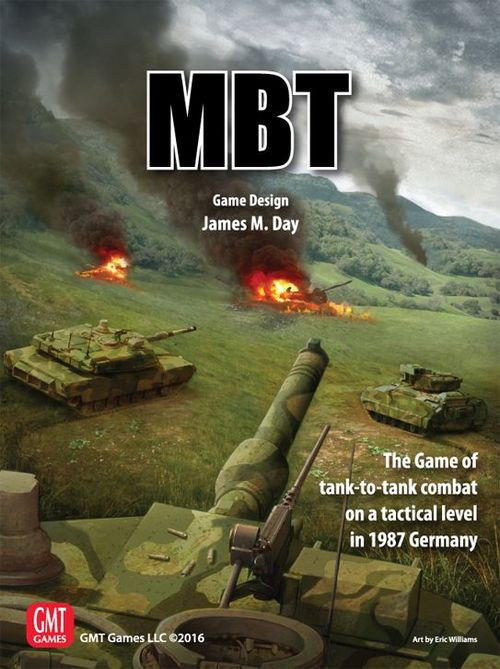
MBT (Second Edition)
MBT (Second Edition) Rulebook
Table of Contents
Table of Contents
- Scale
- Basic Game Rules
- 1.0 Components
- 2.0 Preparation for Play
- 3.0 General Procedures & Rules
- 4.0 Sequence of Play
- Advanced Game Rules
- Introduction to the Advanced Game (AG)
- 5.0 Advanced Game General Procedures & Rules
- 6.0 Advanced Game Sequence of Play
- 7.0 Optional Rules
- Glossary
Scale
The scale is structured to support its predominate one-to-one presentation. With that in mind, the game scale is composed of three distinct elements: force representation, ground scale, and time scale. The force representation is one-to-one for vehicles, towed weapons and aircraft. The main leg units are squads, half-squads and sections. Leg crew-served weapons are grouped into sections of 2-3 HMGs, mortars, ATGMs, etc. Off-map artillery units are batteries of 2-6 gun tubes.
The horizontal ground scale is 1 hex equals 100 meters; the vertical ground scale is one level equals 3 to 8 meters.
The time scale is fluid with each complete turn representing approximately 15 seconds to 15 minutes.
Basic Game Rules
1.0 Components
Players should familiarize themselves with all game components before starting play. Some components are not used in the Basic Game and are marked with (AG) or (OR) indicating their use with the Advanced Game or Optional Rules.
1.1 Rulebooks
All of the information required to play the game is contained in the two rulebooks. For ease of use, they include diagrams, illustrations, and examples of play to speed up the learning process. A table of contents, glossary and index are also available to facilitate quick reference.
The rulebooks are divided in to the Basic Game, and the Advanced Game (AG) and Optional Rules (OR) sections.
Some of the rule sections refer to units or capabilities for units included in the FRG and BAOR expansions or to possible future expansions. Where specific references are included, (FRG) or (BAOR) is noted.
1.2 Geomorphic Mapboards
The five double-sided geomorphic mapboards (also referred to as maps) are used to battle it out through the included scenarios. These also enable a wide variety of configurations when setting up or designing scenarios. The terrain depicted is representative of the area of West Germany garrisoned by the US V and VII Corps.
The superimposed hex grid regulates movement and determines combat results.
-
They may be flipped and combined along the short or long edge to form many different configurations.
-
Each hex has a specific terrain type that clearly dominates the hex. It affects both movement and combat.
-
Partial hexes are playable. They are part of the mapboard containing the hex identifier when they link on two connecting maps.
-
Each mapboard has a directional hex. The number in the center identifies the mapboard in play. Its hex is also used for special setup conditions and other random events.
-
Each hex has a center white dot that is used when determining line-of-sight.
-
Textual notations including hill and village identifiers are typically utilized for setup and victory determination. Villages have coded names (NATO phonetic alphabet and mapboard number) to support encrypted communications.
-
Each hex contains a unique alpha-numerical identifier, e.g., E9. Certain partial hexes may be numbered 0, e.g., E0. When referring to a hex, the first character is the mapboard number followed by a specific hex identifier, e.g., 2E9.
Note that the geomorphic mapboards from the Panzer series are fully compatible with MBT.
1.3 Game Cards
There are two identical Game Cards with sides A and B. These cards contain all of the combat and support tables and contain all of the tables and charts required for play. Find the Combat Effects Summary card on the back cover of the Playbook. This card summarizes combat effects. Whether it is combat determination, command control, morale, the combat effects summary, or the sequence of play, all of that information is found on one of the Game Cards. Game Card tables and charts of similar function all have the same color title bar to help organize and direct players to similar use tables. The various tables and charts are explained throughout this rulebook.
1.4 Data Card Keys
The Data Card Keys provide a summary of the information found on the numerous Data Cards. The land and air units share a great deal of common information, but also possess information unique to the particular type of unit. It is a good idea to become familiar with the various format types and presentation of data.
1.5 Data Cards
All of the specific unit information is provided on the various Data Cards. Some contain information for multiple units.
Review the various Data Cards in conjunction with their respective keys. The various sections are explained throughout this rulebook.
1.6 Game Counters
The various die-cut counters are punched out to provide playing pieces and are interchangeably referred to as counters or markers. They are used to show information and track status. Note that with the exception of the Command counters all the other counters are two-sided. The side used depends on what information a situation requires; their use is described throughout this rulebook.
1.6.1 Units
These counters represent an assortment of Soviet (tan color) and US (green color) units.
The larger counters represent vehicles, towed guns and aircraft and contain the name, national symbol, image of the unit represented, Data Card reference, individual identification number, and movement factor. The smaller counters represent leg units and contain a national symbol, image of the unit represented, and an individual identification number. For ease of use, squads have their corresponding half-squads on the reverse side; helicopters have their two altitude options front-to-back.
1.6.2 Command Counters (Unit Orders)
The 5 Command counters determine the actions each unit will conduct during an upcoming turn. In the Basic Game, each vehicle receives its own dedicated Command counter. When the Advanced Game’s Command Control rules are employed, one or more units typically must share a single Command counter thereby executing the same action.
The five Command counters are: Fire Command, Move Command, Fire/Move (Short Halt) Command, Overwatch Command, and N/C (No Change) Command.
1.6.3 Information Counters
These are placed on the mapboard or directly on units to record game information or to track the status of units, e.g., KO and BU, for knocked out and brewed up vehicles.
1.6.4 Terrain Counters
These are placed on the mapboard to alter a hex’s terrain, e.g., DITCH and WIRE.
1.7 Turn Track, Transport & Summary & Hidden Unit Card
The two Turn Track, Transport & Summary & Hidden Unit cards include a Turn Track, and sections for Transport & Summary and Hidden Units.
While each card features a Turn Track, only one is used to track the current turn and the force designated as the First Player. If one force is utilizing the Hidden Unit rules (OR) (see 7.2), it is probably easier to use the Turn Track on the other card.
The Transport & Summary Track helps organize units that are either being transported or are held off the mapboard as instructed by the scenario rules, a special condition, or just to better organize a hex containing a large number of units and other counters.
For transport purposes place the passenger unit(s) in one of the 10 numbered hexes. Then place its corresponding Summary counter on the transporting vehicle.
For summary purposes place the units and counters from a hex again in one of the 10 numbered hexes.
Then place its corresponding Summary counter in the appropriate hex on the mapboard. Be careful to position vehicles and towed guns along the edges of the summary hex so as to maintain their correct facing. When used to organize hidden or off-map units, it is best to place the card somewhere away from the mapboard or under a cover sheet to hide the units from view.
Place the hidden units in one of the numbered boxes. Then place its corresponding Hidden Unit counter in the appropriate hex on the mapboard.
1.8 Formation Summary (Playbook)
The Formation Summary is used to record information about each formation in a player’s force. Is not required for the Basic Game or for most elements of the Advanced Game, but becomes essential when employing the Command Control (AG) and Morale rules (OR). It also helps players to organize their forces and keep track of various other information items. Please feel free to copy or print the page as needed.
1.9 Percentile Dice
Two sets of percentile dice are included. To keep play moving in larger games of 3 or more players, provide each player with their own set of dice.
What are percentile dice? They are a set composed of two different colored 10-sided dice each numbered from 1-10 or 0-9. They are commonly called d10s.
1.10 Other Items (not included)
A straightedge is very useful when determining any questionable lines-of-sight. Some Optional and scenario rules require random mapboard events; a standard six-sided die (commonly called a d6) is used for resolution.
Each player may also want to have a pencil handy for making notations on the Formation Summary or a notepad for any other pertinent information necessary for Advanced Game or Optional Rules situations.
2.0 Preparation for Play
Select one of the available scenarios or feel free to design your own. Review the scenario information and position the mapboard based on the sides played.
The Setup Section of the scenario provides any special or unique requirements. In addition, the Special Conditions Section may also provide notes for the preparation of play.
Select the required unit counters and also select their corresponding Data Cards.
Give each side a set of dice, a Game Card and position a Turn Track, Transport & Summary & Hidden Unit Card for ease of tracking the current turn. It is now time to open fire.
3.0 General Procedures & Rules
The following rules have an impact on more than one phase or step of the Sequence of Play, so it is a good time to review them at this point.
3.1 Definition of the Phasing Player
Players perform all actions and dice rolls for the vehicles they command—their Force. Therefore, a player is designated as the phasing player for his own vehicles. Within that context, after determining the Initiative a player is either the First or Second Player on any given Turn.
3.2 Reading the Dice
A set of two d10s (one colored and one white) generates a result from 01-00 (100), where a single d10 generates a result from 1-10 (where 0 equals 10). When rolling both d10s, players should be clear which color represents the ten’s value and which color represents the unit’s value. Keep it consistent.
With a colored d10 & white d10 combination, if a 2 is rolled on the colored die and a 7 is rolled on the white die, the result is 27. If a 0 is rolled on the colored die and a 1 on the white die, the result is 1. If a 0 is rolled on the colored die and a 0 on the white die, the result is 100.
When a 1-100 result is required to resolve an action, roll (100) is stated; when a 1-10 result is required, roll (10) is stated.
3.3 Vehicle Facing
All vehicles have a front, side and rear facing. The fronts are shown as the top of the vehicle’s pictures on each of their Data Cards; i.e., the direction in which it is facing. Vehicles must at all times face towards a hexside, not towards the angle of a hex.
Except during reverse moves, vehicles must always move with the front of the vehicle facing towards the direction of movement. During reverse moves, the vehicle moves in exactly the reverse of its front.
3.4 Counter Use & Facing
Counters are placed on or near a vehicle to display information about that vehicle and to indicate its Command for the current turn. Some counters have different information on the various faces of its counter that are further identified this rulebook.
The applicable information is always that which is on the face that matches the front of the vehicle. For example, the facing of the Spot counter placed with the M1 Abrams tank indicates that it was spotted by its fire. Rotate the counter 1800 and it would be spotted through movement. The side and facing determine what counter information is active in any given situation.
One of the Command counters, Short Halt , possesses two distinct commands—both Fire and Move . For this Command, face the command that was just executed to the front of the vehicle. All Fire commands are executed first, and then Move commands. Players are able to keep track of unmoved Short Halt vehicles, since the Fire side is facing front until those vehicles move.
A counter’s active component is identified in these rules by its name/ active component, if any, e.g., Spot /Fire .
3.5 Range
Range is the distance from one vehicle to another and is always expressed as range in hexes.
3.5.1 Range in Hexes
The range in hexes is determined by counting hexes from one vehicle to another vehicle along the shortest route. Count the hex that the target vehicle occupies but not the hex that the spotting/firing vehicle occupies.
3.5.2 Maximum Ranges
All weapons have a maximum range beyond which they may not fire. Note that most vehicles have more than one ammunition type and some have more than one weapon.
The maximum range of a weapon, for an ammo type, is the range value found on a vehicle’s Data Card in the E column (Extreme Range) along the R row (Range). Vehicles may never engage targets beyond their maximum range.
Reference the Vehicle Data Card Key, the T-80BV’s 125mm gun’s APFSDS ammo has a maximum range of 33 hexes.
3.6 Controlling Objectives
Scenarios usually call for meeting D certain objectives beyond just the destruction of opposing vehicles.
Typically, these objectives are geographic features, e.g., a bridge, ford or building hexes, hills, or exiting the mapboard, both are worth a number of victory points that are used in determining the victorious side in a scenario. For on mapboard objectives, utilize the Control counters to track which force has control.
The Victory Conditions section of the scenarios list the conditions that must be met to capture an objective. Most require a vehicle to occupy an objective for one or more complete turns. The occupying vehicle need not be the same one that occupied an objective at the start of the turn, as long as the objective is still occupied by a friendly vehicle at the end of the turn. Once captured, continuous occupation is not required.
Unarmed vehicles may not capture objectives.
If contested, e.g., opposing units adjacent to a building hex that is On Fire, neither side controls the objective.
The turn requirement prevents players from moving vehicles in a mad dash on the very last turn to capture objectives.
3.7 Modifiers & Adjustments
Certain combat conditions call for spotting at greater than or less than the base spotting ranges.
AP Combat includes modifiers to the base spotting ranges and combat values. It typically adds or subtracts a modifier value or values from the base on the Spotting Ranges and AP Hit Tables. Short Halt commands and Damage results call for vehicles to reduce their movement speed allowance by ¼ or ½—always round down. If a Damaged vehicle has a Short Halt command, it moves at ¼ of the available movement speed allowance. A movement speed allowance is never less than 1.
If the original Movement Speed Allowance is 5, ½ is 2; ¼ is 1.
3.8 Stacking
A 100 meter hex is actually quite a large area (approximately 6,500 square meters), but there still is a physical limit as to what could reasonably occupy a hex before visual overcrowding occurs. In game terms, any number of vehicles may stack in a single hex. However, if at any time a hex contains 6 or more vehicle counters (Wrecks do not count for stacking purposes), it is considered to be over-stacked and negative spotting, combat, and movement effects come into play. Those effects are outlined in the Spotting (see 4.1.3.2), Combat (see 4.4.3.2.2), and Movement (see 4.5.1.1.5) Phases sections.
4.0 Sequence of Play
A scenario starts after all setup and preparation is complete. During a scenario, each side uses its forces in attempting to meet the scenario objective(s). A scenario is played in Turns. Each turn is divided into Phases, which may be further divided into one or more Steps. These phases and their corresponding steps (see Sequence of Play on Game Card B) are executed in the exact order listed. For the Basic Game, ignore those phases and steps with red notations for the Advanced Game, or blue notations for Optional Rules.
4.1 Basic Game Spotting Phase
“If the enemy is in range, so are you.”
~ Anonymous
Even though players can see the opposing vehicles on the mapboard, this does not necessarily mean that the vehicles can see each other in the context of the game.
Before a vehicle can fire on a target vehicle, that target vehicle must be spotted by the firing vehicle as described by the rules of spotting. Obviously, it makes no sense to give a Fire command to a vehicle that cannot see any opposing vehicles.
Determining who is seen during the Spotting Phase is what makes it possible to give vehicles Fire or Short Halt commands during the following Command Phase.
The spotting determination process is also followed when determining when an Overwatch command is triggered. Players may freely check spotting at any time. However, keep in mind that this may “give away” a key shot or strategy. On the other hand, it just might mislead the opposing side into falling for a deceptive plan of action.
4.1.1 Who may Spot?
Any vehicle combat unit may spot opposing vehicles. For spotting purposes, a vehicle combat unit is defined as one possessing some form of offensive firepower or fire support sighting capability, e.g., US M981 FISTV.
Unarmed vehicles, e.g., M60 AVLB, MT-55A AVLB, Biber AVLB (FRG), Chieftain AVLB (BAOR), and trucks (FRG), may not spot. A continuity of spotting exists throughout a turn and from turnto-turn. For ease of flow and game play, the different activities performed during a turn are broken down into phases and steps. In real life these actions actually occur simultaneously, but in the context of the game, and ease of play, they are conducted sequentially. Once an opposing vehicle is spotted, it remains so as long as at least one friendly vehicle meets the range and line-of-sight requirements. Vehicles hand off spotted targets to one another as vehicles move into the area, move out, or are eliminated. As long as a single vehicle meets the spotting criteria during the Spotting Phase, an opposing vehicle remains spotted.
To fire on an opposing vehicle, it must be individually spotted by the firing vehicle as described by the rules of spotting. Handing off spotting targets does not mean friendly units are spotting for one another. Unless the spotted vehicle moves away or all friendly vehicles move out of line-of-sight or are eliminated, the vehicle is still considered spotted.
-
A spots C since it has a Spot /Fire counter. B does not spot C due to blocking terrain. 2) During the following Movement Phase, while C remains stationary, A moves behind blocking terrain while B moves from behind its blocking terrain to a clear line-of-sight to C. 3) C continues to be spotted by B since it still has its Spot / Fire counter.
-
C spots A. B does not spot C due to blocking terrain. During the Combat Phase, C eliminates A and is marked with a Spot /Fire counter. 2) During the following Movement Phase, B moves from behind the blocking terrain to a clear line-of-sight to C. C is now spotted even though B moved during a later phase of the same turn. If a spot is lost, it must be reacquired through the normal spotting and line-of-sight rules. A vehicle is not automatically spotted again if a condition changes even by the original spotting vehicle. Once a vehicle is spotted, it just doesn’t disappear from view at the end of a turn—it remains spotted. It is not realistic for spotted vehicles to automatically disappear from view at the end of a turn.
4.1.2 Spotting Orientation
Vehicle combat units spot in all directions (360°), not just in the direction their front faces. They may spot any and all opposing vehicles that may be spotted from their current hex.
4.1.3 Determining Spotting Ranges
Spotting ranges are based on the terrain type of the hex occupied by the target vehicle. Terrain provides both cover and concealment for vehicles; hereafter collectively referred to as Cover. It is classified as providing None, Light, Medium or Heavy Cover.
The terrain Cover types are listed in the fourth column of the Terrain Effects Table on Game Card B, cross-referenced by the terrain type listed in the first column. The Cover type in a spotting vehicle’s hex has no impact on spotting.
The corresponding spotting ranges are found in the Spotting Ranges Table on Game Card B. When attempting to spot a vehicle, cross-reference the V column with the base 0 row. The V column is the general spotting category for all vehicles.
The base spotting range for all vehicles is 20 hexes. In the Basic Game, this base range may increase or decrease due to the target vehicle’s Cover and whether or not it fired or moved. All spotting modifiers are cumulative. A net modifier greater than +2 is treated as +2; less than –5 is treated as –5. Note that vehicles spotted via base range only are not marked with a Spot counter.
At any time, a vehicle may be marked with either a Spot /Fire counter or a Spot /Fire counter, not both.
Adjust the base spotting range by applying the Cover modifier, if any, of Light Cover –1, Medium Cover –2, or Heavy Cover –3, by moving that many rows down the table.
A Soviet BMP-2 is located in a Woods hex; it is spotted out to 7 hexes.
If the target vehicle moved it is marked with a Spot / Move counter; apply the +2 modifier by moving 2 rows up on the table.
A Soviet BMP-2 moves into a Woods hex and is marked with a Spot /Move counter; it is now spotted out to 20 hexes.
If the target vehicle fired, it is marked with a Spot /Fire counter; apply the +3 modifier by moving 3 rows up on the table. Use the +2 row for all modifiers greater than +2.
A Soviet BMP-2 fires from a Woods hex and is marked with a Spot / Fire counter; it is now spotted out to 30 hexes.
If the terrain is in any way mixed, e.g., in an Improved Position (AG) in a Woods hex, use the terrain type that is the most advantageous to the target vehicle; in this case utilize Heavy Cover. If the terrain lists Other as its Cover type, use the other terrain type in the same hex to determine the Cover type, if any.
If a vehicle is on a Path in Scrub hex, Light Cover is in effect.
4.1.3.1 Vehicle Size
The vehicle Target Size Modifier does not impact spotting ranges.
4.1.3.2 Over-Stacked Hex
If a vehicle is located in an over-stacked hex, treat any Cover in the hex as None.
4.1.4 Line-of-Sight
A second aspect of spotting is line-of-sight. It is a very basic concept, and works hand-in-hand with the spotting ranges. It is defined as a straight line between two vehicles. If a line-of-sight is blocked by some obstacle located between the two vehicles (not including the two vehicles themselves or any intervening vehicles) they may not spot each other even if they fall within spotting range. Line-of-sight is measured from the center dot in the hex containing the spotting vehicle to the center dot of the hex containing the target vehicle. An obstacle blocks line-of-sight even if it passes through only a fraction of its hex or along its hexside.
4.1.4.1 Terrain Features
Broad categories are used to represent the various terrain types in the game.
Terrain comes in two flavors, that which fills an entire hex and that which covers just a hexside. Included are terrain features printed on the mapboard and that added by placing Terrain counters. The specific Terrain types are found in the Terrain Effects Table on Game Card B and the Terrain Key located on the back of this Rulebook. Terrain types may potentially block line-of-sight based on their Height, as found on the second column in the Terrain Effects Table. Height is measured starting at 0 for ground-level terrain. Some terrain types have an inherent height while others add height to the terrain they occupy. Vehicles, whether friendly or enemy, have no Height and never block line-of-sight.
4.1.4.1.1 Non-Blocking Terrain
Terrain with a Height of 0 or –1, e.g., Clear, Brush, Crops, Rough, Railroad Track, Scrub, Shellhole, Stream, or Wall, does not block line-of-sight.
4.1.4.1.2 Blocking Terrain
Terrain with a Height of 1 or more may block line-of-sight depending on the Height of the spotting and target vehicles and their relationship to the potential blocking terrain.
4.1.4.1.3 Building Hexes
Since each hex equals 100 meters, Building hexes are not made up of single structures, but represent a cluster of structures of a particular type—Brick, Stone, or Wood. They are usually found along Paths or Roads.
Vehicles may freely enter Building hexes, as they are not actually entering the Buildings themselves, but are in the Alleyways between the Buildings. Therefore, any vehicle located in a Building hex is actually occupying Alley type terrain.
Building hexes have a height of 1 per story above ground level; a two-story Building hex has a Height of 2. All Building hex types may block line-of-sight.
Roads and Paths in a hex negate the blocking effects for units spotting along a straight line into or through a Building hex. A vehicle in hex 5Q5 has a clear line-of-sight to hex 5N4. However, it does not have a line-of-sight to hex 5N3.
All Buildings are considered to be 1 story high unless indicated otherwise by a scenario’s Special Conditions.
4.1.4.1.4 Hill Hexes
Unlike other terrain that possess inherent Height, Hills add elevation to the mapboard. However, Hills do not represent terrain—they are covered by terrain. If Rough terrain is in a Hill hex, it does not make the Hill hex any higher since Rough has a Height of 0. However, the Hill hex is Rough terrain.
Each level of a Hill adds a Height of 1. Hills are stacked in individual levels of varying colors up to any height. Heights of 4 to 5 are typically the limit.
The Hill is 2 Heights at its maximum elevation.
4.1.4.1.5 Slope & Crest Hexsides
Slope hexsides are the transition points from one Height or elevation, either up or down, to another. They are found only in conjunction with Hills. If a Hill is depicted without a Slope on an edge or side, that creates a sheer edge or cliff, that hexside is impassable to vehicles. Slope Hexsides
Crest hexsides are elevation transitions or small rises in terrain. They may be found anywhere on the mapboard, but typically form breaks along hills.
Both Slope and Crest hexsides have a Height of +1. However, only Crest hexsides may individually block line-of-sight. Slope hexside are part of a Hill formation and any line-of-sight checks are made from the Hill hexsides.
This Crest hexside equally divides Hill 1.7. Any vehicles in hexes V2 and W1 may not spot one another due to the fact that they are at Height 1, while the Crest hexside is at Height 2.
4.1.4.1.6 Gully, Ford & Stream Hexes
Gully, Ford and Stream hexes have a Height of –1; they are actually one Height lower than the surrounding terrain. These Terrain types do not block line-of-sight.
A Bridge hex that crosses a Stream hex is at Height 0, since a bridge crosses above a stream at a higher elevation.
There is a special spotting rule for Gully, Ford and Stream hexes. When spotting to a Height 1 level above their Height, only adjacent hexes may be spotted. Like Roads and Paths, units may spot along a straight line in Gully or Stream hexes.
These Stream hexes are at Height –1. The Clear hexes in the vicinity of the Stream are all at Height 0. Only those hexes adjacent to the Stream hexes may be spotted from the Stream hexes and vice versa.
4.1.4.1.7 Woods Hexes
Light Woods and Woods hexes represent stands of trees that provide cover for vehicles. Vehicles may never enter Heavy Woods hexes unless on a Road or Path.
Light Woods and Woods hexes both have a Height of 3, while Heavy Woods hexes have a Height of 4 above ground level; they may block line-of-sight.
Roads and Paths in a hex negate the blocking effects for units spotting along a straight line into or through a Woods hex. Note that vehicles in Light Woods or Woods hexes are actually at the ground level of the terrain not up at the maximum Height of the terrain.
4.1.4.1.8 Wrecks
A Wreck is created whenever a vehicle suffers a Knock-Out (KO) or Brew-Up (BU) result from AP combat. The Wreck may also be a source of Brew-Up Smoke if that was the result of the combat.
Wrecks have a Height of 0; they do not block line-of-sight. A hex may never contain more than a single Wreck counter, although a KO counter is replaced by a BU counter due to combat results; not vice-versa.
In a similar manner to Illumination rounds Brew-Up Wrecks increase spotting ranges during night/limited visibility conditions (OR) (see 7.27).
4.1.4.1.9 Smoke, Brew-Up
Whenever a vehicle is Brewed-Up as a result of AP combat, it also creates Brew-Up Smoke as represented by the BU counter. Brew-Up Smoke has a Height of 2, but does not block line-of-sight. It hinders AP combat.
4.1.4.1.10 Hedgerow Hexsides
Hedgerow hexsides have Height of 1 and block line-of-sight depending on the Height of the spotting and target vehicles and their relationship to the potential blocking terrain. An Optional Rule, Hedgerow Spotting (see 7.10) expands on the limitation.
4.1.4.2 Determining Line-of-Sight
The line-of-sight for AP combat is checked from the spotting vehicle to the Height of the target vehicle. Obstacles—the highest point of any intervening terrain—affect line-of-sight based on the following conditions:
4.1.4.2.1 Obstacle Higher than Both
If the line-of-sight crosses an obstacle and it is higher than the Heights of both the spotting vehicle and the target vehicle, the lineof-sight is blocked. The obstacle blocks line-of-sight at any range.
4.1.4.2.2 Obstacle Higher or Equal
If the line-of-sight crosses an obstacle which is equal in Height to either the spotting vehicle or to the target vehicle, and is higher than the other vehicle, the line-of-sight is blocked.
The obstacle blocks line-of-sight behind it at any range.
4.1.4.2.3 Obstacle Equal or Lower
If the line-of-sight crosses an obstacle which is equal to or lower than the Height of both vehicles, the line-of-sight is not blocked. The line-of-sight is not blocked.
4.1.4.2.4 Obstacle Higher and Lower
If the line-of-sight crosses an obstacle which is higher than one vehicle but lower than the other vehicle, a line-of-sight check must be made using one of the following procedures. Count the hex that the potential obstacle occupies but not the hex the spotting vehicle occupies. A calculated Blind Zone is never less than 1 hex. Note that in all cases the reverse is also true whether the spotting vehicle is the higher or lower vehicle in Height.
Lower by 1 Height: The obstacle creates a blind zone behind it, where no line-of-sight is possible, equal to ½ the range in hexes (round down) from the higher vehicle to the obstacle.
The obstacle creates a blind zone of 7 hexes (14 divided by 2) behind it. Any vehicle located at a range from 15-21 hexes from the higher vehicle may not be spotted.
Lower by 2 Heights: The obstacle creates a blind zone behind it equal to ¼ the range in hexes (round down) from the higher vehicle to the obstacle.
The obstacle creates a blind zone of 4 hexes (16 divided by 4) behind it. Any vehicle located at a range from 17-20 hexes from the higher vehicle may not be spotted.
Lower by 3 Heights: The obstacle creates a blind zone behind it equal to 1/8 the range in hexes (round down) from the higher vehicle to the obstacle.
The obstacle creates a blind zone of 2 hexes (18 divided by 8) behind it. Any vehicle located at a range from 19-20 hexes from the higher vehicle may not be spotted.
Lower by 4 Heights or more: The obstacle creates a blind zone behind it equal to 1 hex from the higher vehicle to the obstacle. The obstacle creates a 1 hex blind zone behind it. Any vehicle located at a range of 20 hexes from the higher vehicle may not be spotted.
4.1.4.2.5 Spotting Into/From Obstacles
Vehicles may spot up to 1 hex into or from any Terrain type that would normally block line-of-sight unless blocked by an intervening hexside, e.g., if a target vehicle is located in a group of Woods hexes, a 1 hex spotting perimeter exists around the edge of the Woods. The 1 hex spotting range is also applicable to vehicles located within terrain that would normally block line-of-sight. For example, if two opposing vehicles are moving through a group of Woods hexes, they spot one another if the range is 1 hex.
Line-of-sight into blocking terrain.
4.1.4.2.6 Obstacle Hexsides
A hex containing blocking terrain blocks line-of-sight even if it passes through only a small fraction of the hex. In all cases, if a hex or hexside can block line-of-sight and the line-of-sight runs exactly along one of its hexsides, the line-of-sight is blocked. Line-of-sight is blocked by the intervening Woods hex.
4.1.5 Extraneous Spot Counters
If it is determined that a vehicle is not spotted, remove any Spot / Fire or Spot /Move counter it may have.
It many cases, it may not be necessary to mark all vehicles that fired or moved with Spot counters, as the spotting ranges may be obvious, e.g., vehicles located in Clear terrain. This should help keep the mapboard a little tidier.
4.2 Basic Game Command Phase
“There are no bad regiments, there are only bad colonels.” ~ Napoleon Bonaparte
At the heart of the game is the Command system. With just five individual commands, players prepare and manage their vehicles for the current turn.
Each of the five Command counters has unique characteristics that distinguish its purpose.
The Commands include:
-
Fire: enables any vehicle combat unit to fire at a spotted vehicle during the First or Second Player Direct Fire Step (see 4.4).
-
Move: enables any vehicle to move during the First or Second Player Movement Step (see 4.5).
-
Short Halt: enables any vehicle combat unit to fire at a spotted vehicle during the First or Second Player Direct Fire Step (see 4.4) and then move during the First or Second Player Movement Step (see 4.5).
-
Overwatch (OW): enables any vehicle combat unit to voluntarily fire at a spotted vehicle that fired in an earlier step or in response to a spotted vehicle moving during the Movement Phase. Note that the target vehicle may be spotted as a result of its current action, fire or movement; it need not have been previously spotted during the Spotting Phase.
It is key to note that Overwatch Fire is never required. The command may never be executed.
- No Command (N/C): tells the vehicle to sit tight and not perform any actions. This is the default stature for all vehicles not marked with a command.
Note that the Command Phase is executed prior to the Initiative Phase. Players must therefore commit their Commands without the knowledge of who is going be the First or Second Player. Welcome to the fog-of-war!
4.2.1 Place Commands Step
Place a Command counter with the Command side visible on or adjacent to the vehicle so that the opposing side does not know what command was given. Each command enables a vehicle to perform only certain actions during specific phases or steps. When the time comes to carry out those actions, players are bound by them. Only OW and N/C commands allow a vehicle to take no specific action. If a vehicle has a command to Fire , Move , or Short Halt , it must execute that command—it is not an option. Care must therefore be taken when assigning commands.
In some cases, a vehicle may be Knocked Out or Brewed Up, therefore making it impossible to carry out a command. Until a player reveals a command to perform some action; i.e., fire or movement, the command is maintained with its command side up. This also helps keep track of those vehicles that have not yet executed their commands.
Vehicles may not be given commands that cannot be executed. A vehicle that does not have any spotted targets may not have Fire or Short Halt commands.
In the event a vehicle is given an illegal command, it is automatically converted to an N/C command.
4.3 Basic Game Initiative Phase
“Commanders at every level must therefore act with audacity, dash and determination, seizing the initiative and thus subordinating their opponent’s will to their own.”
~ Marshal Mikhail Tukhachevsky
Initiative is a key aspect of the game. Through its careful use, players control the flow of the game by controlling the First and Second Player steps.
Since the Command Phase takes place before the Initiative Phase, players must make command decisions without the advantage of looking into a crystal ball as to the order of execution. A superior force should more often than not find itself controlling the initiative. This really comes into play in the Advanced Game where the superior force receives a positive die-roll modifier and therefore should win the initiative more often than not. Through this, it is able to dictate and control the course of battle. However, as with all things in life (and war), it is not guaranteed.
4.3.1 Determining Initiative
During the Initiative Phase, each Force D rolls (100); reroll ties unless instructed otherwise in the scenario Special Conditions. The Force rolling the higher result determines who is the First Player for the current turn. Flip the T urn counter to indicate the First Player.
Staggered Initiative (OR) (see 7.5) expands the Initiative process based on formations.
4.3.2 How Initiative Works
The First Player always performs the actions listed as First Player in the Sequence of Play. The Second Player follows suit by performing the actions listed as Second Player in the Sequence of Play. It is very important to remember that combat and movement actions are performed sequentially.
Quickdraw (OR) (see 7.44) enables the possibility of simultaneous fire.
If the Second Player has a vehicle with a Fire command that is Knocked Out during the First Player’s Direct Fire Step, that vehicle is Knocked Out and removed from play before the Second Player can execute its Fire commands.
Simultaneous actions do not have First or Second Player as part of their Phase or Step. These actions are resolved in any agreeable order.
4.4 Basic Game Combat Phase
“Battles are won by superiority of fire.”
~ Frederick the Great
The players execute fire combats sequentially based on the order determined previously in the Initiative Phase. In the Basic Game all fire is classified as Direct Fire.
The Basic Combat Phase includes a single Step—Direct Fire. Only Armor Piercing AP Direct and Overwatch Fire is addressed at this time. This section encompasses vehicle-to-vehicle AP combat. Nuclear, Biological and Chemical Weapons (NBC) weapons? Their use holds no standing in MBT. Let alone the devastating impact on the battlefield, the morality of such weapons is better suited for another discussion and not modeled in a simulation of modern warfare.
4.4.1 Direct Fire Step
The First Player announces and resolves Direct Fire by revealing the Command for every vehicle with a Fire or Short Halt command as they announce their fire.
The Second Player then announces and resolves Direct Fire by those vehicles still able to fire and marked with Fire or Short Halt commands by following the same procedures.
Direct Fire is resolved under the following rules and conditions:
-
Fire and Short Halt commands require a legitimate spotted target that was identified during the previous Spotting Phase. Players may never place Fire or Short Halt commands in anticipation of spotting a target.
-
Vehicles fire in the order described in the Sequence of Play. First Player vehicles fire first during that Fire Step; Second Player vehicles fire second during that Fire Step.
-
Shots are resolved individually.
-
Each vehicle only fires once per turn.
-
Fire in each step is resolved from the positions and facings the vehicles occupy at the point the fire is resolved. The terrain occupied by the firing vehicle or its Spot counter has no impact.
-
All fire on a single opposing vehicle must be announced before any fire is resolved. If that target vehicle is eliminated before all the announced vehicles have fired, they are assumed to still have fired at the announced target. They may not then shift their fire to a new target.
-
All combat results are applied immediately.
-
If the vehicle does not have an existing Spot /Fire counter or it has a Spot /Move counter, place the new Spot /Fire counter partially under its Command counter to signify that it is a new status. That way, there is no confusion as to the vehicle’s status as of the previous Spotting Phase.
-
All vehicles with Fire or Short Halt commands must declare fire unless the command was placed in error; i.e., no visible targets are available.
4.4.2 Overwatch Fire
Overwatch Fire is a triggered event in response to opposition fire (during the Combat Phase) or movement (during the Movement Phase)—it fires at targets of opportunity.
After resolving Direct fire, announce and resolve all desired Overwatch Fire by those vehicles marked with OW commands at opposing vehicles that fired during Indirect Fire or Direct Fire Step. Overwatch Fire is voluntary; vehicles with OW commands are not required to fire. Since Overwatch Fire has built in penalties, it is not intended as a method of engaging spotted targets. It does, however, act as a deterrent to opposition fire and movement.
Overwatch Fire is resolved under the same rules and limitations as described for Direct Fire with the following additions:
-
All First and Second player Direct Fire is resolved before any Overwatch Fire is announced.
-
Additional Overwatch Fire may be triggered as a result of earlier Overwatch Fire. Consider it a cascading effect where one initial OW shot could trigger a whole series of follow on shots. Again, Direct Fire takes precedence.
-
Spotting is confirmed at the time the Overwatch Fire is announced. A previously spotted target is not required.
4.4.3 AP Firing Sequence and Rules
Only those vehicles with an AP row in the Offensive Information section of their Data Cards may fire. AP Type fire is directed only at vehicles; it is never used against any other target type. There are other types of AP ammo, e.g., APFSDS, APDS, HEAT, HEAT-MP, and HESH, these are also classified as AP Type fire. While ATGMs are also AP Type weapons, they are not utilized in the Basic Game; they are addressed in the Advanced Game To fire at a target, it must be spotted, in range of the weapon firing, and fall within the firing vehicle’s Field-of-Fire.
4.4.3.1 Fields-of-Fire
All combat vehicle units have a defined Field-of-Fire. Some have a limited field-of-fire. Those include non-turreted vehicles with fixed gun mounts.
4.4.3.1.1 Turreted Vehicles
Turreted vehicles have all-round Fields-of-Fire. Turreted vehicles are those with a TT Factor of 1, 2 or 3 in their Weapon Data section. An Optional Rule, Turrets (see 7.8) expands on turret Fields-of-Fire and use.
4.4.3.1.2 Turretless 360° Vehicles
Like turreted vehicles, vehicles with a TT Factor of 360 are classified as Turretless 360° and have all-round Fields-of-Fire. Their pivot guns, mounted behind gun shields or in open gun mounts, are able to engage opposing vehicles in any direction.
In the Basic Game, they are essentially the same as turreted vehicles.
4.4.3.1.3 Non-Turreted Vehicles
Non-Turreted vehicles have weapon mounts with limited fields-offire. They are those with a TT Factors of 60, 120 and 180. Virtually all have their weapons facing to the front, although a few have their weapons facing to the rear. Non-Turreted vehicles are only able to engage targets that fall within their front or rear Field-of-Fire depending on the position of their weapon.
4.4.3.1.4 Front Fields-of-Fire
A vehicle that has a limited Field-of-Fire to its front is indicated by an underscored ammo notation on its Data Card.
A Front Field-of-Fire, in this case, is defined as the area that falls within the Front 60°, 120° or 180° of its counter. All hexes bisected by the respective arc fall within its Field-of-Fire.
No fire may be directed at a target falling outside of the area described by the appropriate Front Field-of-Fire.
Front 60° Field of Fire
Front 120° Field of Fire
Front 180° Field of Fire
4.4.3.1.5 Rear Field-of-Fire
A vehicle that has a limited Field-of-Fire to its rear is indicated by an overscore ammo notation on its Data Card.
A Rear Field-of-Fire, in this case, is defined as the area that falls within the Rear 60°, 120° or 180° of its counter. All hexes bisected by the arc fall within its Field-of-Fire. It is the direct opposite of a Front Field-of-Fire.
No fire may be directed at a target falling outside of the area described by the Rear Field-of-Fire.
4.4.3.2 Resolving AP Fire
The firing player flips the firing vehicle’s Command over to demonstrate that it is correct and announces the target. Since the Short Halt command is a two part Command, face the Fire half of the Command counter towards the front of the vehicle. This way when it comes time to move those same vehicles, players can easily identify which vehicles have not yet moved.
4.4.3.2.1 The AP Range Factor
Find the portion of the Data Card with the name of the weapon to fire in the Ammo Type column of the Offensive Information section. Some vehicles have multiple AP ammo types as mentioned earlier. Some vehicles also have multiple AP weapons. The weapons and their AP ammo are clearly labeled to assist in matching the proper sets. In the Basic Game, only AP Type ammo should be used. Vehicles with multiple weapons may have different Fields-of-Fire for those weapons. In all cases, shots are resolved individually. Determine the range in hexes from the firing vehicle to the target vehicle. Move along the R – Range sub-row for the AP row until finding the value that is greater than or equal to the value that corresponds to the range in hexes. Above that value is one of five possible outcomes:
-
P – Pointblank
-
S – Short
-
M – Medium
-
L – Long
-
E – Extreme
That factor found above the range is the AP Range Factor. Reference the Vehicle Data Card Key for the T-80BV. Assume the range to be 15 hexes. The AP Range Factor at that range is M – Medium.
4.4.3.2.2 AP Hit Modifiers
The AP Hit modifiers are now checked to determine their effect, if any. These modifiers are found on the AP Hit Modifiers Table found on Game Card A. Many of the listed AP Hit modifiers are not utilized in the Basic Game.
All AP Hit modifiers are cumulative, and together are called the Net Modifier.
If the target vehicle is Moving (–2) in Light Cover (–1), the Net Modifier is –3.
Target Size
The Size of a target vehicle is found in the Defensive Information section. The possible values range from +2 to –2.
Reference the Vehicle Data Card Key for the T-80BV. Its Target Size modifier is 0.
Target Moving
If the target vehicle has a Move or Short Halt command—the modifier is –2.
If the target vehicle’s command is not yet visible, the controlling player must reveal it to receive the modifier (turn the Command counter face down again to show it is not yet executed). Note that in this case, the controlling player is not required to reveal the command; respond that the command has no effect. If player chooses not to reveal the command, the modifier is 0. This limits players from taking low-odds reconnaissance-by-fire shots just to reveal commands.
Target in Light, Medium, or Heavy Cover If the target vehicle is located in terrain classified as Light, Medium, or Heavy Cover—the modifier is –1, –3, or –5, respectively. If a vehicle is located in an over-stacked hex, treat any Cover in the hex as None.
Short Halt: SB: 0, Other
If the firing Vehicle has a Short Halt command and is SB: 0—the modifier is –4.
All vehicles have a Stabilization Rating.
This represents the greater challenge of hitting a target while firing and then moving with a Short Halt command. SB: 1 is the best rating, while SB: 0 is non-stabilized.
Short Halt: SB: 1/2/3
If the firing Vehicle has a Short Halt command and is SB: 1, 2 or 3, the modifier is –1, –2, or –3, respectively.
All vehicles have a Stabilization Rating.
Shooter Damaged
If the firing vehicle was Damaged during a previous turn or previous action during the current turn—the modifier is –3.
Brew-Up Smoke
If Brew-Up Smoke originates in the firing vehicle’s hex, passes through, or enters the target vehicle’s Brew-Up Smoke hex—the modifier is –2.
The modifier is applied for each unique occurrence of Brew-Up Smoke the Line-of-Sight starts from or encounters; it is cumulative. All Brew-Up Smoke created during the current Player step does not take effect until the conclusion of that step.
Overwatch/CIS
If the firing vehicle is executing Overwatch Fire at a target located within its Front (or rear) 60°, 120°, or 180° Field-of-Fire—the modifier is –1. This is applicable whether the vehicle is Turreted, Turretless 360°, or Non-Turreted.
If it is equipped with a Commander Independent Sight (see 7.48)— the modifier is 0.
The Rear Field-of-Fire is used for those Non-Turreted vehicles with a rear facing gun.
Keep in mind that the Target Moving modifier is also applicable in addition to this modifier if triggered by movement.
Overwatch Adjust/CIS
If the firing vehicle is executing Overwatch Fire at a target located outside of its Front (or Rear) 60°, 120°, or 180° Field-of-Fire—the modifier is –3. Only Turreted and Turretless 360° vehicles may execute Overwatch Fire at target vehicles located outside of the firing vehicle’s Front (or Rear) Field-of-Fire.
If it is equipped with a Commander Independent Sight (see 7.48)— the modifier is –2.
Again, the Target Moving modifier is also applicable in addition to this modifier if triggered by movement.
Since vehicles typically focus their view on the area described by their primary weapon, this modifier represents the additional time required to quickly spot and engage a target located to its side or rear.
4.4.3.2.3 AP Hit Number
Reference the AP Hit Table on Game Card A. Cross-reference the AP Range Factor (see 4.4.3.2.1) with the Net Modifier (see 4.4.3.2.2). The number found there is the AP Hit Number.
If the Net Modifier is greater than +5, use the +5 row. If it is less than –10, use the –10 row. Note that with a Net Modifier of –10 and an AP Range Factor of E, it is not possible to hit a target vehicle. If the Net Modifier is –2 and the AP Range Factor is S, the AP Hit Number is 56. If the Net Modifier is –6 and the AP Range Factor is P, the AP Hit Number is 36.
Roll (100), if the result exceeds the AP Hit Number, the shot missed. If less than or equal to the AP Hit Number, the shot hit.
4.4.3.2.4 Basic Game Hit Angle Determination
The orientation of the target vehicle to the firing vehicle is used to determine where a vehicle is hit. In the Basic Game, vehicles have either a Front or Rear Armor Aspect.
If the line-of-sight runs exactly down a hexside dividing the Front and Rear aspects, the player controlling the target vehicle determines which aspect to utilize.
4.4.3.2.5 Determining Armor Penetration
The Basic Game utilizes a streamlined method of determining armor penetration. The armor information found in the Defensive Information section is only used in the Advanced Game (AG). The armor information in the Basic Game is found in the target vehicle’s Notes Section as Armor Front Factor/Rear Factor. Reference the Vehicle Data Card Key for the T-80BV. Its Front Armor Factor is 90; its Rear Armor Factor is 34.
For armor penetration, find the portion of the firing vehicle’s Data Card with the name of the firing weapon Type column of the Offensive Information section. Move along the P – Penetration sub-row for the AP row until finding the value that is just below the value that corresponds to the range in hexes. That value is the AP Penetration Factor.
Reference the Vehicle Data Card Key for the T-80BV. Assume the range to be 15 hexes. The AP Penetration Factor for APFSDS Type ammo is 86.
If the firing vehicle’s AP Penetration Factor is greater than or equal to the target vehicle’s Armor Factor, the shot penetrated. If less than the Armor Factor, the shot has no effect.
4.4.3.2.6 Basic Game AP Damage & Effects
If the shot penetrates, apply the following:
-
If the Penetration Factor is equal to or greater than the Armor Factor by 1-3, the target suffers a Damage Hit.
-
If greater by 4-9, it suffers a KO.
-
If greater by 10 or more, it suffers a BU.
Damage effects are also summarized on Combat Effects Summary (back cover of the Playbook).
Damaged
The target vehicle was damaged by the hit. Place a Dmgd counter on or next to the target vehicle.
If a damaged vehicle receives a second Damaged result, it is considered KO—Knocked-Out instead and those results apply.
If Damaged, a vehicle:
-
Must apply Damage AP Hit modifiers to all future fire.
-
Immediately has its remaining and future movement speed allowance reduced by ½ (round down).
Note that the Dmgd counter has Turret, Hull, Radar and ATGM/SAM listed. Turret and Hull are specific damage areas and are utilized in the Advanced Game; Radar and SAM/ATGM are used with the Optional Rules.
KO – Knock-Out
The vehicle was knocked out by the hit. It is no longer operable and is totally out of action.
It is considered to be eliminated and is now a Wreck in the context of the game. Remove the vehicle counter from the hex and replace it with a KO counter. If a KO or BU counter is already in the hex, do not place a second counter. BU – Brew Up
The vehicle was brewed up by the hit. It suffered a catastrophic hit, exploded, and caught fire. It is now a source of Brew-Up Smoke. It is considered eliminated and is now a Wreck in the context of the game. Remove the vehicle counter from the hex and replace it by a BU counter. If a KO counter is already in the hex, replace the counter; if a BU counter is already in the hex, do not place a second counter.
The Situation
A Soviet BMP-2 (Data Card SM-4B) located in a Clear hex and a US M2A1 Bradley (Data Card UM-4A) located in a Woods hex are engaging one another at an unblocked range of 3 hexes. The BMP-2 has a S hort
Halt command while the
M2A1 Bradley has a Fire command. The Soviet player is the First Player.
As such, the BMP-2 resolves its fire first. Its Short Halt counter is revealed and placed with the Fire side facing the front of the vehicle counter.
The M2A1 Bradley is within spotting range as the actual range of 3 hexes is less than 7 hexes, which is the maximum spotting range when attempting to spot a vehicle in Medium Cover.
At a range of 3 hexes for the APDS ammo type, the AP Range Factor is
P – Point Blank.
The AP Hit modifiers are now checked for any effect. The Net Modifier is –6 as a result of the following modifiers:
-
Target in Medium Cover –3
-
Shooter Short Halt, SB: 3, –3
The P Range column on the AP Hit Table is cross-referenced with the –6. The AP Hit Number is 36.
The Soviet player rolls (100), the result is a 27; a hit is made on the M2A1 Bradley. The BMP-2 is marked with a Spot /Fire counter under the edge of its Command counter.
It is determined that the M2A1 Bradley’s Rear Armor Aspect is applicable. That results in an Armor Factor of 9. Since the BMP-2’s APDS ammo penetrates 12 at range 3, the shot penetrated. Comparing the Penetration Factor of 12 to the Armor Factor of 9 (+3); the US vehicle is damaged. The M2A1 Bradley is marked with a Dmgd counter.
Now the M2A1 Bradley resolves its fire. Its Fire counter is revealed. Had it been Knocked-Out or Brewed-Up by the BMP-2 during the First Player Step, it would not now have a shot. However, it must apply the just incurred Shooter Damaged modifier of –3. The BMP-2 is within spotting range as the actual range of 3 hexes is less than 20 hexes which is the maximum spotting range when attempting to spot a vehicle in None Cover. Note that the just placed Spot /Fire counter does not yet come into play.
At a range of 3 hexes, for the APDS ammo type, the AP Range Factor is P.
The AP Hit modifiers are now checked for any effect. The Net Modifier is –6 as a result of the following modifiers:
-
Target Size –1
-
Target Moving –2
-
Shooter Damaged –3
The P Range column on the AP Hit Table is cross-referenced with the –6. The AP Hit Number is 36.
The US player rolls (100), the result is a 36, a hit is made on the BMP-2. The M2A1 Bradley is marked with a Spot /Fire counter under the edge of its Command counter.
It is determined that the BMP-2’s Front Armor Aspect is applicable. That results in an Armor Factor of 5. Since the M2A1 Bradley’s APDS ammo penetrates 12 at range 3, the shot penetrated. Comparing the Penetration Factor of 12 to the Armor Factor of 5 (+7), results in a Knock-Out for the Soviet vehicle. The BMP-2’s counter (and any other counters) is removed from play and replaced with a KO counter.
4.5 Basic Game Movement Phase
“Aptitude for war is aptitude for movement.”
~ Napoleon Bonaparte
The players execute movement sequentially based on the order determined previously in the Initiative Phase.
The Second Player announces and resolves movement for every vehicle marked with a Move or Short Halt command. Vehicles are marked with Spot /Move counters as they move.
While the Second Player is moving, the First Player announces and resolves all desired Overwatch Fire by vehicles marked with unrevealed OW commands at opposing vehicles as they move. The First Player then announces and resolves movement. While the First Player is moving, the Second Player announces and resolves all desired Overwatch Fire by vehicles marked with unrevealed OW commands at opposing vehicles as they move.
As is the case with Direct Fire, Overwatch Fire taken in the Movement Phase can result in a series of triggered Overwatch Fire responses. A vehicle that fires at a moving vehicle could then receive fire from a vehicle with unrevealed OW commands, and so on. Note that vehicles with Move or Short Halt commands are not required to actually move from their current hex, but must still reveal their Command counter. In fact, there are certain actions that are covered in the Advanced Game rules, that require movement without actually exiting a hex. However, even if they do not move from their hex, they are still considered to be moving and are marked with Spot /Move counters.
4.5.1 General Movement Rules
A player may move all, some or none of the commanded vehicles up to the maximum Movement Speed Allowance.
All vehicles are marked with Spot /Move counters. This replaces the Spot /Fire counter for the fire portion of a Short Halt command that was placed during the Combat Phase.
4.5.1.1 Movement Procedure
Vehicles move one at a time and must complete their entire move before the next vehicle moves. Movement costs should be called out as expended.
If there is a possibility a move may trigger Overwatch Fire, the movement should be slow enough to permit the opposing player to observe and to decide if and when to fire.
Use the Command counter to mark the start of the move in case the player decides to retrace the move or if the accuracy of a move is called into question. Move the Command counter forward once the move is completed.
When a vehicle moves, it must always move in the direction its front faces, except for reverse moves where it is directly opposite, and keep its facing towards the direction of movement.
Vehicle facing is critical when determining the correct aspect for AP fire.
4.5.1.1.1 Movement Factor
Each vehicle has a Movement Factor that determines the distance it can move during a turn. A vehicle’s Movement Factor is listed on its Data Card in the General Information section following the M:. Reference the Vehicle Data Card Key for the T-80BV. Its Movement Factor is 8T 10-16. With vehicles, the Movement Factor is made up of four distinct elements. The first two are listed in combination and determine the Cross-Country movement speed allowance and the Mode of Traction. From the example above, 8T gives a Cross-Country movement speed allowance of 8 and Mode of Traction of T=Tracks. Other vehicles have H=Half-track or W=Wheeled for their Mode of Traction. The third element is the vehicle’s Path movement speed allowance, and the fourth is the Road movement speed allowance. From the above example, Path equals 10 and Road equals 16.
Vehicles with Move commands may expend any portion of the available movement speed allowance.
Vehicles with Short Halt commands may expend up to ½ of the available movement speed allowance (round down). Vehicles with SB: 1 stabilization may expend up to ¾ of the available movement speed allowance (round down).
Damaged vehicles may expend up ½ of the available movement speed allowance (round down). All Damaged vehicles, regardless of their SB rating, with Short Halt commands may expend ¼ of the available movement speed allowance (round down).
While a vehicle may use any part of its available movement speed allowance, the unused portion does not carry over from one turn to another. It may also not be transferred from one vehicle to another vehicle.
The movement speed allowance is expended by performing various movements which have various costs depending on the Terrain type and the vehicle’s Mode of Traction.
4.5.1.1.2 Movement Costs
The cost for a vehicle to enter a hex or cross a hexside is listed on the Terrain Effects Table on Game Card B. All movement is considered to be Cross-Country unless the vehicle is utilizing Path or Road movement.
The movement cost varies for each new hex entered or hexside crossed based on the type of terrain in the hex along with the vehicle’s Mode of Traction. Moving 1 hex in Clear terrain costs 1, while moving 1 hex in Rough terrain costs 4 for a T type vehicle.
Tracked (T) and Half-tracked (H) vehicles pay the same movement costs while Wheeled (W) vehicles pay their own movement costs. Use the appropriate column for the Mode of Traction. No movement is allowed into prohibited (P) type terrain, e.g., vehicles may not enter Heavy Woods hexes.
Pay close attention to the information in T, H column on the table. While available to tracked vehicles, some terrain types are prohibited to half-tracked vehicles, e.g., crossing a Wall hexside. Slope and Crest Hexsides
Movement between terrain of different Heights (crossing a Slope or Crest hexside) has a value added (+1 or +2) to the cost of the terrain in the destination hex. Height change costs vary per the number of levels changed, up or down, when the move is made.
Tracked and half-tracked vehicles may not change elevation by more than 2 Heights in a single 1 hex move while wheeled vehicles are limited to a single Height change.
A tracked (T) vehicle moves from ground level (Height 0) across a Slope hexside at Height 1 into a Hill hex containing Scrub type terrain. The vehicle expends 3 of its available movement speed allowance, 2 for the Scrub terrain and +1 for the change of 1 Height. Wall and Hedgerow Hexsides
Movement across these hexsides does not result in a change of Height, but costs a value added to the cost of the terrain in the destination hex. Note moving a tracked vehicle across a Hedgerow hexside costs the vehicle its entire speed allowance (see 4.5.1.1.3 Exceeding Movement Costs).
Brew-Up Smoke
Movement into or through a Brew-Up Smoke hex adds +1 to the cost of the other terrain type in the hex when moving or turning in a hex.
4.5.1.1.3 Exceeding Movement Costs
A vehicle may always move just 1 hex during its move if it has Move or Short Halt commands even if the cost of moving 1 hex exceeds the vehicle’s available movement speed allowance. This exception also applies to reverse moves.
This is allowed as long as the vehicle does not expend any of its movement speed allowance while turning and does not exceed height change limitations. Otherwise, vehicles may not exceed their available movement speed allowance.
4.5.1.1.4 Turning
Turning costs apply only to vehicles. Vehicles turn by pivoting in place and then moving in a new direction. Turn costs apply only if the vehicle makes a turn in excess of one hexside (60°). Vehicles receive one free hexside turn for each hex they occupy or enter. This could be at the beginning of a move, during a move, or at the very end of a move.
Turn costs are based on the Terrain type, not the magnitude of the turn. If the vehicle turns 2 or 3 hexsides in a hex, the turn cost is subtracted from the available movement speed allowance. Turn costs are the same during forward or reverse moves.
Turn costs are listed on the Terrain Effects Table on Game Card B in the Turn column. Vehicles may never exceed their available movement speed allowance by turning. Turning can trigger Overwatch Fire. Reference the Vehicle Data Card Key for the T-80BV. It enters a Woods hex and then turns 3 hexsides expending 5 of its available Movement Speed Allowance of 8.
4.5.1.1.5 Path and Road Movement
Vehicles move faster when traversing the battlefield via Paths or Roads. Wheeled vehicles typically receive the greatest advantage while fully tracked vehicles receive the least.
Vehicles moving at Path or Road speed ignore the actual terrain costs in a hex expending only 1 of its Movement Speed Allowance for each hex entered (2 for reverse moves).
To move at the Path or Road speed, the vehicle must start its move on a Path or Road hex and follow the route described by the Path or Road for its entire move, ending its move on a Path or Road. While a vehicle may face any direction at the start the move, it must maintain its facing along the route described by the Path or Road for the entire move. It may not adjust its facing to a more advantageous angle, during or even at the end of the move. In other words, it is always facing the Road or Path as it would enter the next hex. If a vehicle combines Path or Road movement with non-Path or Road movement, it must use its Cross-Country movement factor for the entire move.
If a vehicle moves along a route that combines Path and Road movement, it uses the rate based on the greatest number of hexes traversed. If equal, it utilizes the Path movement rate. Reference the Vehicle Data Card Key for the T-80BV. It is moving along a route consisting of 10 Road hexes and 6 Path hexes. It may use it Road Movement Factor of 16 for the entire move. A Wreck (KO or BU) counter or an opposing vehicle located in a Path or Road hex does not prevent movement but does stop a vehicle from using its Path or Road movement factor. If the route crosses a Wreck or an opposing vehicle, the vehicle must use its Cross-Country movement factor for the entire move.
A friendly vehicle located in a Path or Road hex does not stop a vehicle from using its Path or Road movement factor unless the hex is over-stacked. If the route crosses an over-stacked hex (including the moving vehicle), the vehicle must use its Cross-Country movement factor for the entire move. Vehicles may enter prohibited terrain hexes, e.g., Heavy Woods, while moving on a Path or Road. However, they may never exit from the Path or Road into prohibited terrain hexes that do not include a Path or Road.
Vehicles may also move at the road/path rate of 1 of its movement speed allowance per hex (not at the bonus movement rate or change elevation bonus) when on a road/path through terrain even if they did not start on a road/path when moving along a road/path. It must maintain facing while moving.
Vehicles that change height while moving along a Path or Road treat the cost of changing height as if it were 1 less than the actual value. Vehicles may still not add more than +2 for changing heights within a 1 hex move.
A vehicle is moving along a Road and is required to change 2 heights, it costs only +1 speed rather than the normal +2 for the height change.
4.5.1.1.6 Movement Over Bridges
Bridge hexes along a Path or Road are of a terrain type that matches the connecting Path or Road hex. If a bridge is connected on one end by a Path on the other end by a Road, the Bridge is treated as a Road hex.
Vehicles may not enter or exit a Bridge hex other than from its connected Path and/or Road hexes. Bridges are considered a continuation and part of its connected Path and/or Road hexes.
4.5.1.1.7 Reverse Moves
Vehicles may move in reverse during any portion of their move. When moving in reverse, the vehicle moves in the direction directly opposite from its front face.
Reverse moves cost the vehicle twice the normal movement cost for the terrain entered. Turn costs are unaffected during reverse moves.
4.5.1.1.8 No Move Moves
Vehicles with Move or Short Halt commands may remain in their current hex, they are not required to move from that hex, but they are still considered to be moving and are still marked with a Spot / Move counter and are still subject to Overwatch Fire. Vehicles may also just turn in place.
4.5.1.1.9 Off Mapboard Moves
Any vehicle that moves off the mapboard is considered out of the scenario and may not return to play. It is not counted as eliminated, but it no longer has any impact on the scenario.
To move off the mapboard, a vehicle expends its movement speed allowance based on the terrain type in the hex it is exiting from. An exception to this rule are vehicles that are not yet committed to play and are being held off the mapboard. Once they enter play, if they then move off the mapboard, they may not return to play. In addition, vehicles may be required to exit the mapboard to meet certain victory conditions. These vehicles may not return to play once they exit, but still figure into the scenario’s victory conditions.
4.5.1.1.10 Vehicle Coexistence
Vehicles may freely pass through Wrecks, and friendly and opposing vehicles without additional cost other than for the cost of the terrain entered. However, opposing vehicles may never end their movement in the same hex. Stacking limits are a consideration when moving through a hex containing opposing or friendly vehicles. Since movement is resolved sequentially, there can never be a case of contention for a specific piece of ground. One side always grabs the hex first.
This is the one case where the player controlling the initiative may choose to be the Second Player, since the Second Player completes all movement before the First Player.
4.6 Adjustment Phase
The players resolve the final actions for the turn and prepare for the next turn by clearing off excess counters, and advancing the Turn counter to the next turn.
4.6.1 Adjust & Remove Counters Step
Simultaneously flip over all Command counters that were not revealed. Unused OW and N/C commands are ignored. Note any unused Fire , Short Halt , or Move commands. Any occurrence of this situation is an illegal play as all Fire , Short Halt and Move commands must be revealed during those respective First or Second Player Steps. Players should make certain this situation does not occur. Players may decide if these units should be subject to unexecuted Overwatch Fire.
Mark all units with unused Fire or Short Halt commands with Spot /Fire counters and units with Move commands with Spot / Move counters. Remove all Command counters from the mapboard.
4.6.2 End Turn Step
The current turn is now complete. If it is the last turn of the scenario, the Victory Conditions are reviewed to determine the outcome of the scenario. If it is not the last turn of the scenario, the scenario continues on to the next turn.
Advanced Game Rules
Introduction to the Advanced Game (AG)
The Advanced Game adds many new concepts and processes that expand on those found in the Basic Game. In some cases, the Advanced Game just adds more depth to the Basic Game. However, in other cases it adds completely new concepts. When reviewing the Advanced Game keep in mind that all Basic Game rules still apply. In many cases, the Advanced Game may be treated as drop-in, modular rule sets. They can be used as called for or as desired, but in many cases they are not required for play.
5.0 Advanced Game General Procedures & Rules
5.1 Leg Units
Squads are the largest leg units fielded, followed in order of size, by half-squads and sections.
Leg units are typically armed with AP and GP or AP only or GP only weapons. Their combat resolution is the same as any other AP or GP weapon. All leg units have a 360° Field-of-Fire unless suppressed. Leg units may be further classified as motorcycle units (FRG). Other than for their mode of transport, they function essentially the same as their foot-bound counterparts.
5.1.1 Squads & Half-Squads
Squads and half-squads are the primary leg units found in infantry formations. In fact, squads are actually made up of two half-squad units. Combat results may call for a squad to be reduced to a half-squad rather than total elimination. Half-squads are not reduced further, they are eliminated from play.
Squads may never voluntarily split into two half-squads. They may only be reduced to a single half-squad as a result of combat. Similarly, two half-squads may never combine to form a squad. Squads and half-squads are always of a certain unit type as instructed by the Force List in a scenario.
Reference the Leg Data Card Key, Soviet squads and half-squads may be of Heavy Motor Rifle Infantry or Motor Rifle Infantry unit types in any given scenario.
Squads and half-squads are armed with their intrinsic GP weapon, plus in some cases with attached crew-served weapons. Unsuppressed squads may utilize their basic GP weapon plus all attached crew-served weapons when executing combat. Suppressed squads and half-squads may utilize their intrinsic GP weapon or a single attached weapon.
5.1.2 Sections
Sections are fielded without attached weapons, i.e., Command or FO Sections, or may attach crew-served weapons, e.g., HMGs, ATGMs or MANPADS.
Sections have two Movement Factors. The first, 2L 3, is for sections without (w/o) any attached crew served weapons; and the second, 1L 0, is for sections with attached crew-served weapons. All Sections are armed with their intrinsic GP weapon in addition to any attached crew-served weapons. Sections may utilize their intrinsic GP weapon or a single attached weapon when executing combat.
5.1.3 Attached Crew-Served Weapons
Many leg units have AP and/or GP Fire capable crew-served weapons attached. These include heavy machine guns, ATGMs, anti-tank rocket launchers, grenade launchers, MANPADS, and mortars (FRG and BAOR).
Crew-served weapons are never fielded individually; they must be attached to a squad, half-squad or section unit. While there is no specific limit as to the number of crew-served weapons a leg unit may have attached, logic should dictate what is employed. The scenarios dictate which leg units have attached crew-served weapons. When necessary, use the Formation Summary to indicate which units are so equipped. The Notes Section of their Data Cards classify crew-served weapons as to their type and any other special factors.
Reference the Crew-Served Weapons Data Card Key, six US crew-served weapons are available: one HMG, one ATGM (Dragon), two hand-held anti-tank weapons (AT4 and LAW), and two man-portable air defense systems (Stinger-A and Stinger-C).
5.1.3.1 Mortars
Mortars loft their explosive bombs through a high arc. Mortars have two GP Gunnery sections on their Data Cards. One is for GP Direct Fire (DF) and the other is for GP Indirect Fire (IF). The appropriate Gunnery Table is referenced based on the type of fire. Mortars do not have an AP Direct Fire capability. Crew-served mortars may not fire while being transported or located in the upper floors of buildings. Mortars are considered Small Arms (see 5.7) for spotting purposes. Some mortars have a minimum firing range (see 5.6). They may utilize indirect fire out to their maximum range from Full Cover (see 6.1.4.2).
Some vehicles field them as a primary weapon. They may not fire if located inside of a building.
Reference Data Card UM-6A, the 107mm M30 is a vehicle mounted mortar.
5.1.3.2 HMGs
Heavy machineguns are tripod or platform mounted automatic weapons. HMGs are GP Direct Fire weapons; they do not have an AP Direct Fire capability. Crew-served HMGs may not fire while being transported.
HMGs are considered Small Arms (see 5.7) for spotting purposes. Reference the Crew-Served Weapons Data Card Key, the US HMG is a crew-served HMG.
5.1.3.3 Anti-Tank Guided Missiles (ATGM)
ATGMs are a special class of modern AP weapons focused primarily on the destruction of tanks and other combat vehicles. While they also possess a GP capability, their primary purpose is vehicle destruction. They utilize HEAT-type (CE) rounds featuring individual or tandem warheads.
They include relatively short range weapons (1,000 meters) and those capable of engaging targets out to the sighting limits of the firing unit. They are guided to the target by an operator who inputs course corrections either manually via an input device, e.g., joystick, or via a semi-automatic sighting device. Course corrections are transmitted to the ATGM by a radio/infrared signal, laser, or through a thin wire that unspools in flight.
Crew-served ATGMs may not fire while being transported or located in the upper floors of buildings unless otherwise indicated (see Data Card Notes Section).
Some vehicles carry them as a primary or secondary weapon. They may not fire if located inside of a building.
Reference the Crew-Served Weapons Data Card Key, the US Dragon is a crew-served ATGM.
ATGMs include additional factors, game mechanics, and resolve their AP Combat in a slightly different manner than standard AP weapons.
Note that laser guided ATGMs, e.g., the T-80U’s (Data Card SM-1A) Sniper (Refleks), may not be utilized if Smoke (including Brew Up and DS) or Fire originates in the firing unit’s hex, passes through, or enters the target unit’s Smoke/Fire hex (see 6.5.2.2.5). Naming Convention: Seldom when initially fielded are the official names known for Soviet/Russian ATGMs or for that matter other weapon system, i.e., aircraft, helicopters, SAMs, and MANPADS. As a standard practice, NATO designations are assigned to these weapon systems for ease of identification and pronunciation. For example, AT-5 Spandrel is the NATO designation for the 9M113 Konkurs ATGM. Where feasible, both names are listed, e.g., Spandrel (Konkurs).
5.1.3.3.1 ATGM Factors
ATGMs include two additional weapon factors beyond the standard penetration and GP factors. For vehicles, all four factors are listed directly below the range information. For crew-served ATGMs, the GP Factor is listed in their Ammo Type column.
-
P (Penetration): As a CE-type warhead, the penetration factor is non-range dependent, e.g., the Soviet T-80U’s (Data Card SM-1A) Sniper’s penetration is 180. It also has a tandem warhead as indicated by the TW suffix.
-
GP: Fixed, non-range dependent GP Factor, e.g., the US Dragon’s (Data Card UM- 8B) GP Factor is 12. It has the same range as AP Fire. GP Direct Fire is used only when these weapons fire at a leg or towed units. If fired at a vehicle transporting leg or towed units, the GP Factor may be applied against the passengers in addition to the AP fire directed at the transporting vehicle.
-
CL (Class): Includes 1, 2, 3 or 4 class ATGMs. This refers to the type of guidance, e.g., the Soviet Saxhorn’s (Data Card SM- 8B) is CL: 2. Class 1 and 2 are semi-automatic command to the line-of-sight (SACLOS) ATGMs, while Class 3 and 4 are manual command to the line-of-sight (MCLOS) ATGMs.
-
SP (Speed): The speed at which ATGMs fly is comparatively slower than the typical tank shell. The ATGM Speed Factor is a numeric value representing a number of hexes, e.g., the Soviet BMP-1’s (Data Card SM- 5A) Spigot’s SP is 12 hexes.
5.1.3.3.2 ATGM AP Range Factor
What may seem counterintuitive at first, the ATGM AP Range Factor is determined by starting at Extreme Range and moving along the R – Range sub row from right to left until finding the value that is greater than or equal to the value that corresponds to the range in hexes.
Some Range Factors may be skipped. They list “—“ as the range. ATGMs have a higher probability of hitting a target at longer ranges. The operator must first capture the ATGM within his sight to guide it to the target. Some ATGMs, especially early model MCLOS types, have a longer capture range while SACLOS and later models have a much shorter capture range.
Reference the Vehicle Data Card Key, the Soviet T-80BV’s Songster ATGM: at a range of 1, the AP Range Factor is E; at a range of 2, the AP Range Factor is M (note that L – Long Range is skipped); at a range of 3 or 4, the AP Range Factor is S; at a range of 5 to 40, the AP Range Factor is P.
5.1.3.3.3 ATGM Short Halt
Class 1 and 2 ATGMs may have a Short Halt command. They resolve fire in the same manner as other AP/GP Type fire. Regardless of the stabilization for any other weapons, all CL: 1 and CL: 2 ATGMs are classified as SB: 0. They apply a –4/–15 modifier and the vehicle may expend up to ½ of the available movement speed allowance (round down).
CL: 3 and CL: 4 ATGMs and all crew-served ATGMs, regardless of Class, may not have a Short Halt command.
5.1.3.3.4 ATGM Dodge
Considering their slower speed, moving vehicles may at times avoid an incoming ATGM by dodging behind or into covering terrain. Dodge is possible against vehicle or crew-served ATGM Direct Fire or Overwatch Fire during the Movement Phase.
Dodge is also possible against helicopter ATGM fire announced during the 1st Air Phase. If the ATGM is fired during a Pop-Up Attack (see 6.7.5.1.2), Dodge is not possible. Dodge is also not possible during the 2nd Air Phase.
Dodging is not possible in those cases where the ATGM’s SP is greater than its maximum range, e.g., US Dragon (Data Card UM-8B). To dodge an incoming ATGM, the target vehicle:
-
Must have a Move command (not Short Halt ).
-
Must have spotted the firing unit during the current turn’s Spotting Phase.
-
Compares the ATGM speed (SP) with the range. If the range is less than or equal to the ATGM speed (SP), the vehicle may not dodge. If greater than the ATGM speed (SP):
-
The vehicle may expend 1 of its available movement speed allowance per each full increment of the ATGM’s speed (SP) if its movement speed allowance (cross-country, path or road) is 6 or less. o The vehicle may expend up to 2 of its available movement speed allowance per each full increment of the ATGM’s speed (SP) if its movement speed allowance (cross-country, path or road) is 7 or more.
-
If ATGM Direct Fire, do not actually move the vehicle, place an unused Move command in the new hex. If moving multiple hexes, pay close attention to all of the hexes it enters as it could trigger Overwatch Fire. Place additional Move commands, if necessary, for multiple hex moves.
-
Must enter a new hex that results in blocking the firing unit’s LOS or its inability to spot due to a new spotting range (including the Spot /Move modifier).
-
Meets ALL of the above conditions, the ATGM shot automatically misses.
-
Is committing to moving into the dodge hex(es). Once it enters that hex, it may continue moving.
The Situation
A Soviet BMP-1 (Data Card SM-5A) located in a Light Woods hex is firing a Spigot ATGM at a US M2A1 Bradley (Data Card UM-4A) located in a Clear hex at a range of 13 hexes. The BMP-1 has a Fire command and a Spot /Move counter having entered its hex the previous turn. The M2A1 Bradley has a Move command. The Soviet player is the First Player. Its Fire counter is revealed.
The M2A1 Bradley was within spotting range as the actual range of 13 hexes is less than 20 hexes, which is the maximum spotting range when attempting to spot a vehicle in None type Cover.
5.1.3.3.5 ATGM Overwatch Response
Overwatching ATGMs may themselves be targeted by Overwatch Fire before they are able to resolve their Overwatch fire regardless of the First/Second Player status.
If an unit with an unrevealed Overwatch command can fire at the ATGM unit, meeting ALL of the following conditions, it resolves its Overwatch fire before the ATGM unit.
-
May or may not be the target of the ATGM.
-
Fires with a non-ATGM weapon.
-
Fires without Overwatch Adjust, see 4.4.3.2.2, (note that a Commander Independent Sight (FRG) does not eliminate this requirement).
If targeted by GP Fire and the ATGM unit is not Suppressed, it is subject to ATGM Under Fire (see 5.1.3.3.6). The ATGM unit must apply all combat results before resolving its fire.
5.1.3.3.6 ATGM Under Fire
Since ATGMs are guided to a target, GP fire can disrupt control of the ATGM making guidance more difficult.
If an Unsuppressed unit that possibly has unresolved ATGM fire is itself the target of GP Direct or Indirect Fire resulting in No Effect (N), mark it with an Under Fire counter. If Suppressed by the fire, do not also mark it with an Under Fire counter.
If it is not possible for the GP Fire to achieve a Suppression, do not mark it with an Under Fire counter.
Once the Soviet player announces that the BMP-1 is firing its Spigot, the US player announces that the M2A1
Bradley is going to Dodge the
ATGM.
The players determine if the
M2A1 Bradley meets all of the
ATGM Dodge criteria.
- The M2A1 Bradley has a
Move command. Its Move counter is revealed.
- The BMP-1 was within spotting range as the actual range of 13 hexes is less than 30 hexes, which is the maximum spotting range when attempting to spot a moving vehicle in Light
Cover.
-
The Spigot’s speed (SP) of 12 is less than the range of 13.
-
The M2A1 Bradley’s movement speed allowance is 7 so it may expend up to 2 of its movement speed allowance dodging the ATGM.
The US player commits to move the M2A1 Bradley 1 hex down behind Hill 10.15 and places an extra Move command in that hex. Since the BMP-1 no longer has LOS to the M2A1 Bradley, the Spigot automatically misses.
During the upcoming Movement Phase, the M2A1 Bradley must first move into the committed hex, moving anywhere thereafter, as desired.
If the unit subsequently fires a non-ATGM weapon, if so equipped, ignore the Under Fire modifiers and remove the Under Fire counter When resolving ATGM fire, apply the following AP/GP modifiers:
-
If CL: 1, the modifiers are –1/–5.
-
If CL: 2 or CL: 3, the modifiers are –2/–5.
-
If CL: 4, the modifiers are –3/–10.
-
Remove the Under Fire counter after resolving the ATGM fire.
5.1.3.4 Hand-Held Anti-Tank Weapons
Hand-Held Anti-Tank Weapons (HHATW) fire HEAT (CE) rounds to defeat armored vehicles. They fire rocket-propelled shells. They may not fire while being transported or located in the upper floors of buildings unless otherwise indicated (see Data Card Notes Section), e.g., US AT4. They are AP Direct Fire weapons, but they also have a fixed, non-range dependent GP Direct Fire capability, it has the same range as AP Fire. The fixed GP Factor is listed in their Ammo Type column. GP Direct Fire is used only when these weapons fire at a leg or towed unit.
If fired at a vehicle transporting leg or towed units, the GP Factor may be applied against the passengers in addition to the AP fire directed at the transporting vehicle.
Reference the Crew-Served Weapons Data Card Key, the US AT4 and LAW are hand-held anti-tank weapons. Their GP Direct Fire Factors are 7 and 6, respectively.
5.1.3.5 Grenade Launchers (GrnLnchr)
Grenade Launchers rapidly fire 30mm or 40mm belt-fed grenades. Their GP fire can be devastating to soft and lightly armored targets. Crew-served Grenade Launchers may not fire while being transported, however, they may fire when located in the upper floors of buildings. They cannot have Short Halt commands.
Some vehicles field them as a primary or secondary weapon. Reference Data Card SM-8B, the Soviet AGS-17 is a 30mm crew-served, grenade launcher. Reference Data Card UM-12B, the US M998 may field the Mk.19 40mm grenade launcher.
5.1.3.6 Man-Portable Air-Defense Systems (MANPADS)
The mid-1960s saw the introduction of the first light-weight surfaceto-air missiles. These man-portable systems enabled the everyday foot solider to engage tactical ground attack fixed-wing aircraft and helicopters.
The vast majority are IR (Infrared) guided, e.g., Grouse (Soviet), Redeye (FRG), and Stinger (US). They home in on an aircraft’s heat signature, the hottest area typically is the engine exhaust. As such, the earlier systems, e.g. Redeye, could only fire at the rear aspect of a an aircraft (MT: tail chase). Newer systems may engage aircraft from any aspect (MA: all aspect).
The British Javelin (BAOR) is guided by an operator in a very similar manner to SACLOS ATGMs and is an all aspect system.
Infrared homing MANPADS are susceptible to decoys or spoofing in the form of flares launched from the target aircraft or other forms of spoofing. Most MANPADS have a CM (countermeasures) rating. They may not fire while being transported or located in the upper floors of buildings unless otherwise indicated (see Data Card Notes Section).
Reference the Crew-Served Weapons Data Card Key, the US Stinger-A and Stinger-C are MANPADS. Their CM ratings are 5 and 4, respectively.
5.1.3.7 Flamethrowers
Flamethrowers are devastating short range weapons. They are treated only as combat die roll modifiers in Close Assault or Hand-to-Hand combats. They must be attached squad, half-squad or section units.
5.2 Towed Units
Towed units are guns that require some form of transport as their primary means of mobility. Their crews are built-in and are not represented by separate counters. All towed units have a leg component as part of their transport capacity. A towed gun’s crew never detaches from its gun. All combat results are applied to the towed gun and its crew as a single unit; they suffer the effects equally. Most towed units may move a single hex, referred to as manhandling, without the aid of transport.
Towed units are typically armed with AP/GP or AP or GP only weapons. Their combat resolution is the same as any other AP or GP weapon. All towed units have a Front 60° Field-of-Fire. Platform Gun Mounts (OR) (see 7.16) expands on this limitation.
Some may not fire if located inside of buildings or Improved Positions (see Data Card Notes Section).
5.3 Artillery Units
Artillery batteries are represented D off-board. Soviet and US Artillery Impact counters are used to mark the impact hex of their fire. Their combat resolution is the same as any other indirect fire GP weapon.
5.4 Aircraft Units & SAMs
5.4.1 Fixed-Wing Aircraft
Fixed-wing aircraft are capable of quickly and surgically delivering a heavy and varied load of weapons. They are dedicated tactical strike aircraft or variants of other types employed in a ground attack role. Interdiction-type aircraft, e.g., the US F-111F Aardvark and the Soviet Su-24M Fencer-D, while possessing tactical strike capabilities, are not modeled.
Fixed-wing aircraft are armed with GP weapons classified as strafe, basic iron bombs, including high-drag bombs, precision guided munitions (PGM), e.g., US AGM-65 Maverick, cluster bombs, e.g., US Rockeye, and incendiary bombs, rockets, anti-radiation missiles (ARM), e.g., US AGM-88 HARM, and FASCAM mines.
The mix and availability of these weapons varies from type to type. Their combat resolution is the same as any other GP weapons. They resolve combat and movement during either of the two Aircraft Phases.
5.4.2 Helicopters
Helicopters are a very versatile combat option available to modern forces. They carry a heavy load of weapons and may quickly transport troops to the battle area. Their speed and maneuverability make them quick strike weapons. Helicopters are armed with vehicle-type weapons, including MMGs, HMGs, cannons, rockets, and ATGMs. The mix and availability of these weapons varies from helicopterto-helicopter. Depending on their altitude, Low or Nap-of-the-Earth (NOE), helicopters function as a cross between fixed-wing aircraft and vehicles. For the most part, they spot, move and engage in combat in a similar manner to vehicles. They resolve combat and movement during both of the two Aircraft Phases.
5.4.3 SAMs
The US Nike Ajax was the first surface-to-air (SAM) system deployed when it became operational in early 1954. It was closely followed by the first Soviet system in 1955, the SA-1 Guild (S-25 Berkut). These early SAM systems were capable of engaging large bombers at very high altitude and relatively slow speed when compared with more modern high-performance aircraft. The new SAM systems are designed to engage ground attack aircraft maneuvering at lower altitudes in environments flooded with countermeasures. They are still susceptible to decoys or spoofing in the form of flares launched from the target aircraft or other forms of spoofing, but typically less so than MANPADS. Most SAMs have a CM (countermeasures) rating.
They are IR (Infrared) guided, e.g., Chaparral (US), Gaskin (Soviet), and Gopher (Soviet); radar guided, e.g., Grisom (Soviet), Roland 2 (FRG); and SACLOS guided, e.g., Rapier (BAOR).
Due to their size and weight, they are mounted on vehicles or fielded as towed units.
5.5 Advanced Game Unit Facing
Leg, towed, and aircraft units have a front facing. Just like vehicles, they must at all times face towards a hexside, not towards the angle of a hex.
Leg, towed and helicopter units may move in any direction. Fixed-wing aircraft may only move into the hex their front is facing.
5.6 Minimum Range
Some weapons have a minimum range (the projectile must travel a certain distance before it is able to hit a target). Weapons may never engage targets at a range less than their listed minimum range. If no minimum range is listed, the unit has a minimum range of 1 hex. Reference Data Card UM-6A, the 107mm M30 mortar has a minimum range of 5 hexes (min-5).
5.7 Small Arms
Certain weapon types are classified as Small Arms. Their fire impact is less significant and their fire signature is less identifiable than larger weapons, like tank guns, and are therefore sighted at shorter ranges when fired.
Those weapons classified as Small Arms are listed in the Offensive Information section of their Data Cards in the GP or AP/GP Effectiveness column or in the Notes section. Reference Data Cards UM-8B and SM-10B1, the US HMG and Soviet MT-LB are both classified as or carrying Small Arms weapons.
5.8 Grade
Grade denotes troop quality and is rated at three different levels; from highest to lowest: Force, Formation, and Unit; of six different qualities, from best to worst: Elite, Veteran, Seasoned, Regulars, Green and Raw.
The scenario description outlines the Force, Formation and Unit Grade for the forces. Grade is an inherent trait; it never changes during a scenario.
5.8.1 Force Grade
Force Grade is the single overall rating of the Forces’ collective effectiveness. Formations or the individual units within a formation may have a grade greater than, equal to, or less than the Force Grade. Force Grade is also used to represent unbalanced situations where high-quality troops have weak leadership, e.g., Veteran troops with a Regulars Force Grade, or lesser quality troops with superior leadership, e.g., Green troops with Veteran Force Grade. Force Grade is used as a dice roll modifier when determining the current turn’s Initiative.
5.8.2 Formation Grade
A side’s force is composed of one or more formations. These formations organize the individual units of a force into distinct elements for command control and morale purposes, typically at the company level.
Through the course of a scenario, individual units may not transfer from one formation to another; they remain part of that formation for the entire scenario.
5.8.3 Unit Grade
Formations are composed of individual units, each having a Unit Grade. Unit Grade is the same as a unit’s Formation Grade unless otherwise indicated in a scenario’s force listing. Unit Grade is used in a number of situations including: all types of combat resolution, Suppression recovery, Quickmarch, Bail Out, Indirect Fire Response, and morale status and recovery.
Individual off-map artillery units do not have a Unit Grade rating. The observer’s Unit Grade is used for all artillery combat situations.
5.9 Command, Recon, Engineer, and FO Units
Special unit types have Command, Recon, Engineer and/or FO labels. These designations empower those units with unique capabilities. The notations may also be combined. In those cases, the units possess multiple capabilities.
5.9.1 Command Units
Mounted or dismounted leg units and vehicles with a Command label, CHQ (company, battery, troop, or squadron (BAOR) headquarters), BHQ (battalion or squadron headquarters), or RHQ (regiment or brigade headquarters), are the only command units within a headquarters formation. Most HQ formations are composed of a number of units including the command units, security forces, reconnaissance units, transport units, and forward observers (FOs). Only those units with a Command label may exercise command authority over subordinate units.
5.9.2 Recon Units
Mounted or dismounted leg units and vehicles with a Recon label possess special reconnaissance capabilities that typify their independent role and higher level of training.
5.9.3 Engineer Units
Dismounted leg units with an Engineer label possess special combat engineer capabilities that typify their unique role within combat formations.
5.9.4 FO Units
Mounted or dismounted leg units and vehicles with an FO label possess special forward observer capabilities that enable them manage and control indirect fire capable units and aircraft.
5.10 Suppression
In the Advanced Game, units may also be Suppressed as a result of GP combat or other actions, e.g., Bail Out. Suppression reduces the effectiveness of a unit for spotting (see 6.1.3.1), combat (see 6.5.2.5 and 6.5.4.3) and movement (see 6.6.2) purposes. Suppressed units have either the Suppression /O n or Suppression /O ff side of the counter facing front to indicate the status. The Suppression effects are the same for either Suppression /O n or Suppression / O ff .
Multiple Suppression results do not cause any additional impact. However, a new Suppression result on a unit is recorded by placing a Suppression /O n counter; or by rotating an existing Suppression / O ff counter to Suppression /O n .
5.11 Coexisting Fire, Smoke & Barrages
It is possible to have Fire, Smoke and/or a Barrage in the same hex and to have a line-of-sight pass through these multiple instances. In the case where coexistence occurs, apply the single largest combat modifier that provides the greatest advantage to the target unit. If a Fire counter and a Closed SHEAF Barrage is located in the same hex, apply the On Fire –5 AP Combat modifier or –20 GP Combat modifier. Ignore the Barrage Closed SHEAF –3 AP Combat modifier and –10 GP Combat modifier.
5.12 Modifiers & Adjustments
GP combat adds or subtracts a modifier value or values from the combat dice roll. In all cases, the indicated modifiers are cumulative. If a GP combat calls for a +10 modifier and a –20 modifier, the net dice roll modifier is –10.
Some GP combat results require a comparison against ½ of the shooter’s GP Factor. Always round down unless the original GP Factor is a 1; in that case ½ of the GP Factor is still 1. Short Halt commands, Suppression and Hull Damage results each call for units to reduce their movement speed allowance by ¾ or ½, always round down. The minimum value is 1.
5.13 Stacking
If a hex, at any time, contains 6 or more vehicles and/or dismounted towed units, and/or landed helicopters, it is considered to be over-stacked and applies the over-stacked hex effects. Wrecks, leg and aircraft units do not count for stacking purposes.
Those effects are outlined in the Spotting (see 4.1.3.2), Combat (see 4.4.3.2.2), and Movement (see 4.5.1.1.5) Phases sections.
5.14 Dual Fire
Some vehicle units carry two weapons types, while squads and half-squads may have multiple weapon types. These units have the ability to fire any or all of the weapons at the same time. While sections may carry multiple weapons, they may utilize only a single weapon at a time.
Dual Fire simulates the challenge of managing the fire of multiple weapons against the same or different targets.
The controlling player announces the fire normally, but must indicate if one or all of the weapons are firing and if they are firing on the same or different targets. If only one of the weapons is firing, regardless which one, the modifier is ignored.
Note that ammo limits (see 5.16) may individually apply to one or all of the weapons.
Suppressed units may not employ Dual Fire; they must select a single weapon.
If firing at different targets, the unit is bound by Combat Command Control Limitations if the unit is sharing a command with other units. If it has its own unique command, it may fire on any legitimate targets (see 6.2.1.1.3).
The Dual Fire AP/GP modifier only applies to the weapon displayed as a reverse image on the vehicle Data Card and all attached leg crew-served weapons. The other weapon is treated normally. Dual Fire does not apply to Overrun Combat (see 6.6.10). Reference Data Card UM-6A, the M106A2 may fire both its 107mm M30 mortar and its MMG. Only the MMG is subject to the Dual Fire modifiers if both weapons fire.
Even though they are listed as a separate row on the Data Cards, vehicle mounted ATGMs are classified as an AP ammo type, not a separate weapon.
Reference Data Card SM-4B, the BMP-2 may fire APDS or Konkurs, not both. Reference Data Card UM-5B, the M901A1 may fire TOW II and/or its MMG. The MMG is a separate weapon.
5.15 Bailing Out
Even though a vehicle was not Knocked Out or Brewed Up as a result of combat, the crew and/or passengers may still decide that the shot was just too close for comfort and elect to abandon it. In addition, when a vehicle unit transporting one or more leg or towed units is eliminated, those passenger units must determine if they are able to exit the vehicle safely or are also eliminated. When a vehicle receives a No Damage, Damage, Knock Out, Brew Up or a Track hit from AP Fire (see 6.5.2.6), or it receives a Knock Out or Brew Up from GP Fire (see 6.5.4.4.2), there is a chance that the vehicle’s crew and any leg or towed passenger units may bail out. When a leg or towed passenger unit is Suppressed as a result of Direct or Indirect GP Fire, there is a chance that unit may bail out. A vehicle’s bailed out crew is not represented by a counter; it just melts into the battlefield. Once a vehicle is abandoned it is out of action and may not be reoccupied, by either side, for the remainder of the scenario. Place a BAIL counter on or next to the vehicle. If there is any chance of bail out, the attempt must be made immediately after all combat is resolved affecting the vehicle, and any leg or towed passenger units, by referencing the Bail Out Table on Game Card A (see 6.5.2.7).
If more than one bail out condition applies, the condition affecting the transporting vehicle is resolved first. The condition affecting the passenger unit(s) may still be applicable or it may change due the vehicle’s bail out outcome.
A transporting vehicle is Knocked Out by Direct GP Fire; its passenger leg unit is Suppressed by the same GP Fire. The passenger leg unit does not use the Suppressed – DF row in the Bail Out Table (20-) to determine if it bails out. It must use the Knock Out Leg row (21+) to determine if it survives the bail out. A transporting vehicle is Damaged by Indirect GP Fire; its passenger towed unit is Suppressed by the same GP Fire. The vehicle’s crew bails out. The passenger leg unit does not need to check the Bail Out Table as it automatically bails out since the vehicle crew bailed out.
5.16 Ammo Limits
Some ammo types may only be available in limited numbers. Some combat units are only able to carry a limited amount of basic AP and GP rounds, but most units carry sufficient basic AP and GP rounds so that in the time frame modeled in a typical scenario ammo limitations are no issue.
All of these situations and units are subject to the Ammo Limit rules. The Ammo Limit rules are structured so that the players are not required to track ammo usage or shots fired. No record keeping is required, except for aircraft and possibly artillery and ATGMs.
5.16.1 Special Ammo Availability
Special Ammo types include HEAT, Cannon Launched Guided Projectiles (CLGP), Improved Conventional Munitions (ICM), Family of Scatterable Mines (FASCAM), Smoke, Illumination, and ATGMs.
5.16.2 Determining Ammo Limits
If a combat unit is subject to ammo limits, it has an A: in its Weapon Data section on its Data Card followed by a letter-number combinations along the same row. For units with multiple weapons, the ammo limits, if any, are listed for each weapon. If a weapon is not subject to ammo limits, it does not have any A: type information. The prefixes include:
-
A: AP, APDS, APFSDS
-
G: GP
-
H: HEAT, HESH
-
P: CLGP
-
C: ICM
-
M: FASCAM
-
S: Smoke
-
I: Illumination
-
D: Smoke Dischargers (OR) (see 7.9)
Reference the Vehicle Data Card Key for the T-80BV, its AP and GP ammo are subject to a limit of 9. Its Smoke Dischargers have a limit of 5.
When fielded as a Command ‘K’ tank (see Notes), its AP and GP ammo are subject to a limit of 8. Its Smoke Dischargers are unchanged.
To determine if a unit suffers the effects of an ammo limit, before resolving the actual AP or GP combat, roll (10) and compare the result to the listed ammo limit value. If the result is greater than the ammo limit value, the unit still resolves the combat, but must apply the ammo limit effects.
5.16.2.1 AP and GP Ammo Limits
Resolve the shot, but the unit’s rate-of-fire is reduced to N if not already N.
If AP Fire, apply the –3 Ammo Limit AP Hit modifier to the shot resolution.
If GP Fire, including AA Fire, apply the –10 Ammo Limit GP Hit modifier to the shot resolution.
Reference the Vehicle Data Card Key for the T-80BV. The Soviet player decides to fire APFSDS with this vehicle. Before resolving the AP Combat, the Soviet player rolls (10); the result is a 10. Since 10 is greater than the Ammo Limit of 9, it must apply the –3 Ammo Limit modifier to the AP Combat resolution. Its rateof-fire was originally N.
5.16.2.2 On-Map Smoke & Illumination Ammo Limits
With Smoke (S prefix) or Illumination (I prefix), the fire is not resolved; do not place a SMOKE or Illumination counter on the mapboard. The unit is still marked with a Spot /Fire counter.
5.16.2.3 Leg & Towed Ammo Limits
Some leg crew-served weapons and all towed units have Ammo Limits. However, unique conditions apply to those limits. These units have unlimited ammo as long as their transporting vehicle unit is within 1 hex of the towed unit or leg crew-served weapon, or the towed unit or leg crew-served weapon was placed on the mapboard at the start of the scenario, in which case there is a nearby ammo dump in the same hex..
If the transporting unit moves away or is knocked out or brewed up, or if the towed unit or leg crew-served weapon moves away from its transporting unit or its ammo dump, the limit on its ammo is immediately applicable.
If the transporting unit moves back within 1 hex, or the towed unit or leg crew-served weapon returns to its starting hex with its ammo dump, the supply of ammo returns to unlimited. Only the original transporting vehicle may be used to supply ammo for that unit. It may be necessary to make a notation to keep track of units. If the towed unit or leg crew-served weapon starts the scenario placed on the mapboard and it also has a transporting unit, it may draw its ammo supply from either source.
Apply AP or GP(AA) Ammo Limits as listed in 5.16.2.1.
5.16.2.4 Off Map Artillery Ammo Limits
Off-Map Artillery Batteries have an unlimited supply of GP ammo. Only CLGP (P prefix), ICM (C prefix), FASCAM (M prefix), Smoke (S prefix), and Illumination (I prefix) fire missions are subject to Ammo Limits.
For all special fire missions the fire is not resolved, do not place the Artillery Impact counter on the mapboard.
Scenarios may allocate a specific number of special fire missions (must still role for Ammo Limits; failure does not consume available special fire missions). In those cases, players should note the number of fire missions taken for each special fire mission.
5.16.2.5 Aircraft Ammo Limits
For fixed-wing aircraft and helicopters, the listed ammo limits are the exact number of any particular weapon that an aircraft or helicopter may employ. Do not roll for aircraft Ammo Limits. In these cases, players should note the number of actual shots taken for each weapon type.
5.16.2.6 ATGM Ammo Limits
For vehicles and helicopters, the listed ATGM ammo limits are the exact number carried. Roll for ammo limits for all values of 9 or less. For crew-served ATGMs, see 5.16.2.3.
Apply AP or GP(AA) Ammo Limits as listed in 5.16.2.1.
While requiring notes, for a more realistic representation, players may track the actual number of shots taken by each unit instead of rolling for ammo limits.
5.16.2.7 SAM Ammo Limits
For SAMs, the listed ammo limits are the exact number carried. Do not roll for SAM Ammo Limits. In these cases, players should note the number of actual shots taken for each weapon type.
6.0 Advanced Game Sequence of Play
6.1 Advanced Game Spotting Phase
6.1.1 Who may Spot?
All leg, towed, helicopters and fixed-wing aircraft units may spot opposing units. Helicopter units may only hand off spotted targets to or have spotted targets handed off to them by other helicopter units, except for helicopter observers (see 6.7.7). Fixed-wing aircraft may never hand off spotted targets to or have spotted targets handed off by other fixed-wing aircraft, vehicle, leg, towed or helicopter units. In the Basic Game only combat units could spot. In the Advanced Game a leg passenger unit being transported by a non-combat vehicle. e.g., truck (FRG), can spot normally.
6.1.2 Spotting Orientation
Eligible units spot in all directions (360°), unless Suppressed.
6.1.3 Determining Spotting Ranges
When attempting to spot a leg or towed unit, cross-reference their size by using the L or S column, with the base 0 row. The S column is the general spotting category for leg units. Leg and towed unit size is found in the Defensive Information section of their Data Cards. Reference Towed Data Card Key, the Soviet SPG-9 is size S. The base spotting range for all L-sized units is 15 hexes; for S-sized units it is 10 hexes.
If the target unit fired a weapon classified as Small Arms (see 5.7), it is marked with a Spot /Fire counter; apply the +1 modifier by moving 1 row up in the table.
If the target unit fired both Small Arms and non-Small Arms weapons (even if firing Small Arms in subsequent turns), utilize the non-Small Arms modifier for spotting. If there is any difficulty recalling which units fired just Small Arms, place their Spot counter sideways.
Passenger leg and towed units are not spotted as individual units when being transported. They are part of their transporting vehicle and are therefore spotted when that vehicle is spotted. Passenger leg or towed units that dismount from their transporting vehicle are moving and are therefore marked with a Spot /Move counter.
Fixed-wing aircraft and helicopters are exceptions; they do not have a unit size. All AA capable ground units may spot aircraft.
6.1.3.1 Suppressed Units
All Suppressed units can only spot to the area identified and described as their Front 60° Field-of-Fire (or Rear 60° Field-of-Fire) and apply a 2 modifier by moving 2 rows down on the Spotting Ranges Table.
Turreted, Turretless 360° and Non-Turreted vehicles can only spot to the area identified and described from the front 60° (or rear) of the vehicle and apply a 2 modifier by moving 2 rows down on the table. Helicopters can only spot to the area identified and described from the front 60° of the helicopter and from the side 120° only if those weapons are equipped; apply a 2 modifier by moving 2 rows down on the table.
6.1.3.2 Full Cover Units
Leg and towed units in Full Cover (see 6.1.4.2) are spotted by applying a 2 modifier; move 2 rows down on the table. Leg and towed units spotting from Full Cover apply a –4 modifier by moving 4 rows down on the table.
6.1.3.3 Recon Units
Recon vehicle, leg and towed units spot by applying a +1 modifier; move 1 row up on the table.
6.1.4 Line-of-Sight
6.1.4.1 Hull Down & Partial Hull Down
Vehicles in Hull Down and Partial Hull Down positions mask part of the vehicle from AP Direct Fire. They do not affect sighting or the chance to actually hit the target vehicle, but negate track hits and the hits on some or most hull locations. To signify that a vehicle is hull down mark it with a Location counter with the HD side facing front. See 6.5.2.2.3 for effects.
6.1.4.1.1 Hull Down
Vehicles may find hull down positions when moving (see 6.6.9) or by occupying certain terrain types.
6.1.4.1.2 Partial Hull Down
Vehicles may find Partial Hull Down positions when moving (see 6.6.9), by occupying certain terrain types, e.g., Railroad Track hexes, or due to the height difference when determining line-of-sight. To indicate that a vehicle is in a Partial Hull Down position, mark it with two HD Location counters.
6.1.4.1.3 Automatic Partial Hull Down
A vehicle is automatically in a Partial Hull Down Position when receiving AP Direct Fire from a unit at a lower height from a range equal to or less than the target vehicle’s height advantage over the firing unit.
If the target vehicle’s Height is 3 and the firing unit’s Height is 0, the target vehicle is Partially Hull Down if the range is 3 or less.
6.1.4.2 Full Cover
Dismounted leg units (including motorcycle) and dismounted towed units can utilize Full Cover to make maximum use of the natural cover offered by the terrain type they currently occupy. They may not enter Full Cover in Bridge, Ford or Stream hexes. Vehicles and fixed-wing aircraft and helicopters may not enter Full Cover. Leg and towed units may freely enter into or move out of Full Cover, regardless of their orders, during the Adjust Full Cover Step of the Adjustment Phase (see 6.8.3). This does not require any portion of a unit’s movement speed allowance and is not considered movement for spotting purposes.
The Full Cover status selected during the Adjust Full Cover Step determines a unit’s status for the next turn.
To signify that a leg unit is in Full Cover mark it with a Location counter with the FC side facing front.
Full Cover impacts both the spotting of the Full Cover unit and its ability to spot other units, combat, and the unit’s GP Defense Factor. Full Cover towed units may never have Move commands. Full Cover leg units may never have Short Halt commands. Sections with any attached crew-served weapons may never have Move commands. Full cover leg units may initiate Close Assault and Hand-to-Hand combats against adjacent units.
Full Cover units defend against Hand-to-Hand Combats normally; there is no advantage or disadvantage.
6.1.4.3 Terrain Features
The Advanced Game adds functionality to terrain features outlined in the Basic Game and also adds the Terrain counters Block, Ditch, Fire, Hasty Entrenchment, Improved Position, Mines, Rubble, Smoke, and Wire.
With the exception of Stream, Ford, Water, and Building hexes, they are placed on the mapboard to alter a hex’s terrain type. They are positioned as instructed by the Setup or Special Conditions in a scenario.
In addition, some terrain types are now subject to destruction through combat or other means (see 6.5.4.4.3).
6.1.4.3.1 Building Hexes
Tracked vehicles with overhead protection may attempt to enter (or exit) the actual buildings located in a Building hex (see 6.6.3). However, they may suffer Damage or a Track hit as a result of that movement.
Open-topped tracked vehicles and AA tracked vehicles may not attempt to enter buildings. No other vehicle types may attempt to enter buildings.
Reference Data Card UM-5A, the US M150 is an open-topped tracked vehicle. Reference Data Card SM-12A, the Soviet ZSU-23-4 Shilka is an AA tracked vehicle. Neither may enter buildings. Reference Data Card UM-1A, the US M1 Abrams is not an open-topped tracked vehicle. It may enter buildings. Vehicles located inside of a building, are marked with a Location counter with the INB side facing front.
They receive the Cover provided by the building terrain type. In addition, vehicles located inside Brick or Stone Buildings are Hull Down from all angles. An HD Location counter is not required.
Just like vehicles, towed units may freely enter Building hexes, as they are not actually entering the Buildings themselves, but are in the Alleyways between the Buildings. Therefore, any towed unit located in a Building hex is actually occupying Alley type terrain. Most towed units may not move inside of buildings nor may they dismount from their transport inside of buildings. In some cases, towed units may setup inside of buildings as instructed by a scenario’s Setup or Special Conditions. If set up inside a building, they may not move from that position; they may still pivot.
Some towed units are small and light enough to be manhandled inside of a building. Reference the Notes Section of their Data Cards. During the course of a scenario, these units may move inside a building. Towed units located inside of a building are marked with a L oca tion counter with the INB side facing front. They receive the Cover provided by the building terrain type.
Leg units in building hexes automatically occupy the buildings. There is no need to mark them with a Location counter. They receive the Cover provided by the building terrain type.
Motorcycle leg units also occupy buildings just like their cousins on foot. Their transport is kept in close proximity; it is not represented by a separate counter.
Leg units may move up to the top floor of multi-story buildings; i.e., buildings with a Height of 2 or more.
For spotting considerations their Height is considered to be 1 less than the actual Height of the Building hex. Leg units located on the top floor of a building are marked with a Location counter with the UP side facing front. A squad is located up in a 3 story building. For spotting, it is at a Height of 2.
6.1.4.3.2 Wall Hexsides
Vehicles are Hull Down when the target of AP Direct Fire that crosses or runs exactly along an adjacent Wall hexside.
Both vehicles are Hull Down.
6.1.4.3.3 Block
Blocks are man-made obstacles constructed to impede vehicle and towed unit movement. Vehicles and towed units are prohibited from entering Block hexes. Block hexes provide Light Cover for leg units.
6.1.4.3.4 Ditch
Ditches are man-made obstacles constructed primarily to impede vehicle and towed unit movement. Vehicles and towed units are prohibited from entering Ditch hexes. Ditch hexes provide Light Cover for leg units.
Ditch hexes have a Height of –1. They follow the same sighting rules as Streams and Gullies.
6.1.4.3.5 On Fire
A Fire (OR) (see 7.35) may start in a Building or Rubble hex as a result of GP Combat. In some cases, fires may also start in other terrain types as instructed by the Special Conditions in a scenario. A Fire hex is marked with an O n Fire counter. Fire has a Height of 5 above ground level. All units, with the exception of fixed-wing aircraft and helicopters, are prohibited from entering a Fire hex. Vehicle, leg and towed units may not remain in a Fire hex once it starts. A unit that has not exited a Fire hex by the end of the next turn immediately after the fire starts is eliminated and removed from play. Like Brew-Up Smoke, Fire does not block line-of-sight. It hinders combat. If a line-of-sight passes through a Fire hex, a modifier is applied when determining the combat results.
6.1.4.3.6 Hasty Entrenchment
Hasty Entrenchments are constructed by leg and towed units to provide additional cover by applying a –10 GP Combat die roll modifier.
They are large enough for only a single unit unless otherwise instructed by the Set Up or Special Conditions in a scenario. To designate which unit is in a hex with a Hasty Entrenchment, place the HASTY ENTRENCHMENT counter on top of the unit occupying the position.
If abandoned, another single friendly or enemy leg or towed unit may reoccupy it. They are interchangeable between leg and towed units; i.e., if a towed unit creates a Hasty Entrenchment, any other towed or leg unit may occupy it. In some cases, leg and towed units may also start a scenario in Hasty Entrenchments.
6.1.4.3.7 Improved Position
Improved Position is a collective term for any number of fortifications, built-up areas, bunkers, or revetments found across the battlefield. Vehicles, leg, and towed units may occupy Improved Positions. Improved Positions provide Heavy Cover for both combat and spotting. Vehicles may not Overrun Improved Positions. They are large enough for only a single unit unless otherwise instructed by the Set Up or Special Conditions in a scenario. To designate which unit is in a hex with a an Improved Position, place the IMPROVED POSITION counter on top of the unit occupying the position.
If abandoned, another single friendly or enemy unit may reoccupy it. In some cases, units may also start a scenario in Improved Positions. Vehicles within an Improved Position are Hull Down from all angles except the Rear Angle (or Front Angle if it reversed into the position) based on its initial setup. An HD Location counter is not required. If a vehicle pivots within an Improved Position the non-HD angle remains in its original position.
6.1.4.3.8 Mines
Mines (OR) (see 7.31) are used to deny or channel the opposition movement. They are dispersed as either Hasty, Deliberate or FASCAM Minefields.
Both anti-personnel and anti-vehicular mines, or a combination of the two types may be dispersed in a minefield hex. Minefields are typically placed in contiguous hexes and may either be hidden or marked as known (visible) minefields.
Mines are not consumed by attacking vehicles, towed, or leg units. They are distributed throughout a hex and in a dense enough manner to maintain their full potency unless cleared.
6.1.4.3.9 Rubble
Rubble is typically the end result of the destruction of building or bridge hexes. Half-tracked and wheeled vehicles and towed units are prohibited from entering Rubble hexes. Rubble hexes provide Cover for tracked vehicles and leg units equivalent to the type of terrain it replaced.
In the case of Building hexes, units in Rubble hexes are spotted based on the type of terrain it replaced; i.e., Rubble located in a Wood or Brick Building hex provides Light and Medium cover for spotting, respectively.
6.1.4.3.10 Smoke and Barrages
On-map units as well as Artillery Batteries are capable of firing Smoke Shells (Smoke) in Indirect Fire.
Some vehicle, towed, and mortar units have the ability to Direct Fire smoke rounds instead of normal AP or GP fire. The Data Cards indicate which vehicle, towed, and mortar units are capable of firing smoke. Engineer leg units also have the ability to Direct Fire smoke rounds into an adjacent hex.
To Direct Fire smoke rounds, the unit D must have a Fire or Short Halt command; announce a target hex that is within the unit’s line-of-sight, Field-of-Fire and range (same as GP); and does not contain any friendly units. This Closed SHEAF smoke occupies just a single hex. Direct Fire smoke does not require a spotted target to fire.
Reference Data Card UM-6B, the US M125A2 may fire smoke shells; it has SMK listed in its Weapon Data section.
Reference Data Card SM-7A, the Soviet Light, Medium, Heavy and Super Heavy artillery batteries may each fire smoke indirect fire missions; they each have SMK listed in theType of Unit column. When a unit executes an Indirect Fire mission a Barrage area is created that is defined by its SHEAF Pattern. A SHEAF Pattern also defines the size of its Smoke area if firing smoke. If an on-map or mortar unit creates smoke, it occupies just a single hex. Both Smoke and Barrages have a Height of 4 above ground level.
Smoke has either Smoke /O n or Smoke /O ff counters to indicate its status. New smoke is recorded by placing a Smoke /O n counter; or by rotating an existing Smoke / O ff counter to Smoke /O n .
Like Brew-Up Smoke, Smoke and Barrages do not block line-of-sight. They hinder combat. If a line-of-sight passes through a Smoke or a Barrage hex, a modifier is applied in determining the combat results.
Combat modifiers for Smoke and Barrages created during the current Player step do not take effect until the conclusion of that step. Smoke created during the Indirect Fire Step takes effect in the following Direct Fire Step. Smoke created during the Direct Fire Step takes effect in the following Close Assault/Hand-to-Hand Combat Step. In most cases, SMOKE counters are placed individually on the mapboard; they are not placed on US or Soviet units. To properly orient their ON and OFF sides they must be faced to a consistent hexside. Use the Directional hex as a point of reference. Typically direction 1 is used for facing counters.
6.1.4.3.11 Wire
Wire is a man-made obstacle deployed to impede leg and towed units and some vehicle movement. Halftrack and wheeled vehicles and leg and towed units are prohibited from entering Wire hexes.
Wire is destroyed after a fully tracked vehicle (T) enters its hex. If destroyed, Wire is removed from the mapboard.
6.1.4.3.12 Bridge, AVLB
AVLB vehicles (OR) (see 7.49) typically deploy bridge spans over Gully, Stream, and Ditch hexes.
6.1.4.3.13 Railroad Track Hexes
Vehicles are Partial Hull Down from all angles when located in a hex with Railroad Tracks. They also provide additional cover to leg and towed units targeted by GP Direct Fire by applying a –5 GP Combat die roll modifier.
6.2 Advanced Game Command Phase
In the Basic Game, each vehicle received its own individual command. When employing the Command Control rules, the Determine Number of Available Commands Step is added to the Command Phase as its first Step. Each individual Formation in a Force receives a finite number of unique commands of any combination that are allocated to all of its member units.
The ability to command multiple units performing many different tasks is representative of the unit’s Formation Grade. An Elite formation is understandably much more able to quickly respond to the changing battlefield conditions and to perform a greater number of tasks over a greater range than a same sized Raw formation. A Raw formation just does not possess the training, experience, or for that matter, the élan of an Elite formation.
Units are not forced to sit by idly while other units perform actions due to a lack of available commands. Instead, the formation’s units may share the available commands.
The Formation Summary is used to record each formation’s unique information; i.e., grade, command, engineer and recon units and the other member units of that formation.
6.2.1 Determine Available Commands Step
At the start of the Command Phase, the players must determine the number of Available Commands per formation within their Force. The typical Formation size is a Company. The scenarios provide Formation information on a company-level basis.
6.2.1.1 Determining Available Commands
Each Formation’s Force Grade, along with its current number of active units, is used to determine its number of available commands. These two elements are cross-referenced on the Available Commands Table found on Game Card B.
For command purposes, only those units that are not eliminated, bailed-out, knocked out, brewed up, or currently not on the mapboard may be active units.
All combat units including damaged vehicles and vehicles with Track hits are counted as active units. Suppressed units or units Hesitating (OR) (see 7.1.5) are also counted as active units. Broken (OR) (see 7.1.5) units are not active units.
Unarmed units, e.g., M60 AVLB, are not active units unless they are within the Command Range of a combat unit from the same formation. Otherwise, they are not active units even though they are on the mapboard.
In addition, no more than one unarmed unit may be activated per combat unit.
This prevents all the trucks from a formation congregating in a safe, out of the way spot on the mapboard along with a single combat unit just to reap the benefits of extra commands. Combat units are not required to be within Command Range of one another to be active units.
Units currently being transported (see 6.6.7) are not active units. However, if the transporting unit is an unarmed unit, it is counted as an active unit since by default it is within the Command Range of the combat unit it is currently transporting. Even if an unarmed unit is transporting more than one combat unit, it is still counted as a single active unit. If the transporting unit is a combat unit, it is counted normally as a single active unit regardless if transporting any units. Recon units (see 5.9.2) are not included in a formation’s active unit count even though they are part of that formation. They are a special case for command purposes. Command, Engineer, and FO units are counted normally.
For reference purposes, the scenarios summarize the total number of combat units in a formation. When Recon units are present in a formation, the summary is presented as two values, e.g., 26(24), for total units and (total less Recon units).
An Option Rule, Disrupted Communications (see 7.42), expands on the number of Available Commands.
6.2.1.1.1 Available Commands Procedure
At first, the makeup of the Available Commands Table may seem a little different, but it is actually quite straightforward. Across the top of the table are values from 1 to 10. The 10s column is treated as the multiplier, while columns 1 to 9 are individual values. A formation never receives less than 1 Command even if 0 is listed. If the Formation Grade is Regulars, and the total number of active units is 7, the number of Available Commands would be 3. The 3 is found in the 7s column opposite the Regulars row.
If the Formation Grade is Veteran, and the total number of active units is 12, the number of Available Commands would be 8. The 7 found in the 10s column is added to the 1 found in the 2s column opposite the Veteran row.
If the Formation Grade is Seasoned, and the total number of active units is 27, the number of Available Commands would be 16. Two times the 6 found in the 10s column (since the number of active units is 27, the value found in the 10s column is multiplied by 2) is added to the 4 found in the 7s column opposite the Seasoned row.
6.2.1.1.2 Command Range
Command Range is based on Formation Grade and is found in the Available Commands Table on Game Card B.
Command Ranges:
-
Elite: 2 hexes
-
Veteran: 1 hex
-
Seasoned: 1 hex
-
Regulars: 0 (same hex)
-
Green: 0 (same hex)
-
Raw: 0 (same hex)
One important point to note is that Command Range is measured from any combat unit in a formation to any other combat unit in the same formation not just to or from Command units.
An Option Rule, Command Span (see 7.43), expands on Command Range.
6.2.1.1.3 Sharing Available Commands
Only Fire , Move , Short Halt and OW are unique commands. N/C is not a unique command.
Combat units and activated unarmed units that are within Command Range of one another may all utilize the same unique Command counter; place a single unique Command counter in the vicinity of the units sharing the command. If units sharing commands do overlap, players must point out which units are sharing which commands. Do not place a unique Command counter next to each unit unless they are each receiving a unique command, as each unique command placed on the mapboard counts as one towards the total of available commands.
The four US vehicles are all part of the same Company with Seasoned Formation Grade. A1, A2, A3 are within the 1 hex Command Range of one another. Unarmed unit A4 is counted as an active unit because it is within the 1 hex Command Range of combat unit A3. However, A4 is not within Command Range of units A1 and A2. Units A1, A2 and A3 may all share the same unique command. A4 could have its own unique command or share with A3, but may not share with the other two vehicles. Commanding Vehicles on Roads and Paths All vehicles on a road or path, moving at the road or path rate, that are stacked with or adjacent (regardless of Command Range) to the vehicle to its immediate front (except the lead vehicle) may all share a single Move command.
The vehicles must maintain their starting order and may not exceed stacking limits.
Commanding Inactive Unarmed Units Inactive unarmed units may still be commanded. They just may not share a command with other units except on a road or path. This is a one-for-one proposition; each inactive unarmed unit must receive its own unique command.
Commanding Recon Units
Due to their independent role and typically superior training, each Recon combat and unarmed Recon unit automatically receives a unique command. This unique command does not count towards the total of available commands for its parent formation. Remember that Recon units were not counted in the total number of active units. Non-Recon units may not share commands with Recon units. These commands are assigned and used by each individual Recon unit. Formation Command Limitations
Formations may not share or trade available commands with units from other formations. Formations may not save unused commands from turn to turn. The total of available commands is recalculated for each new turn.
N/C (No Command) Commands
Since N/C commands are not unique commands, players may place any number of this type of command without counting towards a formation’s total.
The N/C command does have a very important purpose. Suppressed units (see 6.8.4) and units with a Broken (OR) Morale status (see 7.1.5) have a much greater chance of recovery if they perform no other action.
By default, any unit without a marked command is considered to have an N/C command. Tactically speaking, in some cases it is a good plan to physically mark N/C commands so as to disguise intent.
6.2.1.1.4 Executing Shared Commands
When two or more units share the same Fire , Short Halt , Move , or OW command they must coordinate their fire and move actions. Firing – Fire or Short Halt
The targets must all be within the firing unit’s Command Range of one another to be legitimate targets. This Command Range check is measured from the targets to one another. The targets must still be within legal range from the firing units.
Three Soviet units with Seasoned Formation Grade are sharing a single Fire Command. They elect to fire on three separate US targets. The three targets must all be within 1 hex of one another. A1, A2 and A3 are legitimate targets. A4 is not.
With Regulars or Green and Raw Formation Grade, they could select only one of the four possible targets.
Even Elite Formation Grade would not encompass all four of the possible targets, since A4 is 3 hexes from A2. Although it could include A1, A3 and A4.
If there are more units sharing a command than available legitimate targets, more than one unit can certainly fire on the same target. If a target is eliminated before all of the units have a chance to resolve their fire, they may not shift their fire to another target. Moving – Short Halt and Move
The units must all be within Command Range of one another at the completion of their move. If the units have different Movement Speed Allowances, their movement is adjusted to meet the Command Range requirement. Three units are with Regulars Formation Grade sharing a single Move command move during the Movement Phase. The three units must all be in the same hex at the completion of their move. Overwatch
The units must all announce their fire at the same time and fire on the same target.
If for some reason, e.g., one or more units have a blocked line-of-sight, or the wrong ammo type, etc., they may not then fire at a different target; their Overwatch action is complete.
6.3 Advanced Game Initiative Phase
Each side’s Force Grade Modifier is used to modify the dice roll when determining who controls the Initiative for the current turn.
6.3.1 Determining Initiative
During the Initiative Phase, each Force D rolls (100) and applies their Force Grade Modifier to their roll; the net result may be greater than 100 or less than 0. Reroll ties unless instructed otherwise in the scenario Special Conditions. The Force rolling the higher result determines who is the First Player for the current turn. Flip the Turn counter to indicate the First Player.
Staggered Initiative (OR) (see 7.5) expands the Initiative process based on formations.
6.3.2 Force Grade Initiative Modifiers
-
Elite: +40
-
Veteran: +20
-
Seasoned: 0
-
Regulars: –20
-
Green: –40
-
Raw: –60
6.4 Advanced Game 1st Air Phase
See 6.7 Advanced Game 2nd Air Phase for all aircraft and AA operations. First review 6.5 Advanced Game Combat Phase.
6.5 Advanced Game Combat Phase
Advanced Game Combat adds the Indirect Fire Step, AP hit locations, AP number of hits, special AP ammo types, smoke and illumination ammo, ammunition limits, unit grade, bail out, and GP Combat for vehicle, leg, towed, and aircraft units.
In the new Indirect Fire Step, on-board units with Indirect Fire capability as well as off-board artillery units resolve their fire.
6.5.1 Indirect Fire Step
Indirect Fire is a method of engaging targets with units that are unable spot the targets themselves due to intervening terrain, spotting range or they are located off-map. There are two types of indirect fire, Called (see 6.5.1.7) and Planned (see 6.5.1.11).
Called Indirect Fire requires a Forward Observer (FO), a Command unit, or a Recon unit who can spot the target unit to call for and observe the fall of the Indirect Fire. Units spotting for Indirect Fire are collectively called observers.
Planned Indirect Fire fires at a point on the map, on a specific turn, does not require an observer, and does not require a spotted target. Only those units possessing a GP-IF row in the GP Gunnery section of their Data Cards may employ Indirect GP Fire. If a unit has both a GP-DF and a GP-IF row for the same weapon, only the GP-IF row is used for Indirect Fire.
Reference Data Card UM-6B, the US M125A2 has both GP-DF and GP-IF rows in its GP Gunnery section. It may fire Direct or Indirect GP Fire.
Units may not utilize Indirect Fire for Overwatch Fire. Overwatch Fire must be Direct Fire. Also, units may not utilize Indirect Fire against targets they can personally spot; they must use Direct Fire. Units fire in the order described in the Sequence of Play. The First Player executes his fire before the Second Player. The Second Player must apply all Indirect Fire results inflicted by the First Player before resolving his Indirect Fire.
On-map units must have a Fire command to execute Indirect Fire; units may not use Short Halt commands.
Observers must have an OW command to call for and observe Indirect Fire. They may not perform any other Overwatch related actions. Indirect Fire is resolved from the positions and facings the units occupy at the point the fire is resolved. The terrain occupied by a firing unit or its Spot /Fire or Spot /Move counters has no impact. Within the following restrictions, each player may resolve Indirect Fire in any desired order.
-
Each Indirect Fire shot is called for and resolved individually.
-
Each unit fires only once per turn.
-
Each ground unit (friendly or enemy) or Terrain Type (see 6.5.4.4.3) that falls within the SHEAF Pattern is attacked individually.
-
After a unit fires, immediately mark it with a Spot /Fire counter.
-
Observer units are not spotted; observing Indirect Fire is a passive action that does not involve fire or movement.
6.5.1.1 Announcing Indirect GP Fire
The firing player announces Planned Indirect Fire or calls for an Indirect Fire mission. The firing player may resolve the shots in any desired order. All Called Indirect Fire is controlled from the observer unit not the firing unit. The ability to spot a target and measure spotting range is determined from the observer unit. An individual observer may only call fire to a single target hex.
While Called Indirect Fire may involve more than one distinct source of Indirect Fire, they all fire at the same target hex. A distinct source of Indirect Fire can be any off-map artillery battery or any on-map unit capable of Indirect Fire.
Planned Fire is not called, it is plotted to arrive on a certain turn in the scenario.
6.5.1.1.1 FOs – Forward Observers
Typically, FOs are section-sized leg units most often found in company, battalion or higher echelon HQs. They may even be vehicles. They utilize the FO row in the Called Indirect Fire Response Table on Game Card A.
Their role is to manage and control both off-map and on-map Indirect Fire units. These highly trained troops are in communication with a formation’s Indirect Fire assets. Therefore, they are the most capable and reliable units for managing Indirect Fire.
In addition, based on their Unit Grade, FOs are the only units that have the ability to call Indirect Fire from more than one distinct source of Indirect Fire, whether off-map or on-map.
FOs with Elite, Veteran or Seasoned Unit Grade may call fire from up to four distinct sources of Indirect Fire.
FOs with Regulars, Green Unit Grade may call fire from up to two distinct sources of Indirect Fire.
FOs with Raw Unit Grade may call fire from a single source of Indirect Fire.
6.5.1.1.2 Command Observers
Command units may call fire from one distinct source of Indirect Fire. They utilize the appropriate row, for their command level, in the Called Indirect Fire Response Table on Game Card A. Command observers may also be classified as Recon units. In that case, they are Command Recon Observers.
Command FO
Some Command units may also possess FO capabilities. In those cases, use the FO row instead of the unit’s Command row.
6.5.1.1.3 Recon Observers
Recon units may call fire from one distinct source of Indirect Fire. Recon units are the only non-FO or non-Command units that may call Indirect Fire. They utilize the Recon row in the Called Indirect Fire Response Table on Game Card A.
Command Recon Observers
Command observers may also be classified as Recon units. In that case, they are Command Recon Observers. They utilize the appropriate row, for their command level, in the Called Indirect Fire Response Table on Game Card A.
6.5.1.1.4 On-Map Units
A special case exists for on-map units. Two on-map units may be considered a single distinct source of Indirect Fire if they are within Command Range of one another (see 6.2.1.1.2); not within Command Range of the observer unit. They still resolve their fire response and combat as individual units.
6.5.1.2 Types of Indirect Fire Units
Off-map Indirect Fire units are all collectively referred to as artillery units and are presented in a somewhat abstracted manner. They are classified as Light, Medium, Heavy or Super Heavy Batteries. Reference Data Cards UM-7A and SM-7A for off-map artillery batteries.
As opposed to off-map artillery batteries, on-map Indirect Fire units are all specific combat units. They are typically mortars. Reference Data Cards UM-6A and UM-6B for on-map Indirect Fire capable units.
6.5.1.3 Level of Attachment
Attachment Levels represent the degree that each Indirect Fire unit is dedicated to a specific formation, and consequently, the expected chance of response.
There are three Attachment Levels, from best to worst, Attached, Organic, and Unattached.
When dealing with Attachment Levels, it is very important to keep the hierarchy of formations in mind. In the TO&Es, formations are organized and read from the top down; i.e., the highest level formations and combat units are listed first, followed by the subordinate formations and combat units.
6.5.1.3.1 Attached
Off-map artillery batteries may be classified as Attached. While not specifically listed as part of their designation, all on-map Indirect Fire units are considered Attached to their immediate parent formation and only that formation. They are considered Unattached to all other formations.
Reference the Soviet Tank Regiment (SFM1) found in the Soviet TO&Es, its Motor Rifle Battalion BMP has two Attached Light Batteries. These batteries are available to any of that battalion’s five observers as Attached assets.
6.5.1.3.2 Organic
Only off-map artillery batteries are classified as Organic. These batteries are found only at the highest level of a formation. They are available as Organic artillery assets to its headquarters and all of the subordinate formations.
Reference the US Heavy Brigade (UFM1) found in the US TO&Es, it has four SP Heavy and two SP Super Heavy Organic Batteries. These six batteries are available to all observers in the brigade as Organic assets.
6.5.1.3.3 Unattached
Indirect Fire units are never specifically classified as Unattached. Indirect Fire units classified as Organic or Attached are considered Unattached to all other units outside of their immediate formations. Reference the Soviet Tank Regiment (SFM1) found in the Soviet TO&Es, the Attached Light Batteries in the Motor Rifle Battalion BMP are Unattached to any other observer that is not part of that battalion including those found in the Regimental HQ.
6.5.1.3.4 Soviet Attached Artillery
Soviet formations, typically when advancing, field organic artillery assets as attached fire support units that move in direct support with the formations. In MBT, these artillery assets are represented as individual 2S1 or 2S3 vehicles. When fielded in this manner these units do not have CLGP, FASCAM, or ICM ammo types available. Reference scenario 3, the Soviet Tank Company (+) has three 2S1 vehicles as part of its OB.
6.5.1.4 Pre-Registered Points
In certain situations, especially with defensive artillery fire, off-map artillery batteries are able to zero-in on certain points on a battlefield. These unique hexes on the mapboard are called Pre-Registered Points. There is a higher probability that artillery fire will respond when called to a Pre-Registered Point. The scenarios indicate if Pre-Registered Fire is available and to what extent.
On-map units and unassigned off-map artillery batteries may be called to a Pre-Registered Point, but they do not receive any fire response advantage. It is only applicable to off-map artillery batteries assigned to specific Pre-Registered Points. Multiple batteries may have the same Pre-Registered Point.
Pre-Registered Points are written down before the scenario begins, after all Terrain counters are placed but before any force’s units are placed on the mapboard. Use the back of the Formation Summary or any other handy source. The notation must include the Pre-Registered Point’s hex and its assigned off-map battery or batteries.
6.5.1.5 Indirect Fire SHEAF
The hex area covered or impacted by Indirect Fire is called the SHEAF Pattern.
What is a SHEAF? The word finds its roots in the definition of “a collection of items bound or held together.” In artillery fire it is the lines of fire that produce a desired pattern of bursts from rounds fired by two or more guns.
There are four possible Indirect Fire SHEAFs. The smallest SHEAF is used for on-map fire and off-map CLGP Indirect Fire; it affects just a single hex –the Target Point. On-map units always use this Closed SHEAF Pattern for GP Indirect Fire The other three SHEAF Patterns are used only for off-map Indirect Fire. The largest is the Open SHEAF; it impacts the Target Point and covers two hexes radiating out from the Target Point. Next is the Closed SHEAF; It impacts the Target Point and covers one hex radiating out from the Target Point. Last is the Closed Linear SHEAF Pattern; it impacts the Target Point and runs in a straight line out 6 hexes from the Target Point.
Indirect Fire SHEAFs
On-Map/CLGP Closed SHEAF
Off-Map Open SHEAF
Off-Map Closed SHEAF
Off-Map Closed Linear SHEAF
Whenever Indirect Fire impacts the D mapboard, the player places an A r tillery Impact counter for the appropriate force in the impact hex. The Artillery Impact counters are numbered to track different Indirect Fire missions. The counter remains in the hex until the fire is Checked (see 6.5.1.9) or it no longer responds. If necessary, make notations for the various Indirect Fire missions.
6.5.1.6 Indirect Fire Types
There are six possible types of Indirect Fire, GP, CLGP, ICM, Mines, Smoke, Illumination (OR) (see 7.27). The Data Cards indicated which types are available to the various units.
Scenarios may allocate a specific number of special fire missions (not consumed by Ammo Limits or a failure to respond). In those cases, players should note the number of fire missions taken for each special fire mission.
6.5.1.6.1 GP and Smoke Types
GP and Smoke fire missions may fire in Closed, Open and Closed Linear SHEAFs. Place a Smoke /O n counter on the Artillery Impact counter to denote a Smoke fire mission.
6.5.1.6.2 Illumination and FASCAM Type
Illumination and FASCAM Fire Missions may fire only in Closed SHEAFs, excluding the Closed Linear SHEAF.
6.5.1.6.3 CLGP Type
CLGP Fire Missions may fire only in On-Map/CLGP SHEAF.
6.5.1.6.4 ICM Type
ICM Fire Missions may fire only in Open SHEAF.
6.5.1.7 Called Indirect Fire
The action of requesting Indirect Fire is referred to as Calling for fire support. Only observers may call for Indirect Fire. To call Indirect Fire, the observer must have a spotted target. Indirect Fire may not be called to open areas or against unspotted targets; this is often referred to as reconnaissance by fire. An Optional Rule, Artillery Reconnaissance by Fire (see 7.37) expands on this limitation. Called Indirect Fire may utilize all Indirect Fire types and Indirect Fire SHEAFs. It can only take place when the observer unit can spot at least one non-terrain target unit. The actual Target Point of the Called Indirect Fire must be placed directly on a spotted target. The Target Point must be within the maximum range of all firing unit(s). Just by the nature of the size of an Indirect Fire SHEAF, any number of units including both friendly and enemy units, whether spotted or not, as well as Terrain Types may be affected by a Called Indirect Fire mission.
Called Indirect Fire Response
Called Indirect Fire is subject to Fire Response (see 6.5.1.12). This represents the possibility of units not responding to a fire call. The Attachment Level of the firing unit and the type and unit grade of the observer unit determine Fire Response. The unit grade of on-map units has no impact on Fire Response.
Each firing unit being called must individually determine Fire Response, including combined units. The success or failure of one unit has no bearing on other units responding to the same call. If an individual firing unit fails to respond, it is considered to have completed its orders for that turn. It may not be used for any other Indirect Fire if an off-map unit or any other actions if an on-map unit. Why did they not answer the call? The off-map units may be responding to other fire calls from another observer or a higher echelon, or off-map and on-map units may not receive the fire call, the call was garbled, or they are unable to correctly align their fire in time to respond.
6.5.1.8 Continuous or Adjusted Indirect Fire
Continuous and Adjusted Indirect Fire is used to maintain existing Called Indirect Fire missions from turn-to-turn. The observer unit must have an OW command and all on-map firing units must have Fire commands.
Players may never change observer units as part of continuing or adjusting Indirect Fire.
6.5.1.8.1 Continuous Called Indirect Fire
A Called Indirect Fire mission may be continued at the current Target Point hex with the existing fire SHEAF without having to roll again for Indirect Fire Response.
The Indirect Fire type may be freely changed between GP and Smoke fire mission.
A switch to an ICM, CLGP, FASCAM or Illumination fire mission or back from one requires the fire be adjusted.
A continuation may take place as long as the Target Point is still spotted by the original observer unit and there is at least one spotted target unit in or adjacent to the Target Point hex. If both of these two conditions cannot be met, the Indirect Fire must be adjusted or checked.
6.5.1.8.2 Adjusting Called Indirect Fire
A Called Indirect Fire mission may be adjusted up to 3 hexes from the current Target Point and/or change the existing fire SHEAF. The Indirect Fire type may also be freely changed. With Indirect Fire adjustments, the player must again roll for Indirect Fire Response for all firing units, but applies a +1 Fire Response modifier to those units currently firing. Adjustments are very much like initial Indirect Fire calls. The 3 hex adjustment must be able to reach a spotted target unit. If the observer has the capacity, it may call fire from additional units not currently firing as part of the Called Indirect Fire. The player must roll for Indirect Fire Response for any additional firing units. They do not apply the +1 Fire Response modifier.
6.5.1.9 Checking Indirect Fire
During a player’s Indirect Fire Step, if desired, any existing Called Indirect Fire where the observer unit can still see the Target Point, may be checked (cancelled). Checked Indirect Fire is not resolved for the current turn.
If an Indirect Fire mission is checked, none of the firing or observer units may participate in any other Indirect Fire missions, including Planned Indirect Fire missions, during the turn in which its fire is checked. On-map units may perform any non-Indirect Fire actions, including Direct Fire.
Due to the break in communication, Called Indirect Fire missions that are no longer observed (i.e., Danger Close (see 6.5.1.10); or are now out of the observer’s line-of-sight; the observer unit has orders other than Overwatch; or it was eliminated) automatically check. Fire missions may never be handed-off to another observer. Called Indirect Fire must be checked before an observer may call a new Indirect Fire Mission and before any firing units may attempt to respond to a new Indirect Fire Mission.
Planned Indirect Fire missions are never checked; they must follow their fire plot.
6.5.1.10 Danger Close Indirect Fire
When Indirect Fire is called or adjusted (not continuous fire) to a Target Point hex that is within 5 hexes of spotted friendly units, it is possible that due to inaccuracy on the part of the observer or a firing unit the fire may instead miss the desired Target Point and instead hit a friendly unit.
Always pay close attention when calling or adjusting Indirect Fire in the proximity of friendly units. During the next turn, all Danger Close Indirect Fire automatically checks.
6.5.1.11 Planned Indirect Fire
Planned Indirect Fire missions are those plotted before the scenario begins and are scheduled to arrive sometime in the future. The advantage of Planned Indirect Fire is that it does not require an observer, does not require a spotted target, and is not subject to Fire Response. The scenarios indicate if Planned Indirect Fire is available and to what extent.
6.5.1.11.1 Plotting Planned Indirect Fire
Planned Fire is employed only by off-map artillery batteries. It is plotted before the scenario begins, after all Terrain counters are placed but before any forces’ units are placed on the mapboard. Use the back of the Formation Summary or any other handy source. The Target Point for Planned Indirect Fire is plotted in the same manner as Pre-Registered Point hexes. However, Planned Indirect Fire requires a few additional pieces of information.
In addition to the Target Point hex, players must plot the turn the fire is scheduled to arrive, the type of fire mission (any type excluding CLGP), the SHEAF Pattern, and the duration (number of turns) for the mission.
The maximum duration for a Planned Fire mission is five turns; it may be less. With any multi-turn Planned Fire mission, players may freely switch between fire types and Open, Closed and Closed Linear SHEAFs as indicated by the mission plot.
At the conclusion of a Planned Indirect Fire mission, the battery is unavailable for any fire missions for the next turn. A Planned Indirect Fire mission may never continue beyond its indicated plot. A battery may not be used for other fire missions as long as they are part of a Planned Indirect Fire mission or during the one turn wait period. A five turn Planned Indirect Fire plot could read: Turn 6 (the turn of arrival), GP (the fire type), Closed (the SHEAF Pattern), 1L6 (the Target Point hex) for 2 turns (the initial duration), Smoke (new fire type), Open (new SHEAF Pattern), 1 turn (duration), GP (new fire type), Open, 2 turns (final duration for a total of 5 turns).
6.5.1.11.2 When Planned Fire Arrives
Due to the nature of the game’s time scale, players may actually announce a Planned Indirect Fire mission one turn earlier or one turn later than the actual plot. Once the fire arrives, it executes sequentially as indicated by the plot.
6.5.1.11.3 Adjusting Planned Indirect Fire
On each turn of a fire mission, Planned Indirect Fire may be plotted to adjust up to 5 hexes from its current Target Point hex. It is not subject to Danger Close (see 6.5.1.10).
6.5.1.11.4 Limited Ammo
If ammo limits are in effect for ICM, FASCAM, Smoke or Illumination fire, neither the Artillery Impact counter nor the Smoke /O n counter is placed on the mapboard. However, this does not cancel or lengthen the Indirect Fire mission.
If the next turn of the plot calls for GP fire, it is placed as plotted. If the fire plot again calls for ICM, FASCAM, Smoke or Illumination, the player must still check for ammo limits.
6.5.1.12 Determining Indirect Fire Response
After announcing the Indirect Fire, including its type and SHEAF Pattern, place the Artillery Impact counter in the Target Point hex. If Planned Indirect Fire, the fire automatically responds. If Called Indirect Fire (including adjusted Called Indirect Fire), Fire Response must be determined. Each fire unit must individually determine Fire Response.
Reference the Called Indirect Fire Response Table on Game Card A. Cross-reference the observer type with the Attachment Level of the artillery battery or on-map Indirect Fire unit. The value found is the Fire Response Factor.
The firing player rolls (10). The Called Indirect Fire Response modifiers are now checked to determine their effect, if any. These modifiers are found in the Called Indirect Fire Response Modifiers Table found on Game Card A.
If the modified result is equal to or greater than the Fire Response Factor, the fire responds and impacts at the Target Point as marked. An Optional Rule (see 7.26) expands on this. If the modified result is less than the Fire Response Factor, the fire fails to respond; remove the Artillery Impact counter if all of the firing units fail to respond. If the result is an unmodified 1, a Danger Close friendly fire incident may occur (see 6.5.1.10). If one or more spotted friendly units are within 5 hexes of the announced Target Point, the opposing (originally targeted) player repositions the Artillery Impact counter over one of the spotted friendly units as if that player called the fire. If no spotted friendly units are within 5 hexes of the Target Point, the fire automatically fails to respond regardless if any modifiers would have resulted in the fire responding. It may be necessary to place additional Artillery Impact counters if there are multiple units firing.
6.5.1.12.1 Called Indirect Fire Response Modifiers
The Indirect Fire Response roll may be subject to one or more modifiers. All Called Indirect Fire Response modifiers are cumulative. Note that if a 1 is rolled before any modifiers are applied, the Indirect Fire is subject to Danger Close or does not respond.
Preregistered Point
If the Target Point is a plotted Pre-Registered Point for an off-map battery, the modifier is +2.
Command Recon Observer
If the observer unit is a Recon Company, Battalion, Regiment or Brigade level Command unit, the modifier is +1.
Adjusted Fire
If the fire was adjusted Called Indirect Fire (adjusted Planned Indirect Fire is not subject to Fire Response), the modifier is +1. Observer Suppressed
If the observer unit is Suppressed, the modifier is –2. Observer Damaged
If the observer unit’s Turret is Damaged, the modifier is –2. Hull Damage has no effect.
Observer Hindered
If Brew-Up Smoke, Smoke, Barrage, and/or Fire originates in the observer unit’s hex, passes through, or enters the Target Point hex, including its own barrage, the modifier is –1. The modifier is –1 regardless if the SHEAF Pattern is Open or Closed.
The modifier is applied for each unique occurrence of any and all types the line-of-sight starts from or encounters; not per each hex. It is cumulative.
Observer Heat Haze
Heat Haze is a visual anomaly that occurs during hot conditions in the desert and also in arid environments. The shimmering effect caused by dynamic atmospheric turbulence from rising ground heat, and the distortion of light passing through it, is a hindrance to clearly engaging targets. Heat Haze is in effect as instructed by a scenario’s Setup or Special Conditions.
Heat Haze applies a –1 modifier. The spotting range at which the modifier is applicable depends on the size of the target. The range is:
S-Sized Target: ≥ 3 hexes
L-Sized Target: ≥ 5 hexes
V-Sized Target: ≥ 8 hexes
Observer Hesitating
If the observer unit is Hesitating (7.1), the modifier is –1. Observer Broken
If the observer unit is Broken (7.1), the modifier is –2. Observer Grade
Only the observer’s unit grade affects Indirect Fire, and then only whether or not Called Indirect Fire missions respond. The firing unit’s grade, does not affect Indirect Fire. In fact, off-map artillery units are not graded.
Reference the Unit Grade Modifiers Table on Game Card A. Apply the listed modifier, if any, found in the IF RSP column.
-
Elite: +2
-
Veteran: +1
-
Seasoned: 0
-
Regulars: –1
-
Green: –2
-
Raw: –3
6.5.1.13 Indirect Fire Resolution
For Called Indirect Fire on-map units, range is measured from the firing unit or the observer unit, whichever is greater, to the Target Point hex for all units that fall within the SHEAF Pattern, regardless of their actual range. For Called Indirect Fire off-map artillery batteries, the range is measured from the observer unit to the Target Point. In either case, the range must be equal to or greater than the firing unit’s minimum range and less than or equal to its maximum range. For Planned Indirect Fire, the range is always M-Medium. For GP Fire, use that procedure in determining the results of the fire (see 6.5.4).
For smoke, place a Smoke /O n counter on the Artillery Impact counter to indicate that it is a Smoke fire mission.
For illumination, place an Illumination /O n counter on the A rtil lery Impact counter to indicate that it is a Illumination fire mission.
6.5.1.13.1 ICM Resolution
ICM applies a +20 GP Modifier.
It has No Effect against targets located inside a building or an Improved Position. ICM also has No Effect against Block, Building, Bridge, Mine or Wire terrain types.
6.5.1.13.2 FASCAM Resolution
FASCAM fire missions place minefields consisting of a combination of anti-vehicular and anti-personnel Mines (OR) (see 7.31) in each hex described by the SHEAF.
Non-moving units located in a hex affected by a FASCAM fire mission are not immediately attacked. A unit must enter or a helicopter land in the minefield hex or a unit must move within a minefield hex to be attacked by mines.
Place a MINEFIELD counter in the impact hex and, if necessary, note the minefield’s location and type (FASCAM) on the back of the Formation Summary or any other handy source.
6.5.1.13.3 CLGP Resolution
CLGP fire missions represent the US M712 Copperhead and the Soviet 30F39 Krasnopol weapon systems. They are projectiles that home on reflected laser energy.
To be employed, the observer calling the fire (CLGPs may not be used with Planned Fire) must have a Laser Designator (D) Sight, e.g., US M981 FISTV [UM-5B], Soviet ACRV [SM-10B2] or leg FO with an attached laser designator.
-
The target Impact hex must contain at least one spotted vehicle or landed helicopter.
-
May not target vehicles located inside of a building or an Improved position.
-
May not target leg or towed units.
-
Individually attacks all spotted vehicles or landed helicopters in the Impact Hex.
-
Roll (100) for each target, a result of 01-50 is a Knock Out; 51-85 is a Brewed Up.
The Situation
A Soviet FO section, Seasoned Unit Grade, is attempting to call fire from both an off-map Organic Heavy Artillery Battery and an Attached off-map Light Artillery Battery.
The FO has a spotted target: a US Mech Infantry squad (Data Card UM-8A) located in a Woods hex at a range of 14 hexes; it is marked with a Spot /Fire counter having fired its Dragon ATGM last turn. An unspotted US M2A1 Bradley (Data Card UM-4A) is located in an adjacent Woods hex.
No spotted Soviet units are within 5 hexes of the Target Point; Danger Closer is not a possibility.
The US is the First Player. The Soviet FO is marked with an OW command. The Mech Infantry squad has a Fire command, while the M2A1 Bradley has a Move command.
Even though the Soviets are the Second Player, Indirect Fire is resolved in the Indirect Fire Step of the Combat Phase, which precedes the Direct Fire Step. Therefore, the Soviets resolve their Indirect Fire first. The Soviet FO section attempts to call Indirect Fire from the two off-map batteries. As a Seasoned Forward Observer it may call fire from up to four distinct units. In summary, it has OW orders; there is no blocking terrain; the Mech Infantry squad is within spotting range as the actual range of 12 is less than 15, which is the maximum spotting range for a small target in Medium Cover with a Spot /Fire counter. The Soviet player announces the Indirect Fire as GP with a Closed SHEAF and places an Artillery Impact counter in the hex with the US squad. The area covered by the SHEAF Pattern also includes the adjacent M2A1 Bradley.
Since the two Soviet batteries have different Attachment Levels, they have different Response numbers. The FO row is cross-referenced with the Attached column where 2 is found for the Light Battery; under the Organic column 4 is found for the Heavy Battery. The announced Target Point hex is a Pre-Registered Point for the Heavy Battery.
The Soviet player first rolls (10) for the Light Battery (the order is up to the Soviet player); the result is a 5. No modifiers apply. Since 5 is not less than that battery’s Response number of 2, the Light Battery responded.
The Soviet player now rolls (10) for the Heavy Battery; the result is a 1. An unmodified 1 normally indicates Danger Close. However, Danger Close is not possible. In any event, the Heavy Battery automatically fails to respond.
The Soviet player first attacks the Mech Infantry squad. At a range of 12 hexes (measured from the FO section), for the GP ammo type, the GP Factor is 6 (Data Card SM-7A); the GP Range Factor is M. The Mech Infantry squad’s GP Defense is 6S; it is located in Medium Cover. The GP Fire modifiers are now checked for any effect; the Net Modifier is 0.
The 6 GP Factor column on the GP Combat Table is cross-referenced with the GP Defense of 6. The two numbers found are 53 for the N-Effect and 83 for the S-Effect.
The Soviet player rolls (100). The result is 59, so the net roll is 59. Since 59 is greater than 53, but not greater than 83, the combat is a Suppressed result. The US squad is marked with a Suppression /O n counter.
The Soviet player now attacks the M2A1 Bradley. The range is still measured to the Target Point hex even though the Bradley is located in a different hex. Its GP Defense is 3A.
The GP Fire modifiers are now checked for any effect. The Net modifier is –40 as a result of the following modifiers: - Target Vehicle Moving IF: –20
- Target A-Type Vehicle: –20
Note that cover for the Woods terrain does not apply to Indirect Fire.
The 6 GP Factor column on the GP Combat Table is cross-referenced with the GP Defense of 3. The two numbers found are 39 for the N-Effect and 69 for the S-Effect. Note that with the –40 modifier, it is not possible to achieve an Effective result. The Soviet player rolls (100). The result is 92, so the net roll is 52 (92-40). Since 52 is greater than 39 but not greater than 69, the M2 Bradley is Suppressed. It is marked with a Suppression / O n counter.
6.5.2 Direct Fire Step – AP Fire
The Advanced Game adds a number of new concepts to the Basic Game. Now, in addition to vehicles other units may also employ AP Direct Fire.
AP Fire is still directed only at vehicles, but no special counters are required for the various choices; they are declared at the time of the fire.
6.5.2.1 AP Number of Hits
AP weapons do not necessarily have the same Rates-of-Fire. Four distinct Rates-of-Fire are modeled in the game. They are identified by a single character:
-
N: Normal
-
Q: Quick
-
R: Rapid
-
F: Fast
The Rate-of-Fire for a specific weapon is listed on the same row as the weapon’s name following ROF.
Reference the Vehicle Data Card Key, the T-80BV’s Rate-of-Fire for its 125mm L/48 gun is N –Normal.
Reference Data Card SM-4B, the Soviet BMP-2’s Rate-of-Fire for its 30mm gun is R – Rapid.
No additional die roll is required when determining the number of hits. The same AP Hit Number Roll (100) is used by referencing the AP Number of Hits Table on Game Card A.
Multiple hits are not a consideration with GP Fire. The impact of Rate-of-Fire is already factored into the weight of GP Fire. N Rate-of-Fire
The N Rate-of-Fire is not referenced in the table. If the result is equal to or less than the AP Hit Number, one hit is made. If the result exceeds the AP Hit Number, the shot missed.
Q, R and F Rates-of-Fire
With these three Rates-of-Fire, it is possible to achieve multiple hits on a target or targets. All additional hits are resolved individually. Find the row containing the AP Hit Number in the left or right hand column of the table.
Cross-reference the Hit Number row with the columns corresponding to the weapon’s Rate-of-Fire. If the result exceeds the AP Hit Number, all shots missed. If the result is equal to or less than the AP Hit Number, one or more hits were made. The number of hits made is found at the top of the sub-column in whose die-roll range the result falls.
A shot has an AP Hit Number of 56, with a Rate-of-Fire of F. The values listed in the table are 01-11 in the F: 3 sub-column, 12-22 in the F: 2 sub-column, and finally, 23+ in the F: 1 sub-column. So, if the result was from 01-11 three hits are made; from 12-22 two hits are made; from 23-56 one hit was made; and if 57 or higher, the shot missed.
An added bonus of Q, R or F Rates-of-Fire is that additional hits may spread to other target vehicles. To spread additional hits to other targets, all the additional targets must be within the firing unit’s Command Range of the original target vehicle. This Command Range check is based on the firing unit’s Unit Grade (not its Formation Grade, as is the case with sharing commands) and is measured from the original target to any other potential targets.
The additional targets must still be legal targets and fall within the same AP Range Factor (or closer) as the original target. The additional hits are spread before determining damage from the hits. A unit with Veteran Unit Grade and a R Rate-of-Fire fires at A3. It may spread any additional hits to A1 and/or A2; they are both within 1 hex of A3. It may not spread any hits to A4. With Regulars, Green or Raw Unit Grade, it is not possible to spread any additional hits; Elite Unit Grade would include A4.
6.5.2.2 AP Hit Angle
In the Basic Game, the orientation of the target vehicle to the firing unit was based on just two Hit Angles—Front and Rear. The Advanced Game has six Hit Angles—Front, Front/Side (right and left), Rear/Side (right and left), and Rear. Within these Hit Angles there are now eight unique Hit Locations.
-
TF: Turret Front
-
TS: Turret Side
-
TR: Turret Rear
-
HF: Hull Front
-
HS: Hull Side
-
HR: Hull Rear
-
TK: Track
-
DK: Deck
Note that all vehicles have turret-hit locations even those classified as Non-Turreted or Turretless 360°. This is because those vehicles typically have turret-like superstructures or gun shields. It also allows for a uniformity of data presentation.
The six Hit Angles (Front, Front/Side, Rear/Side and Rear) are oriented around a vehicle with the right and left side as mirror images of one another. The orientation of the target vehicle to the firing vehicle’s line-of-sight is used to determine where a vehicle is hit. Hit Angles
If the line-of-fire runs exactly along a hexside dividing two angles, the player controlling the target determines which of the two angles to utilize.
After determining the Hit Angle, roll (100). Compare the tens result to the values listed in the Hit Angle row in the AP Hit Locations Table on Game Card A. Do not lose sight of the units result of the dice roll as that is used for damage determination (see 6.5.2.6). Small Turrets (OR) (see 7.45) may change a turret hit location to a hull hit. With a Front/Side Hit Angle, a 76 is rolled. The 7 indicates a HS – Hull Side Hit Location. The 6 is used when determining damage.
6.5.2.2.1 Track Hits
With a result of 10, the Hit Location is TK – Track, the vehicle suffers damage immediately. Skip any further damage determinations. Any subsequent Track hits do not cause any additional damage and are ignored.
Track Hit is a generic term used to describe a mobility hit on a vehicle; it applies equally to tracked, half-tracked and wheeled vehicles. An Optional Rule, Variable Track Damage (see 7.21) adds variability to the automatic damage. Place a TRACK counter on or next to the target vehicle. A vehicle may have both a Track Hit and a Damage Hit.
A A vehicle vehicle with with a a Track S hort Hit Halt may command not move receives or pivot a for Track the remainder Hit from of ire the from scenario the First including Player. the When M it portion resolves of its any fire command as the Second not yet ove executed. Player, it If is the still vehicle considered is currently to be moving. moving, it immediately stops and A vehicle may not with change a M its facing. command It is receives also subject a Track to Bailing Hit during Out. the ove
Any Indirect combat Fire not Step. yet resolved It is still still considered treats the to vehicle be moving as if it during is moving. the subsequent Direct Fire Step.
Vehicles sharing Move or Short Halt commands must maintain Command Range upon completion of their move. However, if one or more of those units receive a TK Hit preventing movement, the remaining units may move normally, leaving the tracked unit behind, as long as the those remaining units maintain Command Range upon completion of their move.
6.5.2.2.2 Deck Hits
If the hit is from falling shot; i.e., the firing unit’s Height is greater than the target vehicle’s Height, there is a chance that the target vehicle’s Deck Armor is hit.
With a result of 1 and falling shot, the Hit Location is DK – Deck. The Deck Armor is hit, and it is used when determining if the shot penetrated. The other Hit Location listed in the table is ignored. With a Rear/Side Hit Angle and falling shot, a 14 is rolled. The 1 would normally indicate a TS – Turret Side Hit Location. However, since it is falling shot it is treated as a DK Hit instead. The 4 is used when determining damage.
6.5.2.2.3 Hull Down Hits
When Hull Down or Partial Hull Down, portions of the vehicle are protected from AP Fire, rendering those hits ineffective. When in a Hull Down position, all Hull, Hull* and TK Hit locations are treated as a miss instead of a hit.
With a Front/Side Hit Angle and Hull Down, Hit Locations 5 through and including 10 are treated as a miss instead. When in a Partial Hull Down position, all Hull* and TK Hit locations are treated as a miss instead of a hit. With a Front/Side Hit Angle and Partial Hull Down, Hit Locations 6, and 8, 9, 10 are treated as a miss instead.
6.5.2.2.4 Damaged Result
In the Basic Game a Damaged Result affects both the target vehicle’s combat and movement. In the Advanced Game, a Damaged Result affects either the target vehicle’s Combat or Movement, not both. If a vehicle is marked with a Turret Dmgd counter (see 6.5.2.6), it must apply all Shooter Damaged modifiers. Its movement is not affected by the damage.
If a vehicle is marked with a Hull Dmgd counter (see 6.5.2.6), it has its remaining and future movement speed allowance reduced by ½ (round down). Its combat is unaffected by the damage.
If a damaged vehicle receives a second Damaged result regardless of type, it is considered KO – Knocked-Out instead and those results apply.
6.5.2.2.5 Weapon Sights
All weapons possess some form of Primary Sight from simple optical to modern laser sights. Reference the Weapon row on the Data Cards for the type of weapon sight, listed as ST.
-
O: Optical
-
M: Ranging Machinegun
-
S: Stereo (also represents coincidence sights)
-
L: Laser
-
D: Laser Designator (see 6.5.1.13.3)
-
R: AA Radar (see 6.7.8.1.1)
-
GR: Ground-Based Radar (see 7.46)
With the exception of ATGMs, weapons also have secondary sights due to certain limitations. Secondary sights are only applicable when primary sights are not available.
-
Laser sights have no effect from, into or through Smoke (including Brew Up and DS) or Fire hexes.
-
Laser Designators have no effect from, into or through Smoke (including Brew Up and DS) orFire hexes.
-
Ranging Machinegun sights are limited to a range of 20 hexes.
-
AA Radar may be turned off.
With M, S and L sights, AP and GP Combat modifiers are applicable (see 6.5.4.3)
Reference the Vehicle Data Card Key, the T-80BV’s 125mm L/48 has a LO sight. It has a Laser primary sight and an Optical secondary sight. Its Songster (Kobra) ATGM has an Optical sight. ATGMs with only Laser sights may not fire from, into or through Smoke (including Brew Up and DS) or Fire hexes.
Reference Data Card SM-2A, the Soviet T-72BA Sniper (Svir) ATGM only has a Laser primary sight.
6.5.2.3 Armor Determination
The values found in a vehicle’s Data Card Defensive Information section represent its Armor Factor (armor thickness adjusted for armor composition and shot angle) for each Target Angle and each Hit Location.
From a defensive standpoint, vehicles are classified as A-Type (Armored), P-Type (Protected) or S-Type (Soft). Both A-Type and P-Type vehicles carry armor, however, P-Type vehicles are typically open-topped and are less common. S-Type vehicles are unarmored. A-Type and P-Type vehicles have the specific Hit Locations listed while S-Type vehicles have an Armor Factor of 0 for all Hit Locations. Reference the Vehicle Data Card Key, the T-80BV’s GP Defense Factor is 8A. The A suffix indicates that it is an A-Type vehicle. Reference Data Card UM-5A, the US M150’s GP Defense Factor is 1P. The P suffix indicates that it is a P-Type vehicle. Reference Data Card UM-12B, the US M998 HMMWV GP Defense Factor is 1S. The S suffix indicates that it is a S-Type vehicle.
6.5.2.3.1 Level, Rising & Falling Shots
In the Basic Game, all AP Direct Fire was treated as Level Shot. In reality, changing a shot’s angle of inclination, either above or below a target, affects the geometry of the target’s armor basis. In most cases, falling shots decreases armor effectiveness while rising shots increase armor effectiveness.
For Level Shots (firing Height and target Height equal), use the Level row; for Falling Shots (firing Height greater than target Height), use the Falling row; for Rising Shots (firing Height is less than target Height), use the Rising row. An Optional Rule, Lower Hull Hits (see 7.13) expands on Rising Shots.
6.5.2.3.2 Front or Rear Hit Angles
TF, TR, HF and HR Hit Locations are listed. It is impossible to hit the TS or HS at these angles.
Reference the Vehicle Data Card Key, a Front Angle, Rising Shot hitting the HF. The T-80BV’s Armor Factor is 119.
6.5.2.3.3 Front/Side or Rear/Side Hit Angles
TF, TS, TR, HF, HS, and HR Hit Locations are listed.
Reference the Vehicle Data Card Key, a Front/Side Angle, Level Shot hitting the HF. The T-80BV’s Armor Factor is 100.
6.5.2.4 AP Ammo Types & Special Armor
AP ammo types are classified as either KE – Kinetic Energy or CE – Chemical Energy, as listed in the Ammo Type or Types of Unit columns of the Data Cards. This information matches the Defensive Information section of the vehicle Data Cards.
Reference Data Card UM-1A, the US M1 Abrams has APFSDS KE ammo and HEAT CE ammo types.
The most common KE ammo types include sub-caliber, solid projectiles that are fin or spin stabilized. Tungsten and some steels are the preferred material of choice. By far, the most common CE ammo types are HEAT and to a much lesser extent, HESH.
With the advent of HEAT anti-tank shells during WWII, including those fired from guns as well as hand-held anti-tank weapons, all nations have continued to develop alternatives to degrade or attempt to defeat their performance especially since ATGMs arrived on the battlefield. These alternatives typically take the form of special composite or spaced armor configurations and explosive reactive armor (ERA). Tanks are the typical platform as a heavy armor foundation is required to maximize effectiveness.
6.5.2.4.1 CE-Type Armor
The most recognizable is Chobham composite armor, originally developed by the British in the 1960s. While its actual configuration is classified, speculation has it constructed of ceramic tiles encased within a metal matrix with an elastic backing. Due to its weight composite armor is typically fitted only on a tank’s frontal arc. It has been disclosed that the US M1 Abrams series of tanks and the British Challenger 1 (BAOR) are fitted with Chobham Armor. The West German Leopard 2 series (FRG), some Leopard 1 tanks (FRG) and most Soviets tanks are also fitted with composite or spaced armor or a combination of the two configurations.
Tanks so equipped have special notations in the vehicle’s Data Card Defensive Information section. It is indicated by a special color and CEx2, CEx1.5 or CEx1.25. Each unique Hit Location covered by the CE special armor has a matching color.
Reference Data Card UM-1A, the US M1 Abrams has CEx2 special armor covering its TF, TS, HF and HS Hit Locations. Reference Data Card SM-1A, the Soviet T-80U has CEx2 special armor covering it TF, TS, and HF Hit Locations.
If a vehicle is hit by CE-Type ammo at a protected location, the additional armor is applicable. If hit by CE-type ammo or at a non-protected location, the additional armor is not applicable. The CEx# suffix indicates the amount of additional armor protection provided by the special armor. Reference the Special Armor Table on Game Card A to calculate the increased armor.
Note that the table provides only an approximation of the actual armor values, but should in most cases show whether or not a shot penetrates.
Actual calculations may, of course, be made in lieu of using the table; always round down.
Reference Data SM-3A, the Soviet T-64BV was hit in the TF, Level, through the Front Hit Angle by an ITOW fired by a US M150 (US Data Card UM-5A). The T-64BV’s TF has CEx2 Armor and the ITOW is CE-Type ammo.
The TF base armor factor is 90. Cross-referencing the 90 row with the 2.0 column, 180 is found. Since the adjusted armor factor of 180 exceeds the ITOW’s 126 Penetration Factor, the shot does not penetrate.
A Hit Location with a spilt color indicates that the location features CE-type Armor as well as explosive reactive armor (ERA). Reference the Vehicle Data Card Key for the T-80BV. The Soviet tank has both CEx1.5 special armor and L-ERA covering it TF, TS, and HF Hit Locations.
6.5.2.4.2 Explosive Reactive Armor (ERA)
ERA consists of high explosive blocks sandwiched between metal plates. When hit by a penetrating weapon of sufficient mass, the explosive powerfully detonates, driving the plates apart lessening the penetration effects.
ERA blocks are appliqué armor fixed to the locations of a vehicle most likely to be hit, typically the front aspect. Their use requires that the vehicle itself be fairly heavily armored to protect the vehicle and its crew from the exploding ERA.
Against CE-Type ammo, the plates disrupt the formed penetrator, effectively providing a greater length of material to be penetrated. Against KE-Type ammo, the plates work to deflect and break up the penetrator.
ERA is fielded in one of two types, Light (L-ERA) and Heavy (H-ERA).
Only H-ERA is effective against both KE-Type and CE-Type ammo. L-ERA is effective against only CE-Type ammo. During the time period covered in MBT, L-ERA is, by far, the most common type fielded. The Soviet designed Kontakt-5 was the first instance of H-ERA fielded.
Tanks so equipped have special notations in the vehicle’s Data Card Defensive Information section. It is indicated by a special color and L-ERA or H-ERA. Each unique Hit Location covered by the ERA special armor has a matching color.
Reference Data Card SM -1A, the Soviet T-80U has H-ERA covering its TF, TS, HF, HS (partial-see below) and DK (partial-see below) Hit Locations.
Reference Data Card SM-3A, the Soviet T-64BV has L-ERA covering it TF, TS, HF, HS (partial-see below) and DK (partial-see below) Hit Locations.
If a vehicle is hit at a protected location, the ERA may be effective. If hit at a non-protected location, the ERA is not a consideration. Unlike CE-Type Armor, ERA is not automatically effective. Due to the fact that it typically does not cover 100% of any Hit Location, may be damaged, depleted or ineffectual, there is a chance it may not come into play.
The player controlling the target vehicle rolls (10). If the result is 7 or less the ERA is effective; otherwise, it has no effect. Reference the Special Armor Table on Game Card A to calculate the increased armor.
For KE-Type ammo, reference the ERAK column; the calculation is 1.6x the listed armor. For CE-Type ammo, reference the ERAC column; the calculation is 80 plus the listed armor.
Note that the table provides only an approximation of the actual armor values, but should in most cases show whether or not a shot penetrates.
Actual calculations may, of course, be made in lieu of using the table; always round down.
Reference Data SM-3B, the Soviet T-62MV was hit in the HF, Level, through the Front Hit Angle by an ITOW fired by a US M150 (US Data Card UM-5A). The T-62MV’s HF is protected by L-ERA. The Soviet player rolls (10), the result is a 5, so the ERA is effective.
The HF base armor factor is 53. Cross-referencing the 50 row with the ERAC column, 130 is found. Since the adjusted armor factor of 130 exceeds the ITOW’s 126 Penetration Factor, the shot does not penetrate.
A Hit Location with both CE-Type Armor and ERA colors indicates that the location features CE-Type Armor as well as ERA. When calculating the adjusted armor protection for both CE-Type Armor and ERA, calculate effect of the CE-Type armor first followed by any effect of the ERA.
Reference Data SM-3A, the Soviet T-64BV has both CEx2 special armor and L-ERA both covering it TF, TS, and HF Hit Locations. The Soviet tank was hit in the TF, Level, through the Front Hit Angle by an TOW II fired by a US M901A1 ITV (US Data Card UM-5B).
The TF base armor factor is 90. Cross-referencing the 90 row with the 2.0 column, 180 is found.
The Soviet player rolls (10), the result is a 2, so the ERA is effective. Now, cross-referencing 180 with the ERAC column, 260 is found. Since the adjusted armor factor of 260 exceeds the TOW II’s 180 Penetration Factor, the shot does not penetrate. A Hit Location with only one-half of the ERA special color indicates that the location features front-only ERA. Only shots received through the Front or Front-Side Hit Angles are applicable. Reference Data Card SM-3A, the Soviet T-64BV has partial L-ERA covering it HS and DK Hit Locations.
If the tank’s HS is hit through its Front-Side Hit Angle, the ERA is applicable. On the other hand, if its HS is hit through its Rear-Side Hit Angle, the ERA is not applicable. If the tank’s DK is hit through its Front or Front-Side Hit Angles, the ERA is applicable. On the other hand, if its DK is hit through its Rear or Rear-Side Hit Angles, the ERA is not applicable. Tandem Warhead ATGMs (see 5.1.3.3.1) degrade ERA performance. L-ERA has no effect against a Tandem Warhead ATGM. H-ERA is only effective if the roll (10) result is 5 or less.
ERA detonations are quite forceful. Vehicles equipped with ERA may not transport leg units. They have a Transport Capacity Factor of TR: 0-0.
6.5.2.4.3 CE Ammo
CE rounds vs. S-Type vehicles do not apply the –2 damage modifier. CE-Type ammo has considerable explosive force and can be used for GP Direct Fire. However, the construction of the shells makes them somewhat less effective in open areas.
When ATGMs or hand-held anti-tank rocket weapons are fired at dismounted leg or towed units in terrain other than inside of buildings or Improved Positions, apply a –10 modifier.
6.5.2.5 AP Hit Modifiers
The Advanced Game adds a number of new AP Direct Fire modifiers. Target Moving
If the target vehicle has a Move or Short Halt command, the modifier is –1 if an ATGM is fired. Shooter Damaged
If the firing vehicle’s turret was Damaged during a previous turn or previous action during the current turn, the modifier is –3. Shooter Suppressed
If the firing unit was Suppressed during a previous turn or previous action during the current turn, the modifier is –5.
Smoke – Open/Closed SHEAF
If Smoke originates in the firing unit’s hex, passes through, or enters the target unit’s Smoke hex, the modifier is either –3 or –5 depending whether the Smoke’s Fire SHEAF is either Open or Closed. It is Closed for all on-map units.
The modifier is applied for each unique occurrence of Smoke that the line-of-sight starts from or encounters; not per each hex in its Fire SHEAF. It is cumulative.
Thermal Imager Smoke (7.36.4.3)
Regardless of the Fire SHEAF, if Smoke originates in the firing unit’s hex, passes through, or enters the target unit’s Smoke hex, the modifier is –1/–2.
The modifier listed before the slash is for the first unique occurrence of smoke; the modifier listed after the slash is for each subsequent unique occurrence of Smoke, of any type, that the line-of-sight encounters; it is cumulative.
Barrage – Open/Closed SHEAF
If a Barrage originates in the firing unit’s hex, passes through, or enters the target unit’s Barrage hex, the modifier is either –1 or –3 depending whether the Barrage’s Fire SHEAF is either Open or Closed. It is Closed for all on-map units.
The modifier is applied for each unique occurrence of a Barrage that the line-of-sight starts from or encounters; not per each hex in its Fire SHEAF. It is cumulative.
Both the US M1 Abrams and the Soviet T-80BV fall within the same Open SHEAF Smoke Barrage; the modifier is 3. Only one unique occurrence of Smoke is in play, and the Smoke modifier takes precedence over the Barrage modifier (see 5.11).
On Fire
If the line-of-sight passes through a Fire hex, the modifier is –5. The modifier is applied for each unique occurrence of Fire that the line-of-sight encounters; it is cumulative.
On the rare occasions that a target unit or a firing unit is located within a Fire hex, the modifier is also applied for each of those situations.
Ammo Limit
If the firing unit has Ammo Limits in effect (see 5.16), the modifier is –3. Heat Haze
Heat Haze affects the combat results by applying a –3 modifier to AP Direct Fire. The spotting range at which the modifier is applicable depends on the size of the target.
The range is:
- V Sized Target: ≥ 8 hexes
All vehicles are considered as V Sized targets regardless of their listed Target Size Modifier.
Defensive Fire (7.18)
If the firing unit is employing Defensive Fire, the modifier is –2. Dual Fire
If the Dual Fire weapon (see 5.14) is firing at the same target as the unit’s primary weapon, the Dual Fire modifier is –1. However, if the Dual Fire weapon is firing at a different target, the modifier is –3. Note that the Dual Fire modifier only applies to the Dual Fire weapon, the one displayed as a reverse image, on vehicle Data Card or any attached leg weapon.
A US Mech Infantry squad fires both its GP small arms and an attached LAW. The LAW must apply the Dual Fire modifier of –1 if it fires at the same vehicle or –3 if it fires at a different vehicle than the GP small arms.
Shooter Hesitating (7.1)
If the firing unit is Hesitating (see 7.1.5.1) due to a Morale Check during a previous turn or previous action during the current turn, the modifier is –3.
Shooter Broken (7.1)
If the firing unit is Broken (see 7.1.5.2) due to a Morale Check during a previous turn or previous action during the current turn, the modifier is –5.
ATGM Under Fire
If the ATGM is CL: 1, the modifier is –1.
If the ATGM is CL: 2 or 3, the modifier is –2.
If the ATGM is CL: 4, the modifier is –3.
AP Unit Grade
The AP Direct Fire Unit Grade modifiers are referenced in the Unit Grade Modifiers Table on Game Card A. It is based on the firing unit’s Unit Grade. The Force or Formation Grade of the firing unit or the target Unit’s Grade has no impact.
The AP and GP Unit Grade Modifiers share space in the table; the AP modifiers are those preceding the slash.
The AP Range Factor is used to determine the applicable modifier, if any. Note that Seasoned Grade is considered the baseline and, therefore, does not have any modifiers.
With Regulars Unit Grade and an AP Range Factor of M, the AP Unit Grade modifier is –2.
AP Weapon Sight
The AP Direct Fire Weapon Sight modifiers are referenced in the Weapon Sight Modifiers Table on Game Card A. The AP and GP Weapon Sight Modifiers share space in the table; the AP modifiers are those preceding the slash.
ATGMs do not apply Weapon Sight modifiers.
The AP Range Factor is used to determine the applicable modifier, if any.
With a Laser sight and an AP Range Factor of M, the AP Weapon Sight modifier is +2.
6.5.2.6 AP Damage & Effects
If the shot penetrates, the Offensive Information section, AP Damage, on the firing unit’s Data Game Card is referenced to determine the amount of damage caused by the penetrating hit. An Optional Rule, Variable AP Penetration (7.12) adds variability to the AP Penetration Factor.
Now the unit’s result from the Hit Angle roll (see 6.5.2.2) is applied. One of four distinct outcomes is possible: ND – No Damage, DM – Damaged, KO – Knocked Out, or BU – Brew Up.
If the target is an S-Type vehicle, a –2 modifier is applied to the unit’s result; the net result is never less than 1. This reflects the reduced effectiveness of AP ammo versus unarmored vehicles. An Optional Rule expands on Brew Up results (see 7.11).
ND – No Damage
The shot penetrated, but did no appreciable damage—it is a dud. The vehicle suffers no ill effects from the hit, but is subject to Bailing Out. DM – Damaged
If the Hit Location is TF, TS, TR or DK, mark the vehicle with a Dmgd counter with the TURRET side facing front.
If the Hit Location is HF, HS, or HR, mark the vehicle with a Dmgd counter with the HULL side facing front.
In addition, the vehicle is subject to Bailing Out.
KO – Knock Out
In addition to the effects outlined in the Basic Game, any passenger units are subject to Bailing Out.
BU – Brew Up
In addition to the effects outlined in the Basic Game, any passenger units are subject to Bailing Out.
When a vehicle suffers a brew up result, all friendly ground units in the same hex are immediately Suppressed. It does not apply to passenger units Under Armor or Under Cover (see 6.5.4.2.3).
6.5.2.7 Bail Out – AP Fire
6.5.2.7.1 Crew
If the target receives a No Damage, Damage or Track Hit result, its crew may decide to abandon the vehicle. Find the appropriate Crew row on the Bail Out Table on Game Card A for the result, e.g., if the vehicle suffered a Track Hit, the dice roll value for TK – Crew is 30- (30 or less).
Roll (100). If the vehicle’s Unit Grade is Elite, a +5 modifier is applied; if Green or Raw Unit Grade, a –5 modifier is applied. If the vehicle is Broken (OR) (see 7.1), a –20 modifier is applied; if Hesitating (OR) (see 7.1), a –10 modifier is applied. If the result is equal to or less than the value, the crew Bails Out.
If the vehicle is transporting leg and/or towed units when its crew Bails Out, all passenger units automatically Bail Out; no roll is necessary. They are placed in the same hex as the transporting vehicle. They may face in any direction and are marked with a Suppression / O n counter.
Vehicles that receive multiple No Damage results must check for Bail Out for each occurrence; additional Track Hits are ignored.
6.5.2.7.2 Passengers
No Damage, Damage or Track Hit
If a vehicle transporting leg and/or towed units receives a No Damage, Damage or Track Hit result, and its crew does not Bail Out, its passengers may each still decide to Bail Out. Find the appropriate Pass row for the result, e.g., if the vehicle suffered a No Damage Hit, the dice roll value for AP No Damage – Pass is 50-. If the vehicle provides Under Armor or Under Cover transport, do not roll for Bail Out (see 6.5.4.2.3).
Roll (100); roll separately for each passenger unit. If the passenger’s Unit Grade is Elite, a +5 modifier is applied; if Green or Raw Unit Grade, a –5 modifier. If the result is equal to or less than the value, the passenger unit Bails Out. It is placed in the same hex as the transporting vehicle. It may face in any direction and is marked with a Suppression /O n counter.
For vehicles that receive multiple No Damage or Track Hit results, their passengers must check for Bail Out for each occurrence. Knock Out or Brew Up
If a vehicle transporting leg and/or towed units receives a Knock Out or a Brew Up result, the passenger units must each determine if they successfully Bail Out or are eliminated along with the transporting vehicle. Find the appropriate Pass row for the result, e.g., if the vehicle suffered a Knock Out Hit, the dice roll value for Knocked Out – Towed is 61+ (61 or more).
Roll (100); roll separately for each passenger unit. If the passenger’s Unit Grade is Elite, a +5 modifier is applied; if Green or Raw Unit Grade, a –5 modifier. If the result is equal to or greater than the value, the passenger unit successfully Bails Out; otherwise, it is eliminated. If successful, it is placed in the same hex as the transporting vehicle. It may face in any direction and is marked with a Suppression /O n counter.
The Situation
Continuing the AP Direct Fire example from the Basic Game, everything remains the same with the exception of the Hit Angle, Hit Location and Damage determinations.
It is determined that the M2A1 Bradley’s Rear/Side Hit Angle is applicable. The Soviet player rolls (100) with a result of 24. The 2 tens result indicates a TS Hit Location. Comparing the Penetration Factor of 12 to the Armor Factor of 11, the shot penetrated. The 4 units result indicates that the Bradley is damaged (from the BMP-2’s Data Card). The M2A1 Bradley is marked with a Turret Dmgd counter.
The M2A1 Bradley must check for Bail Out; it has Seasoned Unit Grade. The US player rolls (100). The result is 57; there is no modifier. Since 57 is greater than 30, the crew stays put. It is determined that the BMP-2’s Front Hit Angle is applicable. The US player rolls (100) with a result of 57. The 5 tens result indicates a HF Hit Location. Comparing the Penetration Factor of 12 to the Armor Factor of 4, the shot penetrated. The 7 units result indicates that the BMP-2 is Knocked Out (from the M2A1 Bradley’s Data Card). The BMP-2’s counter (and any other counters) is removed from play and replaced with a KO counter.
6.5.3 Overwatch Fire – GP Fire
The rules for GP Overwatch Fire are the same as outlined for AP Overwatch Fire (see 4.4.2) except for the application of the GP Fire modifiers.
6.5.4 Direct Fire Step – GP Fire
In the game, GP (for General Purpose) is a collective term representing all types of fire that rely on explosive force (HE shells from guns, artillery, mortars, etc.) or weight of fire (assault rifles, machineguns, etc.) for their effect.
GP Fire comes in two flavors—Direct and Indirect. The procedures for GP Direct Fire are the same as AP Direct Fire in that it is directed at a single target. Whereas GP Indirect Fire affects each unit and terrain individually in an area based on the size of the SHEAF Pattern. Most units may employ only Direct or Indirect GP Fire. However, a few units have the ability to utilize either type.
Only those units possessing a GP row in the Offensive Information section of their Data Cards may employ Direct or Indirect GP Fire. As a Direct Fire action, all rules for Direct Fire are applicable to GP Direct Fire.
6.5.4.1 The GP Factor
Determine the range in hexes from the firing unit to the target. Move along the R – Range sub-row for the GP row until finding the value that is greater than or equal to the value that corresponds to the range in hexes. That value found directly below the appropriate range along the F-Factor sub-row is the GP Factor.
Reference the Vehicle Data Card Key for the T-80BV, the range is 10 hexes. Its GP Factor is 7.
Reference the Leg Data Card Key, for the Soviet Motor Rifle Squad. The range is 4 hexes; its GP factor is 4.
6.5.4.2 The GP Defense Factor
All units have a GP Defense Factor. That value is cross-referenced with the GP Factor on the GP Combat Results Table on Game Card A to resolve GP Fire.
6.5.4.2.1 Vehicle GP Defense Factors
Vehicle GP Defense Factors are listed on their Data Cards. It is an alphanumeric value that indicates both the GP Defense Factor and the Target Type. Vehicles are Target Types A, P or S. The vehicle GP Defense Factor is a fixed value.
Reference the Vehicle Data Card Key, the T-80BV’s GP Defense Factor is 8 and its Target Type is A.
6.5.4.2.2 Leg and Towed GP Defense Factors
Leg and towed GP Defense Factors are listed on their Data Cards. It is an alphanumeric value that indicates both the GP Defense Factor and the Target Type. All leg and towed units are Target Type S. The GP Defense Factors for these units is based on the terrain occupied, whether or not it is in Full Cover or whether or not it is moving. The GPD (GP Defense Factor) is listed for all Terrain types classified as None for Cover. The remaining GP Defense Factors are for Terrain types classified as Light Cover, Medium Cover, or Heavy Cover.
If in Full Cover (see 6.1.4.2) add 1 or 2 to the listed GP Defense Factor. If moving (it has a Move or a Short Halt command) subtract 2. The net GP Defense Factor is never less than 1 or greater than 10. If there is more than one Terrain type in a target’s hex, e.g., an Improved Position in Rough terrain, use the Terrain type with the highest GP Defense Factor. If the terrain lists Other as its Cover type, use the other Terrain type in the same hex to determine the Cover type, if any.
Note that while Brush is considered Light Cover, Crops Medium Cover, and Wood and Brick Buildings Heavy Cover for spotting purposes, they are considered None, None, Light and Medium Cover, respectively, when determining the GP Defense Factor.
Reference the Leg Data Card Key, for any Soviet leg unit. If occupying a Clear hex, not in Full Cover, and not moving, its GP Defense Factor is 2S.
If occupying a Woods hex, not in Full Cover, but moving, its GP Defense Factor is 4S-6S for Medium Cover and –2 for moving. If occupying an Improved Position, in Full Cover, and not moving, its GP Defense Factor is 10S-8S for Heavy Cover and +2 for Full Cover.
6.5.4.2.3 Transported GP Defense Factors
When GP Fire is directed at a vehicle transporting leg and/or towed units, the transporting vehicle and any passengers may be attacked by the same GP Fire.
Passengers are never attacked separately from the transporting vehicle. They are only attacked as part of GP Fired directed at the transporting vehicle.
The firing unit’s GP Factor is first compared against the transporting vehicle and then against each individual passenger. Each unit has its own GP combat roll (100) to determine the results. The combat results, if any, are applied as they occur.
If there is a chance of Bail Out, the attempt(s) is made after all combats affecting the transporting vehicle and passenger units are resolved.
Passenger leg and towed units transported by an Under Armor capable vehicle are not attacked. Passenger leg or towed units transported by an Under Cover capable vehicle have a set GP Defense of 3S. Passenger leg or towed units transported by a non-Under Armor/Under Cover capable vehicle have a set GP Defense of 1S. Note that MBT does not include any Under Cover capable vehicles. They are typically open-topped armored vehicles, e.g., World War II era halftracks.
The Terrain type and movement status of the transporting vehicle has no impact on the passengers’ GP Defense Factor.
Reference Data Cards UM-4A and UM-4B, both versions of the Bradley are Under Armor capable vehicles.
Reference Data Card SM-2A, the T-72BA is a non-Under Armor/ Under Cover capable vehicle.
6.5.4.2.4 Fixed-Wing Aircraft & Helicopter GP Defense Factors
GP Defense Factors are listed on their Data Cards. It is an alphanumeric value that indicates both the GP Defense Factor and the Target Type. They are Target Type S.
6.5.4.2.5 Terrain GP Defense Factors
Blocks, Bridges, Buildings, Improved Positions, Mines, and Wire may be destroyed as a result of non-small arms GP Fire; they have GP Defense Factors. The Terrain Effect Table on Game Card B lists GP Defense Factors for terrain in the GP Def column.
They are all S-Type targets and are attacked by Direct or Indirect GP Fire. AP Fire has no effect against terrain targets. No other Terrain types have a GP Defense Factor. Terrain types are never Suppressed. The combat either results in their elimination or has no effect. The scenarios indicate the GP Defense Factor for variable defense terrain features; i.e., Blocks, Bridges and Wire. If none is listed, they may not be attacked. Terrain types lacking a GP Defense Factor are not subject to destruction unless instructed otherwise by a Scenario’s Setup or Special Conditions.
Terrain is only attacked by GP Direct Fire when a target occupies a vulnerable terrain type when it is attacked. Engineers (OR) (see 7.19) are the only combat units that may directly attack Terrain. They do not require a target. Their special abilities enable them to attempt to destroy terrain features.
Since vehicles in Alley type terrain are not actually in the Building, it is not attacked by GP Direct Fire.
Terrain is also incidentally attacked by GP Indirect Fire and fixed-wing aircraft bombs (including cluster and incendiaries) and rockets and helicopter rockets. If a vulnerable Terrain type falls within an Indirect Fire SHEAF or bomb or rocket impact patterns, it is attacked whether or not co-located with a target.
6.5.4.3 GP Fire Modifiers
The GP Fire modifiers are now checked to determine their effect, if any. These modifiers are found on the GP Fire Modifiers Table found on Game Card A. Unless otherwise indicated, a modifier is applicable to both GP Direct Fire (DF) and GP Indirect Fire (IF). GP Fire modifiers affect the GP combat dice roll (100). All GP Fire modifiers are cumulative, and together are considered the Net Modifier.
If the target is an A-Type Vehicle (–20) and the firing unit has Turret Damage (–10), the Net Modifier is –30.
Target Vehicle Moving DF/IF
If the target vehicle has a Move or Short Halt command—the modifier for Direct Fire (DF) is –10 or –20 for Indirect Fire (IF). If the target vehicle’s command is not yet visible, the controlling player must reveal it to receive the modifier (turn the Command counter face down again to show it is not yet executed). Note that in this case, the controlling player is not required to reveal the command; respond that the command has no effect. If the player chooses not to reveal the command, the modifier is 0.
The IF modifier is not applicable with Planned Indirect Fire or any unit not in the Target Point hex, or vehicles that voluntarily move within a Barrage.
Target P-Type or A-Type Vehicle
If the target is a P-Type or an A-Type vehicle, the modifier is –10 or –20, respectively.
No effect vs. ICM Indirect Fire Missions, Fixed-Wing Aircraft Incendiary, Cluster and/or PGM bombs and ARMs.
Target Vehicle in Medium or Heavy Cover If the target vehicle is located in terrain classified as Medium or Heavy Cover, the modifier is –10 or –20, respectively. If a vehicle is located in an over-stacked hex, treat any Cover in the hex as None. For Indirect Fire, fixed-wing aircraft and helicopters at Low Altitude, this modifier only applies to vehicles located in Cover that provides overhead protection. Medium Cover—inside of a Brick Building; Heavy Cover—inside of a Stone Building or in an Improved Position. All other terrain is treated as None. Leg Crawling
If the target is a crawling leg unit (see 6.5.4.3), the modifier is +10. Target Leg/Towed DF over Wall Hexside If a leg or towed unit is the target of GP Direct Fire that crosses or runs exactly along a Wall hexside (see 6.1.4.3.2), the modifier is –10. Target Leg/Towed DF Railroad Track Hex If a leg or towed unit is the target of GP Direct Fire and is located in a Railroad Track hex (see 6.1.4.3.13), the modifier is –5. Short Halt: SB: 0, Other
If the firing unit has a Short Halt command and is a vehicle with SB: 0 or is a non-vehicle unit, the modifier is –15.
All vehicles have a Stabilization Rating.
Short Halt: SB: 1/2/3
If the firing Vehicle has a Short Halt command and is SB: 1, 2 or 3, the modifier is –5, –5, or –10, respectively.
All vehicles have a Stabilization Rating.
Shooter Damaged
If the firing unit’s turret was Damaged during a previous turn or previous action during the current turn, the modifier is –10. Shooter Suppressed
If the firing unit was Suppressed during a previous turn or previous action during the current turn, the modifier is –20.
Shooter Hesitating (7.1)
If the firing unit is Hesitating (see 7.1.5.1) due to a Morale Check during a previous turn or previous action during the current turn, the modifier is –10.
Shooter Broken (7.1)
If the firing unit is Broken (see 7.1.5.2) due to a Morale Check during a previous turn or previous action during the current turn, the modifier is –20.
On Fire
If the line-of-sight passes through a Fire hex, the modifier is –20. The modifier is applied for each unique occurrence of Fire the line-of-sight encounters; it is cumulative. It does not apply to Indirect Fire, Fixed-Wing Aircraft or Helicopter (Low Altitude) Combat. On the rare occasions that a target unit or a firing unit is located within a Fire hex, the modifier is also applied for each of those situations.
Brew-Up Smoke
If Brew-Up Smoke originates in the firing unit’s hex, passes through, or enters the target’s Brew-Up Smoke hex, the modifier is –10. It does not apply to Indirect Fire, Fixed-Wing Aircraft or Helicopter (Low Altitude) Combat.
The modifier is applied for each unique occurrence of Brew-Up Smoke that the line-of-sight starts from or encounters; it is cumulative. Dismounted FO (7.39)
If the firing unit is a Dismounted FO, the modifier is –10. Smoke – Open/Closed SHEAF
If Smoke originates in the firing unit’s hex, passes through, or enters the target unit’s Smoke hex, the modifier is either –10 or –20 depending whether the Smoke’s Fire SHEAF Pattern is either Open or Closed. It does not apply to Indirect Fire, Fixed-Wing Aircraft or Helicopter (Low Altitude) Combat.
The modifier is applied for each unique occurrence of Smoke that the line-of-sight starts from or encounters; not per each hex in its Fire SHEAF. It is cumulative.
Thermal Imager Smoke (7.36.4.3)
Regardless of the Fire SHEAF, if Smoke originates in the firing unit’s hex, passes through, or enters the target unit’s Smoke hex, the modifier is –5/–10.
The modifier listed before the slash is for the first unique occurrence of smoke; the modifier listed after the slash is for each subsequent unique occurrence of Smoke, of any type, that the line-of-sight encounters; it is cumulative.
Barrage – Open/Closed SHEAF
If a Barrage originates in the firing unit’s hex, passes through, or enters the target unit’s Barrage hex, the modifier is either –5 or –10 depending whether the Barrage’s Fire SHEAF is either Open or Closed. It does not apply to Indirect Fire, Fixed-Wing Aircraft or Helicopter (Low Altitude) Combat.
The modifier is applied for each unique occurrence of a Barrage that the line-of-sight starts from or encounters; not per each hex in its Fire SHEAF. It is cumulative.
IF Open SHEAF
If an off-map artillery battery is utilizing an Open SHEAF Pattern, the modifier is –20. This modifier is not applicable to on-map Indirect Fire units. Overwatch/CIS
If the firing vehicle is executing Overwatch Fire at a target located within its Front (or rear) 60°, 120°, or 180° Field-of-Fire, the modifier is –5. This is applicable whether the vehicle is Turreted, Turretless 360°, or Non-Turreted.
If it is equipped with a Commander Independent Sight (see 7.48), the modifier is 0.
The Rear Field-of-Fire is used for those Non-Turreted vehicles with a rear facing gun.
Keep in mind that the Target Moving modifier is also applicable in addition to this modifier if triggered by movement.
Overwatch Adjust/CIS
If the firing vehicle is executing Overwatch Fire at a target located outside of its Front (or Rear) 60°, 120°, or 180° Field-of-Fire, the modifier is –10. Only Turreted and Turretless 360° vehicles may execute Overwatch Fire at target vehicles located outside of the firing vehicle’s Front (or Rear) Field-of-Fire.
If it is equipped with a Commander Independent Sight (see 7.48), the modifier is –5.
Again, the Target Moving modifier is also applicable in addition to this modifier if triggered by movement.
Ammo Limit
If the firing unit has Ammo Limits in effect (see 5.16), the modifier is –10.
Heat Haze
It does not apply to Indirect Fire.
Heat Haze applies a –10 modifier. The spotting range at which the modifier is applicable depends on the size of the target. The range is:
S-Sized Target: ≥ 3 hexes
L-Sized Target: ≥ 5 hexes
V-Sized Target: ≥ 8 hexes
Transported Fire
If a passenger leg unit is firing its GP weapon, the modifier is –10. Defensive Fire (7.18)
If the firing unit is employing Defensive Fire, the modifier is –10. ICM
If ICM Indirect Fire, the modifier is +20.
Overrun Attack
If a vehicle is executing an Overrun Attack against a leg or towed unit, the modifier is +20.
Dual Fire
If the Dual Fire weapon (see 5.14) is firing at the same target unit as the unit’s primary weapon, the Dual Fire modifier is –5. However, if the Dual Fire weapon is firing at different target units, the modifier is –10.
Note that the Dual Fire modifier only applies to the Dual Fire weapon, the one displayed as a reverse image, on vehicle Data Cards or any attached leg weapon.
Pinning Fire (7.18)
If a unit is executing Pinning Fire (see 7.18), the modifier is +20. Pinning Fire is available only to Small Arms GP Direct Fire. Hasty Entrenchment
If a target leg or towed unit is located in a Hasty Entrenchment, the modifier is –10.
CE Ammo
If the target of a CE type ammo (see 6.5.2.4), the modifier is 10. Coax MG (P-Range) vs. P or S
If a Coax MG equipped vehicle unit is firing at a P-Type or a S-Type vehicle or any leg or towed unit from Pointblank Range (P), the modifier is +10.
Reference the Vehicle Data Card Key for the Coax MG indicator. Air Burst (7.38)
If the target of an Air Burst, the modifier is 10.
GP Unit Grade
The GP Direct Fire Unit Grade modifiers are referenced on the Unit Grade Modifiers Table on Game Card A. It is based on the firing unit’s Unit Grade. The Force or Formation Grade of the firing unit or the target unit’s grade has no impact.
The AP and GP Unit Grade modifiers share space on the table; the GP modifiers are those following the slash.
The GP Range Factor is used to determine the applicable modifier, if any. Note that Seasoned Grade is considered the baseline and, therefore, does not have any modifiers.
With Veteran Unit Grade and an GP Range Factor of L the GP Unit Grade Modifier is +5.
GP Weapon Sight
The GP Direct Fire Weapon Sight modifiers are referenced in the Weapon Sight Modifiers Table on Game Card A. The AP and GP Weapon Sight Modifiers share space in the table; the GP modifiers are those following the slash.
ATGMs do not apply Weapon Sight modifiers.
The GP Range Factor is used to determine the applicable modifier, if any.
With a Laser sight and a GP Range Factor of M, the GP Weapon Sight modifier is +5.
6.5.4.4 GP Fire Determination
For Direct and Indirect GP Fire reference the GP Combat Results Table on Game Card A. Cross-reference the GP Factor column (see 6.5.4.1) with the GP Defense Factor row (see 6.5.4.2). Two numbers are listed: one for the N-Effect and a second for the S-Effect. If the GP Factor is 5 and the GP Defense Factor is 3, the N Effect is 43 and the S-Effect is 72.
Roll (100) and modify the result by the net GP modifier (see 6.5.4.3), if any. In this case, the modified result may be greater than 100 (with a red background at the lower left section of the table) or less than 0 (with a green background at the upper right of the table). If the final modified dice roll is equal to or less than the N Effect number, the fire had No Effect.
If equal to or less than the S Effect number but greater than the N-Effect number, the target is Suppressed.
If greater than the S-Effect number, the target suffered an Effective result. If the GP Factor is 7, the GP Defense Factor is 5, and the modified result is 60, the target is Suppressed. If the GP Factor is 2, the GP Defense Factor is 9, and the modified result is 109, the target suffered an Effective result. If the GP Factor is 15, the GP Defense Factor is 2, and the final modified result is –1, the fire had No Effect.
If a vehicle target is transporting leg and/or towed units in a non-Under Armor vehicle, roll (100) individually for each GP Fire Determination. While the GP Factor remains the same, the GP Defense Factors and/or the net GP modifiers may be different.
If GP Fire is directed at a target that also affects terrain, roll (100) individually for each GP Fire determination. In the case where GP Fire affects both units and a terrain, determine the combat results against the unit before determining the results against the Terrain. All GP Fire Effects are summarized in the Combat Effects Summary card.
6.5.4.4.1 No Effect Result – All Units
The GP Fire caused no appreciable damage and is ignored.
6.5.4.4.2 Vehicle Suppression & Effective Results
When determining GP Fire effects against vehicle units, there are three elements that must be considered:
-
If the GP Fire is from a S-Small Arms or non-S-Small Arms type weapons.
-
If the vehicle Target Type is A, P or S.
-
If the rule of 5s and 10s applies (see below).
Small Arms & Non-Small Arms
The Data Cards indicate if a particular weapon is Small Arms (see 5.7). If not, it is non-Small Arms.
Vehicle Target Type
The Data Cards indicate a vehicle’s Target Type (see 6.5.2.3). The Rule of 5s and 10s
A Track Hit or a Damaged result may apply whenever the final modified result ends in a 5; i.e., 75 or 95, or a 10; i.e., 40 or 100. These are the only cases when a vehicle may suffer a Track Hit or Damage result from GP Fire.
Suppressed Result, Non-Small Arms vs. A, P or S-Type The vehicle is Suppressed. Place a Suppression /O n counter on or next to it.
Effective Result, Non-Small Arms vs. A or P-Type Effective Result only if a shooter’s maximum GP Effectiveness Factor is greater than or equal to the target vehicle’s GP Defense Factor. Otherwise, the target vehicle is Suppressed by an Effective Result. GP Effectiveness Factors are listed on the Data Cards in the Offensive Information section.
An Optional Rule, Turrets (see 7.8) expands on the GP Effectiveness Factor. Reference the Vehicle Data Card Key, the T-80BV’s GP Effectiveness Factor is 1-5. If an Effective Result and the final modified result ends in 5, the target vehicle is Damaged. The shooter rolls (10). If the result is equal to or less 4, place a Turret Dmgd counter on or next it; otherwise place a Hull Dmgd counter on or next it. If an unarmed vehicle is damaged, it suffers automatic Hull Damage. The vehicle’s crew is subject to Bail Out.
If an Effective Result and the final modified result ends in 10, the target vehicle received a Track Hit. Place a TK counter on or next to it. The vehicle’s crew is subject to Bail Out. If hit by GP Direct Fire and the vehicle is Hull Down or Partial Hull Down, a TK hit is treated as No Effect.
If an Effective Result and the final modified result does not end in a 5 or a 10, the vehicle unit is Knocked Out or Brewed Up. The shooter rolls (10). If the result is equal to or less than maximum GP Effectiveness Factor, the vehicle Brews Up (see 6.5.2.6), otherwise it is Knocked out (see 6.5.2.6). Passenger units must attempt to bail out (see 6.5.4.5).
When a vehicle suffers a brew up result, all friendly ground units in the same hex are immediately Suppressed. It does not apply to passengers Under Armor/Under Cover (see 6.5.4.2.3).
Effective Result, Non-Small Arms vs. S-Type If an Effective Result and the final modified result ends in a 5 or 10; follow the previous steps. If an unarmed vehicle is damaged, it suffers automatic Hull Damage.
If the final modified result did not end in a 5 or a 10, the vehicle is Knocked Out or Brewed Up; follow the previous steps.
Suppressed Result, Small Arms vs. A-Type If the GP Range Factor is Point Blank (P), the vehicle is Suppressed. Place a Suppression /O n counter on or next to it. If at any other range, the result is treated as a No Effect result.
Suppressed Result, Small Arms vs. P-Type If the GP Range Factor is Point Blank (P) or Short (S), the vehicle is Suppressed. Place a Suppression /O n counter on or next to it. If at any other range, the result is treated as a No Effect result. Suppressed Result, Small Arms vs. S-Type The vehicle is Suppressed from any range. Place a Suppression /O n counter on or next to it.
Effective Result, Small Arms vs. A-Type If the GP Range Factor is Point Blank (P) or Short (S), the vehicle is Suppressed instead. Place a Suppression /O n counter on or next to it. If at any other range, the result is treated as a No Effect result. In this context, it is impossible for small arms to achieve an Effective Result against an A-Type vehicle unit. An Optional Rule, Turrets (see 7.8) expands on Small Arms effectiveness.
Effective Result, Small Arms vs. P-Type If the GP Range Factor is Point Blank (P), the vehicle is Damaged; follow the previous steps. The vehicle’s crew is subject to Bail Out. If the GP Range Factor is Short (S), the vehicle is Suppressed instead. Place a Suppression /O n counter on or next to it. If at any other range, the result is treated as a No Effect result. Effective Result, Small Arms vs. S-Type If an Effective Result and the final modified result ends in a 5 or 10; follow the previous steps. If the final modified result did not end in a 5 or a 10, the vehicle is Knocked Out or Brewed Up. The attacker rolls (10), if the result is equal to or less than ½ of the firing unit’s GP Factor (round down), the vehicle Brews Up, otherwise the vehicle is Knocked out. Passenger must attempt to bail out (see 6.5.4.5). When a vehicle suffers a brew up result, all friendly ground units in the same hex are immediately Suppressed. It does not apply to passengers Under Armor/Under Cover (see 6.5.4.2.3).
6.5.4.4.3 Leg, Towed & Terrain Suppression & Effective Results
Suppressed Result, Non-Small Arms or Small Arms The unit is Suppressed. Place a Suppression /O n counter on or next to it. Passenger units may Bail Out (see 6.5.4.5).
Effective Result, Non-Small Arms or Small Arms The target unit is either eliminated or reduced in size by the fire. If the target is anything other than a squad, it is eliminated and removed from play. If it is a squad, it is reduced to a half-squad and is Suppressed. Flip a squad counter to its half-squad side and place a Suppression /O n counter on or next to it. Any attached weapons are unaffected by this reduction. An Optional Rule, Attached Weapon Loss (see 7.17) expands on Attached Weapon loss.
Effective Result, Non-Small Arms vs. Terrain Roll (100) a second time (except for mines). If a second Effective Result, the target Terrain Type is eliminated. All other results are ignored.
Two effective results? Terrain occupies the entirety of a 100 meter hex. It is not a just a single target. It takes much more to eliminate the terrain in an entire hex.
Building
It is Destroyed. Place a RUBBLE counter in its hex.
May start On Fire (OR) (see 7.35). All units occupying an eliminated building hex are immediately eliminated.
All units are removed from play; do not place wrecks.
Bridge
It is Destroyed. Place a RUBBLE counter in its hex.
The hex is now prohibited terrain for all units. All units occupying an eliminated bridge are also immediately eliminated. All units are removed from play; do not place wrecks.
Improved Position
It is Destroyed and removed from the mapboard. Place a RUBBLE counter in its hex. Any unit occupying an eliminated Improved Position is immediately eliminated. All units are removed from play; do not place wrecks.
Blocks, Mines or Wire
They are Destroyed and removed from the mapboard. Any units occupying eliminated Blocks, Mines or Wire terrain are unaffected; they do not suffer any additional combat results.
6.5.4.5 Bail Out – GP Fire
A Bail Out may occur if Direct or Indirect GP Fire results in a Suppression, Track, Damage, Knock Out or Brew Up. The GP Bail Out process is exactly the same as the AP Bail Out process (see 6.5.2.7). Suppression apples only to passengers. Vehicle crews do not bail out when Suppressed. With multiple passengers, only the Suppressed units must check for Bail Out. The other passengers and the transporting vehicle are unaffected if a passenger Bails Out. Passengers that receive subsequent Suppression results are not required to check for Bail Out if they are marked with a S uppres sion /O n counter. However, if a unit has a Suppression /O ff counter changed to Suppression /O n , it must check for Bail Out. The Situation
A US M150 (Data Card UM-5A), Seasoned Unit Grade, located in a Clear hex and a Soviet Heavy Motor Rifle squad (Data Card SM-8A), Veteran Unit Grade, located in a Scrub hex are engaging one another at an unblocked range of 3 hexes.
Both units are at the same Height and have Fire commands. The Soviet player is the First Player. As such, the Motor Rifle squad resolves its fire first. Its Fire command is revealed.
The M150 is within spotting range as the actual range of 3 hexes is less than 20 hexes, which is the maximum spotting range when attempting to spot a vehicle in None type Cover.
At a range of 3 hexes for GP Direct Fire, the GP Range Factor is S – Short Range, and GP Factor is 8. The M150’s GP Defense Factor is 1P.
The GP Fire modifiers are now checked for any effect. The Net Modifier is –10 as a result of the following modifier:
- Target P-Type Vehicle –10
The 8 GP Factor column on the GP Combat Table is cross-referenced with the GP Defense Factor of 1. The two numbers found are 22 for the N-Effect and 54 for the S-Effect.
The Soviet player rolls (100). The result is 81, so the net roll is 71 (81-10). Since 71 is greater than 54 the combat is an Effective Result. The Motor Rifle squad is marked with a Spot /Fire counter, turned sideways indicating small arms fire, under the edge of its Command counter.
Since the GP Range Factor is S, and the M150 is a P-Type vehicle, the actual result is a Suppression. It is marked with a Suppression / O n counter.
Now the M150 resolves its fire. Its Fire counter is revealed. It is going to fire both its ITOW and its MMG. It must apply the just incurred Shooter Suppressed modifier. The Heavy Motor Rifle squad is within spotting range as the actual range of 3 hexes is less than 5 hexes, which is the maximum spotting range when attempting to spot a S-Sized Target in Light Cover.
For the ITOW, at a range of 3 hexes for GP Direct Fire, the GP Range Factor is S – Short Range, and GP Factor is 13. The Heavy Motor Rifle squad’s GP Defense is 4S.
The GP Fire modifiers are now checked for any effect. The Net Modifier is –20 as a result of the following modifier:
- Shooter Suppressed –20
The 13 GP Factor column on the GP Combat Table is cross-referenced with the GP Defense of 4. The two numbers found are 16 for the N-Effect and 53 for the S-Effect.
The US player rolls (100). The result is 35, so the net roll is 15 (35-20). Since 15 is less than 16 the combat had No Effect. For the MMG, at a range of 3 hexes for GP Direct Fire, the GP Range Factor is S – Short Range, and GP Factor is 2.
The GP Fire modifiers are now checked for any effect. The Net Modifier is –25 as a result of the following modifier:
-
Shooter Suppressed –20
-
Dual Fire Same Target –5
The 2 GP Factor column on the GP Combat Table is cross-referenced with the GP Defense of 4. The two numbers found are 60 for the N-Effect and 86 for the S-Effect. It is not possible to get an Effective Result.
The US player rolls (100). The result is 92, so the net roll is 67 (92-25). Since 67 is not greater than 86 but greater than 60, the Motor Rifle squad is Suppressed. it is marked with a Suppression / O n counter.
The M150 is marked with a Spot /Fire counter under the edge of its Command counter.
6.6 Advanced Game Movement Phase
This adds the Close Assault and Hand-to-Hand Combat and Overrun Combat to the Movement Phase, in addition to a few special movement situations and movement for leg and towed units. Close Assaults are a form of GP Fire simulating the actions of leg units attacking vehicles at extremely close range. It is a very effective means of attacking vehicles with leg units. It differs from GP Direct Fire in that they are resolved in the Hand-to-Hand/Close Assault Step of the Movement Phase rather than the Combat Phase. Hand-to-Hand Combats are special attacks simulating the actions of leg units attacking other leg or towed units at extremely close range with individual soldiers from both sides typically coming to blows. As part of normal movement, vehicles may engage leg or towed units by Overrunning their positions.
6.6.1 Close Assault/Hand-to-Hand Combat Step
Eligible leg units engage vehicles (Close Assault) or other leg or towed units (Hand-to-Hand Combat) by close combat.
Why its own step? This prevents Second Player units from moving away from First Player units before they attack.
6.6.1.1 Close Assault Combat
Only unsuppressed, unbroken (OR) (see 7.1.5.2) or non-hesitating (OR) (see 7.1.5.1) squads, half-squads and sections may initiate Close Assaults. Towed units may not initiate Close Assaults. They may attack in any direction. If a leg unit is Suppressed before it can initiate a Close Assault, it cannot then attack.
To Close Assault, dismounted leg units must have a Move command. In a special form of Close Assault, passenger units may also dismount into a Close Assault.
Close Assault is the only method where Engineer units may attack Terrain features (OR) (see 7.19).
Only spotted vehicles (and terrain by engineer units) are attacked by a Close Assault. The attacking units must be adjacent to a target to initiate the attack. Squads, half-squads and sections (w/o attached weapons) may expend 1 of their movement speed allowance to move adjacent to a target; this is called an Advancing Attack. The target must be spotted before the unit moves. Vehicles cannot be attacked if they are two or more Heights above or below the attacking unit. Each leg unit may only attack a single vehicle. If there is more than one vehicle in a hex, the others are ignored. If more than one unit in the same hex is attacking the same vehicle, they must combine their attack. One of the units is identified as the primary attacker; there may be any number of additional attackers from the same hex. If units located in another hex are attacking the same vehicle, the attacks are resolved separately in any order desired.
All Close Assaults against the same vehicle must be announced before the first is resolved. If a common target is eliminated before all of the Close Assaults are resolved, the remaining units may then move normally, but they may not initiate a Close Assault or enter into Hand-to-Hand with an unannounced target. Although the attacking units are technically firing, they are marked with Spot / Move counters.
While Close Assaults take place during the Movement Phase, they do not trigger Overwatch Fire unless the attacking unit is executing an Advancing Attack. In that case, the Overwatch Fire is resolved before the Close Assault.
Passenger leg units may dismount (see 6.6.7.1.1) and then immediately Close Assault an adjacent unit. This is called a Dismount Attack. They may not combine their attack with any other units in the hex. The target must be spotted before any movement takes place and the attacking unit(s) dismounts.
This special form of Close Assault actually takes place during the Movement Step of the Movement Phase along with normal movement, not during the Close Assault/Hand-to-Hand Combat Step. The movement of the transporting vehicle unit may trigger Overwatch Fire, but once the leg unit dismounts, Overwatch Fire may not be taken.
6.6.1.1.1 Close Assault Combat Resolution
The First Player announces and resolves all Close Assault and Hand-to-Hand combats in any order followed by the Second Player. Close Assault is a form of GP Direct Fire, but utilizes its own unique set of modifiers.
All leg units use common GP Factors based on the size of primary unit.
-
Squad: 8
-
Half-squad: 4
-
Section: 2
Reference the GP Combat Results Table on Game Card A. These common GP Factors are highlighted on the table. Cross-reference the attacking unit’s GP Factor with the target’s GP Defense Factor. If the vehicle’s GP Defense Factor is greater than 5, it is treated as 5. Roll (100) and modify the result by the net Close Assault modifier (see 6.6.1.1.2), if any. In this case, the modified result may be greater than 100 or less than 0.
6.6.1.1.2 Close Assault Combat Modifiers
The Close Assault modifiers are used exclusively. All modifiers are cumulative. The terrain occupied by either side has no impact on Close Assault combat.
Advance Attack
If the attacking unit(s) expended movement to move adjacent to the target, the modifier is –10.
Uphill Attack
If the target is 1 Height above the attacking unit(s), the modifier is –10.
Dismount Attack
If the attacking unit dismounted into the attack, the modifier is –10. Vs. Moving Vehicle
If the target vehicle is moving, the modifier is –10.
If the target vehicle’s command is not yet visible, the controlling player must reveal it to receive the modifier (turn the Command counter face down again to show it is not yet executed). Note that in this case, the controlling player is not required to reveal the command; respond that the command has no effect. If player chooses not to reveal the command, the modifier is 0.
Vs. Suppressed Vehicle
If the defending vehicle is Suppressed, the modifier is +20. Vs. Vehicle with C Modifier
If a target vehicle has a C Close Assault indicator on its Data Card, the modifier is +20.
Reference the US M981 FISTV (Data Card UM-5B, Notes section) for the C indicator. This modifier represents armored vehicles with very limited or no self-defense weapons.
Vehicle in Unsupported Hex
Attacks by leg units in close terrain can be overwhelming for vehicles. The Terrain Effects Table on Game Card B lists the terrain types subject to support, e.g., buildings and woods.
Only unbroken (OR) (see 7.1) squads and half-squads may support vehicles. The leg unit must be in the same hex as the vehicle. A dismounted squad-size unit supports up to two vehicles, while a half-squad supports a single vehicle.
The leg units may be mounted. If mounted, support is on a onefor-one basis. A squad would support only its transporting vehicle. If the vehicle is unsupported, the modifier is +30.
The most obvious example is vehicles unsupported in urban areas—never a good idea.
- Attacker
Additional attackers use common modifiers based on the unit.
-
Section: the modifier is +5 per additional unit
-
Half-squad: the modifier is +10 per additional unit
-
Squad: the modifier is +20 per additional unit Vs. P-Type Vehicle
If a target vehicle is a P-Type, the modifier is +20.
Vs. S-Type Vehicle
If a target vehicle is a S-Type, the modifier is +30.
Vs. Open A-Type Vehicle (7.8)
If the target vehicle is an open A-Type, the modifier is +10. Attacker has a Flamethrower
If any of the attacking units has an attached flamethrower, the modifier is +20.
Vs. Hesitating (7.1)
If the defending vehicle is hesitating, the modifier is +10. Vs. Broken (7.1)
If the defending vehicle is broken, the modifier is +20. Dismounted FO (7.39)
If Dismounted FO, the modifier is –10.
Attacker Unit Grade
The Unit Grade modifiers for Close Assault combat are found in the HTH CA column in the Unit Grade Modifiers Table on Game Card A. This modifier applies to only the primary attacker, and is based on that unit’s Unit Grade. If there are additional attacking units, their Unit Grade is not applicable.
If the Unit Grade of the attacking unit is Regulars, the Close Assault Unit Grade Modifier is –10.
6.6.1.1.3 Close Assault Combat Results
If the vehicle has an unrevealed command; i.e., Move or OW, it may still execute it during the appropriate Step or Phase.
Suppressed Result
The vehicle is Suppressed. Place a Suppression /O n counter on or next to it. If the vehicle already has a Suppression /O ff counter, it is replaced by a Suppression /O n counter.
Effective Result
With Close Assault combats, Effective Results yield a Damaged, Track, Knock Out or Brew Up regardless of the target vehicle unit’s Target Type. Follow the rule of 5s and 10s for vehicle GP Fire (see 6.5.4.4.2) to determine Damage or a Track Hits.
If the final modified result does not end in a 5 or a 10, the vehicle is Knocked Out or Brewed Up. If the Close Assault included a flamethrower, the vehicle automatically Brews Up. Otherwise, the attacker rolls (10), if the result is equal to or less than ½ of the primary unit’s GP Factor (see 6.6.1.1.1), the vehicle unit Brews Up, otherwise the vehicle unit is Knocked out. Passenger units must attempt to Bail Out (see 6.5.4.5).
When a vehicle suffers a Brew Up result, all friendly ground units in the same hex are immediately Suppressed. It does not apply to passengers Under Armor/Under Cover (see 6.5.4.2.3).
If the target is eliminated, any or all of the attacking units may move into the hex previously occupied by the defending vehicle if no other opposing units are present in the hex or they may remain in their original hex. This move does not trigger Overwatch Fire. The Situation
A Soviet Motor Rifle squad (Data Card SM-8A), Regulars Unit Grade, located in Woods hex is Close Assaulting a Suppressed US M1 Abrams (Data Card UM-1A) located in a Scrub hex at a range of 1 hex.
Both units are at the same height and have Move commands. The US player is the First Player.
Even though the Soviet player is the Second Player, Close Assault combat is resolved in the Close Assault/Hand-to-Hand Combat Step of the Movement Phase, which precedes the Movement Step. Since the US unit is already adjacent, Overwatch Fire is not triggered.
The Motor Rifle squad’s GP Factor is 8; not 7 as listed on its Data Card. The M1 Abrams’s GP Defense Factor is 5A; not 8A as listed on its Data Card.
The Close Assault modifiers are now checked for any effect. The Net Modifier is 0 as a result of the following modifiers: - Moving Vehicle –10
-
Vehicle Suppressed +20
-
Motor Rifle squad Regulars Unit Grade –10 The 8 GP Factor column on the GP Combat Table is cross-referenced with the GP Defense of 5. The two numbers found are 40 for the N-Effect and 72 for the S-Effect.
The Soviet player rolls (100). The result is 85, so the net roll is 85 (0 modifier). Since 85 is greater than 72 the combat is an Effective Result. The Motor Rifle squad is marked with a Spot /Move counter. Since the net result ended in 5, the M1 Abrams is damaged. The Soviet player rolls (10). The result is 3. The M1 Abrams is marked with a Turret Dmgd counter.
6.6.1.2 Hand-to-Hand Combat
It is a fight ‘til the bitter end that uses a die roll comparison between the opposing sides. This is the only case in the game where the defending side rolls off during combat.
Only unsuppressed, unbroken (OR) (see 7.1.5.2) or non-hesitating (OR) (see 7.1.5.1) squads, half-squads and sections may initiate Hand-to-Hand combat. Towed units may not initiated Hand-to-Hand combat. They may attack in any direction. If a unit is Suppressed before it can initiate the combat, it may not then initiate the attack. To engage in Hand-to-Hand combat, dismounted leg units must have a Move command. In a special form of Hand-to-Hand combat, passenger units may also dismount into a Hand-to-Hand combat. Only spotted dismounted leg and towed units may be attacked by Hand-to-Hand combat. The attacking units must be adjacent to a target to initiate the attack. Squads, half-squads and sections (w/o attached weapons) may expend 1 of their movement speed allowance to move adjacent to a target; this is called an Advancing Attack. The target must be spotted before the unit moves. Units may not be attacked if they are two or more Heights above or below the attacking unit.
Each leg unit may only attack a single target. If there is more than one target in a hex, the others are ignored. If more than one unit in the same hex is attacking the same target, they must combine their attack. One of the units is identified as the primary attacker; there may be any number of additional attackers from the same hex. If units located in another hex are attacking the same target, the attacks are resolved separately in any order desired.
All Hand-to-Hand combats against the same target must be announced before the first is resolved. If a common target is eliminated before all of the attacks are resolved, the remaining units may then move normally, but they may not initiate a Close Assault or enter into a Hand-to-Hand Combat with an unannounced target. Although the attacking units are technically firing, they are marked with Spot / Move counters.
While Hand-to-Hand combats take place during the Movement Phase, they do not trigger Overwatch Fire unless the attacking unit is executing an Advancing Attack. In that case, the Overwatch Fire is resolved before the Hand-to-Hand combat.
Passenger leg units may dismount and then immediately enter Hand-to-Hand combat with an adjacent unit. This is called a Dismount Attack. They may not combine their attack with any other units in their hex. The target must be spotted before any movement takes place and the attacking unit(s) dismounts.
This special form of Hand-to-Hand combat actually takes place during the Movement Step of the Movement Phase along with normal movement, not during the Close Assault/Hand-to-Hand Combat Step. The movement of the transporting vehicle unit may trigger Overwatch Fire, but once the leg unit dismounts, Overwatch Fire may not be taken.
6.6.1.2.1 Hand-to-Hand Combat Resolution
The First Player announces and resolves all Hand-to-Hand and Close Assault combats in any order followed by the Second Player. Hand-to-Hand combat is resolved through a die roll comparison; high side wins; roll again for ties.
Both sides roll (100) and modify each of their results by the net Hand-to-Hand modifier (see 6.6.1.2.2), if any. In this case, the modified result may be greater than 100 or less than 0.
6.6.1.2.2 Hand-to-Hand Combat Modifiers
The Hand-to-Hand modifiers are used exclusively. All modifiers are cumulative and are applied to each side. The terrain occupied by either side has no impact on Hand-to-Hand Combat.
Squad
If the primary attacking unit and/or the defending unit is a squad, the modifier is 0.
Half-squad
If the primary attacking unit and/or the defending unit is a half-squad, the modifier is –25.
Section
If the primary attacking unit and/or the defending unit is a section, the modifier is –30.
Towed
If the defending unit is a towed unit, the modifier is –40. Defender Suppressed
If the defending unit is Suppressed, the modifier is –20. Advance Attack
If any attacking unit(s) expended movement to move adjacent to the target, the modifier is –10.
Uphill Attack
If the target is 1 Height above the attacking unit(s), the modifier is –10.
Dismount Attack
If the attacking unit dismounted into the attack, the modifier is –10. + Attacker
Additional attackers use common modifiers based on the unit.
-
Section: the modifier is +5 per additional unit
-
Half-squad: the modifier is +10 per additional unit
-
Squad: the modifier is +20 per additional unit Has Flamethrower
If any of the attacking units and/or the defending unit has an attached flamethrower -- the modifier is +20.
Dismounted FO (7.39)
If Dismounted FO, the modifier is –10.
Defender Hesitating (7.1)
If the defending unit is hesitating, the modifier is –10. Defender Broken (7.1)
If the defending unit is broken, the modifier is –20.
Unit Grade
The Unit Grade modifiers for Hand-to-Hand combat are found in the HTH CA column in the Unit Grade Modifiers Table on Game Card A. This modifier applies to both the primary attacker and the defender, and is based on each unit’s Unit Grade. If there are additional attacking units, their Unit Grade is not applicable.
6.6.1.2.3 Hand-to-Hand Combat Results
Hand-to-Hand combat requires that both sides roll (100), comparing the net results with the higher side winning the engagement; re-roll all ties. Hand-to-Hand combat ultimately results in one side’s elimination even if it takes multiple roll-offs. Only one side is left standing.
If the target has an unrevealed command (i.e., Move or OW) it may still execute it during the appropriate Step or Phase.
Attacker Higher Result
If the target is a squad, it is reduced to a half-squad (it is not Suppressed). Flip the squad counter to its half-squad side. Any attached weapons are unaffected by this reduction. An Optional Rule (see 7.17) expands on attached weapon loss.
The defending side must now recalculate its modifiers based on a half-squad-sized unit and another roll-off takes place. If the target is anything other than a squad, it is eliminated and removed from play.
If the target is eliminated, any or all of the attacking units may move into the hex previously occupied by the defending unit if no other opposing units are present in the hex or they may remain in their original hex. This move does not trigger Overwatch Fire. Defender Higher Result
If the primary attacker is a squad it is reduced to a half-squad (it is not Suppressed ). Flip the squad counter to its half-squad side. Any attached weapons are unaffected by this reduction. An Optional Rule (see 7.17) expands on attached weapon loss.
The attacking side must now recalculate its modifiers based on a half-squad-sized unit. If there are other squad-sized units as part of the attack, the attacking player may designate one of those units as the primary unit and recalculate the modifiers. In either case, another roll-off takes place.
If the primary attacking unit is a half-squad or section-sized unit, it is eliminated and removed from play. If it was the only attacking unit, the defending side wins the engagement and the combat is complete. If there are additional attacking units, one of those units must be designated as the primary unit. Recalculate its modifiers based on the new unit and another roll-off takes place. If the attacking side is eliminated, the defending unit remains in its original hex.
The Situation
A US Mech Infantry squad and a Mech Infantry half-squad, both Veteran Unit Grade, in a Woods hex are attacking a Soviet Motor Rifle squad, Regulars Unit Grade, in a Woods hex at a range of 1 hex.
Both sides are at the same height. The US units each have a Move command; the Soviet unit has an OW command. The US player is the First Player.
The US side resolves its attack. The US player designates the squad as the primary attacker. Since the US units are at a range of 1 hex, Overwatch Fire is not triggered.
The US player determines that his Net Modifier is +20 as a result of the following modifiers:
-
Additional half-squad sized attacker +10
-
Veteran Unit Grade +10
The Soviet player determines that his Net Modifier is –10 as a result of the following modifier:
- Regulars Unit Grade –10
The US player rolls (100). The result is 13, so the net roll is 33 (13+20). The Soviet player rolls (100). The result is 65, so the net roll is 55 (65-10).
Since the Soviet player’s 55 is greater than the US player’s 33, the US squad is reduced to half-squad; the Hand-to-Hand combat continues.
The US player must recalculate the Net Modifier; it is now –5 as a result of the following modifiers:
-
Half-squad (the primary attacking unit is now a half-squad) –25
-
Additional half-squad sized attacker +10
-
Veteran Unit Grade +10 The Soviet’s side’s Net Modifier is unchanged at –10.
The US player rolls (100). The result is 72, so the net roll is 67 (72-5). The Soviet player rolls (100). The result is 51, so the net roll is 41 (51-10).
Since the US player’s 67 is greater than the Soviet player’s 41, the Soviet squad is reduced to a half-squad; the Hand-to-Hand combat continues.
The US side’s Net Modifier is unchanged at –5.
The Soviet player must recalculate the Net Modifier; it is now –35 as a result of the following modifiers:
-
Half-squad (now SMG half-squad) –25
-
Regulars Unit Grade –10
The US player rolls (100). The result is 48, so the net roll is 43 (48-5). The Soviet player rolls (100). The result is 62, so the net roll is 27 (62-35).
Since the US player’s 43 is greater than the Soviet player’s 27, the Soviet half-squad is eliminated. The US player won the Hand-to-Hand combat. The US player decides to occupy the Soviet hex with just one of the half-squads.
Both the US half-squads are marked with Spot/Move counters.
6.6.2 Suppression Effects – Movement
Suppressed units move at only ½ of their normal movement speed allowance (round down) whether moving cross-country or on paths or roads. Suppressed units with Short Halt commands move at only ¼ (½ of ½) of their normal movement speed allowance (round down). Suppressed and Hull Damaged units with Short Halt commands move at only ⅛ (½ of ½ of ½) or their normal movement speed allowance (round down). A movement speed allowance is never less than 1.
Suppressed vehicles may initiate Overrun combat as long as all of the Overrun requirements are still met.
Suppressed leg units may not initiate Close Assault or Hand-to-Hand combat. They may, however, be the targets of Hand-to-Hand combat.
6.6.3 Vehicle Building Movement
At the point a tracked vehicle attempts to enter or exit a building in its current hex (if entering from an adjacent hex, it pays movement cost for just for the Building not the Alley), it must first check for damage before actually entering or exiting. Open-topped, AA vehicles or non-Under Armor vehicles transporting any unit may not enter buildings. Vehicles may not reverse into buildings. The US M150 (Data Card UM-5A) is an open-topped tracked vehicle.
Reference the VEHICLE INTO section of the Building Effects Table on Game Card B. Determining if there is Damage or a Track hit is a two-step process.
Determine the type of Building hex: Wood, Brick or Stone. Then determine the vehicle’s GP Defense Factor. Roll (100) and add 5 times the GP Defense Factor to the result.
If a Soviet BMP-2 (Data Card SM-4B) attempts to enter or exit a building, it applies +5 (1Ax5) to the result.
If the net result falls within the range listed in the HIT# column, the vehicle suffers Damage or a Track Hit. If the net result does not fall within the range, the vehicle enters or exits the building normally paying the listed terrain cost.
If the net result falls within the range, roll (100) again and reference the result based on the listed ranges in the TK and Dmgd columns. If damaged, roll (10). If the result is less than or equal to 4, the vehicle suffers turret damage, otherwise Hull Damage.
The BMP-2 attempts to enter a Brick Building, the Soviet player rolls (100). The result is 22; the net result is a 27 (22+5). Since 27 falls within the 01-65 range for a Brick Building, the BMP-2 did sustain Damage or a Track Hit.
The Soviet player rolls (100) again. The result is 77. It falls within 66-00. The BMP-2 is damaged. The Soviet player rolls (10); the result is 9. The tank is marked with a Hull Dmgd counter. If a vehicle suffers a Track Hit when attempting to enter a building, it stops movement before entering the building; it remains in the alley. If it suffers a Track Hit while attempting to exit a building, it stops movement before exiting the building; it remains inside the building. If a vehicle is damaged when attempting to enter a building, it still enters the building if it has sufficient movement speed allowance remaining; otherwise, it remains in the alley. If it is damaged while attempting to exit a building, it still exits the building if it has sufficient movement speed allowance remaining; otherwise, it remains inside the building. A vehicle may always move one hex if it does not expend any movement turning.
6.6.4 Leg Movement
For movement, leg-type units are squads, half-squads, sections and towed units.
6.6.4.1 Leg Movement Factors
Each leg unit has a Movement Factor that determines the distance it can move during a turn. A leg unit’s Movement Factor is listed on its Data Card in the General Information section following the M:. Reference the Leg Data Card Key for a Squad or Half-squad. Its Movement Factor is 2L 3.
For leg-type units, the Movement Factor is made up of three distinct elements. The first two are listed in combination and determine the Cross-Country movement speed allowance and the Mode of Traction. L=Leg. The third element is the Quickmarch movement speed allowance. Leg units do not have Path or Road information.
Dismounted towed units and motorcycle leg units located in a Path or Road hex do not prevent movement but do stop a vehicle from using its Path or Road movement speed factor. Squads, half-squads and sections on foot (not motorcycle units) located in a Path or Road hex do not stop a vehicle from using its Path or Road movement speed factor.
Leg units move in a similar manner as that described for vehicles in the Basic Game. They expend a portion of their movement speed allowance based on the Terrain type. They do not have a turn cost; they may move freely in any direction. They may enter prohibited terrain if transported by a vehicle. As they are utilizing the vehicle’s movement abilities.
Like vehicles, they may always move one hex, as long as it is a legal move. Otherwise, they may not exceed the available movement speed allowance. Leg units move up or down in buildings by expending 1 Movement Factor.
Squads, and half-squads and sections (w/o attached weapons) may not change elevation by more than 2 Heights in a single 1 hex move. Note: Motorcycle and bicycle leg units (see 6.6.4.4) are wheeled vehicles for movement.
Squads, half-squads and sections (w/o attached weapons) with S hort Halt commands may expend up to ½ of the available movement speed allowance (round down). Sections (with attached weapons) may not be given Short Halt commands.
Suppressed units with Short Halt commands may expend ¼ of the available movement speed allowance (½ times ½).
6.6.4.2 Quickmarch
Unsuppressed, unbroken (OR) (see 7.1.5.2) or non-hesitating (OR) (see 7.1.5.1) dismounted squads, half-squads and sections (w/o attached weapons) have the ability to move double-quick or quickmarch, enabling the unit to move faster than normal. On the other hand, Quickmarch does have a downside; the unit may be Suppressed as a result of the move.
Due to their equipment loads, sections with attached weapons may not quickmarch. Squads and half-squads may quickmarch even if they have attached weapons.
The unit may start its move in any terrain hex, but the entire move must traverse and end in Brush, Clear, Crops, Path or Road hexes. It may change a single Height.
A unit may not quickmarch into Close Assault or Hand-to-Hand combats.
The unit must have a Move command to quickmarch. It then moves normally, using its quickmarch movement speed allowance. At the end of the move, determine if it is Suppressed.
Quickmarch Suppression is based on Unit Grade. Reference the Quickmarch column in the Unit Grade Modifiers Table on Game Card A.
The moving player rolls (100). If the result falls within the listed range, the unit is Suppressed and is marked with a Suppression /O n counter.
After a Veteran unit completes a quickmarch, it has a Suppression range of 01-40.
6.6.4.3 Crawling
Unsuppressed squads, half-squads and sections (w/o attached weapons) in Full Cover (see 6.1.4.2) may move 1 hex while maintaining their Full Cover status.
Crawling units cannot:
-
Have Short Halt commands
-
Change elevation
-
Move adjacent to an opposing unit spotted by any friendly unit
-
Move up or down in a building
Crawling is not considered moving for combat or spotting purposes. Units are not marked with a Spot /Move counter. However, all GP Direct and Indirect Fires apply a +10 modifier.
6.6.4.4 Motorcycles
Squads, half-squads and sections can be designated as Motorcycle (M/C) units. In those cases, the leg units use the listed W=Wheeled Movement Factors found on their Data Cards instead of the normal Leg Movement Factors. They execute movement as if they were Wheeled vehicles. They still spot and are spotted as normal leg units. In game terms, they never separate from their motorcycles. Their transport is always kept in close proximity, but is not represented by a separate counter.
They may not traverse Hedgerow or Wall hexsides. They never conduct Overrun combats.
They conduct Close Assault and Hand-to-Hand combats in the normal manner as described in those sections of the rules; however, in this case, Advancing Attacks are at ½ of their motorcycle movement speed allowances.
6.6.5 Towed Movement - Manhandling
Towed units are anti-tank guns, infantry guns and anti-aircraft guns. They all have a L=Leg listed on the Movement Row of their Data Cards. While their most efficient method of movement is transport by an appropriate vehicle or limber, all but the very large guns do possess an inherent, but limited movement capability. Moving a towed unit without the assistance of transport is called manhandling. Like leg units, the Towed Movement Factor is composed of three elements or allowances. The first two are listed in combination and determine the Cross-Country movement The third element, which is always 0, is the Quickmarch movement factor. Towed units do not have Path and Road information. Towed units may move only 1 hex per turn. They do not have a turn cost; they may move freely in any direction. They may change only a single Height. They may not traverse Hedgerow or Wall hexsides. They may not have Short Halt commands. They may enter prohibited terrain only if transported by vehicle. Like vehicles, they may always move one hex, as long as it is a legal move. Otherwise, they may not exceed the available movement speed allowance.
6.6.6 Barrage Movement
Since Indirect Fire actually takes place throughout a turn, units that move to a new position that falls within the area described by an Indirect Fire SHEAF Pattern are immediately attacked by those Indirect Fire units represented by the SHEAF Pattern.
The moving unit is attacked just once for any movement within a SHEAF Pattern by each Indirect Fire unit no matter how many hexes of that pattern they enter. If SHEAF Patterns overlap, that could result in multiple attacks.
Since units with Move or Short Halt commands are not required to enter a new hex, units that start the Movement Phase under a Barrage are not required to actually move to a new position, thereby avoiding additional attacks.
Vehicles that move within a Barrage do not apply the –20 Target Vehicle Moving modifier.
Units may pivot without incurring additional attacks.
6.6.7 Transporting
Leg and towed units can be transported (carried or towed) by vehicle. Units being transported are classified as passengers mounted on vehicles while non-transported units are classified as dismounted. Passengers are not marked with a separate command.
Place the vehicle counter under the units it is transporting or utilize the Summary Card.
6.6.7.1 Transport & Passenger Capacity
All vehicles have a Transport Capacity Factor on the Movement Row of their Data Cards; it is listed as TR: #-#. The first value is the vehicle’s Towed Capacity, the second value is its Leg Capacity. Some vehicles provide Under Armor or Under Cover protection for passenger leg or towed units (reference the Vehicle Data Card Key). Vehicles that have both a Towed and Leg Capacity may transport either type. Vehicles that have a Leg Capacity but 0 for their Towed Capacity may only transport leg units. Vehicles that have 0 for both may not transport either type.
Reference the Soviet MT-LB (Data Card SM-10B1). Its Transport Capacity is 2-2. Its Towed Capacity is 2 while its Leg Capacity is 2. Leg and towed units have a Passenger Capacity. The data is presented as a reverse image indicating that they are passenger units. Their capacity indicates how much space they, their equipment and ammunition requires while being transported.
Reference the Leg Data Card Key. A US section has a Passenger Capacity of 0-1 (reverse indicates that it is a passenger unit). Its Towed Passenger Capacity is 0 while its Leg Passenger Capacity is 1. The Passenger Capacity for Towed units has both a leg and towed component. This represents not only the capacity required for the weapon itself but also the capacity required for its crew, equipment and ammunition. When transporting a towed unit, the transporting vehicle may not move in reverse.
Note that MBT does not include any Towed units. While classified as towed units, the Soviet NSV HMG (SM-14A) and SPG-9 (SM-14B) do not have a Towed Passenger Capacity. They are transported like leg units.
Reference the Towed Data Card Key. The Soviet SPG-9 has a Passenger Capacity of 0-1 (reverse indicates that it is a passenger unit). Its Towed Passenger Capacity is 0 while its Leg Passenger Capacity is 1.
To transport a leg or towed unit, the vehicle’s Transport Capacity must be equal to or greater than the passenger unit’s Passenger Capacity. A vehicle may transport as many individual leg units as its Transport Capacity can accommodate; it may tow only a single unit regardless of its Transport Capacity.
6.6.7.1.1 Mounting & Dismounting
For passengers, mounting is movement; they must have Move commands. On the other hand, vehicles may mount or dismount passengers when moving or stationary. Hesitating (OR) (see 7.1) or Broken (OR) (see 7.1) status does not impact the transport process other then the movement effects for those units.
Passengers Mounting
Unsuppressed squads, half-squads, and sections (w/o attached weapons) must have a Move command and be adjacent to or in the same hex with the transporting vehicle. Suppressed squads and half-squads and all sections (with attached weapons) and towed units must have a Move command and be in the same hex with the transporting vehicle.
All passenger units expend their entire Movement Speed Allowance mounting. Passengers Dismounting
Unsuppressed squads, half-squads and sections (w/o attached weapons) are placed adjacent to or in the same hex with the transporting vehicle. They may not dismount off map. Suppressed squads and half-squads and sections (with attached weapons) and towed units must be placed in the same hex with the transporting vehicle. All passenger units expend their entire Movement Speed Allowance dismounting; they are marked with a Spot /Move counter. They may face in any direction.
Vehicle Mounting & Dismounting
All Suppressed or unsuppressed vehicles may mount and/or dismount passengers. They may have any Command marked. If marked with a Move or Short Halt command, vehicles expend ½ of their available Movement Speed Allowance (round down) mounting or dismounting any number of passengers. They may mount or dismount any number of passengers in a single hex or perform both actions at the same time in a single hex.
The process of mounting or dismounting passengers may take place anytime during a vehicle’s move as long as it has the requisite Movement Speed Allowance. A vehicle may mount/dismount units and then move; it may move and then mount/dismount units; or it may move, mount/dismount units and then continue moving.
6.6.7.1.2 Emergency Bail Out
All unsuppressed passengers may Bail Out during a player’s portion of the Movement Phase (First or Second Player) at no cost to a transporting vehicle with a Move or Short Halt command at any point during its move.
Any passenger utilizing an emergency Bail Out must be placed in the same hex as the transporting vehicle at the point they bail out and are marked with a Suppression /O n counter. They may face in any direction.
Passengers may never use an emergency Bail Out to avoid announced OW Fire. They may use emergency Bail Out after resolving an announced OW Fire. Hesitating (OR) (see 7.1) or Broken (OR) (see 7.1) status does not impact emergency bail out.
6.6.7.2 Transported Fire
Squads, half-squads and sections may utilize Direct GP Fire while transported, except from helicopters.
The passenger may fire, or observe for indirect fire, if their transporting vehicle has any command except Move . A passenger makes its own spotting attempt. It may fire at the same target if the vehicle is also firing, or at any other spotted target. The passenger must apply the Transported Combat GP (–10) modifier to all fire. It does not apply the Short Halt modifier. Passengers firing from Under Armor vehicles are limited to a range of 2 hexes.
Since passenger units are not spotted separately from their transporting vehicle, the transporting vehicle is marked for the Small-Arms fire. If the transporting vehicle unit already has a Spot /Fire counter other than for small arms, it is retained.
6.6.8 Hasty Entrenchments
Unsuppressed, dismounted leg units, including motorcycle units, and unsuppressed, dismounted towed units are able to dig in by constructing shallow cover—a Hasty Entrenchment. To construct a Hasty Entrenchment, a unit must be in Full Cover and have a N/C command. Once emplaced, Hasty Entrenchments are not removed. It takes 4 turns to construct a Hasty Entrenchment; the turns need not be consecutive. The Hasty Entrenchment counter has four sides, three numbered 1 through 3 and one labeled Hasty. Place the counter with the 1 side facing forward after the first turn of construction. As each turn of construction is completed rotate the counter to the next side. The construction status is updated during the Adjust Full Cover Step.
One unit may start construction, only to have it completed by another unit. If abandoned before construction is complete, use the Directional hex as a point of reference.
The required number of turns is the same regardless of the type or size of unit constructing a Hasty Entrenchment, except engineers. Due to their construction training and on-hand equipment, engineers require only 2 turns to construct a Hasty Entrenchment. After the first turn of construction place the counter with the 2 side facing forward. The second turn completes the construction. Engineers require 1 turn to complete an abandoned Hasty Entrenchment numbered 1 through 3.
6.6.9 Searching for Hull Down
Many Terrain types contain irregularities that could provide vehicles with a Hull Down or Partial Hull Down position. Reference the Hull Dn column in the Terrain Effects Table on Game Card B. Only those Terrain types with a listed numerical range may provide a position unless otherwise instructed by the Set Up or Special Conditions in a scenario.
Any vehicle may attempt to find a position. It must have a Move command and expends all of its movement speed allowance searching in its current hex. The moving player rolls (100), if the result falls within the listed range, the vehicle found a position and is marked with a Location / HD counter(s).
A vehicle may search for a Hull Down or Partial Hull Down position. Announce the type before rolling. When searching for a Partial Hull Down position, apply a –20 modifier.
It makes sense that smaller vehicles should have more luck finding a position than larger vehicles. Apply the following modifiers, based on the vehicle’s size:
-
Size +2: the modifier is +10
-
Size +1: the modifier is +5
-
Size 0: no modifier
-
Size –1: the modifier is –5
-
Size –2: the modifier is –10
It also makes sense that Unit Grade should have an impact. Apply the following modifiers, based on the vehicle’s Unit Grade:
-
Elite: the modifier is –10
-
Veteran: the modifier is –5
-
Seasoned: no modifier
-
Regulars: the modifier is +5
-
Green or Raw: the modifier is +10 The vehicle may turn in the hex to face any hexside. The position is found moving either forward or in reverse.
Vehicles in these positions are Hull Down from all angles except the Rear/Side and Rear (or Front/Side and Front if it reversed into the position).
If a vehicle is marked with a Move or Short Halt command, it abandons the position even if it remains in its current hex. Remove its Location /HD counter(s). To reassume the position, it must search again. Once a vehicle abandons a position, no other vehicle may occupy it without first searching.
Since vehicles expend all of their movement speed allowance searching, passengers may not mount or dismount, except for Emergency Bail Out.
If the potential for Bogging Down (OR) (see 7.29) also exists, the player must first determine if a vehicle bogs down. If it bogs down, it may not search.
6.6.10 Overrun Combat
Overrun combat is a shock form of GP Fire where vehicles literally drive into the positions occupied by leg and towed units potentially crushing units in their path. It is different from normal GP Fire since it is resolved during the Movement Step of the Movement Phase rather than the Combat Phase.
Only non-hesitating (OR) (see 7.1) or unbroken (OR) (see 7.1) vehicle combat units may Overrun. Suppressed and/or Damaged vehicles may Overrun. However, they must apply those GP Fire modifiers and movement limitations.
To Overrun, vehicles must have a Move command; vehicles with Short Halt commands may not Overrun. They may Overrun only a single dismounted leg or towed unit; the target must have been dismounted at the start of the turn. If more than one vehicle is attacking the same target, they resolve their attacks separately. The target must be spotted before the vehicle starts its move. All Overruns of a common target must be announced before the first combat is resolved. If a common target is eliminated before all of the Overruns are resolved, the remaining vehicles may move normally, but may not Overrun another target.
The Overrunning vehicle unit must have a sufficient movement speed allowance available to enter the target’s hex. The terrain occupied by the target must be legal for vehicle movement; i.e., a vehicle cannot Overrun a target in a Heavy Woods hex.
If the vehicle unit is Overrunning a target located inside a building, it must attempt to enter the building before initiating the Overrun. If the vehicle suffers a TK Hit, it must stop outside of the building before initiating the attack. If its Hull is Damaged, it must then immediately halve its remaining movement speed allowance and apply that GP Fire modifier.
Although Overrunning units are technically firing, they are marked with Spot /Move counters.
Since Overruns take place during the Movement Phase, it may trigger Overwatch Fire. It is triggered before the vehicle moves into the target’s hex or after it exits, but not while conducting the Overrun.
6.6.10.1 Overrun Combat Resolution
The GP Factors at a range of 1 hex for all of the Overrunning vehicle’s weapons, excluding AA Factors, (subject to minimum range and ammo limits) plus the GP Factor of any passenger squads, half-squads and sections are added together. Attached weapons are not part of the Overrun. If the total GP Factor is greater than 15, use the 15 column.
The terrain occupied by the target determines its GP Defense. Roll (100) and apply all appropriate GP Direct Fire modifiers. Since Overruns are not executed with a Short Halt commands, that modifier is not applicable. If the target is eliminated and there are no other opposing units in the hex, the vehicle may remain in the hex. If the vehicle is able to continue moving it may do so. If it does not have any movement speed allowance remaining and the target or any other opposing units are still in the hex, the vehicle is placed back in the hex from which it entered the Overrun.
6.6.10.2 Overrun Combat Results
If the target has a Suppression /O ff counter, it is replaced by a S up pression /O n counter regardless of the outcome of the Overrun. If it has an unrevealed command; i.e., Move or OW, it may still execute that command during the appropriate Step or Phase.
Suppressed Result
The target is Suppressed. Place a Suppression /O n counter on or next to it. Ignored if already Suppressed.
Effective Result
If the target is a squad, it is reduced to a half-squad and Suppressed. Flip the squad counter to its half-squad side and mark it with a Suppression /O n counter on or next to it. Any attached weapons are unaffected by this reduction. An Optional Rule (see 7.17) expands on attached weapon loss.
If the target is anything other than a squad, it is eliminated and removed from play.
The Situation
A Soviet T-62MV (Data Card SM-3B), Veteran Unit Grade, located in a Clear hex is Overrunning a spotted US Heavy Mech Infantry half-squad (Data Card UM-8A) located in a Scrub hex at a range of 3 hexes. Both units are at the same height.
The T-62MV has a Move command. The half-squad has an OW Command. The US player is the First Player.
In the Movement Step, the Second Player moves first. The tank expends 4 of its movement speed allowance entering the half-squad’s hex (2 for a Clear hexes and 2 for a Scrub hex). It has 1 of its movement speed allowance remaining to exit the US hex, if desired.
Since the tank is 3 hexes from its intended target, Overwatch Fire could be triggered. The half-squad takes Overwatch Fire as the tank enters the adjacent hex (P7). It does not have any attached crew-served weapons.
At a range of 1 hex, the half-squad’s GP Factor is 6; the GP Range Factor is P-Point Blank. The tank’s GP Defense Factor is 7A. The GP Fire modifiers are now checked for any effect. The Net Modifier is –35 as a result of the following modifiers: - Target Vehicle Moving DF –10
-
Target A-Type Vehicle –20
-
Overwatch –5
The GP Factor 6 column on the GP Combat Table is cross-referenced with the GP Defense Factor of 7. The two numbers found are 57 for the N-Effect and 87 for the S-Effect.
The US player rolls (100). The result is 83, so the net roll is 48 (83-35). Since 48 is less than 57 it had No Effect.
At first glance, this seems like a wasted shot. It is not. Had the tank been Suppressed, It would not have adequate movement speed allowance remaining to enter the half-squad’s hex (5–2=3. ½ of 3 = 1 (rounded down)). The tank continues moving and enters the US occupied hex.
At a range of 1 hex, the tank’s GP Factor is 7; the GP Range Factor is P-Point Blank. Its HMG is not included since it is an AA weapon. The half-squad’s GP Defense Factor is 4S.
The GP Fire modifiers are now checked for any effect. The Net Modifier is +30 as a result of the following modifiers: - Coax MG +10
- Overrun Combat +20
The GP Factor 7 column on the GP Combat Table is cross-referenced with the GP Defense Factor of 4. The two numbers found are 40 for the N-Effect and 71 for the S-Effect.
The Soviet player rolls (100). The result is 42, so the net roll is 72 (42+30). Since 72 is greater than 71 it is an Effective Result. The half-squad is eliminated and removed from the mapboard. Since the US unit was eliminated, the T-62MV could remain in the hex, however, it decides to exit the hex. It is marked with a Spot /Move counter.
6.6.11 Command Control with Close Assault, Hand-to-Hand and Overrun
When executing movement based combats, if units are sharing a Move command, they may only attack the same target unit. It is possible for units to share a Move command that are unable to execute a combat, e.g., a squad sharing a Move command with a vehicle where the squad is executing a Close Assault, or three squads sharing a Move command where a Hand-to-Hand combat is to take place and only two of the squads may take part in the combat.
In any case, the remaining units must still meet Command Range requirement at the completion of the Movement Phase even if they do not take part in a combat.
6.7 Advanced Game 2nd Air Phase
“You can shoot down every MiG the Soviets employ, but if you return to base and the lead Soviet tank commander is eating breakfast in your snack bar, Jack, you’ve lost the war” ~ Anonymous A-10 Pilot
In scenarios with aircraft (fixed-wing aircraft and/or helicopters), the controlling side is considered to have local air superiority. That being said, the two Air Phases are not divided into First and Second Player Steps; just the side with aircraft can fly and combat during the two Air Phases. Air-to-Air combat does not take place and is not modeled.
Unlike ground units, aircraft are not assigned commands. This is the case even for helicopters, which remain on the mapboard unless exited. Why have two Air Phases? It enables fixed-wing aircraft to activate in anticipation of opposition combat and movement or in response to it. It also enables helicopters to maximize their effectiveness by activating in both Air Phases.
6.7.1 Fixed-Wing Aircraft Weapon Loads
Fixed-wing aircraft are capable of delivering a heavy load of ordnance from strafing to various types of bombs, rockets, missiles and mines. The fixed-wing aircraft Data Cards list the possible weapon loads. All fixed-wing aircraft carry integral Strafing weapons. Fixed-wing aircraft have a base point value that is the cost to field a “clean aircraft”—without weapon loads other than for its integral gun(s).
Reference the Aircraft Data Card Key, the US A-10A’s base point value is 174.
The LD: # found in the Gun Data Section indicates the maximum number of weapon loads that may be carried; any number less than the maximum may be carried. Each weapon load costs additional points. In addition, some weapon loads may be modified for additional points to the listed value. When called for in a scenario, fixed-wing aircraft are outfitted with any desired weapon mix (unless limited by the scenario) by the controlling force before any units are placed on the mapboard. Check for specific weapon load information in the Load Notations and Notes sections of the fixed-wing aircraft data cards. Reference the Aircraft Data Card Key, the US A-10A has a Weapon Load limit of 6. It may carry from 0 to 6 Weapon Loads. It could include its integral 30MM GAU-8/A Gatling Cannon plus 1 Bomb load for 30 points; 2 High Drag Bomb loads for 40 points each (30+10); 1 PGM Bomb load for 50 points (30+20); 1 Drop Tank load for 20 points; and finally, 1 ECM Pod load for 50 points. The total cost is 404 points (174+230).
Once a load out is determined, the mix of weapon loads may not change during the course of a scenario. List the load out on the back of the Formation Summary or any other handy source. It is best to keep the load out secret, that way opponents cannot modify their tactics based on that knowledge, e.g., ARMs vs. active radar. It is highly recommend that the Aircraft Limited Ammo rule is employed (see 5.16.2.5). Otherwise, fixed-wing aircraft would have an unlimited number of attacks available, greatly distorting their actual capabilities.
6.7.2 Fixed-Wing Aircraft Movement – Flying
Fixed-wing aircraft never remain on the mapboard during the course of a scenario. They appear individually, enter the mapboard along one edge, move across the mapboard, attack and are attacked, themselves, and then, if they survive, exit the mapboard along another edge.
6.7.2.1 Fixed-Wing Aircraft Appearance & Loitering
Unless instructed otherwise by a Scenario’s Setup or Special Conditions, fixed-wing aircraft may initially appear on any turn of a scenario and in either the 1st or 2nd Air Phase.
However, once it initially appears, it may loiter (is available for use) for only a total of 5 consecutive turns, including the turn in which it makes its first appearance. It may loiter for an additional 3 consecutive turns for each Drop Tank load carried.
After making its initial appearance an aircraft may reappear; i.e., fly, each turn, in either the 1st or 2nd Air Phase, not both. Whether or not it appears during a turn, the five-turn limit is still in effect. On its initial appearance, it may appear on any edge of the mapboard. Subsequent appearances must be on the edge from which it exited the mapboard during the previous turn. However, if it skips one or more turns before reappearing, it may then reappear on any mapboard edge. These skipped turns do, however, count towards the total turn loiter limit.
6.7.2.2 Fixed-Wing Aircraft Speed & Altitude
Fixed-wing aircraft fly at one of two speeds: Slow or Fast, and at one of three altitudes: Low, Medium or High. Its Speed and Altitude are announced when the it is placed on the mapboard’s edge. Speed and Altitude affect its ability to maneuver and to make certain attacks and impacts its vulnerability to anti-aircraft fire. Its Speed and Altitude remain in effect for the current turn, unless damaged, but may change in subsequent turns.
6.7.2.3 Fixed-Wing Aircraft Movement Procedure
A fixed-wing aircraft moves in the direction its front is facing (no reverse moves here!). It does not possess a Movement Speed Allowance nor does it pay for movement; it is considered to be flying above all mapboard terrain.
Fixed-wing aircraft at Low Altitude may not enter a hex with a helicopter that is also at Low Altitude.
6.7.2.3.1 Turning Fixed-Wing Aircraft
A fixed-wing aircraft’s ability to turn while moving is based on its Speed. Altitude does not impact turning.
Fixed-wing aircraft at Slow Speed may make a single hexside righthand or left-hand turn anytime during its move across the mapboard. After turning, it must fly in a straight line until it exits the mapboard. The turn is optional.
An aircraft at High Speed may not turn; it flies straight across the mapboard until it exits.
6.7.2.4 Fixed-Wing Aircraft Flight Conditions
Fixed-wing aircraft typically fly only in the daytime and only during clear weather conditions. The fixed-wing aircraft modeled in MBT have limited all-weather capabilities. Keep this in mind when designing scenarios.
6.7.3 Fixed-Wing Aircraft Combat
Fixed-wing aircraft may attack ground units by strafing and with their various weapon loads. These units differ from ground units in that they may make as many attacks as desired, one per acquired target, or as many as are possible during the course of one move across the mapboard. They may make these attacks from any legal point during their move.
6.7.3.1 Fixed-Wing Aircraft Spotting
Due to their high speed relative to ground units, fixed-wing aircraft are limited in their ability to spot targets. As with all combat, they must have a spotted target to make any type of attack.
Fixed-wing aircraft may only spot those units, with an unblocked line-of-sight, that fall within their Front 60° Field-of-Fire. Fixed-wing aircraft with Crew: 2 (FRG and BAOR) have a Front 120° Field-of-Fire.
6.7.3.1.1 Fixed-Wing Aircraft Acquiring Targets
Fixed-wing aircraft require a certain amount of movement to acquire (spot) targets. They must have an unblocked line-of-sight to the target and maintain it within its Front Field-of-Fire for the entire movement requirement.
They may turn and still acquire a target as long as the target remains in its Front Field-of-Fire.
Acquisition Ranges are based on the its Speed and Altitude and are found on the AA/Aircraft Spotting Table on Game Card B in the Acquire column.
Fixed-wing aircraft with Crew: 2 (FRG and BAOR) reduce the listed Acquisition Range by ½ (round down).
A fixed-wing aircraft is flying Fast at Low Altitude. To acquire a target, it must move 10 hexes with an unblocked line-of-sight to the target. With Crew 2, it must move 5 hexes.
If Suppressed, double the range requirement for any new acquisitions. If Suppressed before it acquires a target, it must still meet the doubled requirement but subtracts the number of hexes already expended acquiring the target.
Unblocked ground units that are closer to a mapboard edge than the minimum required Acquisition Range may still be acquired. The fixed-wing aircraft is considered to have expended any required hexes of movement off the mapboard as it was flying up to the edge of the mapboard. Once it is on the mapboard, it must acquire any subsequent targets by meeting the movement requirement. After completing an attack, it may start acquiring its next target from that point or exit the mapboard. It never has more than one acquired target at a time.
Fixed-wing aircraft cannot acquire targets located inside any Building hexes or Improved Positions, or located in Light Woods, Woods, or Heavy Woods hexes without the assistance of an FO unit.
6.7.3.1.2 Observers Spotting for Fixed-Wing Aircraft
Ground units located inside Building or Improved Positions, or located in Light Woods, Woods, or Heavy Woods hexes may not be acquired by fixed-wing aircraft unless a friendly FO unit (ground or helicopter) can spot the target.
No other observers may spot for fixed-wing aircraft. If an FO unit is unavailable, the fixed-wing aircraft cannot acquire targets located in those terrain types.
The FO unit must have a clear line-of-sight to the target unit, and it must be within spotting range of the FO unit. The FO unit may simultaneously spot a single target for multiple fixed-wing aircraft. Ground FOs must have an OW command to spot for fixed-wing aircraft and it may not perform any other Overwatch related actions or observe for Indirect Fire. Helicopter observers (see 6.7.7) may also spot for fixed-wing aircraft.
Even with an FO Unit spotting a target, the fixed-wing aircraft unit must still acquire the target (see 6.7.3.1.1).
6.7.3.1.3 Blocking Terrain for Fixed-Wing Aircraft
In addition to Acquisition Range, fixed-wing aircraft must have an unblocked line-of-sight to the target during its entire Acquisition Range movement.
Determining the line-of-sight from a fixed-wing aircraft to a target is a simpler process due to its higher altitude. The line-of-sight from a fixed-wing aircraft to a target is potentially blocked if the target is within a specific number of hexes of a specific height obstacle based on the Altitude of the fixed-wing aircraft. Its speed has no impact. Potential blocking terrain heights are based on the highest point of the terrain; i.e., the tops of woods or buildings. Based on the fixed-wing aircraft Altitude, the line-of-sight is blocked if the ground unit is adjacent to an obstacle or 1 additional hex from the obstacle for each Height over the listed base. The blocking ranges are found on the Aircraft Line-of-Sight Table on Game Card B.
A fixed-wing aircraft is at Low Altitude. The line-of-sight is blocked if the target is within 1 or 2 hexes of a Woods hex. The line-of-sight is blocked if the target is within 3 hexes or less of a Heavy Woods hex.
If it is a Medium Altitude, the line-of-sight is blocked if the target is adjacent to a Heavy Woods hex.
6.7.3.1.4 Target Acquisition with Limited Spotting
During limited spotting conditions the range requirement for target acquisitions increases based on the magnitude of Limited Spotting modifier.
The range requirement is determined by multiplying the unsigned Limited Spotting modifier with the listed Acquisition Range based on the current Speed and Altitude.
Limited Spotting –1 has no effect. Crew: 2 and Suppression effects are still applicable.
A fixed-wing aircraft is flying Slow at Medium Altitude with a Limited Spotting –3 modifier applicable. To acquire a target, it must move 30 hexes (10 x 3) with an unblocked line-of-sight to the target.
6.7.3.2 Strafing
All fixed-wing aircraft are armed with a certain number of internal cannons. These are GP weapons that utilize a Strafe Pattern based on the Speed of the fixed-wing aircraft. Strafing attacks must be conducted from Low Altitude. The “A” column lists the number of Strafing attacks that may be conducted.
If the fixed-wing aircraft unit is strafing at Slow Speed, it hits the target unit’s hex immediately in front of the aircraft and the next 2 hexes. If the aircraft is strafing at Fast Speed, it hits the target unit’s hex immediately in front of the aircraft and the next 4 hexes. Strafing patterns:
Each ground unit (friendly or enemy) or Terrain Type (see 6.5.4.4.3) that falls within the Strafe Pattern is attacked individually. Each strafing attack is considered a single attack for aircraft Ammo Limits (see 5.16.2.5) purposes no matter the number of individual ground or Terrain Types that are actually attacked.
Strafing attacks use the GP Fire procedure (see 6.5.4). The Aircraft Combat modifiers are also checked to determine their effect, if any (see 6.7.3.8). These modifiers are found on the AA/Aircraft Modifiers Table found on Game Card B.
6.7.3.3 Bombs
Bombs are dropped from Low, Medium or High Altitude. An Optional Rule, Indirect Fire & Fixed-Wing Aircraft Scatter (see 7.26) adds the chance of Bomb Scatter.
Bombs are GP weapons that have a Blast Pattern based on the type and Altitude of the fixed-wing aircraft.
Each ground unit (friendly or enemy) or Terrain Type (see 6.5.4.4.3) that falls within the Bombing Pattern is attacked individually. Each bombing attack is considered a single attack for fixed-wing aircraft Ammo Limits (see 5.16.2.5) purposes no matter the number of individual ground or Terrain Types that are actually attacked. Bombing attacks use the GP Fire procedure (see 6.5.4). The Aircraft Combat modifiers are also checked to determine their effect, if any (see 6.7.3.8). These modifiers are found on the individual Data Cards and the AA/Aircraft Modifiers Table found on Game Card B.
6.7.3.3.1 Iron Bombs
Iron bombs are basic free fall bombs that are dropped from Medium or High Altitude and hit the target unit’s hex immediately in front of the fixed-wing aircraft. The may be modified as PGMs for an additional 20 points per load.
Iron Bomb patterns:
6.7.3.3.2 High-Drag Bombs
High-drag bombs are iron bombs modified for Low Altitude drops. They are dropped only from Low Altitude and hit the target unit’s hex immediately in front of the fixed-wing aircraft. High-drag bombs cost an additional 10 points per load.
High-Drag Bomb pattern:
6.7.3.3.3 Incendiary Bombs
Incendiaries are highly flammable bombs designed for maximum effectiveness against dismounted leg and towed units, and open and unarmored vehicles. They are dropped from Medium or High Altitude and hit the target unit’s hex immediately in front of the fixed-wing aircraft. Incendiaries use the same Medium and High Altitude bomb patterns as iron bombs.
-
A vehicle Knock Out is treated as a Brew Up.
-
Leg and towed, no effect vs. Under Armor transport.
-
No Effect against. Block, Building, Bridge, Improved Position, Mine or Wire terrain types.
-
Fire starts in each affected hex (OR) (see 7.35).
6.7.3.3.4 Cluster Bombs
Cluster bombs dispense many small bomblets over a wide area. They are effective against leg, towed and vehicle units. They are dropped from Medium or High Altitude and hit the target unit’s hex immediately in front of the fixed-wing aircraft. The may be modified as PGMs for an additional 20 points per load.
No Effect against. Block, Building, Bridge, Improved Position, Mine or Wire terrain types.
Cluster Bomb Medium Altitude pattern:
Cluster Bomb High Altitude pattern:
6.7.3.4 Rockets
Rockets represent a salvo of multiple projectiles that are fired at an acquired target directly to the front of the fixed-wing aircraft; the field-of-fire is FOF: 0. They affect just the target unit’s hex. Rockets must be launched from Low Altitude. They have a range of 6-30 or 6-40 hexes.
Rocket pattern:
Each ground unit or Terrain Type (see 6.5.4.4.3) in the target’s hex is attacked individually. Each rocket attack is considered a single attack for aircraft Ammo Limits (see 5.16.2.5) purposes no matter the number of individual ground or Terrain Type that are actually attacked.
Rocket attacks use the GP Fire procedure (see 6.5.4). The Aircraft Combat modifiers are also checked to determine their effect, if any (see 6.7.3.8). These modifiers are found on the AA/Aircraft Modifiers Table found on Game Card B.
6.7.3.5 Anti-Radiation Missile (ARM)
ARMs are used to attack a single AA unit emitting “radar radiation”; i.e., its radar is active (see 6.7.8.1.1). ARMs are “fire-and-forget” weapons that home on an active radar source, so the target unit is not acquired in the normal manner. Acquiring or an acquired target is not affected by launching an ARM.
ARMs only attack a single AA unit. If more than one is available, the player controlling the fixed-wing aircraft selects the target unit. In game terms ARMs have limitless range and may launch before a fixed-wing aircraft enters the mapboard. ARMs do not attack any other units or terrain located in the target hex.
6.7.3.6 FASCAM
Fixed-wing aircraft delivered FASCAM minefields are considered to be the same as indirect fire delivered FASCAM minefields in their effects. They are dropped from Medium or High Altitude and hit the target unit’s hex immediately in front of the fixed-wing aircraft. The minefield pattern is the same whether dropped at Medium or High Altitude.
FASCAM pattern:
6.7.3.7 Precision Guided Munition (PGM)
PGMs are stand-off iron or cluster bombs. They are available for additional 20 points per load. PGMs are guided to an acquired target and are very accurate. They are dropped from a range of 6-10 hexes at Medium Altitude or 11-20 hexes at High Altitude.
PGMs hit an acquired target’s hex normally except for the stand-off range. The acquired target may be anywhere within the fixed-wing aircraft’s field-of-fire. The direction of flight of the aircraft when the PGM is launched determines the layout and direction of the PGM bomb pattern. If more than one pattern direction is available, the player controlling the fixed-wing aircraft selects the layout and direction of the bomb pattern.
An example of a PGM Medium Altitude Iron Bomb pattern. It is located in the A-10A’s field-of-fire and flight direction:
6.7.3.8 Aircraft Combat Modifiers
All fixed-wing aircraft Combat Modifiers are cumulative with any other GP modifiers applicable to the fixed-wing aircraft (Damaged or Suppressed), Data Card Load modifiers, or the target, and together is called the Net Modifier.
Unit Grade modifiers apply only to Strafing Attacks unless also employing Optional Rule, Indirect Fire & Fixed-Wing Aircraft Scatter (7.26). Use Extreme Range when determining Strafing Attack Unit Grade modifiers.
All helicopter Combat Modifiers are also cumulative with all other AP or GP modifiers.
Fixed-wing/Helicopter Rocket Attack If the fixed-wing aircraft is attacking from Low Altitude or a helicopter from NOE or Low Altitude, the modifier is +20. Fixed-Wing Incendiary Bombs
If the target is a Dismounted leg or towed unit or transported by non-Under Armor vehicle, the modifier is +20.
If the target is an S-Type vehicle or an Open A or P-Type vehicle, the modifier is +20.
Fixed-Wing Attack at Low Altitude If the fixed-wing aircraft is attacking from Low Altitude (strafing or bombing), the modifier is +20.
Fixed-Wing Attack at Medium Altitude If the fixed-wing aircraft is attacking from Medium Altitude (bombing), the modifier is +10. Fixed-Wing Attack at Fast Speed
If the fixed-wing aircraft is attacking at Fast Speed (any altitude), the modifier is 20.
6.7.4 Helicopter Weapons
Unlike fixed-wing aircraft, helicopters are fielded with the weapons listed on their data cards. In some cases, alternative weapons are listed in the Notes section of their Data Cards. The listed point information includes the listed weapons and any adjustments for alternative weapons.
Reference the Helicopter Data Card Key, the Soviet Mi-24V Hind-E’s weapons include: 1x12.7mm HMG, 4xRockets, and 4xSprial ATGMs. As an alternative, its weapons may include: 1x12.7mm HMG, 2xRockets and 8xSprial ATGM. Either option costs 168 points.
Reference the Soviet Mi-8T Hip-C (Data Card SM-15B1), in this configuration, its weapons include: side mounted MMGs. The cost is 122 points. In the Mi-8TB configuration, its weapons include: side mounted MMGs, 2xRockets and 4xSwatter ATGMs. The cost is 173 points.
Once the mix of weapons is determined, it may not change during the course of a scenario. List the weapons on the back of the Formation Summary or any other handy source. It is best to keep it a secret. It is highly recommend that the Aircraft Limited Ammo rule is employed (see 5.16.2.5). Otherwise, helicopters would have an unlimited number of attacks available, greatly distorting their actual capabilities.
6.7.5 Helicopter Movement
Helicopters are handled similarly to ground units. They activate twice per turn during both of the two Air Phases. They fly individually and remain on the mapboard throughout the scenario, unless they exit.
6.7.5.1 Helicopter Altitude and Speed Factor
A helicopter altitude affects its movement speed allowance. At the beginning of each Air Phase the altitude for each helicopter is announced. Helicopters may be at either NOE (Nap-of-the-Earth) or Low Altitude. Flip each helicopter counter to the appropriate side to indicate its altitude.
-
NOE Altitude: A helicopter is always two heights above the highest terrain height in its hex, e.g., if located in a Scrub hex, its Height is 2; if located in Woods hex, its height is 5.
-
Low Altitude: A helicopter’s Altitude is the same as Low Altitude for fixed-wing aircraft.
-
Flying helicopters at the same altitude may never occupy the same hex.
-
Landed helicopters may occupy the same hex.
A helicopter’s Movement Factor is made up of two elements, Low and NOE Altitude movement speed allowances. The movement speed allowance for the current Air Phase is determined by its altitude and is listed in the General Information section of its Data Card and counter.
Reference the Helicopter Data Card Key, the available Movement Speed Allowances for both the Soviet Mi-24V Hind-E and Mi-24P Hind-F are 26 and 10 at Low and NOE altitudes, respectively.
6.7.5.1.1 Hovering
If a helicopter does not expend any of its available movement speed allowance, except for rappelling, it is considered to be hovering.
6.7.5.1.2 Pop-Up Attacks
Helicopters are able to hide behind intervening terrain while at NOE Altitude and hovering and pop up to quickly spot (see 6.7.6.1.5) and fire at opposing units. When conducting a pop-up attack, a helicopter is considered to climb from NOE to Low Altitude. The attack is then resolved as if the helicopter is at Low Altitude.
ATGM Dodge is not possible with Pop-Up Attacks.
After completing the attack, the helicopter immediately returns to NOE Altitude.
6.7.5.2 Helicopter Movement Procedures
A flying helicopter moves from hex to hex retaining its facing unless it turns. In forward flight, it expends a movement cost of 1 for each new hex entered. A helicopter may expend any portion of its available movement speed allowance per Air Phase.
As a helicopter moves, it flies above the terrain. At NOE Altitude it changes height as necessary to maintain two heights above the highest terrain in each hex entered. A helicopter never crashes into mapboard terrain due to movement.
6.7.5.2.1 Turning
Helicopters may turn one hexside for each new hex entered. Unlike vehicles, helicopters must enter a new hex to turn; they may not start a move with a turn. There is no cost for turning.
They may combine right and left hand turns while moving. A hovering helicopter may turn any number of hexsides.
6.7.5.2.2 Reverse Moves
Helicopters may move in reverse at a movement cost of 2 per each new hex entered. They may turn, side slip and funnel turn during reverse moves.
Helicopters may not combine forward and reverse moves (including side slips, pylon and funnel turns) during the same Air Phase.
6.7.5.2.3 Side Slipping
Helicopters side slip by moving forward to the right or left while maintaining their original facing. They expend a movement cost of 1 for each new hex entered (must side slip a minimum of 2 hexes). They may side slip in reverse for a movement cost of 2 for each new hex entered (must side slip a minimum of 2 hexes). A normal turn may be made at the end of a side slip.
Helicopters may side slip any number of hexes, minimum 2, in the same direction, but must move normally at least one hex before side slipping in the opposite direction.
Side Slip Left
6.7.5.2.4 Pylon and Funnel Turns
Pylon turns are forward movement where a helicopter moves around a single hex keeping its nose pointed at the hex. It expends a movement cost of 2 for each new hex entered. Pylon Turn Left
Funnel turns are the reverse variation where a helicopter moves around a single hex keeping its tail pointed at the hex. It expends a movement cost of 3 for each new hex entered.
Funnel Turn Left
Helicopters may make pylon or funnel turns for any number of hexes in the same direction, but must move normally at least one hex before making a pylon or funnel turn in the opposite direction.
6.7.5.3 Landings, Take Offs and Transport
In same manner as vehicles, some helicopters may transport leg and/ or towed units. The Transport Capacity Factor information on the helicopter Data Cards shows the information in the same format as for vehicles. All helicopters are Under Armor capable for transport. Reference the US UH-60A Black Hawk (Data Card UM-11A1), its Transport Capacity Factor is 1-3.
6.7.5.3.1 Landing
Helicopters may only land in Brush, Clear, Crops, or Scrub hexes. To land, helicopters must be at NOE Altitude and expend ½ (round down) of their available Movement Speed Allowance.
Landed helicopters count the same as a vehicle for stacking purposes. Helicopters may engage in combat in the same Air Phase in which they land. They may not land and take off during the same Air Phase.
6.7.5.3.2 Take Off
To take off, helicopters expend ½ (round down) of their available NOE Altitude Movement Speed Allowance. They remain at NOE Altitude after taking off.
Helicopters may engage in combat in the same Air Phase in which they take off. They may not take off and land during the same Air Phase.
6.7.5.3.3 Transport
Landed helicopters may mount or dismount passengers, not both during an Air Phase. It does not cost helicopters any portion of their movement speed allowance to mount or dismount. Otherwise, passengers follow the same rules for mounting or dismounting as for vehicles. Passengers may not employ Transported Fire.
Helicopters may load or unload passengers during the same Air Phase in which they land or take off.
6.7.5.3.4 Rappelling
Rappelling is a method for leg units (towed units may not rappel) to dismount from a helicopter without first having to land. Helicopters must be at NOE Altitude and must expend ½ (round down) of their movement speed allowance to enable any number of leg units to rappel. Passengers may rappel at any point during a helicopter move or from hover.
Helicopters may engage in combat in the same Air Phase in which passengers rappel.
Units may not rappel into Fire, Water, Wire, Woods, or Heavy Woods hexes.
The leg unit(s) are placed in the hex currently occupied by the helicopter and must take a Quickmarch check (see 6.6.4.2) to see if they are Suppressed while rappelling.
Apply the following modifiers:
-
+20: for rappelling
-
–10: Ditch, Gully, Shellhole, Stream (fordable), and Light Woods terrain type
-
–20: Rough and Rubble terrain type
-
–10: Smoke (including Brew Up and DS) plus any other applicable terrain modifier The Rappelling Table is found on Game Card B.
6.7.5.3.5 Helicopter Bail Out
Transported units never voluntarily or involuntarily bail out of a helicopter. If a helicopter is eliminated, all transported units are also eliminated.
6.7.5.4 Helicopter Flight Conditions
Helicopters typically fly only in the daytime and only during clear weather conditions. A few helicopters modeled in MBT (e.g., US AH-64A Apache) have all-weather capabilities. Keep this in mind when designing scenarios.
6.7.6 Helicopter Combat
Helicopters may conduct a single combat per Air Phase. They may attack with any or all of their guns and one other weapon from the same hex at spotted ground unit(s) at any point during their move or from hover.
In the same manner as ground units, to fire on an opposing unit, it must be individually spotted by the firing helicopter. Handing off spotting targets does not mean friendly helicopters are spotting for one another (exception, see 6.7.6.5). Helicopters do not expend any portion of their movement speed allowance when conducting combat.
6.7.6.1 Helicopter Spotting
During either Air Phase, helicopters are able to spot ground units, but are not as limited as fixed-wing aircraft in their ability to spot. Suppression does not affect helicopter spotting.
Helicopters may only spot those units, with an unblocked line-of-sight, that fall within their Front 120° Field-of-Fire. In addition, helicopters equipped with S120 weapons may also spot those units, with an unblocked line-of-sight, that fall within the Side 120° Fieldsof-Fire. Side mounted weapons are treated as two individual weapons for combat purposes.
Helicopter Side 120° Fields of Fire
6.7.6.1.1 NOE Altitude Spotting
Helicopters are two heights above the highest terrain height in their hex. They spot in the same manner as vehicles. They are not required to acquire a unit like fixed-wing aircraft. They only need to see the unit, meeting both the line-of-sight and spotting range requirements. Since ground units may not hand off spotted units to helicopters (see 6.1.1), those units marked with Spot /Fire or Spot /Move counters are a special case.
A helicopter activating during the 1st Air Phase must have spotted the unit itself or by another helicopter during the current turn’s Spotting Phase.
A helicopter activating during the 2nd Air Phase must have spotted the unit itself or by another helicopter during the current turn’s Spotting Phase or must have spotted the unit itself or by another helicopter during the current turn’s Combat or Movement Phases when they are marked with Spot /Fire or Spot /Move counters. Helicopters that lose line-of-sight to a unit while flying or changing altitude from Low to NOE, lose the range benefit of Spot /Fire or Spot /Move counters unless the unit remains spotted by another helicopter.
Keeping track of helicopter spots can get complicated, make notes as necessary to avoid any confusion.
6.7.6.1.2 Low Altitude Spotting
Helicopters are considered to be at the same altitude as fixed-wing Aircraft at Low Altitude. They utilize the same method of determining blocking terrain (see 6.7.3.1.3). They must still meet the spotting range requirements and treat Spot / Fire or Spot /Move counters as helicopters at NOE Altitude.
6.7.6.1.3 Masked Spotting
The US OH-58D carries a mast-mounted sight (MMS), resembling a large beach ball perched on top of its rotor system. This enables the helicopter to peer over adjacent terrain to spot for other helicopters and observe for indirect fire, fixed-wing aircraft (see 6.7.7) and guide Hellfire ATGMs (see 6.7.6.5). It is also equipped with a thermal imager (T). The MMS has 360° Line-of-Sight.
To utilize its MMS, the helicopter must be at NOE Altitude and hovering. The helicopter is considered at Low Altitude just for spotting purposes. It is not considered at Low Altitude for Anti-Aircraft Combat; it is still at NOE Altitude.
It may not utilize its MMS and fire any of its weapons in the same Air Phase.
6.7.6.1.4 Limited Spotting
Whether at Low or NOE Altitude, helicopters must meet the spotting range requirements and apply all spotting modifiers including Limited Spotting modifiers. They do benefit from equipped night fighting passive aids.
6.7.6.1.5 Pop-Up Attack Spotting
Helicopters immediately spot target units upon reaching Low Altitude. Since they are popping up from NOE to Low Altitude, the target unit must be spotted by another helicopter during the current turn’s Spotting, Combat or Movement Phases to take advantage of Spot /Fire or Spot /Move counters.
6.7.6.2 Guns
All helicopter armaments not listed as Rockets or ATGMs are considered to be gun-type weapons and their combats are resolved in the same manner as similar weapons fielded by ground units. Gun attacks use the AP (see 4.4.3, 6.5.2) and GP Fire procedures (see 6.5.4). Each gun may conduct a single attack per Air Phase. They may fire at NOE or Low Altitude.
These weapons have similar characteristics with fields-of-fire (FOF), stabilization (SB: #) factors, sights (ST: x), and rates-of-fire (ROF). The modifiers and procedures are applied in the same manner as for ground units.
-
For stabilization, if a helicopter fires while hovering, the stabilization modifiers are not applied.
-
Fields-of-fire for S120 (see 6.7.6.1) and FOF: 0 (see 6.7.3.4) are special cases.
-
Only S120 guns may fire when a helicopter is landed.
6.7.6.3 Rockets
A single rocket attack may be made per Air Phase. Rocket fire is resolved in the same manner as fixed-wing aircraft (see 6.7.3.4), except with helicopters they have a range of 2/6-30 or 2/6-40 hexes. If fired at NOE Altitude, the minimum range is 2 hexes. In addition, the helicopter must be at least 2 heights above the target unit for every increment, or partial increment, of 10 hexes of range from the helicopter to the target unit. For example, if the range to the target unit is 10, 12, 27, or 31 hexes, the helicopter must be 2, 4, 6 or 8 heights above the target unit, respectively.
Rockets may fire at Low Altitude without height restrictions. The minimum range is 6 hexes.
They apply the Rockets Combat Modifier (see 6.7.3.8) whether fired at Low or NOE Altitude.
6.7.6.4 ATGMs
ATGM combats are resolved in the same manner as similar weapons fielded by ground units (see 5.1.3.3). A single ATGM (exception Hellfire ATGM) may be fired per Air Phase. They may fire at NOE or Low Altitude.
-
Class 1 and 2 ATGMs may fire while the helicopter is moving. They are classified as SB: 0. They apply a –4/–15 modifier and the helicopter may expend only up to ½ of the available movement speed allowance (round down).
-
If a helicopter fires while hovering, the movement modifiers are not applied.
-
Class 3 and 4 ATGMs must fire while the helicopter is hovering.
6.7.6.5 Hellfire ATGM
In addition to the ATGM rules above, the US AGM-114 Hellfire ATGM has some additional considerations. It homes in on reflected laser energy coded to each launched Hellfire. This is different from the other laser guided ATGMs in MBT, e.g., the Soviet Sniper. Those ATGMs are laser beam riders. They fly along a coded laser beam to the target.
The unit spotting the target must have a Laser Designator. This may be the AH-64A Apache or OH-58D Kiowa Warrior firing the Hellfire ATGM, another AH-64A or OH-58D, or a ground unit equipped with a laser designator, e.g., US M981 FISTV.
The helicopter may fire one or two Hellfire ATGMs from the same hex at the same or different target units. Each target must have its own spotter equipped with a laser designator even if located in the same hex.
If spotted by a ground unit, that unit must have an OW command to spot and it may not perform any other Overwatch related actions or observe for Indirect Fire. However, it may also spot for fixed-wing aircraft. They may spot the same target unit for both during the same turn.
The range to the target is measured from the firing helicopter, not the spotting unit, if different. If spotted by another unit, the helicopter firing the Hellfire ATGM must still have a clear line-of-sight to the target unit. It does not need to be within spotting range since the spotting unit is observing the target unit.
6.7.7 Helicopter Observers
Observer helicopters; i.e., the US OH-58C Kiowa, US OH-58D Kiowa Warrior, and the Soviet Mi-2T Hoplite, can function as observers. They have “may observe” listed in the Notes section of their Data Cards.
Observer helicopters at NOE or Low Altitude may spot for indirect fire and fixed-wing aircraft. They may spot the same target unit for both during the same turn. Observer helicopters must still follow the spotting rules for NOE and Low Altitude.
6.7.8 Anti-Aircraft Combat
Where aircraft (fixed-wing and helicopters) fly, there is anti-aircraft fire. While aircraft are flying across the mapboard, AA capable ground units may fire at them with their anti-aircraft weapons. Not all ground units have the ability to use anti-aircraft fire. Only those units with an AA row in the Gunnery section of their Data Cards may use anti-aircraft fire. If there is no AA row, the unit may not employ anti-aircraft fire.
AA units must have an OW command to execute AA fire.
6.7.8.1 Anti-Aircraft Spotting
Due to their relative high speed, Aircraft (fixed-wing and helicopters) must be tracked (spotted) before AA units are able to fire at them. All AA units have a 360° Line-of-Sight when tracking aircraft.
6.7.8.1.1 Anti-Aircraft Tracking Targets
AA units track aircraft optically or with radar. Only those units with R weapon sights (see 6.5.2.2.5) may utilize radar tracking. General Tracking Requirements
AA units require a certain number of hexes of aircraft movement to track a target. The AA unit must have an unblocked line-of-sight to the aircraft for the entire movement requirement. Turning does not impact the acquisition requirement.
Hovering helicopters (including Pop-Up Attacks) are immediately tracked with an unblocked line-of-sight.
Tracking Ranges are based on the fixed-wing aircraft’s Speed and Altitude. Non-hovering helicopters use NOE-Low. Tracking Ranges are found on the AA/Aircraft Spotting Table on Game Card B in the Track column
If the AA unit is Suppressed, double the range requirement for any new track. If Suppressed before it tracks a target, it must still meet the doubled requirement but subtracts the number of hexes already accumulated tracking the target.
A fixed-wing aircraft is flying Fast at Medium Altitude. To track it optically, an AA must have an unblocked line-of-sight to the aircraft for 6 hexes of the aircraft’s movement. To track it with active radar, an AA must have an unblocked line-of-sight to the aircraft for 3 hexes of the aircraft’s movement.
Unblocked fixed-wing aircraft that appear on the mapboard edge are automatically acquired. The AA unit is considered to have acquired the target as it was flying up to the edge of the mapboard. In addition to the Tracking Range, AA units must have an unblocked line-of-sight to the target aircraft during its entire Tracking Range movement. The method and determination is the same process as for determining blocking terrain for aircraft acquisition and spotting, just in reverse. If the aircraft can see the AA unit, the AA unit can see the aircraft (see Fixed-wing aircraft 6.7.3.1.3, helicopters 6.7.6.1). All AA weapons are GP weapons. Each AA unit may take one Overwatch AA shot per turn no matter how many different aircraft they may track. AA fire must be announced. AA units equipped with both guns and SAMs (e.g., Soviet 9K22 Tunguska) may utilize either, not both, per AA shot.
If announced after an aircraft announces its combat, the AA fire is resolved after the aircraft resolves its combat. AA fire is automatically resolved after helicopter Pop-Up Attacks. AA units inside Buildings or in Improved Positions may not track or fire at aircraft.
Radar Tracking Requirements
Radar sights are either in an active or inactive state. This is designated during the Turret Adjustment & Visualization Step (see 6.8.2). Units may start a scenario in either state. AA units with active radar are marked with a VISU-ALIZATION counter with the RADAR side facing front; with inactive radar, they are marked with the OPTICAL side facing front. OPTICAL is the default, if unmarked.
-
Active radar reduces the tracking range requirement by ½ (round down), with a minimum tracking range of 2 hexes. This does not apply to units with Limited Radar Tracking (e.g., US M163A1 PIVADS), although they still resolve their AA fire using the radar row.
-
Active radar is subject to spoofing from countermeasures (see 6.7.8.2.1).
-
Even with active radar, AA units may optically track aircraft in situations where radar use is negated, if also equipped with optical sights. They must resolve their AA fire using the optical row.
-
Active radar may not track helicopters at NOE altitude; optical tracking must be used. They must resolve their AA fire using the optical row.
-
Active radar may track helicopters making Pop-Up attacks if they are firing an ATGM or guiding a Hellfire ATGM.
-
Active radar may not track helicopters making Pop-Up Attacks firing non-ATGMs weapons or a Hellfire ATGM guided by another helicopter. They must resolve their AA fire using the optical row.
Reference the Soviet 9K22 Tunguska (Data Card SM-12B), it has radar and optical weapon sights for its 30mm guns, but radar only weapon sights for its Grisom missiles.
SAM/MANPADS Tracking Requirements SAMs and MANPADS are classified as All Round (MA), e.g., Soviet 9K35, or Tail Chase (MT), e.g., Soviet 9K31, for tracking purposes. All radar, e.g., Soviet 9K22 and Roland 2 (FRG), and SACLOS, e.g., Rapier (BAOR), guided SAMs are All Round (MA) for tracking purposes.
MT-Types may only track aircraft when located in the Rear 120° facing of the aircraft. In other words, the aircraft must be flying away from the tracking unit for the entire tracking range requirement. MA-Types may track aircraft from any angle.
-
SAMs and MANPADS increase the tracking range requirement by 2x. Radar guided SAMs reduce the tracking range requirement by ½ (round down); the net effect, if both are applicable, is no adjustment to the listed Track Ranges.
-
SAMs and MANPADS may track helicopters making Pop-Up attacks if they are firing an ATGM or guiding a Hellfire ATGM.
-
SAMs and MANPADS may not track helicopters making Pop-Up Attacks firing non-ATGMs weapons or a Hellfire ATGM guided by another helicopter.
6.7.8.1.2 AA Fields-of-Fire
AA units have a 360° Line-of-Sight when tracking aircraft. However, to fire at a tracked aircraft, it must fall within the AA unit’s Field-of-Fire.
Turreted & Turretless 360° Vehicles & Vehicle Mounted SAM, AA (HMG) & AA (MMG)
These vehicles and weapons have all-round Fields-of-Fire for AA Fire. Some vehicles must have an Open Turret (OR) (see 7.8) for AA Fire.
MANPADS
These weapons have all-round Fields-of-Fire.
Towed Units
Towed units have a Front Field-of-Fire. Platform Gun Mounts (OR) (see 7.16) expands on this limitation.
High Altitude Restriction
Some AA units may not fire at fixed-wing aircraft at High Altitude. They have N/A vs. High Altitude listed.
SAM/MANPADS Minimum Range
All SAMs and MANPADS have a minimum range. The range must be equal to or greater than the missile’s minimum range and less than or equal to its maximum range. Tracking Range is unaffected by minimum range.
6.7.8.2 AA Procedure
AA fire uses the GP Fire procedure (see 6.5.4) with the exception that Overwatch GP Fire modifiers are not applicable.
All AA Combat modifiers are cumulative with any other individual GP fire modifiers applicable to the AA unit (on Data Card) and together are called the Net Modifier.
Reference the Soviet 9K22 Tunguska (Data Card SM-12B), it has a +10 modifier for either its 30mm guns or its Grisom SAM. AA Combat modifiers are found on the AA/Aircraft Modifiers Table found on Game Card B.
AA vs. Fast Speed or High Altitude If a fixed-wing aircraft is at High Altitude or at Fast Speed, the modifier is –10 for each.
AA vs. Low Altitude
If a fixed-wing aircraft or a helicopter (including Pop-Up Attack) is at Low Altitude, the modifier is +10.
AA vs. Hovering Helicopter
If a hovering helicopter not making a Pop-Up Attack (did not track (spot) the helicopter before it executed the Pop-Up Attack), the modifier is +10.
AA vs. Helicopter Pop-Up Attack
If a helicopter is making a Pop-Up Attack, the modifier is –30.
6.7.8.2.1 Spoofing AA Fire
Fixed-wing aircraft equipped with an ECM Pod or helicopters equipped with Countermeasures can attempt to “spoof” some anti-aircraft fire. The availability of this spoofing equipment varies. Fixed-wing aircraft may optionally load an ECM Pod as part of their load out. Helicopters equipped with Countermeasures include a notation in the Unit Identifier section of their Data Cards. Reference the Helicopter Data Card Key, both the Soviet Mi-24V Hind-E and Mi-24P Hind-F are equipped with Countermeasures. Spoofing throws off an AA unit’s fire thereby causing it to automatically miss the target. Effective Results from SAMs and MANPADS with CM ratings and all radar tracked guns may be spoofed. The player controlling the aircraft rolls (10). If the result is equal to or less than the CM rating for the AA unit, the shot is treated as a No Effect Result.
Aircraft may only attempt to spoof AA fire directed at themselves, not AA fire directed at other aircraft.
6.7.8.2.2 AA Fire Results
Aircraft are either eliminated (Effective Result), damaged (Effective Result), Suppressed, or missed (no Effect Result) as a result of AA fire.
No Effect Result
The shot missed the aircraft or did no appreciable damage; it continues its flight unabated. Suppressed Result
The aircraft is Suppressed. Place a Suppression /O n counter next to it. Suppressed aircraft are limited in both combat (see 6.5.2.5, 6.5.4.3) and the ability of fixed-wing aircraft to acquire new targets (see 6.7.3.1.1).
Effective Result – Damaged
If the final modified dice roll ends in a 5 or 10, the target aircraft is Damaged. Note that aircraft do not differentiate between turret or hull damage. Place a Dmgd counter next to it. If damaged a second time, it is eliminated.
Damaged aircraft are limited in combat (see 4.4.3.2.2, 6.5.4.3). Fixed-wing aircraft must now fly at Slow Speed for the remainder of the current turn and future turns. If it is currently at Fast Speed it is immediately reduced to Slow Speed.
Helicopters have their remaining and future NOE or Low Altitude movement speed allowances reduced by ½ (round down).
Effective Result – Eliminated
If the final modified dice roll does not end in a 5 or 10, the target aircraft is shot down and crashes. Roll (10). The result is the number of hexes the aircraft moves forward from its front facing before it crashes into the ground. Divide the result by 2 (round down) if the aircraft was at NOE or Low Altitude. Hovering helicopters crash in their current hex.
The loss does not count for Morale purposes.
Each ground unit and Terrain Type occupying the crash hex is attacked individually with a GP Factor of 15. It is considered a non-small arms attack against all vehicles regardless of their GP Defense Factor. May start Fires (OR) (see 7.35).
Aircraft may never intentionally crash.
6.7.9 Special Combats vs. Helicopters
6.7.9.1 Indirect Fire and Fixed-Wing Aircraft
Helicopters at NOE Altitude or landed located in or that enter GP or ICM (landed only) indirect fire SHEAFs or fixed-wing aircraft iron, high-drag, cluster (landed only), or incendiary bomb patterns are subject to normal GP Fire. All modifiers apply.
6.7.9.2 Direct Fire and Landed Helicopters
Landed helicopters may be spotted and attacked as S-Type vehicles for AP or GP Direct Fire. They are +2 Size for AP Direct Fire. If Knocked Out or Brewed Up, place the appropriate Wreck counter in the hex.
Note that landed helicopters could take off during the 1st Air Phase negating them as a target. If that is the case, the ground units do not violate rule 4.6.1, although the Fire or Short Halt command is still considered executed.
6.7.9.3 Mines and Landed Helicopters
See 7.31.2.3.
6.8 Advanced Game Adjustment Phase
Advanced Game Adjustment adds the Pivot, Turret & Visualization, Full Cover, Adjust/Remove Suppression, and Adjust/Remove Morale Steps. The Adjust/Remove Counters step is expanded. Players simultaneously execute the Adjustment Steps in the order listed. The Adjust Turrets & Visualization and Adjust/Remove Morale Counters Steps use optional rules.
6.8.1 Pivot Step
Regardless of their commands, all dismounted leg and towed units, in any order, may change their facing to any hexside—pivot in place. Pivot does not expend movement; it is not marked with a Spot /Move counter.
6.8.2 Adjust Turret & Visualization Step
In any order, vehicles may adjust their turrets (OR) (see 7.8); AA units (see 6.7.8.1.1) and ground units (OR) (see 7.46) set radar to active or inactive; and vehicles activate their IR or WL searchlights (OR) (see 7.36.4.1).
6.8.3 Adjust Full Cover Step
In any order, dismounted leg units (including motorcycle units) and dismounted towed units freely move into or out of Full Cover, regardless of their commands.
Adjust HASTY ENTRENCHMENT counters as necessary.
6.8.4 Adjust/Remove Suppressions Step
In any order, the players first attempt to remove all Suppression /O ff counters from their units. The ability to recover from a Suppression is based on a unit’s Unit Grade, whether it was attacked and its Command during the current turn.
Reference the Unit Grade modifiers and the Suppression Recovery Tables, both found on Game Card A.
The base recovery range is found in the Sup’d Recvy column of the Unit Grade Modifiers Table. The terrain occupied by unit has no impact on its recovery. Roll (100) and apply any applicable Suppression modifiers found in the Suppression Recovery Table.
6.8.4.1 Adjust/Remove Suppression Modifiers
These are used exclusively and are cumulative. These modifiers do not apply to aircraft; they always use their base recovery range.
6.8.4.1.1 Command other than N/C
Units have a much greater chance of recovering from a Suppression is they attempt no actions during the turn. If the Suppressed unit has a command other than N/C marked for the current turn, the modifier is +20.
If a unit employed Defensive Fire (OR) (see 7.15), it must apply the Command other than N/C –20 modifier.
6.8.4.1.2 Under Direct or Indirect Fire
If the Suppressed unit was attacked by AP or GP Direct Fire or GP Indirect Fire during the current turn; the modifier is +10. To avoid any difficulty recalling which Suppressed units were attacked, mark them with Under Fire counters.
The effectiveness of the fire is not a factor, just that it occurred. It does not matter how many times a units is attacked, just if any of these fire types occurred. It is not cumulative.
6.8.4.2 Adjust/Remove Suppression Results
If the net result falls within the listed range, the Suppression /O ff counter is removed. If the result does not fall within the listed range, the Suppression /O ff counter is retained; it is not replaced by a S up pression /O n counter. The Situation
A Soviet Motor Rifle squad, Regulars Unit Grade, marked with a Suppression /O ff counter is attempting to recover. It has a Fire command for the current turn and was also subject to Direct GP Fire.
The SUP’D RECVY range for Regulars Unit Grade is 01-50. The net modifier is +30:
-
Command other than N/C +20
-
Under any Fire +10
The Soviet player rolls (100). The result is 29, so the net result is 59 (29+30). Since 59 does not fall within the indicated range, the Motor Rifle squad retains its Suppression /O ff counter.
6.8.5 Adjust/Remove Morale Counters Step
In any order, the players remove all Hesitation /O ff counters and attempt to remove all Break /O ff counters from their units.
6.8.5.1 Hesitation Recovery
All units with Hesitation /O ff counters automatically recover; remove the counters.
6.8.5.2 Break Recovery
All units with Break /O ff counters may attempt to recover. This is just like suppression recovery, but in this case, all units have a base recovery range of 51-00 regardless of Unit Grade. If a unit recovers, remove the counter. If the result does not fall within the listed range, the Break /O ff counter is retained; it is not replaced by a Break /O n counter.
Roll (100) and apply all applicable modifiers (see 7.1.4). The Situation
A US M3A1 Bradley, Veteran Unit Grade, marked with a Break / O ff counter is attempting to recover. It is located in a Woods hex; it has a N/C command for the current turn. Its unbroken CHQ is in an adjacent hex.
The base recovery range for all units is 51-00. The net modifier is +40:
-
Veteran Unit Grade +10
-
Medium Cover +10
-
Unbroken Command unit in command range +20 The US player rolls (100). The result is 34, so the net result is 74 (34+40). Since 74 falls within the indicated range, the Break / O ff counter is removed.
6.8.6 Adjust/Remove Counters Step
Remove all Under Fire , Smoke /O ff and Illumination /O ff (7.27) counters and any Smoke /DS (7.9) counter that is under its vehicle. Replace all Smoke /O n , Suppression /O n , Illumination /O n (7.27) Hesitation /O n (7.1), and Break /O n (7.1) counters with their corresponding OFF counters and place any Smoke /DS counter (7.9) under the vehicle that fired it.
7.0 Optional Rules
Optional Rules should be thought of as nothing more than that— optional. While typically adding more depth or realism to certain aspects of the game, many of them come with a cost—greater complexity and/or record keeping—and therefore increase play time. There is no requirement to employ any or all of the Optional Rules. They each stand on their own merits and are not necessarily interdependent.
7.1 Morale
“The worst cowards, banded together, have their power.” ~ Homer, The Iliad
Morale is a descriptive term used to convey the overall status of a formation’s ability to stand in a fight. Keep in mind that a formation’s morale is totally different from its Grade. Grade, at the Force, Formation or Unit level, is a measure of skill and training, while Morale is a measure of relative stability in the face of the enemy. Two key elements make up the Morale System: the Numeric Cohesion Point and the Break Point. The Numeric Cohesion Point should be thought of as the trigger point. Until it is reached, a formation functions normally in all respects, although certain special events may cause a unit to take a Morale Check. After the Numeric Cohesion Point is reached, the units within a formation become more likely to break with each passing turn.
The Break Point is a representation of probability of a unit’s breaking. Breaking is not automatic. Some units have a greater chance of breaking than others. Once a unit breaks, it is severely limited in its ability to function and must recover before it can again function normally.
A third element also comes into play: Hesitation. A unit may not break, but it is not quite certain of its situation; it is Hesitating. The addition of this element or status removes breaking as an all or nothing situation. The impact of Hesitation is not as severe as breaking. In addition, units automatically recover from Hesitation. While a formation’s units are more effective when operating within Command Range of non-command units, this can have just the opposite effect once morale starts to break down. Fear, the inability to function effectively, or whatever breaking actually represents, unfortunately breeds more of the same. Breaking has a tendency to cascade through a formation once it starts; units see other broken units and more often than not decide to join the fray.
When employing the Morale Option, players must record each formation’s Morale information on a Formation Summary. List the Formation’s name and circle its Numeric Cohesion Point in the Cohesion Point Box for that formation.
7.1.1 Cohesion Point
The Cohesion Point is an expression of a formation’s initial unit composition. It is presented as a descriptive term as one of nine possible levels from Superb (the best) to Poor (the worst). That information is then translated into the formation’s Numeric Cohesion Point listed as CP #. Only Combat units are counted when determining a formation’s Numeric Cohesion Point. The loss of non-combat units does not count toward a formation’s Cohesion Point.
However, all units in a formation, whether combat or non-combat, are subject to Morale Checks.
Scenarios indicate each formation’s Cohesion Point and Numeric Cohesion Point.
Reference Scenario 1, First Clash: Czech Western Border 27 September 1987. The US Tank Company has a Cohesion Point of Excellent and a Numeric Cohesion Point of CP-8.
Use the Determining the Cohesion Point process (see 7.1.1.1) to vary a scenario’s listed Cohesion Point or when creating scenarios.
7.1.1.1 Determining the Cohesion Point
Reference the Cohesion Point and Numeric Cohesion Point Tables below. The Cohesion Point is calculated by rolling (100) and by combining the modifiers listed on the Cohesion Point Table for the correct Nationality & Deployment.
Deployment is based on those forces initially deployed when the conflict begins (Int) or at intervals of +1, +2, +3 or +4. In most cases, formation grade should be expected to decline as additional forces deploy.
The result is then checked on the Numeric Cohesion Point Table to determine the actual Numeric Cohesion Point. It is read in the same manner as the Available Commands Table (see 6.2.1.1.1). N umeric Cohesion Point
Morale Factor 1 2 3 4 5 6 7 8 9 10 Superb ≥ 91 1 2 2 3 4 5 6 6 7 8
Exceptional 86-90 1 1½ 2 3 4 4½ 5 6 7 7½ Outstanding 76-85 1 1 2 3 4 4 5 6 6 7 Superior 66-75 1 1 2 2½ 3 4 4½ 5 6 6½ Excellent 56-65 1 1 2 2 3 4 4 5 5 6 Good 46-55 ½ 1 2 2 3 3 4 4½ 5 5½
Adequate 36-45 1 1 2 2 3 3 4 4 5 5 Fair 26-35 ½ 1 1 2 2 3 3 3½ 4 4½
Poor ≤ 25 0 1 1 2 2 2 3 3 4 4
Cohesion Point
Deployment
Nation Int +1 +2 +3 +4
Soviet — –10 –20 –30 –40
USA +10 — –10 –20 –30
FRG +10 — –10 –20 –30
UK +10 –10 –20 –30 –40
France — –10 –20 –30 –40
Canada +10 –10 –20 –30 –40
Elite: +20; Veteran: +10; Regulars: –10, Green: –20 , Raw: -30 For Soviet, no more than +1 level; may decrease to any level. For USA, FRG, UK, France or Canada: no more than + two levels.
The Deployment is +2 for a Soviet Regulars formation fielding 17 combat units. The Soviet player rolls (100); the result is a 77. The Soviet Nationality modifier of –20 is added to the Regulars Grade Formation modifier of –10 resulting in a total modifier of –30. The net result is 47 (77-30).
On the Numeric Cohesion Point Table, 47 is found in the 46-55 row; the Soviet Veteran formation is considered to have Good Morale.
Since the formation has 17 combat units, add the values found under the 10 (5.5) and 7 columns (4). The final result is 9.5 (rounded down). 9 is the Numeric Cohesion Point.
Any unit of this Soviet Regulars formation may break when it accumulates 9 or more combat unit casualties.
Consider all factors above the same, but with a formation of 24 combat units. Add the values found under the 10x2 (11) and 4 (2) columns. The final result is 13, the Numeric Cohesion Point. When varying the listed Cohesion Pont in an existing scenario, certain limitations apply:
For Soviet formations, do not increase the listed Cohesion Point by more than one level; it may decrease to any level.
If the listed Cohesion Point is Excellent, do not increase it above Superior. However, it may fall all the way to Poor.
For USA, FRG, UK, French or Canadian formations, do not increase or decrease the listed Cohesion Point by more than two levels. If the listed Cohesion Point is Excellent, do not increase it above Outstanding or below Adequate.
As an added twist, wait to determine the Cohesion Point until a formation suffers it first loss. That way players are unsure of a formation’s Cohesion Point until a battle is engaged; a much more realistic situation.
7.1.1.2 Tracking the Cohesion Point
As a formation suffers combat unit losses, check off one number, starting at 1, for each of its eliminated combat leg or towed units (the reduction of a squad to a half-squad is not recorded) and each of its combat vehicles Bailed Out, Knocked Out or Brewed Up (Track or Damaged results are not recorded). Artillery, helicopter and fixed-wing aircraft losses do not count.
Once a formation’s recorded losses reach its Numeric Cohesion Point its remaining combat and non-combat units are subject to Breaking.
7.1.2 Normal Morale Check
Once a formation equals or exceeds its numeric Cohesion Point, all combat or non-combat units from the formation must immediately take a Morale Check whenever a unit:
-
Moves from its current hex.
-
Is attacked by Direct or Indirect Fire, or any air attack.
-
Is attacked by Overrun, Close Assault, or Hand-to-Hand combat.
-
Has a formation vehicle Brew Up in the same hex.
-
Has a formation command unit eliminated that is within Command Range (see 6.2.1.1.2). The command unit must be in the unit’s chain of command, e.g., if a unit is part of company A it is not affected if a command unit from company B is eliminated. However, it is affected if its battalion or higher command unit is eliminated. This requirement also applies to command units if a higher level command unit is eliminated.
-
Is a leg or towed unit that has a formation leg or towed unit eliminated by Overrun or Hand-to-Hand combat in the same hex.
All Morale Checks are taken at the completion of the triggering event, e.g., a move is completed or the Hand-to-Hand combat has determined a victor.
7.1.3 Forced Morale Check
If a unit’s formation has not yet reached its Cohesion Point, combat and non-combat units are required to immediately take a Morale Check whenever a unit:
-
Has a formation command unit eliminated that is within Command Range (see 7.1.2).
-
Is attacked by Overrun combat, except if occupying an Improved Position or Building hex.
-
Is a leg or towed unit that has a formation leg or towed unit eliminated by Overrun or Hand-to-Hand combat in the same hex.
-
Receives a flame attack as part of Close Assault or Hand-to-Hand combat. Once a formation reaches its Numeric Cohesion Point, all of its units follow the Morale Check conditions (see 7.1.2).
7.1.4 Morale Check Procedure
The Break Point Table on Game Card B is used whenever a unit takes a Morale Check. The row on the table that corresponds to the unit’s nationality is used to determine if the unit Breaks, Hesitates or is unaffected by the Morale Check.
If a unit Breaks it is marked with a Break /O n counter; if it Hesitates, it is marked with a Hesitation /O n counter. If a Broken unit receives a Hesitation result, it retains its current Break status (On or Off) instead.
Roll (100) and apply all applicable modifiers:
Elite Unit Grade
If the unit’s Unit Grade is Elite, the modifier is +20. Veteran Unit Grade
If the unit’s Unit Grade is Veteran, the modifier is +10 Regulars Unit Grade
If the unit’s Unit Grade is Regulars, the modifier is –10. Green Unit Grade
If the unit’s Unit Grade is Green, the modifier is –20. Raw Unit Grade
If the unit’s Unit Grade is Raw, the modifier is –30.
In Medium Cover
If the unit is in Medium Cover, the modifier is +10.
In Heavy Cover
If the unit is in Heavy Cover, the modifier is +20.
Unbroken Command Unit in Cmd Rng
If an unbroken (it may be Hesitating, Suppressed or Damaged) command unit from the unit’s formation (see 7.1.2) is within Command Range, the modifier is +20.
The maximum is +20 no matter how many command units are within Command Range.
Suppressed or Damaged
If the unit is Suppressed or Damaged, the modifier is –20 each. Forced Morale Check
If the unit is taking a Forced Morale Check, the modifier is +20. Broken unit from Formation in Cmd Rng If any Broken unit from the same formation is in Command Range of the unit, the modifier is –10.
Spotted Unit within 2 Hexes
If there is a spotted opposing unit within 1 or 2 hexes, the modifier is –20.
Spotted Unit within 5 hexes
If there is a spotted opposing unit within 3, 4 or 5 hexes, the modifier is –10. Suppressed and Full Cover units are less able to spot units. Ignorance is bliss. Command other than N/C
If the unit has a command other than N/C marked for the current turn, the modifier is –20.
7.1.5 Morale Check Results
If a unit Breaks or is Hesitating, it is subject to the following limitations until it recovers.
7.1.5.1 Hesitating
Any unit with a Hesitation /O n or Hesitation /O ff counter has the following limitations:
-
If employing Direct or Indirect Fire, applies the following modifiers:
-
–3 to all AP combat
-
–10 to all GP combat
-
May not initiate Overrun, Close Assault or Hand-to-Hand combat.
-
If in Hand-to-Hand combat, the modifier is –10.
-
Moves at normal speed; automatically changed to Hesitation /O n if currently Hesitation /O ff .
-
For Called or continuous Indirect Fire response, the modifier is 1.
-
Vehicle crew checking for Bail Out, the modifier is –10.
7.1.5.2 Broken
Any unit with a Break /O n or BREAK /OFF counter has the following limitations:
-
Does not count as an active unit for command purposes; have their command span reduced to 0.
-
Applies a –2 spotting modifier by moving 2 down on the table.
-
If employing Direct or Indirect Fire, applies the following modifiers:
-
–5 to all AP combat
-
–20 to all GP combat
-
May not initiate Overrun, Close Assault or Hand-to-Hand combat.
-
If in Hand-to-Hand combat– the modifier is –20.
-
Moves at ½ speed (round down); this is cumulative with other movement modifiers. Automatically changed to BREAK /ON if currently BREAK /OFF.
-
For Called or Continuous Indirect Fire Response, the modifier is –2.
-
Vehicle crew checking for Bail Out, the modifier is –20. The Situation
A US Mech Inf squad, Veteran Unit Grade, located in a Scrub hex was just Overrun by a Soviet T-80BV and Suppressed. The T-80BV is now adjacent to and directly behind the squad. Its formation is not yet at its Cohesion Point. An unbroken command unit from its formation is within Command Range.
Due to the fact that the squad was Overrun, it must make an immediate Forced Morale Check even though its formation is not yet at its Cohesion Point.
The net modifier is +30:
-
Veteran Unit Grade +10
-
Suppressed –20
-
Unbroken command unit within Cmd Rng +20 - Forced Morale Check +20
The Spotted Unit within 2 Hexes modifier is not applied since the squad is Suppressed, and Suppressed units may only spot directly to their front. The T-80BV is directly behind it.
The US player rolls (100). The result is 36; the net result is a 66 (36+30). Since 66 falls within the Hesitation Range (51-70) on the USA row on the Break Point Table, the US Mech Inf squad is marked with a Hesitation /O n counter.
7.2 Hidden Units
In board wargames, it is often very difficult to maintain the element of surprise and concealment when all on-map units are displayed in full view. It is also a very difficult and time consuming process to plot hidden movement either before the start of a scenario, or, for that matter, during a scenario.
This option helps to bridge the gap between fully open deployment and plotting hidden units.
7.2.1 Hidden Unit Counters
As dictated by a scenario’s Special Conditions one or both forces’ ground units may start a scenario Hidden; replaced by a HIDDEN UNIT counter. These counters are provided in two sets, red and gray. Assign one color to one side and the other color to the other side.
A HIDDEN UNIT counter may be used to represent nothing, a fake position to fool the opposing side, or one or more units from the same formation. A HIDDEN UNIT counter may not represent units from different formations.
7.2.2 Placing Hidden Unit Counters
For HIDDEN UNIT counters that actually represent one or more units, place the counter in any legal hex. A counter may be used to represent a mix of vehicle, towed, leg and helicopter units or just one particular type. The number of HIDDEN UNIT counters on the mapboard may not exceed the designated limit in a scenario. Place the hidden units on the Turn Track, Transport & Summary and Hidden Unit Card in the box that corresponds to the number on the HIDDEN UNIT counter. Place the card in a secure location away from the prying eyes of the opposing players. The hex of the HIDDEN UNIT counter represents the actual location of at least one of the hidden units.
For fake HIDDEN UNIT counters, just place it on the map board in any legal hex. Obviously, no units are placed on the hidden unit card.
7.2.2.1 Spotting Hidden Units
Players spot HIDDEN UNIT counters just like any other ground units. The actual position of the units around a counter is not known until the units are placed on the mapboard, so the counter itself is used for spotting determination. If a counter is spotted, all of the units represented by that counter are placed on the mapboard whether or not all of the units could actually be spotted.
The unit type represented by a HIDDEN UNIT counter that affords the greatest spotting range is used when determining spotting. If a HIDDEN UNIT counter represents 1 vehicle and 10 leg units, the vehicle is still used when determining spotting range. At least one hidden unit of the type spotted must be placed in the hex occupied by the HIDDEN UNIT counter. The remainder of the units may be placed in that hex or any legal hex (by not crossing impassable terrain) within Command Range of the counter; units may face in any direction.
Players may treat fake counters as any unit type, vehicle, towed, leg or helicopter. However, when an opposing unit reaches the range at which even a leg unit would be spotted, the owning player must reveal the HIDDEN UNIT counter as a fake.
7.2.2.2 Moving Hidden Unit Counters
Players may move HIDDEN UNIT counters just like regular ground units and helicopters. If the counter represents one or multiple types, it may not move faster than the Movement Factor of the slowest hidden unit.
Hidden units may mount or dismount following the normal rules for those actions. Moving HIDDEN UNIT counters are subject to greater spotting ranges just like visible units. Hidden units may enter Full Cover.
Fake counters may move as if they were any unit type. However, if a fake counter moves at a rate that would suggest it is a vehicle or helicopter, it cannot then be treated as a towed or leg unit for spotting purposes.
7.2.2.3 Revealing Hidden Unit Counters
With the exception of Indirect Fire, any hidden unit that engages in any other form of combat is automatically revealed and all units represented by the HIDDEN UNIT counter are placed on the mapboard (see 7.2.2.1). Units that either observe for or engage in Indirect Fire are not revealed by that fire.
Any HIDDEN UNIT counter that is the target of Indirect Fire or an Aircraft attack is automatically revealed and all units represented by the HIDDEN UNIT counter are placed on the mapboard (see 7.2.2.1).
7.2.3 Adding Hidden Unit Counters
While not quite as mysterious as units that start a scenario hidden, players may, during the course of a scenario, hide units that are not currently spotted by removing them from the mapboard and replacing them with one or more HIDDEN UNIT counters. These units must still be from the same formation. Fake counters may also be added. The number of existing and new HIDDEN UNIT counters may not exceed the designated limit.
7.3 Platoon & Section Command Control
Only combat units and activated unarmed units that are all from the same Platoon, Section or Troop (BAOR) Formation and are within Command Range of one another may utilize the same unique Command counter. Units from other platoons, sections or troops, including non-command HQ units, even if they are part of the same formation may not share the same command (exception, Vehicle Assault Cover, see 7.41).
Command units from the same formation, at any level, may share commands with subordinate platoons or sections, e.g., regimental Command units may share a command with a platoon or section unit in their regiment.
The command unit must be in the unit’s chain of command, e.g., if a unit is part of company A it may not share with a command unit that is from company B.
Utilization of this option requires the players to document the Formation organization for each platoon and section. The unit numbers for each platoon or section should be noted on the Formation Summary.
7.4 Removing Spot Counters
Where eligible Spot /Fire and Spot /Move counters are checked to see if they are removed. Employing this Optional Rule may add a fair amount of play time to a scenario. Reference the Spot Removal Table on Game Card B.
During the Spotting Phase of each turn for each unit with a Spot / Fire and Spot /Move counter:
Spot counters not eligible for removal:
-
Spotted unit occupies None-type Cover.
-
Spotted unit is adjacent to one or more Unsuppressed, Non-Full Cover, Unbroken opposing combat units.
Spot counters eligible for removal:
- Spotted unit occupies Light, Medium or Heavy Cover. Note that all Building hexes are treated as Heavy Cover for spotting for leg units and for vehicles and towed units inside the buildings. Note that Brush and Crops hexes are treated as Light and Medium Cover, respectively, for spotting.
Count of the number of Unsuppressed, Non-Full Cover, Unbroken opposing combat units who are able to spot the unit.
Based on the count above, for each Cover type, two values are listed: if the spotting range for any of the units included in the above count is equal to or less than ½ of the maximum spotting range (round down) use the first value; for ranges greater than ½ up to the maximum range use the second value. Roll (100) if the net result is less than or equal to the listed value, the Spot counter is removed.
Apply the following modifiers:
-
Based on the highest Unit Grade of any of the units included in the above count, apply the indicated modifier.
-
If one or more Recon units are included in the above count, a +10 modifier applies.
A Soviet SPG-9 with a Spot /Fire counter is located in a Woods hex. No US units are adjacent to its hex. Two Seasoned M2A1 Bradley IFVs and a single Veteran M1 Abrams tank are able to spot it. The two IFVs are at a range of 10, while the tank is at a range of 6. Cross-referencing the Medium Cover row with the 3-5 units column on the Spot Removal table, the values listed are 20/40. Since at least one of the US units is at ½ range or less (15/2, round down), the 20 value is applicable.
The Soviet player rolls (100) and applies a +10 modifier for the US tank’s Veteran Grade. If the net result is 20 or less, the Spot counter is removed.
7.5 Staggered Initiative
This is an alternative method of determining the Initiative for each turn as opposed to the single roll (100) method (see 4.3 & 6.3). Depending on the granularity employed, it may add play time to a scenario.
In this approach, Initiative is triggered on a formation by formation basis. To keep it manageable, base it on the largest formations possible. In scenarios that field multiple companies per force, use companies as the basis. With smaller scenarios of a single company per side, use a company’s individual platoons and sections as depicted in the force summaries; or use any predetermined grouping. The players need to agree up front as to the initiative organization used and maintain that structure throughout the scenario. It should be noted that this option requires that players note the order in which the Initiative was triggered, because the same order, in reverse, is followed during the Movement Phase [Exception see 7.5.3].
7.5.1 Determining Initiative – Initial First Player
During the Initiative Phase each Force selects a specific formation, rolls (100) and applies their Force Grade Modifier to their roll; the net result may be greater than 100 or less than 0. Reroll ties unless instructed otherwise in the scenario Special Conditions. Note that while formations trigger initiative on a formation by formation basis, Force Grade, not Formation or Unit Grade determines the modifier to apply.
The Force rolling the higher result is the First Player for the Indirect Fire Combat Step and resolves all Indirect Fire followed by the Second Player. Flip the TURN counter to indicate the initial First Player. In scenarios where one or both Forces apply a Initiative DRM based on whether or not they won the Initiative during the previous turn, its application is determined by which Force was designated as the initial First Player the previous turn.
The First Player from above then utilizes the announced formation to resolve its fire first during the following Direct Fire Combat Step. Make a note of the formation executing its Direct Fire.
7.5.1.1 Subsequent Formations
After resolving the initial formation’s Direct Fire, each Force again identifies a formation and rolls (100) and applies their Force Grade Modifier to their roll. The Force rolling the higher result is next to resolve its formation’s fire during the Direct Fire Combat Step. The formation now firing may be from the same Force or the other Force. Make a note of the formation now executing its Direct Fire. Continue identifying formations to next resolve their Direct Fire until all Direct Fire is complete. Note that one Force may have a greater number of formations than the other or resolve all of its Force’s Direct Fire before the other Force. In that case, all of a Force’s remaining formations resolve their fire in any order desired. The order of execution is still noted.
7.5.1.2 Combining Fire
All of a formation’s fire on a single opposing unit must be announced before any of that formation’s fire is resolved. Subsequent formations may again fire on this same unit by announcing all fire against the same opposing unit before any of that formation’s fire is resolved. Note that this is an exception to the rule where all units had to announce their Direct Fire against a single opposing unit before that fire was resolved (see 4.4.1, 6th bullet).
A unit that must take a Morale Check due to Direct Fire, takes a single check after all fire directed at it is resolved from all opposing formations. Use Under Fire counters as necessary to note pending checks. However, it must take the Morale Check before it resolves its own Direct Fire even if all opposing units have not yet fired. It still only takes a single Morale Check
7.5.1.3 Overwatch Fire
After all formations have executed their Direct Fire, resolve all Overwatch Fire with the initial First Player announcing and resolving its Overwatch Fire followed by the initial Second Player.
7.5.2 Movement Phase
During that Step, the initial First Player announces and resolves all Close Assaults/Hand-to-Hand Combats followed by the initial Second Player.
During the Movement and Overrun Combat Step, formations execute their movement in reverse order with the last formation to resolve its Direct Fire moving first followed in reverse order ending with the formation that resolved its fire first moving last. Overwatch Fire may trigger normally as each formation resolves its movement.
A unit that must take a Morale Check due to being Overrun, takes a single check after all Overruns directed at it are resolved.
7.5.3 Streamlined Movement Phase
The Movement Phase is executed as described in the Basic and Advanced Game. This eliminates the need to note the formation order in which the Initiative was initially triggered. The initial Second Player moves all units, followed by the initial First Player as selected above [see 7.5.1]. Reference the TURN counter to identify the initial First Player.
7.6 Tank Fright
Prior to executing Close Assault attacks, leg units must first pass a Forced Morale Check (see 7.1.3). This option applies only to leg units with Green or Raw Unit Grade.
This Morale Check does not use the Spotted Unit Morale Check modifiers. All of the other listed Break Point modifiers are applicable. Units executing an Advancing Attack (see 6.6.1.1) conduct this Morale Check prior to executing the move. The Tank Fright Morale Check does not in and of itself trigger Overwatch Fire, the unit must still actually move.
If the Morale Check result is Break, mark the unit with a SUP-PRESSED/ON counter instead. If the result is Hesitate, mark the unit with a SUPPRESSED/OFF counter instead. If the unit passes the Morale Check, it conducts the Close Assault normally.
7.7 Limited Spotting
The absolute nature of spotting a target unit is a chance situation, especially as spotting ranges increase. With this option players must attempt to spot units when the spotting range is greater than 1; units at a range of 1 are still automatically spotted. Employing this Optional Rule may add a fair amount of play time to a scenario.
7.7.1 Spotting Ranges
The ability to spot is based on the spotting unit’s Unit Grade and its range to the target unit. Reference the Spotting Table on Game Card B.
For each Unit Grade, two values are listed: if the spotting range is equal to or less than ½ of the maximum spotting range (round down) use the first value; for ranges greater than ½ up to the maximum range use the second value.
If more than one friendly unit is attempting to spot the same opposing unit, utilize the friendly unit that has the greatest probability of actually spotting the target unit since only one attempt is made to spot a unit; each spotting unit does not roll individually. However, for each unit attempting to spot the same target unit, apply a +10 modifier to the attempt. A spotted target is handed off to other friendly units as long as the target unit is within their maximum spotting range. Roll (100) if the net result is less than or equal to the listed value, it is spotted. Failure does not cancel Overwatch Fire.
Two US M1 Abrams tanks, Veteran Unit Grade, are both attempting to spot a Soviet T-72AV located in a Woods hex at a range of 4 hexes. Since the spotting range of 4 hexes is greater than ½ of 7, the US player must roll (100) with a result of 70 or less (60+10) to spot the T-72AV.
7.7.2 Maximum Spots
A subset of this option limits the total number of spotted units a single unit is able to maintain. This limitation is also based on its Unit Grade.
Reference the Spotting Table on Game Card B. The value listed in the Max column is the maximum number of spots a unit of any particular Unit Grade may individually maintain including hand-offs. Any spots in excess of the Max value are ignored or must be removed.
7.8 Turrets
This option adds moveable Turret
D counters for vehicles. Turret counters display an image of either a US or a Soviet turret, but either may be utilized as there is no functional difference between the two types. The front side of the counter designates Open turrets while the reverse B side designates Buttoned-up turrets.
The use of Turret counters enables turreted vehicles to face their turrets to different hexsides from their hulls. This presents a more realistic game model as turreted vehicles may only direct fire at targets that fall within their turret’s Field-of-Fire depending on the weapon employed. It also enables them to minimize the impact of the Overwatch Adjust modifier by positioning their turrets to cover specific areas.
Whether a turret is open or buttoned-up also impacts the potential damage sustained from GP Fire by A-Type vehicles.
7.8.1 Adjust Turrets
Like vehicle counters, turrets must face a specific hexside.
They are adjusted during movement and/or the Adjust
Turret & Visualization Step of the Adjustment Phase. The maximum number of hexsides a turret may turn is equal to its TT Factor found in the Weapon Data row of its Data Card. TT Factors range from 1 to 3.
Turretless vehicles have a factor of 0.
Reference the Vehicle Data Card Key, the T-80BV’s TT Factor is 2. Its turret may turn 1 or 2 hexsides.
As a vehicle moves, it may adjust its turret up to its listed TT Factor for each new hex entered or maintain its turret’s facing in relation to its hull. The non-phasing player may fire eligible units in Overwatch at any time while the phasing player adjusts a turret, by simply interrupting the phasing player, prior to or after a turret adjustment. Tracked damaged vehicles retain their listed TT Factor. Turret Damaged vehicles’ TT Factor is reduced to 1 if not already a 1.
7.8.2 Turreted Vehicle Hit Locations
When a vehicle is hit by AP Direct Fire, its turret may have the same or a different Hit Angle than its hull. When determining the Hit Location, if the Hit Location is a Hull Hit, continue on to the next step. However, if the result is a Turret Hit, an additional check is made. If the Turret’s Hit Angle is the same as the Hull’s Hit Angle continue on to the next step. However, if it is not, determine its Hit Angle and apply the same result (the dice are not rolled again) against the Turret’s Hit Angle.
A Soviet T64BV’s (Data Card SM-3A) Level Shot Hit Angle is Rear/ Side. The US player rolls (100) the result is 39. The Hit Location is TR. However, the T-64BV’s turret is actually positioned on its Hull’s Rear/Side directly facing the US unit making the Turret’s Hit Angle Front. The Hit Location is now TF. The Armor Value is 90 as opposed to 35; nearly a 300% advantage.
7.8.3 Open & Buttoned Up Turrets
A-Type vehicle turrets are positioned as Open or Buttoned Up. Non-turreted A-Type vehicles may Button Up; they just, of course, do not adjust their turrets. This Turret status is selected during the Adjust Turret & Visualization Step of the Adjustment Phase and applies to the entire next turn. Turret Open or Buttoned status may not change during a turn.
Some A-Type vehicles must have an Open Turret to fire some or all of their weapons. The Notes Section of their Data Cards indicates that requirement.
Turret Open or Buttoned status affects a vehicle’s ability to spot targets and the impact of Direct or Indirect GP Fire and Aircraft Combat. Vehicles with Open Turrets spot normally, but are more susceptible to GP Fire and Aircraft Combat. Vehicles with Buttoned Up turrets have spotting limitations, but resolve GP Fire normally. Vehicles with Buttoned Up turrets must apply a –1 Spotting modifier by moving 1 row down on the table.
Vehicles with Open Turrets may suffer increased damage from GP Fire. AP Direct Fire is not affected.
-
With non-small arms fire with an Effective Result, the vehicle suffers turret damage if the shooter’s maximum GP Effectiveness Factor is less than the vehicle’s GP Defense.
-
With small arms fire with an Effective Result at Point Blank Range, the vehicle suffers turret damage.
7.8.4 Overwatch Fire
If the firing vehicle is executing Overwatch Fire at a target located outside of the turret’s Field-of-Fire, the modifier is –3. Based on its TT Factor, the turret must be able to adjust its facing a number of hexsides to place the target within its Field-of-Fire. This becomes the turret’s new facing.
The Commander Independent Sight (CIS) adds additional capabilities (OR) (see 7.48). Again, the Target Moving modifier is also applicable in addition to this modifier if triggered by movement.
7.9 Smoke Dischargers
Vehicles equipped with Smoke Dischargers (see 5.16.2) may create a smoke cloud that covers just that vehicle and any units it is transporting. It may attempt to create a smoke cloud only once per turn during its Command Phase before placing its command.
Since this process actually takes place before the current turn’s Initiative Phase, the previous turn’s First Player places all DS smoke first followed by the Second Player.
To determine if a vehicle creates a smoke cloud, roll (10) and compare the result to the listed Ammo Limit value (see 5.16.2.3). If the result is less than or equal to the Ammo Limit value, place a Smoke /DS counter on the vehicle; if it is greater than the Ammo Limit value, the attempt failed.
The smoke cloud is treated as Open/SHEAF Smoke that applies only to fire to or from the vehicle and its passengers not to any other units in the hex. It does not apply to Indirect Fire or Fixed-Wing Aircraft or Helicopter (Low Altitude) Combat.
The Smoke /DS counter is removed during the current turn’s Adjust/ Remove Counters Step (see 6.8.6) or if the vehicle moves to a new hex or moves within its hex. Place the counter under the vehicle unit; vehicles may not create discharger smoke in consecutive turns. It is removed during the next turn’s Adjust/Remove Counters Step.
7.10 Hedgerow Spotting
Hedgerow hexsides basically block the line-of-sight of units on opposite sides. With this option, leg units may “dig in” to Hedgerow hexsides enabling them to expand their ability to spot units on the opposite side of Hedgerow hexsides.
To dig a leg unit into a Hedgerow hexside, it must have a Move command. It remains in its current hex and is marked with a L oca tion counter with the INB side facing front. It may also be in Full Cover by marking it with a second Location counter with the FC side facing front.
Once dug in to a Hedgerow hexside, a leg unit may spot and be spotted normally as if the Hedgerow hexside did not exist. In the same manner as Brick Building hexes, it is considered to be in Heavy Cover for spotting and to be in Medium Cover for defensive purposes on either side of the Hedgerow hexside.
To exit from a dug in Hedgerow hexside, mark a Move or S hort Halt command. The INB Location counter is removed during the Movement Phase. It now occupies the hex adjacent to the Hedgerow hexside it started from. It may Crawl out if eligible.
7.11 BU Modifier
Based on their turret layout or ammo storage, some vehicles are more susceptible to explosive damage when receiving a Knocked Out result from combat. Those vehicles have a BU notation listed in the Unit Identifier section their Data Cards.
The BU modifier does not increase the overall chance of damage; it just increases the chance of a Knock Out becoming a Brew Up. It is not applicable with Basic Game Damage.
Reference the Vehicle Data Card Key, the Soviet T-80BV has the BU notation listed. A US M1 Abrams (Data Card UM-1A) penetrates it with its AP ammo and rolls a 6 result for damage. That would normally result in a Knock Out. However, with the +2 BU modifier applied, the 6 result is now a 8, resulting in a Brew Up. If a Mech Inf Squad achieves an Effective Result with Close Assault Combat and rolls a 5 damage result, the –2 BU modifier is applied; the 5 result is now a 3, resulting in a Brew Up. A modified AP Damage result of 11 or 12 still causes a Brew Up even if the max damage is 10=KO. For example, US M113A2 (Data Card UM-3A) or M2A1 Bradley IFV 25mm (Data Card UM-4A) vs. a BMP-1 (Data Card SM-5A).
7.12 Variable AP Penetration
AP penetrations values (KE and CE-Type shells) are presented in absolute terms based on a long study of ballistic data. The actual penetration values do vary due to slight deviations in the angle of impact or the quality of the vehicle armor at any given impact point. With this option, whenever an AP Hit is made, before the Hit Location-Damage roll, the firing player rolls (10x2) and references the AP Penetration Table on Game Card A. Reference the row on the table that corresponds to the listed AP Penetration Factor. The two dice are read separately. Add the two listed results together to find the total adjustment. It may not be plus or minus greater than the listed Max Value.
Note that dice roll results of 1, 2, 3, and 4 subtract from the AP Penetration Factor, while results of 7, 8, 9, and 10 add to it. Results of 5 and 6 have no effect.
With an AP Penetration Factor of 110, the roll (10) results are 10 and 4. The Total Adjustment is +8. The 10 result adds 11 to the Penetration Factor while the 4 result subtracts 3.
With an AP Penetration Factor of 12, the roll (10) results are 1 and 2. The Total Adjustment is –3. The 1 subtracts 2 from the Penetration Factor while the 2 result also subtracts 2. However, the Max adjustment is ±3.
7.13 Lower Hull Hits
This option models the possibility of hitting a vehicle’s less armored lower hull front with AP Direct Fire. It is only possible when a moving vehicle is changing elevation or its Height is 2 or more above an opposing unit. ERA is not applicable.
7.13.1 Changing Elevation
When a vehicle moves out of a Gully, Ford or Stream hex or crosses a Wall (Hull Down does not apply) hex, any overwatching unit at a Height equal to the Vehicle’s new Height hitting the HF utilizes an Armor Factor equal to ½ (round down, not less than 1) of the listed Rising HF Armor Factor. Note that Rising Shot is utilized even though it is actually a Level Shot.
7.13.2 Height Difference
When the target vehicle is not in a Hull Down or an automatic Partial Hull Down position and the firing unit’s range is equal to or less than twice the Height difference, hitting the HF utilizes an Armor Factor equal to ½ (round down, not less than 1) of the listed Rising HF Armor Factor.
If the target vehicle’s Height is 3 and the firing unit’s Height is 0, the firing may hit the target vehicle’s lower hull if the range is 4, 5 or 6. The target vehicle is Partially Hull Down if the range is 3 or less (see 6.1.4.1.3).
7.14 Fire Priority
In the heat of battle, vehicles typically engage opposing vehicle targets posing the greatest threat and those tend to be the closest targets. A vehicle with a Fire or Short Halt command must fire at the closest opposing vehicle combat unit (see 4.1.1) unless it is already engaged by another vehicle from the same formation. Friendly leg and towed units firing at a vehicle do not offset this requirement.
7.15 Defensive Fire
The Command Control rules limit the number of unique commands each company may utilize per turn potentially forcing some of the units to mark N/C commands (see 6.2.1). Typically, a unit may not perform any actions when marked with an N/C command.
When employing this option, units with N/C commands may defend themselves, but only when fired upon with Direct AP or GP Fire. If fired upon, the unit may return fire, as if Overwatching, against a single firing unit if it can spot the unit and it is within its Field-of-Fire. If also employing Optional Rule 7.8 Turrets, see section 7.8.4. It must apply a –2 AP Hit Modifier or a –10 GP Fire Modifier in addition to any other applicable modifiers including the applicable Overwatch modifier.
If later attempting to recover from a Suppression or Morale Break after utilizing Defensive Fire, apply the Defensive Fire modifiers.
7.16 Platform Gun Mounts
Some towed guns are mounted on platform or turntable mounts that enabled them to quickly engage targets located in any direction. The Towed Data Cards indicate which units have Platform Gun Mounts. Reference Towed Data Card Key, the Soviet NSV HMG has a Platform Gun Mount.
Like Turretless 360° vehicles, for the purposes of Overwatch or Anti-Aircraft Fire, their Field-of-Fire is always assumed to be facing the target. These units always use the Overwatch Front Modifier for all Overwatch Shots.
If they fire at a target located outside of their Field-of-Fire, pivot the towed unit to face the correct Field-of-Fire.
7.17 Attached Weapon Loss
When a full squad is reduced as a result of GP Fire or Hand-to-Hand combat, roll (10) for each attached weapon (including laser designators) the squad was carrying. On a result of 1-5, the attached weapon is destroyed.
If the squad was carrying more than one attached weapon, apply a –2 modifier to the first roll (10). Randomly select which is the first attached weapon.
7.18 Pinning Fire
Ground units employing small arms Direct GP Fire against leg or towed units may use Pinning Fire against the target. Pinning Fire simulates a unit spraying fire in the proximity on a target unit to pin or force them to keep their heads down as opposed to trying to eliminate them.
Pinning Fire may be used with Fire , Short Halt or OW commands. It must be declared at the point the fire is announced. The GP Fire is resolved normally; the +20 Pinning Fire modifier is applied. An Effective Result is treated as a Suppressed result instead. It is not possible to achieve an Effective Result with Pinning Fire.
7.19 Engineer vs. Terrain Combat
Engineer squads, half-squads and sections are the only ground units that may directly attack certain types of terrain. All Terrain types possessing a GP Defense Factor, with the exception of Building hexes, may be attacked as if they are normal ground units. The engineer unit must have a Move command. These attacks utilize the Close Assault combat procedures. With an Effective Result roll (100) again. With two Effective Results the Terrain type is destroyed; otherwise there is no effect.
7.20 Long Guns
If utilizing the Optional Turrets Rule (see 7.8), some turreted vehicles have long guns that can inhibit their movement in Alley, Woods and Light Woods hexes. Units so equipped have Long Gun listed in the Notes section of their Data Card.
If a Long Gun turreted vehicle unit moves into or within an alley hex or a Woods or Light Woods hex, its turret must be positioned directly to the vehicle’s front or rear. While stationary, it may turn its turret to any hexside.
If a Long Gun turreted vehicle unit is following the route described by a Path or Road (see 4.5.1.1.5), its turret may be positioned in any direction.
7.21 Variable Track Damage
In reality, small caliber guns would have a difficult time achieving a track hit against many of the more heavily armored vehicles. With this option, an additional calculation is required to determine if a track hit is actually made. This same method of calculation is used whether firing AP or GP weapons.
Triple the firing unit’s maximum GP Effective Factor for its GP weapon. If the result is equal to or greater than the target’s GP Defense Factor, the Track Hit was made; if it is less, the Track Hit is treated as a miss instead. If treated as a miss, no Bail Out attempt is required.
For firing units with small arms or for those that lack a GP weapon, they are assumed to have a tripled factor of 1. ATGMs and hand-held anti-tank weapons are excluded from this calculation.
A Soviet BMP-2 (Data Card SM-4B) made a Track Hit on a US M1 Abrams (Data Card UM-1A). The BMP-2’s maximum GP Effectiveness Factor is 1. That value is tripled to 3 and compared to the M1 Abrams’s GP Defense of 8A. Since 3 is less than 8, the Track Hit is treated as a miss.
7.22 Infantry Smoke
Squads and half-squads receive a Smoke Ammunition limit of S5; Unit Grade and engineer status may modify this value. Unsuppressed, non-hesitating, and non-broken units may create smoke in their current hex if it does not contain any other dismounted leg or towed units.
7.22.1 Direct Fire Smoke
Only units with Fire or Fire Short Halt commands may place smoke within the Ammo Limits (see 5.16.2) constraints as Small Arms Fire. The unit may still utilize any attached weapons.
Place a Smoke /O n counter in the hex. The smoke affects just the target hex and is the equivalent of an Open SHEAF Pattern.
7.22.2 Smoke Ammo Limit Modifiers
Special Ammo Limit modifiers:
-
Elite or Veteran Unit Grade: +1
-
Green or Raw Unit Grade: –1
-
Engineer: +3
7.23 Vehicle Collateral Damage
This option requires some form of record keeping or unit notation. Any AP hit on an A-Type or P-Type vehicle that penetrates but results in No Damage may cause Collateral Damage. Each collateral hit is only applied once. Cross-reference with the vehicle hit location and roll (10):
7.23.1 TF – Turret Front
On a result of 1: Optics damaged
-
The vehicle’s primary weapon sight (L, S, M and/or D) is out of action for the remainder of the scenario. It must now utilize its secondary weapon sight. If a vehicle weapon is not equipped with secondary sights, it may not fire for the remainder of the scenario.
-
Apply a –1 AP Direct Fire modifier for the remainder of the scenario.
-
Apply a –5 GP Direct Fire modifier for the remainder of the scenario.
On a result of 2: night-fight equipment damaged
- Vehicle’s night-fighting equipment (T, I2, IR, WP or P) is out of action for the remainder of the scenario.
On a result of 3: Coax MG damaged, if equipped, otherwise, mark a SUPPRESSED/ON counter.
- The vehicle no longer applies the +10 Coax MG modifier to GP Direct Fire or Overrun combats.
On a result of 4-10: No effect.
7.23.2 TS/TR – Turret Side or Turret Rear
On a result of 1: Turret Ring
-
The turret is fixed in its current position. It may not rotate for the remainder of the scenario.
-
For Turretless 360° (see 4.4.3.1.2) and Turretless (see 4.4.3.1.1) vehicles, mark a SUPPRESSED/ON counter.
On a result of 2: Radio damaged
-
The vehicle has limited Command and/or Recon abilities.
-
The vehicle must also follow Damaged Radio Sets (see 7.23.5). On a result of 3-10: No effect.
7.23.3 HF – Hull Front
On a result of 1: Running Gear Damage The vehicle loses 2 Movement Factors (minimum 1) for the remainder of the scenario. On a result of 2-10: No effect.
7.23.4 HS/HR – Hull Side or Hull Rear
On a result of 1: Fuel Damage
-
At the beginning of each Movement Phase roll (10).
-
On a result of 1: the vehicle is out of fuel for the remainder of the scenario. Mark a TK Hit (including Bail Out attempt).
-
On a result of 2: the vehicle catches fire and suffers a BU Hit (including Bail Out attempt and Suppression effects).
On a result of 3-10: No effect.
7.23.5 Damaged Radio Set
Vehicles with damaged radio sets are limited in spotting, command, observer and morale capabilities.
7.23.5.1 Spotting Limitation
May not hand off spotted targets (see 4.1.1) to or receive spotted targets from other units. It must spot its own targets.
7.23.5.2 Command Limitation
Command Range is treated as 0 regardless if their Formation Grade is Seasoned, Veteran or Elite.
Recon vehicles maintain all of their special abilities with the exception of the Spotting, Observer and Morale Limitations.
7.23.5.3 Observer Limitation
May not call Indirect Fire or observe targets for aircraft.
7.23.5.4 Morale Limitation
To receive the modifier associated with the presence of an unbroken command unit, it must occupy the same hex as the command unit.
7.24 Camouflage
As dictated by a scenario’s Special Conditions one or both forces’ ground units may limit the ability of opposing forces to spot them by the use of camouflage. Only those units that start a scenario setup on the mapboard may camouflage. Use the Formation Summary to list camouflaged units.
Camouflage does not function in the same manner as Hidden units (see 7.2). Camouflaged units remain on the mapboard at all times. The controlling player must announce a camouflaged unit at the point the opposing player announces a spot. Camouflaged units are automatically spotted at a range of 1 hex.
After meeting normal spotting range requirements, the spotting player rolls (10); Recon units apply a –1 modifier and Thermal Imager equipped units apply a –2 modifier. The result must be less than or equal to the spotting range found on the Spotting Ranges Table on Game Card B for the unit being spotted. Spotting units hand off spotted camouflaged units to other friendly units at the same range or less.
If a unit attempts to spot a vehicle located in a Woods hex, the spotting player must roll a 7 or less to spot the vehicle. Camouflaged units permanently lose their camouflage status once they execute a Move or Short Halt command. They also permanently lose their camouflage status once they execute a Fire or OW command if an opposing unit meets the normal spotting range requirements. No spotting roll is necessary.
7.25 Weapon Malfunction
This option requires some form of record keeping or unit notation. AP Direct Fire combat resulting in 00 or GP Direct Fire combat resulting in an unmodified 01 is treated as a weapon malfunction. It may not fire again until repaired. The combat that resulted in the malfunction is resolved normally.
To repair, roll (10) at the end of the Command Phase:
-
If the result is a 2 or less, the weapon is repaired and functions normally on all subsequent turns.
-
If final the result is a 10, the weapon is permanently out of action and may not attempt repair during future turns.
-
If the unit has an N/C Command, apply a –2 modifier.
7.26 Indirect Fire & Fixed-Wing Aircraft Scatter
7.26.1 Indirect Fire Scatter
When the modified response roll equals the value listed for the observer on the Called Indirect Fire Response Table on Game Card A, the Impact Point for that firing unit missed the designated target hex and has scattered 1 or 2 hexes.
Roll (10). On a result of 1-6, it scatters 1 hex; on a result of 7-10, it scatters 2 hexes. It may be easier when determining fire response to just roll (10x2) on the chance fire scatter occurs. Roll (d6) and reference the Directional Hex on the mapboard and move the Impact Point the required number of hexes in the indicated direction. If the new Impact Point is still within the observer’s line-of-sight, the Indirect Fire may be continued or adjusted normally next turn.
7.26.2 Fixed-Wing Aircraft Scatter
Scatter applies only to iron, cluster and incendiary bombs and FASCAM loads that are dropped from Medium or High Altitude. High-drag bombs, rockets, PGMs and ARMs are not subject to scatter. If the fixed-wing aircraft was attacked by Anti-Aircraft fire within 5 hexes of the drop hex, the load may scatter.
-
If a No Effect result from the Anti-Aircraft Fire, roll (10). If the result is a 1 or a 2, the load scatters.
-
If a Suppressed or Damage result from the Anti-Aircraft Fire, roll (10). If the result is 6 or less, the load scatters.
-
Based on the fixed-wing aircraft’s Unit Grade, apply the following modifiers: o Elite: +2
-
Veteran: +1
-
Regulars: –1
-
Green: –2
-
Raw: –3
Roll (d6) and reference the Directional Hex on the mapboard and move the Impact Point in the indicated direction 1 hex if at Medium Altitude or 2 hexes if at High Altitude.
7.27 Illumination Indirect Fire Missions
Illumination Fire Missions are used to increase spotting ranges during night/limited visibility conditions. Illumination rounds may be fired only in non-linear Closed SHEAFs. Illumination has either Illumination / O n or Illumination /O ff counters to indicate its status. New illumination is recorded by placing an Illumination /O n counter; or by rotating an existing Illumination /O ff counter to I llumina tion /O n . They illuminate the area described by the SHEAF Pattern. Any unit within the area applies a +2 spotting modifier as long as the area remains illuminated. The illumination modifier never increases the Spotting Level above 0.
Illumination counters are placed individually on the mapboard; they are not placed on US or Soviet units. To properly orient their ON and OFF sides they must be faced to a consistent hexside. Use the Directional hex as a point of reference. Typically direction 1 is used for facing counters.
Brew-Up Wrecks also provide illumination to any units in the same hex as the wreck by applying a +1 spotting modifier; this modifier never increases the Spotting Level above 0.
7.28 Counter Battery Fire
Counter Battery Fire is the action of locating opposing off-map artillery batteries and then executing disruptive fire missions to suppress or eliminate those batteries.
Counter Battery Fire is conducted only by off-map batteries dedicated to counter battery fire missions. They are not the same organic or attached batteries assigned to the support of the friendly forces. They must be included as specific Counter Battery Fire assets in the list of friendly forces in a scenario.
7.28.1 Utilizing Counter Battery Fire
A Counter Battery unit is considered to be available at all times, may be used any number of times, and each may attempt to find one opposing off-map artillery battery per turn. Whenever opposing off-map artillery responds to Called Indirect Fire, continues a fire mission or arrives as planned fire, “counter battery fire” may be announced.
All Counter Battery Fire takes places after the targeted artillery battery resolves the fire mission for the current turn.
7.28.2 Resolving Counter Battery
For each Counter Battery Fire announced, the controlling player rolls (100) to first determine if its counter battery firing unit located the targeted artillery battery.
Reference the Artillery Data Card for the Counter Battery Fire information. If the location result falls within the range of 01-40, the artillery battery is located. Otherwise the location attempt failed. The following location modifiers apply:
-
If the targeted artillery battery’s current fire mission equals 2 or 3 consecutive turns, apply a –10 modifier.
-
If the targeted artillery battery’s current fire mission equals or exceeds 4 consecutive turns, apply a –20 modifier.
-
If the targeted artillery battery is self-propelled (SP), apply a +10 modifier.
If the artillery battery is located, roll (100).
-
On a result of 01-50, the targeted artillery battery is suppressed. o Suppressed artillery batteries may still function and conduct normal operations, but apply the Shooter Suppressed –20 GP Fire modifier (see 6.5.4.3). Place a SUP-PRESSED/ON counter on the battery’s Data Card for reference.
-
All artillery batteries have a fixed recovery range of 01-50 when attempting to recover from Suppression. No Suppression modifiers apply.
-
On a result of 51-80, the targeted artillery battery is Damaged. o Damaged artillery batteries may still function and conduct normal operations, but apply the Shooter Damage –10 GP Fire modifier (see 6.5.4.3). Place a Dmgd counter on the battery’s Data Card for reference.
-
All damaged batteries apply a –2 modifier when determining fire response. o A second damage results in a Knock Out.
-
On a result of 81-00, the artillery battery is Knocked Out. o It may not fire for the remainder of the scenario.
-
Its listed Victory Points are awarded to the opposing side. o Its loss does not count for Morale purposes.
7.28.3 Counter-Counter Battery Fire
If both forces possess Counter Battery Fire assets, they are also subject to Counter-Counter Battery Fire. Once Counter Battery Fire is announced and resolved an opposing Counter Battery Fire unit may attempt to locate and fire on the first counter battery unit. In this case, a Suppression result is ignored. A Damage or Knock Out result eliminates a counter battery unit for the remainder of the scenario. Its listed Victory Points are awarded to the opposing side.
7.29 Bogging Down
Unhidden vehicles are subject to Bogging Down in some terrain types. Reference the Bog column on the Terrain Effects Table on Game Card B. Only those Terrain types with a listed numerical range are subject to Bogging unless otherwise instructed by the Set Up or Special Conditions in a scenario.
Some vehicles have a positive or negative Bog modifier listed in the Movement row or in their Notes section of their Data Cards and on their counters. In addition, all vehicles currently towing another unit, apply a –5 modifier.
Reference the Vehicle Data Card Key, the T-80BV has B: +5 listed. It applies a +5 Bog modifier.
If any vehicle has a Move or Short Halt command while occupying one of the listed Terrain types, it first checks for Bogging Down. Vehicles employing the Path or Road bonus are not subject to bogging. A vehicle entering a hex of the listed Terrain types does not check for bogging. However, if it attempts to exit the hex or move within the hex (e.g., searching for a Hull Down position or entering a building), it must check for bogging before exiting the hex or moving within the hex.
The controlling player rolls (100). If the net result (modified for any vehicle specific modifiers) falls within the listed range for the Terrain type, the vehicle immediately ceases movement and may not turn for the remainder of the turn.
A Soviet BRDM-2 (Data Card SM-9A), attempts to exit a Rough terrain hex. If the Soviet player rolls (100) with a net result of 35 or less (the BRDM-2 applies a 5 modifier), it bogs down. A bogged vehicle moves during the next turn with no additional penalties. It must again check for bogging before exiting or moving within the hex. Passengers mount or dismount normally from a bogged vehicle. A bogged vehicle still marks a Spot /Move counter.
7.30 Narrow Roads & Paths
As dictated by a scenario’s Special Conditions roads and paths through Building hexes or Woods, Light Woods or Heavy Woods hexes may be classified as Narrow Roads or Paths. This Optional Rule could also apply to a narrow bridge.
In those cases, vehicles and dismounted towed units may not enter or move through a hex occupied by opposing vehicles. Vehicles may only move through a hex occupied by dismounted towed or leg units by Overrun combat. All units may enter a hex occupied by friendly vehicles, towed units or a wreck, but may not exit the hex. Dismounted leg unit movement is not restricted.
Vehicles and dismounted towed units may not exceed stacking limits (see 5.13). The order of entry of the units in a hex are stacked first on top (excluding wrecks).
By expending their entire movement speed allowance, tracked vehicles with a Move command may attempt to push a wreck, immobile vehicle, or towed unit to the shoulder of the road or path hex.
-
The pushing vehicle’s Weight must be equal to or greater than the immobile unit.
-
Roll (100). On a result of 51+, the immobile unit is moved to the shoulder of the road or path, but still considered to be in the same hex. Units are removed from AVLBs. Otherwise, no movement is possible.
-
For each full 5 tons of additional Weight the pushing vehicle has over the unit to be pushed, apply a +5 modifier.
-
Units pushed to the shoulder of a road do not stop a vehicle from using its Path or Road movement factor.
When a Soviet T-80BV (Data Card SM-1B), attempts to push an immobile BMP-2 (Data Card SM-4B), it applies a +25 modifier. This Optional Rule could also apply to sunken roads. Players may at their option or as dictated by a scenario’s Special Conditions, allow units to exit the sides of a sunken road. Sunken roads typically have a Height of –1.
7.31 Mines & Minefields
Mines are employed to deny or channel movement into an area or in a certain direction. In some respects, they are an effective offensive weapon not just a defensive weapon.
There are two types of mines: anti-vehicular (effective against vehicles and landed helicopters) and anti-personnel (effective against dismounted leg and towed units). Anti-vehicular mines have the capability of damaging or inflicting track hits on vehicles and landed helicopters. Anti-personnel mines can inflict effective results on leg and towed units. Unless otherwise indicated, minefields may contain either or both types. By default, FASCAM minefields consist of a combination of anti-vehicular and anti-personnel Mines. Mines are not employed individually; they are laid or dispersed in minefields covering multiple hexes. Correspondingly, there are three types of minefields: Hasty, FASCAM and Deliberate.
The scenarios indicated the type and availability of mines. While strictly speaking, FASCAM (Family of Scatterable Mines), is a US acronym, it is still utilized to represent all artillery or aircraft delivered mines regardless of origin.
7.31.1 Minefield Placement
Minefields typically occupy a multiple hex area of the mapboard. The controlling player either plots their location during the setup of a scenario after all terrain counters are placed on the mapboard, but before any units are placed or disperses them via fixed-wing aircraft or indirect fire missions.
In most cases, the location of minefields is kept hidden from the opposing side. The scenarios indicate when a visible minefield is in play.
7.31.1.1 Hidden Minefields
Minefield plots must include the minefield hexes, the type of minefield (Hasty or Deliberate) and the type of mine (anti-vehicular, antipersonnel or both). Unless otherwise indicated, a minefield’s hexes must be contiguous.
Use the back of the Formations Summary to note their type and location. Once placed, minefields may not move or alter their type. Minefields may not be placed in bridge (although they may be placed in any path or road hex), building, alley, ditch, ford, gully, improved position, rubble, shellhole, stream, or water hexes. The plotted location of a minefield may surround these terrain types, but may not occupy their hex.
A legal 4 hex minefield plot includes hexes 1BB8, 1BB9, 1CC7, and 1CC8.
7.31.1.2 FASCAM Minefields
Since they actually lay on the terrain surface FASCAM minefields may be placed in bridge, alley, ditch, gully, rubble, or shell hole hexes. They may not be placed in building (inside of), ford, improved position, stream, or water hexes. They may overlap Hasty and Deliberate minefields, resulting in multiple minefields in a hex.
7.31.2 Minefield Combat
Friendly units are assumed to know the exact placement of hidden or friendly minefields and the clear paths through them unless otherwise indicated by the scenario. They may freely move through hidden or friendly minefield hexes without being attacked. Due to the random scattering of FASCAM mines in a hex, they attack either force regardless of which force placed the FASCAM minefield. When an opposing unit enters a hidden minefield hex, the controlling player must announce that a minefield hex was entered and resolve the minefield attack. Units that move within a minefield hex are attacked again.
The controlling player is not required to announce the entry into a hidden minefield hex if a vehicle enters or a helicopter lands in an anti-personnel minefield or a dismounted leg or towed unit enters an anti-vehicular minefield hex. Once a minefield hex is discovered, the opposing player may place a MINEFIELD counter as a reminder of its location.
7.31.2.1 Anti-Vehicular Minefield Combat
Reference the Minefield Effects Table on Game Card B and find the column containing the vehicle’s GP Defense Factor; the target type A, P or S is not a factor. Cross-reference this with the row indicating the type of minefield, Deliberate FASCAM, or Hasty.
The non-moving player rolls (100) and the indicated result, if any, is immediately applied with the normal effects for that type. If damaged, a vehicle suffers automatic Hull Damage. A vehicle with a GP Defense Factor of 5A enters an opposing Hasty Anti-Vehicular Minefield, a roll (100) result of 01-10 is a Hull Damage Hit, a result of 11-50 is a TK Hit, while a result of 51+ has no effect.
7.31.2.2 Anti-Personnel Minefield Combat
Reference the Minefield Effects Table on Game Card B and find the Leg & Towed column and cross-reference this with the row indicating the type of minefield, Hasty, FASCAM or Deliberate. The non-moving player rolls (100) and the indicated result, if any, is immediately applied with the normal effects for that type. A leg unit enters an opposing Deliberate Anti-Personnel Minefield, a roll (100) result of 01-70 is an Effective Result, while a result of 71+ has no effect.
Squads are reduced to a half-squad and Suppressed, while all other leg and towed units are eliminated by an Effective Result. If a squad, half-squad or section enters or moves within an anti-personnel minefield using Quickmarch (see 6.6.4.2), apply a –20 modifier.
Note that transported leg or towed units dismounting or bailing out into an anti-personnel minefield are immediately attacked. Leg or towed units that mount a vehicle while occupying anti-personnel minefield hex are not attacked as a result of mounting.
7.31.2.3 Landed Helicopter Minefield Combat
Reference the Minefield Effects Table on Game Card B and find the column containing the landed Helicopter’s GP Defense Factor (maximum 3). Cross-reference this with the row indicating the type of minefield, Deliberate FASCAM, or Hasty.
The non-moving player rolls (100) and the indicated result, if any, is immediately applied. If damaged, it suffers Damage. If a TK Hit, the helicopter may no longer fly; it must remain landed in the hex. A helicopter with a GP Defense Factor of 4S (treated as 3S) lands in an opposing Deliberate Anti-Vehicular Minefield, a roll (100) result of 01-40 is a Damage Hit, a result of 41-70 is a TK Hit, while a result of 71+ has no effect.
7.31.3 Eliminating Minefields
Minefields are not consumed or used up by attacking ground units. They are deployed densely enough to attack all units that may enter their location for the duration of the scenario. They may be eliminated in four ways: by Indirect Fire, certain aircraft bombs and rockets, by engineer leg units, or by vehicle equipped mine plows. Minefields have a GP Defense Factor and are treated as a Terrain type. However, in the case of mines, only a single effective result is required for elimination. Unless indicated otherwise in a scenario, Hasty minefields have a GP Defense Factor of 3, FASCAM minefields have a GP Defense Factor of 4, and Deliberate minefields have a GP Defense Factor of 6.
7.31.3.1 Indirect Fire vs. Minefields
Both off-map and on-map Indirect Fire attacks visible minefield hexes that fall within the area defined by their SHEAF Patterns. Smoke, CLGP, FASCAM, ICM and Illumination Fire Missions do not attack minefields.
7.31.3.2 Bombs & Rockets vs. Minefields
Fixed-wing aircraft iron bombs, high-drag bombs, and rockets and helicopter rockets attack visible minefield hexes that fall within the area defined by the bomb or rocket impact patterns.
On the off chance an aircraft or helicopter crashes into a visible minefield hex, it attacks it with 15 GP Factors.
7.31.3.3 Engineer Units vs. Minefields
Engineer leg units attack visible minefield hexes in the same manner as other terrain types.
7.31.3.4 Mine Plows (Plough (BAOR)) vs. Minefields
Vehicles that may be equipped with mine plows have a notation on their Data Cards. When spotted, mine plow equipped vehicles must be identified.
Mine plow equipped vehicles attack visible minefield hexes, once per turn, upon entering or moving within the hex. They attack the minefield with 12 GP Factors; there are no modifiers. Even if the attack fails, mine plow vehicles are not attacked by anti-vehicular minefields.
Each time a minefield hex is eliminated, there is also a chance the mine plow will also be eliminated. Roll (100), on a result of 01-20, the mine plow is eliminated. The vehicle is unaffected and may otherwise perform normally.
AVLB vehicles (see 7.49) are also equipped with mine plows. They must deploy their bridge before attempting to attack visible minefield hexes.
Why only visible minefield hexes? It is the cleanest method of dealing with minefield elimination without a great deal of record keeping, delayed elimination determination, or forcing the controlling player to reveal the location of hidden minefields. As an offset, it requires only a single Effective Result to clear a minefield hex.
7.32 Weight Limitations
Bridges may be assigned a weight limitation in a scenario. Unless specifically addressed, the weight limit for a bridge is considered unlimited and any unit may cross it. AVLBs have weight limitation from 50 to 65 tons (see 7.49). If a unit is too heavy to cross a bridge, it must use an alternate route; it may not enter the bridge. A scenario may designate that a stream is frozen over and may also indicate a weight limit for its ice. Units that may cross the ice treat the terrain as if it were Clear terrain. If a unit is too heavy for the ice, it may only cross at a Ford by expending the indicated movement costs.
7.33 Dual Driving Controls (FRG)
Armored cars equipped with dual-driving controls enable them to move in reverse without expending the twice normal movement cost for the terrain entered. They expend the same cost as if they are moving forward. Units so equipped have an R following their mode of traction on their Data Card.
7.34 Amphibious Movement
A number of vehicles have an amphibious movement capability enabling them to traverse impassable streams or water hexes. Units so equipped have an A following their mode of traction on their Data Card.
Reference Data Card UM-3A, the US M113A2 is amphibious. Amphibious units may only move one hex per turn when entering an impassable stream or water hex. They may not tow units. Note that the Soviet NSV HMG and SPG-9 are transported not towed. If an amphibious unit suffers a Track Hit, suffers Hull Damaged, or is Knocked Out or Brewed Up while occupying an impassable stream or water hex, it immediately sinks and is eliminated and removed from play. No Bail Out is possible.
7.35 Fires
Buildings or Rubble may catch fire and burn as a result of non-small arms Direct GP Fire that is directed at units located in a building or rubble hex or Indirect GP Fire and fixed-wing aircraft bombs and rockets and helicopter rockets that includes a building or rubble hex that fall within the SHEAF or impact patterns. Close Assaults, Overruns and Hand-to-Hand combats do not normally start fires. In all cases, there can only be one fire in a hex; it is either on fire or not. Once a fire starts, it continues to burn for the remainder of the scenario.
7.35.1 Start Fires
Any building or rubble hex, not currently on fire, that had Direct, Indirect or Aircraft delivered GP Fire directed at a unit occupying the hex or if it falls within a SHEAF or impact pattern must be checked to determine if a fire has started. The check for fire starts anytime during the Adjustment Phase. Small arms may not start fires. Reference the Building Effects Table on Game Card B and cross-reference the building/rubble type with the largest GP Factor that was directed at a building or rubble hex during the turn. No matter how many shots were directed at the hex during a turn, only one fire determination is made.
Roll (100). If the result falls within the listed range a fire starts. Mark the building or rubble hex with an O n Fire counter.
If checking for a fire start in Rubble hex, apply a –10 modifier. 8 GP Factors are directed at a unit in a Brick Building hex. If the roll (100) result is 10 or less, a fire starts.
Close Assaults, Overruns and Hand-to-Hand combats may not start fires unless a flamethrower was utilized in the attack. If a flamethrower was involved in an attack directed at a target in a building or rubble hex, the fire automatically starts. Fixed-wing aircraft incendiary bombs automatically start fires.
7.35.2 Ground Units in Fires
Ground units may not remain in a fire hex. Any ground unit that has not vacated a fire hex by the end of the next turn after the fire started is eliminated and removed from play. Do not place Wreck counters.
7.35.3 Hand-Held Anti-Tank Rockets
As an added option, if an ATGM or a hand-held anti-tank rocket attacks at a vehicle located in a building or rubble hex and the shot misses, determine if the errant shot starts a fire; utilized their fixed GP Factor listed in Ammo Type column.
7.35.4 Fire in other Terrain
As indicated by the scenarios, fires may start in Brush, Crops, Scrub, Woods, Light Woods, or Heavy Woods hexes. These Terrain types are not listed on the Game Card as this option is treated as special case only.
The scenario must list that these hexes are treated as if they are a Wood, Brick or Stone Building hex, plus any additional modifiers, for starting a fire purposes.
A scenario’s Special Conditions could list that fires may start in Woods and Heavy Woods hexes (both treated as a Wood Type Building) also applying a –5 modifier.
7.36 Terrain, Time of Day & Weather Conditions
The basic conditions in the game are daytime, clear weather and no adverse terrain conditions. However, in many cases alternative conditions may exist. The scenarios indicate if any alternate conditions are applicable.
7.36.1 Alternate Spotting Conditions
The time of day when a scenario takes place may have limited visibility. Limited visibility applies a –1 to –5 spotting modifiers so it works well to represent dusk, twilight or dusty conditions as well as fog or moonlight conditions.
7.36.2 Cautious Movement
During periods of limited visibility, units are more cautious when executing movement.
If the scenario calls for it, reduce vehicle and helicopter NOE Altitude movement factors by ½ (round down). Squads and half-squads may not quickmarch. During limited visibility conditions, vehicles reduce the vehicle path and road movement factor by ½ (round down); during very limited visibility conditions vehicles may not use the path or road movement bonus (see 4.5.1.1.5).
7.36.3 Ground Weather Conditions
Combat forces do not take a vacation during the winter. As such, less than desirable ground conditions such as snow or mud could dominate a battlefield. In addition, during snow conditions, streams may be frozen over or overflowing their banks making them impassable during springtime thawing or rainy conditions. These special ground conditions may be designated as applicable to only certain portions of the mapboard.
With snow ground conditions, add 1 to the listed movement cost for all impacted Terrain types.
With mud ground conditions, double the listed bogging range for all impacted Terrain types.
During snow or mud conditions, transporting vehicles must apply a –5 modifier per each unit of the passenger unit’s towed capacity when checking for bogging.
7.36.4 Night Fighting
Many modern combat units are designed to conduct operations at night or during limited visibility conditions. Units may be equipped with active or passive spotting aids that enable units to spot targets under limited visibility conditions.
Spotting aids, if any, are found bracketed in the Weapon Data section of the Data Cards. Reference the Vehicle Data Card Key, the T-80BV is equipped with an Infrared Searchlight [IR].
All spotting aids cover a 60° arc from the front of the unit or turret. Note that in some cases, the covered arc may be smaller than the weapon’s FOF, e.g., US M150 (UM-5A). In that case, only potential targets that fall within the 60° arc are affected by the Spotting aids.
7.36.4.1 Searchlights
Searchlights are of two types, infrared (IR) and white light (WL). Searchlights are either in an active or inactive state. This is designated during the Turret Adjustment & Visualization Step (see 6.8.2). Vehicles may start a scenario with active searchlights.
Active searchlights are marked with a VISUALIZATION counter with the IR or WL side facing front. Inactive searchlights are unmarked and is the default state. Note, no units in MBT, FRG or BAOR are equipped with WL searchlights.
7.36.4.1.1 IR Searchlights
Active IR searchlights have a maximum range of 10 hexes. Within this range, equipped units spot all units and ignore any Limited Spotting modifiers applicable to the scenario.
In addition, any friendly units with Passive IR [P] or inactive IR searchlights (units so equipped also have Passive IR) may also spot all units that fall within the IR searchlight’s 60° arc out to a range of 10 hexes.
Units with active IR searchlights are themselves subject, within a 360° arc, to spotting by all opposing units with Passive IR [P] or inactive IR searchlights out to a range of 10 hexes.
Units with Passive IR or inactive IR searchlights require an active IR source to function.
IR searchlights are subject to normal blocking terrain. They may spot into but not through smoke (including Brew Up and DS) or fire hexes.
7.36.4.1.2 WL Searchlights
Active WL searchlights have a maximum range of 15 hexes. Within this range, equipped units spot all units and ignore any Limited Spotting modifiers applicable to the scenario.
In addition, all friendly units may also spot all units that fall within the WL searchlight’s 60° arc out to a range of 15 hexes. Units with active WL searchlights are themselves subject, within a 360° arc, to spotting by all opposing out to a range of 15 hexes. WL searchlights are subject to normal blocking terrain. They may spot into but not through smoke (including Brew Up and DS) or fire hexes.
7.36.4.2 Image Intensifiers
Image Intensifiers [I2] magnify ambient light to spot units during limited visibility conditions. As passive spotting aids, they are always active. No action is necessary to activate them.
Image Intensifiers have a maximum range of 15 hexes. Within this range, equipped units spot all units and ignore any Limited Spotting modifiers applicable to the scenario. Only the equipped unit benefits from the spotting.
Image Intensifiers are subject to normal blocking terrain. They may spot into but not through smoke (including Brew Up and DS) or fire hexes.
Note, no units in MBT are equipped with Image Intensifiers.
7.36.4.3 Thermal Imagers
Thermal Imagers [T] utilize infrared energy to spot units during limited and normal visibility conditions. Generally speaking, the greater an object’s temperature, the more infrared energy it emits and the more visible it becomes when viewed against its background. As passive spotting aids, they are always active. No action is necessary to activate them.
Thermal Imagers have a maximum range of 20 hexes. Within this range, equipped units spot all units and ignore any Limited Spotting modifiers applicable to the scenario. Only the equipped unit benefits from the spotting.
Thermal Imagers are subject to normal blocking terrain. They may not spot into or through fire hexes. However, they may spot into and through smoke hexes (including Brew Up and DS).
Units equipped with Thermal Imagers apply the special Thermal Imager –1/–2 AP Modifier or the –5/–10 GP Modifier.
The modifier listed before the slash is for the first unique occurrence of smoke, of any type; the modifier listed after the slash is for each subsequent unique occurrence of Smoke, of any type, that the line-of-sight encounters; it is cumulative. Therefore, equipped units may utilize their Thermal Imagers during any conditions, including normal visibility conditions, to spot through smoke.
7.37 Artillery Reconnaissance by Fire
The standard artillery rules do not allow the possibility of calling fire against an unsighted hex; i.e., the target hex must contain at least one spotted unit. In reality, the ability to target open areas is a major force multiplier of artillery fire. It is strongly recommended that this Optional Rule only be employed if the Hidden unit option (see 7.2) is also in play.
To call artillery reconnaissance fire, the observer must have a clear line-of-sight to the target hex and must be within the maximum range of the firing unit. Only an FO may call artillery reconnaissance by fire and only from a single artillery battery; on-map units may not be utilized. It must be a Closed SHEAF, GP Fire mission. In addition to all the other Fire Response modifiers, the FO must also apply a –2 Fire Response modifier.
The fire must check the next turn; it may not be adjusted or continued. Why a –2 Fire Response modifier? Yes, it is really not any more difficult to call reconnaissance by fire than standard Indirect Fire. However, having the knowledge of where the opposing forces are most likely located, even if employing hidden units, is a very large advantage those in the real world do not possess. The –2 modifier just balances that out.
7.38 Air Bursts
Indirect Fire GP and ICM, mortar Direct GP Fire and aircraft delivered iron bombs, high-drag bombs cluster bombs and rockets directed at targets located in Light Woods, Woods and Heavy Woods hexes may cause additional damage due to shrapnel/splinters created from explosions in the trees.
Affects all ‘S’ and ‘P’ type targets and Open ‘A’ type targets (OR) (see 7.8) by applying +10 modifier.
7.39 Dismounted FOs
Integrated vehicle crew based FOs may separate from the crew and dismount and move independently from their parent vehicle. The FO dismounts normally; add a leg unit section to represent the dismounted FO. If required due to combat results, it may not bail out from the parent vehicle crew and act as an independent leg unit. Laser Designator (D) sights may not be dismounted from US M981FISTV or Soviet ACRV vehicles.
When dismounted, it functions as a leg FO unit. However, it applies a –10 modifier for all GP Fire, Close Assault and Hand-to-Hand Combats. The parent vehicle is unaffected and may operate normally as an independent unit.
The FO section may remount its parent vehicle normally; remove the leg unit section. It may also mount a different vehicle as a normal passenger unit.
7.40 Delayed Reaction
Scenario Special Conditions may stipulate that certain units may not be prepared for action or may be surprised by the appearance of opposing forces. Therefore, there is a delay in responding to sighting opposing units. This is represented by a delay before the unit may operate normally. Until that time, the unit must have an N/C command marked.
7.41 Vehicle Assault Cover
Vehicles normally provide Light Cover for leg units when located in the same hex. With this Optional Rule, when advancing, a limited number of leg units are also able to utilize the cover from vehicles. All vehicle types may provide assault cover for leg units. Each vehicle provides Light Cover for a squad, or two half-squads, or a half-squad and a section, or 2 sections sized units. Covered leg units do not apply the –2 GP Defense Movement modifier.
The covered leg unit(s) must be dismounted, not in Full Cover and start its turn in the same hex as the vehicle. The vehicle and the covered leg unit(s) must share the same Move or Short Halt command. If the units are from different formations (exception to 6.2.1.1.3), the shared command may be from either formation.
During their Movement Phase, the vehicle and covered leg unit(s) are moved at the same time to indicate Vehicle Assault Cover and must remain in the same hex.
Leg units may utilize Vehicle Assault Cover to execute Hand-to-Hand or Close Assault Combats against adjacent units or to advance into Hand-to-Hand or Close Assault Combats both with a Move command.
The vehicle and the covered leg unit(s) may be individually targeted for Direct and Overwatch Fire.
7.42 Disrupted Communications
The modern battlefield presents a challenge to many communications networks. Any number of forces create an environment that has the potential to disrupt communications between command elements and their subordinate units, reducing their overall effectiveness. The scenarios indicate if the potential exists for disrupting communication. Typically, it affects both forces in the scenario, NATO and Soviet. Although, it may be stipulated that just one force is subject to disrupted communications.
There are three condition levels that reflect the probability of disrupting communications: Slight, Moderate and Intense. They are listed in the Disrupted Communications Table on Game Card B.
As the first step of the Command Phase, both forces roll (100), applying their Force Grade Modifiers. Note that this is a separate roll from the upcoming Initiative Phase. If the difference between the two modified results is greater than the value listed in the “Dif” column for the applicable level, the Force rolling the lower result may have their communications disrupted. That Force rolls (100) a second time for each Formation. If the result falls within the listed range, that Formation’s communications are disrupted for the current turn. Its total number of available commands is reduced by ½ (round down, minimum 1).
A scenario’s Special Conditions list that Moderate conditions exist. At the beginning of the Command Phase both Forces roll (100). The results are Veteran NATO 64+20 and Seasoned Soviet 29+0. Since the difference between the modified results, 55 (84-29), is greater than 50, each of the Soviet Force’s Formations are subject to disrupted communications.
Rolling (100) for each Soviet Formation, if any of the results are equal to 30 or less, that Formation has its total number of available commands reduced by ½ for the current turn. If the Command Span (OR) (see 7.43) is also in play and a formation has units out of its Command Span, that formation applies a –20 modifier when determining if its communications are disrupted. It is recommended that Defensive Fire (OR) (see 7.15) also be employed due to the reduction in available commands.
7.43 Command Span
Even in a tactical setting, command units perform critical roles beyond the function of morale support and recovery. By maintaining communications with their subordinate units, they effectively carry out a command role.
To maintain communications, subordinate units must be within a certain range of their command unit(s). In turn, the command units must be within a certain range of higher level command units. In game terms, these various ranges are called Command Span. While many different command elements are affected, Command Span focuses on a subordinate unit’s ability to engage in combat and maneuver across the battlefield.
Combat is a more basic element than maneuver. Units commanded to Fire or Overwatch are much more able to carry out those commands without interaction from their command unit(s) than those units ordered to Move or Short Halt . N/C commands are unaffected by Command Span.
Company (CHQ)
The company (including troop (US), squadron (BAOR)) is the smallest, or lowest command level. The Command Span from any CHQ is 10 hexes to any subordinate unit from its formation. A subordinate unit only needs to be within range of a single CHQ from its formation if more than one CHQ is available. CHQs do not provide any command authority for units outside of their formation. Typically, the company-level Command Span is not modified for Formation Grade, although it may increase or decrease due to other factors, for example, nationality, a large number of subordinate units (decrease) or a defensive posture (increase).
-
If any company-level subordinate units are out of the Command Span, excluding recon units, and any units will be moving, again excluding recon units, (Move and/or Short Halt commands), regardless if those specific units are out of the Command Span or not, the maximum number of Move and/or Short Halt commands available is equal to ½ (round down) of the total available commands (minimum 1). The total number of available commands is not affected.
-
After the loss of all company CHQs (elimination, bail out, knock out or brew up), there is a permanent reduction of the total available Move and/or Short Halt commands by ½ (round down) of the total available commands. The total number of available commands is not affected.
-
CHQs with damaged radio sets (see 7.23.5) have their Command Span reduced to 0. Reference Scenario 3: The Gap. The Soviet CHQ’s Command Span is decreased to 6 hexes due to the size of the company. At full-strength and all leg units mounted, the company has 27 combat units (the recon BRM-1 is not counted). With Seasoned Formation Grade, it has a total of 16 available commands. If any of the company’s units are greater than 6 hexes from the CHQ T-80BV, the number of available Move and/or Short Halt commands is limited to 8 (16/2) of the available 16 commands. Battalion (BHQ)
The battalion (including squadron (US), regiment (BAOR)) is the intermediate, or middle command level. All CHQs are subordinate to one or more BHQs. The Command Span from any BHQ is 20 hexes to its subordinate CHQs.
Typically, the battalion-level Command Span is not modified for Formation Grade, although, like company-level command spans, it may be increased or decreased due to other factors.
In many cases, BHQs will be position somewhere off map, since they are not listed as part of a scenario’s forces. In that case, it is assumed that any CHQs are within the 20 hex Command Span even if located more than 20 hexes from the mapboard edge. A scenario could include special conditions where this could be modified or adjusted.
-
If a CHQ is out of the Command Span from its BHQ, its formation must move two rows down in the Available Commands table, minimum Raw, when determining its available commands.
-
After the loss of all BHQs (elimination, bail out, knock out or brew up), there is a permanent move of two rows down in Available Commands table, minimum Raw, when determining its available commands.
-
BHQs with damaged radio sets (see 7.23.5) have their Command Span reduced to 0. Brigade (RHQ)
The brigade (including regiment (US), regiment (Soviet)) is the highest, or top command level. All BHQs are subordinate to one or more RHQs. The Command Span from any RHQ is 20 hexes to its subordinate BHQs.
Typically, the brigade-level Command Span is not modified for Formation Grade, although, like battalion-level command spans, it may be increased or decreased due to other factors.
In just about all cases, RHQs will be position off map, since they are not listed as part of a scenario’s forces. In that case, it is assumed that any BHQs are within the 20 hex Command Span even if also located off map or located more than 20 hexes from the mapboard edge. A scenario could include special conditions where this could be modified or adjusted.
-
If a BHQ is out of the Command Span from its RHQ, ALL of its company-level formations must move two rows down in the Available Commands table, minimum Raw, when determining its available commands. Cumulative with Battalion-level above.
-
After the loss of all RHQ (elimination, bail out, knock out or brew up), there is a permanent move of two rows down in Available Commands table, minimum Raw, when determining its available commands. Results are cumulative.
-
RHQs with damaged radio sets (see 7.23.5) have their Command Span reduced to 0.
7.44 Quickdraw
Quickdraw is a method by which a Second Player Unit (SPU) simultaneously executes Direct Fires against a First Player unit (FPU) that just announced Direct Fires against that SPU. To execute Quickdraw, the SPU:
-
Is unsuppressed, unbroken and not hesitating.
-
Must have an unrevealed Fire Command and does not fire an ATGM.
-
Must have spotted the FPU during the current turn’s Spotting Phase and has the FPU within its current field-of-fire (note that a Commander Independent Sight (FRG) does not eliminate this requirement).
-
Must have Unit Grade superior to that of the FPU.
-
Reduces its RoF to ‘N’ if not already ‘N’.
A first player BMP-2 with Seasoned Unit Grade announces Direct Fire against a second player M3A1 Bradley with Veteran Grade and an unrevealed Fire Command. The two vehicles (the Bradley must fire its 25mm gun with a RoF of N) resolve their Direct Fire in any order, only applying any combat results after both have resolve their fire.
7.45 Small Turrets
The Hit Locations in AP Hit Locations Table reflect a standardization in vehicle turret size as a proportion to their hull. In some cases, the turret for some vehicles is actually smaller than that standard. The Notes sections of these vehicle Data Cards indicate “Small Turret.” With this option, if vehicle is not hull down or partial hull down, certain Turret Hit Locations are treated as Hull Hit Locations.
-
Hit locations of 1 and 3 are treated normally.
-
Hit Location 2 becomes Hit Location 6.
-
Hit Location 4 becomes Hit Location 8 .
7.46 Ground-Based Radar
Vehicles equipped with active Ground-Based Radar (i.e., Soviet BRM-1), spot hidden or camouflaged units not blocked by intervening terrain, e.g., hills or buildings. Fire and smoke do not block spotting.
-
Spot Leg/towed units out to 20 hexes
-
Spot Vehicles out to 70 hexes
7.47 Radar, SAM or ATGM Damage
Certain vehicles have exposed or unprotected radar, SAM or ATGM installations. These installations are vulnerable to damage from GP Fire. The Notes sections of these vehicle Data Cards indicate “Radar”, “SAM”, or “ATGM damage”, e.g., Soviet BMP-2, 9K31, ZSU-23-4, and US M150, M163A1 PIVADS, and M48 Chaparral. If the vehicle is Suppressed by non-small arms GP fire, and the roll (100) combat result is within 10 of the maximum Suppression Factor, the indicated installation is damaged and is marked with a Dmgd counter with Radar or ATGM/SAM facing front. Once damaged, the radar, SAM or ATGM installation is no longer functional for the remainder of the scenario.
A Soviet BMP-2 is the target of non-small arms GP Fire. The N-Effect and S-Effect numbers are 34 and 63, respectively. If the roll (100) combat result is 54 to and including 63, the BMP-2’s ATGM is damaged.
7.48 Commander Independent Sight - CIS (FRG)
The CIS provides a vehicle commander with independent stabilized day and night vision with a 360° view, automatic sector scanning, automatic target cueing of the gunner’s sight and back-up fire control. In 1987, only the West German Leopard 1A5, Leopard 2A3, and Leopard 2A4 tanks were fitted with CIS systems. The availability is indicated by a special color of sight type. The capability is lost if the vehicle suffers turret damage.
Equipped vehicles:
-
Overwatch modifier is 0/0.
-
Overwatch Adjust modifier is –2/–5.
-
May quickly engage a second target during the same turn with Direct Fire (must have a Fire command). Does not apply to Short Halt, Overwatch or ATGM Fire.
-
Roll a 3rd d10, e.g., the other color d10. If the result is a 1 or 2, the vehicle may Direct fire at a spotted second target (regardless of the outcome of the first shot) that falls within it turret turn rate.
-
Reduced it ROF to ‘N’ if not already ‘N’ before rolling for first shot; also ‘N’ ROF applies to the second shot. o May not apply the NATO Target Acquisition Bonus (see 7.50) to either target during the next turn.
7.49 Armored Vehicle Launched Bridge (AVLB)
AVLB vehicles typically deploy bridge spans over Gully, Stream, and Ditch hexes; they may not span Rubble hexes. They are represented by the US M60 AVLB (UM-7B), Soviet MT-55A AVLB (SM-7B), FRG Biber AVLB (GM-7B), and the BAOR Chieftain AVLB (BM-7B).
Note that AVLB vehicles are also equipped with mine plows (see 7.31.3.4).
Unless otherwise indicated in a scenario’s Special Conditions, AV-LBs may span all Gully, Stream and Ditch hexes. AVLBs are launched during the Movement and Overrun Combat Step. The vehicle must start the turn adjacent and facing the hex, must have a Move command, and must remain adjacent to the hex for the entire turn. At the end of the Movement and Overrun Combat Step place an AVLB counter in the hex. The bridge may not be utilized until subsequent turns.
All AVLBs have a GP Defense of 6.
Once placed, the AVLB vehicle may move away in subsequent turns. Each AVLB vehicle transports a single AVLB.
AVLBs are recovered in the same manner as they are launched, from either side of the hex; just reverse the procedure. AVLBs may not be recovered if occupied by any unit or a Wreck. After recovery, the AVLB may launch again.
Units may not enter or exit a AVLB hex other than from the hexes immediately to its front or rear. Their weight limitations are 60 tons (M60 AVLB and Biber AVLB), 50 tons (MT-55A AVLB), and 65 tons (Chieftain AVLB) (see 7.32).
If a vehicle is knocked out, brewed up, or receives a track hit while occupying an AVLB hex, the bridge may no longer be traversed or recovered.
May push a wreck, immobile vehicle, or towed unit on an AVLB; remove the wreck, immobile vehicle, or towed unit from the game (OR) (see 7.30). The combined weight of the units may not exceed the AVLB’s weight limitation.
7.50 NATO Target Acquisition Bonus
NATO vehicles are typically equipped with superior fire control systems and/or ammunition handling mechanisms (a pair of human hands) than their Soviet counterparts.
All NATO (US, FRG, and BAOR) vehicles equipped with weapons of 25mm or larger, excluding ATGMs and mortars, are eligible for the Target Acquisition Bonus when engaging in AP or GP Direct Fire. To be eligible for the bonus, the vehicle must fire at the same target with Direct Fire (must have a Fire command) that it fired at during the previous turn with Direct Fire (Fire command). Does not apply to Short Halt or Overwatch Fire.
It may freely switch between ammo types and AP or GP fire. The bonus applies for any number of consecutive turns. If necessary, list target acquisitions on the back of the Formation Summary or any other handy source.
The vehicle applies a fixed +1 AP or +5 GP Modifier.
Vehicles with Q, F or R Rates-of-Fire may not spread additional AP hits to other target vehicles and take advantage of the Acquisition Bonus. Most Soviet tanks must elevate their main guns to enable reloading making it difficult to maintain target aiming points. This is especially true for those tanks equipped with autoloaders; i.e., the T-80 series, T-72 series, and the T-64 series.
Glossary
- (-): Under-Strength Formation
- (+): Over-Strength Formation
- 4 CMBG: 4th Canadian Mechanized Brigade Group
- AFNORTH: NATO Allied Forces Northern Europe
- ATG: Anti-Tank Gun
- A: Ammo limits
- A: Amphibious
- AA: Anti-Aircraft
- Active Unit: Combat units still in action counted for Command Control.
- ACR: Armored Cavalry Regiment
- AG: Advanced Game component or rule
- AP: Armor Piercing
- APC: Armored Personnel Carrier
- APDS: Armor Piercing Discarding Sabot
- APFSDS: Armor Piercing Fin Stabilized Discarding Sabot
- ARM: Anti-Radiation Missile
- Arm Car: Armored Car
- ATG: Anti-Tank Gun
- A-Type: Armored Type Vehicle
- B: Bog modifier
- BAOR: British Army of the Rhine
- Bat: Battalion
- Battle Group: A combined arms force
- Bgd: Brigade
- BHQ: Battalion headquarters
- Block: Prevent line-of-sight
- BMP: Boevaya Mashina Pehoty (infantry combat vehicle)