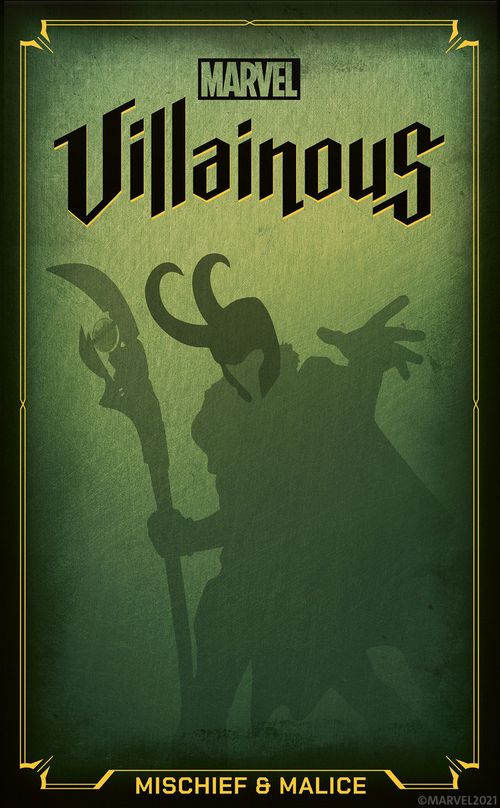
Marvel Villainous: Mischief & Malice
Marvel Villainous: Mischief & Malice Rulebook
Table of Contents
Table of Contents
Components
LOKI — 1 Villain Deck (30 cards: Loki's Objective, God's Throne, Bifrost, Jotunheim, Sanctum Sanctorum, Specialty), 1 Villain Mover, 1 Domain (4 location cards)
M.O.D.O.K. — 1 Villain Deck (30 cards: M.O.D.O.K.'s Objective, A.I.M. Laboratory, A.I.M. Island, A.I.M. Submarine, A.I.M. Warehouse, Specialty), 1 Villain Mover, 1 Domain (4 location cards)
MADAME MASQUE — 1 Villain Deck (30 cards: Madame Masque's Objective, Manhattan, Hell's Kitchen, Nefaria Castle, Maggia Casino Ship, Specialty), 1 Villain Mover, 1 Domain (4 location cards)
- 3 Villain Decks (30 cards in each deck)
- 4 Fate Decks (1 Common Fate deck with 15 cards and 3 Villain Fate decks with 11 cards each)
- 2 Specialty Tiles (Vengeance track 0-8, and Loyalty track 1-5)
- 3 Villain Guides
- 3 Reference Cards
- 25 Power Tokens
- 10 Strength Tokens
- 15 Mischief Tokens
- 1 M.O.D.O.K. Token
- 1 Slide Clip
Villain Guide
Read the Villain guide for your chosen Villain before starting the game. These guides detail your Villain's objective and unique cards, and which Heroes and Events can slow you down. Keep your Villain guide handy and refer to it as needed when you play new cards — or when others play cards against you!
Reference Card
One side of the reference card lists how each Villain reaches their objective. This will help you determine whether an opponent is nearing victory. The other side identifies the actions and icons in the game.
Game Overview
Each player takes the role of a Marvel Villain with their own objective to achieve. On your turn, place your Villain mover on a different location in your Domain, then perform the actions available there. Achieve your Villain's objective first to win the game!
Objective
As soon as a player has achieved their Villain's objective, the game ends and that player is the winner! Refer to your Villain Guide for tips on how to achieve your Villain's objective.
Game Modes
Omnipotent (Easy)
If you're trying Marvel Villainous or a new Villain for the first time, remove all Events from the game, return them to the box, and ignore all references to Event cards. This mode also allows for a faster game.
Inevitable (Intermediate)
Once you've mastered the rules, follow setup as detailed below to incorporate Events for a greater challenge and longer game.
Undying (Difficult)
For a true test and longer game, experienced players should review the Events section of the rules for an additional rule variant.
Setup
- Each player chooses a Villain and takes the corresponding Villain Domain, mover, guide, Villain deck, and Fate deck, as well as a reference card. Return remaining Villains and their components to the box.
- Place your Domain in front of you. Each Domain depicts (from left to right) your portrait and objective, four locations, and an area for Specialty cards. Place your Villain mover on the Villain portrait.
- Shuffle together the Common Fate deck and the Fate decks from all Villains playing this game to create a single Fate deck. Place this deck within reach of all players. Leave room for a discard pile next to the Fate deck.
- Shuffle your Villain deck and place it face down to the left of your Domain. Leave room for a discard pile below the Villain deck.
- Place the Power/Strength tokens in the Vault within reach of all players.
- Draw a starting hand of four cards from your Villain deck. You may look at your cards, but keep them secret from other players.
- The last player to read a Marvel comic goes first. When in doubt, the oldest player starts. Play proceeds clockwise. The first player starts with no Power tokens. The second player starts with one Power token, while the third and fourth players (if present) each start with two Power tokens.
- In turn order, read the objective on your Domain out loud to make all players aware of it.
Some Villains have unique setups as explained in their Villain guides.
Player Setup Reference
- Villain Deck — placed to the left of your Domain, with room for a discard pile below it.
- Domain — placed in front of you; the Villain Mover starts on the Villain portrait.
- Villain Discard Pile — below the Villain deck.
- Starting Hand — four cards drawn from your Villain deck.
- Villain Guide — keep handy for reference.
- Reference Card — keep handy for reference.
- Fate Deck — shared, shuffled from the Common Fate deck plus each playing Villain's Fate deck, with a discard pile next to it.
Game Overview (Detail)
Each player takes the role of a Marvel Villain with their own objective to achieve. On your turn, place your Villain mover on a different location in your Domain, then perform the actions available there. Achieve your Villain's objective first to win the game!
A. Domain
All cards played to your Domain, including Specialty Cards, are "in" your Domain. Cards in your hand, deck, and discard pile are not in your Domain, nor are cards at Events. (See Event Cards.)
Each Domain has four locations to which you may move your Villain. For example Loki's Domain includes Odin's Throne, Bifrost, Jotunheim, and Sanctum Sanctorum. The icons on each location indicate the actions you may perform after you move to it. To the far left of each Domain is each Villain's objective, showing what you must achieve to win the game. To the far right is a space for Specialty cards.
B. Villain Mover
Each player has a mover representing their Villain. Players will move this piece to a new location within their Domain each turn.
C. Villain Deck
Draw from this deck to achieve your objective.
D. Villain Cards
Play cards from your hand to the bottom of your Domain. These do not block actions.
E. Power Tokens & Strength Tokens
In Marvel Villainous, there are two types of game tokens: Power and Strength. Gain and pay Power from the Vault unless specified otherwise. Use +1 or -1 Strength tokens to represent a permanent change in Strength to Allies or Heroes. (See Strength.)
F. Villain Guide
Read the Villain guide for your chosen Villain before starting the game. These guides detail your Villain's objective and unique cards, and which Heroes and Events can slow you down. Keep your Villain guide handy and refer to it as needed when you play new cards — or when others play cards against you!
G. Fate Deck
Draw and play from this deck to foil your opponents' plans.
H. Fate Cards
Your opponents can play Hero and Item cards from the Fate deck to the top of your Domain. These cards cover up actions at the location to which they are played, preventing you from taking those actions. (See Blocking Actions.) The Fate deck also contains Effect cards and Event cards. (See Types of Cards.)
I. Events
In the Fate deck are Events, which are placed in the center of the playing area as a new and unique location. Events are not considered to be in any Domain. Villain movers and Heroes never move to Events. To scale the difficulty of your game by using different Event options, reference the game modes (See Game Modes).
J. Specialty Area
Play Specialty cards to the rightmost area of your Domain. Specialty cards are in your Domain and cannot be relocated or removed. (See Specialty Cards.)
K. Reference Card
One side of the reference card lists how each Villain reaches their objective. This will help you determine whether an opponent is nearing victory. The other side identifies the actions and icons in the game.
Your Domain
Each player has their own Board, representing their Villain's Domain. All cards played to your Board are considered to be in your Domain. Cards in your hand, decks, and discard piles are not in your Domain. Card Abilities only affect cards in the same Domain.
Mid-Game Example — Domain Anatomy
- Locations — Each Domain has four named locations you may move your Villain to.
- Actions — Each location has symbols for actions you may perform when you move to that location.
- Fate Cards — Your opponents play Fate cards to the top of your Board.
- Objective — Each Villain has a different objective they must achieve to win the game.
- Villain Cards — You play Villain cards to the bottom of your Board.
- Specialty Cards — You play your Specialty cards here. You can have more than one Specialty card in play at any time.
On Your Turn
Do the following, in this order:
1. Move Your Villain
Move your Villain from its current location to a different location in your Domain. You may not stay in your previous location in your Domain. You may not move your Villain to Events or to another player's Domain.
2. Perform Actions
Each location has icons representing the actions you may take on the turn you move there. You may perform the available actions in any order. Each action may be performed once for each icon that appears. All actions are optional. (See Types of Actions.)
Blocked Actions. During the game, actions may become covered by Fate cards or by an opponent's Ally. Actions covered this way are blocked. If an action is blocked, that action is unavailable and may not be performed until the card covering it is relocated, vanquished, defeated, or removed. When an action is uncovered, it is available immediately; if your Villain is at that location and it's still your turn, you may perform it.
3. Draw Cards
At the end of your turn, if you have fewer than four cards in your hand, draw from your Villain deck until you have four cards. If you need to draw from your Villain deck when it is empty, shuffle your Villain discard pile to form a new deck, then continue your draw.
You must wait until the end of your turn to draw cards, even if you have fewer than four cards at the start of your turn.
Now it's the next player's turn.
Types of Actions
Cards and their abilities may alter what you can and cannot do with an action. When in doubt, cards overrule anything in this rulebook. If one card grants an ability and another restricts your actions, the card restriction takes precedence and the restriction applies.
Your Villain mover's location dictates which actions you may perform on your turn, but these actions can be carried out at any location in your Domain or at an Event.
Gain Power
Collect Power from the Vault equal to the number in the icon and place it on your portrait. Power is this game's currency. You need Power to play cards and activate abilities.
Example: the icon showing "2" means take 2 Power.
Play a Card
Play a card from your hand. You may play only one card for each play a card action. Most cards have a cost in the upper-left corner. When you play a card, you must pay its cost by returning that much Power to the Vault (unless otherwise stated). If you don't have enough Power to pay a card's cost, you cannot play the card. Some cards have a cost of zero; you must have a play a card action to play these as well.
You may play an Ally to any location in your Domain or directly to an Event. Items are directly played to your Domain only. To play a card at any location in your Domain, pay the card's cost, then place the card below your Domain to any location of your choice. (You do not have to play cards to your Villain mover's location.) To play an Ally to an Event, pay the card's cost, then place the card beside the chosen Event. (See Events.)
Example: Pay the cost (3 Power), then play this item to any location.
Activate
Choose one of your Allies, Items, or Specialties with an activate symbol. Pay the card's activation cost, if any, then perform the card's Activated Ability. You may also activate your Ally or Item in another player's Domain or at an Event.
Activated Abilities. Cards include an activate symbol to indicate that their ability is not always in effect. Play a card with an Activated Ability as normal. Each time you wish to use that card's ability, you must perform an activate action and pay the activation cost, if any.
Example: Use an activate action and then pay 2 Power to use this card's Ability.
Relocate
Move one of your:
- Allies or Items from a location in your Domain to another location within your Domain.
- Allies to either a Global Event or your specific Targeted Event.
- Allies from another Villain's Domain to a location in your Domain.
Unless a card specifies otherwise, you cannot relocate an Ally or Item to a location in an opponent's Domain, nor can you relocate Fate cards. If an Ally you relocate has an attached Item, that Item moves with the Ally. You cannot relocate Allies or Items you do not control.
Relocating a card is not the same as playing a card. If a card's ability is triggered when it (or another card) is played, that ability is not triggered if it is moved by a relocate action or a character's ability.
Vanquish
Defeat one character (a Hero or an Ally) at any location in your Domain by using one or more of your Allies in the same location. Each character has a Strength in the lower-left corner. (See Strength.) Strength may be modified by other cards in play. Your Ally or Allies must have Strength equal to or greater than the Strength of the character you choose to vanquish.
After using this action, both the Allies you used in the vanquish action and the character you are vanquishing are placed face up in their respective discard piles.
Example: You have three Allies at the same location as a Hero with a Strength of 5. Because two of the Allies have a combined Strength of 5 (4+1), only those two Allies need to be used to Vanquish the Hero. Discard the Hero and the two Allies. The third Ally remains at the location.
Fate
Using a Fate action can disrupt an opponent's progress. Reveal one card from the top of the Fate deck, then choose which player to target. (See Fate Cards.)
You cannot use a Fate action to play cards into your own Domain. If you draw a Fate card and cannot play it for whatever reason, discard it with no effect. Fate was not on your side this turn.
Discard Cards
Discard as many cards as you wish face up from your hand to your discard pile. Getting rid of unwanted cards will give you new options on your next turn.
After discarding, do not immediately draw new cards. You must wait until the end of your turn to draw back up to four cards.
Types of Cards
Each player has two decks of cards: Villain cards (with colored backs featuring a unique design) and Fate cards (with white backs featuring the same design). Play your Villain cards from your hand to the bottom of your Domain, to Events, and to the tops of other players' Domains. Specialty cards from your Villain deck are played to the right side of your Domain. Opponents play Fate cards (and sometimes their Allies) to the top of your Domain.
All face-up cards that are not in a discard pile are in play, and their effects are ongoing for as long as the card remains in play. Cards placed in locations on your Domain affect only you. This includes Specialty cards, Items, characters played by other Villains, and any cards from the Fate deck.
Any number of Villain cards and Fate cards may be played to a location. As cards are played, slightly offset them so that all cards at a location are visible.
Some cards may allow you to draw additional cards from your Villain deck into your hand. There is no hand size limit. If you have fewer than four cards at the end of your turn, draw back up to four; if you have four or more, do not draw.
Strength
A character's Strength (both Heroes and Allies) is indicated in the lower-left corner of their card.
Zero Strength Allies and Heroes. If an Ally or Hero is reduced to 0 Strength by other card abilities, that card remains in its location. A 0 Strength Ally cannot be used in a vanquish action, but you may still use its ability, and it can be relocated. A 0 Strength Hero remains in place at its location and continues to block actions. You may use a vanquish action against this Hero as per normal, but the Ally used in the vanquish action is not discarded.
Placing Strength Tokens. When you place a +1 or -1 Strength token on a character, this character's Strength is permanently affected as long as that token remains on the card.
Gaining and Losing Strength. When a character gains or loses Strength, this change is temporary and often relies on the presence of other cards in play.
For example, Loki's Ally Lorelei reduces the Strength of Heroes at her location by 2. If either the Hero or Lorelei are relocated, then those Strength penalties are removed.
Villain Cards
If you cannot follow all of a card's instructions to resolve it completely, you may not play it.
Some Villains have additional card types unique to them, as explained in their Villain guides.
Ally
Ally cards represent your Villain's henchmen and minions. To play an Ally, pay its cost (shown in the upper-left corner), then place that card either at an Event or at the bottom of your Domain in one of the four locations. You do not have to play Allies to your Villain mover's current location.
A card's layout: Cost (upper-left), Name, Ability, Strength (lower-left), Card Type (bottom).
In many cases a card may refer to a set or sub-set of cards with certain words in their name. We use the following phrases to indicate that in the game: "X in their name," "X Allies" or "X Heroes." For example, we use "A card with Avenger in their name," "A.I.M. Allies" or "S.H.I.E.L.D. Heroes."
Some Allies have abilities allowing you to play them to another Villain's Domain. Allies played to another Villain's Domain are placed at the top of that player's Domain and block actions at that location just like Heroes do. However, they are still considered Allies and are controlled by their original Villain. These Allies may be vanquished just like Heroes.
Once Allies have been played to a location, you may use them to defeat characters at the same location by performing the vanquish action. Each Ally has a Strength (shown in the lower-left corner) that may be modified by other cards in the Domain. Additionally, most Allies have an ability that affects other cards or actions. Once an Ally is in your Domain, you need to decide whether to use it to defeat a character, keep it in your Domain for its ability, use it to meet your objective, or use it in some other way.
Item
Item cards have an ability affecting other cards or actions. To play an Item, pay its cost (shown in the upper-left corner), then place the card below any location in your Domain. If an Item says to attach it to an Ally, you must place the Item under an Ally in your Domain. If you have no Allies in your Domain, you may not play an attached Item.
If an Ally with an attached Item is relocated, that Item is relocated, too. If an Ally is defeated, vanquished, or removed, all attached Items are placed in their appropriate discard piles. Unattached Items cannot be relocated to an Event.
Effect
Effect cards are one-time abilities. To play an Effect, pay its cost (shown in the upper-left corner), do what the card says, then place it face up in the appropriate discard pile.
Specialty
Specialty cards have an ongoing ability that a Villain can use on their turn. To play a Specialty card, pay its cost, if any (shown in the upper-left corner), then place it in the rightmost space of your Domain. Some Specialty cards may have an additional requirement to be played or have Activated Abilities. (See Activated Abilities.) While you may use multiple Specialty cards in a single turn, you may not use the same Specialty card more than once per turn. Specialty cards cannot be defeated or removed unless you're required to do so to meet an objective. Refer to your Villain guide to learn more about your Villain's unique Specialty cards.
Fate Cards
Fate decks include three types of cards: Heroes, Effects, and Events. Some Fate cards are Targeted, and therefore more effective against a specific Villain as indicated by the Villain icon in the lower-right corner. Though these cards impact the Targeted Villains more than others, some situations may lead you to target a Villain other than the one indicated on the Fate card; it's your choice. Targeted Events have unique rules and must be played on the Villain indicated. (See Events.)
Villain Icons. Loki, M.O.D.O.K., Madame Masque.
Hero
Hero cards represent the heroes trying to stop Villains from accomplishing their sinister plans. To play a Hero, place the card so that it covers the top of any location in the targeted player's Domain, blocking the actions in that location. Heroes cannot be played to Events.
You can use a Hero to hinder an opponent's progress by covering useful actions. These actions are blocked until the Hero is defeated, vanquished, or removed.
A Hero card's layout: Name, Ability, Strength (lower-left), Card Type, Villain Icon (when shown).
Each Hero also has a Strength (shown in the lower-left corner) that may be modified by other cards. Additionally, most Heroes have an ability that makes it harder for a Villain to achieve their objective.
If multiple Heroes or opponents' Allies are at a location, and the character covering the action symbols is defeated or removed, use any other character in that location to cover the action symbols at the top of the Domain.
Protector
Some Heroes have the Protector ability. If multiple Heroes are in a location, you must defeat the Hero with the Protector ability first. If multiple Heroes in one location have the Protector ability, you may choose which of those Heroes to defeat first.
Item and Effect (Fate Deck)
Item and Effect cards also appear in the Fate deck; they do not have a cost to play them, although other conditions may need to be met for the card to be played.
Event
Event cards are situations with far-reaching effects, which inflict powerful and negative penalties on Villains while in play. The penalty is ongoing, and each player must deal with it on their turn until the Event is resolved.
An Event card's layout: Name, Penalty, Reward, Strength (lower-left), Villain Icon, Card Type.
When a Global Event (one without a Villain icon) is revealed during a Fate action, immediately play this Global Event to the center of the playing area unless a Global Event is already in play. Only one Global Event card can be in play at a time. If a Global Event is in play and you draw a new one from the Fate deck, place the newly drawn Global Event on the discard pile.
Each Event has a Strength requirement in the lower-left corner. To resolve an Event, play Allies directly to the Event itself or use a relocate action to move Allies from a Villain's Domain to an Event. Once the combined Strength of all the Allies at the Event meets or exceeds the Strength requirement, the Event is resolved immediately.
Villains with Allies at the Event receive a reward for resolving it. Place the Event on the Fate discard pile. All Allies used to resolve the Event are placed face up on their respective Villains' discard piles. Items may not be played directly to Events. Allies with attached items may be relocated to Events.
Events are not in anyone's Domain. You can relocate your Allies to an Event, but while there, they are not part of any Villain's Domain.
Targeted Events must be played against the Villain indicated by the icon in the lower-right corner, whether or not a Global Event is already in play. Place this Targeted Event above the indicated Villain's Domain. It is not considered part of their Domain. Only the indicated Villain can relocate Allies to their Targeted Event. This is a personal vendetta only that Villain can resolve.
If you draw a Targeted Event card for your Villain, discard it without effect.
Game Modes (Detail)
When playing an Omnipotent game, remove all Events from the game and ignore all game text referencing Events.
For a tougher challenge, play in Inevitable mode, and read the rules as written.
For true test, play in Undying mode, and do not restrict the number of Global Events that may be in play. Each time a Global Event is drawn, play it next to any other active Events. In this game, a single Villain may be affected by multiple Events at the same time!
Card Actions
Play
Some cards allow you to add a card to a Villain's Domain or to an Event directly from a Villain deck, Fate deck, or discard pile as if it were being played from your hand. Pay the card's cost unless otherwise specified.
Reveal
If a card instructs you to reveal cards, you must show those cards to all players. If the cards are in your hand, show those specific cards to your opponents, then return them to your hand. When revealing cards from your Villain or Fate decks, turn the cards face up as you draw so all players can see them.
Once you have finished revealing cards, shuffle all unchosen revealed cards back into the deck. If you ever need to reveal a card from a Villain or Fate deck when it's empty, shuffle its discard pile to form a new deck.
Look
If a card instructs you to look at cards, either from your Villain deck or the Fate deck, you may look at them privately, keeping them secret from the other players. If you ever need to look at a card from a deck when it is empty, shuffle its discard pile to form a new deck.
Find
If a card instructs you to find a specific card or card type, you must take the specified card or card type from wherever it is, then follow the rest of the instructions on the card initiating the "find" action. When finding a card or card type, first check to see whether it is already at a location in a Domain or at an Event. If so, remove it from its location.
If the card is not already in a Domain, search the appropriate discard pile. If it is not in the discard pile, search the appropriate deck, reveal that card to your opponents, then shuffle that deck.
Defeat
To defeat a character (whether a Hero or an Ally), take that character and place it in the appropriate discard pile. You can defeat a character either by performing a vanquish action or by playing a card. Card abilities that allow you to defeat a character do not require you to perform a vanquish action.
Remove
If a character or Item is removed by a card, place it into the appropriate discard pile. No abilities can be triggered to stop this action. Removing a card is a free and separate action you may take only during your turn and does not require an action or cost. Defeating or discarding a character as a result of a vanquish action or card ability does not count as a removal.
Unless otherwise stated, players receive no rewards (such as Soul Marks or Infinity Stones) for removing a card from play, and effects that trigger after a character is "defeated" do not trigger after a character is removed.
Ending the Game
As soon as a player fulfills their Villain's objective, the game ends and that player wins!
Mixing Games
You can mix the Villains in this box with other Marvel Villainous games to add additional players or explore new rivalries. Discover more Villains, more strategies, and more twists of fate!
Mixing Common Fate Decks (Optional)
You may mix the Common Fate deck of this set with that of any other Marvel Villainous release. To do so, follow these steps:
- Remove the Events from the decks.
- Combine all Common Fate decks into one deck.
- BEFORE adding in the Villain Fate decks, deal out 11 cards face down. This is the deck you will be playing with, and you can add the specific Villain decks to this deck.
If playing with Events, shuffle all the Common Fate Events and draw four Events. Add them to the new Fate deck created above with the specific Villain Events, and reshuffle. The remaining Common Fate cards and Common Events are not used in this game.