Les Deux Bretagnes: Expansion et nouvelles cartes
Les Deux Bretagnes: Expansion et nouvelles cartes Rulebook
Table of Contents
Table of Contents
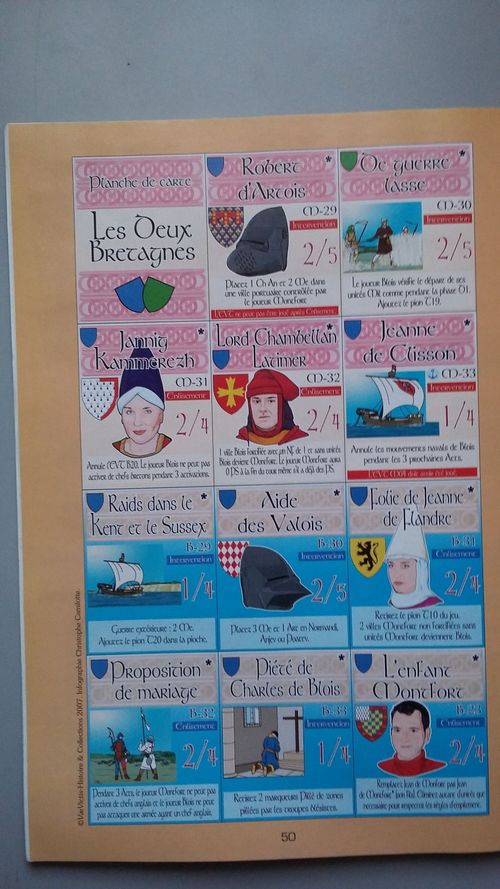
New Cards
The new cards can of course only be used by agreement of both players. Two ways of adding them to the decks may be chosen:
- Add one or more new cards, making sure that each player's deck keeps the same total activation value (add up the activation values of all the cards).
- Replace certain cards with new ones. A card may be exchanged for a new card if both cards have the same activation value. Be very careful then about which cards are set aside from the game, since some have a great influence on play (Bombards, Jean II le Bon, ...).
Card example shown on the page: Lord Chamberlain Latimer (card code CD-32, printed activation "2/4"; the name is read from a low-resolution photo and may need checking). Its small-print effect, as read from the photo: "1 fortified town, Blois, with an NE of 1 and no units. Blois becomes Montfort. The Montfort player will have 0 PS at the end of the turn, even if they already have PS." The abbreviations NE and PS are not explained on this page.
Green Markers
Cards B29 and M30 introduce two new tactical markers, with these effects:
- T19: De guerre lasse ("Weary of war"): The combat is cancelled. The Blois army's activation ends. Remove this marker from the draw pile after use.
- T20: Kuzul Brezel: The Blois player may choose to retreat before the combat. The activation then continues normally. Remove this marker from the draw pile after use.
Chief Markers
The "Jeanne" markers are placed in a friendly zone at the moment their respective husbands are captured or killed. They stay in play for two turns, then are removed from the game during phase F. They act as chiefs set apart, except that they may not recruit or go on a foreign war (guerre extérieure).
Specifics:
- Jeanne de Flandre (wife of Jean de Montfort): She may use tactical marker T10 without having to draw it from the draw pile. Historical note: If Jeanne de Flandre was a war leader, her political influence was rather short-lived.
- Jeanne de Penthièvre (wife of Charles de Blois): She may take control of an unfortified town of the Saint-Brieuc and Bro Dreger area without spending an additional movement point (3.1). Historical note: Jeanne de Penthièvre, although she was the true leader of the Blésois party, never led an army into combat.
Grey Markers
These are used to mark the events of cards with a green coat of arms that have been played, and other important events of the game:
- Edward III roi de France (M01)
- Bombardes (M02)
- Exécution de nobles bretons (M04)
- Crécy (M05)
- Thomas Dagworth (M12)
- Bases anglaises (M21)
- Poitiers (M22)
- Du Guesclin va en Normandie (M25)
- Skuizh é vrezeliñ (M30)
- Cahours change de camp (B03)
- Croquart (B04)
- David II d'Ecosse (B06)
- Clément VI (B10)
- Jean de Normandie (B12)
- Bombardes (B13)
- Combat des Trente (B15)
- Bases françaises (B19)
- Etats généraux de Bretagne (B20)
- Trêve de Bordeaux (B25)
- Bertrand du Guesclin (B28)
Variant
Coats of arms. Inheriting the arms of Montfort-l'Amaury, Jean de Montfort (father) wanted to break with those introduced by his half-brother, Duke Jean III, which were sown with ermines (semées d'hermines). To back his claim to the duchy of Brittany, he adopted new arms "sown with ermines around a border gules, charged with leopards or", recalling on one side his belonging to the duchy and on the other the House of Montfort-l'Amaury.
His son, returning from England, chose other arms. These mixed the original arms of Pierre Mauclerc (House of Dreux, the dynasty in power in Brittany since 1217), "checky or and azure with a franc-quarter of ermine", and the leopards of Montfort-l'Amaury "with a border gules charged with leopards or". It is probably these he bore in combat. Very soon after the battle of Auray he took the arms of Duke Jean III (ermines).
For his part, Charles de Blois adopted the arms of Jean III fairly quickly. This was all the easier to have accepted since he controlled Rennes and Nantes, and most of the Breton nobles were on his side.
Note for this extension. For the sake of clarity, the original arms of Charles de Blois and of Jean de Montfort have been used. In this expansion, the page proposes as a variant to use the provisional arms of Jean de Montfort (son) in place of his chief marker and card B23.
Historical Card Descriptions
- B01 Marine Castillane: The French royal navy being wholly insufficient, Philippe VI and his successors often called on Castilian or Genoese mercenaries to try to gain naval superiority over the English and the Flemish.
- B03 Cahours: A nobleman from Guérande, he was used to changing sides and did not hesitate to betray. Allied with the English in the Marches of southern Brittany, Cahours even went so far as to kill Thomas Dagworth in an ambush, to keep his influence in an area so economically important (salt, wine, ...).
- B04 Croquart: The King of France paid a high sum of money for this illustrious routier (free-company soldier) to join the French forces. Like many others, Croquart changed allegiance several times and took several important places. But once captured and recognised as a brigand by the Anglo-Bretons, he was finally hanged.
- B06 David II d'Ecosse: In 1346, under the terms of an old alliance, he invaded England in the interest of France and was taken prisoner at the battle of Neville's Cross on 17 October. He remained a captive in England for eleven years.
- B10 Clément VI: Pierre Roger de Beaufort became pope in 1342, under the name Clement VI. He tried to act as an arbiter in European affairs. He vainly tried to bring peace between France and England, failed in a mediation between Aragon and Majorca, and fell into conflict with the German emperor Louis IV. He can often be reproached for a pro-French partisan attitude during the long Anglo-French conflict, through his use of truces and legates whenever the situation seemed to turn to the French disadvantage.
- B15 Combat des Trente: On 26 March 1351, an epic combat took place near the Mi-Voie oak, between Ploërmel and Josselin. The thirty Bretons of Jean de Beaumanoir fought the thirty men commanded by Robert Bembrough (English, Germans, Flemish and Bretons). Bembrough and seven of his men were killed, as were four men of Beaumanoir. According to legend, the Breton leader, worn out by the heat and the fasting, asked for a drink, and one of his companions answered "Bois ton sang, Beaumanoir, la soif te passera" ("Drink your blood, Beaumanoir, and your thirst will pass"). This saying remains the motto of the Beau-
[The page ends here, mid-word. The rest of the article is not in the photo, so the file stops at this point.]