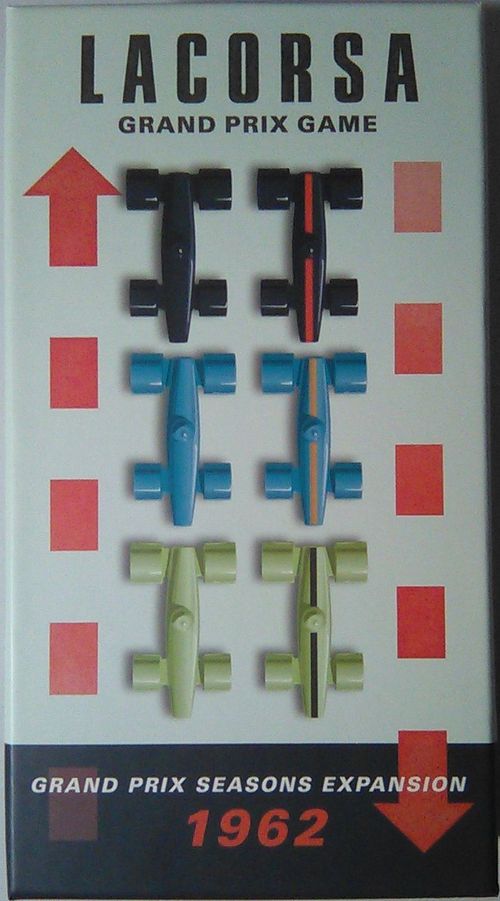
LACORSA Grand Prix Game: 1962 Expansion
LACORSA Grand Prix Game: 1962 Expansion Rulebook
Table of Contents
Table of Contents
Racing Terminology
- Race: One hand. One deal of the cards.
- Qualifying: The method used to determine starting position.
- Suit: Suits are used to divide the cards into groups of thirteen. The suits have no rank.
- Challenging: A racecar battling the racecar directly ahead for position.
- Extending: To move one space forward into an open space by playing an Extend card.
- Drafting (technical): To be pulled along using another racecar's draft (the air pocket behind a moving automobile).
- Field: All the racecars participating in a race as a group.
- Race lap: The battle for positions from the last-placed racecar to the first-place racecar. Once the leader's turn is completed, the next race lap starts from the back of the field.
- Racecar's turn: One racecar's movement during one race lap after defending any challenge.
- Incident: A crash, shunt or mechanical issue.
- DNF: Did Not Finish. Indicates a car that did not finish the race.
Contents
- 78 playing cards (6 new suits, the deck)
- 6 racecar playing pieces (new colors)
- 1 six-sided die
- 1 championship table scorepad (50 pages)
- 18 racecar cards (separate from the deck)
- 7 track cards (separate from the deck)
- 2 incident chart cards (separate from the deck)
- 1 pit stop chart card (separate from the deck)
Race Type
The number of players determines the game type.
Teams' Championship (2-6 players): Each driver operates two racecars. Point totals are combined for both race cars, and scores are recorded for teams and drivers (individual cars).
Drivers' Championship (4-12 players): Each driver operates one racecar. Drivers may form teams in pairs and combine their point totals for a teams' championship.
Rule Set Usage
These regulations include a set of modifiers that can change the outcome of a challenge or assess track position penalties. These are the five expansion rules:
- Lead Driver Advantage
- Incidents
- Track Cards
- Pit Stops
- Racecar Performance
To determine the outcome of a challenge, ADD all the modifiers together.
Track position penalties are given for incidents, ties involving cars going 'flat out' as described in the Lead Driver Advantage rule and Track Card rules, or for race cars taking a pit stop. Penalties are applied first to the challenging car.
You should tailor the rule set to your preferences. You can select to use only the track modifiers, the lead driver advantage, or any combination of the five rules.
Note: Game time will increase with each rule used, especially with more players and race cars. You can achieve period-correct results by using the complete rule set.
Note: Pit stops and Incidents are recommended for races with more than six cars to ensure sufficient race length for adequate passing.
1. Lead Driver Advantage
All racing teams have a number one driver who is exceptionally talented and able to push their car a bit harder. These drivers are often favored by their teams, which can significantly influence the Drivers' Championship, making that competition more intense.
In the game, favored drivers are represented by striped racecars, and their modifiers are printed on the Racecar cards. Example:
Driver adds 1 to every challenge. Optional. Declare "flat out" before reveal. Incident for ties if advantage is used, roll die on the driver incident chart.
These rules work best with Incidents. Here, driver aggression is penalized with a missed corner, car contact, or even a crash. Players must declare "flat out" before the reveal of cards to indicate they are using their advantage.
The challenger must declare first.
2. Incidents
Tied challenges cause incidents on a dangerous track or with a fast car and driver calling 'flat out'.
Note: These take precedence over any other track card rule, such as the Slipstream Rule.
Usually, both cars involved are considered to have been in an accident or to be experiencing a mechanical problem. The penalty is determined by rolling a die for each car on the Car Incident Chart card for dangerous tracks and fast cars, or the Driver Incident Chart for striped cars going 'flat out'. If multiple charts are indicated, the Car Incident Chart takes priority.
The exception is if two striped cars tie with Lead Driver Advantage, the penalty is only applied to the car or cars calling 'flat out'.
Option: If you're running a championship with players divided into teams, each with a single car, all cars are capable of pushing 'flat out'.
Track Position Penalties
Penalties involve losing track position or being removed from the board. Always apply the challenger's penalty first.
If a racecar loses its track position due to an incident, its turn ends, and all the racecars, along with the empty spaces behind it, move forward. The same applies when a racecar is disqualified (DNF) and removed from the board.
If a racecar receives a "no effect" result, it proceeds with its turn. The challenge-winning car continues if both racecars survive without penalties. For example, if the track rule were the Slipstream Rule, it would determine the winner in favor of the challenger.
Example: Incident involving dark green challenging blue
Chart roll penalties: both cars lose 2 spaces.
The challenger penalty is applied first, so the green car moves back 2 spaces. Then the blue car moves back 2 spaces, which causes the empty space and the white car to shift forward. Play continues with the lime car ahead of the incident.
Example: Incident involving red challenging blue
Chart roll penalties: Red moves to last place - no effect on blue.
Red takes the position of the last car (not the last space), and the other cars move forward one space. Since there is no effect on the blue car, it maintains its gap to the field and can continue its turn.
Example: Incident involving green challenging red
Chart roll penalties: no effect on the green car - Red DNFs out of the race.
Red is removed from the board, and the remaining cars move forward one space. Green maintains its gap to the cars behind and continues on its turn.
3. Track Cards
The seven Track cards come with unique house rules that are applied to each round of the championship. By using a different card for each race, you can create varied circuit conditions that will favor different strategies.
Certain tracks pose more challenges to machinery and others make it harder to overtake. High-speed circuits create more opportunities to pass due to a stronger drafting effect. Here are some examples:
- Banked Turns: Challenge one car after extending.
- Limited passing: One pass per lap maximum.
- Deuces Wild: 2s can also be used as 12s.
- Dangerous Track: All ties result in car incidents.
- Slipstream Rule: Ties go to the challenger.
4. Pit Stops
After completing the first lap, a driver can call for a pit stop by declaring 'pit' or 'box' after one pass (not more), after extending, or before a challenge between two cars. The challenger must declare first. If only the defending car pits, the cars switch positions first.
During a pit stop, the driver can draw up to five cards from the discard pile after shuffling, but never hold more than 13 cards in hand.
When a car makes a pit stop, a die roll is required on the Pit Stop Card chart to determine where the racecar reenters the race. This may cause the loss of track position, counting empty spaces and the cars behind the pitting car. Once the pit stop is finished, the racecar's turn ends.
The race continues with the racecar ahead of the car that pitted. If the challenger didn't pit and gained a position, it cannot pit on the next challenge but may do so after extending or passing.
A position gained from another car pitting doesn't count toward the limit on the number of passes on a lap/turn.
A racecar must make at least one pit stop during the race and may make a second if desired. If a racecar runs out of cards without stopping, it is considered out of fuel and will be removed from the board. The cars and gaps behind them will then be moved up accordingly.
Note: Pit stops are recommended for races with more than 6 cars to ensure sufficient race length for adequate passing.
Example: Pit stop protocol during a challenge
Orange is challenging white. Orange declines to pit. White is pitting.
Orange gains a position. White draws up to five cards, rolls on the Pit Stop Card chart, any track position penalties are applied, and white's turn ends. The race continues with the orange car, while only the blue car is allowed to pit.
The orange car must pass the blue car to get the pit option again on its turn. If orange passes blue and red, its turn ends, and it cannot pit.
5. Racecar Performance
Racecars have unique attributes that can be both beneficial and challenging. Power, torque, balance, weight, and reliability can differ greatly depending on the car and the time period it's from. The modifiers on the Racecar cards are designed to reflect these differences. Additionally, performance varied from one season to the next as regulations and car designs evolved.
The modifier example below is reserved for the fastest and often the most powerful racecars:
Car adds 2 to all Redline cards for +4.
Underpowered against the fastest cars, racecars with the modifiers below were light or reliable. This enables the cars to stay, or get back into, contention:
Car adds 1 to every incident chart die roll.
Car turns all 4s into Drafting Extends.
LACORSA Core Game Rules
These are the core LACORSA game rules, reproduced from the expansion regulations' rules sheet.
- Choose race type depending on number of players.
- Pick racecar colors.
- Build the correct deck size. 1 suit per car.
- Shuffle and deal all the cards face down to the racecars.
- Each car selects a card (two with R) to qualify.
- Drivers simultaneously reveal their cards. Highest card (or two with R) wins.
- Played cards are placed face up in a discard pile.
- The car that played the lowest card is placed at the end of the board. Place the remaining cars by card rank, last to first.
- Die roll for ties in qualifying only. Highest roll wins.
- Race starts with the last place racecar challenging the car directly ahead for position.
- Each car plays a card (or two with R). Highest card(s) wins.
- Ties go to the car in front.
- If the car behind wins, the cars switch positions.
- Play continues with the winning racecar challenging the next car directly ahead.
- You must be directly behind another racecar to challenge it for position.
- Once a car loses a challenge its turn is over.
- If a car passes 2 racecars on a lap, its turn is over.
- If a racecar wins a challenge and has an open space directly ahead, it can move one space forward using Extend cards.
- A car can only extend one space regardless of the number on the Extend card.
- The leader cannot use the Drafting Extend card (3) to extend.
- When a car extends, its turn is over.
- If you cannot extend you must discard to end your turn.
- After the leading car's turn the next lap starts with the last-place racecar.
- The race ends when a racecar runs out of cards. Play continues with the next car ahead and the final lap is completed (all the way to the first place racecar).
- Points are scored based on finishing position.
- A Championship consists of seven races. Score for drivers and teams.
Strategy Tips
- Carefully evaluate your cards. Your hand's strength depends on whether it is above or below the average for each card type, especially Extend Cards, Redline Cards, and high cards (11s and 12s).
- If you have two or fewer Extend Cards, try to move to the front during qualifying or early in the race. Being aggressive here can prevent you from falling behind.
Notes on Play
- You must always play a card (to challenge, to extend or discard).
- A driver can pass and then extend, but cannot extend and then pass.
- Only one Redline card may be played at a time (if two Redline cards are accidentally played at once, both are discarded for no value).
- A Redline card may be used to discard two cards.
- If a racecar runs out of cards before it finishes its turn, play passes to the racecar ahead.
- The next lap will not start if a racecar has run out of cards.
- It is important to keep track of how many cards your opponents have. When asked, drivers must show the number of cards they have left to the other drivers.
- When a player is playing with 2 racecars and the racecars meet in a challenge, the player plays a card for each racecar. This allows the player to determine which racecar should be ahead (also known as team orders).
- Your car does not have to extend (play an extend card) even if you have an extend card in your hand. Discard instead.
Suits
The six new suits, listed on the rules sheet: spark plugs, disc brakes, wheel nuts, springs, bearings, and engine blocks.