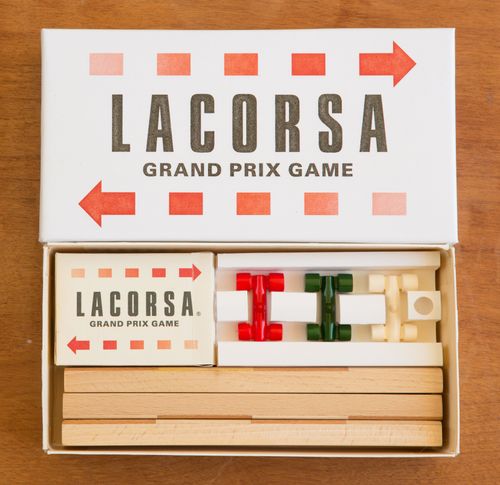
LACORSA Grand Prix Game
LACORSA Grand Prix Game Rulebook
Table of Contents
Table of Contents
Racing Terminology
- race: One hand. One deal of the cards.
- qualifying: The method used to determine the starting positions.
- suit: Suits are used to divide the playing cards into groups of thirteen. The suits have no rank.
- challenging: A racecar battling the racecar directly ahead for position.
- extending: To move one space forward into an open space by playing an Extend card.
- drafting (technical): To be pulled along using another racecar's draft (the air pocket behind a moving automobile).
- field: All the racecars participating in a race as a group.
- race lap: The battle for positions from the last-placed racecar to the first-place racecar. Once the leader's turn is completed, the next race lap starts from the back of the field.
- racecar's turn: One racecar's movement during one race lap after defending any challenge.
Contents
- 78 playing cards (6 suits, the deck)
- 6 racecar playing pieces
- 1 three-piece wooden playing board
- 1 six-sided die
- 1 championship table scorepad (50 pages)
- 23 marker cards (separate from the deck)
- 7 rule cards (separate from the deck)
Introduction
Strategy at Speed
In LACORSA, the cards control the movement of the racecars on the game board as players compete for track position. There is no finish line. The only goal is to stay ahead of your rivals. Each card deal is a race. Players must carefully manage their machines' power to achieve the best possible results. Championship points are awarded based on finishing order after each race, and the driver with the most points after seven races is crowned the World Champion.
LACORSA supports 2-6 drivers, and you can play as teams or individuals.
Race Type
The number of players determines the game type.
Teams' Championship (2-3 players): Each driver operates two racecars. Point totals are combined for both race cars, and scores are recorded for teams and drivers (individual cars). Two cars per player.
Drivers' Championship (4-6 players): Each driver operates one racecar. Drivers may form teams in pairs and combine their point totals for a Teams' championship. One car each.
Pre-Race
Pick your racecar colors.
If a driver is playing with two racecars, the racecars should be the same color. With a team of racecars, each player is dealt two hands, which cannot be mixed. One set of cards for the left hand and one for the right. The racecar with the stripe is always on the right. Use the Marker cards to help identify the correct stack for each car.
Build the Deck
Use one suit of cards for each race car in the game. So, combine 4, 5, or 6 suits to create the full deck, depending on the number of cars racing. Suits have no rank.
The suits are: gears, pedals, pistons, steering wheels, shift gates, cams.
Rank of Cards
- Extend (1): one space forward. 1 in a challenge.
- Extend (2): one space forward. 2 in a challenge.
- Drafting Extend (3): one space forward. 3 in a challenge. The leader cannot play this card to extend.
- Standard (4-11): face value in a challenge.
- Champion (12): 12 in a challenge (highest card).
- Redline card (R): 0 in a challenge. Can be played with any other card to add 2. (12) + (R) = 14.
Qualifying
The Deal
Shuffle and deal all the cards in the deck to each racecar face down.
Select Cards
Each car selects a card (two with R) to qualify and places the intended card face down on top of their card stack. A Redline card must be placed on the top of the stack, and the second chosen card must be placed directly underneath.
Note: Place your racecar on top of your stack to show you are ready to qualify.
Start Position
Drivers simultaneously reveal their cards. The highest card, or total score with R, wins.
The car that played the lowest card is placed at the end of the board. Place the remaining cars on the board by card rank, last to first.
The highest die roll resolves ties in qualifying only.
The Race
First Lap
Played cards are discarded face up. The race starts with the last-place car challenging the car directly ahead. Each car plays a card (or two with R). Highest score wins. A tie goes to the car in front.
Note: The order of play will always be based on the track position.
If the car behind wins, the cars switch position.
Play continues with the winning racecar challenging the car directly ahead. A racecar's turn is skipped or ends when it loses a challenge.
The gameplay proceeds in this manner to the front of the race. A maximum of 2 passes per turn is allowed. If a car passes two racecars on its turn, its turn is over, and play moves on to the next car.
Extending
If a racecar wins a challenge or remains unchallenged and has an open space ahead, it can move one space forward with an Extend card (1, 2, or 3). The leader cannot use the Drafting Extend card (3) and must play a 1 or 2. A car can only move forward one space, regardless of the card's number.
If you cannot extend, you must discard to end your turn. When a car extends or discards, its turn is over. Play moves on to the next car. The racecars behind must extend in the following laps before challenging, since a racecar must be directly behind another car at the start of its turn to attempt a pass.
Next Lap
After the leading car's turn, the next lap starts with the last-place racecar. This pattern continues throughout the race.
Finish
The race ends when a racecar runs out of cards. Play continues with the next car ahead, and the final lap is completed (all the way to the first-place racecar). It might be that the leader plays their last card and ends the race.
The leading car takes the victory! Score points (see below) and get ready to race again. Shuffle, deal, qualify, and go!
Scoring
Scoring is based on the system used in Grand Prix racing from 1962 to 1991.
- 9 points are awarded for first place
- 6 points are awarded for second place
- 4 points are awarded for third place
- 3 points are awarded for fourth place
- 2 points are awarded for fifth place
- 1 point is awarded for sixth place
The driver (or team of drivers) with the most points after 7 races is World Champion. A tie is resolved based on the most victories. Use the championship table scorepad to record race results.
Strategy Tips
- Carefully evaluate your cards. Your hand's strength depends on whether it is above or below the average for each card type, especially Extend Cards, Redline Cards, and high cards (11s and 12s).
- If you have two or fewer Extend Cards, try to move to the front during qualifying or early in the race. Being aggressive here can prevent you from falling behind.
LACORSA Expansion
The Lacorsa Grand Prix Seasons Expansion integrates with the original LACORSA game, enabling players to race with 4-12 drivers, each with one car, or 2-6 two-car teams. New rules introduce pit stops with track position penalties, as well as the risk of crashes that could unexpectedly end your race. Five new features add depth, strategy, and realism, fully immersing you in the high-stakes world of 1960s racing.
Both the Racecar Sets and Track Cards can be used without the full expansion ruleset, adding famous liveries and a unique track house rule for each race.
Notes on Play
- You must always play a card (to challenge, to extend or discard).
- A driver can pass and then extend, but cannot extend and then pass.
- Only one Redline card may be played at a time (if two Redline cards are accidentally played at once, both are discarded for no value).
- A Redline card may be used to discard two cards.
- If a racecar runs out of cards before it finishes its turn, play passes to the racecar ahead.
- The next lap will not start if a racecar has run out of cards.
- It is important to keep track of how many cards your opponents have. When asked, drivers must show the number of cards they have left to the other drivers.
- When a player has two racecars and they meet in a challenge, the player plays a card for each racecar. This allows the player to determine which racecar should be ahead (also known as team orders).
- Your car does not have to extend (play an extend card) even if you have an extend card in your hand. Discard instead.