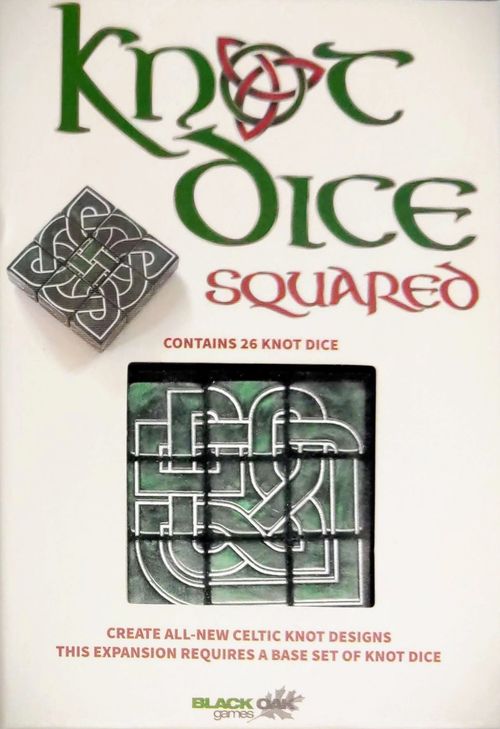
Knot Dice: Squared
Official rulebook: Black Oak Games · PDF
Knot Dice: Squared Rulebook
Table of Contents
Table of Contents
Components
- 26 Knot Dice
- 4 wooden tokens
- 1 game book
- 1 puzzle book
Introduction
The Four Types of Knot Dice
The four types of Knot Dice are crossed, squared, rounded, and bridge.
The first three (crossed, squared, and rounded) have the same layout: one face where the design goes off one edge; one where it goes off two opposite edges; two faces where it turns a corner; one where it goes off three edges; and one where it goes off four edges. Bridge dice have a different layout.
You can always tell what type of die you are looking at from just a single face. Pick up a die from the table and look at one face. If all of the paths cross each other at the edge of the face, you have a crossed die. If there are only straight lines and sharp angles and all of the paths are parallel at the edge of the face, you have a squared die. If there are curved lines and all of the paths are parallel at the edge of the face, you have a rounded die. If some of the paths are parallel and some cross each other at different edges, you have a bridge die.
Knot Dice Squared Is an Expansion
STOP! Knot Dice Squared is an expansion to Knot Dice. You will need a set of the original Knot Dice in order to play these games. Play with the original Knot Dice first and get familiar with them before adding Knot Dice Squared to your games.
Paths
Paths on Knot Dice are not the silver lines on the dice, but the space between two parallel lines.
Connecting Dice
The original Knot Dice all connect to one another, but that is no longer the case with Knot Dice Squared.
Squared and rounded dice all connect to each other, but they do not connect to the original crossed dice. For that, you need to use bridge dice between squared/rounded dice and crossed dice.
- Example 1: both dice have paths correctly connected to one another.
- Example 2: one die has paths extending toward the other die, while the other does not. This is not a valid play (unless otherwise specified in that game's rules).
- Example 3: one die has parallel paths while the other has crossed paths, and they do not connect.
- Example 4: while no path has been broken by the placement of the second die, no connection between the dice has been made either, so it's usually not a valid play... unless other connecting dice are added first as in example 5.
- Example 5: the booklet's example of connecting dice that are added first. The booklet marks examples 1 and 5 as valid (✓) and examples 2, 3, and 4 as not (✗).
In some games, the dice are placed on top of one another. In those games, the paths connect to one another (using these rules) on a side face rather than the top face.
Complete Designs
A complete design is one that connects all paths on the dice to form a full Celtic knot design. The booklet marks the first example as complete (✓) and the other two as not complete (✗).
Keeping Score
Open the original Knot Dice game or puzzle rulebook to the scoreboard page. Keep one wooden token in front of each player and use the matching color token to track that player's score. Flip the token over to count beyond the numbers on the scoreboard.
Get Me Knots
A solo game by Bonnie Neubauer and Matthew O'Malley.
Players: 1. Time: 15 minutes. Complexity: medium.
Story
Gather different flowers together in a bouquet to present to your love before sailing over the ocean.
Objective
Create as many designs as possible made of different numbers of dice.
Setup
Start with one set of Knot Dice and one set of Knot Dice Squared: 18 crossed dice, 9 squared dice, 9 rounded dice, and 8 bridge dice.
Place the dice in 4 pools, separated by type of die, to one side of the center of the table.
Set 8 tokens on the table, with space below each token for several dice.
Play
The game is played over several rounds. At the beginning of each round you select any 4 dice from the pools.
Then you take turns doing the following two actions:
- Roll all of your dice.
- Place any number of the rolled dice, but at least 1. You may place them next to a token that has no dice, or you may attach them to dice previously placed. If no dice can be placed, discard one out of the game.
Note: Since there are 8 tokens, there are only 8 possible locations to place dice.
Repeat these turns until you have finished placing those 4 dice, and then start another round by selecting 4 more dice from the pools.
Game End
The game ends when all dice have been placed or all 8 designs are complete.
Scoring
You score 1 point per complete design using a unique number of dice. The highest possible score is 8.
Example: if you complete designs using 2, 3, 4, 4, 5, 7, and 9 dice respectively and do not complete the design using the other 10 dice, you score 6 out of 8 (you do not score for the second "4" design or for the incomplete design).
Hedgerows
A competitive game by Elizabeth Hargrave and Matthew O'Malley.
Players: 2. Time: 15 minutes. Complexity: medium.
Story
You and your neighbor plant hawthorn and blackthorn hedgerows to mark out your fields.
Objective
Complete designs on your side of your hedgerow using as many of your dice as possible.
Setup
Start with one set of Knot Dice and one set of Knot Dice Squared, but do not include the bridge dice: 18 crossed dice, 9 squared dice, 9 rounded dice.
Give all of the crossed dice to one player, and all of the squared and rounded dice to the other player.
Each player takes one of their dice and sets it with their choice of face upright (you probably want to set it with no paths going down into the table on the face towards you).
The squared/rounded player then places their die in the middle of the table to start their hedgerow. The hedgerows are in two parallel lines touching each other stretching to the right and left between you.
The crossed player goes first.
Play
In Hedgerows, you use the side faces of the dice, rather than the top face. You choose any side, but cannot change the top face.
Each turn, you take three actions:
- Collect dice of your type until you have 3 total (if possible).
- Roll your dice. You may choose not to roll any dice that remain from your previous turn.
- Place 2 of your dice in your hedgerow.
When placing your dice, you may place them in your hedgerow in a space directly on your side of one of your opponent's dice, or one space further out than your opponent's dice in any direction (up, left, or right). After the squared/rounded player places the first die, any of the four crossed dice in this diagram are possible placements for the crossed player.
You do not have to place your dice so that they connect to one another (although you usually want to). You can even place them so that the paths on one die are broken by the closed edge of another die (although you usually don't want to).
Game End
The game ends when all dice have been placed.
Scoring
You score 1 point for each die in a completed design on the side of your hedgerow facing you. A design with paths going down into the table is not complete.
The player with the higher score wins. If both players have the same score, the game is a draw.
Kells, the Book & Abbey
Cooperative games by Matthew O'Malley.
Players: 1 – 5. Time: 20 minutes. Complexity: medium.
Overview of Changes with Knot Dice Squared
The new dice are combined with the rest. When you take a new die, you can choose which type of die to select.
Setup
Start with one set of Knot Dice and one set of Knot Dice Squared: 18 crossed dice, 9 squared dice, 9 rounded dice, and 8 bridge dice.
Place the dice in 4 pools, separated by type of die, to one side of the center of the table. Each player chooses any 2 dice, which are immediately rolled.
Play
Play is the same as the original Kells games.
Scoring
Scoring is the same as in the original games, but the highest possible score in a single game is 37.
Random Draw Variant
Start with all of the dice in a cloth bag. When drawing a new die, draw a random die from the bag. To succeed at this variant, it is very important to keep a close count of how many of each type of die remains.
Knot So Fast
A speedy competitive game by Matthew O'Malley.
Players: 2 – 5. Time: 10 minutes. Complexity: medium.
Overview of Changes with Knot Dice Squared
The new dice are combined with the rest. When you take a new die, you can choose which type of die to select. Be sure to select the right type of die to make completing designs easier.
Setup
Start with one set of Knot Dice and one set of Knot Dice Squared: 18 crossed dice, 9 squared dice, 9 rounded dice, and 8 bridge dice.
Place the dice in 4 pools, separated by type of die, at an edge of the table.
Give each player 1 bridge die, 2 crossed dice, and 2 squared dice. In addition, place 2 crossed dice and 2 rounded/squared dice per player and the rest of the bridge dice in the center of the table.
Play
Play is mostly the same as the original game. When you take a new die after completing a design, choose the type of die carefully to make it easier to complete your designs.
When you take a new die, only you take up all of your dice and restart rolling to complete a new design.
Source note: the sentence above is transcribed as printed in the publisher's booklet. Its wording ("only you take up all of your dice") reads oddly, and the booklet does not say more; it has not been reworded here.
Game End
The game ends when a player completes a design using 9 dice (8 dice with 5 players). That player is the winner.
Knot So Fast Too
A speedy competitive game by Matthew O'Malley.
Players: 2 – 6 (play as a bracketed tournament for even more players). Time: 20 minutes. Complexity: medium.
Overview of Changes with Knot Dice Squared
Matches are played with either the set of 18 crossed dice or the set of 18 squared/rounded dice. Two matches can be played at the same time.
Setup
Start with one set of Knot Dice and one set of Knot Dice Squared, but do not include the bridge dice: 18 crossed dice, 9 squared dice, 9 rounded dice.
With 2 or 3 players, use only the crossed dice. With 4 – 6 players, set the crossed dice in one pool and the squared/rounded dice in one pool.
Play
Play is the same as the original game.
With 4 – 6 players, play 2 matches at the same time. One match uses the crossed dice while the other match uses the squared/rounded dice.
With 5 – 6 players, choose pairings so that each player plays once against each other player.
Note: Try to match players who lost their first match with new players, so that all players play their first match with 9 dice.
Game End
For a shorter game than the original, play until one player has at least 3 points and all players have played an equal number of matches. You can also choose to play until each player has played each other player.
Then the player with the most points is the winner. If there is a tie, play additional matches between the winners until there is a single victor.
Knot the Whole Story
A storytelling game by Jay Treat & Doug Levandowski.
Players: 1 – 6. Time: 30 minutes. Complexity: medium.
Overview of Changes with Knot Dice Squared
The types of dice are tied to characters, settings, plotlines, or other elements. With the addition of more dice, players can choose to tell shorter segments of story with each die or to tell a longer story overall.
Setup
Start with one set of Knot Dice and one set of Knot Dice Squared: 18 crossed dice, 9 squared dice, 9 rounded dice, and 8 bridge dice.
Evenly distribute the dice between players.
Choose two story elements, one to tie to each of the two main types of dice: crossed and squared/rounded. This could be two main characters, two genres, two times, two places, or one could be the setting and one the characters, or anything else you want.
The rest of the setup is the same as the original game.
Play
Play is the same as the original game, with the following change:
When playing a crossed die, relate the story somehow to the element tied to the crossed dice; when playing a squared/rounded die, relate the story to the squared/rounded element; and when playing a bridge die, bring the two elements together somehow.
Distance
A competitive game by Matthew O'Malley.
Players: 2 – 4. Time: 30 minutes. Complexity: high.
Overview of Changes with Knot Dice Squared
The new dice are combined with the rest. When you take a new die, you can choose which type of die to select.
Setup
Start with one set of Knot Dice and one set of Knot Dice Squared: 18 crossed dice, 9 squared dice, 9 rounded dice, and 8 bridge dice.
Place the dice in 4 pools, separated by type of die, to one side of the center of the table.
Place the 8 bridge dice in a "+" shape around 1 crossed die, with the player tokens in the corners as shown in the booklet's diagram.
With 2 players, remove 1 squared die from the game. With 3 players, remove 1 squared die and 1 crossed die from the game. With 4 players, remove 2 squared dice and 1 crossed die from the game.
Play
Play is the same as the original game.
Minarets
A Cardboard Edison design by Chris & Suzanne Zinsli.
Players: 3 – 6. Time: 30 minutes. Complexity: high.
Overview of Changes with Knot Dice Squared
The new dice are combined with the rest. With more dice, each building is larger: between 7 and 14 dice depending on the number of players.
Setup
Start with one set of Knot Dice and one set of Knot Dice Squared: 18 crossed dice, 9 squared dice, 9 rounded dice, and 8 bridge dice.
Divide the dice evenly between players. Discard any extra dice.
The rest of the setup is the same as the original game.
Play
Play is the same as the original game.