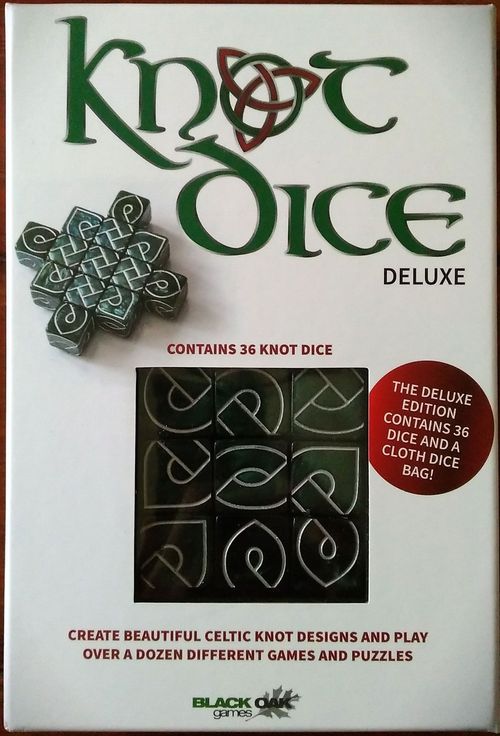
Knot Dice
Knot Dice Rulebook
Table of Contents
Table of Contents
Components
- 18 Knot Dice
- 8 wooden tokens
- 1 game book
- 1 puzzle book
Games Overview
The booklet contains these twelve games, in this order: Kells, Kells: The Book, Kells: The Abbey, Knot So Fast, Knot So Fast Too, A Celtic Yarn, Osbox, Tri na Coillte, Snakes, Knot the Whole Story, Distance, and Minarets. Each game's player count, time and complexity are given under its own heading below.
Introduction
The Six Faces of a Knot Die
The six faces of a Knot Die are: end-cap, chain, rounded corner, sharp corner, branch, and crossing.
Moving Dice
In most Knot Dice games, you move a die around by sliding it on the table while turning it clockwise or counter-clockwise as needed. The top face may rotate, but it can not change to a different face.
Connecting Dice
To connect one die to another, place them next to each other by connecting open parts of the knot design (the paths) on the top face.
- In example 1, both dice have paths correctly connected to one another (valid).
- In example 2, one die has paths extending toward the other die, while the other does not. This is not a valid play (unless otherwise specified in that game's rules).
- In example 3, while no path has been broken by the placement of the second die, no connection between the dice has been made either, so it is usually not a valid play... unless other connecting dice are added first as in example 4 (valid).
In some games, the dice are placed on top of one another. In those games, the paths connect to one another (using these rules) on a side face rather than the top face.
Complete Designs
A completed design is one that connects all paths on the dice to form a full Celtic knot design.
Kells
Cooperative. Players: 1-3 (1-4 players with an additional set of Knot Dice). Time: 15 minutes. Complexity: low.
Story. You are illustrators creating a page for the Book of Kells.
Objective. Cooperate with your partners to include as many dice as possible in a complete Celtic knot design.
Setup
Place all of the dice in a pool to one side of the center of the table. Give each player two dice from the pool, which they immediately roll. The player who most recently drew a picture is the starting player.
Play
On your turn, take these two actions in order:
- Take one of the unused dice from the pool and roll it, adding it to your set of dice (you will now have three). If there are no dice in the pool, you may instead reroll one of your own dice.
- Add one of your dice to the shared design in the center of the table, or discard it out of the game.
- To add your die to the design, connect it following the rules in the introduction. The top face of your die must have paths connecting it to the shared design, and none of the paths can extend into another die's closed edges. If you cannot make a valid play using any of your dice, you must discard one of your dice.
- If you discard a die out of the game, return it to the game box. If players discard 3 or more dice combined, you all lose the game. Be careful: when you complete the design, you will have to discard all of your remaining dice!
Then the next player clockwise takes a turn, until all the dice have been played.
Game End
If you complete the Celtic knot design (as described in the introduction) without discarding 3 dice, you all win! However, if you use up all of the dice from the pool but do not complete the design, or if you discard 3 or more dice (including the dice discarded when you complete the design), you lose.
Scoring
To score your game, count the number of dice in your completed design and subtract the longest dimension of the design. If you include 18 dice in a completed design, and the longest dimension (of a rectangle drawn around your design) is 7 dice, your score is 11 points (18 - 7 = 11).
| Score | Rating |
|---|---|
| 13 | Ar feabhas (excellent) |
| 12 | Go maith (good) |
| 11 | Cothram (fair) |
| 10 or less | Níos mó obair ag teastáil (needs work) |
Advanced Game
To play the advanced game, set up the game with only one die in front of each player (rather than two), so you have only two dice from which to choose each turn.
Once you are very familiar with Kells and want more of a challenge, try Kells: The Book and Kells: The Abbey.
Kells: The Book
Campaign cooperative game. Players: 1-3 (1-4 players with an additional set of Knot Dice). Time: varies. Complexity: medium.
Story. You are illustrators creating many pages for a new manuscript.
Objective. Cooperate with your partners to complete designs using as many dice as possible over several rounds of play. Any dice not used in completed designs in one round are not available for any future rounds.
Setup
Place all of the dice in a pool to one side of the center of the table. Give each player two dice from the pool, which they immediately roll. The player who most recently finished reading a book is the starting player.
Play
Each round of play is very similar to a game of Kells, but you can choose to create several separate designs instead of just one single design. The following rules are different:
- When adding a die, you still must place it adjacent to another die. However, in addition to being able to place a die as in Kells, you can also place a die next to another one if neither has a path towards the other.
- Once you complete a design, you can continue working on other designs with the rest of your dice.
Once all dice from the pool have been played, you have completed a page. Discard to the game box all dice that are not in completed designs; they will not be used again for any future pages in this book.
Score the page according to the scoring rules for Kells. Open the puzzle rulebook to the scoreboard. Track the sum of the page scores using one of the wooden tokens, and track the number of pages you have completed using another color token.
After scoring a page, take all of the dice from the completed designs to start another page.
Game End
When all dice have been discarded into the game box, you have completed your book. Name the book and record the number of pages you completed and your total score for your pages, and compare your score to other books.
Kells: The Abbey
Campaign cooperative game. Players: 1-3 (1-4 players with an additional set of Knot Dice). Time: varies. Complexity: high.
Story. You are building and decorating the walls of an abbey.
Objective. Cooperate with your partners to complete designs using as many dice as possible over several rounds of play. Any dice not used in completed designs in one round are not available for any future rounds.
Setup
Place all of the dice in a pool to one side of the center of the table. Give each player two dice from the pool, which they immediately roll. The player who most recently saw a mural is the starting player.
Play
Play is very similar to Kells: The Book, with two changes:
- Try to complete designs on one side of a vertical wall of dice. Rather than connecting the top face of a die, use any one of the four side faces of a die, but you must use it in the orientation rolled.
- When placing dice, paths cannot extend down into the table.
Once all dice from the pool have been played, you have completed a wall. Discard to the game box all dice that are not in completed designs; they will not be used again for any future walls in this abbey.
Then score the wall according to the scoring rules for the game of Kells. Track the sum of the wall scores using one of the wooden tokens, and track the number of walls you have completed using another color token.
After scoring a wall, take all of the dice from the completed designs to start another wall.
Game End
When all dice have been discarded into the game box, you have completed your abbey. Name the abbey and record the number of walls you completed and your total score for your walls, and compare your score to other abbeys.
Knot So Fast
A speedy competitive game. Players: 2 (with additional sets of Knot Dice, you can add 2 more players per set without increasing playing time). Time: 10 minutes. Complexity: low.
Story. You are treasure hunters collecting pieces of Celtic artifacts. Find and complete more artifacts than your opponent.
Objective. Collect the most dice by using all of your dice to complete Celtic knot designs more quickly than your opponents.
Setup
Give each player 4 dice. In addition, place 4 dice per player plus 1 additional die (i.e., 9 dice for 2 players) in the center of the table.
Play
You do not take turns in this game! Instead, when play begins, everyone acts at the same time.
Roll all of your dice. Pick up and reroll as many of your dice as you want, as quickly and as often as you want, until you use all of your dice to complete a knot design on the top face of the dice. Completing a design means connecting all of the paths to other dice, and leaving no paths open. The complete design can be in any shape (it does not have to be a square).
You may rotate and rearrange your dice as much as you want by sliding them on the table, but you may not change the top face of your dice except by rolling them.
When you complete your design, call out, "Knot Done!" Everyone stops rolling and checks your design.
- If you did not correctly complete your design, then you must take up all of your dice and restart rolling while all of the players continue.
- If you did correctly complete your design, take a die from the center of the table and add it to your dice, then everyone takes up all of their dice (including any newly acquired dice) and starts again.
Game End
All play stops when the last die is taken from the center of the table. The player with the most dice wins. In the case of a tie, the tying players play one final challenge with all of their dice: the first player to complete a design using all of their dice wins.
Leveling Play
If one of the players is clearly more experienced or skilled than the other, the experienced player can start with an extra die at the beginning of the game, and remove that die at the end of the game before determining the winner. This gives the other player an advantage, because they require fewer dice to complete each design.
Keep Rolling Variant (Recommended for 3+ Players)
When you earn a new die, only you take up all of your dice and start again. All other players continue working on their existing designs.
Knot So Fast Too
A speedy competitive game. Players: 3-4. Time: 15 minutes. Complexity: medium.
Story. You are treasure hunters collecting pieces of Celtic artifacts. Find and complete your artifacts more quickly than your opponents.
Objective. Complete Celtic knot designs more quickly than your opponents.
Setup
Open the puzzle rulebook to the scoreboard and set one wooden token for each player next to the scoreboard. Give 2 starting players 9 dice each.
Play
This game is played as a series of matches between 2 players. During each match, the players with the dice act at the same time.
When you are in a match, roll all of your dice. Pick up and reroll as many of your dice as you want, as quickly and as often as you want, until you use all of your dice to complete a knot design on the top face of the dice.
You may rotate and rearrange your dice as much as you want by sliding them on the table, but you may not change the top face of your dice except by rolling them.
When you complete your design, call out, "Knot Done!" Both players stop rolling and everyone checks your design.
- If you did correctly complete your design, add 1 point to your score and move your token up on the scoreboard.
- If you did not correctly complete your design, your opponent gets 1 point instead.
Then the next pair of players take 9 dice each. If one player in the pair has more points than the other before the match begins, the player with more points takes dice from the opposing player equal to the difference between their scores. For example, if Player A has 3 points and Player B has 1 point, Player A takes 2 dice from Player B before starting, so Player A has 11 dice while Player B has 7.
Play another match, repeating the pairings below until the game ends:
- Pairings for 3 Players: 1-2, 1-3, 2-3
- Pairings for 4 Players: 1-2 and 3-4; 1-3 and 2-4; 1-4 and 2-3
Note: With 3 players, the player who loses the first match becomes "Player 1" and is paired with the remaining player. This guarantees that all players play their first match with 9 dice.
Game End
When one player has at least 5 points and all players have played an equal number of matches, the player with the most points wins! If there is a tie, play additional matches until there is a clear winner.
A Celtic Yarn
A puzzling competitive game. Players: 2. Time: 15 minutes. Complexity: medium.
Story. As workers in a yarn factory, your job is to untangle a strand of yarn.
Objective. Untangle the yarn so that a strand originates in one of the 8 dice on the outside of the tangle, includes at least 4 dice, and exits through a different side of the tangle.
Setup
Set four dice to end-caps and five to chains, and randomly set all nine into a 3x3 square, the tangle. Place the two yellow tokens on opposite sides of the tangle, and the two blue tokens on the other two sides. One player plays yellow and the other player plays blue. Each player takes one additional die and rolls it (the remaining dice will not be used in this game). The player who most recently untangled a rope, string, yarn, or wire goes first.
Play
On your turn, you may choose to reroll your die once or leave it on the face it was already showing.
Slide your die into a row or column of the tangle from one of the edges marked by your color token, pushing a die on the opposite side out of the tangle. When inserting a die, it does not have to follow any connection rules.
Take the die that was pushed out and place it in front of you, keeping the same face upright until your next turn.
Alternate turns.
Game End
The first player to form a continuous strand of yarn that runs through at least 4 dice and is on top of the other strands when exiting the tangle on two different sides wins.
In the example, the strand extending out of the left of the middle-left die and the bottom of the bottom-right die is the winning strand. A number of other strands are not valid because the ends are tangled under other strands or the strands are not long enough.
Note: Both ends of the strand must be "on top" of the other strands when exiting the tangle; in other words, the strand must end in a completely open path at the edge of the tangle (which is different than most Knot Dice games).
Advanced Variant
During setup, players roll all 9 tangle dice. Starting with the second player, alternate placing one die at a time in the tangle. Instead of one extra die per player, use only one extra die. To start the game, the first player rolls the extra die. After the initial roll, the extra die will never be rolled again.
When you push a die out of the tangle, rather than rolling the die or leaving it the same, you change the upright face to a face with more open edges per the diagram in the booklet, then hand it to the next player for placement.
Osbox
Players: 2. Time: 30 minutes. Complexity: medium.
Objective. Complete knot designs in multiple rows and columns.
Setup
Open the puzzle rulebook to the page with the playing board and the scoreboard and set it in the center of the table. Place the two yellow tokens on opposite sides of the board, and the two blue tokens on the other two sides. One player plays yellow and the other player plays blue. Choose a starting player.
Play
On your turn, take a die and set it to any upright face and orientation, then push it one space into the grid from one of your sides.
Pushing a die onto the grid may cause other dice to be pushed along the same row or column. Dice can't be pushed onto rows or columns that are full (and would then push dice off the grid).
Knot paths don't have to connect when dice are added to the grid, but when you complete a path you may score points. If you close a knot which passes through more than one row and more than one column, you score 1 point per die in the knot. Then remove the scoring knot(s) from the grid. (In the booklet's example, the knot scores 5 points.)
Keep track of your scores using the black and white tokens on the scoreboard. If you pass the end of the scoreboard, flip your token and restart at the beginning.
Alternate turns until the grid is full, which signals the end of the game.
Game End
The player with the most points is the winner. If both players have the same number of points, the game is a draw.
Any Side Variant
You may enter your die from any side of the grid.
Scoring Variant
When scoring a knot, rather than scoring 1 point per die, you score 1 point for each time the path crosses another path. If the knot's path crosses itself, that will score a total of 2 points. In the previous scoring example, the complete knot is worth 8 points.
Tri na Coillte
"Through the Woods," a competitive game. Players: 2. Time: 10 minutes. Complexity: medium.
Story. During Irish summers, children playfully dress up as spriggans and play a game of chase, taunting each other with a song until one catches the other.
Tríd an coil, táim I do dhiagh / Cos deas agus clé ag gach crann / Ní cuirfidh na cosán athraitheach tú i folaigh / Tógfaidh na coille tú díreach chugam! Through the woods, I'm after you. Turn left or right at each tree. The changing path won't hide you. The woods will lead you right to me!
Objective. Capture your opponent's token by moving your token onto it.
Setup
Roll 16 dice and place them randomly in a 4x4 square, the forest. The dice in the forest do not have to connect correctly with any adjacent dice.
Choose a starting player. The other player chooses a token and places it on top of a die in any corner of the forest. The starting player takes a different color token and places it on the die in the opposite corner of the forest.
Then, the non-starting player rolls two extra dice and sets one near a third different color token next to the forest (this die is called the chase) and gives the other to the starting player (this die is called the tree).
Play
On your turn, do the following in order:
- Choose a die, either the tree or the chase:
- If you choose the chase, roll the die and use the new face. Set the tree next to the chase token to become the new chase.
- If you choose the tree, keep its same face upright.
- Insert your chosen die into the forest from one of the outer edges, moving the entire row or column forward exactly one die. The die that is pushed out of the forest becomes your opponent's new tree.
- When inserting a die, it does not have to follow any connection rules.
- You can't push a line back in the opposite direction it was pushed the previous turn.
- If any tokens are on any of the dice that are moved, they move along with the dice.
- If you push the die that supports the opponent's token out of the forest, place the token on the die that was just inserted on the opposite side of the forest.
- Move your token up to the number of open paths on the chase minus one (see the booklet's diagram). For example, if the chase is a corner die, you may move your token one space. When moving your token, it must follow a path on the top of the dice.
(Example: Yellow slides in the tree, then moves two because of the chase.)
Alternate turns between players.
Game End
When you move your token onto your opponent's token, you capture it and win the game!
Snakes
A competitive game. Players: 2 (2-4 players with an additional set of Knot Dice). Time: 10 minutes. Complexity: low.
Story. Help St. Patrick drive the snakes out of Ireland.
Objective. Drive your snake farther than your opponent's snake.
Setup
Place eight dice in two rows of four next to each other, the snakes. Each snake starts with an end-cap (the tail) and then continues with three chains (the body). Take one wooden token each (of different colors) and place it on your snake, between the third and fourth die away from the end-cap. Place six wooden tokens on the table near the tails (these tokens will be used to count the six rounds of play). Take five dice each and place them in front of you.
Play
The game is played over six rounds in which you push your luck to move your snake at the same time as your opponent. In each round you and your opponent take the following steps:
Step 1: Roll all of the dice in front of you at the same time as your opponent.
- If you roll any chains or corners, you may connect as many of them as you want to the front of your snake, but you must connect at least one, following the rules for connecting dice. You may not connect any dice that would move your snake over to your opponent's side, or that would leave more than one open edge at the front of your snake.
- Special exception: You can also place an end-cap on your snake, but once you do, the snake will not move any more and your game is over. Don't do this until the very last round.
- If you do not roll any dice that you can place, you get bitten! Remove any dice connected to your snake in front of the dice with your token on them, then place those dice back in front of you. Your round is over and you do not roll again until the next round. Note: If you can't place any dice on your first roll, your round is over but you do not remove any dice from the front of the snake, since there are no dice in front of your token.
Step 2: Choose to pass or roll again at the same time as your opponent.
- If you pass, the round is over for you, though your opponent may continue. Move your token forward on your snake to the line between the two dice at the front of your snake. Then take enough dice from the back of your snake so that you have five dice in front of you to start the next round when all players are ready.
- If you roll again, return to step 1 using only the remaining dice not connected to your snake. If your opponent also chooses to roll again, wait until your opponent is ready, so that rolling is simultaneous.
- Special exception: If you successfully place all five of your dice in a single round, you may choose to continue. Move your token forward three dice, take the five dice behind the token, then continue rolling. However, if you are bitten, you lose all of your dice back to your token.
When all players have passed or been bitten, the round ends. Discard one of the tokens near the snakes' tails, then begin another round.
Game End
The game ends after the sixth round when the last token has been discarded. The player whose snake has traveled the farthest forward (not counting travel to the side) from the starting location wins! If both snakes travel the same distance, the game is a draw.
3-4 Player Variant (requires 9 dice per player)
Start with each snake parallel, two die-lengths from each other. Snakes may still turn, but may not move more than one die to the right or the left from their starting line.
Use three tokens to mark rounds. Start the game with all tokens design face-down. Turn the designs face-up for the first three rounds, and discard the tokens for the final three rounds.
Knot the Whole Story
A storytelling game. Players: 2-4. Time: 25 minutes. Complexity: medium.
Story. You are the Fates, weaving together people's lives and stories.
Objective. Work together to craft a story that follows the twists and turns of the results of the dice. Each turn you tell a part of the tale related to the die you place.
Setup
Set two dice to end-caps. Place one of them in the middle of the table to begin your knot. Set aside the other, which will be used to conclude your story.
Evenly distribute the rest of the dice between players (8 each for two players, 5 for three players, or 4 for four players). Then, roll your dice.
Choose a genre for the story, a basic setting, and a character or two to populate the story. Agree on any other elements you'd like to include (this could include a challenge to overcome).
Choose which player takes the first turn. Play passes clockwise.
Play
On your turn, do the following in order:
- Optional: Roll any number of your dice.
- Required: Place one of your dice next to the die that was most recently played, making a connection between them. The top face of your die must have paths connecting it to the shared design, and none of the paths can extend into another die's closed edges (following the connection rules in the introduction).
- If the most recently played die has no open paths, but other dice do, you may choose where to play your die. Don't close the last path of the story unless everyone agrees it's time to end the story.
- If you cannot play any of your dice, roll all of them until you can.
- Required: Continue the story based on the die that you placed as follows:
- End-cap: Bring part of the story to a logical close. This could involve wrapping up a thread of the tale, concluding an important tension in the story, etc.
- Chain: Continue the story in a logical way, extending plot points or tensions.
- Corner: Continue the story, but add a twist. Where possible, curved corners should be natural, smooth turns in the plot while the sharper corners should be sharper, more surprising turns, perhaps even a shift in genre.
- Branch: Continue the story, introducing a branch in the story. It might be a dilemma for one of the characters, an event with two possible results, or a narrative choice where the story could go in either of two possible directions.
- Crossing: Continue the story with something that opens up wide "what happens next." Make sure that the story can go quite a few different ways from where you end your turn.
If you place an end-cap to close part of a story, ensure that it's reasonable to pick the story back up at another open path elsewhere in the knot.
If you connect two open paths with your die, the story you tell should lead from the last part of the story back to the dilemma/branch/open-ended problem of the older die. Perhaps a decision made early didn't work and you need to make a new one. Perhaps a similar problem has cropped up again.
Game End
After the final player has played their final die, place the end-cap you set aside at the beginning of the game. Agree on a way to bring the story to an apt conclusion.
If some paths were not closed with the final die, then something about the story could remain open-ended: Was one of the problems truly solved, or could it come back again?
Distance
A competitive game. Players: 2 (2 or 4 players with an additional set of Knot Dice). Time: 15 minutes. Complexity: medium.
Story. Your children bickered constantly while growing up, but now they are making their way in the world. The farther their paths diverge, the stronger their desire for family grows. "Distance makes the heart grow fonder."
Objective. Create the greatest distance between your two children.
Setup
Place four dice, crossing faces upright, in a line pointing from one player to the other. Each player selects two wooden tokens of the same color as children, and stacks one upon the other on the end closest to them. Place the rest of the dice in a pool off to the side. The player who most recently spoke to a distant family member goes first.
Play
On your turn, take these three actions in order:
- Take one of the dice from the pool and roll it.
- Connect the die to the design being formed, with the following restrictions:
- You may not place a die in a space where there is a child.
- You must connect the die in a position where one of your children will be able to travel over it.
- The paths on the die must connect to at least one adjacent die where your child will travel. Note: This is different from many Knot Dice games! You can place a die so that some of its paths extend into the closed edge of another die.
- Move one of your children along the paths on the top of the dice:
- It must travel over the die you just placed and at least one other die (in any order).
- It must end the turn in a new location.
- If it moves off of the dice onto a space with one of your opponent's children, it bounces out of that space and can move along any path starting from that space, even a path on another die. It can bounce before traveling over the newly placed die. It does not bounce off of your other child.
- It ends its movement when it travels off the dice onto an empty space or your other child, and sits in the space that a die could occupy at the end of a path. If it lands on your other child, it remains there.
If you can't connect the die you rolled following the rules above (including moving a child), you must pass and discard the die out of the game.
Then the next player takes a turn.
(The booklet shows three example turns: Yellow places a die and moves a child a short distance; Blue places a die and moves a child a short distance; Yellow places a die and moves a child a great distance, bouncing off of both blue children in the process.)
Game End
The game ends immediately when there are no dice left in the pool at the end of a turn, or if you can determine that a player will be unable to move any children in future turns.
Count the number of dice between your two children to determine your score. When counting dice, use the shortest possible distance traveling directly over dice (not using diagonals, and not following the paths on the dice). (In the booklet's example, blue scores 5 and yellow scores 7.)
Play two games, alternating who is the starting player, and total your scores to see who was most successful at bringing their family together by keeping them apart. The player with the higher score wins!
"Aesthetically Pleasing" Variant
When connecting a die, the paths of all dice must connect (or not connect) correctly on all sides. This can make dice harder to place unless you keep the paths wide open early in the game.
4-Player Variant (requires 36 dice)
In the 4-player game, play is the same, but start the game with nine crossing dice in a "+" shape, and discard three dice out of the game before beginning. Each player chooses a different color and starts with their children at the four points of the "+".
Minarets
Players: 3-4. Time: 15 minutes. Complexity: high.
Story. In a bid to garner public support for her rule, the Sultana has commissioned the construction of many public buildings. In Minarets, players will have to work together to complete these major projects. But in the end, only one player will prove to be the best and win the game.
Objective. Construct the best possible buildings with your two partners.
Setup
In a three-player game, give each player six dice. In a four-player game, give each player four dice and set aside the remaining dice.
Set one of your dice to a minaret (end-cap) and roll the rest. You each now have a pool of dice in front of you.
Leave room between yourself and the players to your left and right. As you play the game, you will construct buildings out of dice in the spaces between players (buildings AB, BC, and AC in the booklet's example). Orient the buildings so that the front of each building faces the center of the table. This ensures that all players can see each building's face.
The player who most recently built something goes first.
Play
On your turn, take one die from another player's pool. If there are no dice available with legal placement in the buildings to your left or right, then take a die and reroll it until it can be placed. If there are no dice in any of the other players' pools, take a die from your own pool.
Add the die you chose to either the building to your left or the one to your right, following the placement rules below. You may only add a die to the building to your immediate left or right.
The next player is the player whose pool you chose from (turn order is not fixed and can be highly variable). For example, if Player A chooses a die from Player C's pool and adds it to a building, Player C takes the next turn.
Placement Rules
- Die faces may not be changed. Re-orient the selected die so that the previous top face is facing the center of the table when it is added to a building.
- You may discuss strategy freely with the other players.
- Dice may be placed directly on the table or stacked on top of each other. Each die must be placed adjacent to another die that is part of the same building.
- Dice may never be placed so that an open edge is adjacent to a closed edge on another die. Dice with adjacent open edges or with adjacent closed edges are allowed.
- A building may end up being two disconnected adjacent parts.
- Dice may never be placed on top of a minaret.
Game End
The game ends when all of the dice have been taken from players' dice pools and added to buildings.
Scoring
Score each building according to the conditions below. Your individual score will be the lower point value of the two buildings you helped build. The player with the most points wins.
- Foundations: Each die with an open edge touching the table is worth 1 point.
- Minarets: Each minaret (end-cap) is worth 1 point for each die below it. For example, a minaret on top of three other dice is worth 3 points. The open edge of a minaret must be facing down (i.e., the minaret is "pointing up") to score.
- Unfinished construction: Each open edge not connected to another die incurs a penalty of -1 point.
- Highest: The tallest building receives a bonus of 5 points. Tied buildings each receive the full bonus.
- Widest: The widest building receives a bonus of 2 points. Tied buildings each receive the full bonus.
In case of a tie, the player whose second building is worth more points wins. If there is still a tie, the tied players share the win.
Variants
For a longer game, you can play multiple rounds of Minarets. The player who won the last round starts the next round. The first player to win two rounds is the overall winner.
You can also play Minarets with two sets of Knot Dice. Increase the number of dice each player receives at the start of the game.