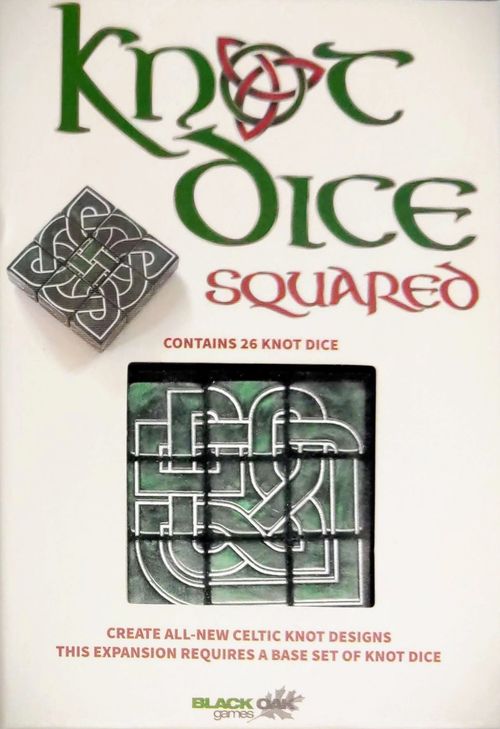
Knot Dice: Squared
Knot Dice Squared Puzzles Rulebook
Table of Contents
Table of Contents
Components
- 26 Knot Dice
- 4 wooden tokens
- 1 game book
- 1 puzzle book
Introduction
The Four Types of Knot Dice
The first three (crossed, squared, and rounded) have the same layout: one face where the design goes off one edge; one where it goes off two opposite edges; two faces where it turns a corner; one where it goes off three edges; and one where it goes off four edges. Bridge dice have a different layout.
You can always tell what type of die you are looking at from just a single face. Pick up a die from the table and look at one face. If all of the paths cross each other at the edge of the face, you have a crossed die. If all of the lines are straight lines and sharp angles and all of the paths are parallel at the edge of the face, you have a squared die. If there are curved lines and all of the paths are parallel at the edge of the face, you have a rounded die. If some of the paths are parallel and some cross each other at different edges, you have a bridge die.
Paths
Paths on Knot Dice are the space between two parallel lines, not the silver lines themselves.
Connecting Dice
The original Knot Dice all connect to one another, but that is no longer the case with Knot Dice Squared.
Squared and rounded dice all connect to each other, but they do not connect to the original crossed dice. For that, you need to use bridge dice between squared/rounded dice and crossed dice (more details are in the game book introduction).
Complete Designs
A complete design is one that connects all paths on the dice to form a full Celtic knot design. The booklet marks the first example as complete (✓) and the other two as not complete (✗).
Keeping Score and Counting Turns
Open the original Knot Dice game or puzzle rulebook to the scoreboard page. Use one wooden token to track your score. Use a wooden token of a different color to count your turns. If you need to count beyond the numbers on the scoreboard, flip the token over or use an additional token.
Moving Dice
Each puzzle type has specific restrictions on how you can move the dice in order to accomplish the goal. These are described in the puzzle instructions.
Which Dice?
Sometimes part of the puzzle is figuring out which dice to use. For the rest of the puzzles, they are labeled with the number of each type of die used in the puzzle. The labels are:
- Squared: □
- Rounded: ○
- Crossed: X
- Bridge: Λ
Creation Puzzles
Puzzles by Matthew O'Malley.
Form a vertically and horizontally symmetrical Celtic knot design from these dice. You may move them freely on the table (there is no turn tracking), but you may not change them to different faces. The name of each puzzle is to the left of its diagram.
The booklet prints these Creation puzzles, by name (the dice layouts are diagrams):
- 4A2, 5A2, 8A2
- 9A2, 9B2, 9C2
- 12A2, 12B2, 12C2, 12D2, 12E2, 12F2
- 13A2
- 16A2, 16B2, 16C2, 16D2, 16E2, 16F2, 16G2, 16H2
- 20A2
- 21A2, 21B2
- 25A2, 25B2, 25C2, 25D2
Completion Puzzles 1
Puzzles by Matthew O'Malley.
Given a preset arrangement of dice, how many turns will it take to complete the design? Set up the dice like one of the arrangements on the next page. Each turn you can take one of these two actions:
- Swap: Swap the locations of two dice on the outside edge of the arrangement, without changing their orientation.
- Translate: Take an entire line (a row or column) of dice and move it to the opposite side of the current layout, without changing the orientation of the line.
The dice you move must be on the outside edge of the current layout. In a 3x3 design, the current middle die can't be changed, but when you translate a line, the middle will change.
The name of each puzzle is above it, with the dice used in that puzzle directly below.
Dice used in each puzzle (□ squared, ○ rounded, X crossed, Λ bridge):
| Puzzle | Dice |
|---|---|
| 3x3 A2 | 4 □, 1 X, 4 Λ |
| 3x3 B2 | 9 ○ |
| 3x3 C2 | 4 ○, 1 X, 4 Λ |
| 3x3 D2 | 5 □, 4 ○ |
| 3x3 E2 | 5 □, 4 ○ |
| 3x3 F2 | 9 ○ |
| 4x4 A2 | 12 X, 4 Λ |
| 4x4 B2 | 8 □, 8 ○ |
| 4x4 C2 | 4 □, 8 ○, 4 Λ |
| 4x4 D2 | 8 □, 4 X, 4 Λ |
| 4x4 E2 | 4 ○, 4 X, 8 Λ |
| 4x4 F2 | 4 □, 8 ○, 4 Λ |
Completion Puzzles 2
Puzzles by Matthew O'Malley.
Given a preset arrangement of dice, how many turns will it take to complete the design? Set up the dice like one of the arrangements on the next page. Each turn you can take one of these three actions (the first two are described in Completion Puzzles 1):
- Swap
- Translate
- Rotate: Rotate the orientation of the top face of one outside die 90 degrees, without changing its location.
The dice you move must be on the outside edge of the current layout. In a 3x3 design, the current middle die can't be changed, but when you translate a line, the middle will change.
The name of each puzzle is above it, with the dice used in that puzzle directly below.
Dice used in each puzzle (□ squared, ○ rounded, X crossed, Λ bridge):
| Puzzle | Dice |
|---|---|
| 3x3 A2 | 4 □, 1 X, 4 Λ |
| 3x3 B2 | 1 □, 8 ○ |
| 3x3 C2 | 5 □, 4 ○ |
| 3x3 D2 | 9 ○ |
| 3x3 E2 | 1 □, 1 X, 7 Λ |
| 3x3 F2 | 1 □, 2 ○, 4 X, 2 Λ |
| 4x4 A2 | 12 X, 4 Λ |
| 4x4 B2 | 8 □, 4 ○, 4 Λ |
| 4x4 C2 | 4 □, 4 X, 8 Λ |
| 4x4 D2 | 8 □, 8 ○ |
| 4x4 E2 | 8 □, 8 ○ |
| 4x4 F2 | 4 ○, 4 X, 8 Λ |
Transformation Puzzles
Puzzles by Matthew O'Malley.
Given a design, how many turns will it take to transform it to a new design? Set up the dice to look like one of the complete designs on the next page, then transform it to another with the same dice. Each turn you can take one of these four actions (the first three are described in Completion Puzzles 1 and 2):
- Swap
- Translate
- Rotate
- Flip: Push down the outer-most edge of the top face of one outside die, rotating the die 90 degrees vertically so that there is a new top face (one of the faces that was previously toward the center of the layout).
The dice you move must be on the outside edge of the current layout. In a 3x3 design, the current middle die can't be changed, but when you translate a line, the middle will change.
Since you can change the top face of a die, if there are any I or X faces (see p18) upright in the starting design, you'll need to determine the orientation of the die. Set an X die so that the I face is towards you; set a vertical I die so that the A face is towards you; set a horizontal I die so that the L face is towards you.
To refer to these puzzles, use the letter of both designs in order. For example, when transforming 3x3 A2 to 3x3 B2, you would refer to Transformation Puzzle 3x3 A2B2.
Dice used in each puzzle (□ squared, ○ rounded, X crossed, Λ bridge):
| Puzzle | Dice |
|---|---|
| 3x3 A2 | 9 ○ |
| 3x3 B2 | 9 ○ |
| 3x3 C2 | 9 ○ |
| 3x3 D2 | 5 □, 4 ○ |
| 3x3 E2 | 5 □, 4 ○ |
| 3x3 F2 | 5 □, 4 ○ |
| 4x4 A2 | 8 □, 8 ○ |
| 4x4 B2 | 8 □, 8 ○ |
| 4x4 C2 | 8 □, 8 ○ |
| 4x4 D2 | 8 □, 8 ○ |
| 4x4 E2 | 8 □, 8 ○ |
| 4x4 F2 | 8 □, 8 ○ |
Building Puzzles
Puzzles by Matthew O'Malley.
Build the shape with complete designs on all visible faces of the dice. The finished designs may wrap over several different faces, but no lines may extend down into the table. There are no limitations to how you may move the dice.
Construct the following shapes with only complete designs on the visible faces. The shapes are diagrams in the booklet. Their printed labels are:
- Use only bridge dice.
- Use all four types of dice.
- Use one or two types of dice.
- Use only two types of dice (then do it again with the other two).
Simultaneous Puzzles
Puzzles by Matthew O'Malley.
These puzzles can be completed by several different players at the same time as a race, or one player can complete them all at the same time as a solo task.
Start by mixing all of the dice together and rolling them in the middle of the table. Part of the puzzle is finding the right dice for each design. Then complete all of the designs in a row at the same time.
Each row can be completed using one set of Knot Dice Squared and one set of Knot Dice. If you have several players, play several rows with the same column for each player.
The booklet groups the grids by player count under three headings: "1-4 players at the same time", "1-3 players at the same time (in addition to the above)", and "1-2 players at the same time (in addition to the above)". The grids themselves are shown in the booklet as symbol-font codes, which are not reproduced here.
Notation
You can use a similar shorthand as the original Knot Dice. Start with the type of die, then add the letter which is the approximate shape of the paths on that face of the die. The booklet's notation is:
- Crossed: XA, XI, XJ, XL, XY, XX
- Bridge: ΛT, ΛI, ΛJ, ΛL, ΛY, ΛX
The letters are illustrated in the booklet by the approximate path shape of each face (the illustrations are diagrams).