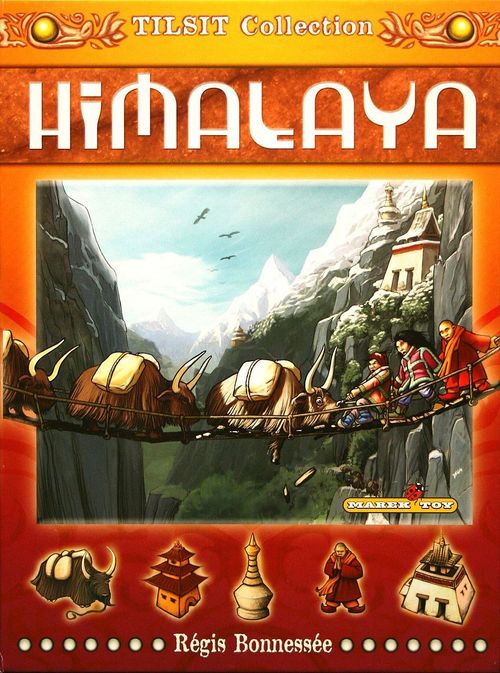
Himalaya
Himalaya Rulebook
Table of Contents
Table of Contents
Contents
- 1 board.
- 4 screens of four different colours.
- 4 caravaneers (4 different colours corresponding to each screen).
- 20 stupa figures (4 colours)
- 60 delegation figures (4 colours)
- 60 "goods" wooden blocks (5 colours)
- 15 inventory markers.
- 40 orders (round markers)
- 24 action markers.
- 12 event markers.
- 4 yeti prints.
- 4 snowstorm.
- 4 market day.
- 1 turn wooden block.
- 1 20 sided dice.
- 2 cloth bags.
The Board
It represents an Himalayan region, at the frontier with Nepal and Tibet containing:
20 villages: 20 villages numbered 1 to 20 and represented by their main building. There are 3 different building types:
- Level 1: House.
- Level 2: Temple
- Level 3: Monastery.
3 different kind of paths:
There are 3 different kind of paths connecting the villages which will be followed by the caravaneer to move from one to another:
- Dirt track
- Ice track
- Stone track
8 regions.
The paths create 8 different regions of different sizes but of the same value. The players can send their delegations inside these regions to improve their political influence.
A turn track
Below the title Himalaya you can find the turn track representing 12 turns for the 12 months of the year.
Set Up
Put the board on the middle of the table.
Place the turn marker on the position "1" of the turn track.
Put all the goods in a cloth bag and shuffle them.
Put all order markers in a cloth bag and shuffle them.
Each player then chooses a tribe and takes all its corresponding elements of the same colour:
- 1 screen.
- 1 caravaneer.
- 5 stupas.
- 15 delegations.
Each player also takes 6 action markers.
Placing the Goods
Roll the die. The number shown indicates which village is to receive 5 goods picked randomly from the bag. Reroll 4 more times to fill 5 different villages with 5 goods.
Important: if the number rolled corresponds to a village already full, place the goods on the following empty village in numerical order.
Example: the roll is 20, but village 20 has already received goods. The following village is village 1, but it also has received goods so village 2 which is empty will get the 5 new goods.
Placing the Orders
Roll the die. The number shown indicates which village is to receive the order drawn randomly from the bag. Reroll 4 more times to fill 5 different villages each with 1 order.
Important: if you roll a village which is already filled with goods or an order, place the new order on the next village (in numerical order) as explained in the previous example for the goods.
On the example on page 2, village 9 contains 5 goods (2 salts, 2 jades and 1 gold), village 14 has one order for 1 tea and 1 jade.
So, at the end of the setup, you must have 5 villages with goods and 5 villages with orders.
Placing the Players
The wisest player begins. To indicate that he is the staring player (the first caravaneer) he places the 20 sided die before him. Later on, the first caravaneer will change every turn clockwise.
Beginning with the first caravaneer, each player places his caravaneer miniature on the village of his choice (with or without order or goods). 2 players can not begin in the same village.
The Game
The game is played in 12 consecutive turns. Each turn is separated in 5 different phases.
- Phase 1: Turn marker progress.
- Phase 2: Each player secretly chooses his actions for the turn.
- Phase 3: Resolve actions.
- Phase 4: Add goods and orders on board.
- Phase 5: Inventory (end of turns 4, 8 and 12 only).
Phase 1: Turn Marker Progress
At the beginning of each turn (except during turn 1), the turn marker is moved one square on the right on the calendar. The player who played first on the last turn now will play last. The player on his left begins the new turn. The game ends at the end of turn 12.
Phase 2: Each Player Secretly Chooses His Actions for the Turn
Each player simultaneously prepares the 6 orders for his caravaneer.
For this they use their action markers which they must place in a row (from left to right) before them but behind their screen in order to remain hidden from the other players.
The given order is indicated by the upper side of the action marker.
The first marker on the left is your first action, the last on the right is your last action.
Explanation of order programing:
The front side of the action marker is used to travel (by using one of the tracks: dirt, ice or stone) or to make a deal in a village (by using the hands symbol).
The backside (representing a sleeping yack) is used to indicate a rest (no move or deal), you stay where you are!
The players have more or less one minute (maybe 2 for beginners) to prepare their 6 actions.
One of the players has to check time and announce the end of the phase.
Then all players simulteanously reveal their orders. From now on no changes are allowed.
Movement (dirt, stone and ice symbols):
A player can move his caravaneer from one village to another if there is a track linking them. If a caravaneer wants to follow a dirt track, he has to put his marker with the dirt symbol on the upper side of the counter.
To rest:
If a player does not want to move or to deal he must rest, showing it by putting the backside of the action marker up (with the yack laying down).
Note: this action is mainly used to let the player pass when he is going in a village with goods. If another player prepared a deal at the same village he will then take the first good available, and you may have a good of a better value then.
Choosen action:
- deal
- move on a stone track
- move on an ice track
- move on a dirt track
- rest (neither move nor deal)
Deals (hands symbol):
A player can make a deal in any village countaining goods or order.
Collecting goods: there are 5 different types of goods in increasing value: salt (white), barley (orange), tea (black), jade (green) and gold (yellow).
A caravaneer can only collect one good per turn in the same village. Furthermore, he always has to collect the good with the lowest value not to offend the locals by being too greedy!
But a caravaneer can collect goods in different villages in the same turn.
Completing an order: the order markers show the same colours as the goods, which are needed by the village. A caravaneer can complete an order at a village if he can deliver all the goods asked for. He has to collect them first of course.
Example (page 4): to complete this order you have to deliver one salt and one jade to the village where the order is.
Phase 3: Resolve Actions
How to resolve an action:
When all players are ready, each one moves his screen away and reveals his actions to all players. The collected goods are still kept hidden inside the screen.
The first caravaneer resolves his first action, then the player on his left resolves his first action and so on.
Players proceed the same way for the five other action counters (action by action each player taking turns and always beginning with the first caravaneer).
Moves:
When a move is possible it must be done, even if the player realizes that he made a mistake.
Deals:
Collecting goods: collected goods are kept inside the screen. It allows you to move your screen without showing the goods you collected previously.
Fulfill an order: when a player fulfills an order by delivering all the goods asked by a village, he can then execute 2 of the 3 following actions:
- barter
- do some offerings.
- send out delegations from his tribe to the neighbouring regions
Note: the goods used to fulfill the order are put back into the bag. If a player realizes that one of his deal is impossible (empty village for example) his action is cancelled and lost but he still keeps going on with his other actions normally.
Barter:
In exchange of the goods you delivered to the village where you fulfilled the order, the player earns a number of yacks equal to the number shown on the order. This number increases his livestock.
He takes the order and puts it behind his screen yack face up. The exact number of yacks in your livestock must be kept secret until the end of the game.
Acquiring yacks improves your economical influence. One of the necessary steps for final victory (see final countdown).
Note: if a player chooses not to barter, put back the order counter into the bag.
Doing offerings:
A player can make an offering to the religious representant of the village where he is. He places a stupa of his own colour on the place of the village where his caravaneer is (Stupas are places of prayer and meditation for bouddhists).
There can only be one stupa per village (whatever colour it is and whatever the level of the village).
Placing stupas improves your religious influence, one of the necessary steps for final victory.
Sending delegations:
A player can send out delegations from his tribe to the neighbouring regions.
He can send:
- 3 delegations if he is in a level 3 village (monastery).
- 2 delegations if he is in a level 2 village (temple).
- 1 delegation if he is in a level 1 village (house).
The player places his delegations where he wants only in the regions around the village where his caravaneer stays.
Sending out delegations improves you political influence, one of the necessary steps for final victory.
Example (page 4): Dolpo-pa caravaneer just completed an order in a level 3 village (monastery). He chooses to send delegations in 2 different regions in contact with the village. 2 delegations go in region 3 and 1 delegation in region 5 (see all the regions on page 2).
Example (page 4): one player turn
The blue caravaneer (sherpa) begins his turn in village 3. He already has behind his screen 2 salt, 2 jade and 1 gold.
He gives the following orders to his caravaneer:
Action 1: deal. Village 3 has 1 salt, 1 jade and 1 gold, the caravaneer collects the good of lesser value (salt) and places it behind his screen. Now he has 3 salt.
Action 2: move. He follows the dirt track to village 4.
Action 3: deal. Village 4 has 2 barley, and 1 jade, the caravaneer collects the good of lesser value (barley) and places it behind his screen.
Action 4: move. He follows the dirt track back to village 3.
Action 5: move. He follows the ice track to village 6 where there is an order to fulfill. Important: the caravaneer cannnot collect the jade in village 3 as he already collected one good in this village during the game turn.
Action 6: deal. The caravaneer fulfills the order: he gives back 1 barley and 1 salt (which are put back into the bag).
As a reward for fulfilling the order, the caravaneer chooses to place one of his stupas on the village plaza. Then he sends out 3 delegations (because this is a level 3 village, a monastery) in region 1 (adjacent to the village).
The player choosed not to barter because the order is of small value (only 3 yacks).
Phase 4: Add Goods and Orders on the Board
If at least one village was emptied of goods or order, the first caravaneer must add goods or orders.
Roll the die, same as set up, and place 5 goods or an order in the empty village rolled. Do this until you have 5 villages with goods and 5 villages with an order.
Note: goods are always placed before orders. You never refill a village with at least 1 good remaining.
Phase 5: Inventory (End of Turns 4, 8 and 12)
By the end of those turns an inventory phase takes place. All players take in their hands all the salt they have in reserve (behind their screen) and show them to the other players.
The player whose salt inventory is the most impportant wins a special inventory marker (worth 3 yacks). If there is a tie nobody wins.
Players then proceed in the same way for all the other goods (barley, tea, jade and gold).
Example: In the first inventory phase (salt), the Sherpa player shows 3 salt markers, the Dolpo-pa 4, the Bhotia and the Tamang 0. So the Dolpo-pa wins an inventory marker (worth 3 yacks).
In the second phase (barley), the Sherpa shows 2 markers, the Dolpo-pa 1, the Bhotia and the Tamang 4. Bhotia and Tamang being equal, nobody gets the inventory marker.
Continue likewise for the 3 next goods (tea, jade and gold).
End of turn.
At the end of the turn, the first caravaneer gives the die to the player on his left who becomes first caravaneer for the new turn. The new turn begins again with phase 1.
Final Countdown
At the end of the year (end of turn 12), players proceed to the final countdown of influence points.
Evaluation of religious influence:
Each player counts his influence in the following manner:
- A stupa on a level 1 village (house) is worth 1 point.
- A stupa on a level 2 village (temple) is worth 2 points.
- A stupa on a level 3 village (monastery) is worth 3 points.
Evaluation of political influence:
Then each player has to count his political influence. To do this count the number of delegation figures you have on each region. The player with the most delegations on a region gets 1 point of political influence. If several players are equal on the same region, the political point for this region is lost.
Evaluation of economical influence:
Each player sums the number of yacks he has in his livestock (from completing orders or from inventory markers). This is his economical influence.
Who Is the Winner?
3 players game:
The winner is the player with the majority in at least 2 of the 3 types of influence. If you cannot decide a winner between the players, then the player with the better economical influence wins. If there is still a draw, consider first political and then religious influence.
4 players game:
First phase: elimination of the player with the least religious influence (stupa).
The player with the least religious influence is eliminated and all his delegations are removed from the board.
If 2 players or more share a tie, the player with the less stupas on the board is eliminated. If there is still a draw, the one with the less yacks is eliminated.
Second phase: elimination of a second player using the political influence (delegations).
The player with the least political influence is eliminated.
If 2 players or more share a tie, the player with the less delegations is eliminated. If there is still a draw, the one with the less yacks is eliminated.
Third phase: The winner is...
Between the 2 remaining players, the one with the greater economical influence is declared winner.
If there is a draw, the one with the better political influence wins. And if there is still a draw the one with the better religious influence wins.
Advanced Rules
Once you have mastered the basic rules, you can add those new rules to spice up the game.
Mountain Events
At the beginning of the game, each player also takes 3 special event counters:
- Yeti footprints
- Snowstorm.
- Market day
You then have to add an additional phase in the game turn between phase 1 and 2.
Placing event counters:
Before preparing your orders for the turn, each player taking turns and beginning with the first caravaneer can place on the board one and only one of his event counters.
Beware: there can only be one event counter of each type at the same turn on the board.
Note: events played are then removed from the game at the end of the turn. You can only use each of them once per game!
Yeti footprints:
Place the yeti footprints counter in the middle of the track of your choice (dirt, ice or stone).
Someone spotted Yeti footprints! No caravaneer can use that track during this turn, it's simply too dangerous!
Snowstorm:
Place the snowstorm counter in the middle of the track of your choice (dirt, ice or stone).
The weather is really bad and moves along this track are hampered. If someone wants to take the track and cope with the snowstorm he must prepare 2 identical actions to use this track. The first one to reach the snowstorm counter and the second one to reach the next village.
Note: it is forbidden to finish the turn on a snowstorm counter!
Market day:
Place the market counter on a village of your choice where there are goods. A great market is organised in this village and exceptionally all caravaneers coming to make a deal can take the good of their choice instead of the one with the lowest value.
Example (page 7): The Tamang caravaneer that just reached this village chooses to collect jade (green good) leaving salt and tea to other players!
Full Inventory
During the inventory phase, the player who is leader in a type of goods chooses to accomplish one of the 3 following actions:
- Take the inventory marker (see basic rules) for 3 yacks.
- Send out 2 delegations from his reserve to a neighbouring region of the village where his caravaneer is.
- Place a stupa on a level 1 village located in one of the regions adjacent to the village where his caravaneer stays.
Example (page 7): the Bhotia caravaneer just won the first inventory (salt). He decides to place a stupa on village 19. If he wins another inventory, he would be able to place a new stupa on village 20 or send out 2 delegations in region 7 or 8; or take the inventory marker (worth 3 yacks).
Rules Summary
Game turn
Phase 1: Turn marker progress. Advance the turn marker on the calendar.
Phase 1 (advanced rules): placing event counters. Each player can, if he wants, place an event counter on the board. (max: one event of each kind on the board at the same turn).
Phase 2: Each player secretly chooses his actions for the turn. Each player secretly prepares his 6 actions for the turn (moves, deals or rest).
Phase 3: Resolve actions. All players show their actions and resolve them one by one by taking turns beginning with the first caravaneer.
- Move: dirt, ice or stone.
- Rest: no move or deal.
- Deal: collect one good (of the lowest value) or fulfill an order. (2 out of 3 of the following actions: barter, offerings or send out delegations).
Phase 4: Add goods and orders on the board. Add goods and orders by rolling the die to obtain 5 villages with goods and 5 other villages with orders.
Phase 5: Inventory (end of turns 4, 8 and 12). In the order of good value (salt, barley, tea, jade and gold), determine which player owns the more resources of each type.
Basic rules: each majority gives a special inventory marker worth 3 yacks.
Advanced rule: each majority enables you either to receive an inventory marker or send out 2 delegations in an adjacent region or place a stupa in a level 1 village in an adjacent region.
Final countdown at the end of turn 12:
- Religious influence: Stupa: number of points = level of the village (house 1, temple 2, monastery 3).
- Political influence: Delegations: 1 point per majority in a region.
- Economical influence: 1 point per yack in your livestock (obtained by completing orders or by inventory markers).
Winning conditions:
For 3 players: having the majority in 2 kind of influences.
For 4 players: First eliminate the player with the lower religious influence, then the player with the lower political influence, then the winner is the one with the greater economical value.