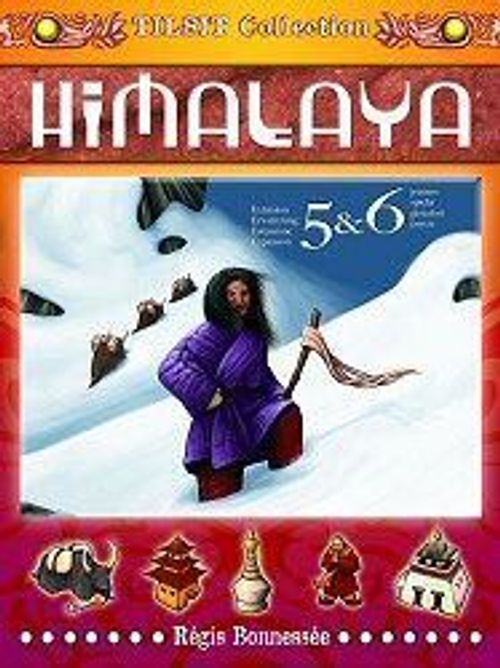
Himalaya: The 5-6 Player Expansion
Himalaya: The 5-6 Player Expansion Rulebook
Table of Contents
Table of Contents
Content
- 2 folding screens for two new tribes (Newar and Limbu)
- 2 sets of die-molded figurines
- 20 resource cubes to be added to the stock of the basic game (6 Salt, 5 Barley, 4 Tea, 3 Jade, 2 Gold)
- 12 "Action" pieces
- 6 "Event" pieces
- 20 "Village" tokens
Distributing the Resource Cubes and Order Rings
At the beginning of each turn, as indicated in the basic rules, place the resources and orders for 5 or 6 players using the following rule modifications:
For 5 players: 6 villages with 4 Resources each and 6 villages with 1 Order each.
For 6 players: 6 villages with 5 Resources each and 6 villages with 1 Order each.
Victory Conditions
To determine who wins in a 5 or 6 player game, the following criteria are applied to the series of elimination rounds:
| Influence | For 5 players | For 6 players |
|---|---|---|
| Religious Influence | eliminate player with least amount | eliminate player with least amount |
| Political Influence | eliminate player with least amount | eliminate 2 players with least amount |
| Economic Influence | remaining player with most yaks wins | remaining player with most yaks wins |
(In the printed sheet the Religious and Economic rows span both player-count columns, so the same text applies to 5 and 6 players.)
As for the rest of the game rules: renewing spent resources and orders, counting inventory phases and breaking ties, all are run in the same way as described in the basic rules.
(The printed sheet reads "rules:renewing" with no space; a space has been added here.)
Optional Rules
1 – Allergic to Chaos!
This Optional Rule allows players to predict the placement of Resources and Orders.
Replace the 20 sided die with the set of 20 "Village" tokens provided in this expansion. Shuffle the tokens randomly and place them in a pile, face down, beside the game board. At the start of the game, during the initial Resource and Order placement, designate the initial village resource and order placements using the tokens drawn one by one from the pile. Discard these tokens into a discard pile.
Then, draw 5 tokens and place them face up in a row next to the draw pile. These tokens represent the next villages to be given resources or an order. The furthest away from the pile is used first. As new villages are designated, slide the revealed village tokens down the row away from the pile, adding new tokens to the beginning of the row from the draw pile so that the next five villages are always shown.
After the last of the twenty village tokens have been drawn, reshuffle the discarded villages and place them back in the draw pile.
2 – Political and Religious Upheaval!
This Optional Rule reverses the strategic importance of monasteries when orders are filled.
Players still take 2 of 3 possible actions, but the strategic value of the villages has been reversed:
House (Level 1): 1 Envoy present and/or 1 Stupa = 3 points.
Temple (Level 2): 2 Envoys present and/or 1 Stupa = 2 points.
Monastery (Level 3): 3 Envoys present and/or 1 Stupa = 1 points.
3 – Long Range Inventory!
This Optional Rule is a variation of the advanced Complete Inventory rule in the basic game.
It gives more significance to the inventory phase and helps set the stage for some spectacular and surprising lead changes!
If you have the majority of resources in an inventory count phase, you may either:
- Place 2 envoys in any region, including regions that are not adjacent to your caravan,
- Or place a 1 religious point Stupa on any house emplacement of your choice that doesn't have one yet (or any monastery emplacement if you are using the above optional Upheaval rule). This also includes regions that are not adjacent to your caravan,
- Or take one 3 yak inventory token.