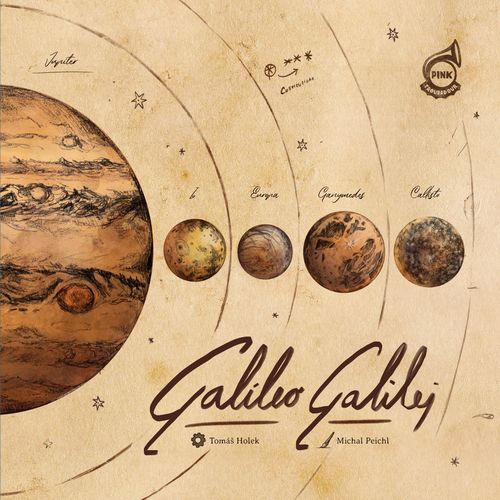
Galileo Galilei
Galileo Galilei Rulebook
Table of Contents
Table of Contents
Components
- 4 Character Boards
- 36 Discovery cards
- 4 Player Boards with telescope (see the instructions lower how to finish the player board before the first game)
- 6 Subject tiles
- 2 Help cards
- 28 Comet tokens (7 per player)
- 24 Action tiles (6 per player)
- 1 First player token
- 32 Inquisitor figures
- 30 Dice (10 in each of the three colors)
- 25 small quadrants (1)
- 8 big quadrants (3)
- 6 Double-sided university Scale tiles
- 16 Book tokens (4 per player)
- 16 University tokens (4 per player)
- 4 tribunal tokens (1 per player)
- 4 score tokens (1 per player)
- 28 constellation tokens (7 per player)
- 16 Objective tokens (4 per player)
- 1 Game Board
Solo components
- 1 Tycho Brahe opponent tile
- 6 Solo action tiles
- 5 Solo movement tiles
Advanced game components
- 1 Giordano Bruno Cellar tile
- 4 Nicolaus Copernicus Library tiles
- 1 Johannes Keppler special action tile
Game Setup
-
Place the Game Board in the middle of the table.
-
Place each player's Score token on the 0 space on the score track.
-
Prepare a deck of Discovery cards:
Select at random cards from all three tiers based on the numbers in the table (*). Put the rest of the cards in the box. You won't need them during the game. Create a deck with the randomized cards. Begin by placing the Tier III cards face-down on the bottom, followed by the Tier II cards, then the Tier I cards on top. Place this deck next to the game board. Flip over and place the top six Tier I cards onto the game board. See the example on the right.
-
Place at random four University Scale tiles in the university, and four Subject tiles above them (arch side up).
-
Use the remaining two Subject tiles to cover the ( ? ) spaces at the top of the university (niche side up).
-
Place each player's University token on the stairs beneath each University Scale tile.
-
Place each player's Tribunal token on the Reputation track. All astronomers begin at (–3) Reputation.
-
Create a supply of quadrants, dice, and inquisitors next to the Game Board.
Dice are meant to be limited resource, other resources are unlimited.
-
The player who observed the starry sky most recently gets the First player token and goes first.
Before the first game, put four stickers on the white circles on the player board. Fold it and press so it holds firmly together.
Before the First game
Attach the telescope with the rivet. Make sure the telescope movement is smooth.
Subject Tiles
The double-sided Subject tiles determine which objectives you must achieve to score points from the university. One side shows an arch, and the other shows a niche.
- Subject tile, Arch side up
- Subject tile, Niche side up
Deck Setup
Use the adjacent table to build your Discovery deck. This is also found at (*) on the game board. Each column indicates the number of Tier I, Tier II, and Tier III Discovery cards required, depending on the number of players.
| Tier | 2 players | 3 players | 4 players |
|---|---|---|---|
| I | 9 | 10 | 12 |
| II | 5 | 6 | 7 |
| III | 4 | 5 | 6 |
Here's an example of setting up the Discovery deck for three players. Always create the deck face-down, with the light side of the cards facing up: 10 Tier I cards, 6 Tier II cards, 5 Tier III cards.
Each card's back side shows its tier to help prepare the deck. On the front side, the card's tier is visible above the observation cost for its Major Object.
Player Setup
-
A. Take one Player Board and telescope, and place it in front of you. At the start of the game, the telescope is pointing at the upper of the two crossed-out spaces.
-
B. Each player chooses an astronomer. Place his Character Board to the left of your Player Board. For your first few games, play with the quadrant symbol side facing up. After you're familiar with Galileo Galilei, try playing with the astronomers' special abilities! (See pages 12–14.)
-
C. Take one die of each color (red, blue, and yellow), and place them in the upper left corner of your Player Board. Each die begins at 1.
-
D. Take a set of six Action tiles, and randomly place them on your Player Board's starry sky with the light side facing up.
Note: We suggest placing the tiles at random during your first game to quicken setup. In later games, try choosing which order to place the tiles in!
-
E. Place your four Book tokens on the starting spaces to the right of your library.
-
F. Place your seven Comet tokens on your comets spaces. They begin with the 1 side facing up.
-
G. Place your seven Constellation tokens on the constellation spaces.
-
H. Place your four Achievement tokens near your Character Board.
Introduction
Galileo Galilei is a game about discovering celestial objects in the starry sky. You play as a historical figure trying their best to be the most famous astronomer of the era! But observing the heavens is not the only way to win—writing about your discoveries and lecturing in the university are also ways to get ahead.
The game's basic mechanic is moving your telescope to select your actions each turn. Actions allow you to observe the heavens, write in the library, lecture at the university, and gain other advantages. Your progress is measured by victory points on the track circling the Game Board.
The player who observed the starry sky most recently goes first. Then, play proceeds clockwise around the table.
The end of the game is triggered when the last Discovery card is placed on the Game Board. Finish the current round, so that each player has had the same number of turns. Then play one last round, and count up your score (see page 13). The player with the most victory points wins!
Turn Structure
Each turn is played in the following three phases:
1) MOVEMENT
At the beginning of your turn, move your telescope forward 1 to 3 spaces. If you reach the last space on the starry sky (the Upgrade action) and still have movement remaining, you may move further. Continue moving from the first space which is not crossed out (the Observe action). The telescope can only move forward toward the top of the starry sky, never backward. See the example to the right.
2) ACTIONS
Each space on the starry sky has a fixed action and a moving action (the Action tile). During the action phase, you may choose in what order you use fixed, moving, and free actions (see Action Phase, following).
3) CLEANUP
During the cleanup phase, you rotate your Action tiles by 1 space, gain rewards from the Book of Comets, are interrogated by the Inquisition, and check for university achievements (see Cleanup Phase, page 11).
Movement phase examples
Once the game begins, the telescope can't point at the two lowest spaces on the starry sky. The telescope must move 1 to 3 spaces clockwise along the rest of the starry sky.
If you want to move the telescope past the Upgrade action, it moves to the lowest section which is not crossed out.
After moving the telescope, you may choose which to play first: the fixed action (dark) or the moving action (light).
Note: When selecting an action, try sliding it a little out of the moving actions queue. This helps remind you to move it to the bottom space of the starry sky during the Cleanup Phase.
Actions in general
Each space in the starry sky has a fixed action (dark) and a moving action (light; the Action tile). During the action phase, you may take any actions in the space at which your telescope points. You may choose in which order to perform these actions.
In addition, you may spend Quadrant tokens to take free actions. You can take as many free actions as you wish, provided you have enough Quadrant tokens to pay for them.
Spaces divided by a slash give you a choice between two actions. When taking that action you get to pick which option to use.
Always resolve your current action before taking another action, including free actions. This includes resolving any rewards from the action. If one of the action's rewards is also an action, resolve that reward before making other actions. For example, if Writing in your Library rewards you with a Lecture action, you must resolve that Lecture before taking a free action.
Action Phase
There are five fixed actions:
- OBSERVE
- GAIN A DIE / LECTURE
- SPOT A COMET
- OBSERVE / GAIN A DIE
- UPGRADE
OBSERVE
OBSERVE – You can choose to observe either a Major Object or up to two constellations. This requires spending observation dice from your Player Board.
Your options when Observing are printed on your Player Board: Major Object, Constellation.
Each card has a Major Object and one or more constellations. You choose which object to Observe during your action.
Observation Dice
The most commonly used game components are the observation dice. Their color indicates the light spectrum, and their value indicates the observation time spent to observe an object. Throughout the game, you'll increase the value of your observation dice through various actions. By spending dice of multiple colors, you'll be able to Observe the rarest celestial objects!
You can store up to four observation dice on your Player Board. However, you may only have up to three dice of the same color at once.
Each object on a Discovery card has an observation cost. This number is in the icons on the left side of the card. The icon's color indicates the color of observation die which must be spent.
- Constellations require dice of a single color (yellow, red, or blue).
- Major Objects require a combination of two colors which create orange, green, or purple.
The Observe action requires spending dice from your Player Board. You may use any number of dice to pay this cost. Observing a constellation requires spending dice of a single color, while observing a Major Object requires spending dice of two different colors. The color combinations are provided in the upper corners of the die icon, and in the upper-left stripe of the Player Board.
You may spend any number of dice to pay observation costs. A Major Object's observation cost may be paid with any ratio of one color to the other, so long as at least one die of each color is used.
Return observation dice to the supply after using them to Observe. Any value in excess of the object's cost is forfeited.
Observing a Major Object
After paying the observation cost, you gain the Major Object's victory points. Some objects also have an inquisitor icon (see The Inquisition, page 12).
Next, place the Discovery card face-up in your Library, on the top-right of your Player Board. Place your Discovery cards so that each card's library row remains visible (see the nearby example). Gaining additional rewards from your Discovery cards is described in the Library section (page 9).
If any Constellation tokens were on the Discovery card, return those tokens to the box. They won't be used any more during this game.
Draw a new card from the Discovery deck, and place it face-up in the blank space on the Game Board.
Galileo chooses to Observe Luna. Luna's observation cost is Orange 8, requiring a combination of red and yellow dice. He spends the following observation dice, returning them to the supply.
Galileo gains 7 victory points on the Game Board, and adds an inquisitor to the leftmost space of the cellar on his Player Board.
After scoring, Galileo puts the Discovery card in his Library face-up next to the rest of his Discovery cards.
Finally, Galileo fills the blank space on the Game Board with a new card from the Discovery deck.
Observing a Constellation
You may Observe up to two constellations as a single action. Resolve the first constellation completely before Observing the second.
After paying the constellation's observation cost, take the leftmost Constellation token from your Player Board, and place it on the constellation you've chosen. You gain any listed rewards for Observing that constellation (such as victory points). Then, gain the reward listed for the space from which you removed your token.
Three of these rewards indicate a "gain a card" symbol. If you receive this reward, take a card face-down from the Discovery deck, and place it in your Library. As with the card gained from a Major Object, make sure each row of your Library remains visible.
After using your seventh Constellation token, you can't Observe any more constellations.
Galileo wants to Observe Ursa Minor. He pays three red observation dice with the values 3, 1, and 1. He covers Ursa Minor's observation cost with his leftmost Constellation token.
Galileo gains 3 victory points, and a Quadrant token. He also gains the reward listed below his Constellation token—in this case, the reward is taking the Lecture action.
Jupiter appears on this game's box as a tribute to Galileo Galilei's groundbreaking discovery of its four largest moons in 1610. His observations challenged the prevailing geocentric model, and supported the heliocentric theory. This pivotal moment in scientific history revolutionized our understanding of the cosmos, and laid the foundation for modern astronomy.
GAIN A DIE / LECTURE
Pick one of the following options:
-
Gain a Die: Take one die of any color from the supply, and put it on your Player Board. Its value is 1.
On the rare occasion that a player already has 4 dice on their board, they may replace one of their dice with the newly gained die. Return the original die to the supply.
-
Lecture: Move one of your University tokens up one space on its Scale tile. Then, gain the reward listed on the right-hand side of the tile. Once one of your University tokens has reached the top of the Scale tile, it can't move any further.
The icon at the top-left of your Player Board is a reminder that you can have up to three dice of the same color. However, you can store up to four dice on your Player Board!
Galileo chose the Lecture action, so he can move his University token up 1 space on any Scale tile. He chooses the Major Object scale. He gains the bonus on the right side of the scale—in this case, one Quadrant token.
Galileo, Bruno, Copernicus, and Kepler studied subjects such as mathematics, astronomy, philosophy, and theology while at university. Their diverse interests and pursuits later converged to reshape our understanding of the cosmos during the Scientific Revolution.
SPOT A COMET
To spot a comet, take the leftmost Comet token from your Player Board, and place it on the Game Board above the Discovery cards. The "1" side should be face-up.
Comet Usage
When you Observe, you may use Comet tokens on the Game Board to reduce the observation cost of an object. The cost is reduced by the Comet token's value. Each token may be used only once per turn. Each used comet must reduce the observation cost. In other words, you can't use the comets you don't need.
After using a Comet token for the first time, move that token to the space below the Discovery cards. Flip the token over, so that the "2" side is face-up. You may use that Comet token to reduce the cost of the next object you Observe. Any excess reduction is forfeited.
After using a Comet token for the second time, place that token on the Book of Comets. If you use multiple Comet tokens with a value of "2," each of those tokens is moved.
Note: When reducing the observation cost with Comet tokens, you still have to spend at least one observation die of each color the object requires. If you don't have a die of the required color, you can't use a Comet token to reduce the object's cost.
Galileo chooses to Spot a Comet. He takes the leftmost comet from his Player Board, and places it on the Game Board above the Discovery cards.
On Galileo's next turn, he Observes. He uses his Comet token to reduce the object's observation cost by 1. This means he has just enough observation dice to pay the cost! Then, he moves the token below the Discovery cards, and flips it over. Next time he Observes, Galileo can use this Comet token to reduce the object's cost by 2. If he does, the token is then placed on the Book of Comets.
In the 16th and 17th centuries, astronomers like Johannes Kepler studied comets, acknowledging both their predictable orbits and the prevailing superstitions associating them with disaster; their work, including Kepler's De Cometis, aimed to provide scientific explanations, while contemporaries such as Tycho Brahe contributed valuable observational data, laying the groundwork for modern comet science.
OBSERVE / GAIN A DIE
Choose between taking the Observe action and the Gain a Die action, as described previously.
UPGRADE
Choose one of your Action tiles, and flip it to the golden upgraded side. The tile does not move. The Upgrade action's space on the starry sky does not allow an Action tile to be played. Instead of taking a moving action, you gain one Quadrant token.
Note: Before your first game take a look at the actions on the upgraded side of your Action tiles. Upgrades reinforce the basic actions, and help you progress more quickly than your rival astronomers.
See the back of the rules or the help card for an overview of the upgraded tiles.
By upgrading the tile shown above, Galileo can move 3 spaces and use it on his next turn!
Moving actions
Action tiles always have two options to choose from. The following icons are used to describe possible options:
- Increase all of your observation dice of the given color by 1.
- Increase all of your observation dice of the given color by 2.
- Gain one Quadrant token from the supply.
- Persuade an inquisitor in your cellar.
- Increase any single of your dice by 2.
- Increase any single of your dice by 3.
- Gain an observation die of any color.
- Lecture on one of the university's Scale tiles.
- Write in your Library of Discovery cards.
Galileo can either increase all of his blue observation dice by 1, or increase a single observation die by 2.
Galileo has three blue dice and one red die on his Player Board. Using the Action tile above, he can increase the blue dice to 3, 2, 2, or he can increase the red die to 5. If he wants, Galileo could instead increase a single blue die by 2—doing so could help him avoid overspending on his next Observe action.
If you Persuade an inquisitor, you must move one Inquisitor token in your cellar 1 space to the right. If you have none which can be moved, the action is forfeited.
Free actions
Quadrant tokens measure your knowledge, and can help you make significant scientific progress. You may spend Quadrant tokens to take any number of free actions during your turn. A free action costs 1, 2, 3, or 4 Quadrant tokens. You can't use a free action while in the process of resolving another action. The free action options are:
- 1 Quadrant: Change the color of one die to another color. The value remains the same. OR Increase any single die by 1.
- 2 Quadrants: Gain a new observation die. OR Write 3.
- 3 Quadrants: Persuade an inquisitor twice. You may choose the same inquisitor twice, or choose two different inquisitors.
- 4 Quadrants: Spot a Comet.
The free actions are listed on your Character Board, above your astronomer's portrait.
Note: If you want to pass an Interrogation smoothly, save your Quadrant tokens to Persuade your inquisitors as a free action.
Cleanup Phase
Complete your turn by taking the following steps:
-
ROTATE ACTION TILES: Remove the Action tile you played this turn from the starry sky. Move the rest of your Action tiles forward. Then, put the removed tile at the beginning of the queue.
-
BOOK OF COMETS: If you have any Comet tokens on the book, place them on any empty pages and gain the shown rewards. Each page may only have one Comet token. Excess Comet tokens may be placed in the Appendix.
When playing the advanced game, some Character Boards have a personal Book of Comets page. You can instead place a Comet token there where you would normally place one in the Book of Comet.
-
INTERROGATION: If you took a Persuade action this turn—even as the reward for another action—check your cellar for interrogation (see The Inquisition, page 12).
-
CHECK OBJECTIVES: Check the top of the university to see if you've completed any objectives this turn (see University, page 11).
Always push the action tiles so they fill the whole queue.
Galileo had two tokens on the Book of Comets at the end of his turn. He places them so that the first Comet token rewards him with a Quadrant token, and the second rewards him with Gain a Die. Galileo takes a red die from the supply and adds it to his Player Board with a value of 1.
Library
Each player creates their own Library from Discovery cards they've collected by observing Major Objects and constellations. Each time you gain a Discovery card, place it horizontally alongside your library section so that each card's four rewards rows are visible.
The Write action allows you to move a Book token as follows:
- Complete writing: Move one Book token to the rightmost space in its row.
- Partial Writing: Move your Book tokens a total number of spaces equal to the icon's number. You may choose any number of different Book tokens, so long as the total number of spaces moved does not exceed the Write action's icon.
After moving your Book token, you gain any rewards listed for each space you moved through or to. You must take all rewards if possible, one by one from left to right. For example, if Galileo doesn't have a red observation die he can't increase his red dice. However, the Gain an Inquisitor icon means he must put an inquisitor in his cellar — even if he doesn't want one.
Book tokens can only move to the right.
A player uses the Writing action, marked with a flag. They choose to move their outermost Book token in order to gain as many rewards as possible from the action:
- Persuade one inquisitor in their cellar.
- Gain 2 victory points.
- Increase their yellow observation dice by 1.
- Persuade an inquisitor again.
- Lecture in the university.
The Book token ends on the sixth space, which is blank. It offers no reward. Note that all rewards are evaluated in strict order from left to right.
During the Renaissance, astronomers advanced the preservation and sharing of scientific knowledge through writing, teaching, and correspondence. They documented their observations, theories, and discoveries. By fostering scholarly exchange, the astronomers left a lasting legacy of scientific progress.
University
The Game Board's university has three sections.
At the top are the objectives you can achieve during the game. In the middle are four Scale tiles for four different Subjects. During the Lecture action, you can climb the university's Scales to gain rewards. You'll also score victory points at the end of the game based on your position. Below the university is the Inquisition's dreaded Tribunal, which tracks your astronomer's Reputation.
Objectives
In addition to observing the heavens, you can score victory points by completing the university's objectives. The first player to achieve an objective scores 7 victory points and places one of their Achievement tokens in the space at the top of the university.
Subsequent players who achieve the objective score 3 victory points, and place their token in the shared space below the goal.
Any player who achieves an objective may choose to take the Inquisitor's Farewell action as a reward.
There are a total of 8 objectives in the game. The two printed at the top of the university are used in each game. The other objectives are on the Subject tiles. Those tiles may serve as an objective (niche side up), or to determine a Scale tile's subject (arch side up).
Niches indicate how many times you need to complete a goal in order to achieve the objective and archs have just the subject that will be scored at the end of the game.
Since Galileo observed two Major Objects, observed two constellations, and spotted two comets first, he places his blue Achievement token at the top of this niche and scores 7 victory points. Copernicus and Bruno achieved this objective after Galileo, so they both score 3 victory points. All three astronomers have the option to take the Inquistor's Farewell action.
The Game Board's objectives are:
- Observe two Major Objects, Observe two constellations, and Spot two comets.
- Reach the top of the Scale tile with two of your University tokens.
Subject Tiles
The Subject tiles are used to track either subjects (niche up) or objectives (arch up).
| Objective (niche side) | Subject (arch side) |
|---|---|
| Observe four Major Objects. | Score for each Major Object in your Library. Each Major Object's reward row has a dark background. |
| Have all of your Book tokens on at least the third space of your Library. | Score equal to the spaces moved by the leftmost Book token in your Library. |
| Have at least six Inquisitor tokens in your cellar at one time. | Score for each Inquisitor token in your cellar at the end of the game. Inquisitors removed with the Inquisitor's Farewell action don't count! |
| Have at least five upgraded Action tiles. | Score for each upgraded Action tile. |
| Have at least five Comet tokens removed from your Player Board. | Score for each Comet token removed from your Player Board. |
| Have at least six Constellation tokens removed from your Player Board. | Score for each Constellation token removed from your Player Board. |
Subjects
In the middle of the university are paired Subject tiles and Scale tiles. Each time you take the Lecture action, your University token moves up the scale. At the end of the game, each player scores additional victory points based on the position of their University tokens. Multiply the number of times you completed the Subject tile's objective by the victory points in your token's row. You gain that many victory points.
For example, Copernicus has observed four Major Objects. Since his brown University token is in the top row, he multiplies 4 × 4, and scores 16 victory points.
Meanwhile Bruno's purple University token is only on the second row. Although he observed six Major Objects, Bruno only scores 12 victory points. Maybe he should have worked a little harder at university!
The Inquisition
The Inquisition is represented in the game by Inquisitor tokens. These tokens are placed in the cellar on your Player Board, beneath your Constellation tokens. Most often, you gain inquisitors when you Observe an object or Lecture in the university. If you don't Persuade the inquisitors of your innocence, they'll ruin your Reputation during interrogation.
The following icons indicate actions involving the Inquisition:
-
Gain an Inquisitor: Take an Inquisitor token from the supply, and put it on the leftmost side of your cellar.
-
Persuade: Move any Inquisitor token in your cellar one space to the right. This improves the inquisitor's opinion of your astronomer, and makes interrogation easier.
-
Inquisitor's Farewell: Remove one Inquisitor token from the rightmost space in your cellar, and return it to the supply. You get to Gain a Die, and also gain one Quadrant token. If you have no Inquisitor tokens on your rightmost cellar space, this action is forfeited. This action is always voluntary—if you receive it as a reward, you are never required to take it.
During the Writing action, Inquisitor's farewell is a reward you may use. You don't have to do it if you don't want to.
Each Player Board has a cellar to keep track of your Inquisitor tokens. The cellar has four spaces with the inquisitor's opinion value on the top arch. These values are used during an interrogation. Values below Inquisitors are resolved during the end-game scoring and never during the game.
The Tribunal lies below the university. Depending on your final Reputation, the Tribunal will penalize or improve your score at the end of the game.
Always place a new Inquisitor token in the leftmost space of your cellar. Here, you're at the greatest risk of losing Reputation from them.
Interrogation
If you Persuaded any inquisitors during your turn, then there is an interrogation during the Cleanup Phase. Interrogation only happens if you successfully moved one of your Inquisitor tokens—if you took the Persuade action but couldn't move a token, you aren't interrogated that turn.
During the interrogation, add together the current value of each Inquisitor token in your cellar. Then, move your Tribunal token along the Reputation track by the result. A negative result moves you leftward and reduces your Reputation, while a positive result moves you rightward and improves your Reputation.
If your Tribunal token is at the furthest left or right side of the Reputation track and an interrogation would make you move further, you instead lose or gain 2 victory points immediately. It doesn't matter how many spaces you would normally move during that interrogation—you just lose or gain the points once.
Galileo has acquired an inquisitor during his turn. Thanks to his upgraded Action tile, he has the option to Persuade twice as his moving action. He chooses to move the newly placed Inquisitor token two spaces to the right. During the Cleanup Phase, Galileo is interrogated because he persuaded at least one inquisitor this turn.
He scores –2 for the token on the second space, and –1 for the token he placed and moved twice this turn. However, he also gets +1 from both of the Inquisitor tokens he fully persuaded earlier during the game! This interrogation's result is –1. Galileo moves his Tribunal token one step to the left on the Reputation track.
During Galileo's time, Church doctrine hindered knowledge development, leading to persecution for those deviating from it. Scholars faced interrogation, torture, or execution for challenging established beliefs. Galileo's trial epitomized the risks of questioning religious authority, underscoring the dangers for dissenters. In this restrictive environment, innovation was stifled, and open inquiry discouraged. The pursuit of knowledge was fraught with peril under the tight grip of religious orthodoxy.
End of game
The end of the game is triggered when the last Discovery card is placed on the Game Board. Finish the current round. Then, starting with the first player, each player takes one final turn. After that round is complete, count up your victory points. The player with the most points becomes the most famous astronomer of the age!
If there is a blank spot on the Game Board during the final round, add another random Tier III card from the box to fill it.
Final scoring
The flag to the upper-right of the university shows the sequence of scoring additional victory points. Score for the university, and then for the inquisition.
UNIVERSITY
Each player gains bonus points based on the progress of their University tokens along the Scale tiles (see Subjects, page 11).
INQUISITION
Each player gains or loses points based on how many Inquisitor tokens remain on their Player Board, and based on their Reputation at the end of the game.
At the end of the game, each Inquisitor token is worth points equal to the number on the bottom of its cellar space. Black icons subtract points, while each fully persuaded inquisitor in the rightmost space gains you 1 victory point.
Finally, your Tribunal token's position indicates how many victory points you gain or lose due to your Reputation.
Three convinced inquisitors give Galileo 3 victory points, but his unconvinced inquisitors take away 2 points and 4 points, respectively. Overall, Galileo loses 3 victory points due to his Inquisitor tokens. He moves his Score token down the track accordingly.
Galileo (blue) gains the following victory points from the university:
- 15 points for observing Major Objects (3 points on the Scale tile × 5 cards from Major Objects)
- 4 points for Comet tokens (1 point on the Scale tile × 4 Comet tokens placed on the Game Board)
- 0 points for Constellation tokens, since Galileo didn't Lecture on this track
- 8 points for writing in his Library (2 points on the Scale tile × 4, his leftmost Book token in the above example)
Galileo also scores 3 points for his Reputation, standing before the Tribunal.
Ties
If two players have an equal number of victory points, the player with the highest remaining sum of their observation dice wins. If there is still a tie, the player with the most remaining Quadrant tokens wins. In the rare case that there is still a tie, both players share the victory.
100+
If you gain over 100 victory points, congrats! Flip your Score token over and keep counting along the Game Board.
Advanced mode – Special abilities
To make Galileo Galilei more variable and challenging, try using the special abilities. Each character has his own unique talent to maximize your discoveries. At the start of the game, choose your character in any manner. Then, take each character's special components as needed. See the following pages for an explanation of each character's special ability.
Galileo Galilei (1564–1642)
Galileo Galilei, born in 1564 in Pisa, Italy, is a pivotal figure in the history of science, hailed as the father of modern physics. A polymath of the Renaissance, he excelled in astronomy, physics, mathematics, and philosophy. Galileo's revolutionary use of the telescope in the early 17th century led to the discovery of the Galilean moons orbiting Jupiter, supporting the heliocentric model proposed by Copernicus and challenging the prevailing geocentric worldview.
Despite his groundbreaking contributions, Galileo faced significant opposition from the Catholic Church due to his support for heliocentrism. In 1633, he was tried by the Roman Inquisition, found guilty of heresy, and forced to recant his views. This conflict, however, did not diminish his lasting impact. Galileo's emphasis on empirical evidence and the scientific method laid the groundwork for modern observational astronomy and physics, influencing subsequent scientific giants like Isaac Newton. His legacy endures as a symbol of scientific courage and the pursuit of knowledge in the face of adversity.
Special Ability:
Galileo was renowned as a great astronomer, and significantly enhanced the telescope's capabilities. His special ability allows him to Observe constellations more efficiently.
Galileo has one personal Book of Comets page. When it is covered, he gains two Quadrant tokens.
Any time Galileo takes the Observe action, he may Observe an additional constellation. He may Observe a Major Object plus one constellation, or three constellations with the same action.
Johannes Kepler (1571–1630)
Johannes Kepler, born in 1571, reshaped our understanding of celestial motion through his groundbreaking work as a mathematician and astronomer. His meticulous observations, particularly focused on Mars, led to the formulation of three laws of planetary motion in the early 17th century. These laws, describing the elliptical orbits of planets around the Sun, replaced previous geocentric theories and provided a more accurate framework for predicting celestial movements.
Kepler's laws served as the cornerstone of modern celestial mechanics, influencing subsequent scientific thought, notably that of Isaac Newton. Kepler's emphasis on empirical observation and mathematical rigor set a new standard for the scientific method, marking a pivotal moment in the scientific revolution.
Special Ability:
Kepler's proficiency with lenses and optics contributed to the advancement of telescopes. His special ability allows him to better utilize Action tiles, including his own special tile.
Kepler has a special Action tile. At the beginning of the game, he places this tile on the last space on the starry sky (to the left of the Upgrade action). Place one of his basic action tiles on his Character Board. Whenever Kepler uses the moving action on his special tile, he gains the following unique action:
- Swap the position of two Action tiles on his Player Board.
- Swap an Action tile on his Player Board with the tile on his Character Board.
Nicolaus Copernicus (1473–1543)
Nicolaus Copernicus, born in 1473 in Poland, reshaped our understanding of the cosmos with his groundbreaking work, On the Revolutions of the Celestial Spheres, published in 1543. He challenged the prevailing geocentric model, introducing the heliocentric theory that positioned the Sun at the center of the solar system. Copernicus's revolutionary insight provided a simpler explanation for celestial motion, paving the way for the scientific revolution and influencing subsequent astronomers like Johannes Kepler and Galileo Galilei. His contributions marked a pivotal shift in our perception of the universe, initiating a lasting impact on scientific inquiry.
Special Ability:
Copernicus, an outstanding astronomer and mathematician, made the most significant contributions to the heliocentric model and extensively engaged in mathematical modeling of planetary motion. This is reflected in his special ability, representing his deep involvement with his library.
Copernicus has one personal Book of Comets page. When it is covered, he may Persuade two different Inquisitor tokens twice (each token moves up to two spaces).
As a free action, once per turn, Copernicus may place one of his special tiles into his Library, replacing the rewards they cover. This free action does not cost him any Quadrant tokens.
Each of his special tiles can't cover up a Book token. These tiles may not stick out of the Library—they have to fit into the available rows from Copernicus Discovery cards.
You may use any side of these double-sided tiles, but do not place them upside down.
Giordano Bruno (1548–1600)
Giordano Bruno, born in 1548, was an Italian philosopher and cosmologist whose ideas pushed the boundaries of conventional thought. Going beyond Copernicus, Bruno proposed an infinite universe with countless worlds, advocating for cosmic pluralism. His bold theories, however, clashed with the doctrines of the Catholic Church, leading to his condemnation and execution for heresy in 1600. Bruno's willingness to explore beyond societal norms made him a martyr for the pursuit of knowledge, and his daring ideas left an indelible mark on the history of scientific inquiry, emphasizing the importance of intellectual freedom and the courage to challenge prevailing beliefs.
Special Ability:
Bruno's heretical views made his interactions with the Inquisition extremely difficult, and eventually led to his death. Because of this, it is more difficult for Bruno to fully persuade inquisitors in his cellar. However, if he succeeds the rewards are significant!
Bruno has two personal Book of Comets pages. When one is covered, Bruno may Persuade four times, divided as he sees fit. When the other is covered, Bruno may Upgrade one of his Action tiles.
Bruno also has a special cellar tile which covers up the cellar on his Player Board. It has five spaces, making it more challenging for him to Persuade inquisitors. However, he gains the tile's shown rewards each time an Inquisitor token moves onto that space.
Solo Game
In the solo game your opponent is Tycho Brahe, an astronomer renowned for his high-quality telescopes. Your goal is to earn more points than him. As usual, the game ends when the Discovery deck runs out of cards.
Setup
Prepare a deck of Discovery cards for a two-player game.
- Place Tycho's Character Board on the table.
- Place a Player Board next to it, folded in half so that the telescope is facing down.
- Place Tycho's special Book token on the Player Board so that it covers all four Library spaces.
- Place the comet tokens and constellation tokens of any other color than yours on Tycho's Player Board.
- Give Tycho three observation dice of random colors. Tycho never cares about an observation die's value.
- Near his Player Board, place Tycho's five Action tiles in any order with the blue side facing up. Place Tycho's telescope token below the leftmost tile.
- Shuffle Tycho's Movement tiles, and make a deck out of them.
- Place Tycho's University tokens at the bottom of the university, his Tribunal token on the Reputation track, and his Score token on the score track as usual.
Gameplay
During the solo game, always use the side of your astronomer's Character Board which lists their special ability. The game always begins with the player, never Tycho. Take your turn as usual, then play out Tycho's turn.
First, flip the top tile of Tycho's Movement deck. This determines how far Tycho moves. His telescope figure always moves from left to right. If it reaches the rightmost tile, return the token to the left and continue moving (like the telescope does on your Player Board).
Tycho has three types of Movement tiles:
- Tycho's token moves the specified number of steps.
- Tycho's token moves the specified number of steps. If it reaches an upgraded Action tile, the token stops early.
- Upgrade the tile on which Tycho's token is currently located. If it's already upgraded, upgrade the nearest tile to the right of Tycho's current position.
After moving, Tycho evaluates his Action tile. He evaluates one row at a time, beginning from the top of the tile. He triggers only one line each turn.
If Tycho meets the condition in the light frame on the left side of the row, he takes that row's action. If he doesn't meet the condition, he skips to the next row and repeats this process. The bottom row is always unconditional, meaning Tycho can always take that action.
The top part of Tycho's Character Board indicates how to evaluate his Action tiles.
After flipping this tile, Tycho's token moves two tiles to the right. He has no upgraded Action tiles, so he doesn't stop early.
The bottom part of Tycho's Character Board indicates how to evaluate the correct row of an Action tile.
Each row of Tycho's Action tiles are separated by a light horizontal line. The condition for evaluating a row is listed in the light bar on the left side of the row.
Conditions on Tycho's Action Tiles
- Tycho's cellar has two or more unpersuaded Inquisitor tokens.
- Tycho has three or more fully persuaded Inquisitor tokens.
- Tycho must spend two observation dice of any color. Some tiles require three dice.
- Tycho must spend two observation dice of any color and there must be at least two constellation spots on the Game Board which can be discovered.
- Tycho must have at least one Comet token on his Player Board.
Effects on Tycho's Action Tiles
- Place one of Tycho's Comet tokens on the Game Board.
- Move one of Tycho's Comet tokens downward (1 to 2, or 2 to the Book of Comets). He prioritizes tokens with a value of 2. Place Comet tokens on the leftmost available page of the Book of Comets in the section for two players. Tycho never receives rewards from the Book of Comets.
- Tycho gains one observation die of any color.
- Move Tycho's Book token to the right by the specified number of spaces. Tycho never receives rewards from his Library.
- Move one of Tycho's University tokens up by one space. He prioritizes the Scale tile whose condition Tycho fulfills the most times. In case of a tie, Tycho moves the University token on the leftmost scale. Tycho never receives rewards from the university.
- Move an Inquisitor token in Tycho's cellar to the right. He prioritizes movement which best improves the results of an interrogation.
- Remove one fully persuaded Inquisitor token.
- Tycho gains the amount of victory points specified in the icon.
- Place Tycho's leftmost Constellation token on the Discovery card with the available constellation of the highest value. Tycho gains the constellation's victory points, and ignores any other rewards on the card. In case of a tie, Tycho chooses the leftmost constellation. Tycho does not gain rewards due to removing a Constellation token from his Player Board.
- Place the Discovery card with the highest score for its Major Object into Tycho's Library. Tycho gains that object's victory points, and ignores any other rewards on the card. Replace the Discovery card as usual.
- Place the top card of the Discovery deck into Tycho's Library, with the light side facing up.
It's Tycho's turn, and you're evaluating this Action tile. Tycho's Player Board is out of Comet tokens, so he can't take the top row's actions. Tycho instead does the bottom row's actions.
Tycho moves his Book token by one space in his Library. He also moves both Inquisitor tokens once, since this gains him the least negative points during the next interrogation.
Since Tycho has placed all seven of his Comet tokens, he prioritizes moving his University token for that subject.
We still need to resolve this bonus condition, which is included in this tile's bottom row.
Since Tycho doesn't have three fully persuaded inquisitors, he doesn't take the additional actions to the right of this condition. If he did, Tycho would remove one of his Inquisitor tokens, and score 8 victory points.
Note: This condition is marked by a rounded bar because it is a partial condition! It provides Tycho with an additional bonus for the bottom row's action if he meets this condition.
End of the Solo Game
The solo game ends when the last Discovery card is drawn. Finish the current round. Then, each player takes one final turn as in the basic game. Evaluate Tycho's score from the university and the Inquisition as he was any other player.
Additional Solo Game Rules
- If Tycho moved an Inquisitor token, then he has an interrogation at the end of his turn. This moves his Tribunal token as usual.
- Tycho only gains victory points from his Action tiles, from Observing constellations and major objects and from the end-game scoring!
- Tycho can achieve objectives in the university. When he does, place an Achievement token as usual. Tycho gains victory points from the objectives, but does not get to take the Inquisitor's Farewell action as a reward.
If Tycho places his comet on the page of book of comets, he won't get any rewards, not even the points.
Tycho does not get any rewards including the points from the writing steps in his library when he covers it.
Appendix
Colorblind help
Each observation die's face has a dot next to the number. The game's icons have one corner painted blank in the same manner. This is to help colorblind persons identify a die's color.
- Yellow Die – dot on the right
- Red Die – dot on the left
- Blue Die – dot under the number
Combined dice are marked for the two colors required to pay their observation cost.
When you Observe Orbis Lacteus, you must spend both red and blue observation dice. The dots on the purple icon indicate this, and match the dots on the face of the red and blue dice.
Remembering Interrogation
Try this trick to remember whether or not you've moved an Inquisitor token on your turn.
- When you gain an Inquisitor token, place it laying down flat.
- Each time you take the Persuade action, stand up your Inquisitor token before moving it.
During the Cleanup Phase, check if you have one or more upright Inquisitor tokens in your cellar. If you do, the Inquisition interrogates you! Make sure to lay your tokens down flat afterward.
Galileo's Write action gained him 2 victory points, an Inquisitor token, let him Persuade once, and then Gain a Die. He stood up his new Inquisitor token, then moved it one step to the right.
During Cleanup, Galileo sees he has two standing Inquisitor tokens. Looks like there will be an interrogation! Despite moving two inquisitors, Galileo knows that the interrogation only happens once. Afterward, he lays his Inquisitor tokens back down.
About the Creators
Tomáš Holek — Game Designer
Tomas has worked in game design since 2010, publishing ambitious games with different companies. He loves designing games, and is a prolific creator. Themes of the cosmos and scientific discovery are close to his heart, and are combined in this game. Tomas often designs Euro games, but is not afraid to explore any board game genre or mechanic. Aside from board games he is interested in good quality teas, and other hobbies.
Michal Peichl — Illustrator, Graphic designer, Game Designer
Michal is a board game enthusiast who began in the board game industry as an illustrator and graphic designer in 2017. After getting deeper into the industry, he soon began designing his own games—a few of them already published! Michal continues combining graphic skills with game development, now mainly in connection with Pink Troubadour. He is known for working on Delicious Games' titles. In his free time, Michal plays drums in a hardcore metal band.
Pink Troubadour would like to thank Planetum for their advice on this game's historical accuracy. Planetum is a brand of the contributory organization Observatory and Planetarium Prague. www.planetum.cz
On the Depiction of Objects
In Galileo's time, astronomers could not see distant objects in clear detail as they are depicted on the Discovery cards. Our characters viewed them as small dots of light.
We chose to stylize the Major Objects' illustrations based on their hand-drawn depictions by the historical astronomers. We hope this makes the game's art immersive!
ICONS
- Gain a Die: Take one observation die of any color from the supply. Set its value to 1.
- Increase all of your observation dice of the given color by 1.
- Increase all of your observation dice of the given color by 2.
- Increase a single observation die's value by 3.
- Major Objects require spending at least one observation die of both colors (in this case, blue and red).
- Write: Move one of your Book tokens to the end of its Library row.
- Write: Move any of your Book tokens a number of spaces equal to the icon's number.
- Take the top card from the Discovery deck, and add it to your Library with the light side facing up.
- Gain an inquisitor: Take an Inquisitor token from the supply, and put it on the leftmost side of your cellar.
- Persuade: Move any Inquisitor token in your cellar one space to the right.
- Inquisitor's Farewell: Remove one Inquisitor token from the rightmost space in your cellar, and return it to the supply. You get to Gain a Die, and also gain one Quadrant token.
- Gain victory points equal to the icon's number.
- Lose victory points equal to the icon's number.
- Lecture: Move one of your University tokens up one space on its Scale tile. Then, gain the reward listed on the right side of the tile.
- Gain one Quadrant token from the supply.
- Major Object
- Upgrade: Choose one of your Action tiles, and flip it to the golden upgraded side.
- Observe: You can choose to observe either a Major Object or up to two constellations. This requires spending observation dice from your Player Board.
- Interrogation values: inquisitors in your cellar affect your reputation during the interrogation.
BASIC AND UPGRADED ACTION TILES
| Basic tile | Upgraded tile |
|---|---|
| Increase all red dice by 1 / Write (move a Book token to the end of its row) | Increase all red dice by 2 / Lecture and Write (move a Book token to the end of its row) |
| Increase all red dice by 1 / Gain a die | Increase all red dice by 2 / Gain a Quadrant token, and Gain a die plus 1 victory point |
| Increase all yellow dice by 1 / Gain two Quadrant tokens | Increase all yellow dice by 2 / Gain three Quadrant tokens plus 1 victory point |
| Increase all yellow dice by 1 / Write (move a Book token to the end of its row) | Increase all yellow dice by 2 / Write (move a Book token to the end of its row) plus 1 victory point, and Gain a Quadrant token |
| Increase all blue dice by 1 / Increase any single die by 2 | Increase all blue dice by 2 / Gain a Quadrant token, and Increase any single die by 3 |
| Increase all blue dice by 1 / Gain a Quadrant token, and Persuade an inquisitor | Increase all blue dice by 2 / Gain a Quadrant token, and Persuade twice |