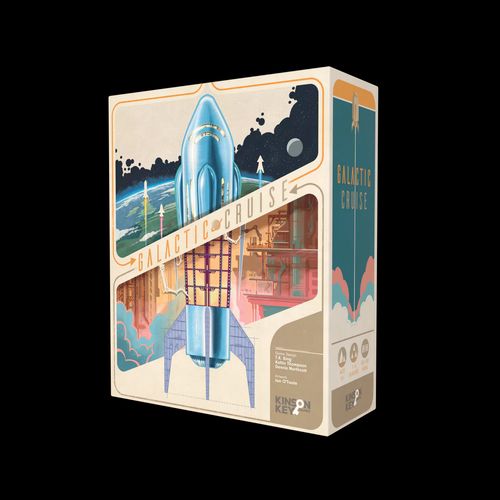
Galactic Cruise
250 questions players ask about Galactic Cruise, answered in plain words and graded by where the answer comes from. See also the full rulebook.
Updated 2026-10-27.
250 questions players ask about Galactic Cruise, answered in plain words and graded by where the answer comes from. See also the full rulebook.
Updated 2026-10-27.
The designer answered both questions directly.
Pick one tray for the whole game, never mixing them: the base game's 48 basic Blueprints, the Advancements set (Cabin-Matching), or the Accommodations set (Cabin-Matching plus Specialized). Use the base tray for your first few games.
The designer explained this, matching the rulebook's standard setup.
Only on the standard side of the board: shuffle them and place 2 at random on each of the 6 Network locations to randomize the actions. The intro side has its actions pre-printed.
The designer said they are optional.
No — they are there to shorten a first game. Experienced groups can leave them out and play the full length on the intro side.
The designer gave this example, matching the rulebook.
Keep adding one Guest of each type until you reach or pass the minimum (7/9/11 for 1–2/3/4 players). For example, 8 Guests in a 3-player game becomes 11.
The designer confirmed the order, matching the rulebook.
Randomly, one at a time, into the 1-, 2- and 3-Ad sections in order, then back to the 1-Ad section (1-2-3-1-2-3, not a snake). Sections don't need equal numbers.
The rulebook's Player Setup draws them from the deck.
No — starting cards come from the top of the deck, not the display, so nothing needs refilling.
The rulebook's Player Setup steps 13–14 describe this.
Players take one free Blueprint each from the display in reverse turn order, without refilling between picks. Slide and refill the display only after everyone has taken one.
The rulebook's Player Setup step 13a says so.
Yes — it must go in an area with no Development yet, covers the Reputation icon, and gives you 1 Reputation. It can't go below a Technology.
The rulebook's Player Setup says the back of the starting Engine lists the starting supplies.
It is your starting Engine, and the icon just reminds you of your setup Money and Ads. It isn't an extra bonus during play.
The designer answered this directly.
Ideally yes, though it barely matters. Groups that care can draw from the back of the tray.
The designer answered this directly.
Yes — neutral Developments are used in every game, including 4 players. In 2-player games an unused player color provides the separate NPC Developments.
The rulebook's turn structure lists these as alternatives.
No — Step 2 of your turn is a choice of exactly one: assign a Worker and take up to 2 actions, launch a Ship, or Call a Meeting. Only an Agenda Card or another rule-breaking ability can let you do both.
Several players agree; the rulebook never moves the token.
No — the first player stays the same for the whole game. It matters at the end, because once game end triggers, the current round is finished before the final round.
Several players agree, citing the Employee Handbook; no official ruling.
Not normally — the base rule forbids it. It becomes possible when the game's Expert Worker ability is self-bumping (for your Expert) and, for your other Workers, once you unlock the Destination Upgrade that gives all your Workers the Expert ability. There is no limit on how often you do it, so you collect the Funding Bonus each time — though you are restricted to locations you already occupy.
The designer explained the intended timing directly.
Usually it makes no difference, since Funding Bonuses don't affect anyone else. The design intent is that being bumped never affects other players, so if a bump-triggered Agenda Card could let you take from a shared display mid-turn, wait until the bumping player finishes. Board Game Arena gives the bonus on your own turn only to avoid constant back-and-forth.
The designer's FAQ gives this exact example.
Yes — with the doubled Resource Funding Bonus you could take, for example, 1 Food and 1 Oxygen.
The designer confirmed this in two threads.
Yes — Food, Oxygen and Fuel count as one bonus type, so you can take any mix of them, such as 1 Food and 1 Fuel. You can't mix in a different category (Money or Ads) in the same drop.
The designer confirmed both the storage rule and that bonuses need not be spent the same turn.
Neither. Resources you spend immediately (for example while launching) need no storage, and you may instead keep them for later turns if you have room. Resources gained directly, like Funding Bonuses, must fit your storage. The drop itself is still limited to once per turn: pick one bonus type and gain one for each of that type you pass.
The rulebook's clarifications say this can be done at any time, including mid-action.
Yes — the once-per-turn Reputation drop can happen at any time on your turn, so you can pause an action (for example right after a Development raises your storage), take the Resources, and finish the action.
The designer confirmed this in two threads.
No — you only gain the bonuses you pass during your once-per-turn voluntary drop. Reputation spent on costs (the Agenda discard pile, Strategic Relationship, refreshing Blueprints) or lost to penalties gives nothing.
The rulebook only grants track bonuses when you reduce Reputation; one player notes the Upgrade exception.
Not normally — moving up the track gives no bonuses by itself. One Destination Upgrade changes that: once you unlock it, you gain the bonuses you pass on the way up.
The designer confirmed this, matching the rulebook's clarifications.
You gain 1 VP for each Reputation you would gain while at 18 — gaining 5 there gives 5 VP. Likewise, at 0 you lose 1 VP per Reputation you would lose.
The designer ruled on this directly.
No — a Reputation gain resolves completely before you can drop Reputation, so you can't interleave the two to farm bonuses, despite the "at any time" wording.
The designer confirmed both points, matching the rulebook's "automatically advances" wording.
Each Ship in space advances exactly one Stop, and it is mandatory — Ships move automatically at the start of your turn, before Step 2. You can still raise Ads or Resources at that point by dropping Reputation or playing Agenda Cards.
The rulebook lets you advance multiple Ships in any order.
Yes — you advance them in any order, completing each Stop fully before the next. That lets one Ship drop an Upgrade Token on a Destination before the other arrives there.
The designer ruled the drop-off is required, consistent with the rulebook.
No — the token must be placed on one of the Cruise's Destinations if there is a legal space. You may hold it for a later Destination on the same Cruise, but it is discarded only if no Destination on the Cruise has room (each holds at most 3 tokens).
The designer confirmed the formula, which matches the rulebook.
Each Guest you score earns 3 VP plus 1 VP per Upgrade Token on that Destination — the bonus applies per Guest, not once for the group. Two Guests at a Destination with one token score 2 × (3 + 1) = 8 VP; with two tokens each Guest scores 5. Tokens have no effect on a Day in Space.
The designer confirmed this, matching the rulebook's scoring rule.
Yes — at every Destination, each Guest you score costs 1 Ad if it matches the Destination and 2 if not. A Day in Space costs no Ads.
The designer explained this in two threads.
No — flipping only marks the token you will carry, and it blocks that Funding Bonus until you launch. After launch the token rides on your Engine, and when you drop it at a Destination it unlocks an Upgrade and adds 1 VP per Guest scored there.
The rulebook's Day in Space section describes this.
They pay out on a Day in Space: each Guest aboard earns its Guest Bonus once for every matching icon in that Ship.
The designer answered both parts directly.
Yes — when you unlock it, you gain a Funding Bonus for each of your cubes already on the whole track. After that, each new cube gives one more; earlier cubes never trigger again.
The designer spelled out each case across several posts.
It adds 1, never doubles — advertising two matching Guests gives 3 Reputation, not 4. It triggers once per instance: at most once in Step 1 (however many Ships are in space), once for a Reputation-granting Location Bonus, and once for each Step 2 action that gains Reputation. Free actions from Agenda Cards that gain Reputation can each add another.
The designer answered both parts directly.
No — it must take a faceup token still in your Launch Tower. A token from the top section gives you the single item printed on it (as if flipped by Schedule a Cruise) and then reveals the doubled Funding Bonus beneath.
The designer explained the symbol directly.
It means you can gain a Segment's bonus even with a Guest whose color doesn't match that Segment.
The designer answered this directly.
Any of the eight Launch Tower tokens — gain its bonus, then return it to the box.
The designer confirmed this, and the rulebook states actions may be repeated.
Yes — your two actions can be any combination of actions you have access to, including the same one twice. The ≠ symbol only stops you from placing a Worker where you already have one; it says nothing about repeating actions.
The designer confirmed only adjacent, connected actions are reachable, matching the rulebook.
No — a Worker reaches the 2 actions at its own location plus the actions at adjacent locations linked to it by a Development, never further. Reaching any connected location through a chain is the special power of one Expert Worker ability (#3), not a base rule.
The designer answered each part directly, consistent with the rulebook's Reputation rules.
Your Reputation sets the price per owner: 2 Money at 0–6 Reputation, 1 at 7–14, nothing at 15+. Each Development or Technology is a separate payment, and you pay every other player who has a Development in that area. You can pay at any time on your turn, and one payment covers that Development for the rest of the turn, including both actions — next turn you pay again. You never pay to use your own, even when an Advanced Technology's track has raised its cost.
The designer ruled on this example directly, and it matches the rulebook's any-time clarification.
Yes — you can pay for another player's Technology at any time on your turn. You may advertise to the first Guest, take its Money, and then use that Money to pay for the Technology before placing the second Guest.
The designer answered both questions directly.
It is a single discount of 1 for the whole action, not one per Segment or per item bought. It combines freely with Technologies, Agenda Cards and other powers, and can bring a cost to 0 but never below.
Players apply the designer's reasoning from a related ruling; there is no ruling on the Expert itself.
Probably not. That build is a bonus of the Schedule a Cruise action, not a Build a Development action, and the designer has ruled the same way for Agenda Cards in that situation; Board Game Arena also plays it without the discount. One reply reads the Expert's text as allowing it.
The designer answered both parts directly.
For Technologies used during a Cruise, the Expert must be that Ship's Pilot to get the free use. With Advanced Technologies, the extra +1 or +2 from the Technology track still has to be paid.
The rulebook gives each player 2 Expert Workers, and a player confirms the consequence.
Twice at most in practice — each player has only 2 Expert Workers, so once both are hired the action does nothing for you.
The rulebook's Build a Development section ties the Resource to the row.
Yes — the cost can be paid in Money and/or the Resource of that Development's row only: Food for the Food row, Oxygen for the Oxygen row, Fuel for the Fuel row.
The rulebook's Build a Development section has you pay only the listed cost.
No — you pay the supply the cost shown on your Player Board. Being first in an area only matters for the 1 Reputation you gain for covering its icon.
The designer's FAQ confirms this, matching the rulebook's "up to 2" wording.
Yes — both actions let you take up to 2, so taking one (or none) is allowed.
The designer's FAQ confirms it, matching the rulebook text.
No — discard the Blueprints you don't want and refill those exact spaces. You can do this any time on your turn, even before placing a Worker, for 1 Reputation each time and with no action. Sliding only happens after Blueprints are taken or built by an action.
The rulebook's Build Ship Segments section describes these extra costs.
They are the extra Reputation and Money you pay, on top of the Blueprint's own cost, to build a Segment straight from that display space instead of from the Blueprints beside your board.
The designer confirmed this, and the rulebook says so under Returning to Earth.
Yes — the only timing limit is that you can't build into a Ship that is currently on a Cruise. Once it's back on Earth you can add Segments up to the usual limit of 3.
Anywhere between the Cockpit and Engine: below the Cockpit, between two existing Segments, or just above the Engine. Segments already built can't be moved or rearranged.
The designer answered this directly.
No — once you've chosen a Cockpit and Engine, that Ship keeps them for the rest of the game.
Two players agree; no official ruling.
You take one Funding Bonus immediately, as though a Worker had just returned to your Break Room, like any other Engine bonus. It isn't saved for a later recall.
The designer answered this directly, matching the rulebook's Silo icon rule.
You choose any Resources you like, and the Storage Silo is unaffected — only actions showing the Silo icon take from it.
The rulebook says Resources gained without the Silo icon do not come from the Silo.
Yes — Resources from cards and bonuses don't come from the Storage Silo, so its level doesn't matter. The Silo only limits Gain Resources and other effects showing its icon.
The designer confirmed this is the rule.
No — the tracker must actually rise to earn the action's rewards. Choosing a Resource already at 5 gives no Money and no Reputation.
The designer ruled it is part of Schedule a Cruise, and players agree it is used at once.
It is not an extra action — it resolves immediately as part of the Schedule a Cruise action when you flip the token, like every bottom-row token's bonus. It can't be saved for a later build.
The designer confirmed this applies in both solo and multiplayer.
Yes — any unscheduled Cruise can be scheduled, and you board its pre-sold Guests for free at launch. The advertiser keeps the Money and Reputation they earned; you just skip that income in exchange for saving the Ads. This applies in multiplayer as well as solo.
The rulebook's Advertise for a Cruise section forbids it.
No — you may advertise only to an unscheduled Cruise or to the one you scheduled yourself. That holds for Upgrades and tiles that let you advertise too.
Several players agree, consistent with the rulebook's launch rules; no official ruling.
No — pre-sold Guests are booked on that specific Cruise and can only board when it launches.
The rulebook's Advertise for a Cruise and launch sections set these limits.
Up to 2 Guests per Advertise, and it counts as one of your two actions (or as your single Meeting action). You choose which Guests and pay their Ad costs; a Cruise holds at most 2 pre-sold Guests, so any more must come from a Last-Minute Sale at launch.
The rulebook's Advertise for a Cruise section sets these rewards, and players agree.
No — each Cruise has at most one Destination of each type, so a Guest matches at most once for 1 Reputation. The Money is different: you gain 1 per Destination on the Cruise.
The designer confirmed this directly.
Yes — those Guests come straight from the supply, so each one permanently raises the number of Guests in the Queue and on Cruises. Normally launches replace boarded Guests one-for-one, keeping that total fixed.
The designer explained the difference directly.
Tile 16 lets you advertise to 2 Guests of the same type; tile 19 requires the 2 Guests to be of different types.
The designer answered each part directly.
During Step 1 you may pay its 2 Fuel to advance one extra Stop, resolving both Stops. You can pay at any point in Step 1 — before the first Stop or after resolving it, for example with Resources gained there.
The designer confirmed this directly.
Yes — trigger your Guests first, then activate the Technology with what they gave you. In general, things gained during your turn can be spent on later steps of it.
The rulebook says a Technology can be used by all players only once it is Invented.
No — a Technology only becomes usable once it is Invented, which happens when the first Development is placed below it. Before that nobody can use it at any price.
One player answered this; no official ruling on the Technology itself.
Yes — each Segment gets the discount, so two Segments costing 2 each would cost 2 in total.
The designer answered both parts directly.
It only discounts advertising to a Cruise and Last-Minute Sales, not scoring Guests at a Destination. The discount applies per Guest.
Two players agree from the tile text; no official ruling.
After you play an Agenda Card from your hand, you may take a card from the faceup display by paying twice the bonus shown beside its space. It doesn't let you play a card straight from the display.
The designer confirmed the 0 floor, which matches the rulebook.
"Cruise" means advertising pre-sold Guests to a Cruise; "Ship" means taking Guests in a Last-Minute Sale at launch. The discount can bring an Ad cost to 0 but never below.
The designer confirmed this directly.
No — you didn't own the Technology when you played Connections, so it doesn't trigger for that card.
The designer ruled on this directly.
After the card is played and fully resolved. With Windfall, the display has already been refilled with 4 new cards before you use the Technology.
Yes — each Agenda Card you play triggers it separately, so you can buy a card, play it, and use the Technology again. It only buys from the faceup display, never from the discard pile.
The designer confirmed both cases directly.
Cards played for their Resource count — any play, text or Resource, triggers it, and you take the new card after the played one resolves. Discarding a card for Refill Storage Silo is not playing it, so it doesn't trigger.
The designer answered this directly, and it matches the rulebook's timing rules.
Any of those — you can play as many Agenda Cards as apply before your first action, between your two actions, and after your second, as long as each card's restriction is met at that moment. Cards played for their Resource can be played at any time on your turn and never count as an action.
The rulebook says unrestricted cards do not count as an action, and players in the thread agree.
No — playing a card never costs an action. Cards with no action restriction in the top right (such as #19) can be played freely during your turn; restricted cards are played alongside the action they name, not instead of it.
The designer ruled on the general rule and the Early Bird and Meeting cases; the Immediate Installation case follows the same no-retroactive rule.
Yes, as long as its trigger hasn't already passed. Unrestricted cards can be played right after you draw them, even during a Meeting, and a card that triggers on the Draw Agenda Cards action can be played during the very draw that gave it to you. Cards can't be played retroactively, though: Early Bird must already be in your hand when you place your lone Worker, and a card triggered by recalling Workers that you draw during that Meeting's action waits for a future Meeting. By the same rule, Immediate Installation gained from a new Engine's bonus can't affect that same Acquire New Ship action.
The rulebook allows restricted cards to be played while taking the named action or step, and players agree that includes mid-step.
Yes — a restricted card can be played at any point while you are performing its step or action. For example, at a Destination you can drop off your Upgrade Token first and then play Family Vacation before scoring Guests.
The designer confirmed that all Agenda Cards are one-time effects.
No — every Agenda Card is a one-time effect. You play it, resolve it for the single action or step it applies to, and discard it; a discount played on your first action does not carry over to your second.
The designer's later ruling replaced his first answer, and the rulebook forbids retaking a card played this turn.
It is discarded as soon as it resolves, not at the end of your turn — play it, resolve it, then put it faceup on the discard pile. You still can't take a card you played this turn back from the discard pile, even by paying Reputation. The designer first said played cards were discarded at the end of the turn, then revised that to discarding each card as it is played.
The rulebook's Draw Agenda Cards section states this, and the designer has repeated it.
Never from the deck — you draw from the faceup display, or pay 1 Reputation per card to take the top card of the discard pile. Taking both of your draws from the discard pile therefore costs 2 Reputation. The only time anyone draws from the deck is the single starting card at setup.
The designer ruled on this directly and kept it consistent with the normal draw rules.
Pay 1 Reputation to take the top card of the discard pile, or skip the bonus. A bonus that grants an Agenda Card follows the normal drawing rules: it doesn't waive the Reputation cost for the discard pile, and it never lets you draw from the facedown deck.
The designer confirmed this in two separate threads.
Yes — the action you take during a Meeting is a normal board action, so an Agenda Card restricted to that action can be played with it.
The designer ruled on this directly.
No — the action you are taking is Schedule a Cruise, and the build comes from the token's bonus, so cards restricted to the Build a Development action don't apply to it.
The designer confirmed this, and it matches the rulebook's Agenda Card rules.
Yes — whenever you spend a Resource you can play an Agenda Card showing it instead, and because it is spent immediately you don't need storage room for it.
The designer confirmed that Marketing Blitz should not charge Fuel.
No — using the text ability has no cost unless the text says so. A card is played either for its text or for its Resource; if your Resource count changed (for example losing Fuel with Marketing Blitz on Board Game Arena), the card was most likely played for its Resource side by mistake.
The designer answered this directly twice.
From the display — you may take any one of the 4 Cockpits and any one of the 4 Engines shown, in any combination, rather than a printed pair.
The designer ruled on both halves of this directly.
Agenda Cards don't, Technologies do. Immediate Installation is part of Acquire New Ship, not the Build Ship Segments action, so cards restricted to that action (such as Financial Loophole) can't be added. A Technology that discounts building Segments still applies.
The designer answered both parts directly.
Yes to both — it discounts each Segment you build in that action, and with Automated Systems you save $3 per Segment. Any discount left over can go toward the extra cost of building straight from the Blueprint display.
The designer confirmed any Worker can use Overtime and contrasted it with the Expert ability.
It lets you place a Worker, take one action, and then launch a Ship with that same Worker as your second action, instead of launching taking your whole Step 2. Any Worker can do this; the Expert ability with a similar effect is a separate thing that requires the Expert.
The designer confirmed this directly.
Yes — it is a normal launch with different timing, so Launch-restricted cards can be played with it.
The designer answered this directly.
No — a "launched" Ship here means one that has been launched before (its Cockpit is flipped) and is back on Earth, not one currently in space.
The designer confirmed both the 5-Segment case and that it can't be repeated on the same Ship.
One Segment over your current maximum, on one Ship. It lets you exceed the limit rather than raising it, so playing it again (or a second copy) can't extend the same Ship further; at most you could exceed the limit on a different Ship. With the 4-Segment Upgrade unlocked, it lets one Ship reach 5 Segments, but never 6.
The designer confirmed this directly.
Yes — you can pay down part of the Fuel cost from your board, then play the card to buy the rest and spend it right away.
The designer confirmed this was the card's intent.
It removes the flipped Upgrade Token right away instead of at launch. For a top-row token that reveals the doubled Funding Bonus immediately, and every token removed also makes the leftmost Expert cheaper, since its cost counts tokens left in the bottom of the Launch Tower.
The designer clarified the slash reading directly.
The slash means "or": the Development costs 2 Money or 2 Resources instead of its usual 5/6/7. Resources must still match the Development's row.
The designer confirmed this directly.
Yes — Connections sets the cost to 2 and Benefactor takes 2 off, so the Development costs nothing.
The designer answered this directly.
No — only Developments that were already there count. If yours is the first Development in the area, you still gain the usual 1 Reputation for covering the icon.
The designer answered this directly.
Yes — it applies even when the Segment is the first one in that Ship.
One player read this from the card text; no official ruling.
Up to 5 in one action — the normal 2 plus up to 3 more, and you may refill the display after taking the first 2. The 5-Blueprint limit still applies at the end of your turn.
The designer ruled on this in his FAQ and again in a later thread.
No — Earnings Boost trades away all of that Meeting's Funding Bonuses for 6 Money, including the extra ones Productive Meeting would add. Play them on different Meetings.
The designer confirmed this in several threads.
Yes — the Final Round recall matches the cards' Meeting icon, so both can be played there even if you have no Workers to bring back. With nothing recalled, Productive Meeting still gives its 3 extra Funding Bonuses and Angel Investor gives 4 Money.
The designer confirmed this reading in several threads.
It is like two Advertise actions in one: you gain 2 Ads, then may advertise up to 2 Guests to each of two different Cruises (up to 4 Guests), still paying each Guest's Ad cost. Because the card says "may," advertising to just one Cruise is fine too.
The designer answered this directly.
No — neutral and 2-player NPC Developments don't count. In a solo game, Rachel's Developments do count, since she is a player.
The designer gave this order of resolution in two threads.
Take one Agenda Card from the display first, then discard the rest of the display, gain all 4 refill bonuses (not just those under the empty spaces), and deal 4 new cards.
The designer confirmed the 2x total.
No — both modify the same Refill Agenda Cards action. Fresh Ideas makes you gain all four bonuses once (it doesn't add a second wipe), and Windfall doubles them, so the total is 2x.
The designer answered this directly.
Yes — all four cards can come from the discard pile with no Reputation cost. You still can't take back a card you played earlier that turn.
The designer answered each part directly.
You must actually use a Technology that turn to get the benefit, though the use can come later in the turn. It works on a Technology you already have a Development under, and your own Development counts toward the Money gained.
The designer explained the card directly.
At a Destination, it lets you score up to 3 Guests already on your Ship without paying their Ads. It doesn't add any Guests.
The designer answered both questions directly.
Only if you've unlocked the Upgrade that allows bumping yourself. With the Advancements Location Bonus tokens, using Pivot gets you the bonuses of both locations.
The designer confirmed this directly.
The whole action — use the card's effect in place of the action's listed options.
The designer confirmed this directly.
The main board — you gain 4 Money if the Worker you place is your only one in the Network.
The designer gave the totals for the from-zero case directly.
It adds 1 Money per Resource added, on top of the action's normal payout. The designer gives the total for refilling a Silo tracker from 0 to 5 as 10 Money and 2 Reputation.
The designer confirmed the single $1 cost.
$1 total — you pay once and receive both the 3 Resources and the 3 Ads.
The designer's FAQ states this, matching the rulebook's turn structure.
Yes — launching replaces only Step 2 (assigning a Worker or Calling a Meeting). You still advance Ships in Step 1 and check Company Goals in Step 3.
The rulebook's launch section sends the Worker from the Break Room.
Yes — to launch, you send a Worker from your Break Room into the Launch Elevator; you can't move one from a Network location.
The designer confirmed this, and the rulebook treats Experts as Workers.
Yes — Experts are Workers in every respect, including launching and piloting, and some Expert abilities reward exactly that.
The designer answered this directly twice.
The Expert you just placed — it leaves its Network location and goes to the Launch Elevator to become the Pilot. You don't need another Worker in your Break Room.
The designer answered this directly.
It depends on the ability. The "use Developments for free" Expert does work while launching or piloting, so it can use Technologies that discount launches or add an extra advance; abilities written around launching work as printed.
The designer confirmed this, matching the rulebook's Preflight Checklist.
It needs at least one Cabin, which takes 2 Segments, and you must board at least one Guest (pre-sold or via a Last-Minute Sale). A Cockpit and Engine alone can't launch, even with the extra-Guest Upgrade, because that Upgrade needs a Cabin to work on. You can build the Ship up over several turns.
Yes — you don't have to wait for a Ship to return. The practical limits are having a Worker to pilot and being able to schedule another Cruise, since you can only have one scheduled at a time.
The designer confirmed this in several threads, matching the rulebook.
Never more than 2. Every Guest beyond the first two must come aboard as a Last-Minute Sale during the launch, paid at its Queue section's Ad cost (or 4 Ads from the supply).
The designer broke down the 7-Guest maximum in several threads.
The theoretical maximum is 7. A 3-Segment Ship has 2 Cabins; the Adventurous 4-Segment Upgrade adds a third; the Relaxing Upgrade can add 1 Guest to one Cabin; Board Game Cruise raises one Cabin to 3; and Titanium Framing allows one Segment beyond your maximum. You still need 1 Food per Guest plus 1 for the Pilot.
The designer confirmed this in three threads.
Neither — once per launch you pay 2 Reputation to raise one Cabin of the launching Ship by 1, so a 2-Cabin Ship holds 3 Guests, not 4. You can't keep paying for more, and the extra Guest must be a Last-Minute Sale.
The designer pointed to the rulebook text, and players agree.
There is no limit beyond your Ship's capacity, and Last-Minute Sales cost no Reputation — only Ads. If the Queue is empty (or lacks what you want), pay 4 Ads for a Guest of your chosen type from the supply. Last-Minute Sale Guests give no Money or Reputation.
The designer explained the icon, which matches the rulebook.
It is a reminder of the "Not Enough Room" rule: any pre-sold Guest you don't take when launching goes to the top section of the Queue, and you lose 2 Reputation.
The designer ruled on this directly.
No — Resources aren't spent until T-Minus 3, so anything gained at T-Minus 4 must fit your storage or it is lost. You can only exceed storage for Resources spent immediately, such as from Agenda Cards or the Reputation Track during T-Minus 3.
The designer confirmed this, matching the rulebook's T-Minus 3 rules.
Yes — launch costs can be paid in any order from any mix of your board, Agenda Cards played for their Resource, and Reputation, and the last two need no storage room. A Technology discount reduces the cost itself, so a Fuel cost above your storage can still be paid this way.
The designer answered this directly.
You can't launch. Back out and take a normal Step 2 instead, and try again on a later turn. Dropping Reputation or playing Agenda Cards for their Resource can often cover a shortfall.
The rulebook's clarification that paid access lasts the rest of the turn decides it.
Yes, if you pay for (activate) them before your Reputation falls. Access bought to another player's Development lasts the whole turn, so activating at 15+ Reputation for free before launching keeps them usable at T-Minus 3. One reply argued they are only checked at T-Minus 3.
The designer walked through this order in several threads, matching the rulebook.
Add the new Cruise first, then for each Destination on it move matching Queue Guests down one section (bottom-section Guests stay put). Then add new Guests to the top section equal to the number that boarded the launched Ship — not the number of Destinations on the new Cruise — taking types from the new Cruise's Destinations left to right and looping as needed.
The designer answered this directly.
No — Queue sections have no maximum or minimum.
The designer confirmed this in several threads.
Shuffle the discarded (completed) Cruises to form a new supply, as with Agenda Cards. It is most likely in a 4-player game.
The designer answered this directly.
No — after collecting your Funding Bonuses the single action is optional, though you will usually want it.
The designer confirmed this, matching the rulebook's Call a Meeting rules and clarifications.
Yes — you can Call a Meeting however many Workers are in your Break Room. Workers not in the Network recall nothing and earn no Funding Bonus (Pilots stay in space), but you still take one action connected to one of your Developments, if you have one in the Network.
One experienced player answered this from the rules; no official ruling.
No — the Meeting action uses no Worker, so no Expert Worker bonus applies to it.
The designer confirmed this, matching the rulebook.
Yes — in Step 3 you claim every Company Goal you meet and place a cube for each. If that pushes cubes into the next Progress Track section, that's fine; each AGM scores only its own section.
The designer ruled on this directly.
It is compulsory — if you meet a goal's requirement in Step 3, you must claim it, even if the cube triggers an AGM or the end of the game.
The designer confirmed launch cubes reveal no Wings, and the rulebook limits each goal to once.
No — each player accomplishes each goal only once, so you can reveal at most 3 extra Wings. Wings are revealed only by moving the cube from above a goal to the Progress Track; launch cubes come from your general supply and never reveal Wings.
The designer answered this directly.
No — Wings only multiply your cubes at AGM scoring. Launch VP is unchanged unless the Cockpit's criteria score Wings.
The designer explained the count and how to track it.
Yes, it counts total launches. Count your Progress Cubes on the track minus those placed for Company Goals; the Upgrades you've unlocked are a backup record. Removing an Upgrade Token through a bonus is not a launch and doesn't count.
The designer answered this directly.
No — each Ship just needs to have been launched at least once.
The designer confirmed both cubes and where the second goes.
Yes — one during the launch countdown (T-Minus 4) and another in Step 3 for the goal. If the first cube fills a section, the second goes into the next section (or the overflow) and counts toward the next AGM.
The designer answered this directly.
Only your own Developments count.
The designer confirmed the set counting.
Each set is one of your Developments in the Network plus one below a Technology, so 2 in the Network and 2 under Technologies make 2 sets. As with every goal, the requirement rises a step after someone accomplishes it.
The designer confirmed both the set definition and the cross-Ship count.
A set is one icon of each of the three Guest types, and icons are counted across all your Ships combined, not per Ship.
The designer explained the goal's counting and its iconography.
All of them — your 2 starting Workers plus hired Experts. The 3-Worker levels need one Expert hired and the 4-Worker level needs both. The icon was changed from Experts to Workers because an Upgrade gives regular Workers the Expert ability, which made it unclear whether they counted.
The designer confirmed this, and the rulebook's clarifications agree.
Yes — if the final advance lets you meet a goal (for example by dropping off a needed Upgrade Token), you accomplish it and its cube scores in AGM C.
The designer answered this directly, matching the rulebook.
At the end of the turn of the player who placed the section's last cube; only the game end waits for the round to finish. Wings revealed by a goal cube placed later that same turn still count for the AGM.
The designer confirmed this in several threads.
Into the next section, where it scores at the following AGM; after Section 3 fills, extra cubes go to the overflow area and score in AGM C. The AGM itself still happens at the end of that turn.
The designer confirmed the icons are reminders, and the rulebook gives the formula.
Each AGM scores only your cubes in its own section, multiplied by your revealed Wings; Section 1 cubes don't score again at AGM B. The 2 and 3 icons only remind you which year is scored — they are not multipliers. The player(s) with the most Reputation count one extra cube.
Two players agree, and the rulebook grants the extra cube without conditions.
Yes — the player with the most Reputation scores as if they had one extra cube, even when it is their only one.
The designer confirmed this in two threads.
Play simply continues with the next player in turn order (in solo, whoever didn't trigger the AGM), and the first player never changes. At game end, the round is finished so everyone has had equal turns before the final round.
The rulebook's Section 3 — Game End describes this sequence, and players agree on the details.
Finish the current round. Then everyone recalls their Network Workers and takes a Funding Bonus for each — this isn't Calling a Meeting, so no action follows. Each player then takes one normal turn in order (Step 1 advance, then assign one Worker for up to 2 actions, launch, or meet; later players can still bump you). Finally, each Ship in space advances to any one remaining Stop and resolves only that Stop before AGM C.
The rulebook ties the bonus to Workers returned from the Network, and players agree.
No — you gain a Funding Bonus only for each Worker actually brought back from the Network to your Break Room.
The designer confirmed this for the Meeting cards.
Yes — even though the recall isn't a Meeting, cards with the Meeting icon (such as Productive Meeting and Angel Investor) can be played then.
The designer confirmed the normal advance plus the bonus advance.
Twice — your final turn includes the normal Step 1 advance, and after everyone has played it each Ship advances once more to any one remaining Stop, forward only.
The designer ruled on this directly.
Only forward — the final advance must go to a remaining future Stop, and returning to Earth counts as one. You can't stay where you are or revisit a Stop already passed.
The designer answered this directly.
Yes — once launched it is on a Cruise, so it can advance to any one remaining Stop and resolve it as usual.
The designer ruled on this in several threads.
No — they only work on a normal Step 1 advance, and the final advance isn't one. You can still use them in your normal Step 1 of the final round. Other Developments still work when they apply, such as Self-Piloting System if the final Stop is a Day in Space.
The designer answered this directly.
Yes — you may still use the Reputation Track during the end-of-game advance.
The designer answered this in two threads, matching the rulebook's final scoring.
Only at the end of the game, and only for Segments built into Ships; unbuilt Blueprints just count as leftover supplies. Blue VP icons are end-game scoring and tan ones are immediate; Cockpits show both because they score at launch and again at the end.
The designer answered this directly.
Score the Cockpit normally, then subtract 5 from it — the result can be negative, down to -5. A Cockpit worth 3 VP would net -2. The Company Records book has a variant that handles it differently.
The designer confirmed this in three threads.
Every section — it counts all your cubes on the Progress Track, including the overflow. The Adventurous Upgrade with similar wording works the same way.
The designer answered this directly.
No — it counts only Expert Workers you actually hired, so at most 2.
One player agrees with the asker that order doesn't matter; no official ruling.
No — each category is scored once and none affects another, so the order makes no difference.
One player answered this; no official ruling.
Yes — cubes in the overflow area to the right of Section 3 are on the Progress Track and count toward the tiebreaker.
The rulebook's T-Minus 2 and final scoring sections say this.
No — only the launching Ship's Cockpit scores at T-Minus 2, though its criteria may count your other Ships. Every Cockpit scores again at final scoring. The Employee Handbook simply lists all Cockpit criteria for reference.
The designer confirmed what counts in two threads.
It counts every Ship you have launched at least once (its Cockpit flipped), whether or not it is in space now — including the Ship being launched, even on its first launch. Relaunching the same Ship, even after adding Segments, doesn't make it a different Ship.
The designer confirmed only the Segments count.
Add the blue VP printed on each Ship's Segments; only Ships whose Segments total 8 VP or more count. The Cockpit's own VP isn't included, and having three Segments isn't enough by itself.
The rulebook's 2-Player Setup says so.
Place one NPC Worker at the next location clockwise from each neutral Development.
The designer's FAQ states this.
Yes — pay the supply, just as for a neutral Development.
The designer confirmed they are different.
Yes — they are different owners, so both can be in one area. Using that connection without a Development of your own means paying for both.
The designer explained this, matching the rulebook.
They bump more: when bumped they skip empty locations to find a Worker belonging to the other player (never the one who bumped them). They skip other NPC Workers, and only if no Worker can be bumped do they stop on the first empty location clockwise.
The designer confirmed this twice.
No — NPC Workers never leave the board. Only the players' Workers are returned before the final round.
The designer confirmed what the icons mean, matching the rulebook.
They remind you of the 1–2 player upkeep after each AGM: place new NPC Developments from a revealed Technology tile and replace one NPC Worker with an NPC Expert.
The designer's newer rulings replace his earlier answer.
Yes — the designer's later rulings (November 2025 and February 2026) say bumping at all with your Expert earns the Funding Bonus, even though the NPC has no Break Room. A February 2025 answer had said it wouldn't trigger for that reason.
The designer answered each part directly.
Only if you have unlocked the ability to bump yourself; then NPCs can bump your Workers too. An NPC never bumps the Worker that just bumped it, so with no other valid target it moves to an empty location.
The designer answered this directly.
Yes, if your opponent caused the bump through the NPC. Not if you bumped yourself, even by way of an NPC with the self-bump Upgrade.
The designer confirmed this in two threads, matching the rulebook's solo setup.
Yes — set up exactly as for 2 players: two NPC Workers in a third color (not Rachel's), the 2-player Progress Track tiles, neutral Developments, and both Marketing Board overlays. At AGM A and B, upgrade an NPC Worker to an NPC Expert and add NPC Developments as in a 2-player game.
The designer issued this setup modification directly.
Yes — this is an official change to solo setup not in the printed rules. After drawing your starting Agenda Card, discard the top card of the deck faceup, so Rachel always has a card to reference for Storage Silo interactions even if the display empties early.
The designer corrected the printed solo goal in his FAQ and again in a later thread.
Yes — since she builds Segments two at a time, the printed Hard value of 5 plays just like Medium's 6, which the designer called an oversight. His FAQ gives the intended Easy/Medium/Hard progression as 7/6/4; in a later post he suggested spacing the steps on alternating Segments instead (7/5/3, or 8/6/4).
The designer confirmed the value, which matches the rulebook's goal list.
Two — Medium and Hard both need 2 different Ships launched, and Easy needs 3. Where the setup page shows something different, it is a misprint.
The designer confirmed this approach, matching the rulebook.
Use the first number; if it can't apply or the target is unavailable, use the second, and if that fails too continue in order (top to bottom, left to right, clockwise). Her Worker placement always comes from the location grid on the card, not the numbers, even if it bumps someone.
The designer confirmed this, matching the rulebook.
An Expert, whenever one is available.
The designer's FAQ and a later ruling cover this directly.
She skips to the card's next action; if she can do neither, resolve the next card instead. For example, with no Agenda Cards in the display or discard pile she can't take that resource action and moves on. The added setup discard makes this rare.
The designer confirmed this directly.
The first Resource she could not take during the failed Gain Resources action, not the first one she tried to take.
The designer's FAQ states this, matching the rulebook.
No — she reveals and resolves at most 2 Action Cards and takes at most 2 actions per turn.
The designer explained this directly.
Neither — her Worker stays where it was placed. Flip the next card and resolve its first possible action without placing a Worker. A second card is revealed only when she is at the matching location (or connected to it on Medium/Hard).
The designer explained both parts directly.
No — she does the card's first possible action wherever her Worker is. On Medium and Hard she gets a second action if her Worker is directly connected by a Development to the location showing the action she just took (not along a chain). If that connection uses your Development, you collect Money from the bank.
The designer confirmed this in two threads.
No — it counts as an action, but it isn't printed on any location, so it can never connect to give her a second action.
The designer confirmed both parts.
Always 2 Guests, chosen by her selection criteria with Guests matching the Destination first; if only one match is available she takes it plus the next by her criteria. She doesn't place her Consultant, so that Cruise stays open for you to schedule.
The designer answered this in two threads.
No — she builds Developments under Technologies but never uses any Technology, even ones she has a Development on.
The designer confirmed both parts.
Pay the supply — Rachel gets nothing. You pay for each Development in the area, so one shared with a neutral Development costs two payments to the bank.
The designer answered this directly.
Yes — the bump chain continues and your Worker returns to your Break Room.
The designer answered this directly.
Yes, she always takes it, and gains the Reputation bonus if it is showing when she refills.
The designer's FAQ states this.
No — she moves an available Worker from her Break Room straight onto the Launch Elevator and launches, so that Worker can't bump anyone.
The designer's FAQ and later posts state this.
The Worker she just placed for her first action — including when she has no other Worker available.
The designer confirmed this directly.
Yes — she can have every Worker in space at once; she then has no Worker to place until one returns and Calls a Meeting instead (on Hard she still resolves a card). The same can happen to a human player.
The designer ruled on this directly.
A 3-Segment Ship, even if it has launched before and an unlaunched 2-Segment Ship is available.
The designer answered this in two threads.
No — as in multiplayer, Last-Minute Sale Guests give no Reputation, even though her launch rules point to the advertising rules.
The designer answered this directly.
Yes — she makes a Last-Minute Sale for the other Guest.
The designer confirmed this, matching the rulebook's launch rules.
Yes — refilling the Queue is part of adding a new Cruise, which happens after her launch as usual.
She ignores the Cockpit's scoring criteria and scores only the printed VP on the Cockpit and the launched Ship's Segments — for example 1 + 2 + 2 + 2 = 7.
The designer confirmed this in two threads, matching the rulebook.
Like a player: 3 VP per Guest plus 1 VP per Upgrade Token on the Destination. She scores all her Guests at every Destination on her Cruise regardless of type, without paying Ads, and drops her Upgrade Token at the first Destination of the Cruise.
The designer's FAQ and a later post say so.
No to both — her Upgrade Tokens only add VP to Destinations and never unlock or trigger Upgrade bonuses, so she is limited to 3 Ships of up to 3 Segments.
The designer ruled on these cases directly.
Into a new Ship, since Ships in space can't be changed; if she has no Ship on Earth, her Construction action gives her a new Cockpit and Engine to build onto. She returns to the first Ship once it is back. If every buildable Ship is full or in space, she moves on to her next action.
The designer confirmed this order in several posts.
Ship #1 if possible, then #2, then #3, choosing Segments by the Number System with no strategic choice — so a higher-VP Segment may end up in a later Ship. A previously launched Ship back on Earth with only 2 Segments still gets built into.
The designer answered this directly.
Yes — she gains it, taking VP as she always does for Funding Bonuses.
The designer confirmed this directly.
It depends on her Launch Tower: 1 VP until she has removed the VP Upgrade Token (by launching with it), 2 VP after.
The designer explained both points directly.
She never resolves the Expert Worker tile's ability. On the + side, her Experts instead earn extra VP when recalled — 2 Funding Bonuses instead of 1.
The rulebook's Advancements section states the Cabin-Matching rule.
Yes — with either expansion Blueprint set, each new Segment must complete a full Cabin with the Segment it joins, matching the left, center or right half-Cabin. Base Blueprints all have their Cabins in the middle, so they always match.
The designer's FAQ and several later rulings state this.
At the end of the action that used the Technology, and at most once per turn — even if you used it on several Segments or in both actions. Because it moves at the end of the action, an improvement reached on the last space doesn't apply to the action that reached it.
The designer's FAQ and several posts confirm the skip.
They mark track spaces used only at that player count. With fewer players, skip them when advancing the tracker — in 2 players skip both, in 3 players skip the 4-player spaces. First printings of the rulebook don't mention this.
The designer explained X in two threads.
X is the Technology's strength. It starts at the base value and rises when the tracker reaches the improvement at the end of the track — for example a discount going from 1 to 2.
The designer answered each part directly.
Each marker the tracker passes adds 1 Money, after discounts, both to building a Development there (on top of the usual 5/6/7, so 9 at most) and to using it through someone else's Development. Extra building cost goes to the supply — you never pay other players to build. You never pay to use your own Technology.
The designer confirmed this in two threads.
Per Segment — like the basic versions, every Segment you build costs X less. The tracker still advances only once.
The designer answered this directly.
You gain all your visible bonuses once, not repeatedly. Shoulders of Giants is an instant effect that is used up as soon as the tracker advances.
The designer ruled on this directly.
No — only when its effect of advancing a Technology tracker can actually happen. Trackers exist only on Advanced Technologies.
The designer's FAQ and a later ruling cover this.
Anywhere, even a Worker piloting a Ship. Placement bonuses where the Expert goes trigger as usual — a Funding Bonus in the Break Room, or a Location Bonus token's reward — but a swap in space doesn't trigger a Day in Space or Destination again.
The designer confirmed both cases.
Yes — it counts for Cockpit #14's per-Expert bonus and for unlocking Expert A.2's fifth Advanced Technology, even without a Hire an Expert Worker action.
The designer confirmed this directly.
Yes — once the swap puts Expert 6 in the Network, it may launch as your second action, even though a regular Worker took the first.
The designer confirmed this directly.
Yes — after the first action the Expert can be placed at another location to take its second action there. With the self-bump Upgrade you could even bump yourself twice.
The designer confirmed the rule had changed to this.
No — trackers advance only when a Technology is used. Instead, Rachel advances the lowest invented Technology when she places a cube. This replaced an earlier rule shown in some playthroughs.
The designer answered this directly.
Yes — Rachel ignores Cabin-Matching and still boards Guests when she launches.
The designer confirmed this in several threads.
One — each Guest goes to one matching Segment, each Segment holds only one Guest, and each Segment's action resolves once per Day in Space (not once per matching icon). Matching Segments left without a Guest give nothing.
The designer confirmed this in two threads.
Yes — Guests return to their Cabins after each Day in Space, so at the next one you may reassign them, including to the same Segments.
The designer answered this directly.
A Guest of either type can visit it.
The designer answered this directly.
No — with no Resources visible on the displayed Agenda Cards, you gain nothing from it.
The designer answered this directly.
To the maximum — Silo increases always max out, and you gain Money and Reputation as normal.
The designer explained the Segment-trigger reminder, and players agree the tokens only cover the base bonuses.
Nothing by themselves — they cover the base Guest Bonus spaces, because with Specialized Blueprints a Day in Space pays out from the Segments the Guests visit instead. The Destination token showing a Guest on a Segment icon is the reminder of that.
The designer explained this directly.
Yes, they have offset Cabins and follow Cabin-Matching, deliberately making them the hardest level: a spatial puzzle plus a bonus to weigh. The modules can't combine because only one set of 48 Blueprints is ever used. Ignoring the offsets is a house variant the designer is happy to see.
The designer gave this assessment in two threads; the maxed-version case comes from one player's reply.
Less so — each Specialized Segment triggers once per Day in Space, so when your Guests already equal or outnumber the Segments, the Pilot adds little. It helps on the common launches with more Segments than Guests, and is stronger with base or Advancements Segments. A maxed version that lets the Pilot count as two Guest types can trigger two different untriggered Segments.
The designer confirmed the once-per-action, 1x reading in two threads.
Once per Advertise action, you may trigger the bonus of one of your built, matching Specialized Segments — just 1x, however many Guests you advertise to. A second Advertise action can trigger it again. Blueprints not yet built into a Ship don't count.
The designer answered this directly.
No — it triggers only once per Day in Space (once in Step 1).
The designer gave both options in several threads.
Choose the bottom-row Upgrade Tokens before dealing — all players use the same 4. Then either remove the cards for tokens not in play, or discard and redraw until you have 2 usable cards. Players resolve their chosen card on their first turn, and boards can differ afterwards.
The designer confirmed this directly.
Yes — the starting Upgrade counts like any other unlocked Upgrade.
The designer answered this directly.
No — they are optional and can be mixed with the base Launch Tower tokens. Each is explained in the Company Records book.
The designer's FAQ records the corrected card text.
The card text was updated: activate the bonus on 1 of the Segments you just built.
The designer answered both parts directly.
Only on a Ship on Earth, since a Ship on a Cruise can't be modified. The swapped-in Cockpit is new and unlaunched, so it goes in unflipped.
The designer ruled on both scenarios directly.
A retrofitted Ship counts as a different Ship, so relaunching it counts as a new unique launch. You qualify whether you relaunch the retrofitted Ship or launch another one, even though fewer Cockpits show as flipped.
The designer ruled on this in two threads.
No — Segments are never rearranged, and every Ship must keep matching Cabins at all times, including the one you take from. In practice, take a top or bottom Segment so the rest still match.
The designer answered this directly.
No — PAL 9001 can't act as a Guest of any type through Self-Piloting System, so it can't trigger a Segment.
The designer answered this directly.
Yes — PAL 9001 can launch even when no Worker is available.
The designer confirmed this is permissible.
Yes — the Expert triggers the launch, and PAL 9001 can then be used as written to put a cube in as Pilot, leaving the Expert on the board.
The designer explained the per-instance rule across several posts.
Any time you gain one or more Funding Bonuses, once per instance. Several gained together — such as recalling two Workers in one Meeting — are a single instance, while separate events in one turn (recalling, then hiring an Expert) each trigger it. Bumping your own Worker with a bump-reward Expert gives two instances.
The designer confirmed this in three threads.
Yes — fully upgraded, you may take the same adjacent bonus twice instead of one from each side, so sitting at either end of the track costs you nothing.
The designer answered this directly.
No — it only grants the Ads, Money and Resources printed along the Reputation Track, never VP.
Two players agree from the tile; no official ruling.
Yes — the symbol on its left adds 1 to the cost of building a Development on it and of using it through another player's Development, on top of the normal costs.
The designer confirmed this directly.
No — Earnings Boost forfeits every Funding Bonus from that Meeting, including any a Technology would add, so Index Reservatory has nothing to trigger on.